

Introduction
We remember through stories, which shape how we make sense of our lives and connect with the world (Schank Reference Schank1990). Narratives do not only preserve the past, but they also organise experience and understanding across time and space (Bruner Reference Bruner1991). What happens when these stories extend beyond humans – when animals, plants, natural elements, objects, or imagined characters participate in shaping memory and meaning? Addressing this question requires expanding storytelling to include nonhuman perspectives. This article examines how comics and more-than-human storytelling can bring relational memories to the surface between humans and nonhumans and foster engagement with ecological practices.
More-than-human storytelling – the creation of stories that include both human and nonhuman characters or collaborators – is a powerful way to cultivate our sense of belonging to an interconnected ecosystem (Gersie Reference Gersie2015; Giaccardi Reference Giaccardi2020; Caracciolo Reference Caracciolo2021; Nanson Reference Nanson2021). At its core, storytelling refers to the human creative and communicative act of shaping meaning through narratives (Ricoeur et al. Reference Ricoeur, McLaughlin and Pellauer1984; Bruner Reference Bruner1991; Clandinin and Connelly Reference Clandinin and Connelly2000). When applied in more-than-human contexts, these narratives reimagine and recognise complex relationships across species. By attributing agency and moral consideration to nonhuman characters and integrating the environment as a central narrative force, more-than-human storytelling challenges traditional human-centred worldviews (Donly Reference Donly2017; Caracciolo Reference Caracciolo2021). The very act of creating and telling more-than-human stories encourages imagination, empathy, and perspective-taking, which can lead to transformative experiences and increased pro-environmental awareness (Gersie Reference Gersie2015; Nanson Reference Nanson2021; Talgorn and Ullerup Reference Talgorn and Ullerup2023). This approach of creating more-than-human stories is increasingly used in education, conservation, design, innovation, marketing, and media to enhance engagement with environmental issues and encourage sustainable behaviours (Moezzi et al. Reference Moezzi, Janda and Rotmann2017; Bieniek-Tobasco et al. Reference Bieniek-Tobasco, McCormick, Rimal, Harrington, Shafer and Shaikh2019; Veselova and Gaziulusoy Reference Veselova and Gaziulusoy2022).
In this context, storytelling becomes more than a way of communicating ideas – it is a relational and world-making practice, as suggested by scholars such as Tim Ingold and Donna Haraway, both foundational figures in more-than-human thought. Their work shares a focus on becoming, a concept that highlights how beings co-evolve through their relationships with others, human and nonhuman alike. Ingold emphasises that life unfolds through movement and interrelation. For him, ‘to tell a story is to retrace the steps by which the narrator came to know what he or she knows’, making storytelling a mode of dwelling and knowing-in-motion, rooted in lived, situated experience (Ingold Reference Ingold2000). Stories, in his view, do not merely recount but ‘reveal the paths of movement by which beings have come into the presence of one another’ (Ingold Reference Ingold2011), underscoring the mutually formative nature of all relations. Haraway foregrounds the narrative and ethical entanglements between species – particularly humans and companion animals. She frames storytelling as an act of response-ability, a situated practice of staying with the trouble and imagining multispecies futures. She writes ‘It matters what stories make worlds, what worlds make stories’, underlining how storytelling is itself generative and relational (Haraway Reference Haraway2016). In both accounts, storytelling is not simply about humans; it is about the entangled processes of becoming-with others. More-than-human storytelling thus emerges as both a tool for ecological awareness and a practice of attunement to the relational, multispecies worlds we already inhabit (Braidotti Reference Braidotti2019).
While attempting to do more-than-human storytelling, people often fall back into human-centric habits and dualistic frameworks that position humans and nature as separate (Veland et al. Reference Veland, Scoville-Simonds, Gram-Hanssen, Schorre, Khoury, Nordbø, Lynch, Hochachka and Bjørkan2018). For example, well-intentioned reports on animal protection may nominally centre on animal welfare, yet ultimately highlight human needs (such as dietary choices) and interventions (eg, farming practices or legislation), while denying animals meaningful agency (Donly Reference Donly2017). In workshops encouraging participants to write more-than-human stories, nonhuman characters are often presented as either victimised or enlightening, contrasted with destructive, selfish, or ignorant humans (Talgorn and Ullerup Reference Talgorn and Ullerup2023). These limitations reflect both a psychological distancing from the nonhuman world and the influence of enduring archetypes in Western culture, where nature is externalised, aestheticised, sublimised, victimised, or instrumentalised (Winter and Koger Reference Winter and Koger2014; Toivonen and Caracciolo Reference Toivonen and Caracciolo2022; Plumwood Reference Plumwood2024).
Furthermore, nonhuman characters are inevitably anthropomorphised. Attributing human characteristics to nonhuman characters is known to encourage empathy and a sense of relatedness (Morell Reference Morell2013; Doughty Reference Doughty2013; James Reference James2015; Nanson Reference Nanson2021; Williams et al. Reference Williams, Whitmarsh and Mac Giolla Chríost2021), but such characters will unavoidably reflect the authors’ human perspective. As storytelling is an inherently human activity (Bruner Reference Bruner, Mateas and Sengers2003), it is difficult – perhaps impossible – to fully escape these limitations (Heise Reference Heise, David Herman and M-LR2005). The value of more-than-human storytelling lies less in objectively representing the voice of the natural world than in blurring human/nonhuman boundaries, enabling navigation across this divide through a creative process, and nourishing the desire to cross that gap (Nanson Reference Nanson2021; Talgorn and Ullerup Reference Talgorn and Ullerup2023).
One possible way to challenge dualistic patterns is by telling stories rooted in memories of interactions with the more-than-human. As we tell stories, we revisit and reshape our pasts, accessing and verbalising memories of encounters, attachments, and transformations that unfold across species and landscapes (Ricoeur et al. Reference Ricoeur, McLaughlin and Pellauer1984; Clandinin and Connelly Reference Clandinin and Connelly2000; Haraway Reference Haraway2003). These memories are not just personal recollections but relational traces, co-constructed with the environments and beings that shaped them (Sjögren Reference Sjögren2022; Gülüm Reference Gülüm2024). This entanglement is mirrored through shared narration, where stories unfold as multi-perspective dialogues blending human and nonhuman voices.
To engage with these relational and memory-centred aspects of more-than-human storytelling, we introduce an experimental arts-based research method: the more-than-human interview, designed to elicit storytelling about memories of more-than-human connections. In this approach, a nonhuman fictional character assumes the role of interviewer, engaging a human participant in a cross-species dialogue that disrupts conventional narrative roles and opens space for shared meaning-making. Memories are central to this exchange, as participants reflect on their lived experiences in relation to the natural world, generating relational stories rooted in situated pasts. The resulting dialogue is illustrated and presented in comic form, allowing the method to unfold through visual and narrative aesthetics. In this way, the creative process itself becomes a methodological intervention – embedding insights and effects in the formal, affective, and sensory dimensions of the comic.
This article explores, through a case study, how storytelling, memory, and art can work together to reconfigure more-than-human relations and cultivate ecological awareness. It focuses on an environmental activist whose personal and professional memories offer a relatable and inspiring entry point into eco-entangled storytelling, and it shows the resulting comic as an expressive, accessible medium that can convey nature memories and more-than-human characters with humour and emotional nuance. Situated in a Northern European, Global North context, the activist’s memories reflect culturally and socio-economically specific ways of relating to more-than-human worlds; they offer insight into relational and affective processes without claiming universality, as similar methods in other contexts may reveal different forms of ecological engagement.
The article starts by elaborating on the concept of nature memories and eco-entangled memories, which are central to the storytelling approach discussed here. In this article, ‘nature’ refers to ecological systems including humans, with language chosen to avoid culture–nature dichotomies. The article then presents the more-than-human interview method and how it is designed to be used with environmental activists, as well as the rationale for using comics to illustrate the interview. Next, the article describes the process of the activist’s interview and comic creation in the case study. It is followed by a brief reflection on the process, and feedback from the interviewee and readers to provide additional interpretative tools. Finally, the article presents the comic itself as the outcome of this exploration and discusses the role of memories and the more-than-human embodiments in the interview and comics.
Nature and eco-entangled memories
Despite long-standing and varied research lines in, for example, psychology revolving around memory, empirical research into how people speak about their nature memories outside of laboratory circumstances is still surprisingly rare. Within memory, mind, and media studies, Reading (Reference Reading2022) has explored a corpus of memory works (eg, blogs, YouTube videos, and artworks) by people with autism, challenging many human-centric and neurotypically biased assumptions of memory. Reading’s article underlines how these works represent more-than-human memory as, for example, not restricted to the living natural environment but also including artefacts and objects as well as vivid, amplified, and enhanced perceptions of the natural world. Holtorf and Williams (Reference Holtorf, Williams, Hicks and Beaudry2006) note that many remembered episodes, whether individual or collective, have a spatial dimension and are tied to specific places in the landscape. Gülüm (Reference Gülüm2024) takes this further by arguing that memory and environment are co-constitutive and embedded: environments are crucial contexts for the acts of remembering and background settings for memory work, but they are also functional aspects of memory processes, as the environment itself carries memories.
Other studies highlight the social and cultural dimensions shaping nature memories. Sjögren (Reference Sjögren2022) shows how the ideal of a Western childhood is often associated with closeness to nature, since nature and morally sound upbringing are viewed as closely related. Her study of autobiographical texts by Swedes born in 1910–1940 found that nature memories are shaped by generational and socio-cultural factors. Today such memories are created and recalled within a public imaginary of global environmental change. Puhakka (Reference Puhakka2024) similarly highlights how shifts such as increased leisure and urbanisation influence how different generations connect with and interpret nature. In her study, Finnish Y-generation participants (born in the 1990s) reflected on their childhoods in nature alongside the experiences of their parents and grandparents.
Kaufman et al. (Reference Kaufman, Ewing, Hyle, Montgomery and Self2001) explored gendered patterns of socialisation through a memory work approach with a group of women recalling nature memories in the 1990s. This approach was focused on the social meaning of memory and showed the profound impact of the fathers in shaping their daughters’ understanding of nature as something separate from humans and open to exploitation. The authors concluded that narratives of nature memories allow us to untangle how we were socialised to relate to nature, enabling us to rethink our relationship to the environment.
Mulcock and Toussaint (Reference Mulcock and Toussaint2002) showed that urban Australians had memories of idealised rural nature involving a longing for lost places and a past Golden Age. In their recent work on nature memories from Dakar, Senegal, Juillard et al. (Reference Juillard, Macia, Duboz and Prévot2024) found that nature interactions were remembered through the emotions they carried; nature often appeared in the background of everyday life memories, and the collected memories mostly had to do with childhood and evoked nostalgia for a time when natural resources were more abundant. Juillard et al. show how most of the remembered interactions with the environment were related to using the living world, for example, as food or medicine or linked with experiencing benefits such as shade or well-being. Some participants described how they learnt exploitative manners of interaction from a young age; however, the authors note that memories of nature-related practices also enabled people to grow and learn in connection to nature instead of being only exploitative.
Taken together, these studies suggest that memories of nature are not isolated recollections but socially and culturally shaped, embedded in relationships across time, space, and generations. Moreover, intergenerational sharing of such memories holds activist potential. As each generation is born into a more degraded environment and is blinded by its own generation’s perception of nature, it gets increasingly challenging to look at the big picture and acknowledge the escalating loss of natural resources (Craps Reference Craps2024). Such a condition can be counteracted by the act of sharing nature memories across generations.
Despite their strengths, most prior empirical studies revolving around nature memories frame them in an individualistic, human-centric manner: humans are at the centre, and the natural world is the backdrop (eg, Kaufman et al. Reference Kaufman, Ewing, Hyle, Montgomery and Self2001; Sjögren Reference Sjögren2022; Juillard et al. Reference Juillard, Macia, Duboz and Prévot2024). Giving the nonhuman active roles in memories may reinforce stories of co-existence and relationality, and change perceptions of environmental issues and responsibilities. To our knowledge, there have been no prior studies examining the co-construction of nature memories using a relational, creative approach. Addressing this area could deepen our understanding of the entanglements of memory, lived experience, and the more-than-human world.
In this study, we introduce the concept of eco-entangled memory – a memory concerning a human’s interactions with the more-than-human world, understood as a dynamic product of co-construction through storytelling in the interview setting, and grounded in four cornerstones:
•Co-constructed narratives
Eco-entangled memories are co-constructed by human and nonhuman actors in several senses. They are shaped through multiple interactions between interviewer and interviewee, for example, through questions and answers during the interview or while making and reading the comics. At the same time, they reflect the human’s deep entanglement with the more-than-human world and are thus co-constructed with, for example, the natural landscape the memory concerns.
• Storytelling as world-making
If we do not pre-exist our relationships but emerge through them (Ingold Reference Ingold2000; Haraway Reference Haraway2016; Braidotti Reference Braidotti2019), telling stories and recalling memories, especially those involving nonhuman others, is a way of constructing the shared world we inhabit. Such stories carry the relational labour, joy, care, or grief that sustains cross-species companionship.
• Ethical recall
Memory in storytelling can serve as ethical witnessing. Haraway urges us to resist species hierarchies, and storytelling grounded in eco-entangled memories honours the agency of the natural world and recalls its role in shaping our entangled history.
• Temporal and emotional entanglement
Storying eco-entangled memories acknowledges that the past is alive, not only cognitively but also as something felt and carried in bodies, spaces, and relationships. The more-than-human interview becomes an archival practice, enabling participants to revisit and bring to life significant past moments with the more-than-human world.
These cornerstones show the need for an embodied and affective practice to engage human and nonhuman voices, which underscores the importance of using artistic storytelling in the more-than-human interview. Recent work in this journal (Makhortykh, Reference Makhortykh2024) has explored the role of new, AI-driven robotic agents in both communicating about memories and producing new forms of memory, thus becoming crucial in new digital memory ecosystems in the upcoming decades. The work at hand leaves the door open to further AI-assisted developments in co-authoring eco-entangled memories together with more traditional ways of conveying and constructing memories – those of oral and visual storytelling.
Building on these insights, we designed a method to elicit memories that foreground human–nonhuman entanglements.
The more-than-human interview method and environmental activism
The more-than-human interview is a qualitative inquiry method that combines a real-life interview with a fictional framing, in which the researcher performs a nonhuman character, and a visual storytelling outcome (in this study, a comic that re-narrates the exchange).
During the interview, the researcher adopts the role of a fictional nonhuman character – such as a plant, animal, or other entity – when asking questions. This role blurs the boundaries between human and nonhuman narration and reconfigures who asks questions and from what positionality, thus creating space for different articulations of eco-entangled memories.
The interviewer attempts to understand the backstory and relational worldview of the nonhuman character. Prior research suggests that adopting a nonhuman perspective in storytelling can foster curiosity, ecological empathy, and systemic awareness, even though the researcher inevitably projects their own subjectivity onto the character (Nanson Reference Nanson2021; Talgorn and Ullerup Reference Talgorn and Ullerup2023). Due to these projections, the nonhuman character does not embody an actual nonhuman voice. However, adopting this role may influence the course of the interview, both in the questions asked and the responses elicited. By reconfiguring who asks, who answers, and whose voice matters, the method may open space for imagining nonhuman perspectives and unsettle conventional power dynamics in environmental storytelling.
The concrete steps of the interview process and the subsequent comic adaptation are detailed in a later section (Interview and Comic Creation Process).
The method is designed to interview individuals with a close, reflective relationship with the natural world – such as environmental activists – but it can easily be extended to anyone interested in exploring their connection to nature. This case study centres on Helle, a 50-year-old Danish woman who works as a lead sustainability strategist and designer at the multinational health technology company Royal Philips. Helle describes herself not as an activist, but as a ‘passionate sustainability advocate’. She devotes her professional life to developing sustainable business strategies and fostering engagement around sustainability, circular economy, and environmental responsibility across the organisation. Although she does not identify with the traditional image of activism as direct political or social action, her work aligns with broader definitions of activism as efforts to drive social and environmental change within institutions (‘Collins English Dictionary’ n.d.).
Activists often serve as role models, inspiring action: their stories, when relatable, can help people see how they could make a difference (Sabherwal et al. Reference Sabherwal, Ballew, van der Linden, Gustafson, Goldberg, Maibach, Kotcher, Swim, Rosenthal and Leiserowitz2021; Sabherwal and Shreedhar Reference Sabherwal and Shreedhar2022). The topics of climate change and environmental crises are so complex and vast that they can leave many people feeling overwhelmed, anxious, discouraged, or even in denial (Markowitz and Guckian Reference Markowitz and Guckian2018). In contrast, stories conveying hope, empathy, and concrete ways to act can engage and empower people on these topics (Nabi et al. Reference Nabi, Gustafson and Jensen2018; Veland et al. Reference Veland, Scoville-Simonds, Gram-Hanssen, Schorre, Khoury, Nordbø, Lynch, Hochachka and Bjørkan2018). Audiences may connect to the natural world through ‘human proxy’ characters, such as activists, ecologists, or nature documentary makers, who demonstrate emotional responses and altruistic actions towards nonhuman entities (Fernández-Bellon and Kane Reference Fernández-Bellon and Kane2020). Hence, an environmental activist’s narrative about their eco-entangled memories and journey can meaningfully inspire agency towards climate change and empathy for the more-than-human world.
The following section expands on the use of comics as an expressive and multi-dimensional medium with the potential to convey posthuman narratives and engage audiences.
Comics as more-than-human narratives
Comics are playing an increasingly significant role in the development of critical posthumanist thinking (Menga and Davies Reference Menga and Davies2020), due to distinctive qualities that make them a medium capable of cultivating posthuman modes of perception in readers – ways of seeing that emphasise interconnectedness, multiplicity, relationality, nonlinearity, and a decentring of the human subject. Posthumanism is a philosophy that calls for a rethinking of humans as open to interrelations and enmeshed with an array of nonhuman, posthuman, and inhuman processes (Braidotti Reference Braidotti2019).
Historically, comics have long explored nonhuman agency and challenged the nature–society divide, particularly through science fiction and the use of hybrid or animal characters. These representations foster a sense of familiarity with more-than-human characters. For instance, in The Swamp Thing, a man-turned-plant character becomes a protector of nature, fighting threats to the environment and serving as an avatar of the Green, a mystical force representing all plant life (Moore Reference Moore1987). Nausicaä of the Valley of the Wind portrays mutual dependence between humans and ecosystems, embodied among others by the toxic jungle and the sentient mutant insect Ohmu (Miyazaki Reference Miyazaki1994).
Notably, in Swamp Thing and Nausicaä, nature memories are important and depicted through multiple layered forms. First, they often appear as dreams or visions, connecting characters to the Green, Ohmu, or other nonhuman entities, allowing access to ancestral, affective, multispecies memory beyond individual experience. Second, the environment acts as a memory archive: ruins, toxic forests, and mutated lifeforms bear material traces of ecological collapse and transformation, making the landscape a carrier of embodied history. Third, both preserve mythologised ecological knowledge and cultural transmission – Nausicaä through oral storytelling in the human community, and Swamp Thing through mythic lore and ecological wisdom shared among beings connected to the Green. In both, nostalgia is critically reframed – not as a longing for an untouched past, but as a desire to restore lost ecological connection and balance, motivating characters while cautioning against idealising a damaged past. While these post-apocalyptic stories sometimes rely on ‘magical’ modes of communication and may not directly apply to this study’s focus on how people today remember the past in more grounded ways, they illustrate the richness of comics’ narrative strategies for depicting nature memories.
Formally, comics align with the posthuman transformation of narrative systems, which calls for complex, networked forms of storytelling with multiplicity in perspectives, temporalities, and dimensions, as well as a move from linear, cause-and-effect logic to systemic and relational thinking (Paul Reference Paul2001; Davies Reference Davies2019). Comics achieve this by representing different events, actions, characters, and spaces, both simultaneously and sequentially on the page (Eisner Reference Eisner1985). This capacity to weave non-linear narratives and overlapping temporalities makes comics well suited to conveying eco-entangled memories and co-constructed journeys. Comics’ capacity for multiple-perspective depiction enables parallel or interwoven representations of human and nonhuman viewpoints, while preserving space for readers to creatively construct their own sense of relational connectedness. An example of such narrative form is The Seeds, a dystopian eco-sci-fi comic that uses parallel storytelling and a non-linear structure, with frequent shifts between human, animal, and alien perspectives and temporalities, and repeated visual motifs like the hexagon and metaphors like the wall connecting these dimensions (Nocenti Reference Nocenti2021).
Structurally, comics often reveal how their own stories are constructed, using self-referential techniques that show readers the mechanics of storytelling itself. They rely on a visible framework of grids, gutters, and panels, which lays bare the architecture behind the narrative (McCloud Reference McCloud1994). This formal transparency echoes the concept of autopoietic systems, that is, structures that are self-producing and self-aware, in posthuman theory (Clarke Reference Clarke2008). The visible narrative structure of comics reinforces the reflexive and system-aware dimensions of posthuman narratives, inviting readers to reflect on how meaning is made. One example is the series Philemon, where characters interact with the very layout of the comic – moving across, breaking, or reshaping panels (Fred 2003). This blurs the boundary between the story and its structure, allowing different narrative dimensions to intersect and making the form itself part of the narrative.
Finally, comics stand out for their capacity to engage audiences beyond traditional academic or activist spaces. Their familiar, accessible format allows complex environmental and posthuman stories to be communicated in ways that feel immediate and intuitive. Their ability to combine images and text activates both visual and verbal cognitive processes, enhancing memory recall and interpretation (McCloud Reference McCloud1994). Comics invite readers into layered narratives, creating emotional resonance alongside engagement with in-depth knowledge. Their ubiquity across newspapers, social media, advertising, and entertainment ensures they reach people who do not typically identify as comics readers, transcending age, cultural, and linguistic barriers and making them a particularly powerful medium for broadening engagement with ecological and posthuman themes.
An excellent example is Le Monde sans fin by Jean-Marc Jancovici and Christophe Blain (Reference Jancovici and Blain2021), which became the best-selling book in France in 2022, with over one million copies sold, surpassing popular novels. This graphic novel tackles climate and energy crises through clear, accessible, yet in-depth dialogue paired with Blain’s light, approachable illustrations that soften the complex and urgent subject matter.
Comics rely on a sense of lightness and playfulness, which can be especially effective in environmental storytelling. Research increasingly supports the idea that comedy and humour open space for new ways of thinking and acting on climate change, moving the discourse beyond doom and gloom narratives, and helping connect with the broader public (Boykoff and Osnes Reference Boykoff and Osnes2019; Skurka and Lee Cunningham Reference Skurka and Lee Cunningham2023). The visual language of comics – exaggerated expressions, metaphorical imagery, and surreal juxtapositions – allows for the insertion of humour into climate discourse in ways that make the subject matter feel familiar and engaging (Deb Reference Deb2016). Furthermore, their history and audience expectations – particularly the tradition of lightness and satire – make comics an ideal format for exploring environmental issues in a new register. In this sense, humour and lightness are not opposed to seriousness but become a strategic tool in posthuman communication and engagement.
Interview and comic creation process
Comics-based research is an established approach in which comics and graphic narrative methods are integrated into one or more stages of the research process (such as data collection, analysis, and dissemination) to leverage the medium’s multimodal combination of text and images for eliciting and communicating qualitative understanding (Atalay et al. Reference Atalay, Bonanno, Pirie, Jacqz, Rybka, Shannon, Speck, Swogger and Wolencheck2019; Moretti Reference Moretti2023). It leverages arts-based research and narrative inquiry approaches that respond to the limits of conventional academic formats by using creative practices to produce and present knowledge (Borgdorff Reference Borgdorff2012; Hölsgens et al. Reference Hölsgens, de Wildt and Witschge2020). They are particularly effective for exploring complex social and environmental issues because they provide multi-dimensional perspectives, foster emotional and intuitive engagement, and allow for the exploration of subjective experiences, emotions, and culturally dynamic contexts (Finley Reference Finley2008). These methods have been used to promote creative problem-solving, amplify marginalised voices, and enable speculative thinking about alternative futures or solutions. In this framework, the artistic or narrative output – a comic in our case – is not only a medium for delivering findings, but it is also integral to the research process, inviting open-ended interpretation and fostering relational insights (Boje Reference Boje2002; Clandinin Reference Clandinin2006; Barone and Eisner Reference Barone and Eisner2011).
In this study, the interview and the comic creation are positioned as forms of action research, a participatory and collaborative approach that combines action and reflection to address real-world issues (Reason and Bradbury Reference Reason and Bradbury2001). The method enables the exploration of how eco-entangled memories emerge from human–nonhuman relationships through co-constructed narratives, shared world-making, emotional resonance, and ethical witnessing across species, as detailed earlier. The comic also aims to function as a communication piece, presenting an environmental activist’s journey in a stand-alone narrative, made accessible through a cartoony visual style and clear, approachable language.
While the comic can be read independently, its full potential may emerge in interactive settings where dialogue and shared reflection position readers as co-storytellers. This research primarily focuses on the interview and comic-making processes themselves, offering only brief insights into readers’ responses to the comic. Future work could further explore how such co-engagement shapes ecological awareness and relational imagination.
Mr Buisson as the more-than-human interviewer
In this case study, the nonhuman character is Mr Buisson (buisson meaning ‘bush’ in French). He was not created specifically for this research but first appeared in paintings (see Figure 1) and short comics by the first author. He was inspired by a humorous moment: the first author once spotted a potted plant sitting on a car’s driver seat, as if ready to drive away. This sparked a thought experiment: if humans try to imagine nature’s perspective, like in more-than-human storytelling, what if nature tried to imagine ours? From this, Mr Buisson’s backstory and personality gradually developed through artistic play in a series of short comics (not included here) that follow his human-like adventures: leaving his forest and entering a city, finding a job, going on a date, or reflecting on current political events.
Acrylic paintings illustrating the development of the character Mr Buisson: depicted driving a red SUV, barbecuing, and commuting to work.

Figure 1. Long description
Three adjacent panels show the bush interviewer. It has a round leafy body. Two leafy extensions resemble arms, and a smaller cluster of leaves at the top suggests a head. The character has no eyes, mouth, or other facial features.
In the first panel, the leafy bush sits inside a red SUV, visible through the side window. Several leaves fly out of the window, giving a sense of speed and movement.
In the second panel, the bush stands beside a barbecue grill, turning a piece of meat with a pair of tongs. It wears a striped apron.
In the third panel, the bush is seen through the windows of a subway carriage. It wears a blue tie and holds onto an overhead handrail. Beside it, another bush sits hunched over a mobile phone.
The bush occupies most of each panel, while the bright, simplified backgrounds suggest different aspects of everyday urban and suburban life.
Mr Buisson is small, round, leafy, a bit awkward, intentionally whimsical. His design is semi-anthropomorphic to foster a sense of empathy and relatedness (Morell Reference Morell2013; Doughty Reference Doughty2013; James Reference James2015; Nanson Reference Nanson2021; Williams et al. Reference Williams, Whitmarsh and Mac Giolla Chríost2021): roughly human-shaped, with branch-like arms and expressive posture but no face. He speaks human language but does not fully understand the human way of living. This ambiguity fosters emotional connection without fully collapsing into human form. The ‘Mr’ in his name reflects his attempt to integrate into the human world, but he is not gendered in any deeper way. Moreover, the title ‘Mr’ contrasts a formal address with Buisson’s humble form and with the playful sound of the French word ‘buisson’, adding humour that resonated with audiences. To a certain extent, Mr Buisson functions as a caricature of the natural world, visually and symbolically exaggerating traits that make him engaging and approachable. As mentioned earlier, this ties into the lightness and humorous impact of comics in supporting engagement and helping shift perceptions of the nonhuman to something familiar and emotionally accessible. In earlier appearances, audiences found him funny, often asking to see more of him. This prior engagement led the author to choose Mr Buisson as interviewer for this case study, hypothesising his charm could facilitate cross-species dialogue.
His character traits – compassionate, naïve, curious, observant – serve his narrative function as a warm, open mediator between two worlds. While he embodies the author’s views and activist stance, this is not a limitation; in arts-based research, the goal is not traditional objectivity but to evoke and expand these values, inviting critical reflection, emotional engagement, and perspective shift. As Herman (Reference Herman2011) argues, comics can do more than symbolically represent nonhumans; they can evoke a form of experiential immersion that encourages readers to question assumptions about subjective experience and agency across species.
Importantly, the character of Mr Buisson is not essential to the method but simply represents one possible approach. The more-than-human interview could certainly be conducted by another character.
Conducting the interview
Helle, previously introduced, was recruited from the author’s network due to her personal and professional involvement in environmental preservation and action. Helle and Mr Buisson – the latter embodied by the first author – met in October 2024 in Helle’s garden, a space of personal and symbolic significance, for the interview. Helle and the lead author knew each other beforehand, both professionally and personally, which facilitated openness during the interview. This choice was intentional, as the study is a pilot for the more-than-human interview approach, and starting with a familiar participant allowed for richer exploration. The focus, however, remains on the co-constructed experiences that emerged during the interview. The insights gained were new to the author, and the questions were open-ended and not tailored to prior knowledge (except for one gardening-related question, included because Helle participated in the interview in her garden), making the approach replicable with other participants.
The session began with a mindfulness exercise inspired by ecopsychology, which grounded the exchange in the garden’s sensory richness and fostered a shared reflective atmosphere. Mr Buisson then posed a series of open-ended questions to Helle, addressing themes such as personal identity, memories of nature, environmental awareness, and sustainable action. These questions were developed in advance through character embodiment, in which the author considered what Mr Buisson, guided by his values and interests, would ask. The interview concluded with a second mindfulness exercise inviting reflection on the Earth’s enduring presence. The 1-hour session was recorded with Helle’s consent. The full script of the mindfulness exercises and interview questions is provided in the Appendix.
Helle shared several childhood memories, particularly of her family garden and the nearby forest. She also expressed a deep connection to this forest, describing it as the place where she would like to be when she dies. Additionally, she recounted what she considered her most beautiful encounter with nature: a moment when a group of deer in the Belgian Ardennes crossed the road and appeared to communicate with her. ‘I could understand what they wanted to say’, she said. Among her more unsettling memories, Helle mentioned experiencing a flood in Eindhoven, where she currently resides, and a storm in Denmark.
She also spoke about purchasing her current home and the significance of its garden, which has become a central and meaningful space for her, along with the surrounding forest and local wildlife. She recounted how her passion for gardening developed. Another memory focused on a business trip, during which she became acutely aware of her environmental impact – an experience that catalysed her decision to adopt more eco-conscious practices and share ‘tips to live more eco-friendly’. Finally, Helle recalled events such as conferences, where she experienced a strong sense of connection with others, reinforcing her feelings of environmental and social belonging.
Translating the interview into comics
In the next stage, the dialogue was turned into a script and a comic. First, the interview audio was transcribed, and the content was structured into sub-story blocks, each describing a series of events, a memory, or a line of thought. The sub-stories were titled and organised to create an emotional flow alternating between high and low emotionality, an introduction, and conclusion. All the details in the stories that could be easily visualised, such as places and characters, were converted into visual guidelines for the drawings (eg, ‘a little girl with short red hair plays and runs in a hilly forest of beech trees with her dog on a leash, a blonde Labrador with a tail like an Arctic dog’). The spoken words and the more abstract content such as emotions or thoughts were formatted as quotes for speech bubbles or captions, with minimal rephrasing for clarity and conciseness. As a result, the script consisted of seven sub-stories, each spanning 12–15 panels. One sub-story (the flood, pp10–11) is the combination of two sub-stories (the flood in Eindhoven and the storm in Denmark) that touched upon similar themes, with Helle’s consent.
The comic was drawn by the first author using Adobe Photoshop and a Cintiq graphic tablet, following a consistent six-panel page layout. The visual style is light and straightforward, making the comics easy and immediate to read. Helle contributed childhood photographs for reference, and Google Maps was used to visualise key locations. Minor modifications were made during the illustration process with respect to the script to enhance visual appeal and support the narrative flow.
Helle reviewed the material at several stages, that is, first the script and preparatory sketches of characters and settings, and then the finished comic. She had minor comments on wording, and none on the visuals. Her feedback ensured that the final work remained true to her voice while amplifying its emotional resonance through artistic interpretation.
Reflection and feedback
Helle’s feedback after the interview and the comic reading
At the end of the interview, Helle was asked if new insights emerged during the conversation, and she stated: ‘The interview was a discovery to me. Although I thought I knew everything by heart, I realised new perspectives in my life by talking to Mr Buisson’. The main surprising realisation was that she perceived the forest near her childhood home as a ‘family member’.
While reviewing the comics, Helle spontaneously remarked that they accurately captured her memories, commenting: ‘it’s like you were there too’. Reading the comic was an emotionally impactful experience for her, described as ‘deeply moving’.
In the months after the comic was made, Helle started sending photographs to the author of the Danish forest she visits when seeing her family, as well as of animals – such as the yellow spider – that she had mentioned during the interview and that were illustrated in the comic. When asked about the impact of reading the comics after several months had passed, she explained that she now connects the forest to the story and to the first author who created the comic: ‘When I am in Denmark and in the forest on that area I describe, I have the urge of sharing a picture of it with you/Mr Buisson and being there makes me feel grateful and makes me think of the story’.
She also noted that her connection to the deer memory and deer, in general, had intensified since seeing her memory visualised: ‘When I cross a deer, see a deer – especially on the track I bike to work, I feel a strong connection to that deer and to the moment in the Ardenne and the deer. […] I do believe the comics helped to emphasise especially the Ardenne moment, also because I saw a deer the day you shared the illustrations’.
Helle reflected that her connection to her nature memories and her awareness of the gratitude she feels towards the natural world had been enhanced by reading the comic: ‘Besides that I am in particular proud and grateful for all the insects that come to feed, drink and rest in my garden and I think that the birds keep singing for longer this year compared to last year […] I connect more directly to the Ardenne memory and to gratefulness when I see a deer… Possibly more aware of gratefulness’.
Following the creation of the comic, Helle began sharing it with family members and colleagues, thereby extending the reach of her memory narrative into new contexts and audiences.
Personal reflection of the author
Reinterpreting Helle’s memories through drawing was both creatively rewarding and risky. It meant visually representing someone else’s personal experiences without distorting their meaning, while also navigating the inherently subjective nature of illustration. Throughout the process, the author made a conscious effort to remain faithful to the photographs and descriptions Helle had shared. Helle’s feedback, affirming that the comic accurately captured her recollections, suggested that this effort had been successful.
As the drawing progressed, the author felt a growing personal connection to Helle’s story. At times, Helle’s memories started to feel as if they belonged, in part, to her too. Today, when Helle shares a photo of her childhood forest, the author feels an emotional bond with that place and recalls drawing Helle as a child, with a sense of tenderness. Similarly, looking at her own garden now evokes memories of the interview and of sketching scenes from Helle’s garden, blending both stories into a layered, shared experience.
Earlier, we assumed that taking the role of Mr Buisson’s may influence the interview. Initially, the author had planned to centre the interview on Helle’s professional work in sustainability – the primary context in which she had come to know her. However, once she embodied the character of Mr Buisson, the conversation shifted. His open-ended, curiosity-driven questions steered the exchange away from professional action and towards Helle’s personal journey, inviting her to reflect on the deeper, internalised relationship she has with the environment. As a result, the comic speaks little about the ‘what’ of her activism, and more about the ‘why’: the emotional and existential connection with nature.
Furthermore, the author had anticipated that having a nonhuman character interviewing might introduce a more critical tone, interrogating the limitations of environmental activism or the burden of human responsibility in addressing ecological degradation. Instead, Helle’s eco-entangled memory stories – grounded in kindness, compassion, and wonder – gently reshaped the tone of the narrative. What emerged was not critique, but an optimistic and relational understanding of environmental engagement reflected in the sharing of her memories.
Focus group feedback
While a study of the comic’s impact on audiences is beyond the scope of this article, we collected preliminary feedback through discussions with peers. This input offered initial insights into audience reception and interpretive responses. Using snowball sampling within the author’s personal networks, five readers who did not know Helle and with varying levels of familiarity with comics and environmental activism were invited to read the comic and write a brief reflection in response to an open-ended question about their experience of reading it.
One participant expressed that while they appreciated the theme and the intention behind the comic, they did not feel personally engaged with the medium, describing some visuals (like the hybrid human-banana in Figure 2d) as ‘weird’. Two readers appreciated the use of comics to address ecological issues and expressed a desire to learn more about Mr Buisson’s personal story: ‘I want to know where Mr Buisson comes from’; ‘I really like Mr Buisson’.
Two participants reported an emotional connection to the narrative and revealed how the comic evoked vivid childhood memories associated with nature. One wrote: ‘Mr Buisson’s interview with Helle gently took me back to that period of my childhood, around the age of 8 or 9, when my parents took a holiday home in the countryside. Born and raised in the concrete jungle of a big city, it was the first time I experienced such a close encounter with nature. Everything seemed so friendly and unusual all of a sudden: there were no blocks of housing along the roads, only corn and wheat fields, the occasional farmer on horseback and shepherds leading their herds. A kid next door showed me around day by day to all his favourite fun spots, especially that hidden pond at the end of a wooded path. In that pond I discovered frogs and their amazing tadpoles. Yeah, I was so amazed by the tadpoles! I realise to this day the impact that experience must have had, because it even made me change the traditional lullaby I used to sing to my daughter by introducing a rhyme with frogs and tadpoles!’
Another reader shared: ‘I saw myself as a child, spending hours lying under the plum trees of the family home in my northern village, listening to the tireless buzzing of insects and watching the clouds drifting by and looking like animals. Watching my grandfather harvest potatoes and name the trees. Eating fruit that actually tasted like fruit. Going to fetch milk from the farm next door, where 20 cows lived a happy life. Thank you, Mr Buisson’.
These examples show that while the comic may not resonate with all readers, it can elicit personal nature memories and encourage some readers to share their own experiences. In particular, the final co-constructed narrative emerging from the readers aligns with previous research on nature memories, which often highlights an idealised connection between nature and childhood.
Comic
See Figure 2a–2r to read the comic.
Comic: The More-Than-Human Interview.
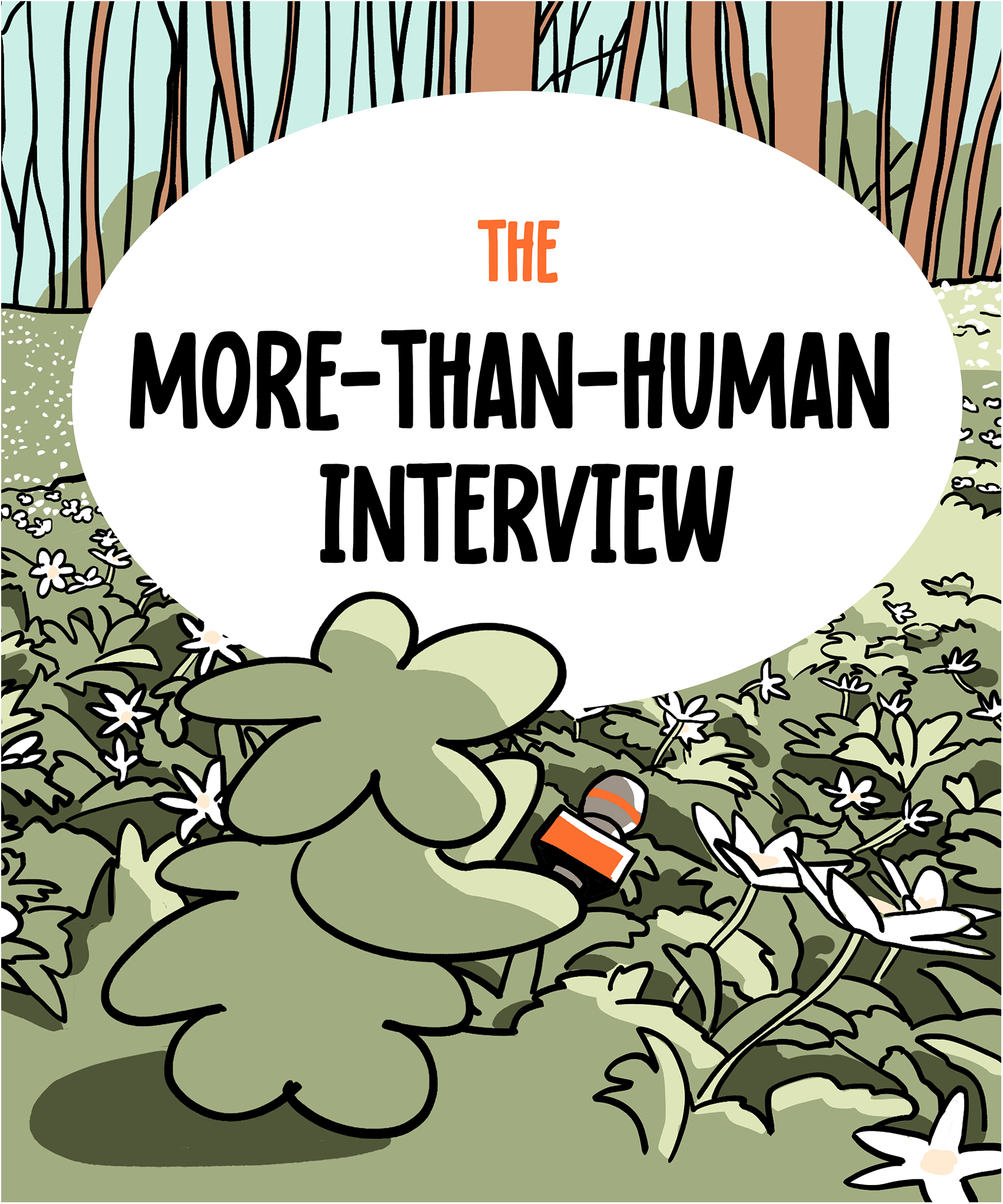
Figure 2a Long description
Visual description
A stylized woodland scene fills the page. Tall, narrow tree trunks rise in the background above dense green ground vegetation dotted with white flowers. In the foreground stands an anthropomorphized bush, drawn as a cluster of rounded green leaves. The bush holds an orange-and-black handheld microphone pointed upward towards a large speech balloon that dominates the centre of the page.
Text
Speech balloon: ‘The More-Than-Human Interview’
Bottom of page: ‘Elise Talgorn’
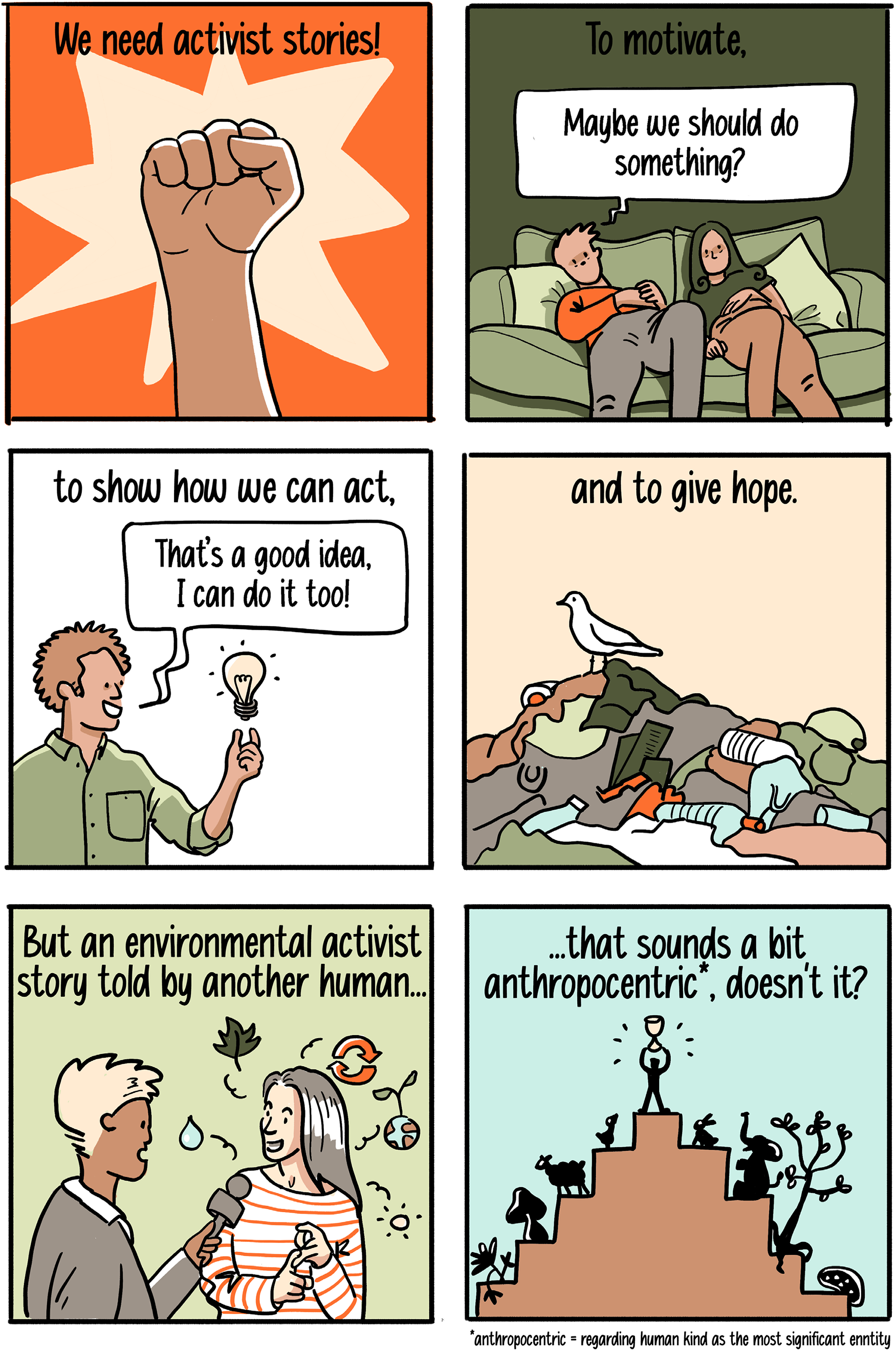
Figure 2b Long description
Panel 1
Visual
Against a bright orange background, a raised human fist occupies the centre of the panel. A pale starburst shape radiates behind it, evoking protest posters and activist imagery.
Text
Caption: ‘We need activist stories!’
Panel 2
Visual
Two people leaning casually in a lazy pose on a sofa in a living room. One speaks in a speech bubble.
Text
Caption: ‘To motivate’,
Speech bubble: ‘Maybe we should do something?’
Panel 3
Visual
A smiling person looks at a glowing lightbulb floating above his hand with two extended fingers. The lightbulb symbolizes a new idea.
Text
Caption: ‘to show how we can act’,
Speech bubble: ‘That’s a good idea, I can do it too!’
Panel 4
Visual
A pile of discarded waste fills the panel. Plastic bottles, containers, and other rubbish are heaped together. A white bird stands on top of the trash.
Text
Caption: ‘and to give hope’.
Panel 5
Visual
A person holding a microphone interviews a woman. Around the woman float small icons associated with environmental issues, including a leaf, a water droplet, a recycling symbol, a globe, and a sun.
Text
Caption: ‘But an environmental activist story told by another human…’
Panel 6
Visual
A stepped podium rises from the bottom of the panel. A human figure stands at the highest level while silhouettes of animals, plants, fungi, and other living beings occupy lower levels around the sides.
Text
Caption: ‘…that sounds a bit anthropocentric*, doesn’t it?’
Footnote: ‘*anthropocentric = regarding human kind as the most significant entity’
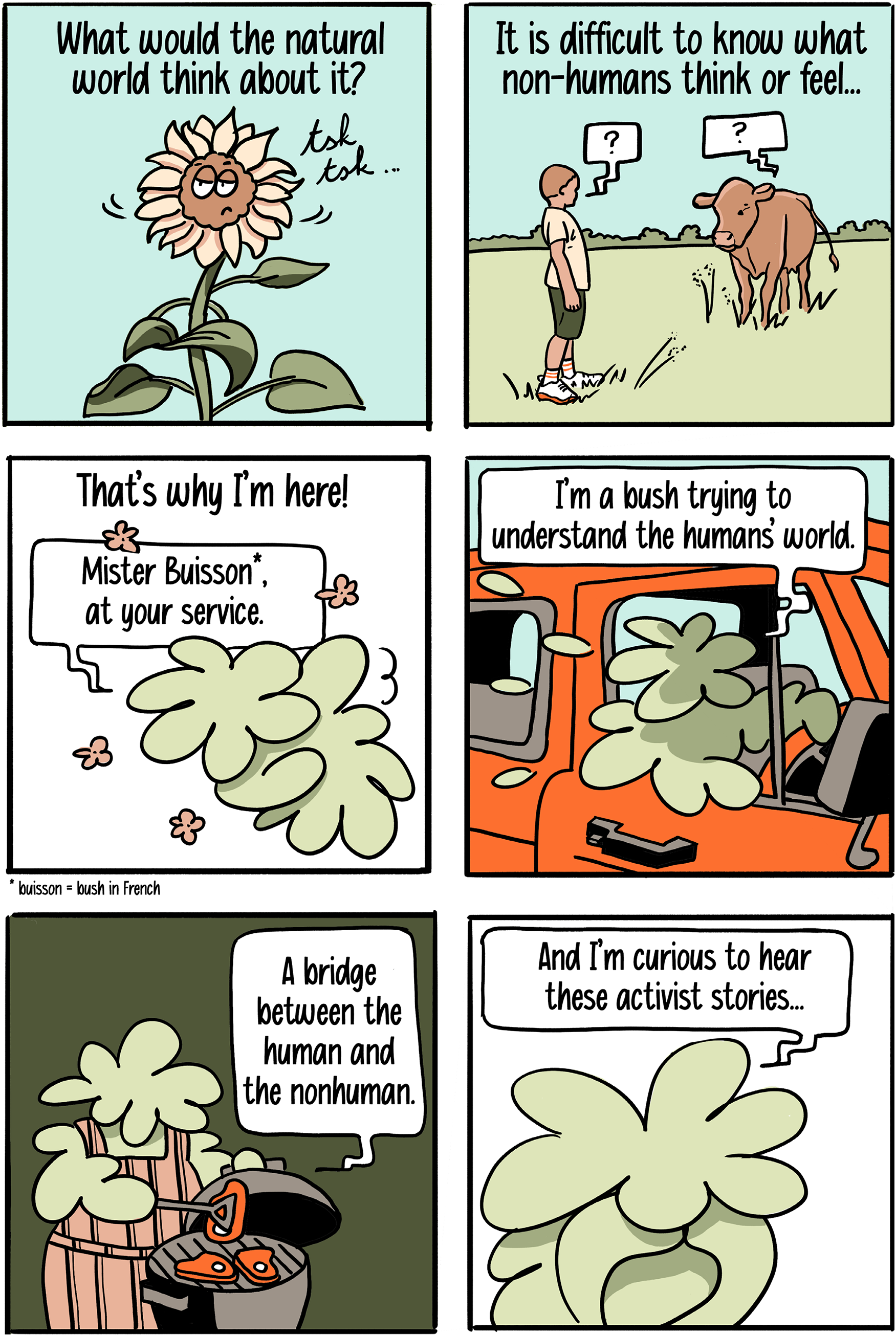
Figure 2c Long description
Panel 1
Visual
A drooping sunflower with half-closed eyes stands against a pale blue background. The flower appears tired or bored. Small motion lines suggest it is nodding.
Text
Caption: ‘What would the natural world think about it?’
Small text near flower: ‘tsk tsk…’
Panel 2
Visual
A human child and a cow stand facing one another in a grassy field. Both have speech balloons containing question marks.
Text
Caption: ‘It is difficult to know what non-humans think or feel…’
Panel 3
Visual
A leafy bush appears as a character. It has a round leafy body. Two leafy extensions resemble arms, and a smaller cluster of leaves at the top suggests a head. The character has no eyes, mouth, or other facial features. Small flowers surround it. The bush speaks directly to the reader.
Text
Caption: ‘That’s why I’m here!’
Speech bubble: ‘Mister Buisson*, at your service’.
Footnote: ‘*buisson = bush in French’
Panel 4
Visual
The bush rides inside an orange SUV, visible through an open window. Little leaves fly away from the bush, suggesting speed.
Text
Speech bubble: ‘I’m a bush trying to understand the human’s world’.
Panel 5
Visual
The bush sits beside a barbecue grill and is turning a piece of meat on the grill with a pair of tongs.
Speech bubble: ‘A bridge between the human and the non-human’.
Panel 6
Visual
Close-up of the bush’s leafy form.
Text
Speech bubble: ‘And I’m curious to hear these activist stories…’
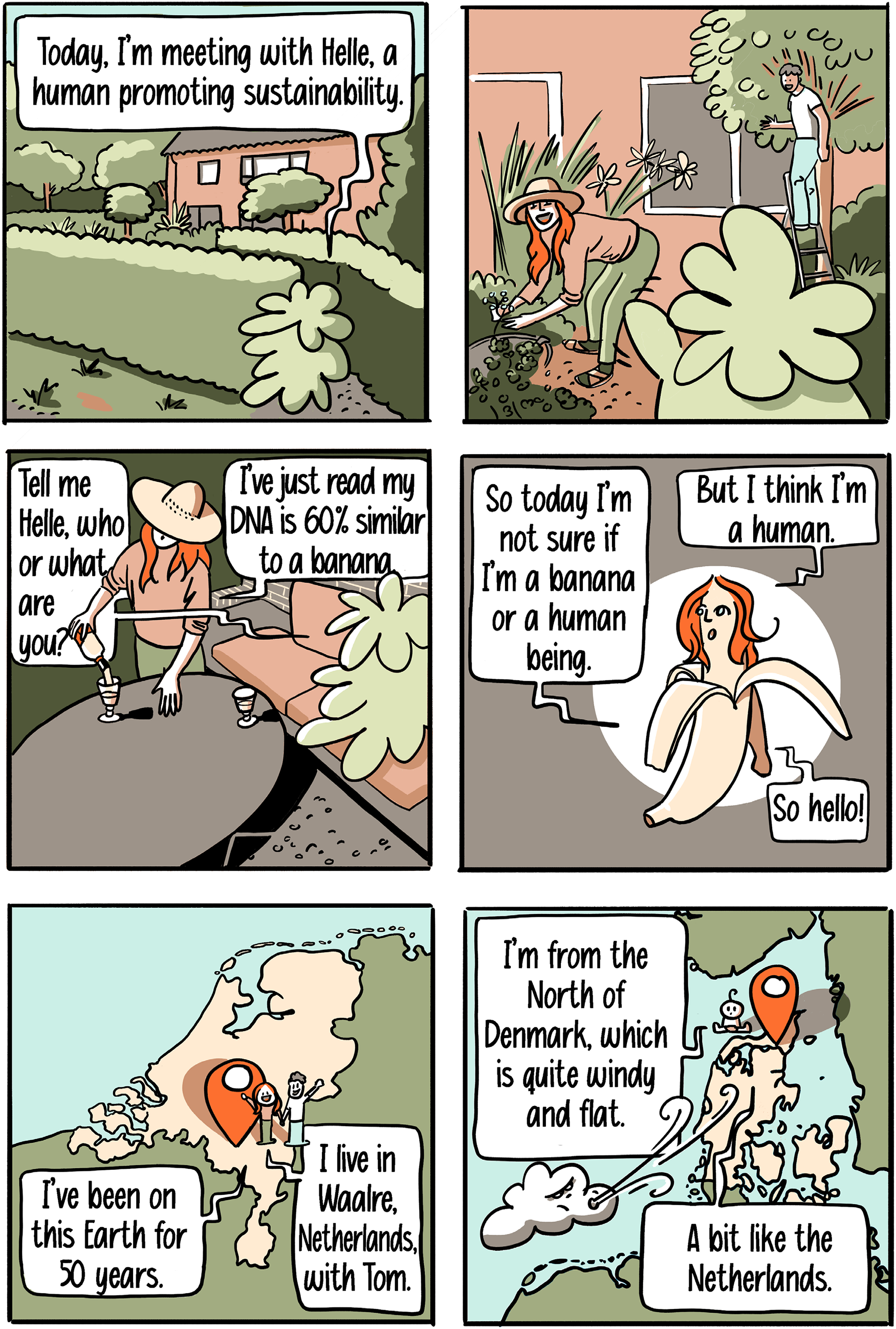
Figure 2d Long description
Panel 1
Visual
A suburban garden surrounds a brick house. Trees and dense greenery fill the background. The bush interviewer approaches along a garden path.
Text
Speech bubble: ‘Today, I’m meeting with Helle, a human promoting sustainability’.
Panel 2
Visual
A woman with long orange hair and a broad hat works in a garden bed. A man with grey hair in a white t-shirt stands nearby on a stepladder next to a tree. The bush interviewer The bush interviewer watches from the foreground, one leafy arm lifted as if saying hello.
Text
None.
Panel 3
Visual
The bush sits at a round garden table. The woman with orange hair stands and pours wine in two glasses on the table.
Text
Speech bubble interviewer: ‘Tell me Helle, who or what are you?’
Speech bubble Helle: ‘I’ve just read my DNA is 60% similar to a banana’
Panel 4
Visual
The woman, Helle, appears partially enclosed within a peeled banana. Her expression is cheerful and humorous.
Text
Speech bubble: ‘So today I’m not sure if I’m a banana or a human being’.
Speech bubble: ‘But I think I’m a human’.
Speech bubble: ‘So hello!’
Panel 5
Visual
A map of northwestern Europe shows a location marker in the Netherlands. Small figures representing Helle and the man with grey hair stand beside the marker.
Text
Speech bubble: ‘I’ve been on this Earth for 50 years’.
Speech bubble: ‘I live in Waalre, Netherlands, with Tom’.
Panel 6
Visual
A map of Denmark appears with a location marker and a small baby in the northern region. A small cloud blows wind across the map towards the south.
Text
Speech bubble: ‘I’m from the North of Denmark, which is quite windy and flat’.
Speech bubble: ‘A bit like the Netherlands’.

Figure 2e Long description
Panel 1
Visual
A winter scene shows a young child with orange hair and a cap in a garden covered with snow. A snowman stands in the background. The child stands beside a small frozen patch and tries to pull a toy duck trapped in ice. A handwritten note points towards the toy duck.
Text
Caption: ‘I grew up close to the forest and the sea’.
Handwritten note: ‘plastic duck stuck in ice’
Panel 2
Visual
The child in a striped t-shirt walks a beige dog through a wooded area. Gentle hills rise through the forest landscape and sunlight goes through the foliage.
Text
Caption: ‘Our house was in a flat neighbourhood surrounded by a hilly forest’.
Caption: ‘Not crazy hilly, but hilly’.
Panel 3
Visual
The child, in shorts, rides a bicycle along a forest path.
Text
Caption: ‘My mum worked in a mental institution in the forest. I used to bike there after school’.
Panel 4
Visual
Present-day Helle appears in close-up, speaking thoughtfully.
Text
Speech bubble: ‘Being close to the forest has been a big part of me growing up’.
Panel 5
Visual
A view of a suburban home and garden from above. Helle stands outside with a suitcase while two people open the door.
Text
Caption: ‘It’s an anchor in my life. When I visit home, I always go greet the forest’.
Caption: ‘It’s like a ritual’.
Panel 6
Visual
A figure embraces a large tree trunk. Only the arm, torso, and part of the tree are visible.
Text
Caption: ‘Only now talking about it, I realize I see the forest as a family member’.
Caption: ‘It’s a homey feeling’.
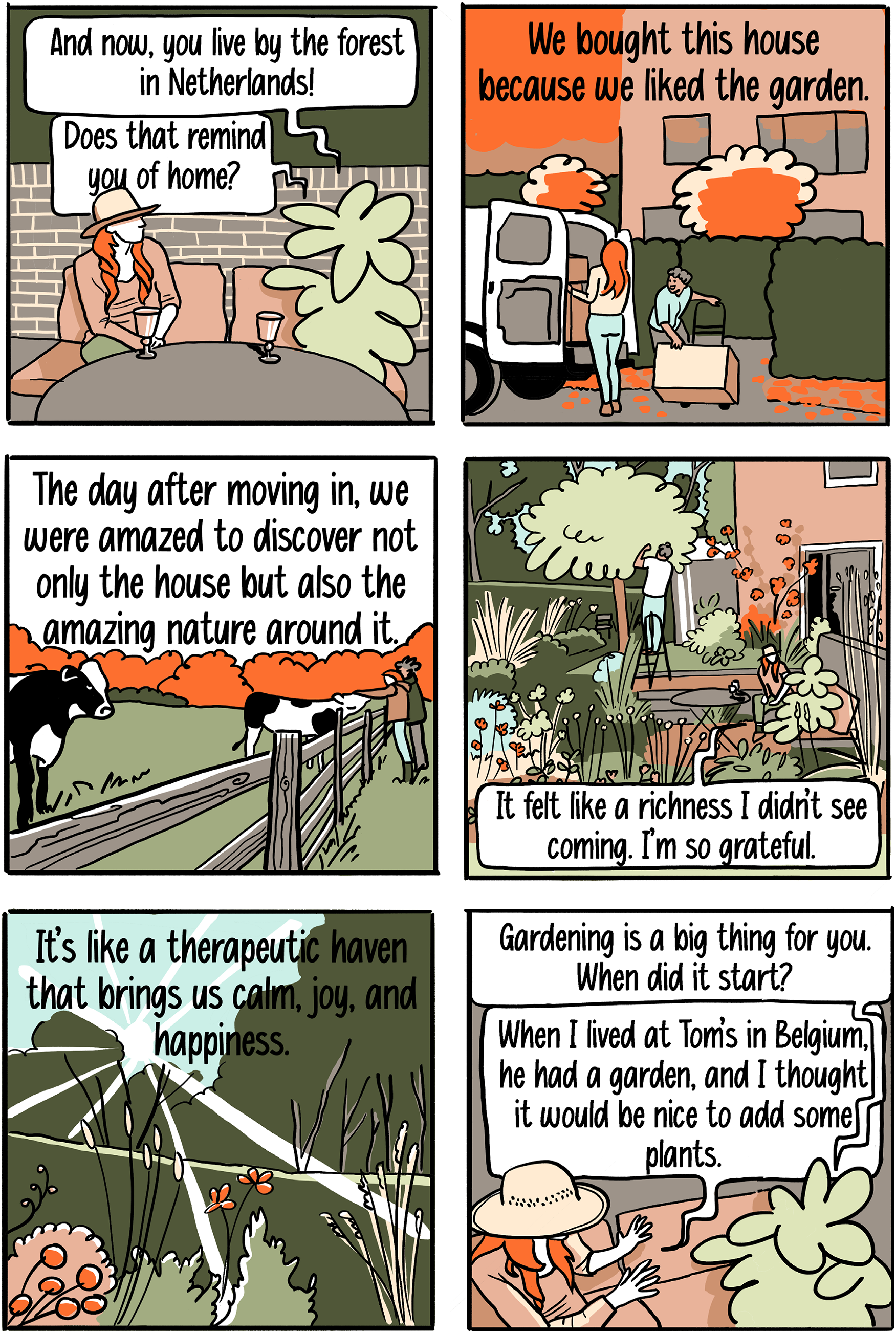
Figure 2f Long description
Panel 1
Visual: Helle and the bush interviewer sit outdoors at the garden table. Two drinking glasses stand on the tabletop. A brick wall and garden vegetation form the background. Helle faces the bush while listening to a question.
Text: Speech bubble interviewer: ‘And now, you live by the forest in the Netherlands!’
Speech bubble interviewer: ‘Does that remind you of home?’
Panel 2
Visual: A moving van is parked outside a brick house. Helle and the man with grey hair, Tom, unload belongings. Orange leaves are scattered across the ground.
Text: Caption: ‘We bought this house because we liked the garden’.
Panel 3
Visual: Two cows stand in a pasture behind a wooden fence. Helle and Tom are on the other side of the fence, and Helle reaches towards one of the cows. Trees and vegetation fill the landscape.
Text: Caption: ‘The day after moving in, we were amazed to discover not only the house but also the amazing nature around it’.
Panel 4
Visual: A densely planted garden surrounds the house. Tom stands on a ladder tending a tree while Helle and the bush sit at the round table among the plants. Flowers bloom throughout the scene.
Text: Speech bubble Helle: ‘It felt like a richness I didn’t see coming. I’m so grateful’.
Panel 5
Visual: Close view of wetland vegetation, grasses, flowers, and seed heads illuminated by rays of sunlight.
Text: Caption: ‘It’s like a therapeutic haven that brings us calm, joy, and happiness’.
Panel 6
Visual: Top-down view of the bush interviewer and Helle continuing their conversation at the garden table.
Text: Speech bubble interviewer: ‘Gardening is a big thing for you. When did it start?’
Speech bubble Helle: ‘When I lived at Tom’s in Belgium, he had a garden, and I thought it would be nice to add some plants’.

Figure 2g Long description
Panel 1
Visual: Close-up portrait of Helle wearing her broad hat. The background is dark, emphasizing a reflective mood.
Text: Speech bubble Helle: ‘Then we broke up for a while…’
Panel 2
Visual: A hand gently places a wilted plant into soil. The plant droops downward.
Text: Caption: ‘After that, I used gardening in my new place to compensate the love I still felt for Tom but couldn’t get rid of’.
Panel 3
Visual: The bush interviewer appears in close-up. A single tear-shaped droplet is visible on one leaf, suggesting emotion or sympathy.
Text: Speech bubble interviewer: ‘So when you garden, you give love to plants but also to Tom, or other people?’
Small handwritten sound: ‘snif’
Panel 4
Visual: Helle kneels among small plants and holds a flower while gardening.
Text: Speech bubble Helle: ‘Well, maybe indirectly, because I know whenever I care for the garden, it cares for us and gives so much back’.
Panel 5
Visual: A butterfly flies above flowering plants. Two small birds stand near a shallow birdbath surrounded by vegetation.
Text: Caption: ‘I’m especially honoured when I see new species coming into our garden’.
Panel 6
Visual: An insect hotel stands on bare soil beside a large spider. Handwritten labels point towards the structure.
Text: Caption: ‘I try to increase the biodiversity. It’s so nice to see it actually has an effect’.
Handwritten text: ‘insect hotel’
Small handwritten sound next to spider: ‘miam’

Figure 2h Long description
Panel 1
Visual: Helle and the bush interviewer sit side by side. Helle is smiling.
Text: Speech bubble interviewer: ‘Can you tell me of a special memory you have with nature or animals?’
Speech bubble Helle: ‘Yes! I knew right away I wanted to share this story with you!’
Panel 2
Visual: A winding road passes through a forested landscape. Trees in shades of green, cream, and orange cover the hills.
Text: Caption: ‘It was 6 or 7 years ago, in the Belgian Ardennes…’
Panel 3
Visual: View from inside a moving car. Several passengers are visible from behind as they travel along a road, Helle and Tom are sitting on the back seats. From the front window we can see three brown animal shapes.
Text: Caption: ‘We were driving back from a lunch with Tom’s family’.
Panel 4
Visual: Three deer stand beside a forest road. They face towards the viewer as if watching the approaching vehicle.
Text: None.
Panel 5
Visual: Close-up portrait of a deer against a pale background. The animal looks directly outward.
Text: None.
Panel 6
Visual: Extreme close-up of a deer’s eye. The eye fills most of the panel.
Text: Caption: ‘We need your help… Please stop the car. Our family needs to cross the road’.
Panel 7
Visual: An adult deer stands in the foreground while three younger deer wait behind it.
Text: Speech bubble deer: ‘It’s safe. The car has stopped. We can go now’.

Figure 2i Long description
Panel 1
Visual: The image is large, equivalent to the size of four of the previous panels. A herd of deer crosses a curved road through a forest. Several animals are mid-stride, leaping or running. Trees with orange, green, and pale blue foliage frame the scene. An adult stag with antlers is among the group.
Text: None.
Panel 2
Visual: The stag stands on the roadside among grass and trees, behind an old stone fence, facing towards the viewer.
Text: Speech bubble stag: ‘Thank you’.
Panel 3
Visual: Inside the stopped car, Helle sits in a passenger seat with her seatbelt fastened. Tears run down her cheeks.
Text: None.

Figure 2j Long description
Panel 1
Visual: The bush interviewer appears against a dark background, holding a flashlight that illuminates its face and creates a dramatic effect.
Text: Speech bubble interviewer: ‘And is there a time where nature unsettled or even frightened you?’
Panel 2
Visual: The front of a train station with a dark grey cloudy sky. Rain falls heavily. Silhouettes waiting in front of the train station.
Text: Caption: ‘Yes… One evening two months ago, I was coming back from work’.
Panel 3
Visual: Helle wearing a long beige coat and a cap steps into the passenger sit of a brown car while heavy rain falls nearby. Another person in a suit under an umbrella and holding a brief case runs. Cars in the background.
Text: Caption: ‘I usually bike from the train station but it was pouring, so Tom came to pick me up’.
Panel 4
Visual: A cyclist rides through deep rainwater while heavy rain continues. The bicycle slips slightly as the cyclist crosses a zebra crossing.
Text: Caption: ‘It had only rained for a few minutes but streets were already flooded’.
Panel 5
Visual: An urban street, with a tree and a nice old building with tall arched windows in the background, is covered with water. The brown car moves through the flooded area. Coloured reflection of the building and the car in the water.
Text: None.
Panel 6
Visual: The car drives through standing water beneath a dark underpass. The water is high and reaches the level of the headlights.
Text: None.

Figure 2k Long description
Panel 1
Visual: Floodwater fills a low-lying landscape viewed from the mouth of the underpass. In the distance, trees and shrubs emerge from the flooded area. Heavy clouds part overhead, allowing beams of sunlight to break through and illuminate sections of the landscape.
Text: None.
Panel 2
Visual: The bush interviewer appears from the opening in the clouds. It is shaped as the bush but has a light blue colour, red eyes, and an open, unhappy mouth. It points a menacing finger at us.
Text: Speech bubble cloud: ‘It’s time to act. NOW’.
Panel 3
Visual: Helle sitting in the car appears shocked and afraid, with eyes as crosses and a wide open mouth.
Text: None.
Panel 4
Visual: The car exits the underpass driving through floodwater.
Text: None.
Panel 5
Visual: Back to the garden view, Helle sits still with the same afraid expression.
Text: Speech bubble Helle: ‘It’s a climate catastrophe!’
Panel 6
Visual: A globe appears surrounded by clouds and lightning symbols. Two clock hands transform the globe into a clock. Motion lines suggest that the hands are moving.
Text: Caption: ‘It’s crazy. I live in it. It can happen anytime…’
Handwritten note: ‘tick tack’

Figure 2l Long description
Panel 1
Visual: The bush interviewer raises his arms.
Text: Speech bubble interviewer: ‘A clear call to action!’
Speech bubble interviewer: ‘Do you consider yourself an environmental activist?’
Panel 2
Visual: Helle sits in the garden, with expressive hand gestures.
Text: Speech bubble Helle: ‘I don’t see myself as an activist’.
Speech bubble Helle: ‘It’s someone who buys sustainability with no break, which is great!’
Panel 3
Visual: A logo-like drawing representing Philips is surrounded by decorative vines and leaves.
Text: Caption: ‘I work for the company Philips in a team focused on sustainability’.
Panel 4
Visual: Three intertwined branches extend upward from a common stem. One branch is associated with leaves, one with a heart, and one with a courthouse-like justice symbol. Handwritten text appears beside each branch.
Text: Caption: ‘Currently I’m involved in a strategic project covering all aspects of sustainability’.
Handwritten note: ‘sustainability’, ‘social’, ‘governance’
Panel 5
Visual: A globe surrounded by interconnected lines floats against a dark background.
Text: Caption: ‘Because it’s in a company of 70.000 employees, I feel my scale of influence is big’.
Panel 6
Visual: An aerial view of Helle’s house and garden next to the forest. Four silhouettes are visible in the garden.
Text: Caption: ‘In my private life, my influence is just the square meters of my garden and my family.’

Figure 2m Long description
Panel 1
Visual: Helle and the bush interviewer sit together in the garden.
Text: Speech bubble Helle: ‘I feel in tune with people who care about the environment’.
Panel 2
Visual: Top-down view of a crowd of people gathering at a conference or event.
Text: Caption: ‘For example, at conferences on sustainability…’
Panel 3
Visual: Top-down view of Helle in an orange suit and a man in a blue suit shaking hands.
Text: Caption: ‘…people might be strangers, but we are all interested in the same topic’.
Panel 4
Visual: Top-down view of Helle and the man engaging in a conversation. Both gesture with their hands as they speak, suggesting enthusiasm and active engagement.
Text: Caption: ‘You don’t have to break the ice, you can immediately have deep conversations.’
Panel 5
Visual: Two heads are shown in profile with brain-like shapes that are interconnected with intertwined vines.
Text: Caption: ‘It’s as if I know them a little bit without knowing them as people’.
Panel 6
Visual: Portrait of Helle smiling warmly beneath her hat.
Text: Speech bubble Helle: ‘I really feel connectedness in these moments’.

Figure 2n Long description
Panel 1
Visual: The bush interviewer does a hand gesture towards us against an orange background.
Text: Speech bubble interviewer: ‘When did you start being so active in sustainability?’
Panel 2
Visual: Helle exits an airplane wearing a long green coat and carrying a suitcase.
Text: Caption: ‘There was a business trip where I realized that I was contributing to consumerism’.
Panel 3
Visual: Top-down view of Helle standing in front of a bookshelf, reaching towards a book.
Text: Caption: ‘It triggered me to find information on ways to reduce my environmental impact’.
Panel 4
Visual: A book cover is shown prominently, with a banana illustration and the title ‘How Bad Are Bananas?’ written inside the banana shape.
Text: ‘So, back to bananas. I read this book by Mike Berners-Lee.*’
Footnote: ‘*How Bad Are Bananas?: The carbon footprint of everything, pub. Profile Books Ltd’
Panel 5
Visual: A simple diagram illustrates different forms of consumption and environmental impact. A longer line is next to a cow icon, a middle line next to a cheese icon, and a shorter line next to a banana icon.
Text: Caption: ‘It’s a very simple book that explains the environmental impact of meat, travel, etc.’
Panel 6
Visual: Helle sits outdoors against a tree with a book, and looks up pensively.
Text: Caption: ‘It gave me a good foundation for making changes in my life’.

Figure 2o Long description
Panel 1
Visual: The bush interviewer pops from a corner of the panel against an orange background.
Text: Speech bubble interviewer: ‘Interesting! Do you have tips for readers who want to do more for the environment?’
Panel 2
Visual: Helle smiles while answering.
Text: Speech bubble Helle: ‘Absolutely! Everyone should explore ways to reduce their daily environmental footprint!’
Panel 3
Visual: Helle sits with the lush garden in the background.
Text: Speech bubble Helle: ‘And it can be very easy!’
Panel 4
Visual: Helle uses a computer displaying an energy-related interface.
Text: Caption: ‘For example you can switch to an energy supplier that uses renewables’.
Panel 5
Visual: Several vegetarian dishes are shown from above.
Text: Caption: ‘Low meat diets are easy now. There’s plenty of meat replacements and delicious vegetarian restaurants!’
Panel 6
Visual: Helle in an orange suit and a blue headscarf stands confidently against an orange star-shaped background.
Text: Caption: ‘Buy second hand’.

Figure 2p Long description
Panel 1
Visual: Helle looks out from a train window.
Text: Caption: ‘Traveling by train is eco-friendlier than flying, and you’ll enjoy the slower pace!’
Panel 2
Visual: Helle walks along a sunny city street. In the distance, the clock tower known as Big Ben and the adjacent Palace of Westminster are visible.
Text: Caption: ‘You go less far, but you can have fantastic holidays’.
Panel 3
Visual: Helle and the bush interviewer stand beside a canal, each holding an umbrella. Across the water, a row of traditional Amsterdam canal houses lines the opposite bank beneath a dark grey sky. Several boats are moored in the canal.
Text: Caption: ‘Even if it’s less sunny’.
Panel 4
Visual: A group of smiling people including Helle pose together. They all wear caps and two wear sunglasses. Helle’s hair flies in the wind. The sealine is visible in the background.
Text: Caption: ‘Buy less stuff. Go more for experiences’.
Panel 5
Visual: A hand places a stone on a stack of balanced stones forming a small tower.
Text: Caption: ‘Start where it feels easy. Try new things, and you’ll build confidence’.
Panel 6
Visual: A small potted tree stands against a plain background. Its shadow appears as a large mature tree, much larger than the plant itself.
Text: Caption: ‘You’ll find that change isn’t that scary’.

Figure 2q Long description
Panel 1
Visual: A wide garden scene. Helle and the bush interviewer sit together at the round table in the middle of abundant vegetation.
Text: Speech bubble interviewer: ‘Thanks Helle! So what motivates you to make these changes?’
Speech bubble Helle: ‘I feel I have a responsibility towards the Earth and its past’.
Panel 2
Visual: A wide prehistoric landscape filled with lush vegetation. Two large long-necked dinosaurs resembling diplodocuses move through the scene among dense ferns and trees. In the foreground, a body of water reflects the surrounding greenery. A small orange dinosaur runs among the ferns near the water’s edge.
Text:
Caption: ‘I’ve great respect for what we’ve had on this planet. I feel honoured to live on the land that hosted dinosaurs’.
Caption: ‘I have no right to destroy something that beautiful’.
Panel 3
Visual: A hand gently holds small white flowers.
Text: Caption: ‘And my memories are intertwined with nature’.
Panel 4
Visual: A forest scene with tall tree trunks.
Text: Caption: ‘This childhood forest is definitely entangled in me’.
Caption: ‘There’s an area there where I feel most at home’.

Figure 2r Long description
Panel 1
Visual: A full-page forest landscape filled with white flowering plants beneath tall trees. Helle kneels among the flowers, reaching towards the ground to pick up a flower. She holds another flower in her other hand. The scene is calm and contemplative.
Text: Caption: ‘That’s where I would like to be when I die’.
Discussion and conclusion
Eco-entangled memories in the more-than-human interview and comics
Narratives of eco-entangled memories were created through the storytelling process representing the four cornerstones of the framework: co-constructed narratives, storytelling as world-making, ethical recall, and temporal and emotional entanglement. This is evident when examining the comics and reflecting on Helle’s experience of the interview, her reading of the comic, and the author’s personal reflection.
Helle links the visual story of her childhood forest memory to her present experience of the place and deepens the exchange by sharing photographs. Through the drawing process and these images, the author also develops a sense of connection to the forest and towards Helle’s childhood self. This once-personal landscape thus becomes a shared emotional space, linking Helle, the forest, her memory, the author, and the comic. This dynamic interaction exemplifies an eco-entangled memory emerging as co-constructed narrative that evolves through interview, drawing, reading, remembering, and exchange of images. It also illustrates emotional entanglement among the co-storytellers.
Helle’s memory of encountering deer illustrates temporal entanglement, world-making, and ethical recall through the storytelling process. The memory is re-activated and reshaped through continual engagement: first by reading the comic, and later by seeing deer in real life on multiple occasions, showing ongoing temporal entanglement of past and present experiences. Through storytelling as world-making, the memory shapes a relational world where encounters with deer – real, drawn, or remembered – become meaningful, evoking gratitude and heightening relational awareness. This becomes an instance of ethical recall, where Helle’s awareness of interspecies kinship and care emerges, transforming the memory into a practice of ethical companionship. The deer event was chosen as the central element of the comic narrative arc, due to its emotional intensity during the interview, symbolising a key moment in the evolution of Helle’s relationship with the environment.
This companionship manifests through other more-than-human actors in the comic, including animals (eg, deer, cows, dinosaurs, spiders), plants, and landscapes (the garden, the childhood forest, the Ardennes). The recounted memories acknowledge not only the influence various more-than-human actors had on Helle, but also the influence she may have had on them, such as creating an insect garden or stopping on the road to let the deer pass safely.
Temporal entanglement is visually represented in the comics through recurring greenery, which serves as a thread linking multiple temporalities: the moment of the interview, Helle’s past nature memories, imagined prehistoric vegetation, and reflections on future mortality. In this context, greenery functions as a connective element across key landscapes for Helle, such as the childhood forest that is ‘a family member’ and the place ‘where [she] would like to be when [she] dies’, and her garden which is her ‘therapeutic haven that brings [them] calm, joy and happiness’, as well as across time, symbolically weaving together memory, imagination, and existential reflection.
Embodying the more-than-human
The idea of introducing Mr Buisson was to bring a nonhuman viewpoint that opens space for alternative, imaginative ways of engaging with memories and environmental activism. Adopting the role of Mr Buisson during the interview allowed the focus to be on Helle’s emotional ties to nature and personal journey. This opened space for a relational, rather than goal-oriented, understanding of environmental engagement. This shift in focus allowed Helle to reflect on her evolution as an activist and to recognise the importance of her past interaction with nature. Today, she uses parts of the comic to introduce herself in professional settings, bringing new attention to her journey of connectedness, and departing from conventional ways of speaking about environmental work.
This case study suggests that light and empathetic more-than-human figures like Mr Buisson can facilitate imaginative and affective dialogues between human and nonhuman worlds and support the telling of eco-entangled memories. As Herman (Reference Herman2011) argues, comics can do more than symbolically represent nonhumans; they can evoke a form of experiential immersion that encourages readers to question assumptions about subjective experience and agency across species. Previous research suggests that reading speculative fiction or discussing climate-oriented micro-fiction can help people sense the world beyond a human frame, challenging the assumption that nature is separate from humans (Toivonen and Caracciolo Reference Toivonen and Caracciolo2022; Kortekallio Reference Kortekallio2023). In this study, the invitation to adopt a less human-centric perspective came through dialogue with a fictional character blending human and nonhuman narration.
Method evaluation, limitations, and further research
This study shows that the more-than-human interview method can open new ways of remembering and engaging with more-than-human encounters, while inspiring participants to reframe and share those memories creatively. Prior studies have shown that people often recall nature as an idealised, lost ‘Golden Age’, particularly in relation to childhood, specific places, and emotionally charged landscapes (Mulcock and Toussaint Reference Mulcock and Toussaint2002; Sjögren Reference Sjögren2022; Gülüm Reference Gülüm2024; Juillard et al. Reference Juillard, Macia, Duboz and Prévot2024). We observe in Helle’s story the importance of landscapes and emotional, mostly positive, encounters with the more-than-human. However, it remains unclear whether these memories should be understood as idealisations in a nostalgic sense. Rather, the method led Helle to (re)construct the positive elements of her memories in the collaborative storytelling context, with the comic reactivating further these memories in the present, making them part of an ongoing, narrated eco-entangled memory. In doing so, it allows the transposition of positive qualities from these past experiences into present-day relationships with the environment.
There is a risk of romanticising nature or simplifying its complexities (Heise Reference Heise2008). Although emphasising positive and interconnected memories may be interpreted as idealising, their re-telling can instead cultivate hope and motivation, both essential for counteracting feelings of powerlessness and sustaining ecological action. For Helle, the process deepened her sense of gratitude towards the natural world and encouraged her to share her story with others. Highlighting positive elements therefore need not obscure systemic environmental challenges; rather, they can function as generative resources for activism.
Another concern relates to the use of a semi-anthropomorphised character such as Mr Buisson, who inevitably carries human projections. The method does not claim to authentically voice the more-than-human; rather, its strength lies in blurring narrative roles, allowing nature memories to be retold differently by softening the human/nonhuman divide. This creative strategy raises broader questions about the role of more-than-human figures in environmental storytelling. Should they primarily model empathy and relationality, or adopt a more critical stance that holds humans accountable? Their tone and function depend on the aims of the narrative and may call for different aesthetic and methodological choices.
Within the comics medium, humour is particularly significant. As a whimsical figure, Mr Buisson may make environmental themes more accessible. Yet the use of humour also carries the risk of simplification or sentimentality. While research has examined environmental comics and eco-humour separately, little attention has been given to their intersection. Further studies could therefore explore how humour in more-than-human comics shapes ecological storytelling and influences audience engagement.
Third, the method’s outcomes are shaped by the interview context, including the Northern European, Global North context and the researcher–participant relationship, and may not generalise across different settings or cultural perspectives. It remains the task of further studies to investigate how the process of remembering, sharing, and shaping memories is influenced by the unique interview and comic format. Our observations suggest that the context may invite less human-centric and more emotionally sophisticated tellings of memories than a regular interview, while also offering the interviewee the chance to reflect on their story through its comic representation.
Finally, the comic’s effects on readers remain preliminary, and further studies should examine its impact on, for example, readers’ sense of connectedness and empathy for more-than-human entities. Preliminary feedback suggests that the comic emerging from the interview can function as meaningful stand-alone environmental narratives that may prompt interested audiences to reconnect with past environments and reflect on formative experiences with nature. These responses highlight the capacity of storytelling of eco-entangled memories to elicit emotional resonance and foster affective links between storytellers, readers, and the natural world. Reflective conversations about the comic may also raise awareness of how people are socialised to relate to nature (Kaufman et al. Reference Kaufman, Ewing, Hyle, Montgomery and Self2001) or enhance ecological sensitivity (Toivonen and Caracciolo Reference Toivonen and Caracciolo2022).
Conclusion
This study suggests that representing and reconstructing nature memories in comic format offers distinct benefits. Comics can fluidly navigate multiple perspectives; their visual stylisation allows for playful in-betweenness, making it plausible for a bush to interview a human. Anthropomorphic or ambiguous more-than-human characters become acceptable to audiences, creating space for imaginative and affective engagement. For the activist, the comic’s light tone and visual structure made it a safe format to share personal experiences.
A more-than-human character like Mr Buisson invites interviewees to look and remember with new eyes and listen with unfamiliar ears. His perspective shifts the narrative focus from professional or action-oriented frames towards a deeper exploration of emotional, ethical, and imaginative connections to nature. Through humour, visual storytelling, and embodied experience, comics allow more-than-human stories to unfold in ways that reach beyond conventional academic or activist discourse.
Eco-entangled memories emerged as a central outcome of the more-than-human interview process and its visual translation into comics. These are memories shaped through emotional, temporal, and relational entanglements between humans and the more-than-human world, co-constructed across interview, drawing, storytelling, and shared reflection. The comic medium offers a compelling form for representing such entanglements, bridging past and present, personal and planetary, and real and imagined.
In a world marked by environmental generational amnesia – forgetting what we have lost (Craps Reference Craps2024) – remembering the more-than-human world becomes a form of both repair and activism. The more-than-human interview is an encouragement to use comics in environmental and climate communication, and a starting point to inspire additional research, creative projects, and conversations on the role of more-than-human perspectives and knowledge co-construction in addressing ecological challenges.
Data availability statement
The complete comic scripts and sketches used in the study are available from the corresponding author upon reasonable request. The full audio recordings and transcripts of the interviews cannot be shared to protect participant privacy.
Funding statement
This research received no specific grant from any funding agency.
Competing interests
The authors declare that they have no competing interests.
AI usage statement
AI-assisted tools were used for grammar, spelling, and sentence flow.
Elise Talgorn is a researcher and artist exploring how storytelling fosters creativity, empathy, and connection across human and more-than-human worlds. With a PhD in renewable energy physics, she is Associate Professor of Social Impact Storytelling at Amsterdam University of Applied Sciences, creating participatory, story-based practices for systems transformation.
Heidi Kristiina Toivonen is Assistant Professor of Psychology at Franklin University Switzerland. With a clinical psychology background and a PhD completed alongside 10 years of practice, her research focuses on psychotherapy conversations, mental health interventions, the role of digital devices in everyday life, and environmental storytelling.
Appendix: Script of the more-than-human interview
Mindfulness exercise: Before starting the interview, we’ll engage in a short mindfulness activity. Sit comfortably and close your eyes. Focus on your breath and gently turn your attention to the sounds around you – birds, wind, the rustling of trees – imagining how these sounds have been present throughout the life of the garden. Imagine the roots of the trees beneath your feet and feel the connection between yourself and the earth.
[Pause for 1 minute]
Interview questions:
-
1. Who or what are you on this Earth?
-
2. Where are you from? How is nature there? How do you remember it? How do you feel when you think about that place?
-
3. Where are you now? How is nature here? How do you feel in this environment?
-
4. Tell me about your earliest memory with nature or animals.
-
5. Tell me about your most beautiful memory of nature or animals.
-
6. Tell me about a time when nature surprised, unsettled, or even frightened you.
-
7. Would you consider yourself an environmental activist? What does environmental action look like for you in your private life? And in your work?
-
8. When did you first start caring about the environment? What sparked that care?
-
9. When did you start gardening? Why do you find joy in it?
-
10. Do you feel a sense of connectedness with nature?
-
11. Tell me about a memory where you felt people and nature when connected.
-
12. How has your relationship with nature evolved over time? What were the key milestones in this evolution?
-
13. What does the concept of ‘eco-entangled memories’ mean to you? Do you feel that your memories are intertwined with nature?
-
14. Is there a place in nature you’ve never visited but feel deeply connected to? What resonates with you about that place?
-
15. Has something in your perception changed since we began this interview? What is your fondest memory from this interview?
Before we wrap up, let’s take another moment for a short mindfulness exercise. Close your eyes and focus on your breath again. Feel the ground beneath you, the air around you, and imagine the garden continuing its quiet life after this conversation. Think about how the earth has been here long before us and will continue long after. Simply notice any thoughts or feelings that arise, and let them come and go.
[Pause for 1 minute.]
Now, as we come back, do you have anything to add?
Is there something we didn’t touch on that you’d like to share or reflect on further?
Thank you for sharing your thoughts, your memories, and your connection to this space.

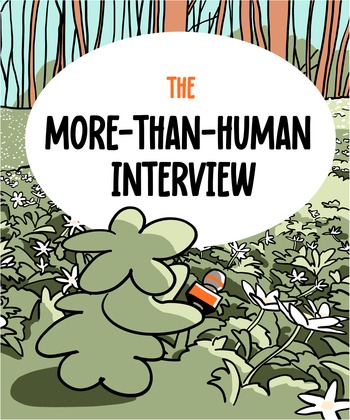
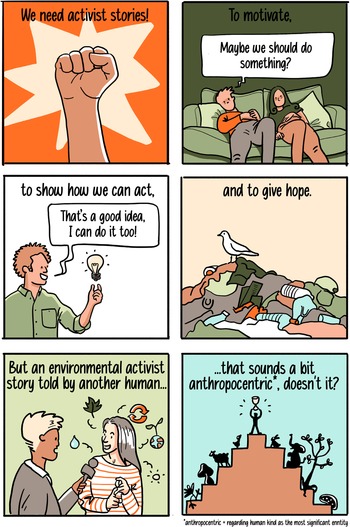
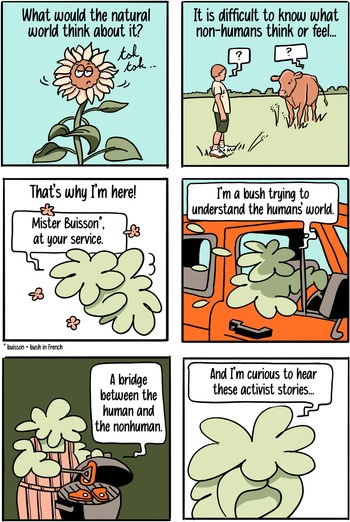
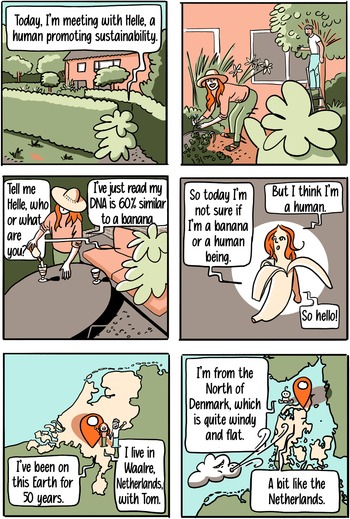

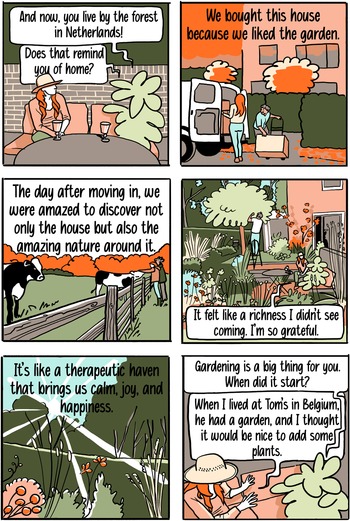
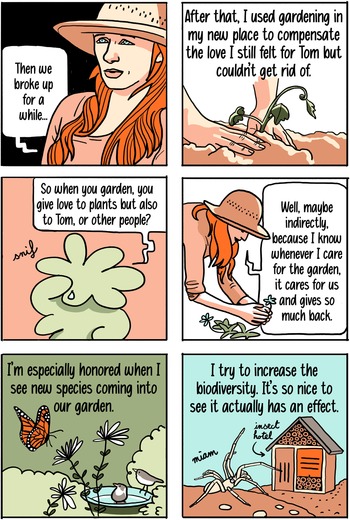

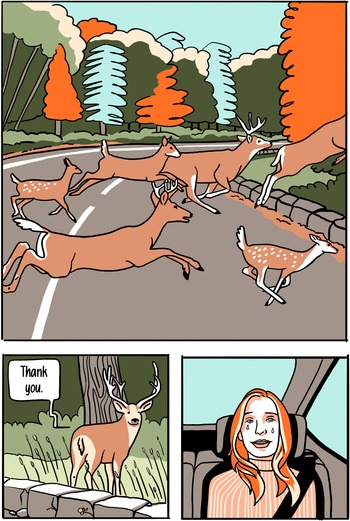


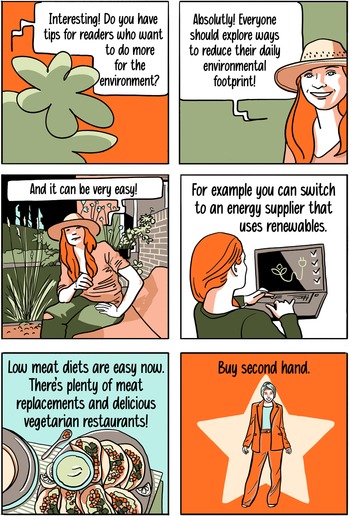


 Open access

