In healthcare settings, a common practice among healthcare workers (HCWs) to minimize airborne contaminant exposure to patients in the sterile field of an operating room is the use of surgical masks. Surgical masks are classified as a medical device, not a respirator, and must be cleared by the Food and Drug Administration (FDA). 1 When respiratory protection in addition to maintaining a sterile field is required, surgical N95 filtering facepiece respirators (FFRs) are used—surgical N95 FFRs are NIOSH-approved N95 FFRs that also meet additional FDA requirements (ie, fluid resistance, flammability, and biocompatibility). 2
More than 11 million HCWs are expected to benefit from the use of respiratory protective devices (RPD) during an infectious respiratory pandemic. Reference Cooley, Lee and Brown3 Since the outbreaks of SARS-CoV-1 in 2003, MERS-CoV (Middle East Respiratory Syndrome) in 2012, H1N1 in 2009, and Ebola in 2014, more attention has been focused on using powered air-purifying respirators (PAPRs) for HCWs. 4 The most commonly used models of PAPRs are manufactured by 3M (St Paul, MN) and Bullard (Cynthiana, KY). Reference Roberts5
A survey conducted in 2014, entitled “Prevalence of Respiratory Protective Devices in US Healthcare Facilities,” found that NIOSH-approved N95 FFRs (including surgical N95s) were the most widely used RPD in healthcare environments followed by PAPRs. Reference Wizner, Stradtman, Novak and Shaffer6 In a context of PAPR utilization in a sterile field, the air exhaled by a wearer is generally expected to contain some aerosolized microorganisms. Reference Grinshpun, Haruta, Eninger, Reponen, McKay and Lee7 In contrast to other types of RPD (eg, N95 FFRs), the air exhaled from a PAPR is not filtered. Therefore, HCWs and health and safety professionals are concerned that the use of PAPRs may potentially lead to increased contamination of the surgical site from exhaled infectious particulates (eg, back of shroud or down pant leg into the surgical environment). The Centers for Disease Control and Prevention (CDC) primarily recommends the use of PAPRs for hospital first responders and in the event of a large-scale disaster or for an unknown biological or chemical threat. 8
Four respiratory activities are known to produce airborne particles or droplets: mouth breathing, nose breathing, coughing and/or sneezing, and talking. Coughing produces the largest concentration of droplets and nose breathing produces the least. Reference Xu, Lei, Zhuang and Bergman9 The exhaled particles that leak outward from PAPR wearers are large enough to be affected by gravity (hence, are subject to falling) rather than remaining atomized and being expelled from the operating room by the air exchange system. Reference Xu, Lei, Zhuang and Bergman9 Surgical masks are not designed nor intended to be respirators, and various studies have shown that surgical masks offer minimal respiratory protection to the wearer due to poor fit characteristics and low filtration efficiency, while N95 FFRs have better filtration efficiency and fit characteristics. Reference Davidson, Green and Gibbs10,Reference Willeke, Qian, Donnelly, Grinshpun and Ulevicius11
A previous study examined the particulate count in the sterile surgical field using a PAPR equipped with a hood under laminar conditions, and the results demonstrated that the hooded PAPR did not increase particulate transfer to the surgical field. Reference Kim and Hale12 Another study examining the aerosolized droplet contamination of a surgical field indicated that surgical masks reduced contamination by 98.48% and PAPRs (a full-facepiece PAPR, 3M Versaflo Headcover S-133 and a full-facepiece 3M Versaflo Hood S-533) reduced contamination by 100%, compared to not using facial coverings. Reference Howard, Lathrop and Powell13 Multiple observational studies have indicated greater self-reported wearer comfort among PAPR users. Reference Candiotti, Rodriguez and Shekhter14–Reference Chughtai, Seale, Rawlinson, Kunasekaran and Macintyre16
Some NIOSH-approved FFRs have an exhalation valve for increased comfort as users breathe out. A concern with FFRs with an exhalation valve is that asymptomatic individuals may spread disease if unfiltered, virus-laden aerosols pass through the valve. During public health emergencies, demand for N95 FFRs may outpace supply, and elastomeric half-mask respirators (EHMRs) may be used. Previous guidance from the CDC did not recommend using an FFR or EHMR with an exhalation valve for source control (ie, to filter exhaled respiratory secretions to prevent disease transmission).
In this study, we evaluated the concentration of airborne bacteria produced from the exhaled air of HCWs while wearing PAPRs, EHMRs, or N95 FFRs in a simulated operating room. Our research aims were (1) to determine the baseline contamination from the air exhaled from wearers of surgical masks; (2) to measure the contamination levels from the air exhaled from wearers of PAPRs, EHMRs, and FFRs; (3) to determine the difference in contamination between FFRs with and without a valve; (4) to determine the difference in contamination between loose-fitting PAPRs with (APF, 1, 000) and without (APF, 25) a hood and shroud; and (5) to investigated distance considerations (30.40 cm, 91.44 cm, and 152.4 cm).
Methods and materials
Study design
Two identical rooms were used, each with a volume dimension of 4.11 m × 4.11 m × 2.44 m and an air exchange rate (AER) of 25 air exchanges per hour (ACH). The ASHRAE 170-2013 guidelines for design and function of the operating room recommend 20–25 ACH. Reference Wagner, Greeley, Gormley and Markel17 The Association of periOperative Registered Nurses (AORN) also recommends that the minimum rate of total air exchanges per hour should be maintained at a constant level of 20–25 ACH. 18
The research protocol received from the institutional review board (WVU/IRB no. 2009129419) before test participants were recruited. Test participants received fit testing and donning instructions for the 2 N95 FFRs with and without an exhalation valve and the 1 EHMR used in the study.
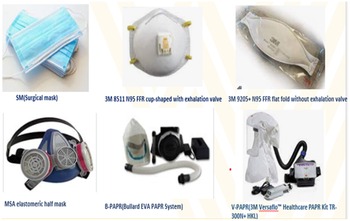
We tested 5 different types of RPDs and 1 surgical mask (Fig. 1) on 18 HCWs grouped into 2 teams of 2 HCWs (Table 1). Participant selection was based on their previous experience working with respirators in a healthcare setting. Participants not achieving an adequate fit with any of the tight-fitting respirators were excluded. No beard or mustache was allowed; all had to be clean shaven. Females were not allowed to have jewelry, earrings, or other personal items that would interfere with the face seal.
Team Member Information (Participant Sex, Age, Weight, and Height)

Team members simultaneously wore each type of RPD while performing CPR and talking. The “rainbow passage,” typically read aloud as part of fit testing, was available to team members to simulate talking. The team members only spoke loud enough to be heard. While participants were performing CPR and talking, active biological sampling was conducted to determine the concentration (CFU/m3) and the particle size distribution of the exhaled aerosol for each respirator type.
Procedures
A previous study used impervious surgical gown, sterile gloves, disposable foot covers, and disposable hair covers. Reference Howard, Lathrop and Powell13 To reduce the chance of bacteria becoming airborne from nonrespiratory sources, all team members wore a full-body Tyvek suit with hood and nitrile gloves over their street clothing and shoes. Previous studies reported very low CFU counts, most likely the result of large particles settling on the agar plates. Therefore, active biological sampling was chosen as the sampling method for this study.
Active sampling of airborne bacteria was performed using the Biostage single-stage impactor (SKC, Eighty-four, PA) and the N-6 Andersen Viable Cascade Impactor (Tisch Environmental, Cleves, OH). The CFU counts were adjusted using the 400-hole head positive hole count correction as stated in the operating manual. This adjustment affected 2 of the CFU count data points (21 and 26 adjusted to 22 and 27); however, this approach had little or no impact on the overall analysis done with the CFU/m3.
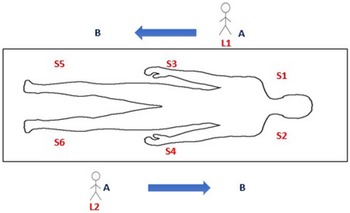
Figure 2 shows a schematic diagram of participant’s placement during testing. One team member (L1) performed full-chest compression CPR for 4 minutes on the manikin while the other team member (L2) read the “rainbow passage” or engaged in conversation. After 4 minutes, both participants rested for 1 minute and then changed position on their side of the bed from A to B to switch activities. Both sampling devices ran for 15 minutes at 28.3 L/min. In this experiment, 5 of the SKC Biostage single-stage impactors and 1 N-6 Andersen viable cascade impactor were positioned on each side of the bed at 3 locations from the head of the bed (30.48 cm, 91.44 cm, and 152.4 cm). The 6-stage Andersen impactor S1 was always located at the 30.48-cm location. The single-stage impactor S2 was also located at the 30.48-cm location. Single-stage impactors S3 and S4 were positioned 91.44 cm from the head of the bed. Single-stage impactors S5 and S6 were also positioned at 152.4 cm from the head of the bed (Fig. 2).
Surgical mask and respiratory protective devices evaluated.

Locations of sampling devices and subjects around the manikin simulated patient.Movement of subjects and placement of devices: One team member (L1) performs full chest compression CPR for 4 minutes on the manikin while the other team member (L2) reads the “rainbow passage” or engages in conversation. After 4 minutes, both participants rest for 1 minute then change positions on their side of the bed from A to B so that they can switch activities. The six-stage Andersen impactor (S1) was always located at the 30.48-cm location. One of the single-stage impactors (S2) was also located at the 30.48-cm location. Single-stage impactors, (S3) and (S4), were positioned at 91.44 cm from the head of the bed. The single-stage impactor, (S5) and (S6), was also positioned at 152.4 cm from the head of the bed.

Background concentration levels of airborne bacteria, serving as negative controls, were measured in each operating room before each test sequence began. Too few CFU were collected by the 6-stage impactor to be able to determine the size of the background bioaerosol in the operating rooms. Background CFU concentrations were then subtracted from the overall mean CFU concentrations measured while participants were wearing each respirator type. With 9 teams, 5 RPDs, 1 surgical mask, and 3 sample locations from the head of the bed (samplers at the same position were averaged), a total of 162 airborne samples were collected.
Statistical design and analyses
Assuming a global significance level of 5% and power of at least 80%, sample size was estimated to be 2 individuals per team (a total of 9 teams) with sample collection at 3 locations (162 in total). A block randomized design was used to develop a statistical model that did not violate the assumption of independence between observations, in which each group participant wore 1 of 5 respirators or the surgical mask once to avoid habituation bias or an order effect. Statistical analyses were performed using SPSS software (IBM, Armonk, NY) for a generalized linear model. Mean concentrations (CFU/m3) were estimated for the surgical mask and each respirator type (3M 9205+, 3M 8511, MSA, B-PAPR, V-PAPR) and at each distance from the head of the bed (ie, 30.48 cm, 91.44 cm, and 152.4 cm).
The resulting distribution of the collected individual concentration (CFU/m3) deviated from normality (Shapiro-Wilk P <.05) and took the form of a nonnegative, positively skewed, integer distribution, which is typical for airborne concentration data.
Using a regression analytical framework to estimate the mean concentration in CFU/m3 between respiratory type, the fit of a Poisson distribution was examined in relation to the normal distribution. Consistent with the visual appearance of the data and the results of the Shapiro-Wilk test, the Poisson distribution provided a better fit through the Akaike information criterion, the Bayesian information criterion, and log likelihood values. Multivariate Poisson regression was used to examine differences in mean CFU/m3 by categorical distances of 91.44 cm and 152.4 cm compared to 30.48 cm and to categorical respirator types 3M 9205+, 3M 8511, MSA, B-PAPR, and V-PAPR compared to the surgical mask.
The mean number of colony-forming units (CFU/m3) was calculated for each of the respirators and was aligned with each of the distances in the data set using a categorical variable. These categorical variables were entered into the regression models with the 30.48 cm distance and the surgical mask as the reference input. This procedure allowed for the comparison of the CFU/m3 at each of the other categorical levels, distances (91.44 cm and 152.4 cm), and respirator types (3M 9205+, 3M 8511, MSA, B-PAPR, V-PAPR) with the reference input of 30.48 cm and surgical mask, respectively. A post hoc Bonferroni pairwise comparison was entered in the context of Poisson regression to do side-by-side comparison to determine whether there was a significant difference between the CFU/m3 at the distance of 91.44 cm and 152.4 cm and between the surgical mask and all the other respirator types to determine their statistical significance. Wald χ2 P < .05 was considered statistically significant.
Results
The test of model effects (ie, omnibus test) showed a significant effect with distance and respirator types with P < .05. The concentration of CFU/m3 significantly varies as a function of distance and as a function of respirator type. The total mean concentrations at distances of 30.48 cm, 91.44 cm, and 152.4 cm were 10.4 CFU/m3, 8.9 CFU/m3, and 8.8 CFU/m3, respectively. The total mean concentrations for the surgical mask and respirator types were as follows: surgical mask (7.9 CFU/m3), 3M 9205+ (8.9 CFU/m3), 3M 8511 (11.7 CFU/m3), MSA (11.4 CFU/m3), B-PAPR (7.8 CFU/m3), and V-PAPR (8.9 CFU/m3).
The percentage difference, exp(B), at 91.44 cm was 0.86 and at the 152.4 cm was 0.85. Thus, 86% and 85% of CFU/m3 are expected at 91.44 cm and 152.4 cm, respectively, when compared to the distance of 30.48 cm, which indicate 14% and 15% average decreases at 91.44 cm and 152.4 cm, respectively, compared to 30.48 cm. Also, exp(B) for respirator type were as follows: 3M 9205+ (1.13), 3M 8511 (1.48), MSA (1.44), B-PAPR (0.99), and V-PAPR (1.13). Thus, compared to the surgical mask, an average increase of 13% in the CFU/m3 concentration is expected when using the 3M 9205+, an average increase of 48% in the CFU/m3 concentration when using the 3M 8511, an average increase of 44% in the CFU/m3 concentration when using the MSA EHMR, an average decrease of 1% in the CFU/m3 concentration when using the B-PAPR, and an average increase of 13% in the CFU/m3 concentration when using a V-PAPR.
As reflected in Table 2, all comparisons were significant for the effect of distance and for respirator types 3M 8511 FFR and MSA EHMR, both of which have exhalation valves. No significant difference was observed between the CFU/m3 concentration resulting from the use of the surgical mask and the 3M 9205+ FFR without an exhalation valve, the B-PAPR, and the V-PAPR respirators.
Mean CFU/m3 at Different Distances as Compared to 30.48 cm and for Different Respirator Types Compared to the Baseline (Surgical Mask)

Note. CFU, colony-forming units; PAPR, powered air-purifying respirator.
a For respirator bacterial source control comparison.
Table 3 shows post hoc Bonferroni-adjusted pairwise comparison between the respirator types that were not answered with the regression table using a reference input. We detected a significant difference in CFU/m3 concentrations between the 3M 9205+ FFR without an exhalation valve and the 3M 8511 FFR with an exhalation valve, but none for the other respirator types. The CFU/m3 concentration produced while wearing the 3M 8511 FFR with an exhalation valve was not significantly different from that for the MSA EHMR with an exhalation valve, but it was significantly higher than those for the 3M 9205+ FFR without an exhalation valve, the B-PAPR, and the V-PAPR. The concentration of airborne bacteria resulting from wearing the MSA EHMR with an exhalation valve was significantly higher than the concentration of airborne bacteria resulting from wearing the B-PAPR; however, it was not significantly different from all the other respirator types. The CFU/m3 concentration resulting from using the B-PAPR was significantly lower than the CFU/m3 concentration resulting from using the 3M 8511 FFR with an exhalation valve or the MSA EHMR; however, there was no significant difference in the CFU/m3 concentration resulting from using the 3M 9205+ FFR without an exhalation valve or the V-PAPR respirators. The CFU/m3 concentration resulting from using the V-PAPR was significantly lower than the CFU/m3 concentration resulting from using the 3M 8511 FFR with an exhalation valve; however, the CFU/m3 concentration resulting from using the V-PAPR was not significantly different than the CFU/m3 concentration resulting from using all the other respirator types.
Post Hoc Bonferroni Adjusted Pairwise Comparison of Mean CFU/m3 Concentration Between Respirator Types a

Note. CI, confidence interval; PAPR, powered air-purifying respirator.
a Pairwise comparisons of estimated marginal means based on the original scale of dependent variable rounded CFU.
b Means are not significantly different at the .05 level.
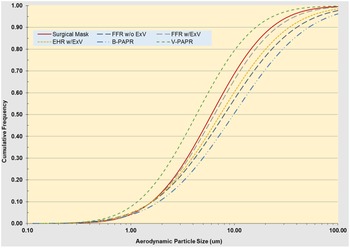
From the 9 teams, 9 six-stage viable cascade impactor samples were collected on each respirator type. These agar plates were handled and incubated as single-stage agar plates. The geometric means and geometric standard deviations calculated for each respirator type are given in Table 4, and the cumulative distributions from the exhaled breath resulting from wearing each respirator type are plotted in Figure 3.
Aerodynamic Diameter Geometric Mean and Geometric Standard Deviation for Exhaled Breath Aerosol While Wearing a Surgical Mask and Different Respirator Types

Note. EHMR, elastomeric half-mask respirator; PAPR, powered air-purifying respirator.
Exhaled particle distribution detected while doing CPR and talking while wearing different types of respirators.

Discussion
The volume of air exhaled by wearers of PAPRs is diluted by the air flow minute volume of the PAPR, which must be a minimum of 170 L/min for approval by the NIOSH. Based on this operational feature, it would be expected that the PAPR wearers would generate more exhalation-associated bacterial contamination than N95 FFR wearers. However, our results show that the airborne concentration of CFU/m3 resulting from using either of the tested PAPR models did not significantly differ from the airborne concentration of CFU/m3 resulting from using the N95 FFR without an exhalation valve or the typically used surgical mask. The data also revealed that the N95 FFR with an exhalation valve generates significantly more bacterial contamination of the simulated sterile field than the N95 FFR without an exhalation valve.
A positive control, measuring concentration (CFU/m3) from test participants not wearing any respirator, could not be done due to pandemic guidelines from the WVU Institutional Review Board that restrict the use of research participants without wearing a face covering. Other RPD models can also be tested to determine any correlation with the RPDs used in this study.
The cumulative distribution plots indicated that 10% of the size of the exhaled breath bioaerosol was below ∼1.6 µm with the surgical mask, the 3M9205+, the 3M 8511, and the MSA Advantage 200 elastomeric respirators. With the B-PAPR, it was ∼1.9 µm and for the V-PAPR it was 1.2 µm. The particle-size data suggest that while wearing one of the respirator types used in this study, very little exhaled breath bioaerosol from these devices is smaller than ∼1.5 µm (Fig. 3), which could be a lower limit of exhaled breath particle size. Notably, the particle-size data could also indicate that even when using active sampling for 2 test participants over a 15-minute test time, particles smaller than 1.5 µm were not in sufficient number or did not have time to settle sufficiently to be sampled with the active samplers.
A study that utilized the TSI 8130 filtration efficiency tester was conducted with a 2% sodium chloride solution in distilled water to look at outward leakage and found that testing 13 FFRs with an exhalation valve can have a wide range of particle penetration on exhalation between <1% and 55%. Reference Portnoff, Schall, Brannen, Suhon, Strickland and Meyers19 Our findings add to the science available by using human participants to evaluate different RPDs, to include PAPRs, EHMRs, and FFRs as source control for bacterial contamination in a sterile field or general healthcare settings. Results from both studies confirm that an exhalation valve on a FFR would not provide source control or prevent contamination.
A previous study showed findings similar to those of our study, indicating that PAPRs can be as effective at preventing bacterial contamination in an operating room sterile field as a surgical mask. Reference Howard, Lathrop and Powell13 Notably, although the methods varied, the results were similar. Using a PAPR has many advantages, including reusability, the absence of a fit-testing requirement, increased respiratory protection to the HCW compared to a surgical mask, and use by those who cannot be fit tested. Given the many advantages of a PAPR when respiratory protection is required, a PAPR could be a viable option to protect both patients and HCWs.
Acknowledgment
The authors recognize Lee Greenawald, Lee Portnoff, and Ed Fisher from the National Personal Protective Technology Laboratory for their thoughtful reviews of this document. The findings and conclusions in this report are those of the authors and do not necessarily represent the official position of the National Institute for Occupational Safety and Health (NIOSH), Centers for Disease Control and Prevention (CDC). Mention of any company or product does not constitute endorsement by the NIOSH, CDC.
Financial support
No financial support was provided relevant to this article.
Conflicts of interest
All authors report no conflicts of interest relevant to this article.