Introduction
Insomnia is a common psychiatric complaint among the elderly (Kim et al., Reference Kim2013; Lyketsos et al., Reference Lyketsos, Lopez, Jones, Fitzpatrick, Breitner and DeKosky2002). Many studies have reported cross-sectional (Lyketsos et al., Reference Lyketsos, Lopez, Jones, Fitzpatrick, Breitner and DeKosky2002; Geda et al., Reference Geda2008; Muangpaisan et al., Reference Muangpaisan, Intalapaporn and Assantachai2008) and prospective (Naismith et al., Reference Naismith, Rogers, Hickie, Mackenzie, Norrie and Lewis2010; Ramakers et al., Reference Ramakers, Visser, Aalten, Kester, Jolles and Verhey2010; Westerberg et al., Reference Westerberg2010, Reference Westerberg2012) associations between insomnia and cognitive dysfunctions, such as mild cognitive impairment (MCI) and dementia. Also, other studies have reported that the prevalence of depression was higher in patients with MCI or dementia than those without cognitive dysfunction (Lyketsos et al., Reference Lyketsos, Lopez, Jones, Fitzpatrick, Breitner and DeKosky2002; Geda et al., Reference Geda2008; Muangpaisan et al., Reference Muangpaisan, Intalapaporn and Assantachai2008).
To examine the insomnia among older adults with cognitive impairments, previous studies used the neuropsychiatric inventory (Lyketsos et al., Reference Lyketsos, Lopez, Jones, Fitzpatrick, Breitner and DeKosky2002; Geda et al., Reference Geda2008; Muangpaisan et al., Reference Muangpaisan, Intalapaporn and Assantachai2008), self-reporting scales such as the Pittsburgh Sleep Quality Inventory (Naismith et al., Reference Naismith, Rogers, Hickie, Mackenzie, Norrie and Lewis2010; Westerberg et al., Reference Westerberg2010), actiwatch (Naismith et al., Reference Naismith, Rogers, Hickie, Mackenzie, Norrie and Lewis2010; Westerberg et al., Reference Westerberg2010), and polysomnography (Westerberg et al., Reference Westerberg2012) for the assessment of their sleep disturbances. Not all studies used the diagnostic criteria for insomnia according to the International Classification for Sleep Disorders, second ed. (AASM, 2005) or the fourth edition of the Diagnostic and Statistical Manual of Mental Disorders (DSM-IV) (APA, 2000). Also, few previous studies examining on the link between insomnia and cognitive impairment concurrently consider the role of depression. For the comprehensive evaluation of insomnia, the effect of depression should be assessed.
Like insomnia, depression is also a common neuropsychiatric symptom in the elderly with dementia and MCI (Enache et al., Reference Enache, Winblad and Aarsland2011; Palmer et al., Reference Palmer, Berger, Monastero, Winblad, Bäckman and Fratiglioni2007). Depressed elderly people often perform poorly on tests of episodic memory, executive function, and visuospatial ability (Elderkin-Thompson et al., Reference Elderkin-Thompson, Boone, Hwang and Kumar2004). Individuals with dementia and comorbid depression could suffer from faster cognitive decline than those without depression (Rapp et al., Reference Rapp2011).
Previous studies showed the existence of an association between depression and insomnia in both normal older adults (Foley et al., Reference Foley, Monjan, Izmirlian, Hays and Blazer1999) and those with dementia (Guarnieri et al., Reference Guarnieri2012). This association could be bidirectional in the patients with dementia (Guarnieri et al., Reference Guarnieri2012). Some studies suggested that the high prevalence of insomnia could be due to the co-occurrence of depression (Aalten et al., Reference Aalten2007, Reference Aalten2008). Another study reported that insomnia was a predictive factor for depression (Arbus et al., Reference Arbus2011). So far, no studies have been conducted to investigate the association between depression and insomnia in patients with MCI.
Many studies have suggested that subjective memory impairment (SMI) or subjective memory complaint (SMC) might be a risk factor for cognitive decline in the future (Schmand et al., Reference Schmand, Jonker, Geerlings and Lindeboom1997; Geerlings et al., Reference Geerlings, Jonker, Bouter, Ader and Schmand1999; Haley et al., Reference Haley2009) or a pre-mild cognitive impairment (Jonker et al., Reference Jonker, Geerlings and Schmand2000; Reid and Maclullich, Reference Reid and Maclullich2006). SMC is defined as a complaint of memory problems and is a common problem among the elderly (Kim et al., Reference Kim, Stewart, Shin, Choi and Yoon2003). A slightly different concept, SMI is defined as complaints of memory problems in the absence of cognitive impairment that is diagnosable by a clinician or identifiable by formal testing (Chin et al., Reference Chin, Oh, Seo and Na2014; Peter et al., Reference Peter2014). Because the old adults with MCI or dementia frequently complain memory problems, they could be classified as SMC. Therefore, SMI is more useful than SMC. There have been a few studies that examined the relationship between SMI or SMC and insomnia. Only one cross-sectional study reported that poor sleep quality was associated with SMC (Kang et al., Reference Kang2015).
We hypothesized that the insomnia in older adults with SMI, MCI, and dementia would be affected by sociodemographic variables and depression. Thus, the principal objective of this study is to investigate the relationship between insomnia and cognitive dysfunctions, including SMI, MCI, and dementia, by considering depression in a community sample of elderly individuals in South Korea.
Methods
From June 2008 to December 2008, a nationwide epidemiological study was performed to estimate the prevalence of dementia and associated risk factors by considering a community sample of elderly individuals in South Korea aged 65 years and over.
A two-stage design based on cluster sampling was employed (Kim et al., Reference Kim2011). In the Phase I population survey, the Korean version of the Mini-Mental State Examination (MMSE-KC) (Lee et al., Reference Lee2002), sleep questionnaires, and the Korean version of the Geriatric Depression Scale-Short Form (SGDS-K) (Bae and Cho, Reference Bae and Cho2004) were applied to all survey participants. From a total of 8,199 elderly individuals in the 15 catchment areas, 3,074 elderly individuals from 5 areas were selected to evaluate sleep problems, considering to the population ratio of the rural to urban areas of South Korea. Among these, 1,958 completed face-to-face interviews, indicating a 63.7% response rate. All of the interviewers received a one-day training session that included didactic sessions concerning general interview skills and interview instruments, mock interviews, and role-playing exercises using the standard protocols and training materials. Throughout the training sessions, the trainers monitored the interviews and gave feedback to the interviewers (Kim et al., Reference Kim2011).
In the phase II diagnostic evaluation for dementia, the elderly individuals were classified according to their score on the MMSE-KC using age-, gender- and education-adjusted norms for Korean elders (Lee et al., Reference Lee2004). Those elderly patients whose score was less than 1.5 standard deviations (SDs) from the MMSE-KC norms were selected for the further measurement of their cognitive function. A total of 561 patients were invited to participate in the diagnostic evaluation for dementia and 353 of them completed the Korean version of the Consortium to Establish a Registry for Alzheimer's Disease Assessment Packet Clinical Assessment Battery (CERAD-K-C) and the Korean version of the Consortium to Establish a Registry for Alzheimer's Disease Assessment Packet Neuropsychological Assessment Battery (CERAD-K-N) (response rate = 62.9%) (Lee et al., Reference Lee2004). The overall response rate was 40.1%. The sociodemographic variables (age, gender, level of education, living arrangement, smoking behavior, and alcohol consumption) of the non-respondents were not significantly different from those of the respondents (all p-values >0.05). Also, there was no difference in the mean MMSE score between the non-respondents and respondents (18.45 for non-respondents vs. 19.17 for respondents, p = 0.139). Brain computed tomography or magnetic resonance imaging (T1-weighted, T2-weighted, and FLAIR) and laboratory tests were conducted for the patients who were diagnosed as having dementia.
This study was approved by the institutional review board of Seoul National University College of Medicine. We informed all of the participants or their family members of this study's purpose and methods, and all of them voluntarily signed an informed consent form (Kim et al., Reference Kim2011).
Assessment of subjective memory impairment, mild cognitive impairment, and dementia
Dementia was defined according to the DSM-IV diagnostic criteria (APA, 2000). Because the presence of dementia reduced the reliability and validity of self-reported depression (Ott and Fogel, Reference Ott and Fogel1992; Snow et al., Reference Snow2005), the 10 patients who scored more than 2 on the clinical dementia rating scale were excluded from this analysis.
MCI was diagnosed according to the consensus criteria from the International Working Group on MCI (Petersen, Reference Petersen2004). The threshold of the objective cognitive impairment was set at −1.5 SD from the age-, gender-, and education-adjusted norms of the CERAD-K-N for Korean elders (Lee et al., Reference Lee2004) and intact functional activity was defined as having 1 or less on the Blessed Dementia Scale included in the CERAD-K-C (Kim et al., Reference Kim2011).
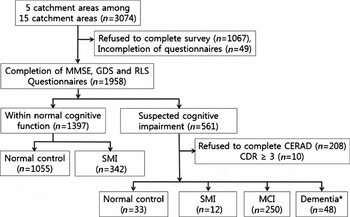
SMI was assessed from the response to the tenth question of the SGDS-K “DO YOU FEEL YOU HAVE MORE PROBLEMS WITH MEMORY THAN OTHER ELDERLY?” The patients with SMI were defined as those answering “YES” to the tenth question of the SGDS-K among the patients who were not classified as having MCI or dementia. Figure 1 shows the recruitment procedure and the distribution of the patients with SMI, MCI, and dementia.
Recruitment procedure. *Mild to moderate dementia (CDR <3).

Assessment of sleep complaints and insomnia
To assess the quality of sleep, we used a questionnaire from the Korean Epidemiologic Catchment Area Study Replication (KECA-R) (Kim et al., Reference Kim2012). The questions about insomnia consisted of difficulty in initiating sleep, difficulty in maintaining sleep, early morning awakening, non-restorative sleep, and daytime consequences (Kim et al., Reference Kim2012, Reference Kim2013). We defined the presence of difficulty in initiating sleep, difficulty in maintaining sleep, early morning awakening, or non-restorative sleep as three or more episodes per week of the symptom in the last month. We defined insomnia as the presence of at least one of the four sleep complaints accompanied by moderate to severe daytime consequences (Kim et al., Reference Kim2012, Reference Kim2013).
Sociodemographic variables and depression
We assessed the sociodemographic variables, focusing on the age, gender, level of education (years), living arrangement (married/in a common-law relationship or single/a widow(er)/separated/divorce), smoking behavior in the last year (packs/day), and alcohol consumption within the last year. One drink was equivalent to a glass of wine, half a pint of beer, or a single measure of spirits (Kim et al., Reference Kim2013). We defined excessive alcohol use as at least three glasses of alcohol per day (Ohayon and Hong, Reference Ohayon and Hong2002).
For the evaluation of depression, the SGDS-K was used. Originally, the GDS is composed of 30 items, yet we used 15 items of the SGDS-K, which has been validated by Bae and Cho (Reference Bae and Cho2004). A cut-off score of 8 was used for major depressive disorder (sensitivity 85.5 and specificity 69.6%). There is no item on sleep symptoms in the SGDS-K.
Statistical analysis
A χ 2 test was conducted to compare sociodemographic variables for the cognitive dysfunctional status (normal control, SMI, MCI, and dementia). Hierarchical multiple logistic regression models were used to investigate the relationships between the insomnia and cognitive dysfunction. The dependent variables were the four sleep complaints and insomnia. The predictor variables were the cognitive status (SMI, MCI, and dementia), age, gender, education, marital status, living arrangements, alcohol consumption, and smoking behavior. The potential confounders were controlled in the following steps: Model 1, none; Model 2, age, gender, education, marital status, living arrangements, alcohol consumption, and smoking behavior; and Model 3, the presence of major depressive disorder in addition to the variables in Model 2.
We excluded missing data from the analyses. We considered a p-value lower than 0.05 as significant. All analyses employed SPSS 19.0 (SPSS Inc., Chicago, IL).
Results
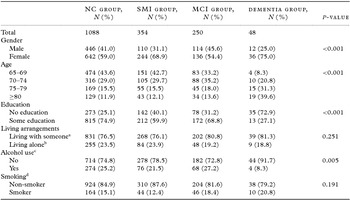
Among the 1,958 people who completed the questionnaires, the 208 patients who refused to be examined using the CERAD and the 10 patients who scored more than 2 on the clinical dementia rating scale were excluded from analysis. Of the remaining 1,740 participants, 354 (20.2%), 250 (14.4%) and 48 (2.8%) were found to have SMI, MCI, and dementia, respectively (Figure 1). Table 1 shows the data for the sociodemographic variables which included gender, age, education, living arrangements, alcohol use, and smoking for each cognitive dysfunction group.
Sociodemographic variables of the patients

NC: normal comparison, SMC: subjective memory complaints, SMI: subject memory impairment, MCI: mild cognitive impairment.
a Married or in a common-law relationship.
b Single, a widow(er), separated, or divorced.
c At least three glasses of alcohol per day in the last year.
d In the last year.
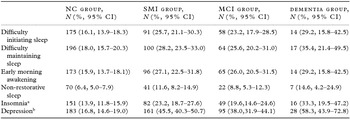
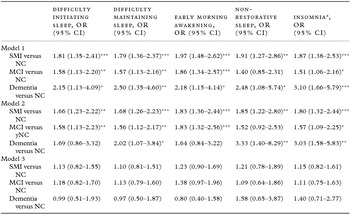
The prevalence of insomnia in the normal comparison patients and the patients with SMI, MCI, and dementia were found to be 13.9% (95% Confidence Interval (CI), 11.8–15.9), 23.2% (95% CI, 18.7–27.6), 19.6% (95% CI, 14.6–24.6), and 33.3% (95% CI, 19.5–47.2), respectively. More than half of the patients with dementia were identified as having a depressive symptomatology (58.3%). Also, 45.5% of the patients with SMI and 38.0% of those with MCI had depression (Table 2). The relationship between insomnia and subjective memory impairment/cognitive dysfunction was examined (Table 3). Before adjusting for any of the sociodemographic variables or depression, the patients with SMI or dementia were significantly more likely to report the four sleep complaints and insomnia, as compared to the normal comparison group, and the patients with MCI were significantly more likely to report difficulty in initiating sleep, difficulty in maintaining sleep, early morning awakening, and insomnia, compared to the normal comparison group. After adjusting for age, gender, education, marital status, alcohol consumption, and smoking behavior, the patients with SMI were significantly more likely to complain of the four sleep complaints and insomnia, as compared to the normal comparison group. The patients with MCI were significantly more likely to complain of difficulty in initiating sleep, difficulty in maintaining sleep, early morning awakening, and insomnia, and those with dementia were significantly more likely to complain of difficulty in maintaining sleep, non-restorative sleep, and insomnia, as compared to the normal comparison group, after adjusting for the sociodemographic variables. After adjusting for the sociodemographic variables and the presence of major depressive disorder, however, the associations between the sleep complaints and insomnia and the patients with SMI, MCI, and dementia, as compared to the control group, were no longer significant.
The prevalence of sleep complaints, insomnia, and depression

NC: normal comparison, SMI: subject memory impairment, MCI: mild cognitive impairment, CI: confidence interval.
a The presence of insomnia was defined as the presence of at least one of the four sleep complaints (DIS, DMS, EMA, and NRS) accompanied by moderate to severe daytime consequences.
b The cut-off value for the SGDS-K was 8.
Relationships between sleep complaints and subjective memory impairment/cognitive dysfunction

NC: normal comparison, SMI: subject memory impairment, MCI: mild cognitive impairment, OR: odds ratio, CI: confidence interval.
Model 1 was unadjusted.
Model 2 was adjusted for age, gender, education, marital status, alcohol consumption, and smoking behavior.
Model 3 was adjusted for the presence of depression by SGDS-K and all of the variables in Model 2. The cut-off value for the SGDS-K was 8.
a The presence of insomnia was defined as the presence of at least one of the four sleep complaints (DIS, DMS, EMA, and NRS) accompanied by moderate to severe daytime consequences.
*p-value of the odds ratio <0.05.
**p-value of the odds ratio <0.01.
***p-value of the odds ratio <0.001.
Discussion
In this study, about 20% of the patients with SMI or MCI and about 30% of those with dementia were identified as having insomnia. Previous studies confirmed the association of SMC, MCI, and dementia with insomnia (Geda et al., Reference Geda2008; Muangpaisan et al., Reference Muangpaisan, Intalapaporn and Assantachai2008; Kang et al., Reference Kang2015). Lyketsos et al. (Reference Lyketsos, Lopez, Jones, Fitzpatrick, Breitner and DeKosky2002) reported that 13.8% of the patients with MCI and 27.4% of those with dementia complained of insomnia, whereas 20% of those with MCI and 32% of those with dementia complained of depression. In this study, the prevalence of insomnia and depression in the patients with MCI or dementia was slightly higher than that reported by Lyketsos et al. The higher rate of depression in the Korean elderly than that in other countries might be related to the increased prevalence of insomnia (Park et al., Reference Park, Min, Min, Lee, Lee and Song2007).
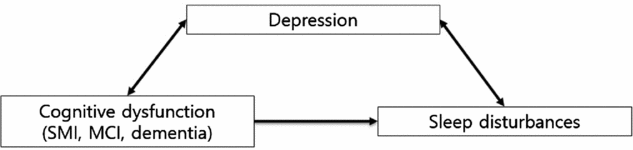
The principal findings of this community study were that insomnia was related to SMI, MCI, and dementia; however, after adjusting for the presence of depression, none of these relationships remained. Guarnieri et al. (Reference Guarnieri2012) reported the existence of an association between depressive symptoms and insomnia in the elderly with dementia. In Europe, according to a previous study, the high frequency of insomnia reported in patients with dementia could be due to the neuropathological mechanisms of dementia or to the co-existence of depression (Aalten et al., Reference Aalten2007, Reference Aalten2008). In the present study, the results suggested that depression might have affect as important factor on the insomnia of patients with SMI or MCI, as in the case of the insomnia of the patients with dementia (Figure 2).
Proposed the role of depression in the relationship between insomnia and cognitive dysfunctional status in the elderly individuals.

In a previous study, the insomnia in patients with cognitive dysfunction was explained by damage to the neuronal pathway, environmental factors, and other factors. The biological origins of insomnia in patients with cognitive dysfunction were explained by the functional disconnection between the hypothalamic suprachiasmatic nucleus and pineal gland (Ohashi et al., Reference Ohashi, Okamoto, Uchida, Iyo, Mori and Morita1999), neurodegenerative change of the subcortical regions, such as the basal forebrain nuclei, raphe nuclei, nigrostriatal, and pallidostriatal pathway (Vitiello et al., Reference Vitiello, Poceta and Prinz1991; Martin et al., Reference Martin, Marler, Shochat and Ancoli-Israel2000), and genetic risk factors such as the APOe4 allele (Yesavage et al., Reference Yesavage2004). The environmental factors included bedtime rituals and habit, amount of day-time activity, and night time noise (Camargos et al., Reference Camargos2011). Complicating neuropsychiatric disorders such as depression (Foley et al., Reference Foley, Monjan, Izmirlian, Hays and Blazer1999), physical illness such as heart disease and respiratory disturbance (Quan et al., Reference Quan2005), and concurrent medication such as long term benzodiazepine (Beland et al., Reference Beland2011) and sedative use (Martin et al., Reference Martin, Sforza, Barthelemy, Thomas-Anterion and Roche2014) were also potential risk factors. In the present study, after adjusting for the severity of depression, the relationships between SMI, MCI, or dementia and insomnia disappeared. This result suggests that depression may be a more important factor leading to insomnia among various factors in the elderly with cognitive dysfunction. To understand the etiology of insomnia in the elderly with cognitive dysfunction, their level of depression should be evaluated.
In South Korea, the prevalence of SMI has not been investigated; however, the prevalence of SMC has been widely reported. The prevalence of SMI (20.2%) in this study was similar to that of SMC (21.3%) reported by another study in South Korea (Ryu et al., Reference Ryu2007), but higher than that reported in other countries (6.3–10.8%) (Geerlings et al., Reference Geerlings, Jonker, Bouter, Ader and Schmand1999; Turvey et al., Reference Turvey, Schultz, Arndt, Wallace and Herzog2000; Jungwirth et al., Reference Jungwirth, Fischer, Weissgram, Kirchmeyr, Bauer and Tragl2004). Because previous studies reported that SMI was closely associated with depression (Kim et al., Reference Kim, Stewart, Shin, Choi and Yoon2003; Zandi, Reference Zandi2004; Balash et al., Reference Balash, Mordechovich, Shabtai, Merims and Giladi2010), the higher rate of depression in the Korean elderly than that in other countries might explain the higher prevalence of SMI in South Korea than that in other countries (Park et al., Reference Park2010).
There are several limitations to this study. First, the overall response rate for the phase 1 and phase 2 participants was low. However, there was no difference in the sociodemographic variables or mean MMSE score between the non-respondents and respondents. Second, we could not examine the causal relationship between insomnia and cognitive functional status since this study was a cross-sectional one. Third, the assessments of SMI were achieved using the 10th question of the SGDS-K, which has not yet been validated. Fourth, we did not examine other variables of cognitive dysfunction, such as biological factors including apolipoprotein E levels (Laws et al., Reference Laws2002), and other environmental factors. Finally, because the patients with dementia who had a score of more than 2 on the clinical dementia rating scale were excluded and the subtype of dementia was not classified, the patients with dementia in this study do not represent all types of dementia.
Insomnia was a very common complaint in the elderly with SMI, MCI, and dementia. The association between insomnia and cognitive function was no longer significant after adjusting for depression. This finding suggests that depression might play an important factor in the relationship between insomnia and cognitive dysfunctional status in the elderly. Further investigations will be needed focusing on the causality of the relationship between insomnia and cognitive dysfunction. Also, more studies are needed to examine how the treatment of depression could affect insomnia in the elderly with cognitive dysfunction.
Conflict of interests
The authors declare that they have no competing interests.
Description of author's roles
W. H. Kim and J. N. Bae designed the study, analyzed the data and wrote the paper. M. J. Cho supervised the data collection and analysis. J. H. Kim, B. S. Kim, S. M. Chang, and D. W. Lee collected the data and assisted with the writing of the paper.
Acknowledgments
This work was supported by a research grant from the Ministry of Health, Welfare and Family Affairs of South Korea (Grant No. 07-2008-0270).