Flipping through the recently published collection of R. K. Laxman's cartoons chronicling Indian democracy (titled Brushing Up the Years: A Cartoonist's History of India 1947–2004, 2005), I was intrigued by the dynamic nature of the material collected together. It is indispensable as a teaching tool that displays the many vicissitudes of Indian democracy over the years. But also, the active nature of actual democratic life pulsated through each and every framed visual satiric political presentation. What is it about his visual melancholic humor that seems to question democratic functioning at its kernel? There is nothing funny/trivial about democratic governance, but by drawing in the comical aspect of a functioning democracy, Laxman's cartoons draw out a democracy alive to its inherent possibilities; a democracy laughing at itself for the aberrations from its idyllic potential.
Laxman is considered by many to be India's most talented cartoonist. From 1947, for over 50 years, Laxman's cartoons have appeared everyday in the Times of India (one of India's leading daily English-language newspapers).1
Except for an interval during the Emergency (1975–1977) and the brief days that he has been on holiday.
“The Times of India is not only India's largest selling English general daily but also the leading English general daily broadsheet in the world. It attracts a daily circulation level of about 22 lakh copies. It is the largest selling English daily between Tokyo and Paris.” http://syndication.indiatimes.com/articlelist/12972317.cms.
Laxman's cartoons have a characteristic trademark: the figure of the generic “Common Man.” The Common Man has both a utilitarian and a symbolic function in Laxman's cartoons. He saves the cartoonist from having to draw large masses of people representative of India's diverse population with differences in dress and appearance (2005, ix). This serves as an important timesaver for a cartoonist straining to meet deadlines. In his early cartoons, Laxman had to draw quite a crowd to denote the common citizen representative of India's heterogeneous population. Gradually, he began to reduce the number. Finally there was only one left: “He was bald and bespectacled … He had a permanently bewildered look and was dressed in a dhoti and a checked coat. This man finally minimized my deadline agonies and took over the strenuous task of representing the mute millions of the country” (Laxman 2000a, 339).
Laxman's Common Man is “no mere cartoon figure of fun, but Everyman, the soul of Modern India” (Laxman quoted in Siegel 1987, 429). This “soul of Modern India” remains a silent witness to all the failings and foibles of post-independence Indian politics. He witnesses the difference between the promises made at the time of independence and the confusion that later ensued. After the British left, the leaders of newly independent India set out to draft a constitution that would ensure liberty, equality, and fraternity for its vast populace. The design was meticulous and the scheme grandiose. But things seldom work the way they are planned, a disconnect that adds material to the cartoonist's repertoire (Laxman 2005a, vii).3
The figure of the Common Man has become dear to the nation in a curious way. He has endeared himself to both those whom he represents and to those whose political acrobatics he satirizes. In 2002, the Indian president unveiled an eight-feet-tall bronze statue of the Common Man in Pune (a city in India near Mumbai). The Common Man also adorned a postage stamp issued by the government of India to mark the 150th anniversary of the Times of India (Laxman 2000a, 318). Ironically, the Common Man has also become a brand name in India, as the brand ambassador of Air Deccan.
Besides the presence of the Common Man, Laxman's cartoons have other stylistic features that singularly distinguish them from those of his contemporaries. Laxman never uses gods, demons, or folk tales to illustrate a political event (2000a, 318). No supernatural or fantastical elements enter into his cartoons. Everyday life with its familiar and easily recognizable features forms the basis of his cartoons. In Laxman's words (2000a, 318), “I followed the standard rules of perspective, drapery and anatomy; when I caricatured a personality I exercised controlled distortion.” Laxman's style is subtle and controlled, his caricatures never outlandishly ludicrous. His cartoons emphasize that the “art of ideal caricature is to bring out the essence of personality through credible exaggeration” (2000a, 334). His craftsmanship is amply demonstrated in the sophisticated maneuvering of details that magnify the simple elegance of his cartoons.
Laxman distinguishes his draftsmanship from two different camps/styles of cartoonists: those who don't care about draftsmanship and simply dash off a sketch, and those whose draftsmanship is so elaborate and ornate that it acts as an impediment in communicating the central idea of a cartoon (2000a, 393). He is equally dismissive of cartoons produced with the help of computers, which eliminate the “labor of drawing” and therefore produce images that “looked stereotypical and utterly soulless!” (2000a, 393). To Laxman, besides the quality of draftsmanship, the humorous amplification of meaning constitutes the “soul” of a visual message: “the sharp satirical perspective and eye for absurdity which form the soul of a political cartoon” (2000a, 311). It is through his use of satire that Laxman “draws out” the essence of a seemingly everyday and routine situation. A critical component of his cartoons remains his satirical perspective and “healthy irreverence” (2000a, 318). He does not trivialize life with his cartoons, but emphasizes the need to laugh at it to realize all of its many dimensions. Man silently accepts his life's predicaments and goes about his routine activities observing the established code of conduct. He accepts the status quo/existing order, “but he is subconsciously in revolt against a system composed of never-ending road repairs, noise-loving neighbors and overcrowded trains which he cannot alter and reconstruct nearer his heart's desire” (Laxman 1967, Preface). Laughter provides a moment of reconciliation, not in terms of desensitizing a person or dampening the different nuances of a situation, but contrarily, humor illuminates a situation's multifacetedness.
However, how do we decipher the significance of Laxman's cartoons and analyze the politics in the cartoons? What is it about his cartoons that throw a different light on democratic functioning? So far we have examined the general features of Laxman's cartoons, their distinguishing characteristics. I propose a method to study Laxman's cartoons through an examination of its use of image and text, the performative dimension, and its storytelling, that seeks to draw out the politics in his cartoons. There can be no strict demarcation between the three and the distinctions are solely for analytical utility. I seek to analyze both the stylistic contrivances of the cartoonist and their political import, both the drawing in and the drawing out. My emphasis will be in understanding the cartoons' democratic personae, or lack thereof. Do they satirize democratic functioning/life to show that democracy is but an ineffectual mode of operation, thereby questioning its reason for existence? Or do the cartoons give us a rare glimpse of democratic “life” that serious theoretical endeavors often bypass?
Image and Text
The images in Laxman's cartoons provide multidimensionality and portray real-life representations that a simple reading of the text would not. Laxman's cartoons are minutely detailed in image representation, the text seldom more than a line of words and stringently impersonal. On the other hand, the visual graphics offer a wealth of details that are easily identifiable and mischievously personal in their Indian-ness. The presence of the Common Man adds this meaning to the graphic presentations: the Common Man could be each and every Indian.
In the cartoon shown in Figure 1, drawn to satirize the economic mood at the dawn of the new millennium, the Common Man gazes at a budget painting being drawn. The finance minister paints with great gusto, proclaiming: “There you are—the dawn of a new era!” The painting is bright and glorious with the sun epitomizing the budget and the promises made through it. Behind the canvas, however, poverty-ridden people peer quizzically on. The Common Man looks at both, at the differences between the promises and harsh reality (Laxman 2005, 268). The text remains on the level of appearance, and purposefully so. The images probe further. Here the text is an extension of the image. The text is clear and delivered as a matter of fact in an optimistic tone. The Common Man looks on with a bewildered face. He doesn't speak. No text enumerates his response. His expression says it all. The image of the Common Man is as easily recognizable and as quintessentially Indian as the reality behind the curtain of optimism. In the play with both lies the moment of satirical perception. Image and text, the personal and the impersonal, optimism and cynicism are involved in a symbiotic play to assess the real merits of the situation. The chasm between appearance and reality, text and image bring out the efficacy of the satiric message, its mischievous provocativeness.

In Laxman (2005, 268). Reprinted with permission.
Performative Dimension
The performative aspect of the cartoons emphasizes the active nature of the comic frame, satires' unique transgressive capacity to be more than a simple political statement. Analyzing the performative aspects of a cartoon necessarily entails taking into account both the drawing itself and the drawing out. More importantly, it illuminates the congruence between the two and the active nature of their conspiracy. By the performative aspect of the drawing itself, I mean the nature of the material/issues drawn into the cartoons, the inspiration behind and on the cartoonist's canvas. The performative aspect of the drawing out refers to the effect of the cartoon and an assessment of its capacity to enthuse performance of any kind. Such a categorization (like most other categorizations) is necessarily arbitrary. But it serves an important function here to underline both the artist's impulse and matters which often slip out of the artist's control.
To some, Laxman isn't simply a cartoonist but “a profound thinker, a social reformer, a political scientist, a critic of errant politicians and so on” (Laxman 2000a, 343). As Laxman writes (2000a, 343), “I received letters complaining about postal delays, telephones, the sloppiness of municipal authorities, inflated electric bills, bribes in school admissions. One such letter pleaded, ‘Please halt the 47 Down train at XXX for a few minutes to save me the bother of waiting four hours for the next one to go home from the office.’ ” Laxman satirizes these expectations, hedged in by satire's own restrictions. In addition to being unable to halt the 47 Down train, Laxman's cartoons don't spur social revolution. Critiques question the performative ability of his visual political messages. OV Vijayan points out, “He doesn't take a debate forward” (Bhandari 2004, 2). Likewise, others like Ravi Shankar have opined that “There is no political comment, only political statement” (Bhandari 2004, 2). Laxman himself writes (quoted in Siegel 1987, 66):
I have been working away at these cartoons for over a quarter of a century now, and I do not think that I can show a single instance of changing the mind of a politician from taking a mad course…. If I had lashed at granite with a feather with the single-minded zeal as I have bestowed on my work, by now I would, perhaps, have been able to show some faint feather marks on the rock … [but] not a trace of a dent have my cartoons caused in any sphere of human activity, whether social, economic or political.
Thus to many these cartoons don't “do” anything. They don't affect social revolution or reform. Why is it that the Common Man never speaks? Is satire just a moment of escape, of relief because nothing can be done? But do these critiques undermine the importance of “seeing”? Is “seeing” less action-oriented, less performative? Have we routinized democratic protest actions and thereby ignored an important component of democratic functioning? Isn't this “seeing” a mode of exploration, democracy's realization of itself?
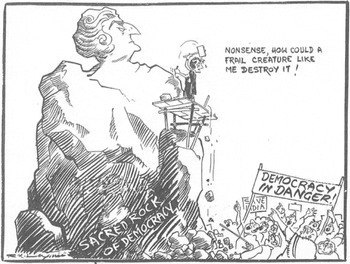
The cartoon in Figure 2 shows Indira Gandhi chiseling her own image on the “sacred rock of democracy.” Indira Gandhi, India's prime minister from 1966–1977 and 1980–1984 governed the country with an iron hand. The opposition maintained that she was destroying democracy in India. The cartoon above responds to that charge. While she is seen fashioning democracy in her own image, she still denies the charges levied, retorting, “Nonsense, how could a frail creature like me destroy it!” Satire mocks this architecture of democracy. It helps us “see” the pith of democracy's sculpture, both the one being crafted and the ideal. Its protest is of a very different nature from the one seen in Figure 2 holding banners and democratically protesting the danger to democracy. The cartoon simply shows. It helps us “see.” It performs through caricatures and exaggerations. Through this performance it showcases the performance of democracy: its inherent contradictions. This performance is indispensable to illuminate the ideal and deviations from it. In this is its value where satire (almost shame-facedly) hides its hope, its vision of the ideal, and thus propels an incessant quest, a ceaseless questioning.

In Laxman (2005, 40). Reprinted with permission.
To me, humor is not a closure. By enabling a democracy to laugh at itself, it demonstrates that the journey is not yet over. I agree with Lee Siegel (1987, 68) when he writes, “Though satire points out vice and folly, its justification on the grounds that it changes social conditions … is a rationalization of its most primary aim which is, quite simply, to be funny.” I don't ignore the fact that often satire is for satire's sake, simply to be humorous. However, while the performative aspect of the drawing itself would justify the above conclusion and ridicule the arbitrary imposition of a democratic personae, the drawing out gives permission to move to a different plane altogether. The drawing out performs by showcasing the lack of performance of both the rulers and the ruled, that which inspired the drawing itself but soon somersaulted out of the de-limited orbit.
Storytelling
Laxman's cartoons have only a single line of text, but that single line has a distinct story to tell. The cartoons are cut-off at critical moments, a sudden freezing of the frame with something before and something after it, the before, the present, and the after being the storytelling, connecting critical understanding to experience. Even though cartoons appear in isolated frames, they tell stories, they have a history. Laxman's cartoons provide a history of modern India not only in terms of its chronological breadth but also in showcasing the history of its democracy; its grappling with poverty, unemployment, ineffective policy decisions, etc. Most important, it showcases the forward movement of democracy through all crises, and in doing so, Laxman portrays its hopefulness.
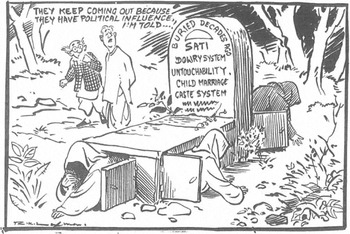
How is a cartoon with ghosts crawling out from tombstones deemed “hopeful”? Don't ghosts signify a closure, an end, and does not the melancholic humor in this cartoon similarly signify the end of hope? The cartoon in Figure 3 epitomizes events in the late 1980s when Roop Kanwar was burnt alive on her husband's pyre in Rajasthan. Very few politicians openly condemned the re-birth of the sati system (Laxman 2005, 136). This incident mocked all of the glorious principles in the Constitution of India, which was drawn up in 1947 with promises to propel India toward a bright era of modern progress. Forty years after independence were the “midnight's children” turning into midnight ghosts instead?4
See Salman Rushdie, Midnight's Children (New York: A. A. Knopf., 1981).

In Laxman (2005, 136). Reprinted with permission.
Satire revels in story-telling. The tombstone reads “Buried Decades Ago” but the ghosts creep out “Because they have political influence, I'm told.” This is a story. But not all of the stories have been told. Multiple stories layer the cartoon in fertile complexity. The congruence of these multiple stories creates both amusement and anguish. We try to discern the story behind the Common Man's anxious expression and silence, the story of the ghosts' death and subsequent appearance. None of the stories can be strictly demarcated. The ghosts blur all distinctions between the living and dead, not only of persons but of issues as well. Satire “haunts” this political predicament. Its storytelling seeks to exorcise the apparitions. The cartoons don't showcase a happy ending, but are instead grim and gloomy. The anxiety stems from prospects that could be otherwise. This is not bereft of hope. In this vision, in the capacity to (story) tell lies hope.
Conclusion
Drawn especially for the collected volume titled Brushing Up the Years: A Cartoonist's History of India 1947–2004 (2005), the cartoon shown in Figure 4 is Laxman's comment on his political art and his subsequent showcasing of politics as art. There is chaos everywhere. The dynamic nature of the comic frame satirizes this performance of democracy. However, the story is far from complete. The ink is not dry. The cartoonist's brush draws out the multihued picture by drawing in with the paint brush that still drips paint. The Common Man sits apart and sees all. His position enables a panoramic view, and he gazes bewildered at the political pandemonium. He perceives and discerns. Satire humorizes the degenerate real, the political chaos. By setting itself apart, satire provides a perceptive glimpse at the abyss between the ideal and the degenerate real. The contradictions stubbornly guard against any closure. Democracy waits in anticipation to be constantly re-made. Through this cartooning of democracy, Laxman draws in and draws out the complex nature of democracy's political functioning. This critique is not a negation of democracy but a probe at its embedded possibilities, its capacity to be otherwise. By cartooning Indian democracy, Laxman Brushes Up its potential.

In Laxman (2005). Reprinted with permission.