I. INTRODUCTION
Complex oxide ceramics with high-performance electrical properties are in demand for a range of electronic applications. Among them, BaTiO3 has received much attention as a multilayer ceramic capacitor, a nonlinear resistor, and a varactor (voltage-controlled capacitors) due to its high permittivity and nonlinear ferroelectric response.Reference Henning, Klee and Waser1–Reference Bhalla, Guo and Roy2 A variety of deposition techniques have been used for the production of BaTiO3 thin films, such as metal-organic chemical vapor deposition,Reference Kwak, Zhang, Boyd, Erbil and Wilkens3 sputtering,Reference Chu, Mahalingam, Liu and Wang4 pulsed laser deposition,Reference Kullmer5 electrochemical deposition,Reference Wu and Lu6 sol–gel,Reference Sharma and Sarma7 spray-pyrolysis,Reference Golego, Studenikin and Cocivera8 and chemical solution deposition.Reference Ihlefeld, Laughlin, H-Lowery, Borland and Maria9 However, most of these techniques require exposure to high temperatures for complete crystallization and organic removal. In some cases, this high-temperature annealing can promote inhomogeneous film composition, porosity, cracking, or peeling of the deposited films.Reference Chan and Lu10 Further, it presents severe limitations for the integration of ferroelectrics on printed wiring boards or other organic substrates.Reference Raj, Balaraman, Abothu, Yoon, Kang and Tummala11
Hydrothermal processing has evolved over the last three decades and provides the opportunity of direct synthesis of crystalline structures at significantly lower temperaturesReference Ishizawa, Banno, Hayashi, Yoo and Yoshimura12–Reference Hou, Wu and Vilarinho16 in strong alkaline solutions. Films of BaTiO3 were precipitated on Ti-coated polyphenylene sulfide,Reference Ishizawa, Banno, Hayashi, Yoo and Yoshimura12 silicon,Reference Chan and Lu10, Reference Bacsa, Dougherty and Pilione17–Reference Seo and Kong24 platinized silicon,Reference Hoffmann, Doll and Fuenzalida25 printed circuit board,Reference Tan, Goh, Chi, Lu and Lok26 FR4 Cu-clad laminates,Reference Raj, Balaraman, Abothu, Yoon, Kang and Tummala11 kapton tape,Reference Hou, Wu and Vilarinho16 and pure and anodized Ti-foils or platesReference Kajiyoshi, Ishizawa and Yoshimura27–Reference Lisoni, Piera, Sánchez, Soto and Fuenzalida30 by utilizing hydrothermal techniques. In all studies, planar Ti films were deposited and utilized as a precursor. According to those studies, the formation of BaTiO3 films by hydrothermal process depends on a dissolution–precipitation reaction.Reference Xu, Zheng, Xin, Lin and Okuyama22, Reference Zhu, Akbar, Asiaie and Dutta29, Reference Xu, Zheng, Lin and Okuyama31, Reference Xu, Zhai and Yao32 This mechanism requires dissolution of Ti from the template into the solution and then precipitation of BaTiO3 when the supersaturating value is reached. Nucleation and growth of a BaTiO3 layer on top of the template inhibits further dissolution of Ti and limits the final thickness of the ceramic layer.Reference Xu, Zheng, Xin, Lin and Okuyama22 In addition, the compositions of the films are not homogenous, as there is no clear interface separating the template and the film,Reference Wei33, Reference Tan and Goh34 which brings difficulties when interpreting electrical measurements. It has been demonstrated experimentally that extending the reaction time, increasing the concentration of Ba(OH)2, or increasing the temperature did not increase the precipitating layer thickness without limit or consume the entire Ti layer.Reference Shi, Cho, Jang, Jeong and Kim19 Further, if the reactive Ti template is thinned to a level that enables full consumption, complete dissolution will occur and a continuous BaTiO3 film will not deposit on the parent substrate. Thus, complete conversion of the precursor layer to the ceramic film under consideration is an important concern.
It is well known that the hydrothermal processing produces a defective structure, such as proton incorporation due to hydroxyls entrapped in the lattice and on the surface of the film.Reference Slamovich and Aksay13, Reference Chien, Xu, Kim, Sachleben, Speck and Lange14, Reference Fuenzalida, Pilleux and Eisele23, Reference Lisoni, Piera, Sánchez, Soto and Fuenzalida30, Reference McCormick and Slamovich35 As expected, protons have an adverse effect on the dielectric properties of BaTiO3 thin films.Reference Lange and Goh36 High-dielectric constant values observed in as-precipitated films are in many cases attributed to additional polarization mechanisms that operate at radio frequencies, with relaxation times related to hydroxyl group contributions.Reference McCormick and Slamovich35 Similarly, high dielectric loss of the films depends on the time lag between the hydroxyl dipole switching rate and migration losses due to proton hopping.Reference Tan, Goh, Chi, Lu and Lok26 A postannealing treatment is generally accepted to be useful for eliminating point and line defects in those films.Reference Hou, Wu and Vilarinho16, Reference McCormick and Slamovich35, Reference Lange and Goh36 It is reported that annealing under nitrogen below 250 °C could remove bonded H2O and OH− only from the film surfaces.Reference Chien, Xu, Kim, Sachleben, Speck and Lange14 The need of higher temperatures was reported to remove all the lattice hydroxyls.Reference McCormick and Slamovich35 Incorporating acceptor dopants during synthesis could be an alternative or a supporting mechanism to postannealing, similar to charge compensation observed in BaTiO3 thin films processed under low pO2 conditions, as in the cases of addition of Mn, Mg, and Ca ions.Reference Ihlefeld, Losego, Collazo, Borland and Maria37 Those largely immobile aliovalent ions can help to reduce and compensate the defects formed inevitably when processing BaTiO3 in basic aqueous media at low temperatures. In a study,Reference Dong, Miao, Tan and Pu38 following a similar idea, the effects of Mg-doping on the electrical properties of hydrothermally produced BaTiO3 powders were discussed. It was shown that Mg substantially occupied B-sites, and the optimized ratio of Mg/Ti was found as 0.06 for high-dielectric constant and a high-breakdown electric field.
In this article, we demonstrate that by controlling the delivery and spatial distribution of precursor chemicals at the nanometer scale, low temperature reactions can be used to fabricate thin-layer microstructures that exhibit greater uniformity and higher density than by conventional hydrothermal precipitation. By delivering precursors and initiating reactions with spatial distribution comparable to the final crystalline phase, deposition times are reduced, thicker layers can be grown, and the need for long-range diffusion is minimized. We are also reporting the effects of in situ acceptor doping during hydrothermal transformation and postannealing under forming gas on the electrical properties of the films.
II. EXPERIMENTAL PROCEDURE
A. Template production
The Ti templates were prepared in two complementary film geometries, i.e., planar and pillar. They were RF magnetron sputtered on Si and platinized-Si wafers from a 2-inch diameter Ti target. Pure argon was used as the sputtering gas with a deposition pressure of 1 mTorr. Planar templates were deposited at a 4.9-W/cm2 target power density for deposition times resulting in Ti films with 50, 100, 200, 250, 400, and 500 nm thickness values. Target to substrate separation distance was 12.5 cm for those templates. Pillar type films, on the other hand, were produced via collimated glancing angle sputter deposition. Identical sputtering conditions were used as mentioned earlier, except the angle between the substrate normal and the target was set to 85° to obtain pillar morphology as has been discussed in detail elsewhere.Reference Dick, Brett, Smy, Belov and Freeman39 Base pressure was maintained at ~1 × 10⁻⁷ mTorr prior to all depositions.
B. Hydrothermal synthesis
Thin films of BaTiO3 were produced hydrothermally in a pressure vessel by reacting those Ti templates with Ba2+ ions in a highly alkaline solution. The initial solution was prepared by dissolving Ba(OH)2 in boiling distilled water. The effect of Ba concentration on transformation was examined by preparing solutions with concentrations of 0.5, 1.0, and 1.5 M. In some experiments, 0.1 M KOH was added as a mineralizer to enhance the precipitation efficiency. Two or three pieces of templates were placed at the bottom of an empty Teflon liner. The premixed Ba solutions were added to the reaction vessel by straining through filter paper once the solution premix cooled to room temperature. The final volume of the alkaline solution added to the vessel in each case was 50 mL. The reaction vessel was sealed and ramped to the desired dwell temperature at a heating rate of 3 °C/min. Films were maintained under hydrothermal conditions at 200 °C for 2, 5, 10, 15, 20, and 24 h. Experiments were carried out under a pressure of 16 bar. This is the saturated vapor pressure of water at the temperature of 200 °C. Where Mn-doping was explored, separate dopant precursor solutions were prepared by dissolving 0.036, 0.072, 0.109, 0.145, and 0.218 g MnCl2∙4H2O in 5 mL boiling distilled water and filtering upon cooling of the solution. These saturated Mn-precursor solutions were added into the Ba(OH)2 solution to provide concentrations of 0.5, 1.0, 1.5, 2.0, and 3.0 at.% Mn. The amount of Mn-doping was predicted based on the Ba content in the primary solution. For all depositions, the reactor was opened after cooling to 50 °C following the hydrothermal step. The samples were rinsed with methanol and washed ultrasonically in hot distilled water for 30 sec to remove the possible carbonates remaining on the film surface. Finally, the films were dried under ambient conditions overnight on a hot plate surface maintained at 100 °C.
After drying, 250-nm thick Pt top electrodes were DC magnetron-sputtered to complete the metal–insulator–metal stack. Depositions were performed at 3.7 W/cm2 in an Ar pressure of 30 mTorr, through a shadow mask. Postannealing was carried out in a tube furnace at 200 °C for 3 h under different atmospheres, i.e., ambient conditions, flowing O2 and forming gas containing 1% H2 balanced with N2, through a room-temperature water bubbler.
Phase identification of templates and as-precipitated samples was performed by x-ray diffraction (XRD) using a Bruker AXS D5000 4-circle diffractometer equipped with a HighStar area detector (Bruker AXS, Madison, WI). Cu Kα radiation was used as an x-ray source and operated at 40 kV and 30 mA. X-rays were delivered through a 0.8-mm diameter circular collimator. The film-surface topography and microstructure were characterized by atomic force microscopy (AFM) using a Nanosurf Easyscan 2 (Nanoscience Instruments, Phoenix, AZ) operated in tapping mode and by field-emission scanning electron microscopy (FE-SEM) with JEOL 6400F instrument (JEOL Ltd, Tokyo, Japan). Film thickness was measured by using Dektak 150 surface profiler (Veeco, Plainview, NY) and FE-SEM. Capacitance and dielectric loss were measured with a Hewlett-Packard 4192A Impedance Analyzer (Agilent Technologies, Santa Clara, CA). Capacitance-density versus frequency curves were plotted at zero DC bias with oscillator amplitude of 0.05 V and frequency in the range of 100 Hz to 1 MHz.
III. RESULTS AND DISCUSSION
A. Flat templates
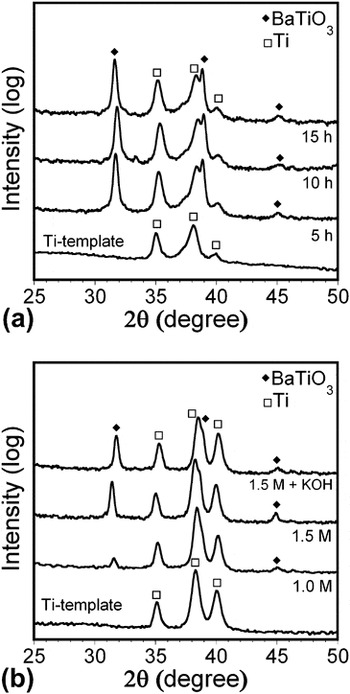
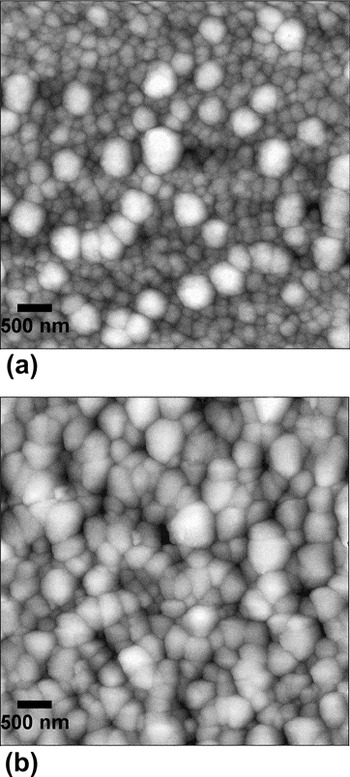
Figure 1 shows XRD data for BaTiO3 layer formation on planar Ti films as a function of reaction time and solution molarity. An as-deposited pattern of the Ti template is also given as a comparison in both graphs. Figure 1(a) was obtained by treating 250-nm thick Ti films in a 1.5-M solution at 200 °C for 5, 10, and 15 h. The x-ray pattern after 5 h of reaction reveals the formation of BaTiO3. On the other hand, there are still intense peaks belonging to Ti after 15 h of hydrothermal reaction, indicating only partial transformation to BaTiO3. Similarly, Fig. 1(b) shows x-ray data obtained from 500-nm thick Ti films treated for 5 h at 200 °C in solutions with concentrations of 1.0 and 1.5 M and also in a 1.5-M solution containing 0.1-M KOH mineralizer. The intensities of BaTiO3 peaks are significantly higher for the samples reacted in 1.5-M solutions when compared with samples treated in a 1.0-M solution. The difference in intensities upon adding the KOH mineralizer is not significant. The dependence on concentration is expected; however, substantial residual metallic Ti is present in all cases. No TiO2 peaks are observed in the patterns; however, this does not rule out the existence of amorphous material. AFM images of the 250-nm thick Ti templates reacted in 1.0- and 1.5-M solutions for 5 h at 200 °C are given in Fig. 2. The morphology of the samples seen here is consistent with the XRD data and with the molarity dependence of grain morphology that has been reported by previous authors. Sample surface in Fig. 2(a) reveals a bimodal grain size distribution, while the sample surface in Fig. 2(b) shows grains whose average diameter is more uniform. This is consistent with a well-known behavior of hydrothermally derived BaTiO3 films in which high pH and Ba2+ concentration favor BaTiO3 crystallization reactions and a more homogeneous microstructure with smaller variations in grain size.Reference Hung, Hsieh, Yang and Sun40
X-ray diffraction patterns showing BaTiO3 formation on Si substrates for (a) 250-nm thick planar Ti template as a function of time, 1.5 M, 200 °C and (b) 500-nm thick planar Ti template as a function of molarity, 5 h, 200 °C.

Atomic force microscopy images of 250-nm thick planar Ti template treated for 5 h at 200 °C in solutions with the molarity of (a) 1.0 M and (b) 1.5 M.

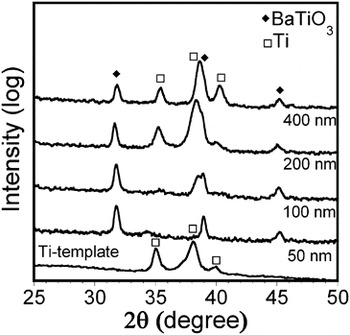
Figure 3 shows XRD data related to BaTiO3 formation on planar Ti films with different as-sputtered thicknesses. All films shown in Fig. 3 were reacted hydrothermally in a 1.5-M solution for 5 h at 200 °C. The pattern of a pure 250-nm thick Ti film is also given as a comparison. These data clearly demonstrate that the maximum thickness attained for the conversion of template to BaTiO3 is not more than 100 nm under the current conditions. Similar thickness conversions were also reported in the literature on Ti and TiO2 planar templates.Reference Fuenzalida, Pilleux and Eisele23, Reference Hoffmann, Doll and Fuenzalida25, Reference Xu, Zheng, Lin and Okuyama41 Further, it was reported that 0.25-mm thick Ti foils treated for 2 weeks at 240 °C could only yield a BaTiO3 film of 500 nm thickness, and this thickness remained constant thereafter.Reference Zhu, Akbar, Asiaie and Dutta29 Therefore, there is a practical limit for the ultimate thickness of BaTiO3 films prepared by reaction of planar Ti templates.
BaTiO3 formation on planar Ti templates with different thicknesses, 1.5 M solution, 5 h, 200 °C on Si substrate.

Overcoming this limitation is possible by engineering the morphology of the Ti template, and several authors have reported data suggesting this possibility.Reference Wei33, Reference Li, Gao, Li, Pan, Yan and Zhu42 Consequent to our observations of thickness limitations and the possibility of an engineered reactive template, we next explore the hydrothermal conversion of nanostructured Ti films.
B. Pillar templates
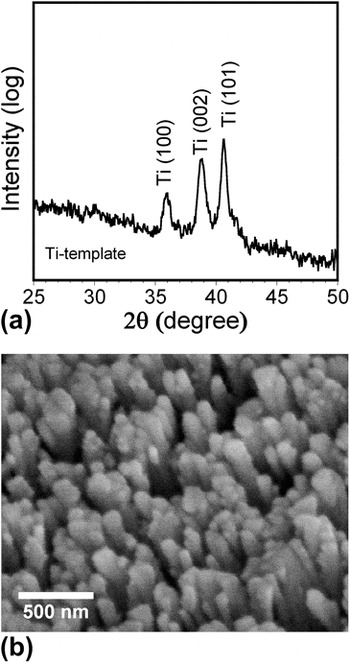
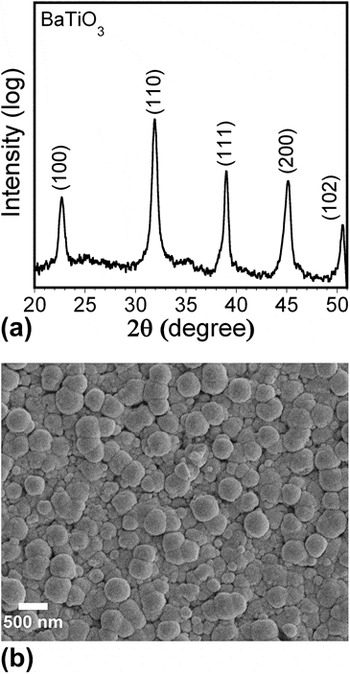
To gain control of growth rate, thickness, and final morphology of hydrothermally reacted BaTiO3, we substituted a Ti layer comprising Ti nanopillars instead of using a flat Ti layer. XRD data and SEM surface image of the pillar-shaped Ti template are given in Figs. 4(a) and 4(b), respectively. This precursor layer was produced via collimated glancing angle sputter deposition in 2 h, under 1 mTorr Ar pressure.
(a) X-ray diffraction pattern and (b) plan view image of collimated glancing angle sputter-deposited Ti template on Si substrate.

Thickness measurements performed on the templates and the films after precipitation using profilometry showed that there is always an increase in film thickness around 90% in the out-of-plane direction. The accommodation of this dimensional change without mechanical failure is not possible for a flat Ti layer precursor. In case of pillar morphology, this complete conversion and volume change appears to be possible given the ability to transport solution between pillars and the ability of BaTiO3 to grow laterally during conversion into the void space between individual precursor template pillars. XRD data show the formation of crystalline Ti, while the SEM image confirms that Ti is nucleating and growing on the substrate as a tilted random array of nanorods with a diameter of ~100 nm. These nanosculpted films were treated in a 1.5-M solution at 200 °C for 2 h in a similar fashion as described for the planar templates in Fig. 1(b). Figure 5 shows XRD data and a representative surface SEM image of these templates after hydrothermal synthesis. According to XRD analysis, there is no unreacted Ti after hydrothermal conversion. In addition, the SEM image suggests a dense microstructure where the voids between the pillars have been filled by BaTiO3 ceramic that formed by hydrothermal reaction, as hypothesized originally.
(a) X-ray diffraction pattern and (b) plan view image of 650-nm thick BaTiO3 film produced hydrothermally in 1.5-M solution for 2 h at 200 °C from pillar Ti templates on Si substrate.

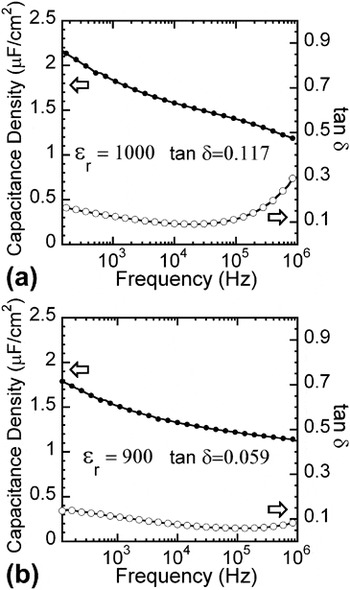
Figure 6(a) shows capacitance density and loss tangent as a function of frequency for BaTiO3 film produced from ~350-nm thick pillar-shaped Ti template on platinized-Si substrate. In the as-precipitated state, the film exhibits a permittivity of ~1000 and loss tangent values around 10% at a test frequency of 100 kHz. A gradual decline of the permittivity observed here was attributed to the relaxation of polarization contributions from hydroxyl groups located in the BaTiO3 film.Reference Tan, Goh, Chi, Lu and Lok26, Reference McCormick and Slamovich35 Dielectric loss behavior seen here also depends on the frequency-dependent reconfiguration of the hydroxyl groups, the time lag between the hydroxyl dipole switching, and space charges due to proton hopping.Reference Chien, Xu, Kim, Sachleben, Speck and Lange14, Reference McCormick and Slamovich35
Frequency dependence of capacitance density (solid markers) and loss tangent (open markers) for (a) as-precipitated 650-nm thick BaTiO3 from pillar template, (b) as-annealed film under forming gas for 3 h at 200 °C. (Relative permittivity and tan δ values refer to measurements at a test frequency of 100 kHz.)

Annealing these films under forming gas containing 1 vol% H2 for 3 h at 200 °C decreased both losses and the permittivity. This behavior is shown in Fig. 6(b). After annealing, the film exhibited a dielectric constant of ~900 and loss tangent values around 6% at 100 kHz frequency. This degree of loss reduction is observed commonly in hydrothermally derived BaTiO3 films and is attributed to the removal of surface water and hydroxyl groups from the structure. Ambient atmosphere and pure oxygen-atmosphere annealing was also performed on the same samples at 200 °C and from 200 to 600 °C, respectively. Results, which are not reported here, show that the forming gas atmosphere is most effective to minimize dielectric loss. A similar dependence between loss tangent and annealing atmosphere was reported by McCormick and SlamovichReference McCormick and Slamovich35 for hydrothermal BaTiO3 samples treated under pure oxygen and Ar–5% H2 atmosphere at 500 °C.
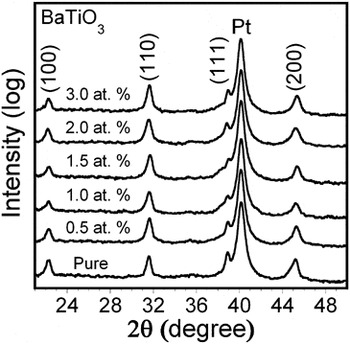
As discussed in the experimental section, Mn was added to a series of precursor solutions in an attempt to acceptor-dope the BaTiO3. Mn was added by dissolving MnCl2∙4H2O in distilled water and directly incorporating into the main Ba(OH)2 solution prior to hydrothermal synthesis. The compositions produced are estimated by assuming that the solution concentration (cation ratio) is preserved in the final film. Figure 7 shows XRD patterns of this sample series, and the data reveal no secondary or manganese oxide phases, with only BaTiO3 peaks present, consistent with the previous study on chemical solution–deposited Mn-doped BaTiO3 films.Reference Ihlefeld, Losego, Collazo, Borland and Maria37
X-ray diffraction patterns for pure and Mn-doped BaTiO3 thin films on platinized-Si substrates.

The measurements of electrical properties of Mn-doped samples showed that the addition of the acceptor decreased both the permittivity and loss of the films in the as-precipitated state. For example, addition of 0.5 at.% Mn decreased the permittivity of the film from 1000 to 900 [Fig. 6(a)]. This reduction approached 50% when Mn content was increased to 2.0 at.%. In all cases of Mn-doped materials, loss tangent values fell below 0.1 and showed a minimum value around 0.08 with 2.0 at.% Mn addition. When Mn content was increased further, the permittivity and loss tangent values increased rapidly.
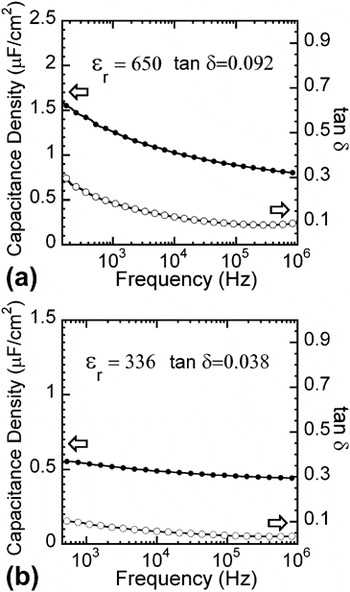
As in the undoped case, postdeposition/conversion anneals in air, oxygen, and forming gas atmospheres were explored. Again, in all cases, the forming gas anneals were most effective in minimizing dielectric loss. Figure 8 illustrates the representative example of frequency-dependent dielectric response for 1.0 at.% Mn-doped sample, up to 1 MHz for the as-precipitated state [Fig. 8(a)] and the as-annealed film [Fig. 8(b)]. Annealing was carried out under flowing forming gas containing 1.0 vol% H2 balance N2 at 200 °C, for 3 h. In comparison with the undoped case [shown in Fig. 6(b)], 1.0 at.% Mn incorporation decreases the frequency dependence of both capacitance and loss tangent at radio frequencies. This sample exhibits a loss tangent value of 0.038 at 100 kHz. Ultimately, addition of 0.072 g of MnCl2∙4H2O into the solution, which yields 1:100 for Mn:Ba ion ratio, during hydrothermal treatment is sufficient to reduce loss tangents below 10% over the entire measurement range.
Frequency dependence of capacitance density (solid markers) and loss tangent (open markers) for (a) 1.0 at.% Mn-doped as-precipitated BaTiO3 thin film and (b) as-annealed film under forming gas for 3 h at 200 °C. (Relative permittivity and tan δ values refer to measurements at a test frequency of 100 kHz.)

With these findings in mind, we propose the following mechanism to describe the apparent ability of forming gas annealing and Mn-doping to produce low loss tangent values in hydrothermal BaTiO3.
Chien et al.Reference Chien, Xu, Kim, Sachleben, Speck and Lange14 identified a set of three physical mechanisms by which the hydroxide defects that populate hydrothermal BaTiO3 are eliminated. The three stages, which occur subsequently with increasing temperature, are given by the following equations and their roughly associated temperature regimes:


The removal of surface water and lattice hydroxides was observed via the evolution of water vapor and the creation of vacant anion sites. In regimes I and II, electroneutrality is most likely maintained by charge balance between a combination of positive hydroxyl species, negative metal vacancies, and electrons both before and after hydroxide loss. The existence of protons, vacancies, and electronic carriers contribute collectively to the high dielectric loss values that are observed routinely, and their elimination is consistent with the reduction of loss tangents and dispersion as annealing temperatures are increased. The fraction of electronic compensation must be substantial to explain the very high losses in hydrothermal BaTiO3 at room temperature in which proton and vacancy diffusion is too slow to follow radio frequency fields.
We can understand our observations of reduced dielectric loss with annealing at 200 °C and lower still by annealing in forming gas as follows: (i) low-temperature annealing drives off surface water and decomposes some hydroxyl groups, and (ii) forming gas annealing enhances this process since the low pO2 will thermodynamically favor the oxygen-vacancy formation that accompanies hydroxyl transformation to a water vapor product. At such low temperatures, this effect is not expected to be predominant, and thus it is consistent with the modest but reproducibly lower loss tangents observed after forming gas as opposed to oxygen annealing. In comparison, for oxygen gas annealing, it was very difficult to find any capacitors in which loss tangent values were less than 0.1 at any frequency.
Finally, we are left to explain the impact of Mn-doping. The first consideration along these lines is the nature of incorporation. In a recent study, Tong et al.Reference Tong, Lin, Zhang, Wang and Nan43 found that Mn ions are found in the form of Mn2+ in hydrothermally produced Mn-doped BaTiO3 nanoparticles. If we assume similar behavior in our thin-film system, we can propose the following defect chemical reactions taking place in annealing temperature regime II:


This doping will compete with the intrinsic mechanisms to compensate for aliovalent hydroxide ions. Most importantly, Mn-doping will substantially reduce the number of electronic charge carriers (as is well known for low pO2 sintered BaTiO3) and can produce the lower loss tangent and frequency dispersion values we observe.
Finally, we must explain the reduction in permittivity that accompanies Mn incorporation. Such behavior has been seen by other authorsReference Ihlefeld44–Reference Tangsritrakul, Unruan, Ketsuwan and Yimnirun48 and has been attributed to the ability of aliovalent dopants to pin the motion of domain walls. Mn substitution (especially the 2+ valence state) presents a substantial charge discontinuity that will interfere with the 180° wall motion that leads to high permittivity under small signal measurements. This effect is analogous to aging in piezoelectric ceramic capacitors.Reference Moulson and Herbert49 It is important to note that though textured templates and acceptor doping are effective in improving microstructure and reducing loss tangents, additional research is needed to improve breakdown strength. The yield for dot capacitors produced by this method was greater than 75%; however, the films could not withstand electric fields much greater than 60 kV/cm without exhibiting uncontrolled loss tangents.
IV. SUMMARY
BaTiO3 thin films were produced via hydrothermal reaction. Sputter-deposited Ti films on Si or platinized-Si substrates and Ba(OH)2 solution were used as precursors. Templates were prepared in two morphologies, i.e., planar and pillar. Samples were treated at 200 °C for a variety of Ba concentrations and durations. The samples produced from flat templates showed sluggish transformation kinetics and an eventual termination of reaction without fully consuming the Ti metal. Templates with pillar morphology, on the other hand, could be transformed to phase-pure BaTiO3 independent of the template thickness. Optimum conditions for the transformation were found as 2 h, 1.5 M, and 200 °C. The films revealed a high dielectric constant and losses around 10% in as-precipitated state. Annealing these films under forming gas containing 1 vol% H2 for 3 h at 200 °C decreased high-field losses to 0.06 and the dependence of permittivity to frequency. Mn as an acceptor dopant improved dielectric properties of the films up to 2.0 at.% and acted as a supporting mechanism to reduce the overall defect concentration. Annealing of doped-samples at just 200 °C under forming gas containing 1 vol% H2 for 3 h completely eliminated the frequency dispersion of both the permittivity and tangent loss. The study demonstrates that nanostructuring and designing the precursor layer provides control on the net diffusion direction and eliminates the need for long-range transport. Finally, though some annealing was needed to achieve low loss tangent values, the maximum temperatures were within the survivability range of several polymer package materials.
ACKNOWLEDGMENTS
Financial support for Hasan Akyıldız was provided by TUBITAK-BIDEP and by NSF (contract 0547134); both are gratefully acknowledged.