1. Introduction
Can one experience or share another's pain? Some recent scientific evidence suggests that for a variety of emotional experiences (e.g., disgust and fear) and bodily sensations (e.g., touch and pain), talk of sharing is not just loose talk (Wicker et al. Reference Wispé2003; Keysers et al. Reference Lamm, Batson and Decety2004; Singer et al. Reference Singer, Seymour, O’Doherty, Kaube, Dolan and Frith2004; Blakemore et al. Reference Blakemore, Bristow, Bird, Frith and Ward2005). In this article, we focus on pain at the expense of other experiences. The question we want to address is, to what extent can you share my pain in my right foot as a result of your becoming aware of my injury? Thus, our topic is empathy for pain, or empathetic pain. Given the ubiquitous and often confusing use of the term ‘empathy’ and its cognates in recent experimental investigation of human social cognition, we take it as an urgent task in the philosophy of the cognitive sciences (cognitive neuroscience, in particular) to clarify their content.Footnote 1 As we will argue, empathetic pain is a vicarious experience of pain. There are both similarities and dissimilarities between what we call, respectively, my experience of standard pain in my right foot and your vicarious experience of pain. Whereas my standard pain is caused by injury to my foot, your vicarious pain is caused by my standard pain. As we will further argue, there are two kinds of vicarious experiences of pain: contagious pain and empathetic pain.
The following commonsense example will illustrate the threefold distinction among standard pain, contagious pain, and empathetic pain. Imagine a screaming infant who feels standard pain after being injected with a vaccine into his shoulder. Now consider the 6-year-old infant's sister watching the needle penetrate her little brother's shoulder. She tenses up and shrinks as if she were anticipating the pain caused by the needle in her own shoulder. Her vicarious experience of pain is an experience of contagious pain. Finally, consider the mother holding her son in her arms. Unlike her daughter, she is not imagining the painful vaccine injected in her own body. Her vicarious experience of pain is an experience of empathetic pain: she is painfully experiencing her son's standard pain. She believes that her son is in pain.
This article falls into six sections. In section 2, we argue that experiencing vicarious pain is to imagine being in pain. What is shared between two individuals, one of whom experiences vicarious pain as a result of her awareness of the other's injury, depends on the former's ability to imagine selective aspects of the latter's painful experience. In section 3, we examine neuroscientific findings showing that standard pain involves the joint activity of two dissociable neurological components: a sensory-discriminative and an affective component. The neuroscientific evidence also shows that the brain regions underlying vicarious pain partially overlap with the brain regions underlying standard pain. In section 4, we try to account for subtle conceptual distinctions among four related psychological phenomena: standard tasks of mind reading another's affective state, empathetic responses, contagious responses, and sympathetic responses to another's affective state. Given that empathetic pain involves both affective sharing and affective mind reading, in section 5, we ask which, in the process generating empathetic pain, comes first: affective sharing or mind reading?
2. Experiencing Vicarious Pain: E-imagining Being in Pain
What does it take to undergo a vicarious experience of pain? Our tentative answer is, to imagine being in pain. This makes our account distinct from either the mirroring-based account (e.g., Rizzolatti and Craighero Reference Singer and Lamm2005; Freedberg and Gallese Reference Freedberg and Gallese2007) or the direct perception view (e.g., Zahavi Reference Zahavi2008). Now, as many philosophers have emphasized (e.g., Currie and Ravenscroft Reference Currie and Ravenscroft2002; Goldman Reference Goldman2006b), there are at least two broad kinds of imaginative processes: one can imagine that p and one can imagine doing so and so. Imagining that p is what Goldman (Reference Goldman2006b) calls supposition-imagination (or S-imagination): it enables us to engage in counterfactual reasoning.Footnote 2 Imagining doing something is what Currie and Ravenscroft (Reference Currie and Ravenscroft2002) and Goldman (Reference Goldman2006a, 42), respectively, call the “recreative” imagination and Enactment-imagination (or E-imagination): it enables one to “create or try to create in one's own mind a selected mental state, or at least a rough facsimile of such a state.”
It is therefore approximately equivalent to a process of mental simulation, whereby a psychological mechanism is being used off-line. Given its basic information-processing function, a cognitive mechanism takes canonical inputs and produces canonical outputs in response. For example, when working online, vision takes retinal inputs and produces visual percepts; the motor system transforms motor instructions into the execution of motor acts; the decision system takes goals and beliefs as input and produces decisions as a basis for action. However, as several scientists and philosophers have argued on behalf of the off-line theory of mental simulation, a cognitive mechanism can also be taken off-line. For example, visual imagery has been construed as an instance of E-imagining seeing something, whereby one's visual system is run off-line: it is provided with inputs from memory, not retinal inputs. In response, it produces a visual image, instead of a visual percept. Motor imagery has been hypothesized to be the output of a process whereby the motor system is taken off-line, and one E-imagines producing a movement. Finally, one's decision system has been hypothesized to be taken off-line for the purpose of predicting another's decision, instead of taking a decision on the basis of which to act (Jeannerod Reference Keysers, Wicker, Gazzola, Anton, Fogassi and Gallese1994; Currie Reference Currie1995; Currie and Ravenscroft Reference Currie and Ravenscroft1997).
Similarly, one can E-imagine being in standard pain, using one's pain system off-line. Interestingly, recent neuroscientific evidence shows that the process of E-imagining being in pain involves similar activity in the brain as the experience of standard pain (Jackson et al. Reference Jackson, Meltzoff and Decety2006; Ogino et al. Reference O'shaughnessy2007). On Currie and Ravenscroft's (Reference Currie and Ravenscroft2002) generalized recreativist hypothesis, accepted by Goldman (Reference Goldman2006a, Reference Goldman2006b), any psychological state (including beliefs and desires) has a pretence or imaginative counterpart, so that one can speak of pretend beliefs (or belief-like imaginings) and pretend desires (or desire-like imaginings). We believe that, applied to beliefs and desires, the generalized recreativist hypothesis faces serious challenges (for further discussion, see Nichols Reference Ogino, Nemoto, Inui, Saito, Kakigi and Goto2004; Carruthers Reference Carruthers and Nichols2006). Nonetheless, we assume that a restricted version of the recreativist hypothesis can help account for experiences of vicarious pain. The assumption is that vicarious pain is the output of the process of E-imagining another's pain by running off-line one's own pain system.
However, one may challenge this assumption on the grounds that imagination is a voluntary process. For instance, one can engage in visual imagery or in pain imagery at will. By contrast, it does not seem as if one could experience vicarious pain at will. If so, then vicarious pain should not be conceived as the output of E-imagination. But this conclusion assumes a binary contrast between voluntary and involuntary acts, which is an unacceptable oversimplification. E-imagining another's pain by running off-line one's own pain system is neither straightforwardly voluntary (or intentional) nor straightforwardly involuntary (or nonintentional). Instead, it is subintentional in O'Shaughnessy's (Reference Rizzolatti, Craighero and Changeux1980) sense. Examples of subintentional bodily actions are the movements of one's tongue in one's mouth as one reads, the movements of one's fingers as one is attending to a lecture, or the tapping of one's feet to the rhythm as one is listening to a piece of music. Such acts are not instances of reflexive responses to an incoming signal, like pupil dilation, which cannot be prevented. On the contrary, one can stop tapping one's feet to the rhythm if requested to do so. Nor are subintentional acts intended in the sense that the movements involved are caused by one's intention to perform them. Upon noticing that one is performing some subintentional act, one discovers that one is, as O'Shaughnessy puts it, “responsible” for it (60). In other words, subintentional acts can be, as McGinn (Reference Nichols2004, 14–15) puts it, subject to the will, “in that it makes sense to direct the will at them.”Footnote 3
Vicarious E-imagination is similarly subject to the will: although it can rarely be voluntarily triggered (except maybe after training, as in Buddhist monks), it can be inhibited and is subject to modulation by a variety of factors. It is known that the experience of standard pain itself can be highly modulated (see, e.g., Hardcastle Reference Hardcastle1999). Not unexpectedly, the neuroscientific evidence reviewed in the next section will show that the vicarious experience of pain also is subject to modulation by attentional, personal, and contextual factors. Furthermore, the susceptibility of vicarious experiences of pain to modulation is corroborated by commonsense observation. Arguably, one may voluntarily stop paying attention to a person in pain or stop empathizing with the pain of a fictitious character, upon realizing that one is just watching a movie. It seems to us that evidence showing modulation of vicarious pain by a variety of factors, including some top-down factors, argues in favor of the conception of vicarious pain in terms of the subintentional E-imaginative process of running one's own pain system off-line.
We thus endorse a simulation-based approach to vicarious pain. To accept a simulation-based approach is to accept what we call the “interpersonal similarity condition” (i.e., psychological similarity between a person's standard pain and another's vicarious pain). However, to what extent are the experiences of standard pain and vicarious pain similar? Given that one's pain system involves two dissociable components, we predict that there are two basic kinds of vicarious experiences: one of which is the output of running off-line the sensory-discriminative component of one's pain system, and the other of which is the output of running off-line the affective component of one's pain system.
3. The Two Components of Standard Pain and Vicarious Pain
The investigation of standard pain raises a number of deep ontological, epistemological, and methodological issues, which have recently come center stage (Aydede Reference Aydede2006). We will not address them here: especially, we leave it open whether standard pain is representational and, if so, what the nature and content of painful experiences are. Our purpose is the investigation of the nature of vicarious pain. As Goldman (Reference Goldman1992, 31) wrote almost 20 years ago, “at present I don't think that we can properly specify the respects of similarity between original and vicarious affective states.” However, thanks to recent evidence from neuroscience, we may now be in a position to assess the similarities and the dissimilarities between standard pain and vicarious pain.
According to the canonical definition provided by the International Association for the Study of Pain (IASP 1986, 250), pain is “an unpleasant sensory and emotional experience associated with actual or potential tissue damage, or described in terms of such damage.” Of particular importance for this article is the widely recognized dual nature of painful subjective experiences: standard pain has both a sensory component and an affective component. For example, when one experiences a toothache, one's painful experience is of a damaged tooth (the sensory component), and one experiences a distinctive kind of unpleasantness (the affective component).
From a neurological standpoint, it has been shown that the so-called pain matrix includes two functionally specialized networks. The sensory-discriminative component involves the experience of the intensity of pain and its bodily location. It recruits primary and secondary somatosensory areas (SI and SII) as well as the posterior insula. SI has a somatotopic organization; that is, distinct body parts are represented in distinct brain areas. Thus, different regions of SI are activated according to whether one experiences standard pain in one's hand, in one's foot, or in one's mouth. In addition, the sensory-discriminative component has a motor counterpart: its activity underlies specific automatic motor responses whose function is to avoid (or decrease) the pain. For instance, the muscles adjacent to the location of the painful stimulus freeze, so to speak. Furthermore, one can find a higher motor reactivity in the hand susceptible to removing the painful stimulus. The affective component involves the experience of the unpleasantness of the painful experience. It recruits the anterior insula, the anterior cingulated cortex (ACC), the thalamus, and the brain stem. It lacks somatotopic organization. The two components of pain can be dissociated: for instance, the administration of drugs and the use of surgery can remove the unpleasantness (or at least the aversion to the unpleasantness) of pain. In such cases, patients no longer seem to mind the pain. The most extreme instance of such dissociations is the syndrome of pain asymbolia. As Aydede (Reference Aydede and Zalta2009, sec. 4.2) puts it, “these people still identify their experience as pain, but show no bodily, emotional, and behavioral signs typically associated with the unpleasant aspect of pains. They are feeling a pain that doesn't hurt!”
When one experiences standard pain as a result of some bodily injury, then both the sensory-discriminative and the affective components of the pain matrix are active. But if one experiences vicarious pain, then what happens? Are both components active? As we will see, the neuroscientific evidence shows that an experience of vicarious pain can be primarily generated by the selective activation of only one of the two components of standard pain: the sensory-discriminative or the affective component.
3.1. Vicarious Sensorimotor Pain
Similar automatic motor responses have been observed when the back of one's right hand is being deeply penetrated by a needle and when one observes the back of another's right hand being deeply penetrated by a needle. In a nutshell, when one sees another's hand being hurt, one automatically freezes one's own hand, as if one's own hand were injured. Using single-pulse transcranial magnetic stimulation, Avenanti et al. (Reference Avenanti, Bueti, Galati and Aglioti2005, Reference Avenanti, Minio-Paluello, Sforza and Aglioti2009) observed muscle-specific inhibition in the participants’ right hand, as well as a generalized increase of corticospinal excitability in their left hand. By contrast, they found no such inhibition when participants were shown either a cotton swab gently moving over the same area of the hand or a needle penetrating a tomato. The intensity of motor inhibition was correlated with the perceived intensity of pain but not with empathy personality traits. Furthermore, it did not make any difference to motor inhibition whether participants were asked to merely watch the needle penetrate or to focus on how unpleasant the experience was for the owner of the hand (Avenanti et al. Reference Avenanti, Minio-Paluello, Bufalari and Aglioti2006). In addition to the motor component of pain, another study found activity in SI during observation of a needle penetrating the hand (Bufalari et al. Reference Bufalari, Aprile, Avenanti, Russo and Aglioti2007). Again, this activity was correlated with the perceived pain intensity but not with its perceived unpleasantness. These experimental results strongly suggest that in experiencing vicarious sensorimotor pain, one responds to the perception of another's bodily part subjected to painful stimulation by imagining pain, that is, expecting specific sensorimotor consequences of pain, at the same location on one's own body. To conclude, both the somatosensory side and the motor side of pain can be recruited in vicarious pain, independently of its affective side.
Let us consider again our earlier example. The 6-year-old sister is anticipating the sensorimotor consequences of the painful injection in her own shoulder. If we were to record her muscle activity, we would probably find muscle-specific motor inhibition, which characterizes the sensorimotor component of pain. Arguably, however, her anticipation of the sensorimotor consequences of the painful injection leads her also to anticipate the affective consequences of the injection for herself. Hence, although she may eventually undergo a vicarious experience of both components of pain, we propose that her full vicarious experience is primarily grounded in the sensory component. She anticipates the affective consequences of pain, only insofar as she anticipates its sensory consequences. As we will see now, there is another type of response to another individual's pain that is primarily grounded in the affective component of pain.
3.2. Vicarious Affective Pain
Other experimental evidence, based on functional brain imaging (fMRI), shows that the affective component of pain can be selectively activated when people are made aware of others’ painful experiences. For instance, when participants saw an arrow indicating that their partner was being inflicted a painful stimulus or when they saw a facial expression of pain, Singer et al. (Reference Singer, Seymour, O’Doherty, Kaube, Dolan and Frith2004) and Botvinick et al. (Reference Botvinick, Jhab, Bylsmaa, Fabian, Solomon and Prkachin2005) found activation only in the affective component of pain (i.e., ACC and bilateral anterior insula), which was correlated with empathy personality traits. No sensorimotor activity was found. Interestingly, fMRI studies that used videos of detailed painful situations (finger or foot crushed by a door) found the same results (Jackson, Meltzoff, and Decety Reference Jackson, Brunet, Meltzoff and Decety2005). Participants’ responses to the pain of others did not depend on whether they knew the bodily location of the pain. Whether they saw a finger or a foot in pain made no difference: no somatotopic effect was found. Taken together, these results suggest that one species of vicarious pain can be deprived of spatial bodily ascription.
Further experiments showed that the selective activity of the affective component of pain was modulated by a wide range of personal and contextual factors (for a review, see Singer and Lamm Reference Sober and Wilson2009). To give a few examples, reduced activity in the affective component was found (i) in male participants when the person in pain was previously unfair to them (Singer et al. Reference Singer, Seymour, O’Doherty, Stephan, Dolan and Frith2006), (ii) in medical practitioners (Cheng et al. Reference Cheng, Lin, Liu, Hsu, Lim, Hung and Decety2007), and (iii) when participants believed that the other's pain resulted from a useful treatment or that the injured bodily part was anesthetized (Lamm, Batson, and Decety Reference Lamm, Nusbaum, Meltzoff and Decety2007). In summary, much evidence shows that affective vicarious pain is subject to modulation by contextual factors, some of which must be processed by high-level cognitive systems, in accordance with our view that vicarious pain is subintentional.
To conclude, in most brain-imaging studies, one kind of vicarious pain activates the affective component of pain but not the sensory-discriminative component. As a result, one can share another's pain without necessarily knowing the bodily location of the other's standard pain. This is why one can vicariously experience pain upon either perceiving another's facial expression (which does not reveal the bodily location of the other's pain) or imagining another's nonlocated painful experience. But if what we call affective vicarious pain lacks spatial and sensorimotor content, then the question arises, is it a genuine experience of pain or is it an experience of psychological distress?
3.3. Affective Vicarious Pain and Social Pain
The question is made more acute by the fact that a recent neuroimaging study shows that psychological distress due to social exclusion also activates the affective component of standard pain (Eisenberg, Lieberman, and Williams Reference Eisenberger, Lieberman and Williams2003). Participants played a virtual ball-tossing game from which they were ultimately excluded. During exclusion, the authors found increased activity of the ACC, which was positively correlated with self-reported distress. The authors refer to this phenomenon as “social pain.” Interestingly, a common painkiller was shown to be efficacious in preventing social pain as well as standard pain (Dewall et al. Reference Dewall, MacDonald, Webster, Masten, Baumeister, Powell, Combs, Schurtz, Stillman, Tice and Eisenberger2010). However, whereas the painkiller relieved standard pain in 4 hours and has no cumulative effect, social pain was only relieved after a period of several days. It follows that, although some of the brain structures underlying the experience of standard pain also underlie the experience of social pain, the latter should not be assimilated to the former. Nor should psychological distress exemplified by social pain be identified with vicarious affective pain.
Social pain involves no bodily injury of any kind, either to one's own body or to another's body. Vicarious affective pain only is generated by another's standard pain. Whereas social pain is not a bodily sensation, we claim that vicarious affective pain is, to some extent, a bodily feeling in Armstrong's (Reference Armstrong1962) sense. In addition to brain activity of the affective component of pain, some pain observation studies found activity related to the sensory component of pain when participants were asked to pay more attention to the intensity of pain or to its bodily location (e.g., SII; see Lamm, Nusbaum et al. Reference Lamm, Meltzoff and Decety2007; Cheng et al. Reference Cheng, Yang, Lin, Lee and Decety2008; Lamm and Decety Reference Lamm and Decety2008). True, none of these studies found a somatotopic organization of the brain responses (and no activity in SI). In other words, the vicarious pain was not encoded in a particular part of the body. Yet, some bodily aspect was encoded. Armstrong's (Reference Armstrong1962) distinction between bodily sensation and bodily feeling may be of help here. Bodily sensations (e.g., touch and pain) are experienced as being located in a particular part of the body, whereas bodily feelings (e.g., thirst and hunger) need not be. Within this conceptual framework, vicarious affective pain might be thought of as a vicarious version of a global (nonlocalized) bodily feeling of the type “It hurts.”Footnote 4
Thus, as we read it, the neuroscientific evidence shows three things. First, it shows that the brain activity underlying vicarious pain partially overlaps with the brain activity underlying standard pain. To some extent, this supports the claim that one can share another's experience of standard pain. But second, since overlap is not identity, it also shows that vicarious pain should not be confused with standard pain. Finally, it shows that there are two kinds of vicarious experiences of pain. On the one hand, vicarious sensory pain is localized in a particular bodily part and is primarily grounded in the sensory component, which in turn can activate the affective component. On the other hand, vicarious affective pain is not localized in a particular bodily part and is primarily grounded in the affective component, although (unlike social pain) it can be associated to some global somatosensory component when explicitly required. In other words, the two kinds of vicarious experience of pain correspond, respectively, to sensory E-imagination, primarily driven by the off-line use of the sensory component of one's own pain system, and to affective E-imagination, primarily driven by the off-line use of the affective component of one's own pain system.
Why this neural dissociation? How come the sensori-discriminative and the affective component of the pain system can be selectively activated in response to the same type of stimuli? Why not both at the same time? Is it just a mere artifact due to experimental differences? Or does it reveal a more fundamental distinction between two distinct species of vicarious pain? Although differences in techniques and attention to bodily details may play a role, they cannot exhaustively account for the differences between the two series of evidence. In particular, they cannot account for a fundamental difference in the direction of intentionality of each species of vicarious pain. As we will argue, vicarious sensory pain is self-centered and constitutes what we call an experience of contagious pain, whereas vicarious affective pain is other-directed and constitutes what we call an experience of empathetic pain. Arguably, being self-centered and being other-directed are two inconsistent properties of an experience: one cannot be in a psychological state that is both self-centered and other-directed at the same time. As our introductory example shows, while the vicarious sensory pain of the infant's little sister is centered on her own body, the vicarious affective pain of the infant's mother is directed toward the infant. Only if the sensory component of pain is bracketed can one undergo an experience of vicarious affective pain that is other-directed.
4. A Definition of Empathy
The goal of the current section is to further elaborate the dissociation between E-imagining the sensorimotor aspect of pain and E-imagining the affective aspect of pain by mapping it onto the distinction between contagious pain and empathetic pain. In many theories, it is quite unclear how to draw the boundaries between sympathy, empathy, and contagion or even whether they should be distinguished at all. But in fact, there are important conceptual and psychologically relevant distinctions among an empathetic response to another's pain, a contagious response, a sympathetic response, and what can be called standard mind reading. As we now argue, many of the relevant contrasts can be best revealed by considering a range of examples involving not only pain but also various emotional experiences.
First of all, we assume that not unless two individuals are experiencing some affective state or other could one be said to empathize with the other.Footnote 5 This condition, which we call the affectivity condition, enables us to draw the boundary between standard mind reading and empathy. When I perform a standard task of mind reading, I come to believe that you are in some psychological state or other (e.g., a feeling), which I ascribe to you. Thus, I may know what you feel without feeling what you feel. For example, suppose that only you suffer from vertigo attacks when you walk on the edge of a cliff. Now, on the basis of my conceptual mastery of vertigo and your behavioral cues, I may come to believe that you are experiencing vertigo without my sharing your experience of vertigo. In such a case, my ascription of vertigo to you counts as an instance of standard mind reading, not empathy.
Second, we assume that not unless the empathizer's affective state stands in some relevant similarity relation to her target's affective state can the former be said to empathize with the latter. This condition, which we call the interpersonal similarity condition, enables us to distinguish sympathy from empathetic and contagious responses, both of which are vicarious experiences whose contents and characters crucially depend on the contents and characters of the basic emotions that cause the vicarious experiences. By contrast, sympathy is a kind of sui generis social emotion: no matter what affective state another is experiencing (e.g., pain, jealousy, anger), to sympathize with another is to feel sorry for her. In our initial example, the nurse is likely to sympathize with (hence, feel sorry for) the infant in pain. Thus, there is no relevant similarity between the nurse's sympathetic response and the child's standard pain. Had she experienced vicarious pain, her medical efficiency might have suffered from it.
Third, we assume that the empathizer's affective state must be caused by the target's affective state. If two individuals experience the same affective state as a result of a common cause, then one's affective experience is not the cause of the other's. If so, then one cannot be said to empathize with the other.
So far, the three mentioned conditions are satisfied by both empathetic and contagious responses to another's affective state. Now, in order to distinguish empathetic from contagious responses, a further condition must be added, which only empathy can meet and which we call the ascription condition, namely, that the empathizer must be aware of the target's affective state, if not of the fact that her own affective state is caused by another's. Arguably, in crowd panic, one may automatically respond to the others’ behavioral display of fear by catching their fear without representing what they are afraid of, let alone the very fact that they are afraid. If so, then one fails to meet the ascription condition, and thus one cannot be said to empathize with their fear.
We lay out in a schematic form the following set of four conditions that must be met for X to empathize with Y (for a similar account, see Vignemont and Singer Reference Wicker, Keysers, Plailly, Royet, Gallese and Rizzolatti2006):
i) Affectivity condition: X is in some affective state or other s*;
ii) Interpersonal similarity condition: X's affective state s* stands in some similarity relation to Y's affective state s;
iii) Causal path condition: X's being in state s* is caused by Y's being in state s;
iv) Ascription condition: X is aware of Y's being in s.Footnote 6
As they stand, these four conditions need tighter articulation, as the following example will illustrate. Suppose Y feels anxious, and his anxiety is contagious, and X catches Y's anxiety. So far, conditions i–iii are satisfied. Conceivably, X feels anxious, but she does not know why. Now suppose that X becomes aware of Y's anxiety after being told about it by some third party. If so, then ascription condition iv is satisfied in addition to conditions i–iii. Still, it does not seem as if X empathized with Y's anxiety because she may not even be aware that her vicarious anxiety is caused by Y's anxiety. In this example, two independent psychological processes are involved: conditions i–iii are met as a result of emotional contagion, but ascription condition iv is met as a result of verbal communication between X and a third party. In this sense, X does not empathize with Y. Even if her psychoanalyst explains to X the source of her anxiety, still X will not empathize with Y. This example highlights the fact that for X to empathize with Y, it is necessary that X's understanding of Y's affective state depends in some way or other on the fact that X's own vicarious experience is relevantly similar to Y's. In other words, the fact that X shares Y's affective state must to some extent contribute to X's understanding of Y's experience. As a result, we offer a revised version iv* of condition iv:
iv*) X's being in s* makes X aware that her being in s* is caused by Y's being in s.
Furthermore, in view of the evidence in favor of the modulation of empathetic responses by contextual and personal factors, a further condition should be built into our attempted definition of empathy:
v) Caring condition: X must care about Y's affective life.
Generally speaking, an egotist stance seems hardly compatible with either sympathy or empathy. The caring condition reflects the fact that empathy is not the default response to one's awareness of another's affective state in general. In particular, empathetic pain is not the default response to one's awareness of another's standard pain. If one is indifferent or has a negative attitude toward the person in pain (e.g., if she has been previously unfair; see Singer et al. Reference Singer, Seymour, O’Doherty, Stephan, Dolan and Frith2006), then one may not engage in a process of affective E-imagination.
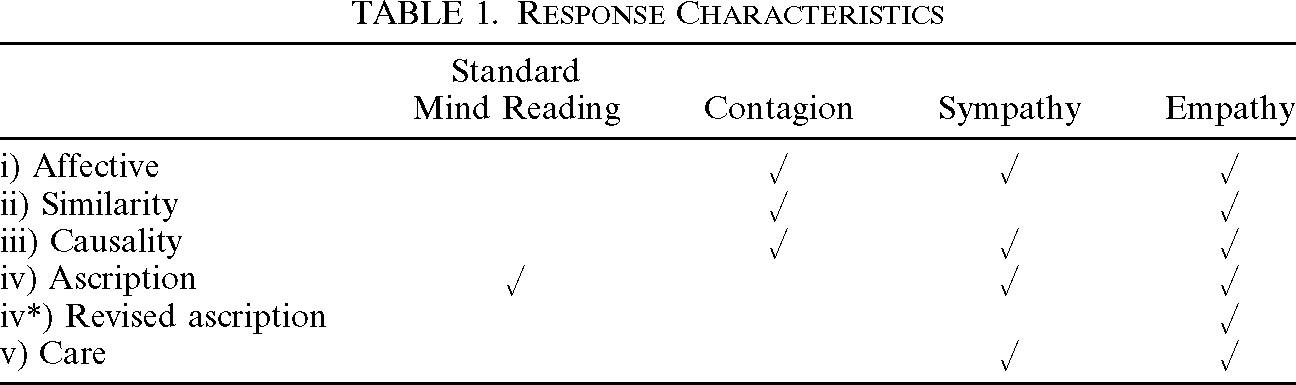
As table 1 shows, our approach offers a systematic account of the distinctions among empathetic responses, contagious responses, sympathetic responses to another's emotion, and nonempathetic emotion ascription achieved by standard mind reading. Only empathetic pain meets all five conditions. This article, however, is not devoted to empathy in general: we do not assume that humans are so built that they must respond to another's emotional display in a single canonical way. For example, there is no reason to suppose that one responds to another's display of anger in the very same way in which one responds to another's display of fear or disgust. Our goal here is merely to spell out the nature of vicarious experiences of pain within this conceptual framework. In particular, we can now interpret the dissociation between sensory and affective vicarious pain. Since both meet the first three conditions, it follows that vicarious pain does not qualify as a sympathetic response. What matters to the distinction between contagious and empathetic responses to another's pain is the ascription condition iv*. We assume that a vicarious experience of pain cannot be both other-directed and self-centered. As we will now argue, only if it meets conditions iv* and v can a vicarious experience qualify as empathetic because it is other-directed and not self-centered.

| Standard Mind Reading | Contagion | Sympathy | Empathy | |
| i) Affective | √ | √ | √ | |
| ii) Similarity | √ | √ | ||
| iii) Causality | √ | √ | √ | |
| iv) Ascription | √ | √ | √ | |
| iv*) Revised ascription | √ | |||
| v) Care | √ | √ |
Let us first consider sensory vicarious pain, which results from E-imagining pain at a definite location on one's own body. When seeing another's hand subjected to painful stimulation, one simply runs off-line the sensorimotor component of one's pain system and thereby maps the other's bodily part subjected to painful stimulation onto one's own bodily counterpart and anticipates the sensorimotor consequences of pain at this bodily location. As a result, one's experience of vicarious pain is both anticipatory and entirely self-centered: it is an instance of contagious not empathetic pain. In all the studies that highlight sensorimotor responses to the observation of another's pain, there is no evidence that the participants were aware that their sensory vicarious pain was caused by another's standard pain. Furthermore, if their response were constitutive of an empathetic response, then one would expect that adopting the other's perspective (“putting oneself into her shoes,” so to speak) should amplify the motor inhibition. However, Avenanti et al. (Reference Avenanti, Minio-Paluello, Bufalari and Aglioti2006) found no such modulation, nor did they find any correlation between the strength of the response and the participants’ score in empathy questionnaires. Avenanti et al. (Reference Avenanti, Minio-Paluello, Sforza and Aglioti2009, 1073) concluded: “corticospinal inhibition may reflect a ‘sensorimotor contagion’, i.e. an automatic embodiment of sensory qualities of pain onto the observers’ motor system.” Following Avenanti and colleagues, we propose to interpret vicarious sensory pain in terms of self-centered contagious pain.
Unlike sensory E-imagination, affective E-imagination is other-directed, as confirmed by several empirical findings (e.g., Singer et al. Reference Singer, Seymour, O’Doherty, Kaube, Dolan and Frith2004, Reference Singer, Seymour, O’Doherty, Stephan, Dolan and Frith2006). Arguably, the most conclusive example is offered by the recent fMRI study by Lamm, Meltzoff, and Decety (Reference McGinn2010). Participants were informed that they were observing neurological patients who experienced pain when they were lightly touched but not when they were submitted to surgical operations. Lamm et al. (Reference McGinn2010) reported that participants displayed activity in the affective component of pain when they saw the patient's hand being touched with a cotton swab but not when they saw it submitted to a needle injection. Participants must have run off-line the affective component of their pain system in order to E-imagine what the neurological patients felt. Following these findings, we propose to interpret affective vicarious pain in terms of other-directed empathetic pain.
Let us consider once again our stock example. When the infant's sister sees the needle penetrate her brother's shoulder at time t, she E-imagines the sensorimotor consequences of the injection at  at the same location on her body at which she sees the painful stimulus being applied on her brother's. Her sensorimotor E-imagination concerns her future self. The content of her sensory E-imagination-based thought would be true if and only if she were in pain at
 as a result of receiving an injection at this bodily location. It would be false if she had not received an injection or if she received an injection but failed to feel pain (because, e.g., she was anesthetized) or it was at a different bodily location. By contrast, when the mother sees the needle penetrate her son's skin, she painfully E-imagines her son's affective disarray from the first-person perspective, namely, from the perspective of her son being in pain. Her affective E-imagination concerns another individual, namely, her son. The content of her E-imagination-based thought would be true if and only if her son was in pain at time t. But it does not make any difference to the content of her E-imagination-based thought whether her son's standard pain was in the right or in the left shoulder. She might be said to misempathize only if her son did not experience standard pain at all.Footnote 7 Her vicarious experience of empathetic pain is her way of painfully representing her son's standard pain.
To conclude, contagious pain and empathetic pain are vicarious experiences of pain that can be distinguished along two dimensions. On the one hand, the former is primarily driven by a process of sensory E-imagination. The latter is primarily driven by a process of affective E-imagination. On the other hand, whereas the former is self-centered, the latter is other-directed. One may wonder whether these two dimensions mutually interact. We do not have a definite answer. However, it seems to us that if you are asked to imagine being in pain, it is likely that you retrieve memories of past experiences of standard pain. As such, those past experiences are remembered as being located in a particular part of the body (e.g., a toothache). By contrast, if you are asked to imagine someone else being in pain, you can more easily E-imagine a global unpleasant bodily feeling without necessarily localizing it in any particular bodily part. We thus suggest that it is the direction of intentionality (i.e., self-centered vs. other-directed) that determines whether it is the sensory or the affective component of pain that is run off-line in vicarious pain. Furthermore, we assume that one cannot undergo both contagious pain and empathetic pain at the same time because an experience cannot be both self-centered and other-directed at the same time. Roughly speaking, there is competition between self-centered and other-directed experiences, and only one can prevail at a time. Imagine the following revised version of our initial example. Both the little boy and his mother receive an injection. Arguably, the focus of the mother's attention can either be her own pain or her son's pain. She might alternate from one to the other, but it seems unlikely that she can attend simultaneously to the two painful experiences. Rather, it seems that her own standard pain might distract her from her vicarious affective pain. The same is true of vicarious sensory pain. If one is expecting the sensorimotor consequences of pain on one's body, then one cannot focus on another's pain. Therefore, one could not experience vicarious affective pain unless one was able to bracket vicarious sensory pain.
5. Affective Sharing and Affective Mind Reading
The motivational role of empathetic pain for moral and prosocial behavior (i.e., responding to another's distress to alleviate it) has often been stressed. Our definition of empathetic pain, however, tackles a more fundamental issue, namely, the ability to ascribe pain to other people. Prosocial behavior psychologically depends on affective mind reading. In order to react appropriately to another's pain, one needs first to understand the fact (or to believe) that she is in pain. Hence, prosocial behavior requires third-person mind reading. It is not clear, however, that empathy is either necessary or sufficient for prosocial behavior. It is one thing to explain the cognitive and psychological competence underlying an individual's ability to perform tasks of affective mind reading, or in Batson's (Reference Batson, Decety and Ickles2009) terms, “how one can know what another person is thinking and feeling.” It is another thing to explain an individual's tendencies toward prosocial behavior or, in Batson's terms, “what leads one person to respond with sensitivity and care to the suffering of another” (16). Here, our focus is on the former more fundamental aspect. Empathy is a special kind of third-person mind reading, that is, a special affective way of representing and understanding another's affective psychological state (hereafter, affective mind reading, by contrast to standard mind reading).
As we argued, what individuates empathetic pain is that it meets the ascription condition. Henceforth, for vicarious affective pain to be an empathetic state, it must contribute to affective mind reading. In order for the revised ascription condition iv* to be met by a genuine empathetic response, affective sharing and affective mind reading must be intimately connected. The question then arises, how do affective sharing and affective mind reading interact with each other? How could the empathizer's belief about the target's affective state give rise to a relevantly similar affective state in the empathizer's mind? Conversely, how could the fact that the empathizer is experiencing an affective state similar to the target's own affective state give rise to the empathizer's belief about the target's affective state? We seem to be facing a dilemma, neither horn of which seems very appealing: the ‘sharing-first’ option and the ‘mind reading–first’ option.
The sharing-first option fits the simulation theory of mind reading (e.g., Goldman Reference Goldman2006b). On this approach, the empathizer comes to share the target's affective state as a result of pretending to be in the other's emotional situation and running her own affective appraisal system as normal. The output of the simulation process, namely, the affective state, is then attributed to the other. But if this is so, then two related questions arise: Why should affective sharing give rise to the belief that the target is in pain? There is a clear difference between experiencing pain and believing that another is experiencing pain. Neither is a necessary condition for the other. In particular, experiencing pain is not necessary for believing that another is in pain. If so, then how could sharing another's pain lead an empathizer to believing that another is in pain and to ascribing pain to him? But now the second question arises: If sharing another's affective state always gave rise to empathy, then wouldn't both the existence of contagious responses to another's affective state and the difference between contagious and empathetic responses to another's affective state become utterly mysterious?
The mind reading–first option has been explicitly advocated by Sober and Wilson (Reference Stueber and Zalta1998, 234), who define empathy as follows: “S empathizes with O's experience of emotion E if and only if O feels E, S believes that O feels E, and this causes S to feel E for O.” This definition assumes that not unless an empathizer first believes that her target is in pain could she share the target's pain and experience empathetic pain. This option gives rise to three problems. First, it is puzzling how belief about another's pain could give rise to some painful experience in the ascriber herself. Second, experiencing pain is costly. If understanding another's painful experience can be achieved by executing a standard task of mind reading without experiencing pain, why should a mind reader assume the additional burden of experiencing pain? What is the function of the experience of pain in a task of pain ascription? Finally, on the face of it, this view seems hard to reconcile with some neuropsychological evidence. Some patients who can no longer experience disgust or fear turn out to be unable to recognize facial expressions of disgust or fear, although they still understand the emotions at the conceptual level (Adolphs et al. Reference Adolphs, Tranel, Damasio and Damasio1994; Calder et al. Reference Calder, Keane, Manes, Antoun and Young2000). Furthermore, it has been reported that seeing someone being hurt does not activate the pain matrix in patients with alexithymia (i.e., those who do not report any emotion; Bird et al. Reference Bird, Silani, Brindley, White, Frith and Singer2010). Being deprived of the capacity for affective experience may thus disrupt mind reading. It seems that affective sharing plays some role in affective mind reading and that being able to undergo emotional experiences is a prerequisite for empathy for pain.Footnote 8
In a nutshell, neither the sharing-first option nor the mind reading–first option seems quite acceptable. On the former option, the distinction between empathy and contagion collapses. On the latter option, the evidence in favor of affective sharing for affective mind reading in neuropsychological patients is unexplainable. Instead, our distinction between two kinds of vicarious pain, contagious and empathetic pain, based on two kinds of E-imagination, may contribute to resolving the dilemma. Thanks to this distinction, we avoid the risk of collapse of empathetic pain into contagious pain. Furthermore, the differences between these two types of E-imagination may help us understand why affective E-imagination alone can meet the revised ascription condition iv*.
In standard pain, the experience of affective disarray is correlated with the localization of pain in some definite bodily part. In vicarious contagious pain (which is self-centered), the experience of psychological disarray arises from E-imagining (expecting) the sensorimotor consequences of pain at some definite location in one's own body in the future. Now, vicarious empathetic pain (which is other-directed) results from running off-line the affective component of one's own pain system. In vicarious empathetic pain, one experiences psychological disarray, as a result of E-imagining the unpleasantness of pain while experiencing no standard pain caused by injury to one's own body. So one experiences psychological disarray as a result of E-imagining the unpleasantness of another's pain. So in contrast to experiences of either standard pain or contagious pain, there is an asymmetry between the strong activity of the affective component (which generates a strong psychological disarray) and the weak activity of the sensory component of the pain system (which generates a weak global bodily feeling). In either standard pain or contagious pain, the unpleasantness of actual or hypothetical pain is correlated with the localization of pain in some definite bodily part. But in empathetic pain, the psychological disarray is only correlated with a global bodily feeling with no definite bodily location.
The lack of bodily location makes empathetic pain a highly specific type of pain. Interestingly, the two components of pain can be dissociated but only in one direction (sensorimotor without affective component). One never experiences the unpleasantness of standard pain without its sensorimotor correlates. One can indeed mislocalize standard pain (e.g., referred pain), but one can never experience standard pain without ascribing it to a rough bodily location. The experience of unpleasantness of standard pain thus generates sensorimotor expectations. However, in the case of empathetic pain, these expectations are not fulfilled. Because of the mismatch between the expectations and the lack of actual sensorimotor activity, one becomes aware that one experiences empathetic pain rather than standard pain; that is, one becomes aware that one's own psychological disarray is caused by another's standard pain. This, we surmise, is why, unlike experiences of contagious pain (and of course standard pain), experiences of empathetic pain alone meet ascription condition iv*. However, if the mismatch was not registered at one level or another, then arguably one could fail to realize that the other's pain is the cause of one's own experience of vicarious pain. If so, then one would experience an instance of illusory standard pain and hopelessly start to look for a nonexistent location of pain in one's own body.
6. Concluding Remarks
What it is like for you to feel my pain in my right foot differs from what it is like for me to feel my pain in my right foot. On the basis of the neuroscientific distinction between the affective and the spatial/sensorimotor components of standard pain, we have argued that the experience of empathetic pain may share some of the qualities of the affective component of a target's standard pain. Awareness of my pain may cause you to E-imagine (i.e., expect) the sensorimotor consequences of pain in your own right foot in the future. If so, then my pain would cause you to undergo a contagious experience of pain. If you were to empathize with my pain, then your experience of empathetic pain would lack the spatial/sensorimotor component of my standard pain in my right foot. If so, then the difference would not be merely quantitative: the former is not merely less intense or vivid than the latter. Empathetic pain and standard pain are two distinct types of pain experiences. Because they are dissimilar, there is no risk for the empathizer to confuse her experience of empathetic pain with an experience of standard pain.
At the core of our account are the joint assumptions that empathetic pain is a vicarious experience of pain (caused by another's standard pain) and that vicarious experiences of pain are generated by a process of mental imagery, that is, a special kind of nonpropositional imagination involving the off-line use of one's own pain system. There are two main current alternatives to an imagination-based account of empathetic pain: the direct-perception and the mirroring models (for detailed discussion, see Jacob Reference Jacob, Vignemont, Biggs, Strokes and Matthen2011; Jacob and Vignemont, Reference Jeannerodforthcoming). The direct-perception model erroneously construes empathetic pain as a perceptual experience of another's pain. Although a vicarious experience of pain can take as input the perception of cues of another's pain, it is not a perceptual experience. Perceiving cues of another's pain is neither necessary nor sufficient for empathetic pain: empathetic pain can be triggered by testimony, and it is not the default response to the perception of cues of another's pain. The mirroring model fails for a distinct reason. We took it as a condition of adequacy that a satisfactory account must be able to distinguish empathetic pain from four related, although distinct, phenomena: standard pain, contagious pain, sympathy for pain, and standard pain ascription. The mirroring account fails to offer a principled distinction between empathetic and contagious pain. Thus, we surmise that the imagination-based account currently offers the best prospect for meeting the above condition of adequacy on empathetic pain.