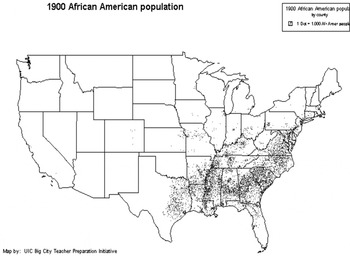
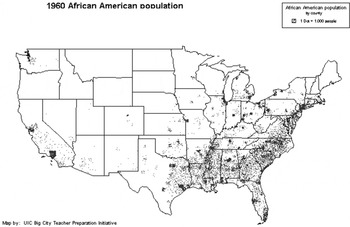
African-Americans who migrated from the rural South to the urbanized North took with them their culture, religion, food, music, and language (Adero, Reference Adero1993; Lemann, Reference Stockman1991). Northbound migrants also transported linguistic and cultural norms that over time, influenced the language of the southern communities that had been left behind. This influence was both direct (through continued contact with their homes and family) and indirect (through greater acceptance of AAVE as a social norm). At the turn of the twentieth century, the majority of African-Americans still lived in the American South (U.S. Census Bureau, Population Division, Racial Statistics Branch). By 1960, the population had shifted so that African-Americans were found in large concentrations in urban areas throughout the East and West Coast. The population of African-Americans is increasingly urban, and there is a substantial remigration to larger Southern cities. Figures 1 and 2 show the patterns of movement and differences in population density of African-Americans in 1900 and 1960 in the United States. The maps are based on data from U.S. Census reports as gathered by the University of Illinois–Chicago Big City Teacher Preparation Initiative (Reference Wolfram and Schilling-Estes2006).
African-American migration 1900.

African-American migration in 1960.

Speakers of AAVE have long attested the ability to distinguish regionalisms in speakers, especially along a Northern/Southern continuum (Labov, Reference Picone1998), but the exact makeup of the regional variation has not been thoroughly examined in comprehensive cross-regional sociolinguistic studies. Moreover, the intersection of region and stylistic variation has rarely been investigated in comprehensive studies, although comparisons can be drawn across studies from the analysis of like populations that have been documented in the earlier sociolinguistic literature such as Wolfram Reference Wolfram(1969), Labov (Reference Lemann1972a), and Baugh (Reference Charity1983) and in accounts of more recent work including Alim (Reference Alim2005), Childs (Reference Craig and Washington2005), and Green (Reference Labov2002).Footnote 1
Fought (2001) gave an overview of the nature of AAVE research in American sociolinguistics. She noted that the categories of variables that have been most often analyzed are centered on standard White English, a variety that AAE speakers may or may not have come into sociolinguistic contact with participants in the studies of AAVE. Fought noted that “surprisingly little” has been done on internally motivated sound changes in AAVE-speaking communities, despite the role that changes in progress have played in sociolinguistic theory. She also stated:
[d]espite the fact that much more cross-regional research on AAVE is needed, certain assumptions about regional variation (or lack thereof) in AAVE have become accepted within the field of sociolinguistics (p. 462).
Fought referred the reader to Wolfram and Schilling-Estes (Reference Rickford2005), who commented on the regionality of AAVE, but noted that many major features of AAVE (as previously reported in the literature) are shared by speakers across the country, minimizing the regional differences. Primary importance has been given to grammatical features of AAVE, as well as features that are unique to African-American speakers. By omitting features that are internally relevant the African-American community, Fought cautioned that sociolinguists might be missing some of the key indicators of regionality in AAVE. For example, whereas vowel analysis has elucidated great regional variation in White speakers across the United States, little comparative work has been done on vowel variation across African-American speakers.
The perpetuation of a theory of a monolithic AAVE dialect also permeates the Educational Linguistics literature. Linguistic information for teachers and practitioners who serve African-American children is often presented as lists of features that are reported to be “common to AAVE,” as found in Delpit and Dowdy (Reference Fought, Chambers, Peter and Natalie2003), Wolfram, Adger, and Christian (Reference Rickford2003), and Dandy (Reference Dubois and Horvath1991), with little information about their frequency or distribution among speakers. Although the omission of quantitative information is understandable for clarity and brevity for a teacher audience, an awareness of the social evaluation in different types of linguistic features is much needed in such accounts.
Assessing regionalism in children in the form of quantitative analysis of linguistic features is crucial for making sure that language assessment criteria are accurate. The observation of frequency differences is important for several key reasons. First, social norms with respect to communicative competence may be sensitive to the relative frequency of AAVE feature production. Speakers using higher frequencies of AAVE features may be seen as more socially distant than their counterparts who use the same features, but in lesser quantities. Second, local differences in the relative frequencies of AAVE production must be taken into account in the assessment of children's speech for educational and psychological purposes. As noted by Stockman (Reference Wolfram and Carpenter1996), it is difficult for teachers and speech therapists to know what the language norm is, in each locale and whether differences are related to development, language change and/or variation, or some other factor such as injury or physical disability. Further complicating this issue is the problem of separating developmental issues from dialect differences in young children. Many of the more robust features of AAVE, both phonological and morphosyntactic, appear later in the developmental stages of White middle class children, on whom the assessment tests are most often based. This confusion/overlap led early researchers to describe AAVE production as a developmental issue, but production of AAVE features may also complicate assessment of developmental issues in African-American children. Third, insight into variation in AAVE production may give great insight into the direction of AAVE change over time. Such information is beneficial for understanding patterns of segregation and desegregation in the United States.
In this study, children's speech was examined while they imitated and then retold a simple story. The theory of the effect of the cognitive load, as described in the psycholinguistic and language assessment literature, is central to the use of sentence imitation as a sociolinguistic measure (Fraser, Bellugi, & Brown, 1963; Radloff, Reference Radloff1991). The theory of the cognitive load states that the limitations of working memory intersect with the evaluation of language and other academic assessment. In their work with adolescent boys in Harlem, Labov, Cohen, Robins, and Lewis (Reference Rickford1968) gave examples from three types of stimuli (memory tests) to see if there was perhaps an interference of cognitive load with speech production. The first memory test presented in Labov et al. (Reference Rickford1968) analyzed four children using three different kinds of stimuli: (1) sentences in which SAE and AAVE are different, (2) sentences in which SAE and AAVE differences are unsure, and (3) long sentences that are grammatically acceptable in AAVE. Labov et al. (Reference Rickford1968) demonstrated that given a sentence-imitation task, African-American children filter Standard American English (SAE) forms through their own grammatical systems during language processing. Items that are not part of a child's linguistic system are likely to be reproduced in the vernacular form. Hence, by having children imitate sentence models spoken in SAE, one can assess the degree to which SAE forms are familiar to them.
In the current analysis, retelling of the story was also examined to provide a stylistic contrast to the imitation task. In story retelling, children are able to reproduce the story in their own words. There is the possibility that in story retelling, children would use more of the vernacular features following Labov's attention paid to speech paradigm (Labov, Reference La Chance, Hirsch and Logsdon1966).
METHOD
Participants and speech samples
The speech samples analyzed in this study are a subset of those that were gathered for an American Federation of Teachers project that provided professional development in reading instruction to inner-city teachers. In that project, speech samples were collected for 217 students who were randomly selected from classrooms in three of the lowest performing schools in the lowest socioeconomic status neighborhoods in the cities of New Orleans, Louisiana; Washington, DC; and Cleveland, Ohio. In previous analyses of the sample, strong correlations were found between the use of nonstandard forms in sentence imitation and lower scores on standardized measures of reading achievement (Charity, Scarborough, & Griffin, Reference Charity, Scarborough and Griffin2004).
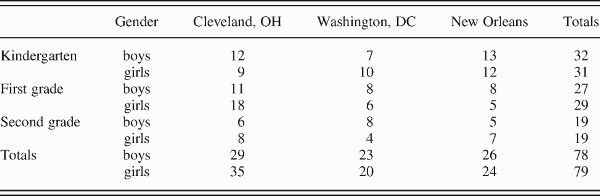
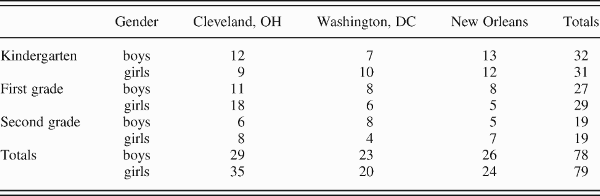
The 157 students examined in the current study were selected because the length of both their imitation and retell samples was adequate for analysis (at least five phonological and morphological items per sample). The students were in kindergarten through second grades (see Table 1). These children lived in neighborhoods that are predominantly populated by minorities of low socioeconomic status; rates for federal free or reduced lunch program in the children's schools are: 94%–100% in New Orleans, 84%–100% in Cleveland, and 74%–94% in Washington, DC.
Composition of the sample by grade, gender, and city
Measures
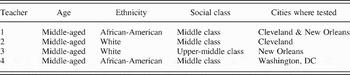
Four female testers, each an experienced teacher, administered the two tasks: sentence repetition and story retelling. The races and backgrounds of the examiners are given in Table 2.
Demographic information for teacher/testers

Sentence imitation
A storybook format was used. The teacher instructed the child by saying, “Here's how we do this. First, I will read a bit, and then you try to say it exactly the way I said it. Sometimes it will be hard to remember everything, but even if you can't say it all, do the best you can, okay?” There were then two practice items to ensure the child's understanding of the instructions. After each practice sentence was imitated, the teacher pointed out differences, if any, between her production and the child's. If necessary, the teacher asked the child to imitate more closely in a second attempt. The seven storybook illustrations showed two children of ambiguous race engaged in activities that correspond to the 15 sentences in the story, which are listed in the Appendix.
Two composite scores were computed, one reflecting the child's production of phonological features, and the other reflecting usage of morphosyntactic forms. Each score represents the number of times that a child produced an AAVE form in lieu of the SAE model out of the total number of opportunities to do so. To compute the phonological score, only the items on which the child actually recalled the item (word or morpheme) in some form (verbatim or altered) were included. The number of phonological dialect differences that the child produced was divided by the number of eligible items, and this ratio was multiplied by 100. To compute the morphosyntactic score, the method was equivalent except that nonrecalled items were included in the eligible set if (a) the omission represented a known feature of AAVE, for example, omission of a copula; and (b) the surrounding portion of the sentence was imitated.
This type of composite dialect score is similar to the approach of speech researchers (e.g., Craig & Washington, Reference Delpit and Dowdy2000; Reference Dubois and Horvath2006) who examine a combination of features to establish the level of dialect density in children's language samples. The features taken individually have been widely reported in the literature on African-American English and can be included in those described by Wolfram and Carpenter (Reference Rickford2006) as core features of African-American Vernacular English.
The following features are included in my analysis:
Phonological features
Consonant cluster reduction
example: best realized as bes'
Interdental fricatives as stops and labiodentals
example: with realized as wit' or wif
The phonological features included in this analysis are also found in other varieties of American English. The frequencies of these features, however, have been found used with greater frequency in African-American English speaking populations Wolfram Reference Wolfram(1969) Labov Reference Labov(1966, Reference Labov1972a).
Morphosyntactic items included in the imitation/retelling analysis are the following.
Zero plural
example: “my three sisters” realized as “my three sister.”
Zero possessive (s)
example: “my momma's house” realized as “my momma house.”
Zero verbal (s)
example: “he sees the dog” realized as “He see the dog.”
Zero copula
example: “he is crazy” realized as “He crazy.”
Morphosyntactic features of AAVE are more specific to the dialect, and may be more salient if used in an academic setting.
Story retelling
At the end of the sentence repetition task, the teacher turned back to the first illustration of the story and said, “Now tell the story back to me. Tell me everything you remember about what happened. Do the best you can.” Teachers were instructed not to ask specific questions about the story and to prompt the child only with the words “anything else?” and with positive reinforcement. Again, the number of dialect differences that the child produced was divided by the number of eligible items, and this ratio was multiplied by 100. Note, however, that because children were free to recast the story into their own words when retelling it, not all features were necessarily included in every speech sample, and the relative proportions of different features in the speech sample varied somewhat from child to child. Therefore, percentage scores on the imitation and retelling tasks are not directly comparable to one another on an absolute basis, although each reflects the relative density of AAVE features used by children.
RESULTS
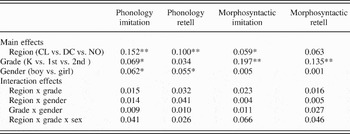
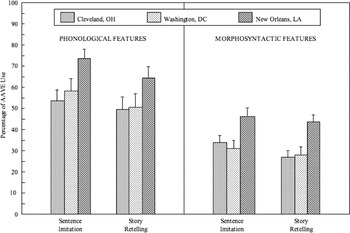
To examine relationships of AAVE usage to grade, gender, and region, a 3 × 2 × 3 analyses of variance (ANOVA) was conducted. The ANOVA results are presented in Table 3. Effect sizes were estimated by partial eta squared statistics, and post hoc Tukey tests were performed as needed to clarify statistically significant effects (the columns in Table 3). Separate ANOVAs were carried out for sentence imitation and story retelling measures because, as noted earlier, scores from the two tasks are not completely comparable for the combination of features on which they are based. Also, as illustrated in Figure 3, although scores from the two tasks were well correlated for the phonological (r=.589) and the morphosyntactic (r=.587) composites (p<.001), they are sufficiently dissimilar linguistically to require separate analyses. A correlation was found between the use of AAVE features on the sentence imitation and the story retell (r 2=.348 for phonological features and r 2=.344 for morphosyntactic features). The results suggest that children in this sample who are consistently more frequent users of AAVE lack linguistic competence in SAE or lack communicative competence in the school setting. Children who are consistently less frequent users of dialect features have a higher degree of linguistic competence in SAE and produce it consistently in the school setting.
Effect sizes (partial eta squared) for differences in phonological and grammatical scores across region, grades, and gender

Effect sizes (partial eta squared) are shown, with conventionally significant effects indicated by asterisks (*p<.01; **p<.001). The cities examined are abbreviated in the chart as follow: CL=Cleveland, DC=Washingtion, District of Columbia, NO=New Orleans.
As in a previous report (Charity et al., Reference Craig and Washington2004), a significant main effect of grade was obtained in analyses of three of the four composite scores, the exclusion being phonological usage in the retelling task. These effects reflected the higher usage of AAVE features by kindergartners than by first or second graders, whose means were similar. In addition, for both of the phonological scores, but neither of the morphosyntactic scores, the boys produced higher percentages of AAVE features than the girls. In no analysis, however, were there any significant interactions of grade or gender with region, and effect sizes for these comparisons were small (.004 to .046). Hence, results for regional differences will not be reported separately for subgroups.
Moderate effect sizes (from .06 to .15) were obtained for the comparison of regional means, and these effects were statistically significant (p<.01), except in the analysis of the morphosyntactic composite for the story-retelling task (p =.98). As shown in Figure 3, means for each dialect difference score were considerably higher in the New Orleans sample than in the samples from Cleveland and Washington, DC, which were quite similar in AAVE feature usage. The error bars in Figure 3 extend two standard errors from the group means.
Differences in AAVE usage by African-American children from three cities.

The mean use of AAVE phonological features for the imitation task is 61%. The mean use of AAVE for the story retelling is 55%. In Cleveland and Washington, DC, there is a wide range in the use of AAVE phonological features across the sample. In contrast, most children in New Orleans produced phonological features of AAVE more than 50% of the time. Their phonological range is restricted both for the individual and across the sample.
The mean use of AAVE morphosyntactic features for the imitation task is 37%. The mean use of AAVE for the story retelling is 32%. As shown in Figure 3, the children in New Orleans again show the most variation across the sample in use of the morphosyntactic features.
DISCUSSION
The results indicate that low socioeconomic status (SES) African-American children in different regions do not, on average, produce AAVE features with the same frequency. Higher frequencies in New Orleans compared to Cleveland or Washington, DC were seen for both phonological and morphosyntactic features of AAVE. Moreover, similar differences among regions were obtained both when children were imitating an SAE model and when they were retelling a story.
Regional differences by feature were similar across speech settings. This indicates that children vary within their use of individual features, but overall, the children's patterns represent a greater use of features based on region. This finding supports the assertions made by Labov (Reference Picone1998) and Wolfram and Schilling Estes (Reference Rickford2005) among others: that the use of core features of AAVE are similar across speech communities, but that their frequencies and their relative acceptability in the local community may vary. While this type of variation may be seen because the speech samples produced by the children are alike (the children are for the most part producing the same words), spontaneous speech would, by most indications, show a greater range of internal constraint differences.
African-American and Southern English feature use by African-American children has been studied in other areas of Louisiana. In southeastern Louisiana, this was studied by Oetting and McDonald (Reference Fought, Chambers, Peter and Natalie2001) and in southwestern Louisiana by Green (Reference Labov, Mufwene, Rickford, Bailey and Baugh2004). While greater sociological and ethnographic analysis of both child and adult speakers is needed to determine why the speech of New Orleans speakers is different, there are several issues that may account for some of the variation. New Orleans is the southernmost city of the three, and there may be greater use of these stable features of AAVE in the South (where presumably many of the features originated) than in the North.
The features analyzed here are features of AAVE, but that does not exclude their use by other Southern speakers and their use in other Southern dialect groups as well. It may also be true that African-Americans of higher socioeconomic status and/or Whites use more of these features in New Orleans, so that the children may feel that greater use of the features in the school setting is acceptable according to local speech norms. Bailey (Reference Bailey2003) presented the situation in antebellum New Orleans as comparable to the linguistic situation in mid-fourteenth century London, where rapid change and great dialect diversity often led to practical and socially motivated dialect leveling. Picone (2003: 416) noted the following:
The linguistic environment of slaves in Louisiana was not stable but was multilingual and volatile. The mix included French-based creoles, French dialects, English dialects, possibly English-based creoles (due to slave migrations from the Atlantic coast and, to a lesser extent, due to the importation of contraband slaves from the Caribbean), African languages (especially during the eighteenth century [Hall 1992], but also later due to contraband shipments), Spanish, and indigenous languages and jargons (primarily during the eighteenth century, but also in the early nineteenth century prior to the “Trail of Tears” removal, and especially in the vicinity of Cane River …
From a social and cultural standpoint, authors including Dubois and Horvath (Reference Fraser, Belugi and Brown2003a), Smedley Reference Smedley(1999), and La Chance (Reference Smedley1992) gave evidence that race and social class, categories that sociolinguists generally treat as external features, are further complicated in New Orleans by the unique and diverse history of the founding and the continually evolving demography of New Orleans. Picone (2003) noted that African-Americans were often the first speakers not to be francophone in and around New Orleans. Picone noted that after the Louisiana Purchase, it became fashionable to have American slaves as opposed to the indigenous Francophone- or Creole-speaking slaves. Later African-American migrants to the area from surrounding states, especially Mississippi and Alabama, were also native English speakers.
Given its unique social and cultural history, phonological features may be used more in New Orleans because they are less stigmatized in the school setting than the morphosyntactic features. Consonant cluster production and interdental fricatives realized as stops and fricatives as opposed to labiodentals are not unique to AAVE, and may be used by teachers and others in the children's sociolinguistic communities at a greater rate than features such as copula absence, which are more unique to African-Americans and carry a greater social stigma even within the African-American community. Thus, phonological features are more likely to be produced by the teachers, even when they are speaking more formally. Interdental fricative use may also be either more common, or less salient or stigmatized than morphological features that are unique to AAVE.
This investigation could be extended by the examination of more varied speech contexts and more diverse settings, such as conversations in the home and on the playground, and groups interviews with other children. These disparate environments may be needed to see variation by speech style; in this sample, the linguistic forms that children are actually evaluated on are limited to those that occur within the school.
What children say and do (and what they do not say and do) in the classroom predicts so much about their future successes and what path their lives will take. To implement change in teacher attitudes and school policy, linguists must emphasize what we can learn in the school setting about African-American children. In the classroom setting, there may be a variety of students from different backgrounds and social networks, but they are taught in the same way. Knowing more about regional differences will help teachers understand what linguistic differences/variation their students may have. Early work on AAVE in children showed that the speech of African-American children is not unsystematic and deprived (Labov, Reference Labov1966; Reference Labov1972a). Many often do not accept this fact because of the mismatch between the richness of the AAVE system that linguists observe and the academic performance of the children who speak it. Our ultimate goal must be to elucidate why this divide persists and then we must work to close it.
APPENDIX
Sentence Imitation Items
1. This is Joe.
2. The girl behind him is called Lisa.
3. She is Joe's best friend.
4. Joe rides his bike down the street really fast.
5. Lisa pushes hard because she is trying to keep up with Joe.
6. Both of the kids are very hungry, so they are going to make themselves a snack.
7. First, they must wash their hands in the bathroom.
8. In the kitchen, Lisa spreads peanut butter on two slices of bread.
9. Joe pours himself some milk without spilling any.
10. He poured another glass for Lisa.
11. Then Joe asked, “Isn't there any jelly?”
12. Lisa answered, “We don't have any jelly so let's have raisins instead.
13. Lisa used raisins to draw a flower on her peanut butter.
14. Joe decided to make an elephant with an open mouth and strong legs.
15. Joe thinks that the snacks are now ready to eat.