Introduction
Brain metastases (BM) are the most common intracranial malignancy in adult patients with systematic cancer and a significant cause of morbidity and mortality. Reference Tsao, Rades and Wirth1,Reference McDuff, Taich and Lawson2 With increasing incidence, BM occur in 20–40 % of patients suffering from primary solid extracerebral tumours. Reference Linskey, Andrews and Asher3 Management options depend on patients and tumour characteristics such as performance status, neurological deficits, tumour size, life expectancy and extracranial disease activity.
Radiotherapy is almost always the most common treatment of brain metastasis. In recent years, stereotactic radiosurgery (SRS) has become a preferred treatment option in the initial management of patients with limited BM. 4 Randomised trials have demonstrated that SRS provides equivalent survival and better neurocognitive function (NCF) compared to whole-brain radiotherapy (WBRT) in both initial management (stand-alone) and postoperative adjuvant setting. Reference Andrews, Scott and Sperduto5–Reference Chang, Wefel and Hess7
In this single-institution retrospective study, we investigated local control (LC), distant brain metastasis (DBM), leptomeningeal control, overall survival (OS) and radiation necrosis rate in patients undergoing SRS for BM. We also aimed to identify the patient, tumour, and treatment-related factors that predict failure, survival, and brain necrosis (BN) after SRS in patients with BM.
Methods
We conducted an IRB-approved retrospective cohort study including all patients with BM with treated SRS. In addition, we retrospectively reviewed the electronic medical records of all consecutive patients with BM. The study cohort included all patients with prior surgery or radiotherapy [WBRT or prophylactic cranial irradiation (PCI)]. Data for his study were collected from December 2019 to March 2021.
In general, the institutional philosophy for salvage SRS versus WBRT was to postpone the use of WBRT for as long as possible and treat with salvage SRS when feasible. No further treatment was reserved for patients with poor life expectancy and who were not expected to benefit from salvage treatment.
We have two different platforms, robotic (Cyberknife M6) and linac-based (Varian EDGE), for SRS delivery. For planning purposes, high-resolution computed tomography (CT) slices with a 1·25 mm thickness were obtained and fused with magnetic resonance imaging (MRI) for tumour contouring. Planning target volume (PTV) was created by adding gross target volume (GTVs) 1 mm in each direction in intact tumours and clinical target volume (CTVs) in resection cavities. Treatment planning was performed using Precision (version 2.0.0.1, Accuray Inc.) and Eclipse (version 15.5, Varian Medical System) treatment planning system software. The prescription dose was normalised to the 70%–80% isodose line range to cover 95% of the PTV volume.
After undergoing SRS, patients underwent follow-up with clinical and radiographic surveillance per institutional standards. Patient and tumour-related factors, treatment details, time until first CNS progression after SRS, type of first central nervous system (CNS) progression (local, distant and leptomeningeal), cause of death and duration of follow-up data were recorded.
An experienced radiologist defined all local recurrences and radiation necrosis with a contrast-enhanced MRI and additional perfusion MRI in the neurooncological tumour board. DBM was defined as any new brain metastasis that developed outside the prior SRS treatment volume. MRI evidence of new nodular enhancement of the dura, diffuse leptomeningeal enhancement or positive cerebrospinal fluid cytology was considered a leptomeningeal failure. Overall survival (OS) was calculated from the completion of SRS to death.
In the descriptive statistics of the data, mean, standard deviation, median minimum, maximum, frequency and ratio values were used. The distribution of variables was measured with the Kolmogorov–Smirnov test. Independent sample t-test and Mann–Whitney u-test were used to analyse independent quantitative data. The chi-square test was used to analyse independent qualitative data, and the Fischer test was used when chi-square test conditions were not met. Cox regression (univariate–multivariate) was used for survival analysis. SPSS 27.0 (IBM SPSS Inc.) program was used in the analysis.
Results
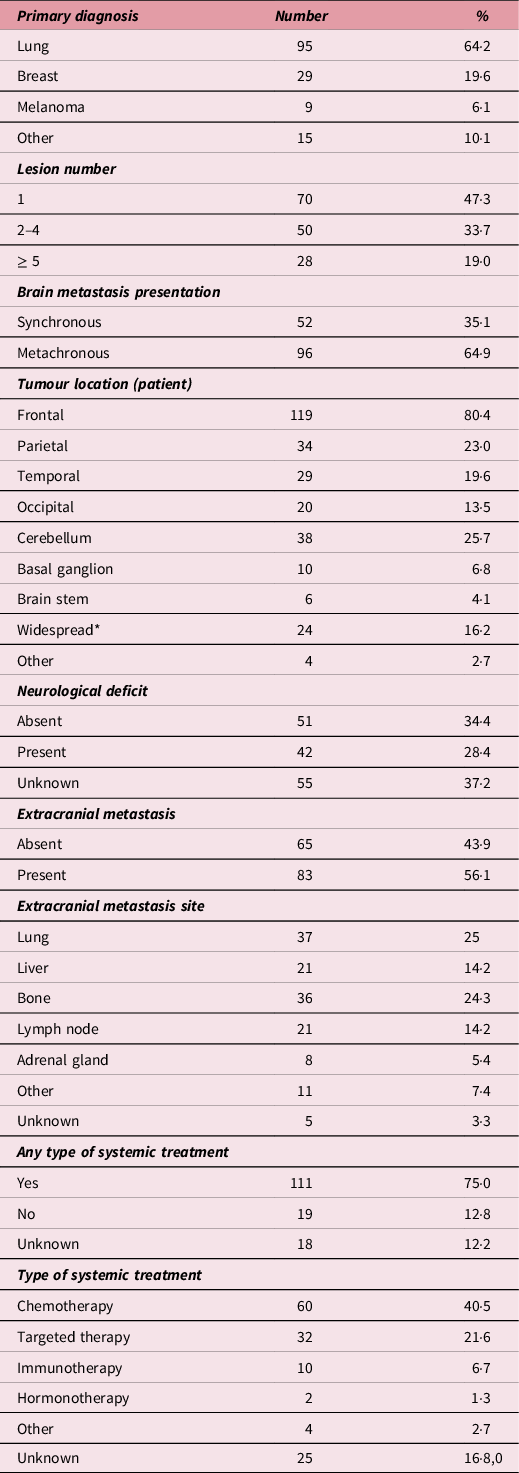
From December 2016 to April 2020, 375 patients were treated with brain SRS. Two hundred twenty-seven patients were excluded because of missing data or less than 6 months of follow-up in surviving patients. The last follow-up was checked in March 2021. One hundred forty-eight consecutive patients, a total of 444 lesions, were analysed.
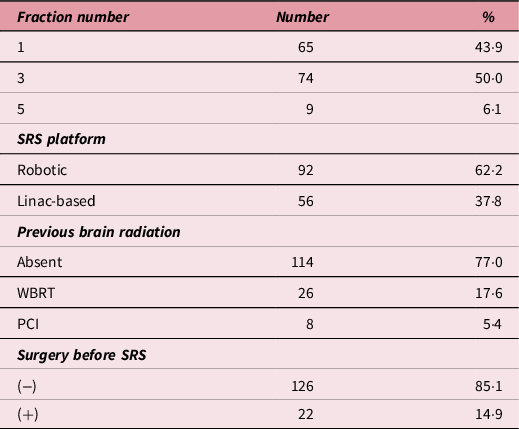
Patient, tumour and treatment characteristics are listed in Tables 1 and 2.
Patient and tumour characteristics

* More than three different supratentorial regions.
Treatment characteristics

The median follow-up was 14·8 months (range 6–51), and the median age was 57 (26–85). The median Karnofsky Performance Scale (KPS) is 90 (50–90 range). Median 2 (1–16) lesions were treated. The medium maximum tumour diameter was 14·3 mm (1–65·3 mm). The prescription doses were 16–18 Gy in a single fraction, 24–27 Gy in three fractions and 30 Gy in five fractions depending on tumour size and the location. The median time between the initial prior RT (WBRT or PCI) and SRS was 7·7 months (1·8–34·1 months). The SRS is used as a salvage strategy in these patients.
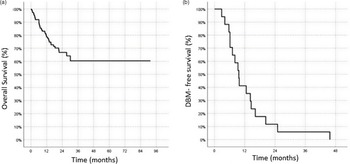
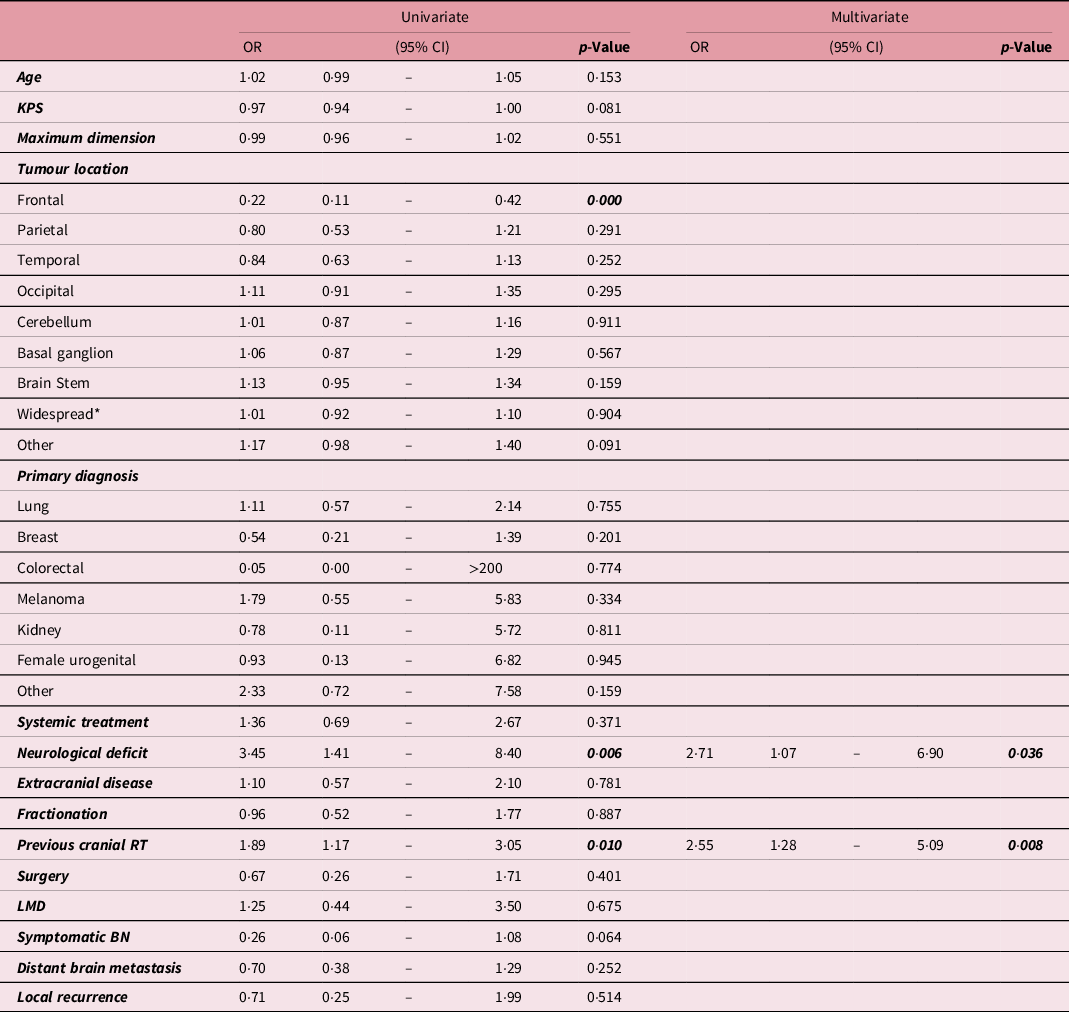
Of the 148 analysed patients, 72·3% were alive, 41 were dead and 36 were alive without disease. One and three years OS survival rates are 80% and 60%, respectively (Figure 1a). Seventy-one patients were alive with disease progression. The presence of neurological deficit (OR 2·71,1·07–6·9, p = 0·036) and prior RT (WBRT and PCI) (OR 2·55, 1·28–5·09, 0·008) is associated with OS in multivariate analyses (Table 3).
Kaplan–Meier curve of overall survival (a) and distant brain metastasis-free survival (b).

Univariate and multivariate competing risk regression analyses of overall survival

* More than three different supratentorial regions.
The local recurrence rate was 11·5 % per patient. The median time to local recurrence was 9·6 months (between 2·8 and 45·7). No significant prognostic factors were associated with LC.
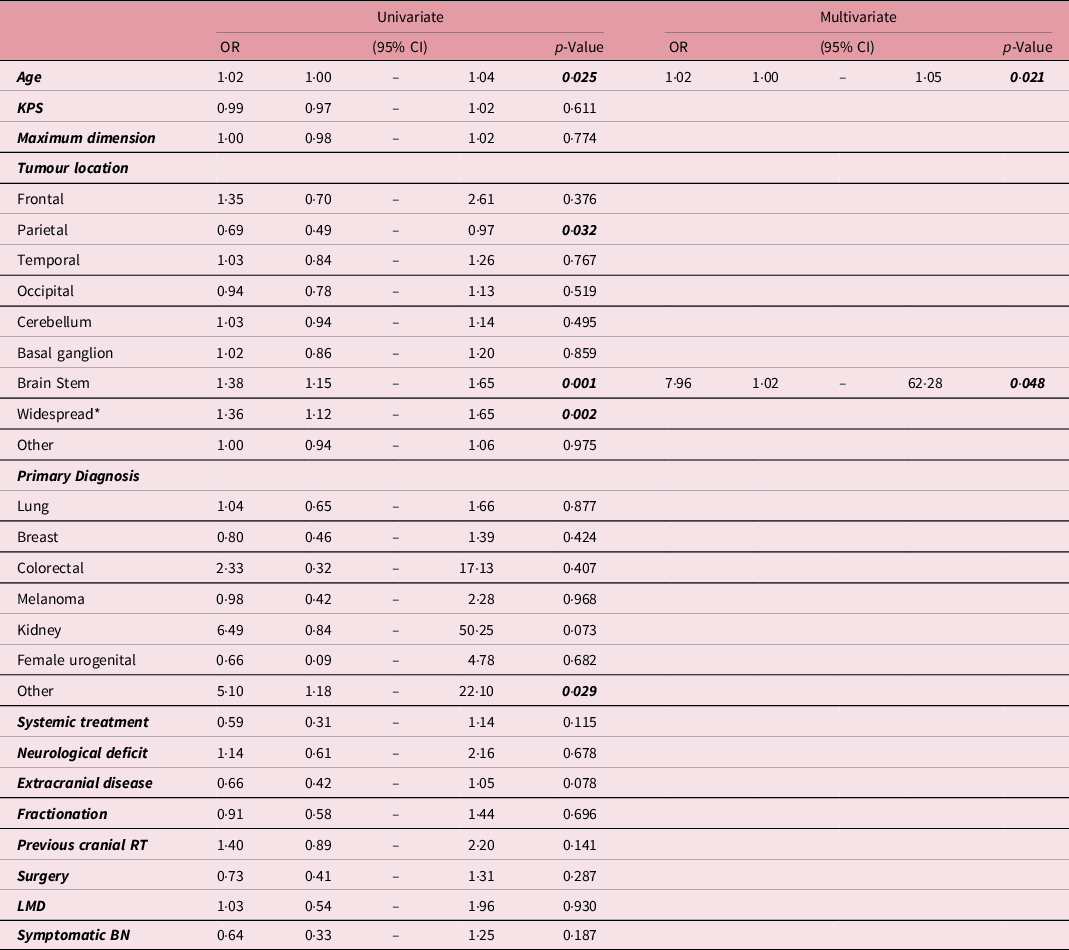
The distant brain recurrence rate was 53·4 % (Figure 1b). The median DBM number was 2 (1–50). The median time to DBM is 6·1 months (between 0·3 and 31). In multivariate analysis, brainstem located lesions (OR 7·97, 1·02–62·28, p = 0·048) and age (OR 1·02, 1–1·05, p = 0·021) were independent parameters for DBM (Table 4). A total of 68 SRS treatments in 53 patients with a median of 1 (1–4 times) and 28 WBRT were applied as a salvage strategy after DBM.
Univariate and multivariate competing risk regression analyses of distant brain metastasis

* More than three different supratentorial regions.
Leptomeningeal metastasis (LMD) was seen in 11 patients (7·4%). The median time to LMD was 14·8 months (between 1·5 and 27·4). No significant prognostic factors were associated with LMD.
Symptomatic radiation necrosis was seen in 19 patients (12·8 %). Median follow-up was longer in patients with BN than patients without BN. The duration of follow is 17·4 versus 13·4 months (p = 0·015). After SRS, the median time to BN development was 12·7 months (between 4·8 and 39·6). BN was more common in those without the extracranial disease (68·4 % versus 31·6%). If BN developed in patients with extracranial disease, it was more likely in patients with only bone metastases (83·3 % versus 40·3 %). The maximal tumour diameter was bigger in patients with BN 13 versus 23 mm (p = 0·034). Cavity radiosurgery is associated with more BN (p = 0·004). Seven out of 22 patients with prior surgery had BN.
Discussion
We present our brain metastasis SRS results in modern technology and systemic treatment area. The survival of metastatic patients has increased since recent imaging and systemic therapy improvements. So LC and side effects related to RT have become increasingly important. The ASTRO guidelines recommend using estimated prognosis and guide treatment decisions. Reference Tsao, Rades and Wirth1
Survival is a complex end point in patients with BM and is influenced by multiple factors. WBRT does not provide survival benefits compared to SRS. Reference Andrews, Scott and Sperduto5–Reference Chang, Wefel and Hess7 In our study, previous whole-brain radiation is associated with decreased survival. These patients probably have more metastasis in initial brain metastasis diagnosis, and after WBRT, residual more radioresistance colones or decreased NCFs may lead to decreased survival.
Intracranial disease progression or WBRT itself can cause neurocognitive decline. In addition, declining NCF increases the caregiver burden and impairs financial, work and social activities. Reference Schulz and Sherwood8 There are no published randomised trials for SRS versus WBRT for patients with five or more BM. This study did not define any correlation between lesion number and treatment outcomes. Yamamoto et al. Reference Yamamoto, Serizawa and Shuto9,Reference Yamamoto, Kawabe and Sato10 documented non-inferior OS rates for patients with 5–10 BM treated with SRS compared to 2–4 lesions. There is no scientific rationale for selecting a certain number of tumours as the cut-off number. Cumulative tumour volume may be more critical in prognostication than lesion number. Reference Routman, Bian and Diao11,Reference Hatiboglu and Akdur12 Brain SRS versus hippocampus avoidance WBRT with memantine in multiple BM is now evaluating in a prospective study. 13
Distant brain recurrence is the main recurrence pattern after brain SRS, with a median 54% (range 35·5%–68%) similar to our study. Reference Redmond, De Salles and Fariselli14 Compared to WBRT, patients treated with SRS are more likely to require salvage therapy following the development of new BM, Reference Brown, Ballman and Cerhan15 but no differences in OS were found. Reference Churilla, Ballman and Brown16 We observed that SRS is a frequent salvage treatment strategy for managing intracranial relapses after SRS (SRS: 68 times in 53 patients versus WBRT: 28 patients). Close surveillance with MRI after SRS treatments is standard in our department for early detection and possible early salvage treatments of CNS relapses. However, no prospective trial analysed the impact of regular MRI follow-up.
Postoperative resection cavity radiosurgery is associated with symptomatic radiation necrosis. There are some uncertainties in defining postoperative treatment volume. Reference Soliman, Ruschin and Angelov17 Normal brain tissue exposes to more radiation with additional PTV margins than primary intact brain SRS treatments. Reference Prabhu, Patel and Press18 Fractionated stereotactic radiotherapy should be preferred for these lesions. Reference Minniti, Clarke and Lanzetta19,Reference Milano, Grimm and Niemierko20 Although we could not show it in this study, cavity SRS is associated with increased LMD rates in the literature. Reference Atalar, Choi and Harsh21–Reference Prabhu, Turner and Asher23 Preoperative SRS can be a good treatment option for BM requiring surgical resection with lower BN and LMD rates. Reference Prabhu, Patel and Press18,Reference Patel, Burri and Asher24
Melanoma, sarcoma and renal cell carcinoma BM have traditionally been considered radioresistant. Reference Khan, Arooj and Li25 However, our analyses found no difference between LC rates comparing different histologies. This radioresistance probably exists in conventional radiotherapy settings, and high doses of radiation with SRS overcome this issue with some radiobiological advantages. Reference Sayan, Zoto Mustafayev and Sahin26 Nevertheless, there is a steep dose response in patients with small melanoma metastases, and dose escalation may benefit LC. Reference Redmond, Gui and Benedict27
Eloquent areas in the central nervous system have a potential higher toxicity risk than other brain regions. Reference Milano, Grimm and Niemierko20 We decreased the dose in the cerebellum, brainstem and eloquent areas by one gray per fraction and used multi-fractionated SRS. With this strategy, similar LC can be achieved compared to the other brain subregions without elevated symptomatic BN rates.
In our series, BN rate increased with longer follow-up and was more common in patients with extra- and intracranially controlled disease or only with bone metastases. As these patients live longer than with uncontrolled disease, the likelihood of side effects associated with oncological treatments may increase. In today’s oncology era, where longer survivals can be achieved with better treatments, the importance of treatment-related toxicities such as BN is increasing, and stricter rules should be followed to prevent them.
The present study has inherent limitations based on its retrospective nature, and the results may be somewhat influenced by clinical selection bias. Nevertheless, standardisation in treatment benefited from the fact that all imaging and treatment were done at a single institution.
Conclusion
SRS is an effective local treatment with a high LC rate in brain metastasis. Furthermore, distant brain recurrence is the main recurrence pattern after brain SRS and is generally salvageable with repeated brain SRS. Due to the increased risk of BN, routine metastasectomy should be made with caution.
Financial Support
None.
Conflict of Interest
None.