
I. INTRODUCTION
As for the lack of fossil fuel-energy sources and increasingly worsened environmental pollution, ever-increasing demands for renewable energy technologies have stimulated extensive interest in the development of energy storage devices and efficient energy harvesters, without doing harm to our environment.Reference Ahmed, Mahmood, Hasan, Sidhu and Butt1–Reference Liang, Yan, Liao, Cao, Zheng, Si, Lu and Zhang3 Supercapacitors (SCs), also known as electrochemical capacitors or ultracapacitors, have the advantages of rapid charge–discharge response, simple operating mechanisms, favorable safety, high specific power, and long operating life (>100,000 cycles), and therefore have been widely recognized as one of the efficient energy-storage devices from both the academia and industry.Reference Yu, Qiu, Wang, Zhai, Fang, Lu and Tong4 In this context, SCs plays a vital role in high-power electronic devices, hybrid electric vehicles, and emergency power supplies. Nevertheless, the relatively lower energy density of SCs than that of batteries makes it the bottleneck of these energy devices, dramatically restricting their practical applications as the primary power sources. Therefore, considerable efforts for SCs studies have been intensively devoted toward increasing the energy density, and significant progress has been made recently.Reference Yu, Lin, Feng, Zeng, Tong and Lu5–Reference Yu, Zhao, Feng, Hu, Zhang, Zeng, Tong and Lu7 It is generally accepted that the rational design and controllable synthesis of the nanostructured electrode with large surface areas and good structural stability is one promising strategy in solving this bottleneck.Reference Zheng, Feng, Zhang, He, Yu, Lu and Tong8
According to the type of the electrode material as well as the energy storage mechanism, SCs can essentially be distinguished into two types that are electrochemical double layer capacitors (EDLCs) and pseudocapacitors (PCs). Carbon materials with large specific surface areas have been widely used in EDLCs, which store energy by accumulating charges on the electrode/electrolyte interface. While PCs used the electrode made of redox-active materials, such as transition metallic compounds, conductive polymers and surface functional groups, which can further store energy with fast and reversible redox reactions occurring on the surface of the electrodes or ion intercalation into the bulk materials and thus achieve higher capacitance than that of general EDLCs. Particularly, in all kinds of redox-active materials that can be used as the electrode material for PCs, transition metal oxides (e.g., RuO2,Reference Ma, Kong, Xu, Xie, Tao, Xiao, Lv, Jang, Huang and Yang9 MnO2,Reference Lu, Yu, Wang, Zhai, Xie, Ling, Tong and Li10,Reference Yu, Feng, Liu, Li and Liu11 VOx,Reference Zhai, Lu, Ling, Yu, Wang, Liu, Liang, Tong and Li12,Reference Bai, Liu, Luan, Li and Liu13 CoOx,Reference Zhai, Wan, Sun, Chen, Sun, Xia and Xia14 NiOx,Reference Yu, Wang, Li, Zhai, Lu and Tong15 etc.) have attracted large amounts of attentions, owing to the higher theoretical capacitance (about 300–1200 F/g)Reference Singh, Sarkar, Khan and Mandal16 and lower cost as compared to the conducting polymers. Nevertheless, such materials seriously suffer from poor ionic and electronic conductivity that limits their practical application in SCs.Reference Rui, Tan and Yan17 One of the excellent and feasible solutions to solve this problem is to design binary transition metal oxides, such as NiCo2O4 (denoted as NCO),Reference Padmanathan and Selladurai18,Reference Ma, Yu, Xu and Lou19 CoMoO4,Reference Zhao, Teng, Liu, Du, Xu and Teng20 NiMnO3,Reference Giri, Ghosh and Das21 and ZnCo2O4.Reference Liu, Liu, Wang, Wang, Xiang, Chen and Shen22 The advantage of different metal cations combining with multiple oxidation state features, accelerate the improvement of electrical conductivity and specific capacitance. Especially, NCO has been identified as the most promising electrode material candidate for the next generation SCs because of the co-existence of Ni and Co species that provide exceptionally higher theoretical capacitance (2125 F/g), better redox activity, and superior electrical conductivity than simplex nickel oxides and cobaltite oxides.Reference Zhang, Wu, Hoster, Chan-Park and Lou23 Moreover, many other merits such as abundant resources, low cost, and environmental friendliness are still maintained. Toward this issue, significant progress has been achieved in the synthesis and electrochemical evaluation of the NCO-based electrode materials. For instance, the hollow NiCoO2 nanoparticles synthesized by the hydrothermal method displays a reversible capacitance of 328 F/g at the current density of 0.62 A/g,Reference Zhang and Xu24 a novel hierarchical NCO nanosheets@hollow microrod array with an increased surface area showed a specific capacitance of 678 F/g at the current density of 6 A/g,Reference Lu, Wu, Li, Li, Ye, Tong and Li25 the porous NCO nanowires synthesized via the polyethylene glycol-directed technique exhibit a high specific capacitance of 743 F/g at the current density of 1 A/g,Reference Jiang, Ma and Li26 and NiCoO2 flowers grown on Ni foam achieved a specific capacitance of 756 F/g at the current density of 0.75 A/g.Reference Xu, Zhao, Zhou, Xue and Gao27 It is obvious that the electrochemical performance of most current NCO electrodes is yet below the expectation, which is due to their low electrical conductivity and poor stability as a result of the limited electron and ion transport as well as easy aggregation structure among the charge–discharge cycles. In this regard, it remains scientifically important and striking challenge to explore new effective methods for designing stable and state-of-the-art NCO electrodes for SCs.
Being aware of the important charge transfer processes through the electrode materials; continuing advancements of the nanomaterial give us an idea that the fabrication of composite materials composed of high conductivity ones, as well as the attempt to improve its inherent electrical conductivity would be very effective for remarkable improvement of electrochemical performance. Various conductive materials such as conductive polymers, metals, and carbon materials have been evidenced to exhibit improved electrochemical performance.Reference Liu, Zhang, Song and Li28,Reference Liu, Zhu, Kou, Worsley, Qian, Condes, Duoss, Spadaccini and Li29 Among these conductive materials, nitrogen modified carbon materials were reported to possess outstanding electrochemical performance for SCs.Reference Xu, Wei, Tan, Yu and Chen30,Reference Wang, Li, Yin, Lu, Chen, Gentle, Lu and Cheng31 Particularly, the carbon skeleton with high conductivity and favorable mechanical properties offers a capable support for active materials, while the nitrogen with five valence electrons increases the charge-density of the space-charge layer,Reference Hulicova, Yamashita, Soneda, Hatori and Kodama32–Reference Lota, Lota and Frackowiak34 thereby strengthening the redox reactions of PCs.Reference Frackowiak, Lota, Machnikowski, Vix-Guterl and Béguin35 So, we committed to fabricate the composite materials composed of nitrogen-doped carbon materials with binary transition metal compound to take full advantage of the high conductivity of the nitrogen-doped carbon materials as well as the significantly enhanced redox activity of the binary transition metal compound. Despite this, improvement of the inherent electrical conductivity of the transition metal compound is still highly desirable for their superior capacitive performance.Reference Lu, Wang, Zhai, Yu, Gan, Tong and Li36
Bearing all these in mind, herein, we reported the facile synthesis of an effective binder-free supercapacitor electrode consisting of binary transition metallic (Ni–Co) nanoparticles embedded nitrogen doped porous carbon matrix on graphite papers (GPs). The 3D hierarchical NCO nanorods are directly assembled on GPs by a simple hydrothermal method. Electrodeposited polyaniline (denoted as PANI) is a favorable N source during the carbonization, which generates the formation of N-doped porous carbon matrix and further promotes the reduction of NCO to obtain ultrafine metallic Ni–Co nanoparticles with ultrafine structure and greatly enhanced conductivity. Therefore, after the carbonization of PANI-wrapped NCO (defined as NCC), mesoporous N-doped carbon matrix was obtained, with Ni–Co nanoparticles homogenously dispersed over the whole structure. Orienting from such a favorable hybrid structure, NCC depicts outstanding electrochemical performance for SCs. An outstanding specific capacitance of 933.5 F/g was reached at a current density of 1 mA/cm2 (2.5 A/g), which is nearly 10-folds as high as that of NCO electrode (99.3 F/g). Moreover, it is also demonstrated that the NCC composites possess a much lower charge ion transfer resistance than the NCO one. Finally, favorable stability was verified by the long-term galvanostatic charge–discharge (GCD) measurement. Given the advantages such as binder-free carbon skeleton, ultrafine metallic partial size, and coverage of porous nitrogen doped carbons, this novel material is hoped to provide guideline for the design of high-performance SCs electrode.
II. EXPERIMENTAL
A. Materials
Graphite paper (HCP202N, Hesen Co., Shanghai, China) with the theakness of 0.2 mm was cutted into 2 × 3 cm before use. Acetone (C3H6O, Jinhuada Co., Guangzhou, China), ethanol (C2H5OH, Jinhuada Co., Guangzhou, China), Nickel chloride hexahydrate (NiCl2·6H2O, Damao Reagent Co., Tianjin, China), Cobalt chloride hexahydrate (CoCl2·6H2O, Aldrich, Shanghai, China), Nickel chloride hexahydrate (NiCl2·6H2O, Damao Reagent Co., Tianjin, China), Urea (H2NCONH2, Tianjin ZhiYuan Reagent Co., Tianjin, China), Sodium sulfate (Na2SO4, Guangzhou Chemical Reagent Co., Guangzhou, China), Sodium hydroxide (NaOH, Guangzhou Chemical Reagent Co., Guangzhou, China), Potassium hydroxide (KOH, Damao Reagent Co., Tianjin, China) and Aniline monomer (Aldrich, Shanghai, China) were of analytical grade and were used directly without any purification. The water used in this work was deionized (DI) water, which was simply deionized by passage through ion-exchange columns.
B. Preparation of NCO nano-needles
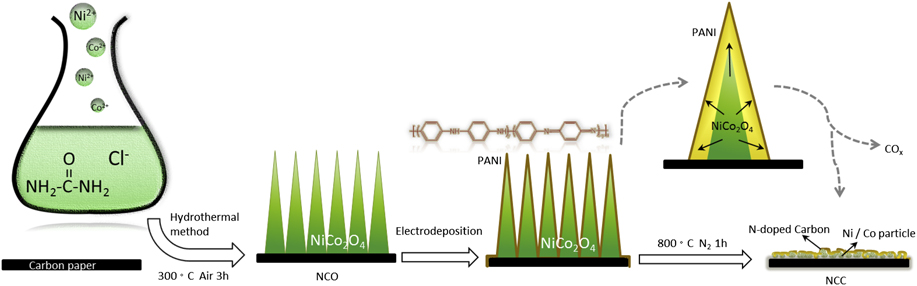
Free-standing NCO nano-needles were grown on graphite paper (GP) by a two-step process, as illustrated in Scheme 1. NCO nano-needles were firstly synthesized on graphite paper via a simple one step hydrothermal method. The graphite paper (2 × 3 cm) was ultrasonically cleaned with 15 mL acetone and 15 mL ethanol for 10 min respectively. In the meantime, 0.7 mmol NiCl2·6H2O, 0.7 mmol CoCl2·6H2O and 7 mmol urea were dissolved in 20 mL deionized (DI) water in turn and stirred into a pellucid solution, followed by the washed graphite paper being immersed in this clear solution and were transferred to a Teflon-lined stainless-steel autoclave (25 mL volume). The sealed autoclave was heated in an electric oven at 100 °C for 8 h and then allowed to cool down slowly at room temperature. A black NCO film was uniformly coated on the graphite carbon surface. The sample was thoroughly washed with DI water and dried at 60 °C. Finally, the NCO nano-needles were further annealed in air at 300 °C for 3 h. The mass loading of NCO nano-needles on graphite paper is about 1 mg/cm2.
Illustration of the synthesis procedure of Ni–Co composite metal embedded porous N-doped carbon on carbon paper.

C. Preperation of NCC electrode
A thin layer of PANI deposited on NCO was prepared through a galvanostatic electrodeposition method by using a CHI760D workstation. The electrodeposition was conducted in a three-electrode electrochemical cell and used Pt counter electrodes, Ag/AgCl reference electrodes with an aqueous solution (17 mL) containing 0.1 mol/L aniline monomer and 0.05 mol/L sodium sulfate at 2.5 mA/cm2 for 300 s at room temperature. Straight after the specific sample was thoroughly washed with DI water and dried at 60 °C, the obtained PANI/NCO/GP was directly annealed in N2 at 800 °C for 1 h to obtain NCC on GP. And the mass loading of NCC is 0.4 mg/cm2.
D. Material characterization
The microstructures of the different samples were analyzed by field-emission scanning electron microscope (FE-SEM; JSM-6330F, JEOL Ltd., Tokyo, Japan) and transmission electron microscope (TEM; FEI Tecnai G2 F30, FEI, Eindhoven, the Netherlands), which equipped with an EMSA/MAS energy dispersive spectroscope (EDS). The compositions of the products were determined by X-ray diffractometry (XRD; D8 ADVANCE, BRuker Corp., Karlsruhe, Germany), Raman spectroscopy (Renishaw inVia, Renishaw plc, Wotton-under-Edge, United Kingdom), X-ray Photoelectron Spectroscopy (XPS; ESCALab250, Thermo VG, ThermoFisher Scientific, Waltham, Massachusetts), and Brunauer–Emmett–Teller (BET; ASAP 2020 Plus 1.02.01, Micromeritics, Norcross, Georgia). Furthermore, thermogravimetric analysis (TG; TG-209, NETZSCH, Selb, Germany) and thermogravimetric differential scanning calorimetry (DSC; Dsc-7, Perkin-Elmer, Waltham, Massachusetts) measurement was performed (from room temperature to 1050 °C) with the heating rate of 10 °C/min in air atmosphere. Cyclic voltammetry (CV), galvanostatic charge–discharge (GCD) and electrochemical impedance (EIS) measurements were carried out by employing an electrochemical workstation (CHI 760D, CH Instruments, Austin, Texas). All the electrochemical studies of the individual electrode were performed in conventional three-electrode cells and used Pt counter electrodes, Hg/HgO reference electrodes (1 M NaOH, Shanghai Chenhua Co., Shanghai, China) and 6 M KOH electrolyte. The NCO and NCC samples are directly made to act as the working electrodes without any ancillary materials or conventional metal current collectors. The specific capacitance was calculated from their GCD curves by the following equation:
 $$C = {{I \times \Delta t} \over {\Delta V \times m}}\quad ,$$
where C (F/g) is the specific capacitance, I (A) is the discharge current, Δt (s) is the discharge time, ΔV (V) is the voltage range of discharge after IR drop, and m (g) is the mass loading of the active electrode material.
III. RESULTS AND DISCUSSION
A. Structural analyses of NCC electrode
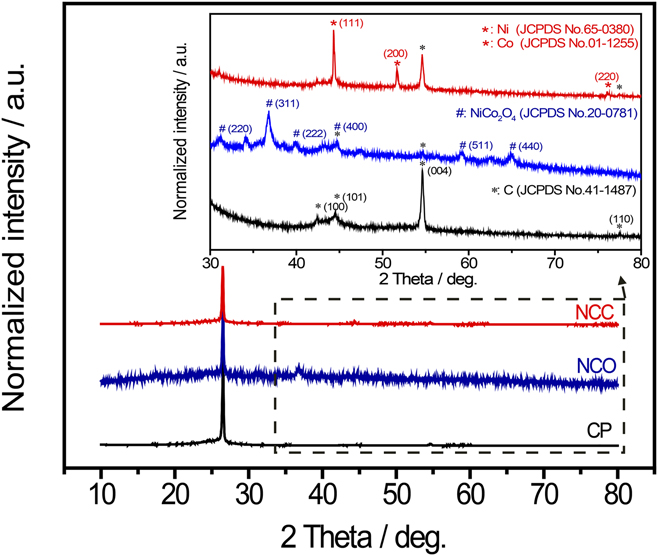
The structural transitions from NCO to Ni–Co metallic partials have been first studied by X-ray diffractometry (XRD), as shown in Fig. 1. The bare GP, NCO, and NCC materials display the same relatively strong diffraction peaks at around 26.42°, which is corresponding to the characteristic peaks of the carbon substrate of GP. To have a better idea of the relatively weaker peaks more clearly, we zoomed in the XRD patterns from 30 to 80°, shown in the inset of Fig. 1. Six characteristic diffraction peaks at around 31.1, 36.7, 38.4, 44.6, 59.1, and 65.0° are observed in the XRD patterns of NCO composites excluding the peaks owning to GP, which are ascribed to the (220), (311), (222), (400), (511), and (440) planes of cubic NiCo2O4 (JCPSDS no. 20-0781), respectively. However, after carbonization of NCO/PANI composite materials, no crystalline peaks of NCO are found in that of the NCC sample and replaced with three strong diffraction peaks at about 44.3, 51.7, and 76.1° corresponding to the (111), (200), and (220) planes of cubic Ni metal and Co metal, which could be indexed to cubic Ni (JCPDS no. 65-0380) and Co (JCPDS no. 01-1255). This demonstrates the fact that the cubic binary nickel cobaltite oxide has completely been reduced during the carbonization reaction, and as a result, the Ni–Co metallic composite are obtained with high crystallinity.
XRD profiles of CP, NCO and NCC samples.

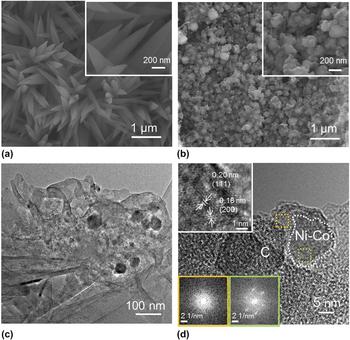
The scanning electron microscope (SEM) and transmission electron microscope (TEM) images were conducted to observe the microstructure of the prepared NCO and NCC samples. As shown in Fig. 2(a), abundant NCO nano-needles were uniformly grown on the surface of graphite paper through a facile hydrothermal reaction. High-magnification SEM image [inset of Fig. 2(a)] further indicates that NCO nano-needles have an average diameter of about 200 nm and length up to 1 μm. In addition, TEM images show the rough and porous surface of the NCO electrode [Supplementary Material, Figs. S1(a) and S1(b)] and the high-resolution TEM (HRTEM) image [Supplementary Material, Fig. S1(c)] reveals the well-defined lattice fringe of 0.22 and 0.30 nm that match well with the (400) and (220) plane of cubic NiCo2O4 (JCPSDS no. 20-0781). And further elemental analysis also confirms the homogeneous presence of Ni, Co, and O elements within the overall nano-needles [Supplementary Material, Figs. S1(d)–S1(g)]. Then, after an electrochemical deposition process, a thin nanolayer of PANI was formed over NCO nano-needles core with its morphologic structure unchanged [Supplementary Material, Figs. S2(a) and S2(b)]. However, during the thermal reduction process, as shown in Fig. 2(b), the morphologic structure of cubic binary nickel cobaltite oxide was collapsed thus forming the 2D core/shell type Ni–Co/carbon cluster of about 200 nm diameter. Furthermore, TEM images [Fig. 2(c)] are used to detail the structural properties of NCC scratched down from the graphite paper substrate, which clearly shows that it consists of rough and porous carbon together with ultrathin nanoparticles. The roughness and porosity of carbon matrix, derived from the oxidation of cubic binary nickel cobaltite oxide and the etching effect of Ni particles, can form a unique 3D structure, which is of help in the penetration of electrolyte and the transmission of electrons. Both the HRTEM image and SAED pattern demonstrate that the carbon matrix is amorphous, while the Ni–Co nanoparticles with the diameter of about 15–50 nm is polycrystalline [Fig. 2(d)]. Furthermore, the observed lattice spacing of 0.18 and 0.20 nm correspond to the (200) and (111) planes of cubic Ni (JCPDS no. 65-0380) and Co (JCPDS no. 01-1255), respectively [Fig. 2(d)], matching well with the XRD test.
SEM images of (a) NCO; (b) NCC sample; Corresponding (c) TEM images and (d) HRTEM images of NCC sample. The insets in panel (d) are the SAED patterns.

B. Component characterization of NCC electrode
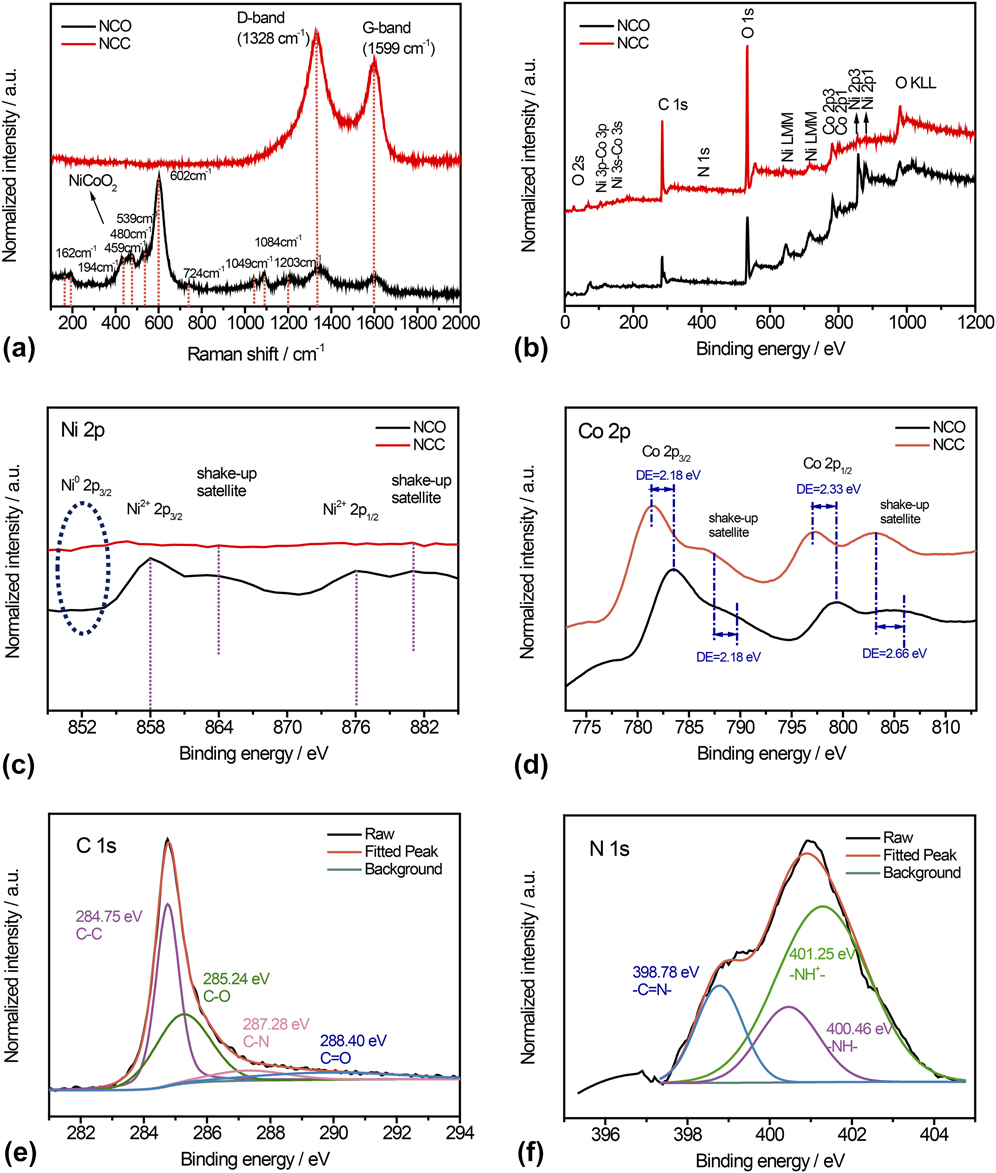
To gain insight into the compositional evolution of the NCO and NCC samples, therefore, Raman and X-ray Photoelectron Spectroscopy (XPS) analysis were studied. First of all, Fig. 3(a) compares the Raman spectra of the NCO and NCC electrodes in the range 2000–100 cm−1. Five vibrational peaks at 162, 459, 480, and 602 cm−1 of the NCO sample [black thread in Fig. 3(a)] are corresponding to F2g, E2g, F2g, and A1g modes of NCO, respectively, which are well consistent with the previously report.Reference Umeshbabu, Rajeshkhanna, Justin and Rao37,Reference Windisch, Exarhos and Owings38 Besides, the extra peaks in Fig. 3(a) also ascribed to the Co–O and Ni–O vibrations of the NCO structure.Reference Du, Gao, Tian, Li, Zhang, Guo and Qian39–Reference Hadjiev, Iliev and Vergilov41 Upon carbonization to form the NCC electrode, the NCO signals were disappeared dramatically, confirming the breaks of Ni–O and Co–O chemical bonds resulting in the reduction of the binary nickel cobaltite to form the simple substance.Reference Dong, Zhang, Xu, Gao, Ding, Li and Li42–Reference Fan, Fu, Shu, Luo, Zhu, Liu, Yue and Zheng44 Figure 3(b) presents XPS survey spectra of the NCO and NCC samples. Except for the specific N signal which derived from the carbonization of PANI standing on the NCC electrode, signals of Ni, Co, C, and O are detected for both the NCO and NCC samples. The core-level Ni 2p XPS spectra of the NCO and NCC samples are compared in Fig. 3(c). The peaks centered at 858.0 and 876.1 eV are corresponding to the characteristic Ni 2p 3/2 and Ni 2p 1/2 peaks of Ni2+, respectively.Reference Peck and Langell45,Reference Biesinger, Lau, Gerson and Smart46 In comparison with the NCO sample, the intensities of the characteristic Ni 2p peaks of the NCC sample are much weaker and the additional peak at about 852.4 eV corresponding to the characteristic Ni 2p 3/2 peak of Ni0 in NCC,Reference Yu, Wang, Li, Zhai, Lu and Tong15,Reference Li, Liang, Lu, Tong and Li47 again indicating that the NCO was reduced after carbonization. Additionally, Fig. 3(d) compares the core level Co 2p XPS spectra of these two samples. The two apparent peaks at about 783.5 eV (Co 2p 3/2) and 799.36 eV (Co 2p 1/2) are best fitted with two spin–orbit doublets of Co2+ and Co3+, and satellite peaks also match well with previously reported peaks.Reference Xu, Zhao, Zhou, Xue and Gao27,Reference Liang, Li, Wang, Zhou, Wang, Regier and Dai48,Reference Harilal, Krishnan, Vijayan, Reddy, Adams, Barron, Yusoff and Jose49 Specifically, the shift of the corresponding peak of NCC to 781.32 eV (Co 2p 3/2) and 797.03 eV (Co 2p 1/2) implies the decrease of Co valence state as well as strong interactions between Ni–Co and carbon matrix.Reference Pisani, Chan, Montanari and Harrison50,Reference Lu, Gu, Wang, Wu, Liao and Li51 Importantly, the NCC sample exhibited apparently higher intensity in the specific C and N peak when compared with that of the NCO sample. Moreover, as shown in Figs. 3(e) and 3(f), the normalized C 1s and N 1s core-level spectra of NCC were well deconvoluted. Four fitting peaks located at 284.75, 285.24, 287.28, and 288.40 eV in Fig. 3(e) are corresponding to the carbons in C=C, C–O, C–N, and C=O groups, respectively.Reference Xu, Xia, Zhang and Gao52,Reference Yan, Zhang, Mao, Huang, Ding and Pang53 Additionally, the three peaks centered at 398.78, 400.46, and 401.25 eV in the N 1s spectrum [Fig. 3(f)] are attributed to C=N, N–H, and NH+ structures,Reference Zinovyeva, Vorotyntsev, Bezverkhyy, Chaumont and Hierso54,Reference Xu, Hong, Zhao, Song, Qiu and Gao55 which are derived from the carbonization of clad layer formed by PANI. The XPS results demonstrated the successful coating of Ni–Co metallic with nitrogen doped carbon through carbonization of PANI, which further agree with the thermogravimetric analysis (TG) and thermogravimetric differential scanning calorimetry (DSC) analyses result (Supplementary Material, Fig. S3). The TG curves of both NCO and NCC materials show two-stage thermal degradation. The weight loss of these two samples in the first stage is around 0.5% up to 350 °C, which is attributed to the removal of water molecules. The rather little increasement of the specific weight of NCC cannot be observed, which confirms that the NCC electrode was completely coated by a carbon shell with hardly any nickel and cobalt nanoparticles exposed to the outside surface of NCC. Therefore, encapsulating Ni–Co nanoparticles began to react with air only when the uniform carbon layer had been burnt off. For the NCC electrode, however, at this stage, the weight increment from the oxidation of elementary substance nanoparticles would be compensated by the weight loss from the oxidation of the carbon matrix. Thus, the weight attenuation rate of the NCC sample is significantly slower than that of the NCO sample in a temperature range of 350–950 °C. And based on the TG results, weight contents of nickel and cobalt nanoparticles in the NCC electrode are found to be about 45.8%. Figure S3 also depicts differential DSC curves (short dot line) of NCO and NCC electrode. The DSC curve of NCO (blue) and NCC (red) sample shows only endothermic peaks, demonstrating that the oxidation of elemental Ni–Co nanoparticles did not run ahead of the themolysis of the carbon matrix, which again certified that those elemental Ni–Co nanoparticles were well wrapped by the carbon matrix. DSC curves of NCO and NCC samples show the same decay rate in the range of 0–200 °C that are attributed to the removal of water from the surface and the interior of these nanocomposites, respectively. Furthermore, three endothermic peaks are observed at 400, 700, and 900 °C, which represent the three stage thermal degradations during the decomposition process of the NCO and NCC electrode. The first two endothermic peaks on the DSC curve of the NCO sample are assigned to the oxidation of NCO nano-needles, and the third one is assigned to the oxidation of the carbon matrix. However, the comparably gentler DSC curve of the NCC sample indicates that the energy loss from the endothermic reactions of the electrode material would be compensated by the energy gain from the exothermic oxidation of elemental Ni–Co nanoparticles, which is in line with the thermogravimetric analysis. These results indicate that with the help of elemental Ni–Co nanoparticles, the NCC electrode can slow down the thermal decomposition and has a better thermal stability than NCO synthesized by a simple hydrothermal method. Also, the nitrogen-doped carbon matrix derived from carbonization of PANI is acting as a barrier, blocking the degradation of active metal particle and hinder the diffusion of degraded Ni–Co particle form the NCC composite. This demonstrates an extraordinary stability of the NCC electrode, which can be operated safely and thus possess great advantages in terms of practical applications. Simultaneously, the specific surface area was measured for both NCO and NCC composites from the Brunauer–Emmett–Teller (BET) data. A surface area of 12.93 m2/g is calculated for NCC electrode, while the pristine NCO electrode only owns a small specific surface area of 8.74 m2/g. Noteworthy is that both samples were measured via cutting the carbon paper into pieces, whose most proportion is the bare carbon paper. The true specific surface area of the active carbon shell is huger than the present value, which is one of the main reasons for the enhanced capacitance of NCC electrode.
(a) Raman spectra and (b) XPS survey spectra of the NCO and NCC sample. Overlay of normalized (c) Ni 2p and (d) Co 2p core-level XPS spectra of the NCO (red line) and NCC (black line) sample, together with specific (e) C 1s and (f) N 1s core-level spectra of the NCC sample.

C. Electrochemical performance of NCC electrode
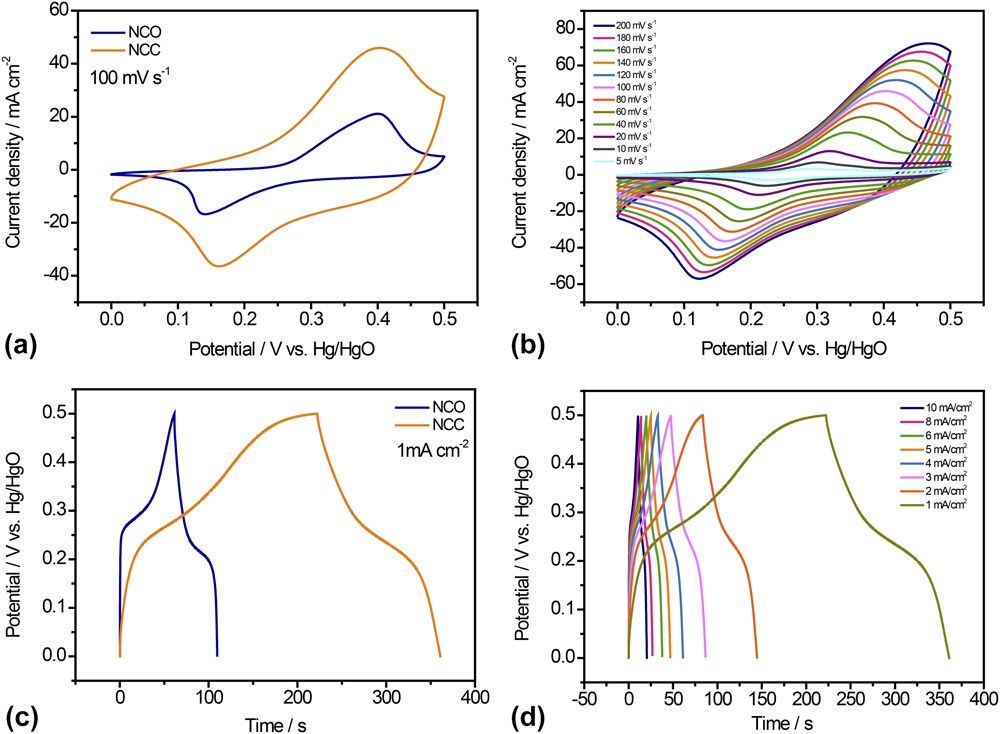
Electrochemical measurements were conducted to evaluate the electrochemical performance of the NCC electrode together with the NCO electrode synthesized by a simple hydrothermal method. First of all, Fig. 4(a) compares the cyclic voltammetry (CV) curves of the NCO and NCC electrodes measured in the range of 0–0.5 V versus Hg/HgO at a scan rate of 100 mV/s. In general, with fast and reversible redox peaks found in the shape of the CV loop, an ideal pesedocapacitive reaction is verified to be occurring on the surface of the electrodes or ion intercalation into bulk materials and thus achieve higher capacitance than that of general electrochemical double layer capacitors (EDLCs). Notably, the NCC electrode presents a considerably larger current density than the NCO electrode, revealing the better capacitive performance of the NCC electrode. To further display the outstanding high-rate discharge performance of the NCC electrode, the CV curves of the NCC electrode collected at different scan rates from 5 to 200 mV/s are exhibited in Fig. 4(b). After ten cycles activation that the metallic Ni–Co of NCC reacted with the alkaline electrolyte to form hydroxide like Ni(OH)2 and Co(OH)2. A clear redox peak corresponding to the reversible Faradic redox reactions of Ni2+/Ni3+ and Co2+/Co3+ are observed in each curve, which can be described as Ni(OH)2 + OH− ⇋ NiOOH + H2O + e− and Co(OH)2 + OH− ⇋ CoOOH + H2O + e−.Reference Wang, Sumboja, Lin, Yan and Lee56–Reference Huang, Chen, Ding, Feng, Wang and Liu58 Significantly, the good symmetrical redox peaks of the NCC electrode illustrate the high redox reversibility and typical pseudocapacitive behavior of the NCC electrode compared with that of the NCO electrode [Supplementary Material, Fig. S4(a)]. Additionally, galvanostatic charge–discharge (GCD) measurements were further presented to indicate the superior electrochemical performance of the NCC electrode. For comparision, Fig. 4(c) illustrates the GCD curves of NCO and NCC electrodes collected at a current density of 1 mA/cm2. The corresponding voltage profiles of both the electrodes exhibited plateaus at 0.2–0.25 V, in good agreement with the CV results. Obviously, the bare NCO shows a rapid charging and discharging process at a potential range from 0 to 0.2 V and 0.5 to 0.3 V, as the result of the low electrical double layer capacitance. Moreover, the much longer discharge time of the NCC electrode confirms its superior electrochemical performance than that of NCO electrode [Supplementary Material, Fig. S4(b)]. Figure 4(d) further displays the GCD curves of the NCC electrode collected at different current densities ranging from 1 to 10 mA/cm2. The highly symmetrical curves, without an obvious iR drop at low current densities, indicate the rapid charge–discharge properties and ideal capacitive characteristics of the NCC electrode.
(a) CV curves collected at 100 mV/s of the NCO and NCC electrodes. (b) CV curves of the NCC electrode collected at various scan rates ranging from 5 to 200 mV/s. (c) GCD curves collected at 1 mA/cm2 of the NCO and NCC electrodes. (d) CV curves of the NCC electrode collected at various scan rates ranging from 1 to 10 mA/cm2.

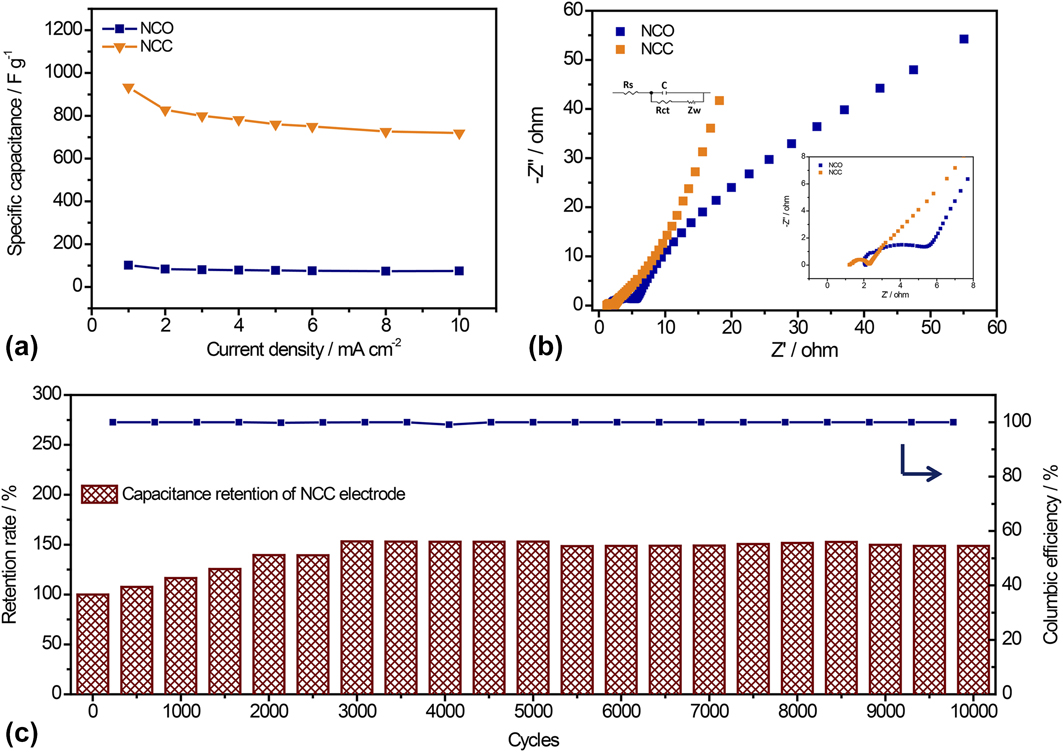
The corresponding specific capacitances (C sp) versus the discharge current density and C sp versus the scan rate of both NCC and NCO electrodes are shown in Figs. 5(a) and S4(c), respectively. Given the ultrafine size of the elementary Ni–Co nanomaterial within nitrogen doped carbon frameworks, the large surface electroactive area of the NCC electrode can provide abundant surface sites in a binder-free conductive framework. These results in high conductivity and much faster redox response; that means, higher capacitance retention can be observed at a relatively higher current density thus causing an outstanding rate capability. The NCC electrode exhibits a much higher specific capacitance of 933.5 F/g, which is nearly 10-fold than that of the NCO electrode (99.3 F/g) at a current density of 1 mA/cm2 (equivalent to 2.5 A/g). As the current density increases from 1 mA/cm2 to 10 mA/cm2, the NCC electrode yields more than 77.7% retention of capacitance and still possess the specific capacitance of 725.5 F/g, which is still ten times than that of the NCO electrode (71.5 F/g), displaying its excellent rate capability for the fast charging and discharging. Moreover, the specific capacitance at 2, 3, 4, 5, 6, and 8 mA/cm2 for the NCO electrode was 90.2, 87.4, 83.9, 81.2, 80.0, and 70.0 F/g, respectively, corresponding to 77.6% capacitance retention at 8 mA/cm2 compared to that at 2 mA/cm2. Excellent capacitance retention was also observed for NCC electrode at a higher charge/discharge rate as well. A specific capacitance at 2, 3, 4, 5, 6, and 8 mA/cm2 for NCC electrode was 834.7, 804.6, 788.8, 766.9, 756.3, and 737.2 F/g respectively, yielding more than 88.3% retention of the capacitance. Note that, this present specific capacitance obtained at such a high discharge current density is also considerably higher than that of recently reported NiCoxOy based electrodes. For instance, NiCoO2 flakes with flower shapes coated on the Ni foam (denoted as NiCoO2@Ni foam) through a simple hydrothermal method achieved a reversible capacitance of 756 F/g at a current density of 0.75 A/g when used as the supercapacitor anode.Reference Xu, Zhao, Zhou, Xue and Gao27 One-dimensional hierarchical hybrid nanostructures composed of NCO nanorods and ultrathin nanosheets on carbon nanofibers (denoted as NCO@CNFs) prepared through a facile solution method combined with a simple thermal treatment synthesis exhibited a stable discharge capacitance of 888.7 F/g at 2 A/g.Reference Zhang and Lou59 Novel composites based on cubic NiCoO2 intimately standing on nitrogen-doped reduced graphene sheets (denoted as NiCoO2@nitrogen doped graphene) synthesized by one step hydrothermal method showed a specific capacitance of 508 F/g at a current density of 0.5 A/g.Reference Xu, Wei, Tan, Yu and Chen30 As well as the NCO@nitrogen-doped carbon@Ni foam electrode with 3D hierarchical dandelion-like structure have been manufactured and displayed a specific capacitance of 864 F/g at 1 A/g.Reference Xu, Hong, Zhao, Song, Qiu and Gao55 This outstanding electrochemical performance of the NCC is attributed to the high conductivity and rapid ion transfer, which can be confirmed by the electrochemical impedance spectroscopy (EIS) test. As shown in Fig. 5(b), NCO and NCC electrodes display the different experimental Nyquist impedance plot composed of three distinct regions. An equivalent circuit made up of the equivalent series resistance (R s), the charge transfer resistance (R ct), the double-layer capacitance (Q c), and the resistance related to ion diffusion (R w) was used to fitted these EIS data [inset of Fig. 5(b)]. From the plots, R s (equate to the intercept on the real axis) on behalf of the inherent resistances of the active material of the certain electrode, bulk resistance of the electrolyte as well as the contact resistance between the interfaces of electrolyte and the electrode.Reference Ma, Kong, Xu, Xie, Tao, Xiao, Lv, Jang, Huang and Yang9 The magnitude of the R s obtained for NCO and NCC electrodes [fitted according to the equivalent circuit as shown in Fig. 5(b)] is found to be 1.90 Ω and 1.40 Ω, respectively, which manifests the better electrical conductivity of NCC electrode compared to NCO electrode. Moreover, R ct (equate to the diameter of the semicircle) in the high frequency range of the NCC electrode is valued to be 0.75 Ω, which is significantly smaller than that of the NCO electrode (4.20 Ω), further confirming the fast electron diffusion of the NCC electrode resulting from the ideal pathway for fast ion and electron transport.Reference Luo, Gao and Zhang60 Moreover, the higher slope of the EIS curve in the low frequency range demonstrates the faster diffusion rate of the NCC electrode in the electrolyte compared to the NCO electrode and confirming that the NCC has better conductivity with lower Warburg resistance.Reference Singh, Sarkar, Khan and Mandal16,Reference Mai, Li, Zhao, Xu, Xu, Luo, Zhang, Ke, Niu and Zhang61 And these findings imply that the unique structure of the ultrafine nanoparticles embedded nitrogen-doped carbon matrix can substantially facilitate ionic motion in the solid NCC electrode. Furthermore, we also studied the long-term cycling stability of the NCC electrode. Figure 5(c) shows the variation of the specific capacitance collected for the NCC electrode at a current density of 5 mA/cm2 for 10,000 cycles. Significantly, the specific capacitance collected for the NCO electrode continuously increased in the initial 3000 cycles and then maintained comparatively steady in subsequent cycling. After 10,000 cycles, the NCC electrode represents about 150% enhancement compared to its initial capacitance (766.8 F/g). Additionally, all the charging/discharging processes exhibit nearly 100% Columbic efficiencies, which can be confirmed by the corresponding GCD curves [Supplementary Material, Fig. S5(a)]. The electrochemical performance of the NCO electrode after 10,000 cycles has been also investigated with good capacitive behavior maintained [Supplementary Material, Figs. S5(b) and S5(c)]. To the best of our knowledge, such enhanced performance of the NCC electrode during the life test can attribute to the increased accessible surface area and continual formation of electrochemically active Ni(OH)2 and Co(OH)2 during both the activation and life test processes, indicating that the electrochemical performance of the NCC electrode can be further improved through the activation process.Reference Yu, Wang, Li, Zhai, Lu and Tong15 Additionally, the potentiation of the electrochemical performance eventually remains unchanged, which confirms the stable morphology of the NCC electrode with a stable nitrogen doped carbon shield. It is clearly revealed that all the calculated capacities of the NCC electrode substantially outperformed those of the NCO electrode. The remarkable rate capability and long-term stability of the NCC electrode can be attributed to the following: (i) In comparison to the poor electrical conductivity of binary nickel cobaltite oxide, a fraction of metallic Ni and Co nanoparticle in NCC electrodes can function as the inherent electrical conductor to successfully solve the low electrical conductivity issue. (ii) NCO electrodes possess boundary barriers between the nanoneedles, which is bad for electronic transmission. Unlike NCO, NCC electrodes provide increased active sites with Ni and Co nanoparticles homogenously dispersed over the whole structure linking between the carbon matrixes to transmit the electrons more effectively. (iii) The nitrogen-doped and porous structure of the carbon matrix is more favorable to composite with ultrafine binary metal particles on unique binder-free graphite paper. Benefitting from the synergetic effect of the carbon skeleton with high conductivity and favorable mechanical properties combined with the nitrogen doping, the carbon matrix on the NCC electrode offers a capable support for active materials as well as accelerates the charge-density of the space-charge layer, thereby boosting the accessible active materials and efficiently charge transport thus strengthening the redox reactions of pseudocapacitors. All these findings convincingly prove that our Ni–Co composite metal embedded porous nitrogen doped carbon hold great promise as advanced, stable and high-rate electrodes for electrochemical capacitors (ECs).
(a) Specific capacitance as a function of the current density of the NCO and NCC electrode. (b) EIS spectra of the NCO and NCC electrode. (c) Life performance and corresponding Coulombic efficiency of the NCC electrode collected at 5 mA/cm2.

IV. CONCLUSIONS
In summary, ultrafine binary transition metal (Ni–Co) nanoparticles embedded N-doped porous carbon matrix with remarkable capacitive performance and rate capability were successfully synthesized on graphite papers as robust electrode for ECs. Such the unique porous structure and additive-free configuration with homogenously dispersed Ni–Co nanoparticles of this electrode endows them with abundant active sites, rapid ion diffusion rate and superior conductivity. Subsequently, the as-obtained Ni–Co@nitrogen doped carbon electrodes deliver a high specific capacitance of 933.5 F/g at a current density of 1 mA/cm2 (equivalent to 2.5 A/g), which is approximately 10 times than that of the bare NCO electrode. Moreover, this NCC electrode has ultrahigh rate capability, which could maintain a significant capacitance of 725.5 F/g at a current density of 10 mA/cm2 (equivalent to 25 A/g) with excellent electrochemical durability (no capacitance decreases after 10,000 cycles). Such the remarkable rate capability and long-term stability of the NCC electrode is correlated with its improved conductivity, increased active sites, as well as the efficient charge transport and fast ion diffusion arising from its synergetic effect of the combination of nitrogen doped carbon and ultrafine binary metal particles on unique binder-free graphite paper. All these findings convincingly prove that our Ni–Co composite metal embedded porous nitrogen doped carbon hold great promise as advanced, stable and high-rate electrodes for electrochemical capacitors (ECs), which give new insights for advancing state-of-the-art electrodes for high-performance ECs.
Supplementary Material
To view supplementary material for this article, please visit https://doi.org/10.1557/jmr.2017.454.
ACKNOWLEDGMENTS
This work is supported by the Educational Commission of Guangdong Province (2016KTSCX134 and 2014KQNCX211), by the Natural Science Foundation of Guangdong Province (2014A030310130 and 2014A030313642), the Foundation of Huizhou University (hzuxl201515 and hzuxl201622) and the China-Ukraine Technology Park Platform Project (2014C050012001).