





Impact statement
This paper proposes a relational and process-oriented framework for articulating biomaterial affordances as they emerge through situated biodesign practice. Grounded in first-person material-led biodesign practice, primarily across gelatin-based biomaterial projects, it offers six analytical dimensions – kinesthetic, tactile, visual, auditory, olfactory and responsive – as relational lenses for attending to, articulating and designing with biomaterial affordances. Temporality and environmental conditions operate across the framework as a whole, shaping how affordances become perceptible, overlap, chain together and become design-relevant. The framework supports biodesign practitioners in making tacit material knowledge more legible and communicable across projects, collaborators and material systems, while foregrounding transformation as a design resource for biodesign research and practice.
Introduction
Biodesign has increasingly foregrounded biomaterials as active participants in design processes, where form, interaction and functionality are shaped through direct material engagement (Bell et al. Reference Bell, Alistar and Buechley2025; Ertürkan et al. Reference Ertürkan, Karana and Mugge2022). Material-led approaches in biodesign emphasize hands-on experimentation, iteration and attunement to material responses – how biomaterials bend, resist, absorb, dissolve, soften, decay or transform across making, use and environmental exposure (Bell et al. Reference Bell, Coffie and Alistar2024; Lazaro Vasquez et al. Reference Lazaro Vasquez, Alistar, Devendorf and Rivera2024; Lazaro et al. Reference Lazaro, Arduini, Sandry, Golla, Devendorf and Alistar2025). Within these practices, knowledge about biomaterial behavior is not pre-given but produced through sustained, situated engagement: through handling, reformulation, failure and repeated encounter with materials that respond, resist and redirect practice in ways that are not always immediately legible.
This situated quality of biomaterial engagement becomes particularly important when considering how biomaterials change. Unlike conventional design materials whose properties are typically stable and specifiable in advance, biomaterials derived from biological sources such as gelatin, agar, chitosan or other bio-based substrates often transform across fabrication, use and environmental exposure in ways that are gradual, cumulative or only visible under particular conditions. A material that feels smooth during fabrication may roughen as it dries; one that appears structurally stable may soften or swell through moisture exposure over weeks. These are recurring features of how bio-based materials participate in design practice. They shape what can be made, how materials can be handled and what kinds of interactions and experiences become possible across time (Karana et al. Reference Karana, Barati, Rognoli and Van Der Laan2015).
These emerging possibilities are often approached in design and HCI through the concept of affordances. In broader design theory, affordances are most commonly understood through Norman’s action-oriented framing: as perceived properties of objects that signal possibilities for interaction to a user (Norman Reference Norman1999). This understanding has been generative across interaction design, but it tends to treat affordances as relatively stable and immediately perceptible qualities of a material or object. Therefore, drawing on Gibson’s foundational framing of affordances as relational and ecological (Gibson Reference Gibson2014), more recent work has begun to extend this relational understanding toward biodesign and material-led design practice, positioning affordances as potentials that arise through engagement between materials, designers, environments and other actors across time (Barati and Karana Reference Barati and Karana2019; Gough et al. Reference Gough, Yoo, Tomitsch and Ahmadpour2021). This relational understanding is particularly relevant for biodesign practice. What a biomaterial appears capable of doing may shift through drying, moisture exposure, handling, reformulation or aging. An affordance initially registered as instability or failure may, through continued engagement and changing conditions, become a design resource. Affordances are therefore possibilities that emerge, shift and sometimes only become perceptible gradually, through processes that unfold across time, environmental conditions and iterative practice.
This gradual and situated emergence of affordances means that engaging with biomaterials generates knowledge that is often deeply tacit: embedded in bodily experience, tied to particular fabrication moments or only legible in retrospect after a behavior has been encountered across multiple contexts. What becomes perceptible through direct handling may differ from what becomes perceptible through prolonged environmental exposure or end-of-life observation. Biomaterial affordances are therefore often encountered in ways that are fragmented, project-specific and difficult to carry beyond the immediate context of their emergence (Benabdallah et al. Reference Benabdallah, Lazaro Vasquez, Devendorf and Alistar2025).
A further difficulty shapes how affordances are discussed in practice. Descriptions of biomaterials often move fluidly across their properties, behaviors and affordances without clearly distinguishing among them (Guridi Reference Guridi2025; Kuo and Srinivasan* Reference Kuo and Srinivasan2025; Nicolae et al. Reference Nicolae, Roussel, Koelle, Huron, Steimle and Teyssier2023). Describing a biomaterial as “elastic” or “moisture-sensitive” points to a property; describing it as “swelling” or “softening” points to a behavior; but neither yet captures what becomes possible through engagement with that behavior in a specific context. Affordances emerge at the intersection of material behaviors, forms of engagement, environmental conditions and time, and the vocabularies most readily available to practitioners tend to be oriented toward stable properties rather than toward relational possibilities that shift across engagement and exposure. Together, these difficulties make biomaterial affordances hard to articulate, communicate across collaborators, compare across material systems or carry forward deliberately into new design work.
Biodesign practice already generates rich material knowledge through situated engagement with biomaterials (Arnardottir Reference Arnardottir2024; Attias et al. Reference Attias, Danai, Tarazi, Pereman and Grobman2019; Vijayakumar et al. Reference Vijayakumar, Cogdell, Correa, Dade-Robertson, Danies, Edens, Forlano, George, Grushkin, Holbert, Hoover, Jalkh, Kisielewski, Obregon, Pirone, Polli, Scarpelli, Stukes, Ward, Wintermute, Balangue and Walker2024). This paper proposes a relational framework that opens up ways of attending to and working with what that practice produces. The framework supports practitioners in making biomaterial affordances more legible, communicable and available to design with across projects, timescales and material systems. The framework emerged through a retrospective synthesis of first-person material-led doctoral practice across multiple bio-based material systems (Lázaro Vásquez Reference Lazaro Vasquez2025), tracing how recurring relations among materials, fabrication processes, environmental conditions, time and forms of engagement shaped what became perceptible and design-relevant across projects. It proposes six analytical dimensions, tactile, visual, auditory, olfactory, kinesthetic and responsive, as relational lenses through which practitioners can attend to, articulate and design with biomaterial affordances across changing conditions of making, use and environmental exposure. A “can + verb” articulation practice runs through the framework, offering a way to make tacit material observations into legible, portable claims: can dissolve, can reveal transformation, can compress, can release odor.
The framework foregrounds transformation, instability and environmental responsiveness as conditions through which biomaterial affordances become perceptible and design-relevant, contributing to ongoing conversations in material-led design, sustainable HCI and biodesign research around impermanence, lifecycle visibility and the ecological relations that biomaterials carry across their use and end-of-life.
The paper proceeds as follows. Relevant literature on affordances, material-led design and biomaterials in design research is reviewed to situate the contribution. The research context and biodesign practice informing the framework are then described, followed by an introduction to the concept of attunement and a detailed presentation of the framework, including its analytical dimensions and relational organization. Illustrative examples demonstrate the framework in use across different biodesign contexts. The paper then discusses the framework’s implications, scope and potential for reflection, communication and pedagogy in biodesign research and practice, before concluding with reflections on future directions.
Related work
Affordances in design and interaction design research
The concept of affordances has played a significant role in design and interaction research. Originally introduced by Gibson as action possibilities emerging from the relationship between an organism and its environment, affordances were framed as relational rather than intrinsic properties (Gibson Reference Gibson2014). Norman later adapted the concept within design, emphasizing how perceived affordances guide users’ understanding of how to interact with artifacts (Norman Reference Norman1999). In Human–Computer Interaction (HCI), affordances have since been used and extended to describe how interface elements, objects and environments suggest and structure possible actions to users.
While these interpretations differ in emphasis, both situate affordances as arising through the relationship between a person and an artifact or environment, rather than as fixed properties of objects alone. In design contexts, this relational view has expanded beyond interface cues to include embodied engagement and material qualities (Goveia da Rocha and Andersen Reference Goveia da Rocha and Andersen2020; Rosner et al. Reference Rosner, Ikemiya, Kim and Koch2013). Researchers have explored how affordances emerge in tangible interaction and embodied systems, emphasizing their dependence on context, perception and use (Gross et al. Reference Gross, Bardzell and Bardzell2014; Schmid et al. Reference Schmid, Rümelin and Richter2013).
While product and industrial design have long considered how material and form shape action possibilities (Pinch Reference Pinch2008), material-led design research has revisited this conversation by paying closer attention to materials themselves as shaping what becomes possible in design and interaction (Tholander et al. Reference Tholander, Normark and Rossitto2012). Affordances may emerge through properties such as flexibility, texture or resistance, suggesting that interaction is shaped not only at the interface level but also through material behavior (Robles and Wiberg Reference Robles and Wiberg2010). More recent work has extended this by framing affordances as relational possibilities that emerge through designers’ acts of making and material engagement (Barati and Karana Reference Barati and Karana2019). In biodesign research, this perspective takes on a distinct inflection, as biomaterials transform across time and environmental exposure in ways that shape how affordances become perceptible and design-relevant across situated practice (Risseeuw et al. Reference Risseeuw, Mcquillan, Martins and Karana2024; Zhou et al. Reference Zhou, Kim, Doubrovski, Martins, Giaccardi and Karana2023).
Material-led design and research-through-design
Parallel to developments in affordance theory, material-led approaches in HCI and design research have foregrounded materials as active participants in shaping design processes. Material-led design emphasizes experimentation, iteration and reflection through direct engagement with material properties and behaviors, attending to how materials shape what becomes possible within a project (Frankjær and Dalsgaard Reference Frankjær and Dalsgaard2018).
Giaccardi and Karana’s framework of materials experience broadened discussions of materiality beyond primarily technical, functional and aesthetic criteria by framing materials as central to sensory engagement, meaning-making and experiential qualities that arise through encounters with materials in context (Giaccardi and Karana Reference Giaccardi and Karana2015). This perspective invites designers to attend to how materials shape both design processes and user experiences. Rather than serving only as criteria to be evaluated or selected, materials actively shape what becomes imaginable, feasible and desirable within a project.
Discussions of material agency further support this perspective by recognizing that materials can resist, redirect or reshape designers’ intentions (Devendorf Reference Devendorf2016; Fernaeus and Sundström Reference Fernaeus and Sundström2012; Knappett and Malafouris Reference Knappett and Malafouris2008; Tholander et al. Reference Tholander, Normark and Rossitto2012). Ingold’s distinction between hylomorphic and morphogenetic approaches highlights how form may emerge through ongoing engagement with material processes rather than being imposed in advance (Ingold Reference Ingold2013, Reference Ingold2016). In HCI, such perspectives have informed approaches such as material tinkering, where unexpected behaviors become generative within iterative design (Parisi et al. Reference Parisi, Rognoli and Sonneveld2017, Reference Parisi, Ferraro, Rognoli, Di Lucchio, Imbesi and Atkinson2024).
Research through Design (RtD) provides an epistemological grounding for these practices by positioning design activity as a site of knowledge production. Through cycles of making, reflection and iteration, tacit insights about material behavior can be surfaced and articulated (Gaver Reference Gaver2012; Zimmerman et al. Reference Zimmerman, Forlizzi and Evenson2007). In material-led design, this often involves attuning to shifting properties, environmental sensitivities and fabrication constraints that shape how materials can be integrated into interactive systems.
Together, these strands of work establish a foundation for understanding material engagement as both generative and epistemic. They support approaches in which knowledge about biomaterials emerges through sustained practice and where frameworks may be constructed retrospectively to articulate recurring observations across projects and material systems.
Biomaterials, temporality and material responsiveness in design
Interest in biomaterials and living systems within HCI and design research has expanded in recent years (Guridi et al. Reference Guridi, Iannacchero and Pouta2024; Kim et al. Reference Kim, Risseeuw, Groutars and Karana2023; Merritt et al. Reference Merritt, Hamidi, Alistar and DeMenezes2020). Designers have explored biomaterial systems including agar- and gelatin-based bioplastics, mycelium composites, microbial cellulose, bio-based foams and other living or bio-based materials as part of broader sustainable and biodesign-oriented practices (Bell and Alistar Reference Bell and Alistar2022; Lazaro Vasquez et al. Reference Lazaro Vasquez, Alistar, Devendorf and Rivera2024; Rognoli et al. Reference Rognoli, Parisi, Pollini, Taranto and Ayala-Garcia2022; Zhu et al. Reference Zhu, Winagle and Kao2024). These explorations situate material choice within ecological values and lifecycle considerations while also foregrounding the distinctive behaviors of bio-based matter (Gough et al. Reference Gough, Yoo, Tomitsch and Ahmadpour2021; Lu et al. Reference Lu, Yi, Gan, Huang, Zhang, Yang, Shen and Yao2024; Poblete et al. Reference Poblete, Romani and Rognoli2024).
Biomaterials often exhibit sensitivity to moisture, heat, microbial activity and mechanical stress. They may swell, soften, dry, dissolve, degrade or grow over time. Such behaviors foreground transformation as an integral aspect of material engagement rather than an undesirable side effect. This shifts attention from designing only for stable performance toward designing with change, where responsiveness, impermanence and environmental dependence become part of how interaction is shaped and interpreted. Interaction may therefore unfold not only through direct manipulation but also through environmental exposure and temporal progression.
Biodesign practitioners, HCI and design researchers have engaged impermanence, decay, growth and responsiveness as meaningful dimensions of interaction (Bell et al. Reference Bell, Friedman-Gerlicz, Urenda and Buechley2025; Karana et al. Reference Karana, Barati and Giaccardi2020; Liu et al. Reference Liu, Bardzell and Bardzell2019; Tsaknaki et al. Reference Tsaknaki, Cohn, Boer, Fernaeus and Vallgårda2016; Zhu et al. Reference Zhu, Chang, Zhao and Kao2025). Projects incorporating microbes, grown materials and responsive biomaterials have expanded understandings of interactivity beyond conventional electronic interfaces, repositioning material processes themselves as sites of interaction (Den Teuling et al. Reference Den Teuling, Winters and Bruns2024; Lazaro Vasquez et al. Reference Lazaro Vasquez, Gabriel, Friske, Wu, De Koninck, Devendorf and Alistar2023; Song et al. Reference Song, Maheshwari, Gallo, Danielescu and Paulos2022). In such work, interaction does not reside only in a discrete interface or computational response but also in how materials react, evolve and become perceptible over time through use and environmental conditions.
Across these explorations, responsiveness, transformation, fragility and tactility frequently emerge as central qualities of biomaterial work. Yet the affordances that arise through engagement with these qualities remain difficult to articulate consistently across projects and material systems. Building on relational understandings of affordances and material-led design traditions, this paper proposes a relational and process-oriented framework that supports practitioners in attending to, articulating and designing with biomaterial affordances as they emerge through situated practice, across changing conditions of making, use and environmental exposure.
Research context and methodological grounding
This section outlines the research context and methodological grounding of the framework. The framework emerges from doctoral Research-through-Design projects centered on bio-based material experimentation and interaction design. The following subsections first situate the biodesign practice from which the framework developed and then describe the retrospective process through which it was articulated.
Situated biodesign practice
This framework emerges from my situated practice as a biodesign practitioner and HCI researcher, active since 2018 and shaped through formal design training and subsequent doctoral research completed in 2021–2025. Throughout this period, sustained engagement with bio-based materials has been central to my work, particularly within interaction design and interactive textile contexts. The framework presented here is grounded in this long-term, practice-based engagement.
My doctoral research (Lázaro Vásquez Reference Lazaro Vasquez2025) consisted of three projects exploring the integration of gelatin-based materials in interactive textile design. Two projects centered on gelatin biofoams, while the third focused on gelatin biofibers. Although my broader practice has engaged additional bio-based material systems, the articulation developed in this paper was primarily shaped through sustained work with these gelatin-based materials and especially biofoam.
Across these projects, material formulation, fabrication processes and environmental exposure were integral to design inquiry. Adjustments in material composition, fabrication techniques and environmental conditions such as moisture revealed shifting material behaviors that directly informed design possibilities. Design decisions were shaped by material properties and behaviors that surfaced through making, including compressibility, elasticity, fragility and solubility, becoming legible through hands-on experimentation and iterative engagement with the materials across projects.
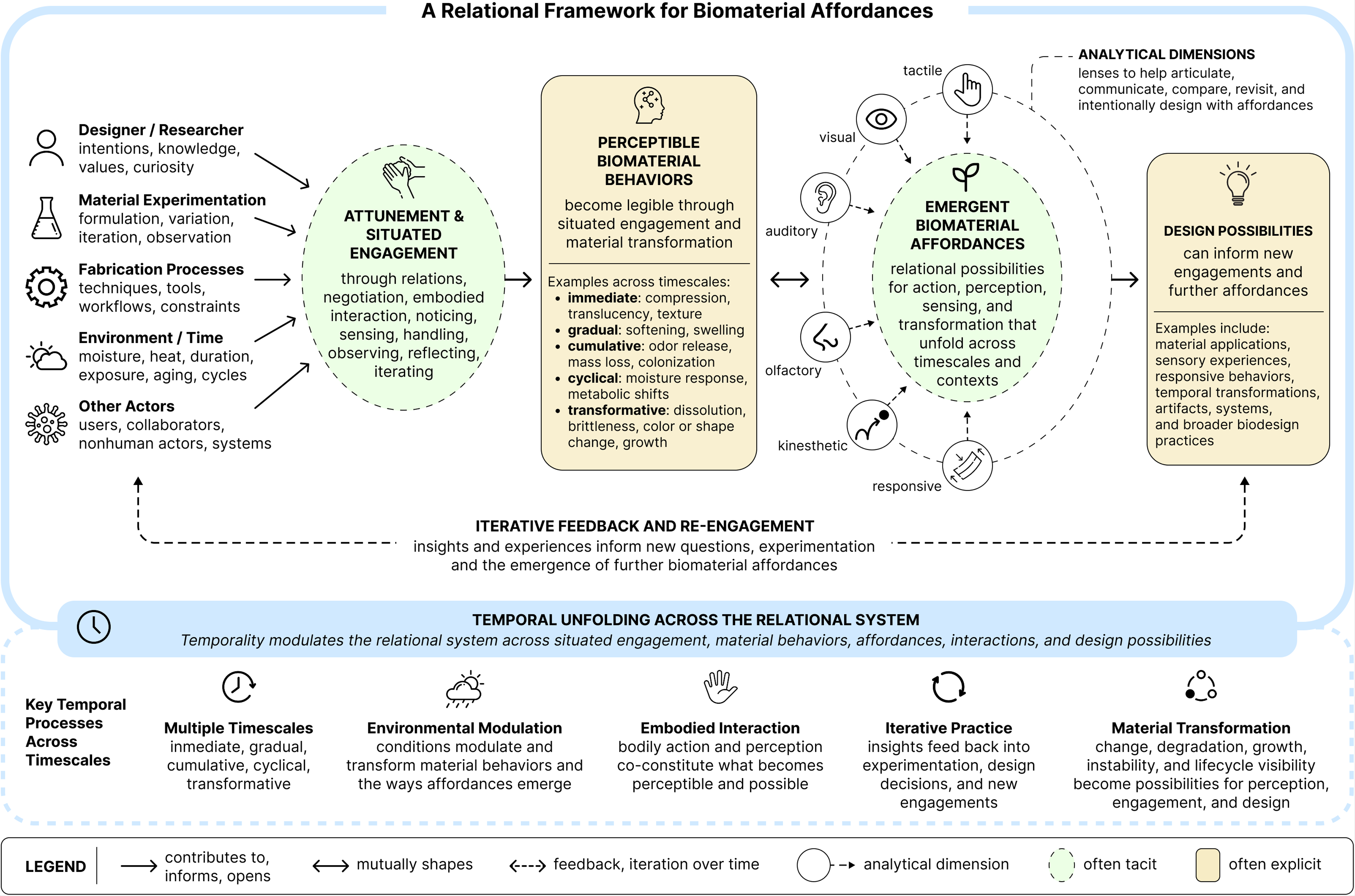
During the writing of my doctoral dissertation, I revisited how biomaterial affordances had been described across these projects. An initial figure emerged as a way to organize and clarify these observations within the dissertation discussion. What began as a reflective diagram for articulating recurring patterns in practice gradually evolved into a more structured formulation. The resulting framework is visually synthesized in Figure 1.
The proposed relational framework for biomaterial affordances, mapping relations among situated engagement, perceptible biomaterial behaviors, emergent affordances, analytical dimensions, design possibilities, and temporality across biodesign practice. Figure designed and assembled by the author using icons generated with ChatGPT (GPT-5, OpenAI, May 2026).

Framework development
This retrospective articulation took shape through a close rereading of the three core papers of my doctoral dissertation, examining how biomaterial affordances were described across the projects. I highlighted the language used to characterize material behaviors and interaction possibilities, noting repeated expressions and shared themes. This rereading surfaced similarities in how affordances were framed and mobilized across different design contexts.
The initial structuring of analytical dimensions began by clustering these descriptions according to shared qualities of material engagement. Terms and observations were gathered and grouped based on how they oriented attention toward particular aspects of material behavior, bodily engagement or transformation. Through this process, distinct dimensions began to emerge as a coherent system for attending to and articulating how biomaterials shaped interaction and design possibilities.
The framework evolved through multiple iterations as it was discussed and refined through informal conversations with collaborators and students. These discussions revealed overlaps between dimensions and prompted clarification of their boundaries. In some cases, what initially appeared as a single dimension encompassed multiple meanings; in others, behaviors that seemed similar were differentiated. It was through this refinement that differences in how affordances became perceptible were made more explicit, including distinctions between those encountered through immediate manipulation and those unfolding through environmental exposure and time.
The resulting framework makes practice-based knowledge explicit and available for wider use. Grounded in sustained engagement with bio-based materials, it offers a relational and process-oriented articulation of biomaterial affordances that emerged through doctoral practice and has since been further developed through informal conversations with collaborators and students and engagement with other practitioners’ work.
Attuning to biomaterial affordances
In biodesign practice, working with biomaterials often involves negotiating with materials whose behaviors are not fully predictable or stable (Dade-Robertson and Zhang Reference Dade-Robertson and Zhang2024; Vanden Elsacker Reference Vanden Elsacker2021). Biomaterials respond to environmental conditions, fabrication processes and modes of handling in ways that actively shape design trajectories. Attuning to biomaterial affordances describes the process through which designers develop sensitivity to these responses across sustained material engagement, learning to recognize and work with what materials do and make possible as practice unfolds.
Attunement develops through direct bodily engagement with materials: handling, pressing, observing, smelling, listening and noticing how materials respond across different conditions and moments of making (Chemero Reference Chemero2013; Ingold Reference Ingold2021). This embodied sensitivity builds gradually through repeated encounter, reformulation and reflection. A designer attuned to a biomaterial has developed a felt sense of what it tends to do, how it responds to handling or environmental change and what kinds of engagement it seems to invite across changing conditions of making and exposure.
Attunement is also relational. It does not reside in the designer alone, nor in the material alone, but emerges through the ongoing relation between them, shaped by fabrication processes, environmental conditions, other actors and time. What a biomaterial appears capable of doing is therefore not fixed in advance but becomes perceptible through engagement and may shift as conditions change, as the material transforms or as the designer’s familiarity with it deepens across projects.
Within my own practice, material formulation and fabrication became primary sites where affordances surfaced and where design decisions were shaped. Adjustments at the level of material composition directly influenced how materials felt, behaved and transformed and therefore what they made possible. Design unfolded alongside material engagement, with affordances becoming perceptible before form or structure were fully determined.
Attunement, as described here, provides the experiential and relational foundation from which the framework developed. The following section introduces that framework, proposing six analytical dimensions as relational lenses for articulating and designing with what attunement to biomaterial affordances produces across situated biodesign practice.
A relational framework for biomaterial affordances
Building on the attunement described above, this paper proposes a relational framework for articulating biomaterial affordances in situated biodesign practice. The framework traces how recurring relations among materials, fabrication processes, environmental conditions, time and forms of engagement became perceptible through iterative making, experimentation and reflection across multiple biomaterial systems.
The framework sits within broader design approaches that foreground reflection on materials and their role in design, including Material Driven Design, materials experience frameworks and perspectives that understand affordances as emerging through material engagement and practice (Barati and Karana Reference Barati and Karana2019; Giaccardi and Karana Reference Giaccardi and Karana2015; Karana et al. Reference Karana, Barati, Rognoli and Van Der Laan2015). It contributes a relational and process-oriented articulation of biomaterial affordances, grounded in situated biodesign practice, proposing six analytical dimensions – kinesthetic, tactile, visual, auditory, olfactory and responsive – as lenses for articulating, communicating, comparing, revisiting and intentionally designing with biomaterial affordances across different biodesign contexts.
Framework overview
Figure 1 presents the overall organization of the proposed relational framework for biomaterial affordances. The framework maps relations among engagement, biomaterial behaviors, affordances, design possibilities and temporality within situated biodesign practice.
The left side of the framework foregrounds the conditions through which engagement with biomaterials takes shape, including material experimentation, fabrication processes, environmental and temporal conditions and the involvement of other actors. Other actors here include not only human collaborators and users but nonhuman participants – microbial activity, humidity, biological growth, temperature – whose presence actively shapes what becomes perceptible in practice. These are not merely background conditions but forces that redirect engagement and surface affordances that direct handling alone would not reveal. These relations converge through attunement and situated engagement, describing the embodied, reflective and iterative processes through which biomaterial behaviors become perceptible within practice – including sensing, handling, observing, comparing, reflecting, negotiating and iterating during material development and use.
The middle section organizes how perceptible biomaterial behaviors and emergent biomaterial affordances mutually shape one another. Perceptible biomaterial behaviors refer to behaviors that become legible through situated engagement and material transformation over time, while emergent biomaterial affordances describe relational possibilities for action, perception, sensing, engagement and transformation that unfold across timescales and contexts.
Surrounding the affordance component, six analytical dimensions – visual, tactile, auditory, olfactory, kinesthetic and responsive – function as lenses for engaging, articulating and working with biomaterial affordances across different biodesign contexts. The right side of the framework highlights how affordances may inform broader design possibilities, including material applications, sensory experiences, responsive behaviors, temporal transformations, artifacts, systems and broader biodesign practices. Insights generated across the relational system feed back into further experimentation, engagement and the emergence of new affordances over time. Temporality operates across the entire relational system. While temporal dynamics appear within specific components represented in the upper portion of the framework, the lower section foregrounds broader temporal processes that operate across the system as a whole – immediate, gradual, cumulative, cyclical and transformative dynamics, alongside environmental modulation, embodied interaction, iterative practice and material transformation.
Distinguishing material properties, material behaviors and affordances
The framework distinguishes material properties, material behaviors and affordances as interconnected but distinct components within situated biodesign practice. Biomaterial affordances are often discussed interchangeably with material qualities or responses, which can make it difficult to articulate how affordances emerge through engagement with biomaterials across changing environmental, temporal and interaction conditions.
Material properties refer to qualities that may condition how a biomaterial responds under particular circumstances – characteristics such as elasticity, translucency, absorbency, rigidity, viscosity or biological activity. Material behaviors refer to how biomaterials respond, transform or become perceptible through fabrication processes, environmental conditions, temporal unfolding and situated engagement, including swelling, deformation, dissolution, softening, brittleness, moisture response, colonization or growth. Affordances emerge through engagement with these behaviors and describe relational possibilities for action, perception, sensing, engagement and transformation within specific contexts.
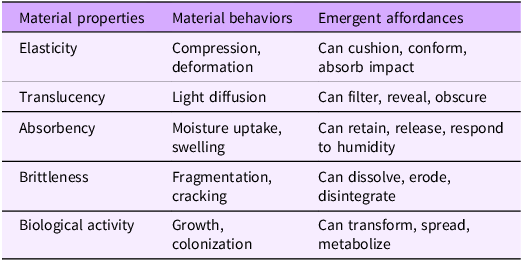
Table 1 illustrates how material properties, perceptible biomaterial behaviors and emergent affordances may be differentiated in language. A biomaterial that appears brittle under dry conditions may soften or become flexible through moisture exposure over time. Dissolution may be interpreted as material instability in one context, while in another it may become desirable as a biodegradable or disappearing interaction.
Illustrative examples of relations among material properties, perceptible biomaterial behaviors, and emergent affordances under specific material and environmental conditions. These relations are relational, situated, and may shift across time, fabrication processes, environmental exposure, and modes of engagement

Table 1. Long description
A table with three columns and five rows. The columns are labeled ‘Material properties’, ‘Material behaviors’, and ‘Emergent affordances’. The rows are labeled with different material properties and their corresponding behaviors and affordances. Row 1: Elasticity, Compression, deformation, Can cushion, conform, absorb impact. Row 2: Translucency, Light diffusion, Can filter, reveal, obscure. Row 3: Absorbency, Moisture uptake, swelling, Can retain, release, respond to humidity. Row 4: Brittleness, Fragmentation, cracking, Can dissolve, erode, disintegrate. Row 5: Biological activity, Growth, colonization, Can transform, spread, metabolize.
Affordances therefore emerge through situated engagement with biomaterial behaviors rather than existing as fixed outcomes of material properties alone and may shift as biomaterials transform, as environmental conditions change or as iterative engagement reshapes what becomes perceptible and meaningful within practice.
Temporality and environmental modulation
Temporality shapes how biomaterial behaviors emerge, shift and become perceptible across situated biodesign practice. In Figure 1, temporality is foregrounded through the lower band, “Temporal Unfolding Across the Relational System,” which frames time as modulating situated engagement, material behaviors, affordances, interactions and design possibilities. The figure identifies multiple timescales, environmental modulation, embodied interaction, iterative practice and material transformation as key temporal processes that shape how affordances emerge across the framework.
Some biomaterial behaviors become perceptible only after prolonged environmental exposure and material aging. In gelatin biofoam samples fabricated for a prior project and stored at room temperature for five months, 3D-molded surfaces gradually became coarser and rougher to the touch, while conductive biofoam pressure sensors became less compressible (Lazaro Vasquez et al. Reference Lazaro Vasquez, Ofer, Wu, West, Alistar and Devendorf2022). Ongoing environmental exposure reshaped how the materials looked, felt and functioned, allowing new material relations to emerge across time.
Environmental modulation may also reshape fabrication processes during making itself. Dissolving biofoam yarns used for knitted garments behaved differently depending on local humidity conditions. In dry climates the yarn handled smoothly, while in more humid environments it stretched and adhered to knitting needles, slowing fabrication and changing how the material could be worked with in practice. Environmental conditions therefore became active participants in the making process, influencing pacing, handling and fabrication decisions as they unfolded.
Within biomaterial practice, transformation, instability, degradation, growth and lifecycle visibility may become meaningful and intentionally designed aspects of engagement rather than conditions to control or eliminate.
Situated engagement and recursive emergence
Affordances become clearer through the work of engaging with biomaterials: handling them, testing them, reformulating them, encountering failures and noticing how they respond across making and use. Each observation, failure or material constraint may redirect how a material is subsequently handled, reformulated or fabricated. Affordance emergence is therefore not only a matter of identifying what a material can do, but of working through how materials respond, resist and redirect practice over time.
This process may involve moments where initially subtle material differences become legible through observation and systematic experimentation. After observing that gelatin biofoam samples dissolved differently when exposed to water, I developed comparative water permeability experiments to measure how long droplets remained on different biofoam formulations before absorption or evaporation (Lazaro Vasquez et al. Reference Lazaro Vasquez, Ofer, Wu, West, Alistar and Devendorf2022). Differences in water retention that were not immediately visible during fabrication became legible through testing and comparison, reshaping how material behaviors were understood and evaluated within practice.
Situated engagement may also involve friction, resistance and redirected forms of making. In one attempt to incorporate conductive stainless steel fibers into gelatin biofoam, whisking caused fibers to collect around the whisk, while felting distributed them unevenly throughout the foam (Lazaro Vasquez et al. Reference Lazaro Vasquez, Ofer, Wu, West, Alistar and Devendorf2022). These failed attempts redirected fabrication toward a different incorporation logic borrowed from baking – folding dry ingredients into whipped egg whites without collapsing airy structures. Even then, the material imposed further constraints: fibers longer than approximately 5 cm continued clumping regardless of technique, requiring shorter fiber lengths to distribute successfully. Material resistance here did not simply reveal a new property; it redirected the fabrication process itself.
Iterative reformulation may also produce temporal trade-offs that reshape affordances in unexpected ways. Introducing a biobased crosslinker into gelatin biofibers improved durability during weaving while simultaneously slowing dissolution time, creating trade-offs between fabrication feasibility, material persistence and dissolution speed (Vasquez et al. Reference Lazaro Vasquez, Alistar, Devendorf and Rivera2024). In these situations, iterative engagement does not only reveal material relations – it actively reshapes them through cycles of adjustment, evaluation and reformulation.
Across these situations, biomaterials emerge as active participants in design practice. They may support particular actions while also resisting, redirecting or transforming how making, engagement and situated practice unfold over time.
Analytical dimensions for articulating and designing with biomaterial affordances
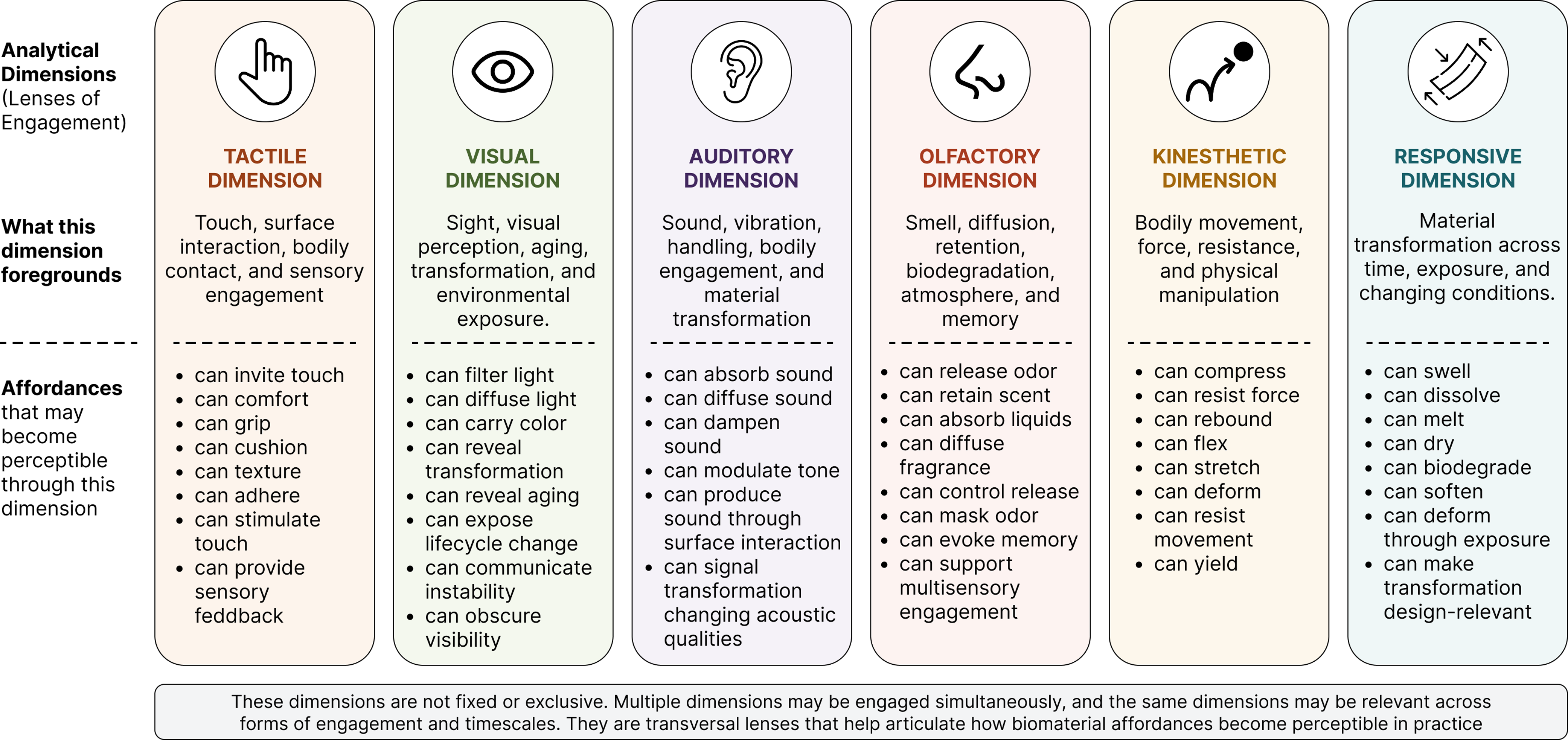
The six analytical dimensions, tactile, visual, auditory, olfactory, kinesthetic and responsive, emerged through my sustained biodesign practice (Figure 2). They took shape by repeatedly returning to biomaterial samples, fabrication processes and annotated publications, attending to what biomaterials appeared capable of doing or changing and what kinds of engagement they seemed to invite. Observing how a biomaterial absorbed water, filtered light, released odor, resisted compression or dissolved under moisture revealed recurring orientations for attending to how biomaterial capacities became perceptible through making and use. These recurring orientations became the six dimensions.
Examples of affordances articulated through the six analytical dimensions that emerged from my biomaterial practice. The “can + verb” phrasing describes what biomaterials appeared capable of supporting, inviting or making possible through situated engagement. These examples are illustrative and may shift across materials, conditions, timescales, and practices. Figure designed and assembled by the author using icons generated with ChatGPT (GPT-5, OpenAI, May 2026).

In this practice-based context, a dimension is best understood as a relational lens that orients attention toward a particular form of engagement through which biomaterial affordances may become perceptible. The dimensions emerged through practice rather than derivation from a unified framework, and what distinguishes them is their primary focus of engagement. Four of them, tactile, visual, auditory and olfactory, orient attention toward how affordances become perceptible through sensory engagement with material qualities. Kinesthetic orients attention toward how affordances become perceptible through direct bodily action, force and physical manipulation. Responsive orients attention toward how affordances become perceptible through material-led transformation, where the material responds to environmental conditions and exposure rather than primarily through direct human engagement. Temporality operates across all six dimensions, as affordances within any dimension may surface immediately or unfold gradually through continued making, use and environmental exposure. Practitioners may orient their inquiry through whichever dimensions are most relevant to their materials, design intentions or stage of engagement and may find that different orientations surface more strongly through their own practice.
Each dimension supports “can + verb” articulations, such as can absorb, can dissolve, can stretch, can reveal or can release odor, as a way to make tacit material observations into legible, portable claims that can be carried forward, compared across project and revisited as engagement deepens.
The dimensions are fluid across timescales. No single dimension is locked to immediate or slow perception. A biomaterial’s capacity to release scent may register immediately upon handling or build gradually through wear and environmental exposure. Melting may be immediate and hands-on during fabrication or slow and ambient during use. What differs across dimensions is through which forms of engagement affordances become perceptible, whether through sensory perception, direct bodily action or material-led transformation in relation to environmental conditions and exposure.
In practice, the dimensions support a set of questions a practitioner might ask during or after engagement with a biomaterial:
-
• What does this material appear capable of doing through touch, sight, sound, smell, bodily movement or transformation?
-
• Which capabilities are already legible, and which are only beginning to surface?
-
• Which are being intentionally engaged with, and which are only becoming visible through continued making or exposure?
Multiple dimensions will often be relevant simultaneously, and changes within one may reshape others. A material transformation can alter tactile feel, visual appearance, olfactory qualities and kinesthetic resistance at once. The dimensions make these entanglements more visible and communicable, supporting articulation within projects and comparison across them.
Tactile dimension
Tactile engagement draws attention to how biomaterials are experienced through touch, surface interaction and bodily contact during making and use. Practitioners may ask how a biomaterial feels against the body, how surfaces invite or discourage touch, how materials provide comfort or how texture shifts through fabrication, environmental exposure or prolonged handling.
Through this dimension, practitioners may articulate that a biomaterial can invite touch, comfort, grip, cushion, texture, stimulate touch, adhere or provide sensory feedback. These affordances often become perceptible through direct bodily contact, while also shifting gradually through drying, moisture exposure, softening, roughening or repeated handling across time. Through tactile engagement, biomaterials may shape how comfort, care, aversion or bodily proximity become part of material experience.
Visual dimension
The visual dimension attends to how biomaterials engage sight and visual perception across changing conditions and forms of engagement. Practitioners may ask how a biomaterial reveals transformation, filters or diffuses light, carries color, obscures visibility, reveals aging, exposes lifecycle change or communicates instability and environmental responsiveness through appearance.
This dimension may help articulate how biomaterials can filter light, diffuse light, reveal transformation, reveal aging, obscure visibility, carry color, expose lifecycle change or communicate instability. These affordances may become perceptible immediately through appearance and may also unfold gradually through discoloration, opacity shifts, surface transformation, degradation, drying or environmental exposure. Visual engagement may therefore make material instability, aging or environmental exposure perceptible as part of the design experience itself.
Auditory dimension
Through auditory engagement, practitioners may attend to how biomaterials interact with sound across handling, surface interaction, bodily engagement and material transformation. Questions may emerge around how biomaterials can dampen, absorb, soften, diffuse, modulate or produce sound when pressed, scraped, stretched, worn or manipulated and how these sound qualities shift across fabrication processes or environmental exposure.
Through this lens, biomaterials may appear capable of absorbing sound, diffusing sound, dampening sound, modulating tone, producing sound through surface interaction or signaling transformation through changing acoustic qualities. In my own practice, auditory qualities often emerged as incidental aspects of handling and material change, including the crunchiness of a bioplastic dried without sufficient plasticizer, the scratch of a rough biocomposite surface during handling or the distinct sound qualities different biofoam pressure sensor samples produced when pressed or manipulated. These affordances may become perceptible immediately through direct handling or may shift gradually as materials dry, harden, soften, break or transform through environmental exposure.
Olfactory dimension
Olfactory engagement becomes relevant when biomaterials are experienced through smell across absorption, retention, diffusion, release, biodegradation and environmental exposure. Practitioners may ask how biomaterials release or retain odor, how scent changes across time or how smell contributes to atmosphere, memory, care or multisensory engagement.
Through this dimension, practitioners may articulate that a biomaterial can release odor, retain scent, absorb liquids, diffuse fragrance, control release, mask odor, evoke memory or support multisensory engagement. These affordances are often deeply temporal, combining immediate sensory perception with slower processes of absorption, diffusion, biodegradation, environmental exposure and material transformation over time (Tonin and Ferrara Reference Tonin and Ferrara2025). Through smell, biomaterials may shape atmospheric, emotional or memory-based relations that continue unfolding beyond immediate interaction.
Kinesthetic dimension
The kinesthetic dimension centers on how biomaterials engage bodily movement, force, resistance and physical manipulation during making and use. Practitioners may ask how a biomaterial responds when compressed, bent, stretched, released or acted upon through direct bodily engagement and how these responses shape handling, control, resistance or physical feedback throughout interaction.
Through this dimension, practitioners may articulate that a biomaterial can compress, resist force, rebound, flex, stretch, deform or yield. These affordances often become perceptible through direct manipulation and bodily engagement, while repeated force, prolonged handling or material fatigue may also reshape how biomaterials respond across time. Kinesthetic engagement may therefore reveal how biomaterials negotiate force, resistance, fragility or bodily control throughout making and use.
Responsive dimension
The responsive dimension attends to how biomaterials transform across time and changing environmental conditions. Practitioners may ask how biomaterials dissolve, swell, melt, soften, dry, deform, biodegrade or otherwise respond throughout making, exposure, use and aging and how these transformations reshape engagement with the material over time.
Through this dimension, practitioners may articulate that a biomaterial can swell, dissolve, melt, dry, biodegrade, soften, deform through exposure or make transformation itself engageable. Responsive affordances often become perceptible through gradual, cumulative, cyclical or irreversible transformations across environmental and temporal timescales. Through this dimension, transformation itself may become central to how biomaterials are engaged with, maintained, interpreted or intentionally designed with throughout biodesign practice.
Dimensions in practice: entanglement and co-presence
Across my biodesign practice, these dimensions rarely appeared in isolation. A dissolving, drying or swelling material could simultaneously alter tactile feel, visual appearance, olfactory qualities and kinesthetic resistance, while bodily engagement could also affect how the material continued to respond over time. As analytical lenses oriented toward relational engagement, the dimensions support practitioners in articulating, comparing and intentionally engaging with biomaterial affordances as they surface and shift across making, environmental exposure and use.
Depending on the context, the questions these dimensions invite may orient inquiry from different positions within the relational system, asking how a biomaterial responds to microbial activity, how it behaves in relation to environmental conditions or how nonhuman actors reshape what becomes perceptible over time, not only from the practitioner’s perspective and remaining open to the entanglements and co-presences that characterize biodesign practice.
Illustrative applications from biodesign practice
This section demonstrates how the framework can be applied to reflect on material-led design decisions and articulate how affordances surface, chain together and connect to design possibilities across different biodesign contexts. Two illustrative examples are offered: the first draws on my own doctoral practice across multiple projects and biomaterial systems, showing how affordances became perceptible through different dimensions over time and how design possibilities fed back into new forms of engagement with the material. The second applies the framework to work by other biodesign practitioners, demonstrating how it can help surface tacit engagement and make affordance chains more communicable across projects and research communities.
Dimensional chaining and feedback into new affordances: gelatin biofoam across doctoral projects
Across three doctoral projects engaging gelatin-based biomaterials, affordances rarely surfaced through a single dimension or a single moment of engagement. Instead, they emerged through chains of relations among dimensions, where one affordance becoming perceptible enabled me to attend to others and where design possibilities fed back into new forms of engagement with the material.
In the first project, exploring gelatin biofoam as a material for tangible interaction, the kinesthetic and tactile dimensions became active lenses through direct handling. Pressing, squeezing and releasing biofoam samples made it perceptible that the material could compress, resist, rebound and invite touch. These did not surface independently – that the material could be softly gripped and handled shaped how I approached it, while the capacity to compress and recover shaped what kind of interaction felt possible. Through iterative formulation and characterization, these affordances chained into a design possibility: conductive biofoam functioning as a soft pressure sensor, where sensing emerged from the material’s inherent mechanical behavior rather than from added electronics alone.
A separate observation during the same project opened a different chain. Through end-of-life experimentation, the responsive dimension became a lens through which a new affordance became perceptible: that the biofoam could dissolve, biodegrade and be recooked into new batches. At this stage, dissolution was observed and documented but not yet fully attended to as a design resource. It remained partly tacit, recognized as a material behavior but not yet legible as an affordance that could be intentionally designed with.
This changed in the second project, designing dissolving wearables. The earlier observation that the material could dissolve enabled me to perceive this responsive affordance anew, not as an end-of-life behavior but as a design possibility. Attending through the responsive dimension to what the material could do, can dissolve, can soften, can release, can unfold through moisture exposure, opened an entirely different design trajectory. As dissolution was explored through biofoam yarns integrated into knitted and crocheted garments, the responsive dimension entangled with the tactile and visual dimensions: as dissolution progressed, it became perceptible that the material could reveal hidden layers, loosen structured pleats and transform from one configuration to another through contact with water. These entanglements opened design possibilities around seasonal transformation, lifecycle interaction and disappearing as a designed event, possibilities that had not been imaginable from the affordances surfaced through the kinesthetic and tactile dimensions alone.
This movement across projects illustrates how the feedback loop represented in the framework operates in practice. A design possibility emerging from one chain, lifecycle observation and the recognition that the material could dissolve as end-of-life behavior, enabled me to perceive a responsive affordance that had previously been tacit, opening new situated engagement and new design possibilities in a subsequent project. The dimensions did not change, but what became perceptible through them shifted as my engagement deepened across time and projects.
Reading affordances in others’ work: chitosan biofilm actuators
Applying the framework to work by other biodesign practitioners requires attending to a distinction the framework makes visible: between what is reported explicitly in a publication and what can be inferred as the often tacit engagement through which affordances became perceptible in practice. Publications typically document outcomes, fabrication decisions, material characterizations and design applications, while the attunement through which those outcomes emerged often remains implicit.
In Den Teuling, Winters and Bruns’ work on chitosan biofilm actuators for sustainable interaction design, the responsive dimension offers the clearest entry point for analysis (Den Teuling et al. Reference Den Teuling, Winters and Bruns2024). Chitosan, derived from crustacean exoskeletons, can absorb moisture from the surrounding environment, swell, bend and return to its original shape when humidity decreases. This capacity, that the material can swell, can bend and can actuate reversibly through humidity, is the explicit affordance the paper builds around, surfaced through the responsive dimension.
What the paper also reports, though not framed as affordance engagement, is a process of iterative substrate testing through which the kinesthetic dimension becomes legible. To achieve controlled and reversible bending, a bilayer structure was needed, requiring a substrate with the right combination of stiffness, water absorption and attachment properties. Twelve different substrates were tested, including tulle, polyester, wool, silk and cotton, evaluated for bending ability and reversibility through hands-on handling and observation. The paper reports the outcome, woven cotton was found most suitable, but the attunement involved in reaching that conclusion, the handling of each material, the noticing of stickiness, flexibility and resistance, represents tacit engagement through which affordances such as can resist, can flex and can bend in calibrated ways became perceptible. These only became legible through direct material engagement across multiple iterations, and the framework helps surface them as part of the affordance chain that led toward design possibilities.
Through the visual dimension, further affordances became perceptible in the design applications. The bending of chitosan films in a 4 × 4 matrix makes it perceptible that the material can reveal transformation and communicate environmental change through shape. A woven textile that transforms from flat to curved as humidity rises shows that the material can signal environmental conditions visually through material behavior. These affordances, surfaced through the visual dimension, chained with what had emerged through the responsive and kinesthetic dimensions to open design possibilities including dynamic displays, haptic interfaces, self-assembling structures and smart textiles that respond to environmental conditions without electronic actuation.
Reading this work through the framework reveals how the design possibilities reported in the paper emerged from a chain of affordances surfaced across the responsive, kinesthetic and visual dimensions through iterative engagement with the material. The framework does not add to what the authors discovered, but it offers a vocabulary for making that chain of engagement more explicit and communicable across projects and material systems.
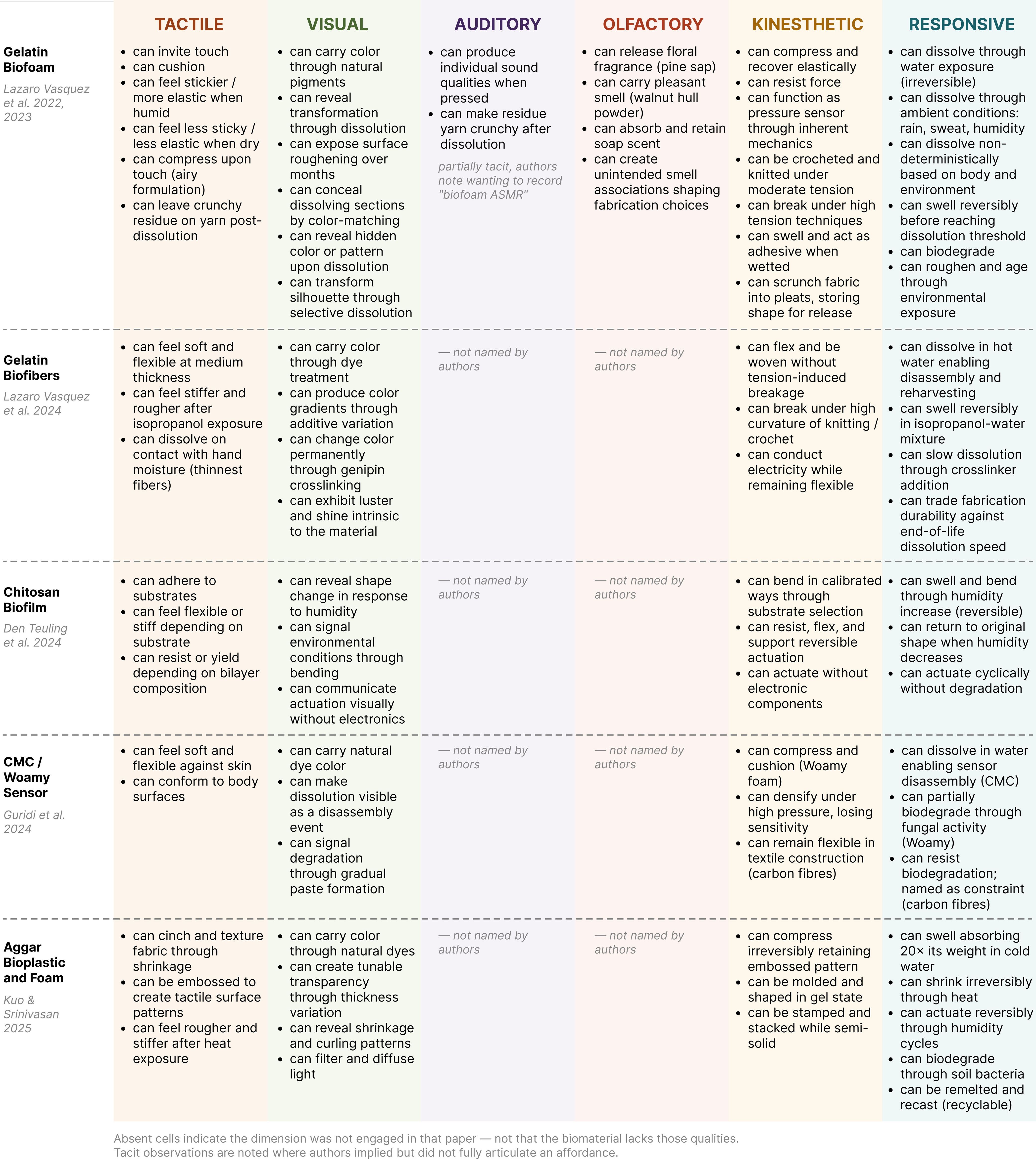
Figure 3 extends the framework’s comparative potential by mapping affordances articulated across other published accounts of several biomaterial systems that included design applications (Den Teuling et al. Reference Den Teuling, Winters and Bruns2024; Guridi et al. Reference Guridi, Basarir, Cho, Nguyen, Vapaavuori and Hummel2024; Kuo and Srinivasan* Reference Kuo and Srinivasan2025; Lazaro Vasquez et al. Reference Lazaro Vasquez, Ofer, Wu, West, Alistar and Devendorf2022, Reference Lazaro Vasquez, Gabriel, Friske, Wu, De Koninck, Devendorf and Alistar2023, Reference Lazaro Vasquez, Alistar, Devendorf and Rivera2024), including the gelatin-based work described in this paper. The table was built by applying the framework retrospectively to published papers, reading each account through the six dimensions to surface what the authors articulated as design-relevant behavior. Absent cells reflect where that language was simply not present in the publication; some dimensions were clearly more difficult to fill than others.
Affordances articulated across published accounts of several biomaterial systems, mapped through the six analytical dimensions of the framework. The table was built by applying the framework retrospectively to published papers, including accounts of the gelatin-based work described in this paper. Absent cells indicate that affordance language was not present in the publication for that dimension, not that the biomaterial engaged with in the paper lacks those qualities. Tacit observations are noted where authors implied but did not fully articulate an affordance.

What the table makes visible is less a ranking and more a pattern: tactile, visual, kinesthetic and responsive affordances appear consistently across materials, while auditory and olfactory dimensions are the least represented. The responsive dimension, in particular, surfaces distinct trajectories even where materials appear similar: dissolution as a designed event, reversible actuation, disassembly enabled by degradation. These divergences are what cross-material comparison through the framework makes legible.
Discussion: articulation, perceptibility and designing with biomaterial affordances
Emerging through sustained biodesign practice, the framework proposed in this paper supports situated ways of articulating how biomaterial affordances become perceptible through making, experimentation, environmental exposure and use. This discussion reflects on four aspects of the framework’s contribution: what it means for affordance articulation as a practice, what foregrounding transformation as a design resource implies for biodesign, where the framework’s scope and limits lie and how it may support reflection, communication and pedagogy across biodesign contexts.
Affordance articulation as an ongoing and layered practice
One of the central contributions of the framework is making visible that affordance articulation is not a one-time act of identification but an ongoing and layered practice. Biomaterial affordances often do not announce themselves clearly or completely at first encounter. They surface gradually, partially and sometimes only under specific conditions of engagement, environmental exposure or fabrication context. What appears incidental or unstable at one stage of practice may become design-relevant at another.
This has methodological implications for how practice-based knowledge is generated and documented in biodesign research. Research-through-design has established that tacit knowledge can be surfaced through cycles of making, reflection and iteration. The framework extends this by providing a structured vocabulary through which that surfacing process can be made more explicit and communicable. The “can + verb” articulation is not only a descriptive tool but a way of making a tacit observation into a legible claim that can be carried forward, compared across projects and revisited as engagement deepens.
Affordance articulation also became cumulative and chained across my practice. One affordance becoming perceptible often redirected attention toward others, opening new forms of engagement and new design possibilities across projects and timescales. A capacity first noticed as a material behavior during end-of-life experimentation could, through continued engagement, become legible as a design resource in a subsequent project. The framework supports this cumulative quality by offering a vocabulary that can travel across projects and remain open to reinterpretation as engagement deepens.
This also means the framework can be used proactively, not only retrospectively. The dimensional questions, what can this material do through touch, sight, sound, smell, bodily movement or transformation, are equally useful at the beginning of engagement with a new biomaterial as they are in reflection after a project. The dissolving wearables project offers a partial illustration: attending through the responsive dimension early in that engagement oriented attention toward dissolution as a design possibility before an artifact design direction had been set. The comparative figure extends this logic across materials. Attending through the responsive dimension to chitosan’s reversible humidity actuation early in a project orients attention toward environmental sensing and dynamic display as design possibilities before form is determined. Attending through the kinesthetic dimension to agar foam’s irreversible compressibility suggests embossing, patterning and surface customization as directions worth pursuing from the start of biomaterial engagement. Attending through the visual dimension to gelatin biofibers’ intrinsic luster and color-change capacity through genipin crosslinking opens aesthetic and expressive possibilities in textile integration that might otherwise surface only late in practice. Used this way, the analytical dimensions orient attention toward capacities that might otherwise remain unnoticed until later stages of making or not noticed at all. Used retrospectively, they help make accumulated material knowledge legible across projects and communicable to others. The framework supports both modes, and future work could explore how it operates differently across these stages of practice.
Transformation as a design resource
A recurring challenge in biomaterial practice is that transformation, including swelling, dissolution, softening, biodegradation, cracking and color change, is often approached as something to stabilize or prevent rather than engage with. The framework proposed here makes a different claim: that transformation can become a site of perception, engagement and intentional design.
This is not only a design proposition but a shift in how biomaterial affordances are understood. If affordances are relational possibilities that emerge through situated engagement rather than fixed properties of a stable object, then a material that transforms is not losing its affordances but generating new ones. Dissolution opens the possibility of disappearing interactions. Biodegradation makes lifecycle visibility perceptible. Softening under humidity invites different forms of bodily engagement than a rigid surface. These are not degraded states of a material that was better before but conditions through which new affordances become perceptible.
In many cases, these transformations did not emerge through direct interaction alone but through prolonged environmental exposure, humidity, heat, drying, microbial activity or other ambient conditions that gradually reshaped what became perceptible in the material. Environmental modulation is therefore not only a background condition but an active co-shaper of how biomaterial affordances emerge, persist, shift or disappear across time. Biomaterial affordances therefore emerge through entanglements among bodies, materials, environmental conditions, fabrication processes and, in some cases, nonhuman biological actors.
This perspective has implications for how biodesign positions itself in relation to sustainability and care. Designing with transformation rather than against it means attending to how biomaterials participate in broader ecological and temporal relations, how they age, how they return to the environment and how their changing states communicate something about use, exposure and time. The framework supports this orientation by foregrounding lifecycle visibility, environmental responsiveness and material change as active participants in design rather than as external constraints to be managed. This connects to broader conversations in sustainable HCI and biodesign around impermanence, care and the environmental relations that materials carry across their lifecycles.
Scope, transferability and limits
The framework emerged through sustained engagement with non-living and bio-based materials, where direct handling, reformulation and iterative experimentation formed the primary conditions through which affordances became perceptible. Although it was developed through work with gelatin-based biofoam, similar dimensions surfaced across engagements with other biomaterial systems, suggesting that the vocabulary may transfer across different material families. What transfers is not a fixed set of behaviors but a practice-grounded orientation for asking how biomaterial capacities become perceptible under different conditions of making, use and environmental change.
The framework’s limits become more visible when applied to living biomaterials involving active biological agency. In work with living organisms, including bacteria, fungi, microbial colonies and other systems that grow, reproduce and die according to their own biological logic, the practitioner is no longer the primary agent of attunement. The organism itself shapes what becomes perceptible and on what timescales, through processes that may remain only partially observable or controllable. As illustrated through work such as Groutars et al.’s exploration of Flavobacteria as a living medium for color interfaces (Groutars et al. Reference Groutars, Risseeuw, Ingham, Hamidjaja, Elkhuizen, Pont and Karana2022), practitioners working with living biomaterials often need to design infrastructures for cultivation, observation and environmental control rather than directly handling and reformulating the material. In these contexts, the responsive and visual dimensions of the framework remain applicable, but the nature of attunement shifts in ways the current framework does not fully account for. Future work could extend the framework toward a fuller account of nonhuman biological agency within biodesign practice.
A related question concerns whether the framework applies beyond biomaterials to other materials that also undergo temporal change, such as metal rusting, plastic discoloring or wood aging under environmental exposure. The dimensions and the attunement framing were developed specifically within biomaterial practice and the relational, often unpredictable and ecologically situated nature of bio-based materials. Whether and how the framework transfers to other material contexts remains an open question that future work could explore.
Finally, the framework was developed through a single practitioner’s retrospective synthesis of doctoral work, which gives it depth as a practice-based contribution but also means its scope reflects a particular set of material engagements. It has not yet been formally evaluated across broader biodesign communities, workshops or classroom settings. Its value for reflection, documentation, communication and pedagogy is discussed here based on my own practice, and future work could examine how the framework operates across different practitioners, material systems and design contexts.
Supporting reflection and communication
Beyond supporting analysis, the framework may function as a shared intermediary structure through which situated observations, material behaviors and emerging affordances can be discussed across collaborators, projects and disciplinary contexts. Material-led insights often remain embedded within isolated project narratives, tacit observations or undocumented moments of experimentation. The framework offers a shared vocabulary and visual synthesis through which these situated engagements can be made more discussable within and across projects.
In my own practice, developing the framework supported a retrospective reading of doctoral work that brought years of material observations, fabrication experiments and project trajectories into a shared structure. This made it possible to recognize how affordances overlapped, chained together or shifted across projects and timescales and to see which dimensions had shaped the work most strongly. This kind of retrospective articulation is itself a form of knowledge production, making explicit what practice had generated tacitly and making it available for further exploration and comparison.
Used across projects and collaborators, the framework may support more precise conversations between practitioners working in different disciplinary contexts. A material described in technical terms as moisture-sensitive, soluble or biodegradable can also be discussed in design terms as a material that can dissolve, can soften, can reveal transformation or can biodegrade at end of life. This does not resolve disciplinary differences but creates a shared surface for conversation that retains the situated and processual character of material engagement.
Used pedagogically, the framework may help introduce biomaterials as more than sustainable substitutes for conventional materials. The overlapping analytical dimensions open discussions around sensory engagement, environmental responsiveness, lifecycle visibility, instability and transformation as active participants in design. In my own practice, including informal exchanges with lab members and students, the ’can + verb’ framing has been a useful starting point for helping students and new lab members begin articulating what they are noticing while engaging with biomaterials – particularly when observations remain difficult to name through existing material or technical vocabularies. Whether the framework functions as a more formal pedagogical scaffold across different teaching contexts and learner backgrounds is an open question that future work could examine.
Conclusion
This paper presented a relational framework for articulating biomaterial affordances as they emerge through situated biodesign practice. The framework proposes six analytical dimensions, tactile, visual, auditory, olfactory, kinesthetic and responsive, as practice-grounded lenses for engaging with, articulating, comparing and designing with biomaterial affordances across changing conditions of making, use and environmental exposure.
The examples and discussion demonstrated that biomaterial affordances rarely surface in isolation. They emerge through chains of relations across dimensions, where one affordance becoming perceptible redirects attention toward others and where design possibilities feed back into new forms of situated engagement with the material. Transformation, environmental modulation and material instability are active conditions through which new affordances become perceptible. The “can + verb” framing supports practitioners in making these often tacit observations legible, communicable and available for reflection and comparison across projects and material systems.
By foregrounding how biomaterial affordances emerge through relations among bodily engagement, materials, environmental conditions, fabrication processes and time, the framework contributes to ongoing conversations in material-led design, sustainable HCI and biodesign research. It offers a situated vocabulary for engaging with transformation, environmental responsiveness and lifecycle change as active participants in biodesign practice.
Data availability statement
Data availability is not applicable to this article, as no new data were created or analyzed in this study. The previously published works that informed the analysis are cited in the article.
Acknowledgments
The author thanks Sam Edens for reviewing an early draft of the manuscript and providing valuable feedback. ChatGPT (GPT-5, OpenAI) and Claude (Sonnet 4.6, Anthropic), accessed through their respective web interfaces, were used between February and July 2026 to support editorial revision of author-written text, including improvements to clarity, organization and wording. ChatGPT was also used to generate the icons appearing in Figures 1 and 2 and to provide iterative input on the figures’ visual presentation and arrangement. The conceptual framework, written content and final design decisions were developed and completed by the author. All AI-assisted outputs were critically reviewed, revised and integrated by the author, who takes full responsibility for the final manuscript.
Author contributions
Eldy S. Lazaro Vasquez: Conceptualization, Methodology, Investigation, Visualization, Writing (original draft) and Writing (review and editing). The author approved the final version of the manuscript and agrees to be accountable for all aspects of the work.
Financial support
This work was partially supported by the National Science Foundation (grant number 2413631).
Competing interests
None.
Ethical standards
Ethical approval was not required for this study because it involved retrospective reflection on and analysis of the author’s own design practice and did not involve human or animal participants.

 Open access

