





Bipolar disorder is a chronic psychiatric condition characterised by recurrent episodes of depression and (hypo)mania. 1 The lifetime prevalence of bipolar disorder has been estimated to be 2.4% across its various subtypes, which include bipolar I disorder (BD-I), bipolar II disorder (BD-II) and subthreshold bipolar disorder. Reference Merikangas, Jin, He, Kessler, Lee and Sampson2 Bipolar disorder typically emerges during adolescence or early adulthood and is associated with a neuro-progressive course in a significant proportion of patients, with increasing frequency of recurrence of mood episodes, significant cognitive impairment, Reference Keramatian, Torres and Yatham3 loss of brain tissue, Reference Keramatian, Chakrabarty, Saraf, Pinto and Yatham4 poor treatment response and functional disability. Reference Kauer-Sant’Anna, Bond, Lam and Yatham5 According to data from the World Health Organization Global Burden of Disease study, bipolar disorder is the fourth leading cause of disability worldwide among individuals aged 10–24 years old. Reference Gore, Bloem, Patton, Ferguson, Joseph and Coffey6 However, despite its high prevalence and large disability burden, bipolar disorder often goes unrecognised and therefore untreated for several years. Reference Fritz, Russell, Allwang, Kuiper, Lampe and Malhi7,Reference Keramatian, Pinto, Schaffer, Sharma, Beaulieu and Parikh8 This prolonged delay is particularly problematic, as there is a limited window during which intervention can prevent potentially progressive cognitive and structural changes associated with bipolar disorder, making the duration of untreated illness a critical factor in long-term outcomes.
There is a vast literature on the concept of duration of untreated psychosis, primarily in patients with schizophrenia, and on the relationship between duration of untreated psychosis and negative clinical outcomes. Reference Drake, Haley, Akhtar and Lewis9 This has led to the development of specialised early-intervention programmes for psychosis worldwide, which has in turn resulted in improved outcomes. Reference Correll, Galling, Pawar, Krivko, Bonetto and Ruggeri10 However, the relationship between the duration of undiagnosed or untreated bipolar disorder (DUBD) and clinical characteristics and outcomes is not well understood. Over the past two decades, numerous studies have investigated the relationships between DUBD and clinical characteristics and outcomes. However, these studies have used differing methodologies and reported conflicting results. For example, whereas several studies have linked longer DUBD to lifetime history of suicide attempts, others Reference Keramatian, Pinto, Schaffer, Sharma, Beaulieu and Parikh8,Reference Drancourt, Etain, Lajnef, Henry, Raust and Cochet11,Reference Marchand, Wirth and Simon17 found no such correlation. Reference Buoli, Cesana, Fagiolini, Albert, Maina and de Bartolomeis18-Reference Oyffe, Shwizer and Stolovy23 Therefore, the main objective of this systematic review and meta-analysis was to synthesise the available evidence on DUBD and its relationship with various clinical characteristics and outcomes.
Method
Search strategy and identification of eligible papers
This systematic review was conducted according to the Preferred Reporting Items for Systematic reviews and Meta-Analyses (PRISMA) statement Reference Moher, Liberati, Tetzlaff, Altman, Altman and Antes24 and was registered at PROSPERO (CRD42021260244). The study identification and selection process is presented as a PRISMA flowchart in Fig. 1, and the PRISMA checklist can be found in Supplementary Table 1 available at https://doi.org/10.1192/bjp.2025.63. We searched MEDLINE, Embase and PsycINFO for peer-reviewed published studies from inception to 17 March 2023, with no restrictions on language or publication date, using the following search terms: ((duration of untreated illness OR duration of untreated psychosis OR delayed diagnosis OR delay in diagnosis OR diagnostic delay OR diagnosis delay OR treatment delay OR delayed treatment OR delay in treatment OR treatment latency OR latency to treatment) AND (bipolar disorder)) OR (duration of untreated bipolar disorder OR duration of undiagnosed bipolar disorder) (Supplementary Table 2). Two independent reviewers (K.K. and V.W.L.T.) inspected all titles and abstracts and selected papers for full-text review. Selected full texts were evaluated and screened against our inclusion criteria. Any discrepancies between the reviewers were resolved first by discussion; if consensus was not achieved, a third reviewer was involved. References of identified publications were also manually searched for additional studies.
Covidence flowchart of the review process and study selection according to the Preferred Reporting Items for Systematic review and Meta Analyses statement. DUBD, duration of undiagnosed or untreated bipolar disorder.

Selection criteria
We included retrospective and prospective studies that were written in English and reported on the DUBD and its association with clinical outcomes in youth and adults. We defined DUBD according to the definitions provided by individual studies. This approach allowed us to be more inclusive of the various conceptualisations of DUBD present in the literature. Studies that reported only on duration of untreated psychosis were excluded from this review.
Risk of bias assessment
Risk of bias was assessed independently by two authors (K.K. and T.C.) using the Quality Assessment Tool for Observational Cohort and Cross-Sectional Studies. 25
Data extraction and management
We used Covidence, a web-based collaborative software platform for conducting systematic reviews, to remove duplicate abstracts and to screen titles and abstracts for eligibility. We then examined full texts of selected studies against the inclusion criteria. Relevant findings including sample size, demographic information, diagnoses, definitions of undiagnosed and/or untreated bipolar disorder, and findings related to the above-mentioned clinical outcomes were initially extracted by one reviewer (K.K.) from the studies that met the inclusion criteria. Subsequently, extracted data were checked against the original articles by the second reviewer (V.W.L.T.). When relevant data were not available in the published manuscript, requests for the information were emailed to the corresponding authors. The first data extraction was performed on 10 April 2023.
Analyses
To investigate the relationship between DUBD and lifetime clinical characteristics, we performed three meta-analyses. First, we calculated pooled mean DUBD (as defined by individual studies), age at onset, and age at which professional help (or treatment) was first received across all included studies using random-effects models with restricted maximum-likelihood (REML). The results are reported as raw means and standard deviations. Next, we calculated the proportions of female participants across the studies and the proportions of patients with depression as the polarity of their first mood episode, reporting these as percentages with respective 95% confidence intervals.
The second set of analyses assessed the associations of mean differences in DUBD with lifetime clinical characteristics including sex, diagnosis of BD-I versus BD-II, polarity of the first mood episode, early age at onset (<18 years), presence of lifetime features and comorbidities (e.g. psychotic symptoms, suicide attempts, rapid cycling, anxiety disorders and alcohol use disorders) and family history of bipolar disorder. These quantitative syntheses were conducted when at least three studies reported a specific characteristic, using REML estimators to account for both within-study and between-study variabilities. Reference Viechtbauer26 The effect sizes of the differences in DUBD by clinical characteristic were assessed using the bias-corrected standardised mean difference (SMD). An SMD of 0.2 was considered to indicate a small effect, 0.5 a moderate effect, and 0.8 or more a large effect. Reference Andrade27 The significance level was set at 0.05. Heterogeneity was tested using Q statistics, applying a P-value threshold of <0.1. Reference Higgins, Thompson, Deeks and Altman28,Reference Higgins and Thompson29 The I Reference Merikangas, Jin, He, Kessler, Lee and Sampson2 statistic was used to investigate the percentage of the variability in effect estimates that was due to heterogeneity, and the t² statistic was used to estimate between-study variance. We used a threshold of I² > 25%. Reference Higgins, Thompson, Deeks and Altman28,Reference Higgins and Thompson29 Next, we used Egger’s test to assess publication bias, with the significant level set to 0.1. When a potential small study effect was detected (P < 0.1) in meta-analyses with significant effect sizes, the trim-and-fill method was used to test the data. Reference Higgins and Thompson29 The leave-one-out procedure, which involves performing a new meta-analysis on each subset of the data-set obtained by excluding one study at a time, was used as a sensitivity analysis to investigate the effects of each study on the main analyses. Reference Viechtbauer26
The third set of analyses was performed to calculate the differences in lifetime clinical characteristics between groups with long and short DUBD (with 2 years as the cut-off point, as used by most studies to define short and long DUBD). Again, meta-analyses were performed when at least three studies reported a specific outcome, and REML models were used. Reference Viechtbauer26 The effect sizes of numerical variables (e.g. age, age at onset, duration of illness and number of psychiatric hospital admissions) were assessed using the bias-corrected SMD, whereas effect sizes of categorical outcomes (e.g. sex, diagnosis of BD-II, history of lifetime suicide attempts, and comorbid substance use disorders) were assessed using odds ratios. Reference Viechtbauer26 The significance level was set to 0.05. Heterogeneity was assessed using Q statistics, I² and t². We used P < 0.1 for the Q statistic or I² > 25% as thresholds for heterogeneity. Reference Higgins, Thompson, Deeks and Altman28,Reference Higgins and Thompson29
Egger’s test was used to assess publication bias, and, when a potential small-study effect was detected (P < 0.1) in meta-analyses with significant effect sizes, the trim-and-fill method was applied. Reference Higgins and Thompson29 Finally, the leave-one-out procedure was used in sensitivity analyses to investigate the effect of each study on the main results. Reference Viechtbauer26 All the analyses were carried out using R software. 30
Relationships between DUBD and clinical outcomes
Outcomes were divided into two broad categories: (a) outcomes subsequent to the diagnosis of bipolar disorder and (b) lifetime clinical outcomes. Outcomes in the first category included frequency of relapse into mood episodes, severity and persistence of mood symptoms, functional and cognitive measures, suicidal thoughts and behaviours, hospital admission rate, and comorbidities such as substance use disorders. It was not possible for us to perform meta-analyses of the relationships of these outcomes with DUBD, because methodological differences resulted in insufficient data. However, we examined the relationship between lifetime outcomes and clinical characteristics including presence and number of psychiatric hospital admissions, number or frequency of mood episodes, presence and number of suicide attempts, and history of psychotic features, as well as psychiatric and medical comorbidities.
Results
The literature search yielded a total of 985 records. Following exclusion of duplicate records and non-peer-reviewed publications, a total of 643 unique titles and abstracts and 57 full texts were screened for eligibility. A total of 30 papers met the inclusion criteria for the systematic review, and 23 studies were included in the three different sets of meta-analyses. Studies excluded at the full-text level are listed in Supplementary Table 3, and the final included studies are detailed in Supplementary Table 4. Fig. 1 summarises the selection process according to the PRISMA protocol.
Description of included studies
Thirty studies were included in the systematic review (Supplementary Table 5). Sample sizes ranged from 37 to 3896. Seventeen studies were from Europe, four from North America, four from Asia, three from South America, one from Africa and one from Australia. In five studies, outcomes were measured prospectively, Reference Altamura, Dell’Osso, Berlin, Buoli, Bassetti and Mundo31-Reference Post, Leverich, Kupka, Keck, McElroy and Altshuler36 whereas 17 studies had a retrospective design, Reference Keramatian, Pinto, Schaffer, Sharma, Beaulieu and Parikh8,Reference Drancourt, Etain, Lajnef, Henry, Raust and Cochet11–Reference Surace, Capuzzi, Caldiroli, Ceresa, Esposito and Auxilia15,Reference Marchand, Wirth and Simon17–Reference Menculini, Verdolini, Gobbicchi, Del Bello, Serra and Brustenghi20,Reference Oyffe, Shwizer and Stolovy23,Reference Medeiros, Senço, Lafer and Almeida37–Reference Altamura, Buoli, Caldiroli, Caron, Cumerlato Melter and Dobrea42 two had a cross-sectional design Reference Galimberti, Caricasole, Bosi, Viganò, Ketter and Dell’Osso43,Reference Hong, Zhang, Xing, Peng, Wu and Wang44 and six used combined retrospective and prospective designs. Reference Undurraga, Baldessarini, Valenti, Pacchiarotti and Vieta16,Reference Buoli, Cesana, Fagiolini, Albert, Maina and de Bartolomeis18,Reference Murru, Primavera, Oliva, Meloni, Vieta and Carpiniello21,Reference McCraw, Parker, Graham, Synnott and Mitchell22,Reference Kvitland, Ringen, Aminoff, Demmo, Hellvin and Lagerberg45,Reference Ahmed, Elbeh, Khalifa and Samaan46 Eight studies dichotomised DUBD into short and long DUBD, Reference Nery-Fernandes, Quarantini, Guimarães, De Oliveira, Koenen and Kapczinski14,Reference Fico, Anmella, Gomez-Ramiro, de Miquel, Hidalgo-Mazzei and Manchia19–Reference Murru, Primavera, Oliva, Meloni, Vieta and Carpiniello21,Reference Altamura, Dell’Osso, Berlin, Buoli, Bassetti and Mundo31,Reference Lagerberg, Larsson, Sundet, Hansen, Hellvin and Andreassen39,Reference Altamura, Buoli, Caldiroli, Caron, Cumerlato Melter and Dobrea42,Reference Ahmed, Elbeh, Khalifa and Samaan46 whereas others treated it as a continuous variable. Studies also varied in terms of how they measured DUBD. For instance, although most studies defined the onset of bipolar disorder as the time when the patient first met the full syndromal criteria for a mood episode (regardless of polarity), others considered the emergence of first mood symptoms or first medical contact for mood symptoms to indicate the onset of bipolar disorder. Only one study Reference Kvitland, Ringen, Aminoff, Demmo, Hellvin and Lagerberg45 examined the duration of untreated mania. A few studies did not provide any operational definition of DUBD (see Supplementary Table 5 for details).
Quality assessment results
Of 30 studies included in the systematic review, five were rated as being of ‘good’ overall quality, whereas 16 were rated as ‘fair’, and the remaining nine received a rating of ‘poor’ (Supplementary Table 6).
Relationship between DUBD and clinical outcomes
For clinical outcomes, we only included studies that established a clear temporal relationship between DUBD and outcome measures. Frequency of relapse into mood episodes was investigated by three studies. Reference Murru, Primavera, Oliva, Meloni, Vieta and Carpiniello21,Reference Post, Leverich, Kupka, Keck, McElroy and Altshuler36,Reference Baldessarini, Tondo and Hennen47 A prospective study of 529 patients with bipolar disorder Reference Post, Leverich, Kupka, Keck, McElroy and Altshuler36 showed significant positive correlation between treatment delay (defined as time between first depressive or (hypo)manic symptoms and first pharmacological treatment for mania or depression) and number of mood episodes during the 1–4 years of follow-up. Similarly, Murru and colleagues Reference Murru, Primavera, Oliva, Meloni, Vieta and Carpiniello21 divided 119 patients (79 with BD-I, 34 with BD-II and five with bipolar disorder not otherwise specified) into two groups according to the duration of untreated illness (time from first mood episode to first treatment with mood stabilisers): <2 years (n = 63) and ≥ 2 years (n = 56). They found long duration of untreated illness to be associated with higher total, hypomanic and depressive recurrences. Conversely, a prospective study by Baldessarini and colleagues Reference Baldessarini, Tondo and Hennen47 followed patients for an average duration of 4.2 years and found no significant association between treatment latency and number of mood episodes per year in 293 patients with BD-I and 157 with BD-II. Notably, this study defined treatment latency as time from the first psychiatric intervention until the initiation of maintenance treatment; thus, it may have excluded several years of illness between onset of the disorder and first psychiatric intervention.
Four studies provided information on the relationship between DUBD and subsequent mood symptom severity. The above-mentioned study by Post and colleagues Reference Post, Leverich, Kupka, Keck, McElroy and Altshuler36 found significant correlations between treatment delay and severity of depressive and manic symptoms (measured by the National Institute of Mental Health Life Chart Method), although the latter finding did not survive correction for multiple comparisons. Another study Reference Menculini, Verdolini, Gobbicchi, Del Bello, Serra and Brustenghi20 divided 135 patients with mood disorders (comprising 101 patients with BD-I or BD-II and 34 patients with unipolar depressive disorder) into two groups according to the duration of untreated illness (time from onset of mood symptoms until first adequate pharmacological treatment): less than 2 years and more than 2 years. They found no significant differences between the two groups in terms of total Hamilton Rating Scale for Depression and Young Mania Rating Scale (YMRS) scores. A study of 62 patients with BD-I also found no correlation between duration of untreated bipolar disorder (time from onset of first mood episode to treatment initiation) and severity of depressive symptoms (as measured by the Inventory of Depressive Symptomatology) or manic symptoms (as measured by the YMRS) in 1 year of follow-up. Reference Kvitland, Ringen, Aminoff, Demmo, Hellvin and Lagerberg45 Finally, Ahmed et al Reference Ahmed, Elbeh, Khalifa and Samaan46 recruited 216 in-patients with BD-I (current episode: mania with psychotic features) and divided them into two groups according to duration of untreated bipolar disorder, defined as the interval between early signs of mood disorder and first effective pharmacological treatment. Compared with patients with a shorter duration of untreated bipolar disorder (<4 months, n = 119), those with a longer duration of untreated bipolar disorder (≥4 months; n = 97) had higher YMRS scores on admission and discharge.
Of three studies that reported on frequency of psychiatric hospital admission Reference Buoli, Cesana, Fagiolini, Albert, Maina and de Bartolomeis18,Reference Altamura, Dell’Osso, Berlin, Buoli, Bassetti and Mundo31,Reference Baldessarini, Tondo, Baethge, Lepri and Bratti33 after diagnosis of bipolar disorder had been established, only one Reference Altamura, Dell’Osso, Berlin, Buoli, Bassetti and Mundo31 found a correlation with longer DUBD (when the cut-off was set to 6 years, which was the median DUBD, but not when it was set to 2 years). The same study also found that patients with a longer DUBD had a greater frequency of suicide attempts and higher number of suicide attempters, Reference Altamura, Dell’Osso, Berlin, Buoli, Bassetti and Mundo31 whereas the other two studies did not find any correlation with suicidality. Reference Buoli, Cesana, Fagiolini, Albert, Maina and de Bartolomeis18,Reference Kvitland, Ringen, Aminoff, Demmo, Hellvin and Lagerberg45 Regarding substance use comorbidity, Buoli et al Reference Buoli, Cesana, Fagiolini, Albert, Maina and de Bartolomeis18 did not find any correlation between duration of untreated illness and substance misuse in the last year of observation, nor was duration of untreated bipolar disorder significantly associated with pattern of cannabis use. Similarly, in a study by Kvitland et al, Reference Kvitland, Ringen, Aminoff, Demmo, Hellvin and Lagerberg45 pattern of cannabis use after onset of bipolar disorder was not associated with duration of untreated bipolar disorder; however, it was positively correlated with duration of untreated mania (time from the first manic or mixed episode to the start of the first anti-mania medication). Five studies investigated current level of functioning using various assessment tools. Reference Goldberg and Ernst13,Reference Fico, Anmella, Gomez-Ramiro, de Miquel, Hidalgo-Mazzei and Manchia19,Reference McCraw, Parker, Graham, Synnott and Mitchell22,Reference Oyffe, Shwizer and Stolovy23,Reference Kvitland, Ringen, Aminoff, Demmo, Hellvin and Lagerberg45 One of these studies Reference Fico, Anmella, Gomez-Ramiro, de Miquel, Hidalgo-Mazzei and Manchia19 used the Functioning Assessment Short Test, Reference Rosa, Sánchez-Moreno, Martínez-Aran, Salamero, Torrent and Reinares48 a validated tool for assessment of patients with bipolar disorder, whereas the others used alternative functional assessment methods including the Global Assessment Functioning scale, Reference Kvitland, Ringen, Aminoff, Demmo, Hellvin and Lagerberg45 Social and Occupational Functioning Assessment Scale Reference McCraw, Parker, Graham, Synnott and Mitchell22 or Outcome Dysfunctions Scale. Reference Oyffe, Shwizer and Stolovy23 None of these studies found any correlation between current level of functioning and DUBD.
Finally, one study Reference Galimberti, Caricasole, Bosi, Viganò, Ketter and Dell’Osso43 investigated the relationship between duration of untreated illness and cognitive performance using the Montreal Cognitive Assessment and found that patients with bipolar disorder had mild cognitive impairment during depression. Cognitive functioning during depression was negatively associated with both duration of untreated illness and severity of depression. There was no significant association between treatment delay and any of the six cognitive domains, except for orientation.
A narrative review of studies reporting on lifetime outcomes and clinical characteristics is presented in Supplementary Table 7.
Meta-analysis: DUBD as a continuous variable and lifetime characteristics
The pooled mean DUBD was 9.10 years (s.d. = 4.21; n = 5942; k = 22), with a pooled mean age at onset of 27.10 years (s.d. = 4.50; n = 5374; k = 18) and a mean age at first help and/or treatment of 30.32 years (s.d. = 4.83; n = 2964; k = 7). The proportion of female subjects across the studies was 59.86% (95% CI: 57.13 to 62.58; n = 6077; k = 22), and 57.7% of patients had depression as the polarity of their first episode (95% CI: 51.1 to 64.4; n = 3398; k = 9).
Meta-analyses showed that characteristics of bipolar disorder including early age at onset (SMD = 0.90; 95% CI: 0.46 to 1.34; P < 0.0001) and depression as the polarity of the first episode (SMD = 0.37; 95% CI: 0.27 to 0.48; P < 0.0001) were associated with longer DUBD. Lifetime characteristics including suicide attempts (SMD = 0.26; 95% CI: 0.15 to 0.38; P <0.0001), comorbid anxiety disorders (SMD = 0.21; 95% CI: 0.08 to 0.35; P = 0.0024), comorbid alcohol use disorders (SMD = 0.21; 95% CI: 0.02 to 0.40; P = 0.0337) and positive family history of bipolar disorder (SMD = 0.17; 95% CI: 0.07 to 0.28; P = 0.0010) were also significantly associated with longer DUBD, but the effect sizes were small for these characteristics. Conversely, diagnosis of BD-I (SMD = −0.35; 95% CI: −0.43 to −0.27; P < 0.0001) and presence of lifetime psychotic symptoms (SMD = −0.29; 95% CI: −0.44 to −0.14; P = 0.0002) were associated with significantly shorter DUBD, albeit with small effect sizes (Fig. 2). There were no significant differences for sex or presence of rapid cycling features (Table 1). In the sensitivity analysis, the effect size for lifetime alcohol disorders exceeded the 0.05 P-value threshold in three of the analyses when each of these studies was removed one at a time. For the other variables, the significance of the effect sizes remained robust in the leave-one-out procedure (Supplementary Table 8).
Effect sizes for the associations of duration of undiagnosed or untreated bipolar disorder with clinical characteristics and lifetime outcomes.

Meta-analysis of DUBD and clinical characteristics

DUBD, duration of undiagnosed and/or untreated bipolar disorder; SMD, standardised mean difference.
Significant heterogeneity was detected for the following variables: bipolar disorder subtype, age at onset, presence of lifetime psychotic symptoms, rapid cycling, lifetime alcohol use disorders and history of suicide attempts. Furthermore, Egger’s linear regression test suggested small-study effects for age at onset (z = 2.25; P = 0.0247), lifetime suicide attempts (z = 2.86; P = 0.0042), lifetime alcohol use disorders (z = 2.08; p = 0.0374) and family history of bipolar disorder (z = 1.68; P = 0.0923) (Table 1). For lifetime suicide attempt, we estimated three missing studies using the trim-and-fill method, but the result remained statistically significant after imputation (SMD = 0.21; 95% CI: 0.11 to 0.32; P < 0.0001). For age at onset and family history of bipolar disorder, two missing studies were estimated, and the results again remained significant after imputation (SMD = 0.59, 95% CI: 0.07 to 1.11, P = 0.0275 for age at onset; and SMD = 0.14, 95% CI: 0.04 to 0.24, P = 0.0051 for family history of bipolar disorder). For lifetime alcohol use disorders, we estimated one missing study by nonparametric data augmentation, and, in this case, the result after imputation exceeded the 0.05 P-value threshold (SMD = 0.16; 95% CI: −0.01 to 0.31; P = 0.0525) (Supplementary Table 9).
Meta-analysis: long versus short DUBD and lifetime characteristics
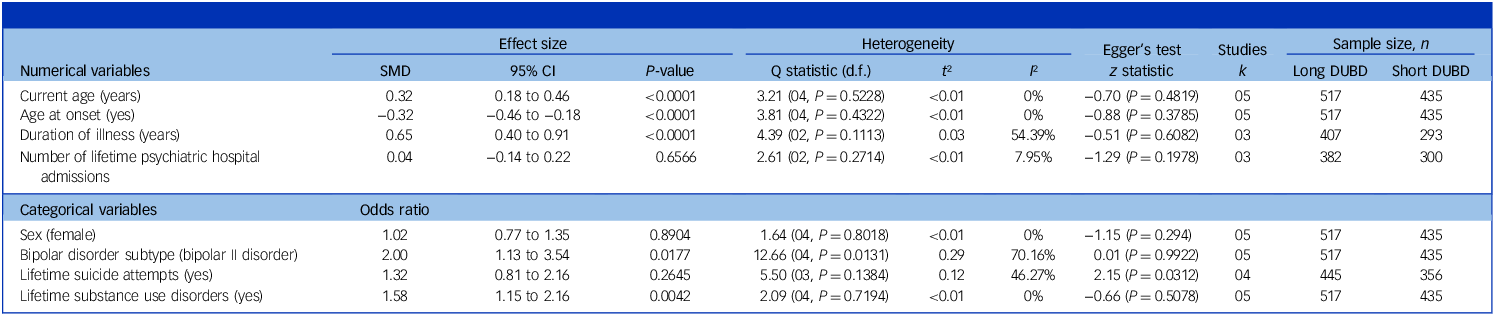
Meta-analyses showed that the long DUBD group was older at the time of assessment (SMD = 0.32; 95% CI: 0.18 to 0.46; P < 0.0001), younger at onset of bipolar disorder (SMD = −0.32; 95% CI: −0.46 to −0.18; P < 0.0001) and had a longer duration of illness (SMD = 0.65; 95% CI: 0.40 to 0.91; P < 0.0001), with effect sizes ranging from small to moderate (Fig. 3). In addition, participants in the long DUBD group were more likely to have a diagnosis of BD-II (odds ratio = 2.00; 95% CI: 1.13 to 3.54; P = 0.0177) and to have a lifetime history of comorbid substance use disorder (odds ratio = 1.58; 95% CI: 1.15 to 2.16; P = 0.0042) (Fig. 4). There were no significant differences between the long and short DUBD groups with respect to the other variables investigated (Table 2). Substantial heterogeneity was found for duration of illness and BD-II subtype. Egger’s test did not identify publication bias in any of the meta-analyses (Table 2). In the sensitivity analysis, the effect size for BD-II subtype lost statistical significance after one of the five studies was removed. All the other effect sizes remained statistically significant in the leave-one-out procedure (Supplementary Table 10).
Effect sizes of differences between groups with short and long duration of undiagnosed or untreated bipolar disorder (numerical variables).

Effect sizes of differences between groups with short and long duration of undiagnosed or untreated bipolar disorder (categorical variables).

Meta-analysis of differences in clinical and sociodemographic variables between short and long DUBD groups

DUBD, duration of undiagnosed and/or untreated bipolar disorder; SMD, standardised mean difference.
Discussion
To our knowledge, this is the first systematic review and meta-analysis of DUBD and clinical outcomes. The pooled mean DUBD across all studies was almost one decade (9.10 years). The gap between mean age at onset (27.10 years) and the mean age at which professional help was received (30.32 years) may have been related to how individuals appraise their early mood symptoms, as well as various patient-, illness- and healthcare-system-related factors that can influence help-seeking behaviours. Reference Keramatian and Morton49 These results are consistent with those of a recently published meta-analysis, Reference Scott, Graham, Yung, Morgan, Bellivier and Etain50 which reported an average delay of 3.5 years in help-seeking among patients with bipolar disorder, whereas the estimated delay in diagnosis was 7 years. Whereas Scott and colleagues focused on potential predictors of delay, our primary objective in the present study was to examine DUBD and its relationship with clinical and functional outcomes. Overall, we found considerable methodological heterogeneity across studies, and more than 83% of the included studies were of poor or fair quality. Studies that investigated outcomes subsequent to the diagnosis of bipolar disorder as a function of DUBD yielded conflicting findings. It was not possible for us to perform a meta-analysis for these outcomes owing to vast heterogeneity and insufficient data.
DUBD and clinical outcomes
Frequency of relapse into mood episodes was associated with longer DUBD in two Reference Murru, Primavera, Oliva, Meloni, Vieta and Carpiniello21,Reference Post, Leverich, Kupka, Keck, McElroy and Altshuler36 of three studies. This discrepancy in findings could have been due to the different definitions of illness onset used in these studies. Specifically, Post et al. and Murru et al. defined the onset of bipolar disorder as the time from the first mood episode. By contrast, the one study that reported no correlation between relapse and DUBD Reference Baldessarini, Tondo and Hennen47 defined the onset of bipolar disorder as the time of first psychiatric intervention, which tends to occur several years after the onset of symptoms or mood episode for many patients with bipolar disorder; this could have obscured the impact of DUBD on outcomes. Severity of mood symptoms was investigated in four studies. One study Reference Post, Leverich, Kupka, Keck, McElroy and Altshuler36 reported a significant correlation between longer treatment delays and more severe depressive symptoms, whereas another study Reference Ahmed, Elbeh, Khalifa and Samaan46 found that more severe manic symptoms in in-patients with BD-I were associated with a longer DUBD. Conversely, two other studies Reference Menculini, Verdolini, Gobbicchi, Del Bello, Serra and Brustenghi20,Reference Kvitland, Ringen, Aminoff, Demmo, Hellvin and Lagerberg45 found no significant correlation between DUBD and severity of mood symptoms as measured by total score on mood rating scales. These discrepancies across studies may stem from methodological disparities. For instance, whereas the study by Post and colleagues Reference Post, Leverich, Kupka, Keck, McElroy and Altshuler36 gauged mood symptoms severity using the prospective National Institute of Mental Health-Life Chart Method, spanning 1 to 4 years, the remaining three studies used singular cross-sectional evaluations.
Notably, none of the five studies that assessed cross-sectional functional outcomes using various assessment tools reported any significant association with DUBD, whereas the single study that investigated cognitive functioning using the Montreal Cognitive Assessment found a negative association between DUBD and cognitive functioning. There were mixed findings for other secondary outcomes subsequent to bipolar disorder diagnosis, including frequency of psychiatric hospital admissions and substance use, preventing us from drawing any firm conclusion regarding these.
DUBD and lifetime clinical and demographic characteristics
Concerning lifetime clinical and demographic characteristics, the results of our meta-analyses suggested early onset, depression as the polarity of the first episode, lifetime suicide attempts, comorbid anxiety and alcohol use disorders and family history of bipolar disorder were associated with significantly longer DUBD while the diagnosis of BD-I, and the presence of lifetime psychotic symptoms associated with significantly shorter DUBD. It should be noted that determining the extent to which these outcomes result from prolonged DUBD or contribute to it is not possible, leading to uncertainty in establishing the direction of causality.
The observed link between DUBD and higher risk of suicide attempts holds significant clinical implications Reference Keramatian, Pinto, Schaffer, Sharma, Beaulieu and Parikh8 given the strong evidence suggesting that successful treatment of bipolar disorder reduces the risk of suicide. Reference Schaffer, Isometsä, Tondo, Moreno, Sinyor and Lars Vedel51 However, when bipolar disorder remains undiagnosed, patients may be treated with antidepressants under the assumption that they have unipolar depression. This can be particularly concerning since studies have suggested that treatment with antidepressants, when used without mood stabilisers in patients with undiagnosed bipolar disorder may increase the risk of suicidal behaviours. Reference Sharma, Persad and Kueneman52 These findings emphasise the importance of early identification and appropriate treatment of bipolar disorder to mitigate safety risks and highlight the potential dangers of misdiagnosis.
The association between family history of bipolar disorder and a longer DUBD may seem counterintuitive, but several factors could contribute to this finding. Approximately, one-third of youth with bipolar disorder have a biological parent with the condition. Reference Brotman, Kassem, Reising, Guyer, Dickstein and Rich53 While one might expect that having a parent with bipolar disorder would facilitate earlier recognition and help-seeking, the situation might be more complex. For instance, parents who have experienced the challenges of bipolar disorder themselves may fear the implications of their child being diagnosed with the disorder, leading them to delay help-seeking. Additionally, parents may downplay early signs of the disorder in an attempt to protect their child from the stigma or burden of the diagnosis. Reference Keramatian and Morton49 Similarly, the affected individual, aware of their family history, may also experience anxiety, shame, or denial regarding the possibility of having the disorder, potentially leading to delays in acknowledging symptoms or seeking professional help. These explanations are speculative, however, and further research is needed to better understand how both the family’s experience with bipolar disorder and the affected individual’s reaction to their family history might influence help-seeking behaviours and the DUBD.
Anxiety disorders are among the main comorbid conditions in patients with bipolar disorder Reference Yatham, Kennedy, Parikh, Schaffer, Bond and Frey54 and are associated with greater symptom severity, functional impairment and higher risk of suicide in these individuals. Reference Simon, Otto, Wisniewski, Fossey, Sagduyu and Frank55 Symptoms of anxiety disorders, including irritability, distractibility and sleep disturbances, may mask early manifestations of bipolar disorder, leading to a prolonged DUBD. Reference Keramatian, Pinto, Schaffer, Sharma, Beaulieu and Parikh8 Similarly, bipolar disorder has a high rate of comorbidity with alcohol use disorder; more than one-third of patients with bipolar disorder are estimated to have comorbid alcohol use disorder, Reference di Florio, Craddock and van den Bree56 and this comorbidity is linked to increased symptom severity and greater risk of suicide. Reference Frye and Salloum57 Epidemiological studies have shown that up to 41% of patients with bipolar disorder may use alcohol or other substances to reduce their mood symptoms; Reference Bolton, Robinson and Sareen58 however, the mood symptoms may also be attributed to the mood-altering effects of alcohol by both patients and clinicians, leading to delays in help-seeking and receiving proper diagnosis.
Finally, a lifetime history of psychotic symptoms and full manic episodes (BD-I) were associated with shorter DUBD. This could be because the most severe and noticeable manifestations of bipolar disorder facilitate help-seeking among patients with bipolar disorder and their families, which in turn could lead to earlier diagnosis and treatment.
Limitations and future directions
The findings of this systematic review and meta-analysis should be interpreted in light of several limitations. The first concerns the definition of onset of bipolar disorder. This is typically defined as the onset of any mood episode regardless of polarity. However, from a diagnostic perspective, bipolar disorder cannot be identified until a manic or hypomanic episode has occurred. Thus, our finding of a longer DUBD when depression is the initial mood episode is self-evident. More importantly, some studies did not differentiate between prolonged DUBD resulting from the natural course of the illness – such as a delay between the first depressive episode and the onset of hypomania or mania – and a delay in recognising mania or hypomania. Therefore, interpretation of their findings may become challenging, as these two pathways could influence outcomes differently. One way to address this is to analyse the duration of untreated (hypo)mania in addition to overall DUBD; this could provide a more nuanced understanding of how delays in recognising and treating mania affect prognosis. In addition, although most studies considered the first syndromal mood episode to be the onset of bipolar disorder, others used other definitions such as first mood symptoms or first medical contact. Notably, results of studies involving individuals at high risk of developing bipolar disorder suggest that it may take several years from the emergence of non-specific mood symptoms until the full diagnostic criteria for bipolar disorder are met. Reference Duffy, Goodday, Keown-Stoneman and Grof59 Similarly, as demonstrated in our meta-analysis, there can be a considerable delay between the onset of illness and first professional help-seeking among patients with bipolar disorder. We believe there is a pressing need for the field to adopt consistent definitions of the onset of bipolar disorder and of DUBD, as the absence of consistent definitions for these key variables limits our ability to compare results across studies and draw clear conclusions.
Second, among the studies that met our inclusion criteria, only five were rated as good quality. This affects the reliability and robustness of our findings and interpretations, as low-quality studies are more likely to produce skewed estimates of treatment effects, potentially leading to inaccurate inferences. Reference Khan, Daya and Jadad60 In addition, we found considerable inconsistencies across included studies in relation to how they conceptualised diagnostic or treatment delays. Some studies treated DUBD as a continuous variable, whereas others used various (mainly arbitrary) cut-offs to divide their samples into short and long DUBD groups. This practice is generally not advisable, as it can lead to reduced statistical power, loss of information and misinterpretation of findings. Reference Ragland61 Furthermore, dichotomising DUBD may obscure important aspects of the relationship between DUBD and clinical outcomes. We propose that future studies treat DUBD as a continuous variable, enabling more precise analyses that capture the full range of variability in undiagnosed or untreated illness duration.
Third, given the retrospective nature of most included studies, it remains unclear to what extent some of the measured outcomes were contributing factors to or consequences of prolonged DUBD. Retrospective designs rely on participants’ recollection of symptom onset and timing of help-seeking; this can be subject to recall bias, especially in individuals with long DUBD. This in turn makes it challenging to establish clear temporal relationships between outcome variables, as there is a possibility of reverse causality, in which factors identified as consequences of prolonged DUBD may in fact contribute to it. Similarly, the onset of bipolar disorder (which was used to calculate the DUBD) in all individual studies (retrospective and prospective) was determined mainly through patients’ self-reports and was therefore subject to recall bias. Moreover, limited long-term outcomes data are available in relation to DUBD. Understanding how DUBD influences the course of bipolar disorder over time, including frequency and severity of mood episodes, functional impairment, and overall quality of life, is crucial for developing effective intervention strategies. Future research should use prospective designs, ideally involving individuals at high risk of developing bipolar disorder, to better clarify the relationships between DUBD and long-term clinical outcomes while minimising the biases inherent to retrospective reporting.
Fourth, the limited number of studies included in our meta-analysis restricted our ability to perform subgroup analyses based on factors such as age groups and geographical regions. Future meta-analyses could explore the potential impact of these factors on the relationship between DUBD and clinical outcomes.
Finally, a key limitation of the studies included in this review was the lack of detailed information on potential confounding factors that could influence both DUBD and clinical outcomes. Factors including socioeconomic status, access to healthcare, and comorbid medical or psychiatric conditions may significantly affect both help-seeking behaviours and outcomes in individuals with bipolar disorder. Moreover, the presence of mixed features – characterised by overlapping depressive and manic and/or hypomanic symptoms – is associated with a greater likelihood of suicide attempts, co-occurring anxiety and rapid cycling, all of which could complicate the clinical presentation of bipolar disorder and contribute to a longer DUBD. Reference Bartoli, Crocamo and Carrà62,Reference Chakrabarty, Keramatian and Yatham63 The absence of detailed data on these confounding factors and the potential influence of mixed features may have obscured the true relationship between prolonged DUBD and clinical outcomes. Future investigations should thus seek to systematically collect and report data on these potential confounders to better clarify the relationship between DUBD and clinical outcomes.
Clinical implications
The results of this systematic review and meta-analysis indicate that there is a substantial gap, of more than 9 years on average, between the onset of mood symptoms and the diagnosis and treatment of bipolar disorder. DUBD may be associated with negative outcomes including more severe mood symptoms and higher rates of relapse, as well as lifetime suicide attempts and greater psychiatric comorbidity. These findings highlight the need for clinicians to adopt a more comprehensive approach to assessment and treatment of mood disorders and to prioritise early screening for bipolar disorder. This is particularly important among adolescents and young adults with a family history of bipolar disorder who present with depressive symptoms, as these individuals may be at high risk of being misdiagnosed and inappropriately treated with antidepressant monotherapy, potentially exacerbating their condition and increasing their risk of suicide.
However, the findings of this review should be interpreted with caution owing to the considerable conceptual and methodological heterogeneity among individual studies and the mixed findings of these studies. These factors limit our ability to draw any firm conclusion regarding the clinical implications of prolonged DUBD and emphasise the need for improved methodological rigour in future studies. Future prospective studies should incorporate assessments of delayed diagnosis and treatment as a potential risk factor that could predict various clinical outcomes. Gathering such data in a systematic way could offer valuable insights into the effects of delayed diagnosis and treatment on the trajectory of bipolar disorder. Moreover, a more standardised approach to definition of DUBD will enhance our understanding of its implications, as will comprehensive collection of data on potential confounding factors such as socioeconomic status and healthcare access, and evaluation of the roles of comorbidities and other clinical characteristics.
Finally, given the treatability of bipolar disorder and the potential consequences of prolonged DUBD, future efforts should prioritise targeted interventions for early detection of bipolar disorder, especially among individuals who are at high risk of developing bipolar disorder, such as those with a family history of bipolar disorder or those presenting with subthreshold bipolar disorder symptoms. Reference Keramatian, Chakrabarty, Saraf and Yatham64 Tailored interventions including psychoeducational programmes for high-risk individuals and their families, as well as training programmes for healthcare providers to improve recognition and management of bipolar disorder and implementation of specialised care pathways, could help to reduce DUBD, thereby improving overall patient outcomes and quality of life.
Supplementary material
Supplementary material is available online at https://doi.org/10.1192/bjp.2025.63
Data availability
The data supporting the findings of this study are available within the article and its supplementary materials.
Acknowledgements
We thank Nazlin Walji for her valuable contribution to the final proofreading of this manuscript.
Author contributions
K.K. conceptualised and planned the study and wrote the original draft of the manuscript. J.V.P. performed statistical analyses. V.W.L.T. and K.K. screened the literature and extracted the data. T.C. and K.K. performed the quality assessment, and L.N.Y. oversaw the study. All authors reviewed and edited the final manuscript.
Funding
This research received no specific grant from any funding agency, commercial or not-for-profit sectors.
Declaration of interest
K.K. has received research support from Michael Smith Health Research BC, Vancouver Coastal Health Research Institute and the Canada Research Chair Program, and participated on the advisory board of AbbVie. T.C. has received grants from the National Research Council Canada and the Michael Smith Foundation for Health Research. L.N.Y. has received grants from AbbVie and Dainippon Sumitomo, consultation fees or honoraria from Alkermes, Allergan (currently AbbVie) Sumitomo Pharma, Kye Pharma, LivaNova and Merck, participated on the advisory board of Alkermes, received study medications from PBG Biopharma and Filament, and received payments from Neurotorium and WFSBP.







 Open access


eLetters
No eLetters have been published for this article.