Milk proteins are considered to be the most important source of bioactive peptides that can be released through hydrolysis by proteolytic microorganisms such as lactic acid bacteria (Meisel & Bockelmann, Reference Meisel and Bockelmann1999; Matar et al. Reference Matar, Valdez, Medina, Rachid and Perdigon2001; LeBlanc et al. Reference LeBlanc, Matar, Valdez, LeBlanc and Perdigon2002, Reference LeBlanc, Fliss and Matar2004; FitzGerald & Meisel, Reference FitzGerald, Meisel, Fox and McSweeney2003; Kenny et al. Reference Kenny, FitzGerald, O'Cuinn, Beresford and Jordan2003; De LeBlanc et al. Reference De LeBlanc, Matar, LeBlanc and Perdigon2005, Reference De LeBlanc, Chaves, Carmuega, Weill, Antoine and Perdigon2008). The immunomodulatory effects of the peptides have been actively studied, particularly those released during milk fermentation with Lactobacillus helveticus (Ng & Griffiths, Reference Ng and Grifffiths2002; Vinderola et al. Reference Vinderola, Matar and Perdigon2007a, Reference Vinderola, Matar, Palacios and Perdigonb & Reference Vinderola, Matar and Perdigonc). However, only a in a few of those studies have the isolated compounds been characterized to understand their interaction with the innate immune system (Coste et al. Reference Coste, Rochet, Lonil, Molle, Bouhallab and Tome1992; Herbert et al. Reference Herbert, Rayas and de Giori1997; Sandre et al. Reference Sandre, Gleizes, Foresties, Gorges-Kergot, Chilmonczyk, Leonil, Moreau and Labarre2001; Vinderola et al. Reference Vinderola, Matar, Palacios and Perdigon2007b).
Macrophages play an important role in innate immunity through mechanisms such as nitric oxide production, phagocytosis, and cytokine production (Aderem & Underhill, Reference Aderem and Underhill1999; Ng & Griffiths, Reference Miettinen, Vuopio-varkila and Varkila2002; LeBlanc et al. Reference LeBlanc, Matar, Valdez, LeBlanc and Perdigon2002; Brovko et al. Reference Brovko, Vandenende, Chu, NG, Brooks and Griffiths2003; Vinderola et al. Reference Vinderola, Matar, Palacios and Perdigon2007b; de Moreno de LeBlanc et al. Reference de Moreno de LeBlanc, Chaves, Carmuega, Weill, Antoine and Perdigon2008). During the course of infection, cytokines such as TNF-α, IL-6, and IL-1 β are produced and transmit signals that alert the various components of the host defence. However, despite the beneficial effects of these proinflammatory cytokines for the activation of host defences, various studies have shown that an over-production of these mediators can also lead to vasodilation, increased vascular permeability, hypotension, multiple organ failure and, ultimately, shock and death (Perdigon et al. Reference Perdigon, Fuller and Rayas2001; Netea et al. Reference Netea, van der Meer, van Deuren and Kullberg2003). Fermented milk containing bioactive peptides has the potential to provide specific health benefits such as enhancement of the performance of the innate immune system through macrophage activation; however, it is important to acquire a better understanding of the role of these bioactive peptides as inducers of immune responses.
The objectives of this study were to further investigate the immunomodulating effect of cell-free fractions of milk fermented by Lactobacillus helveticus LH-2 (Ng & Griffiths, Reference Ng and Grifffiths2002; Brovko et al. Reference Brovko, Vandenende, Chu, NG, Brooks and Griffiths2003) by evaluating cytokine production (TNF-α, IL-1β, IL-6), phagocytic activity and nitric oxide production by macrophages, and to isolate and characterize the active peptides present in the cell-free fraction.
Materials and Methods
Fermented Milk Preparation
Lactobacillus helveticus
LH-2 was obtained from the culture collection of the Canadian Research Institute for Food Safety (University of Guelph, Canada) and maintained on Lactobacilli MRS agar (BD Diagnostic Systems) under aerobic conditions at 37°C.
Reconstituted skim milk (0·1 g/ml) was heat treated at 95°C for 30 mins and then cooled overnight at room temperature. Isolated colonies of the Lb. helveticus strain were used to inoculate the reconstituted milk, which was then incubated anaerobically (BBL GasPak system Becton Dickinson, Oakville, ON, Canada) at 37°C for 24 h. This was used as a starter culture at a ratio 1:10 (v/v) for production of fermented milk by aerobic incubation at the same temperature for 26 h. The fermented milk samples were centrifuged at 16 000 g for 10 mins at 15°C (Avanti J-20 XPI, Beckman Coulter, Brea, California, USA). The supernatant was filtered through a 0·2-μm-pore-size filter (Millipore, Bioscience Division, Mississauga, ON, Canada) to remove any bacterial cells present. The protein content of the cell-free supernatant was determined using the Bradford assay (Coomassie Plus Assay Kit, Pierce, Fisher Scientific Ltd., Nepean, ON, Canada) (Kagan et al. Reference Kagan, Yu, Fishman and McDonald2000). Cell-free supernatant was freeze dried and stored at −80°C. Even though the Bradford assay may be not the most appropriate method for determination of protein content in hydrolysed protein samples, it was used in this study since no other method was able to quantify protein content less than 10 μg/ml.
Peptide purification
Size exclusion chromatography (SEC)
Freeze dried supernatant was reconstituted using 50 mm-sodium phosphate-0·15 m-NaCl buffer (5 times concentrated) and filtered through a 0·45 μm filter (Fisher Scientific Ltd., Nepean, ON, Canada). One hundred microlitres of the sample were loaded on a Superdex 75 column (GE Healthcare Bio-Sciences Corp., Piscataway, NJ, USA) and eluted with the same buffer at a rate of 1·0 ml/min. The proteins and peptides were monitored at 214 nm using a UV Detector-Spectra system UV 2000-Thermo Finnigan, (San Jose, California, USA). Nine fractions that corresponded to the main peaks were collected and freeze dried to be used for further immune stimulation studies and amino acid sequencing.
Macrophage Stimulation Studies
Samples preparation
To compare the stimulatory effect of the fractions (F1 to F9) obtained from fermented milk by SEC, samples were reconstituted using autoclaved, 18-Ω water and adjusted to a protein content of 3 or 20 μg/ml, as indicated below.
Macrophage stimulation
A RAW 264·7 murine macrophage cell line (ATCC TIB 71) was kindly provided by Dr. Ali Ashkar (McMaster University, Hamilton, ON, Canada). Cells were maintained in RPMI-1640 medium (Invitrogen, Burlington, ON, Canada) supplemented with 2 mM L-glutamine, 1% (v/v) penicillin-streptomycin (dual antibiotic solution-10 000 units/ml) and 10% fetal bovine serum (Gibco, Invitrogen, Burlington, ON, Canada). Macrophages were counted and the necessary dilution was made to obtain a density of 5×10⁵ cells/ml. Cell suspensions (1 ml) were placed into wells of 6-well plate (Corning No. 3506; Fisher Scientific Canada, Ottawa, ON, Canada) and incubated overnight at 37°C in 5% CO2. The medium was removed and replaced by 1 ml of samples and or control diluted in medium (1:100 sample to medium). LPS (Escherchia coli O111:B; 0·1 μg/ml) (Sigma-Aldrich, Oakville, ON, Canada) and a commercial immunomodulator from β-casein (f 54-59) (Val-Glu-Pro-lle-Pro-Tyr) (Sigma-Aldrich) were used as positive controls (Jolles & Migliore-Samour, Reference Jolles and Migliore-Samour1988). Negative controls were prepared by hydrolyzing unfermented milk using an enzyme:substrate (w/w) ratio of 1:20 and 1:1000 for trypsin and thermolysin (Invitrogen), respectively. Enzymatic hydrolysis was carried out for 24 h at 37°C and pH 5 followed by centrifugation (92 000 g, 1 h, 20°C) (Optima L-90K Ultracentrifuge, Beckman Coulter, Fullerton, CA, USA). This supernatant was used in further experiments. Macrophages were also stimulated by cell-free supernatant of fermented milk concurrently with LPS. Stimulated macrophage cells were incubated for 18 h at 37°C in 5% CO2 in a CO2 incubator.
Cytokine quantification
An indirect sandwich Enzyme Linked Immunosorbent Assay (ELISA) was used to quantify the amount of TNF-α, IL-6 and IL-1β in the supernatant. Flat-bottom, high-binding, 96-well plates (Fisher Scientific Canada) were coated with 100 μl monoclonal goat anti-mouse IL-6 antibody (R & D Systems Inc., Minneapolis, MN, USA), anti-mouse IL-1β (R & D Systems Inc.) or anti-mouse TNF-α (Sigma-Aldrich) diluted in carbonate-bicarbonate buffer (pH 8·8). The concentration of monoclonal antibody was 1 μg/ml for IL-6 and IL-1β, and 2 μg/ml for TNF-α. The plates were stored overnight at 4°C, washed with TBST (10 mm-Tris-HCl, pH 7·5, 150 mm-NaCl, 0·05% Tween-20) and blocked with 200 μl normal donkey serum (Jackson Immuno Research Laboratories Inc., West Grove, PA, USA) by incubation at 37°C for 2 h with shaking (200 rpm). Before use plates were washed four times with TBST and patted dry. Samples were added to the wells and after 1 h of incubation at 37°C, the plate was washed 4 times with TBST. For detection, goat anti-mouse IL-1 β, IL-6, and TNF-α (R & D Systems Inc.) antibodies were used. The concentration of the polyclonal antibodies was 200 ng/ml for IL-1 β, and 400 ng/ml for the other two cytokines. After 1 h of incubation, plates were washed using TBST. Alkaline phosphatase-conjugated donkey anti-goat antibody (Jackson Immuno Research Laboratories Inc.) diluted in TBS (Tris Buffered Saline) pH 8·0 (Sigma-Aldrich) was added (100 μl/well) at a titer of 1:10 000. Plates were incubated for 1 h, and washed as described before. For colour development, 100 μl p-nitrophenyl phosphate (Sigma-Aldrich), diluted in the diethanolamine substrate buffer (Fisher Canada) at a concentration of 1 mg/ml, were added. Plates were incubated for 30 mins and stop solution (25 μl 3 m-NaOH) was applied to each well. The absorbance at 405 nm (A405 nm) was measured using a Wallac 1420 Victor Multilabel Counter (PerkinElmer Life Sciences Canada, Woodbridge, ON, Canada).
Assay for Nitric Oxide (NO)
Nitric oxide production in culture supernatant was assayed by measuring nitrite (NO2−), its stable degradation product, using Griess reagent (Sigma-Aldrich).
RAW 264·7 cells were seeded on a 24-well plate at a concentration of 106 cells/ml and allowed to adhere by incubation for 4 h at 37°C in a CO2 incubator (Forma Scientific Inc.). Cells were stimulated with LPS (1 μg/ml) or samples (1:100 sample to medium) for 24 h. Fifty microliters of supernatant from the cultured cells were mixed with 50 μl Griess reagent and incubated for 15 mins at room temperature. The absorbance was measured at 540 nm in a Victor MultiLabel microplate reader (Perkin Elmer Life And Analytical Sciences, Inc). Sodium nitrite (Sigma-Aldrich) was used as a standard.
Phagocytosis Assay
To quantify the effect of inducers on phagocytic function, the VybrantTM Phagocytosis assay kit was used (Invitrogen, Burlington, ON, Canada) according to manufacturer instructions. The fluorescence was read using a Wallac 1420 Victor Multilabel counter with excitation and emission wave lengths at 480 and 520 nm, respectively and results were presented as a percent of the Net Positive Reading.
MS analysis and Peptide Sequencing
Active fraction (F5) was spotted on a Matrix-assisted laser desorption/ionization (MALDI) target using 2,5-dihydroxybenzoic acid (Sigma-Aldrich) as the matrix. MALDI mass spectra were acquired on a QStar XL QqTOF (Applied Biosystems, Foster City, CA, USA) equipped with a MALDI 2 source and a nitrogen laser operating at 337 nm. In order to sequence the peptides found in F5, data from MS/MS measurements were searched against the NCBI bovine protein database using the MASCOT server (Matrix Science, Boston, MA, USA) (Perkins et al. Reference Perkins, Pappin, Creasy and Cottrell1999).
Statistical analysis
Data from each experiment were evaluated using ANOVA and a subsequent Tukey's test. Differences at P<0·05 were considered to be significant.
Results
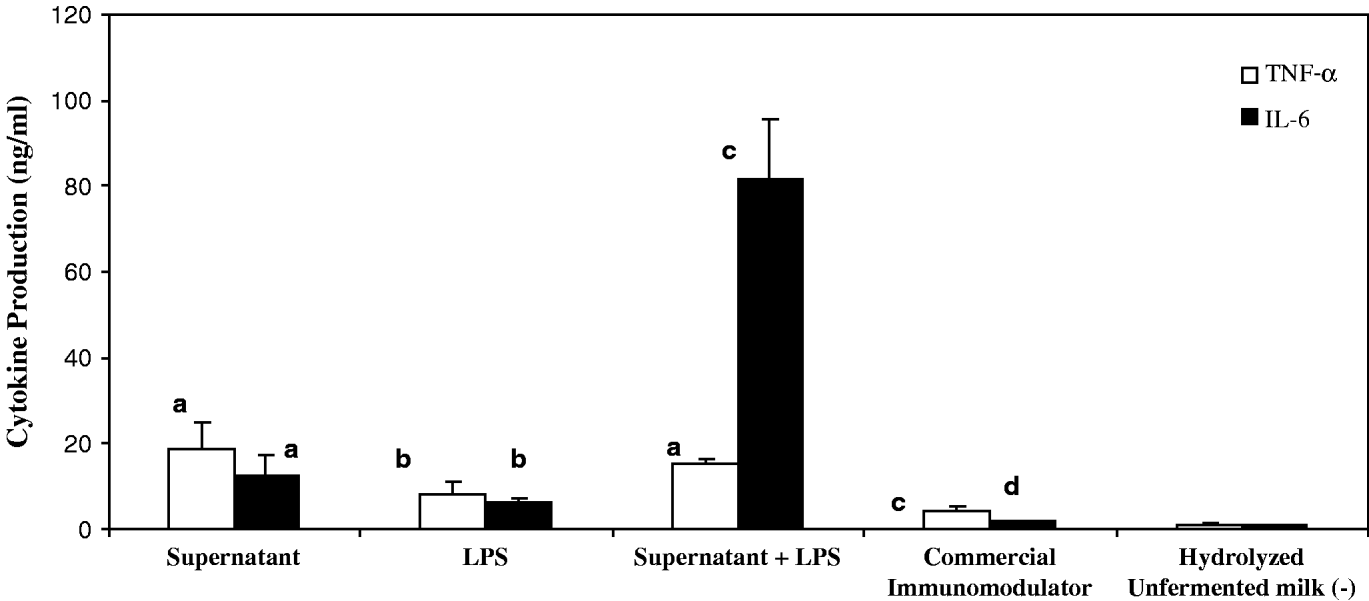
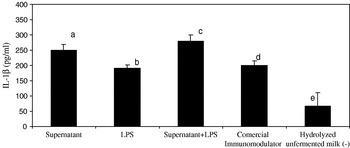
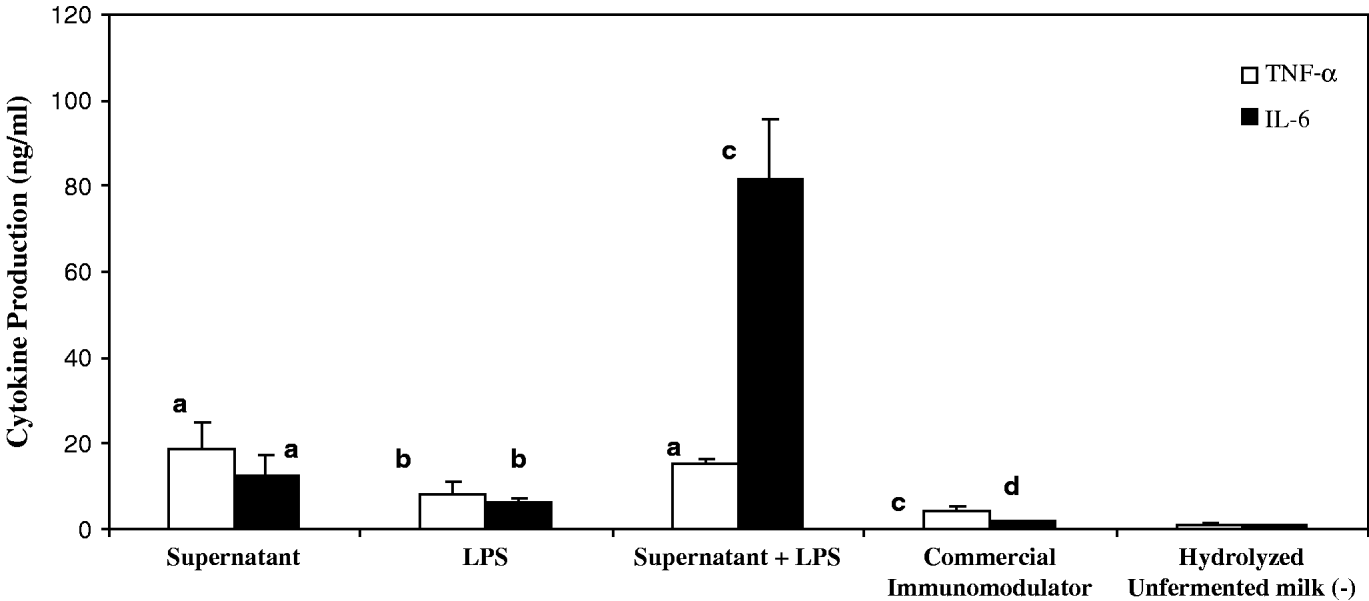
Immunomodulating Activity of Cell-Free Fermented Milk Supernatant was tested by the methods described above. The results obtained suggest that IL-6, TNF-α, and IL-1β production was significantly higher in macrophages stimulated with cell-free supernatant compared to LPS-stimulated macrophages (Fig. 1 & 2). The highest effect was observed for TNF-α since production of this cytokine was 3-fold higher in macrophages stimulated by cell-free fermented milk fraction compared with cells stimulated with LPS. Macrophages stimulated with supernatant concurrently with LPS showed the highest response in terms of IL-6 and IL-1β production. Production of IL-6 in this case was 6-fold higher compared with supernatant-stimulated macrophages. The commercial immunomodulator induced lower cytokine production (TNF-α, IL-6 and IL-1β) compared with cells stimulated with supernatant or supernatant with LPS. Enzymatically hydrolyzed supernatant exhibited a very low effect on cytokine production, confirming that compounds produced during milk fermentation with Lb. helveticus are responsible for macrophage activation as these are not present in milk treated with proteolytic enzymes.
IL-6 and TNF-α production (ng/ml) by RAW 264·7 cell line stimulated by LPS, supernatant, supernatant+LPS, commercial immunomodulator, and hydrolyzed supernatant. The test was standardized at 100 μg/ml protein per sample to compare activity. The data are the means±the standard deviations of the results of three independent replicate trials. Values with different letters are significantly different P<0·05.
IL-1β production (pg/ml) by RAW 264·7 cell line stimulated by LPS, supernatant, supernatant+LPS, commercial immunomodulator, and hydrolyzed supernatant. The data are the means±SD of the results of three independent replicate trials. Values with different letters are significantly different P<0·05.

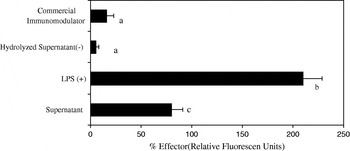
The observed phagocytic activity of macrophages stimulated by supernatant from fermented milk was significantly higher than for the commercial immunomodulator, but lower than for macrophages stimulated by LPS (Fig. 3). The commercial immunomodulator is a hexapeptide from human casein (Val-Glu-Pro-Ile-Pro-Tyr) that exerts a direct effect on macrophages by promoting phagocytosis (Parker et al. Reference Parker, Migliore-Samour, Floch, Zerial, Werner, Jolles, Casaretto, Zahn and Jolles1984).
Phagocytic activity of RAW 264·7 macrophages stimulated by LPS, supernatant, commercial immunomodulator and hydrolyzed supernatant. The data are the means±SD of the results of three independent replicate trials. Values with different letters are significantly different P<0·05.

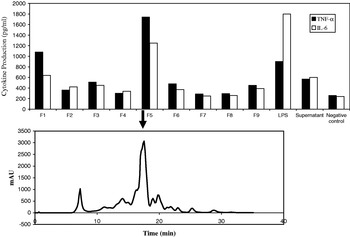
Effect of isolated Peptidic Fractions of fermented milk on macrophages. The effect of the fractions collected by SEC, and adjusted to a protein concentration of 3 μg/ml was evaluated by quantification of cytokine production, phagocytosis and nitric oxide production.
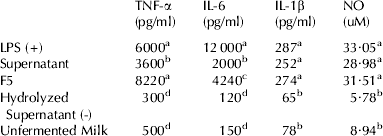
Two fractions (void volume (F1) and a fraction eluted at 15 mins (F5)) produced a higher response in terms of IL-6 and TNF-α release when used to stimulate macrophages compared with all the other fractions (Fig. 4). F5 also induced the highest levels of phagocytosis and NO production compared with all the other fractions since the levels of these biomarkers for the rest of the fractions were below the detection limits (data not shown). TNF-α expression in the presence of fraction F5 was 2-fold higher than that obtained with fermented milk supernatant and 16-fold higher than with unfermented milk. However, there was no significant difference for TNF-α production between LPS and F5 stimulated macrophages (Table 1). IL-6 production for macrophages stimulated with F5 was significantly lower than that obtained in the presence of LPS but was more than 2-fold higher than levels of cytokine achieved by addition of the supernatant. There was no significant difference among the analyzed samples in terms of IL-1β and nitric oxide production when macrophages were stimulated with LPS, supernatant or F5 (Table 1).
IL-6 and TNF-α production (pg/ml) by RAW 264·7 cell line stimulated by LPS, cell-free supernatant, hydrolyzed supernatant, and peptidic fractions from supernatant isolated by SEC. The test was standardized at 3 μg/ml protein per sample to compare activity. The data are the means±SD for three independent replicate trials.

Cytokine and nitric oxide production by RAW 264·7 macrophages
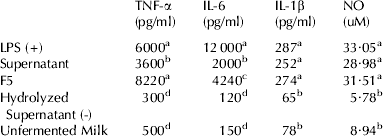
Protein was standardized at 20 μg/ml. Values with different letters are significantly different P<0·05
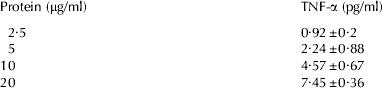
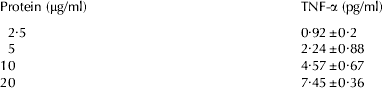
Samples of the Fraction F5 adjusted to protein concentrations between 2·5–20 μg/ml were evaluated in terms of TNF-α production. Results showed a direct relation between the amount of protein present and TNF-α production (Table 2). Higher concentrations (>20 μg/ml) induced macrophage death.
TNF-α production in response to varying level of protein content (2·5 to 20 μg/ml) in F5
Values are the means±sd for n=3 independent replicate trials
Sequencing of peptides in F5 fraction
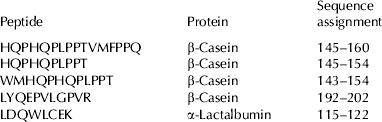
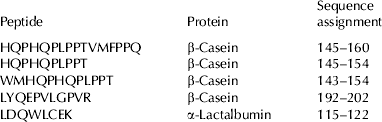
The F5 fraction was analyzed by mass-spectrometry and amino acid sequences of peptides were elucidated. Five peptides were identified in the fraction, which ranged in size from 8 to 16 amino acids (Table 3). Matching of their sequence with bovine proteins (NCBI data base) suggests that four peptides present in the fraction originated from β-casein (f 143-160 and f 192-202), and one from α-lactalbumin (f 115-122).
Peptides identified in the F5 fraction of milk fermented with Lactobacillus helveticus LH-2 strain after separation by SEC using Superdex 75 column
Discussion
Bioactive peptides produced during fermentation of milk by Lb. helveticus have been proposed as an alternative to control bacterial infection because of their potential immune-stimulating and anti-microbial properties (Matar et al. Reference Matar, Valdez, Medina, Rachid and Perdigon2001; LeBlanc et al. Reference LeBlanc, Matar, Valdez, LeBlanc and Perdigon2002, Reference LeBlanc, Fliss and Matar2004; Yasutaka & Kiyoshi, Reference Yasutaka and Kiyoshi2002). In contrast with other studies (Vinderola et al. Reference Vinderola, Matar and Perdigon2007a & Reference Vinderola, Matar, Palacios and Perdigonb), in our work the pH was not controlled during the fermentation to reproduce the process of production of natural dairy products. In the present study, the potential stimulatory effect of cell-free supernatant from fermented milk and its peptidic fraction F5 on macrophages was investigated by evaluating cytokine (IL-6, TNF-α and IL-1β) production, phagocytosis and nitric oxide production. Cytokines play a central role in coordinating inflammatory responses and in providing signals for cellular differentiation and proliferation (Takahashi et al. Reference Takahashi, Oka, Iwana, Kuwata and Yamamoto1993). In this study, a cell-free fraction from fermented milk enhanced the production of IL-6, TNF-α, IL-1β by stimulating macrophages. The observed high production of TNF-α and IL-6 by the macrophages was accompanied by increased nitric oxide production and phagocytic activity. Nitric oxide, the synthesis of which is induced by TNF-α, is one of the cytotoxic agents by which macrophages can kill bacteria and other pathogens, as well as tumour cells (Jeffrey et al. Reference Jeffrey, Van Ostade and Lopez1996; Miettinen et al. Reference Miettinen, Vuopio-varkila and Varkila1996).
Further separation of the components of the supernatant according to their size by SEC gave rise to the fraction (F5) that produced a high stimulatory effect on cytokine production by RAW 264·7 cells. The highest response was observed for TNF-α. TNF-α is part of the major host defence components against trauma and infection, and plays an important role in inducing gene expression of several cytokines and nitric oxide synthesis (Urban et al. Reference Urban, Shepard, Rothstein, Sugarman and Schreiber1986; Tejada-Simon & Pestka, Reference Tejada-Simon and Pestka1999; Tsao et al. Reference Tsao, Lin and Wang2004; Ustundag et al. Reference Ustundag, Yilmaz, Dogan, Akarsu, Canatan, Halifeoglu, Cikim and Aygun2005). The results of the dose-response study for the effect of fraction F5 on the expression of TNF-α suggested that the protein concentration for optimal activity was in the range 2·5–20 μg/ml. Higher concentrations of peptides in the sample produced macrophage death, confirming previous observations that moderated production of cytokines have a beneficial effect but high concentration of TNF-α causes tissue injury and shock (Abbas et al. Reference Abbas, Lichtman and Pobe1994). Thus, preparations of F5 with threshold protein content can induce moderate production of TNF-α and this might have a beneficial effect on macrophage activation.
Five peptides identified and sequenced from fraction F5 were derived from both β-casein and α-la (Table 3). These results confirm our observations from the preliminary tests done on fermentation of the separate fractions of casein and whey. Both preparations stimulated production of IL-6 and TNF-α by RAW 264·7 macrophages, although the fermented milk supernatant induced a higher response (results not shown).
Three of the peptides present in the active fraction F5 share the common amino acid sequence of β-casein with variation at N- and C-terminals (f 148-154; f 145-160 and f 143-154) and have a net charge +2. Peptide β-casein (f 192-202) has a net zero charge, and peptide α-la (f 115-122) has a negative net charge, however, in these two last peptides 50% of their residues are hydrophobic (Protein Identification and Analysis Tools- ExPASy Server) (Gasteiger et al. Reference Gasteiger, Hoogland, Gattiker, Duvaud, Wilkins, Appel, Bairoch and Walker2005). Peptides identified in F5 have in their structure a high percentage of proline and also contain residues of lysine and histidine (Coste et al. Reference Coste, Rochet, Lonil, Molle, Bouhallab and Tome1992; Christensen et al. Reference Christensen, Broadbent and Steele2003).
From all the peptides identified in the present work, only C-terminal fragment of β-casein from 192 to 209 have been reported to have immunostimulating properties (Sandre et al. Reference Sandre, Gleizes, Foresties, Gorges-Kergot, Chilmonczyk, Leonil, Moreau and Labarre2001; Coste et al. Reference Coste, Rochet, Lonil, Molle, Bouhallab and Tome1992). C-terminal fragment of β-casein was obtained by enzymatic hydrolysis of the pure protein using chymosin and isolated by ion-exchange chromatography and HPLC to 80–95% purity. It was tested for mitogenic activity on rat lymph node cells and showed enhanced proliferation of the treated cells at concentration 500 μg/ml. The synthetic analogue of the same peptide produced the similar effect, thus confirming the immunomodulating activity. Later, the effect of the same peptide on phagocytic activity and cytokine production in mouse macrophages was investigated. The stimulatory effect was observed for phagocytic activity, however f193-209 peptide was a very weak inducer of cytokine secretion. Comparing these results with the results obtained in the present study, where F5 was able to up-regulate TNF-α to the same extent as LPS, it can be concluded that peptides isolated from β-casein (f143-154, f145-160, and f148-154) as well as peptide derived from α-la (f115-122) are probably also involved in macrophage activation. In addition the concentration of peptidic fraction used in our study was at least 25 times lower than in previous work, thus confirming the high biological activity of newly obtained peptides. It still remains unclear if all the peptides present in F5 have an impact on its immunomodulatory activity or exert a synergistic effect, or if it is just an individual effect caused by one or a few of the sequenced peptides. Further purification and separation of individual peptides was not possible since the concentration of the peptides in F5 was very low.
In summary, this study showed that the cell free supernatant from milk fermented by Lb. helveticus LH-2 and its peptidic fraction F5 up-regulate cytokines and nitric oxide production by macrophages as well as stimulating phagocytic activity of these cells. Four novel bioactive peptides derived from β-casein and α-la by fermentation with Lb. helveticus LH-2 were identified in this fraction. These effects suggest that F5 might exert an immunostimulating activity through modulation of macrophage functions. It is well-known that the nature and activity of peptides produced by milk fermentation with Lb. helveticus is strain specific, unlike in the case of enzymatic hydrolysis of pure casein (Deutsch et al. Reference Deutsch, Molle, Gagnaire, Piot, Atlan and Lortal2000). Taking advantage of the powerful proteolytic system of this bacterium opens up future opportunities to search for novel food-derived compounds with potential health promoting properties using the approach described in this work.