




Introduction
The Netherlands started 2025 with a cabinet supported by four parties, ranging from the centre-right to the radical right, headed by the independent Dick Schoof. Over the summer, that government fell not once but twice. On 29 October, the country held snap elections, which were won by the social-liberal opposition party Democrats 66 (Democraten 66, D66) led by Rob Jetten. By year’s end, D66 was leading negotiations for a new centre-right government. The Schoof experiment had ended, and the Netherlands appeared to be returning to the coalition politics of the previous decade.
Election report
On 3 June 2025, the Schoof I cabinet fell (see below). New elections were held on 29 October. The campaign was short, as is usual for Dutch campaigns, and lacked a clear substantive focus. Instead, the dominant theme was the question of who could govern with whom after the election.
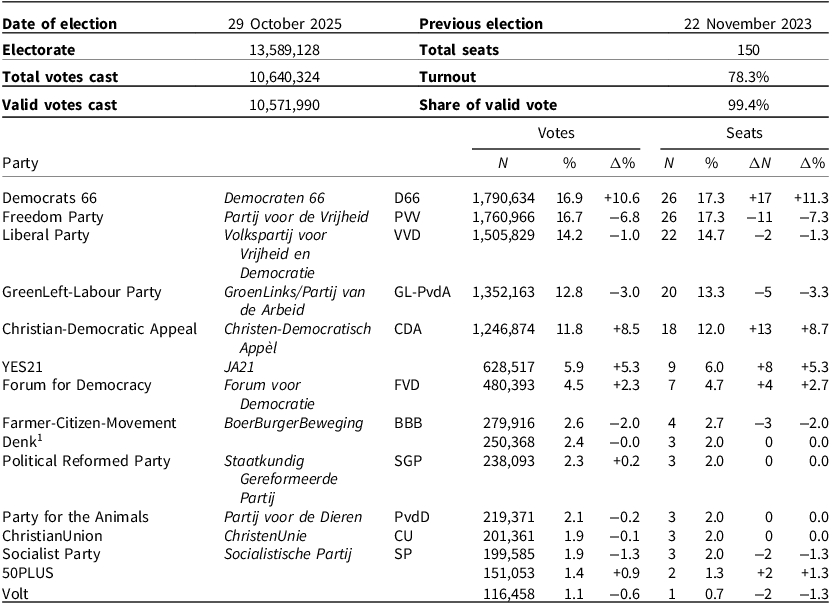
D66 and the radical right-wing populist Freedom Party (Partij voor de Vrijheid, PVV) each won 26 seats, but D66 finished first by a margin of fewer than 30,000 votes and was therefore considered the largest party for the purpose of coalition formation (see Table 1). Under Jetten’s leadership, D66 reoriented itself, focusing mainly on winning centre-right voters. While D66 had previously been outspoken on cultural issues such as migration, the party now presented itself as centrist on these issues – though most of this change was symbolic: the clearest sign of the party embracing a more nationalist course was Jetten reclaiming the Dutch flag. The decision by PVV leader Geert Wilders to drop out of one of the televised debates (see below) proved a game-changer for D66, as Rob Jetten was asked to step in, thereby reaching a wide audience with his positive centrism. Further strong debate performances, in particular against Wilders, boosted the party in the polls (Louwerse Reference Louwerse2025). D66 went on to triple its support, drawing in voters from the joint list of GreenLeft (GroenLinks, GL) and the social-democratic Labour Party (Partij van de Arbeid, PvdA) to its left and New Social Contract (Nieuw Sociaal Contract, NSC) and the Liberal Party (Volkspartij voor Vrijheid en Democratie, VVD) to its right (NOS 2025).
Elections to the lower house of the Dutch Parliament (Tweede Kamer der Staten-Generaal) in the Netherlands in 2025

Table 1. Long description
The table presents the results of the Dutch Parliament elections held on 29 October 2025. It includes data on the electorate, total votes cast, valid votes cast, and the distribution of seats among different political parties. The table has 15 rows and 10 columns, with column headers including Party, Votes N, Votes %, Votes Delta%, Seats N, Seats %, Seats Delta N, and Seats Delta%. Row labels include the names of the political parties. Key parties include Democrats 66, Freedom Party, Liberal Party, Green Left-Labour Party, Christian-Democratic Appeal, YES21, Forum for Democracy, Farmer-Citizen-Movement, Denk, Political Reformed Party, Party for the Animals, Christian Union, Socialist Party, 50PLUS, and Volt. Each row provides the number of votes, percentage of votes, change in vote percentage, number of seats, percentage of seats, change in the number of seats, and change in the percentage of seats for each party. Notable trends include Democrats 66 winning the highest number of seats and votes, followed closely by the Freedom Party. The table also shows significant changes in vote percentages and seat distributions for various parties compared to the previous election.
Note: 1. Denk means ‘Think’ in Dutch and ‘Equal’ in Turkish.
Source: Kiesraad (2026).
With 37 seats, the PVV was the largest party in the outgoing parliament. It continued to lead the polls even after the fall of the government in June. However, on 10 October, just before the first election debate was scheduled, Wilders’s name appeared on a list of targets compiled by a Belgian Islamist terror cell. In response, Wilders suspended his campaign and withdrew from a number of televised debates. The PVV began to fall in the polls (Louwerse Reference Louwerse2025). On 15 October, Wilders returned to the campaign trail. Post-election data indicate that only half of the voters who had voted for the PVV in 2023 did so again in 2025, with the party losing most votes to people not turning out to vote, voting for the VVD or for other far-right parties, namely JA21 and FVD (NOS 2025).
The third party in the 2025 elections was the VVD, led by Dilan Yeşilgöz. She focused the party’s message on the conditions under which it would enter the next government. Yeşilgöz declared that she would not govern with either the PVV or the GreenLeft-Labour joint list. The VVD ultimately lost only two of its 24 seats. While this appears relatively stable on the surface, post-electoral data shows that only about half of its 2023 voters returned to vote for the party again (NOS 2025); the VVD picked up voters from the PVV and NSC while losing voters to D66 and Christian-Democratic Appeal (Christen-Democratisch Appèl, CDA).
The fourth party in the elections was the joint list GreenLeft-Labour Party, the largest opposition party in the outgoing parliament. The two parties had entered a slow process of merging. Among Dutch voters, the party leader Frans Timmermans was seen as out of touch with ordinary citizens. Under his leadership, the joint list adopted more conservative positions on defence and migration than its constituent parties had – particularly GreenLeft. The joint list’s campaign lacked a clear focus. Only in the final weeks of the campaign the support for the party dipped as D66 surged (Louwerse Reference Louwerse2025). The joint list ultimately lost five of its 25 seats, mainly losing voters to D66 (NOS 2025).
The Christian-Democratic Appeal came fifth in the elections. Yet at the start of the campaign, the CDA often polled second, behind only the PVV. A turning point in the campaign was a television interview in which CDA party leader, Henri Bontenbal, was questioned about the tension between LGBT rights and freedom of education: he defended the right of schools to denounce homosexual relations. The party’s moral conservatism was not new, but many voters were unaware of it. Among those who voted for the CDA in 2025, more had supported NSC than the CDA in the 2023 elections (NOS 2025).
Two parties of the radical right profited from the decline of the PVV. JA21 positions itself as the most moderate of the radical right-wing populist parties. In the 2025 elections, JA21 went from one seat to nine, attracting voters who had previously supported the PVV, NSC, and VVD. FVD has radicalised in recent years and can be characterised as an extreme-right party (Rooduijn et al. Reference Rooduijn, De Lange, De Jonge, Van Kessel, Mudde and Zaslove2026). In September 2025, two members of the party’s rank and file were sentenced for planning a terror attack on a former party leader of the CDA. The party changed leadership (see below), which led the media to lift the cordon around it. FVD more than doubled its seat share, winning seven seats. About one-third of its voters had previously supported the PVV, a share roughly equal to the proportion of its 2023 voters that it retained (NOS 2025).
Two other government parties lost sharply. The agrarian-populist Farmer-Citizen-Movement (BoerBurgerBeweging, BBB) shifted its focus from agriculture to migration. The party lost three of its seven seats. Only one in four of its 2023 voters returned to the party, with losses going to abstentions and the VVD. The biggest loser of the night was NSC. This party was built on the reputation of Pieter Omtzigt. He resigned from parliament in April 2025 due to a recurring burnout (see below). Without Omtzigt, the party plummeted in the polls. NSC lost all its 20 seats. The party’s supporters flocked to other parties all over the political spectrum: in particular the CDA and D66 benefited from this exodus (NOS 2025).
The other smaller parties (see Table 1) remained stable or lost a few seats. One party made a parliamentary come-back on election night: the pensioners’ party, 50PLUS, which had fallen out of parliament in the 2023 elections due to infighting, won two seats.
Cabinet report
Fall of the Schoof I Cabinet
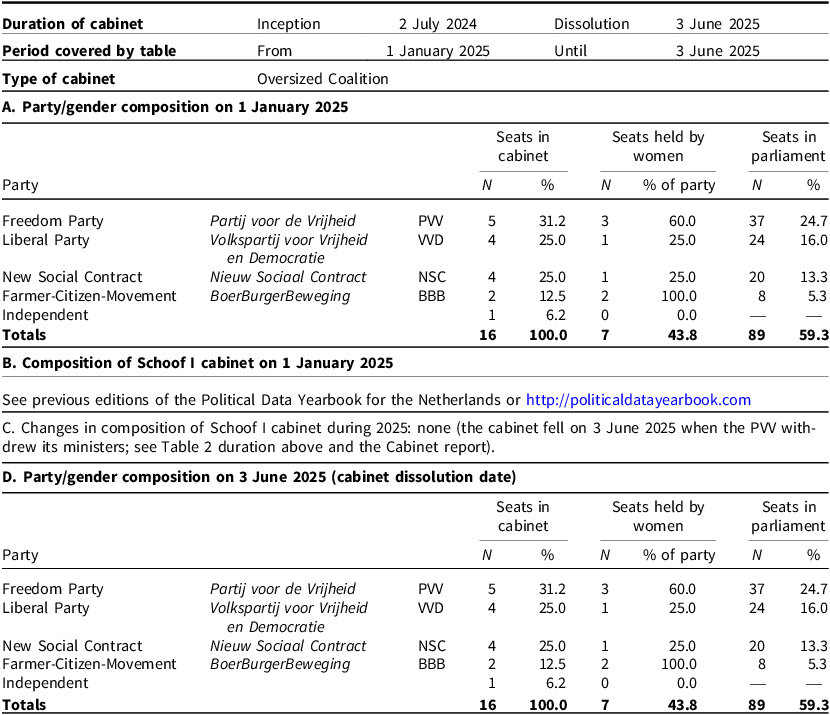
The Schoof cabinet (composition in Table 2) got off to a turbulent start. At the end of 2024, the coalition agreed to abandon its plan to declare a state of emergency on migration, replacing it with a package of migration bills to be dealt with swiftly. In February 2025, the Council of State advised that this package would lead to further delays in the asylum process. PVV leader Geert Wilders was unhappy with the lack of progress on the cabinet’s migration agenda. He was also dissatisfied with the fact that 100,000 migrants had come to the Netherlands in 2024. Moreover, he saw his party slipping in the polls. In response, on 26 May, he presented a ten-point anti-migration plan, which included mirroring Germany’s approach of closing the border to asylum seekers, pausing family reunification and requiring recognised refugees to leave asylum centres even if they had nowhere else to live. He threatened to withdraw ‘his’ ministers from the cabinet if these plans were not adopted by the coalition. After two meetings, Wilders made good on his threat and withdrew the PVV ministers. On Tuesday, 3 June, Prime Minister Schoof tendered his resignation to the King. The PVV’s five ministers and four state secretaries left office.
Cabinet composition of Schoof I in the Netherlands in 2025

Table 2. Long description
The table provides detailed information about the composition of the Schoof I cabinet in the Netherlands in 2025. It is divided into several sections: A, B, C, and D. Section A outlines the party and gender composition on 1 January 2025, listing the number of seats in the cabinet, seats held by women, and seats in parliament for each party. The parties included are the Freedom Party (PVV), Liberal Party (VVD), New Social Contract (NSC), Farmer-Citizen-Movement (BBB), and an independent. Section B mentions the composition of the Schoof I cabinet on 1 January 2025, with a reference to previous editions of the Political Data Yearbook for the Netherlands. Section C notes that there were no changes in the composition of the Schoof I cabinet during 2025, as the cabinet fell on 3 June 2025 when the PVV withdrew its ministers. Section D repeats the party and gender composition on 3 June 2025, the cabinet dissolution date, with the same parties and data as in Section A. The table includes specific values for each party’s representation in terms of seats and gender, providing a comprehensive overview of the cabinet’s composition.
Source: Parlement.com (2026).
Cabinet Schoof II
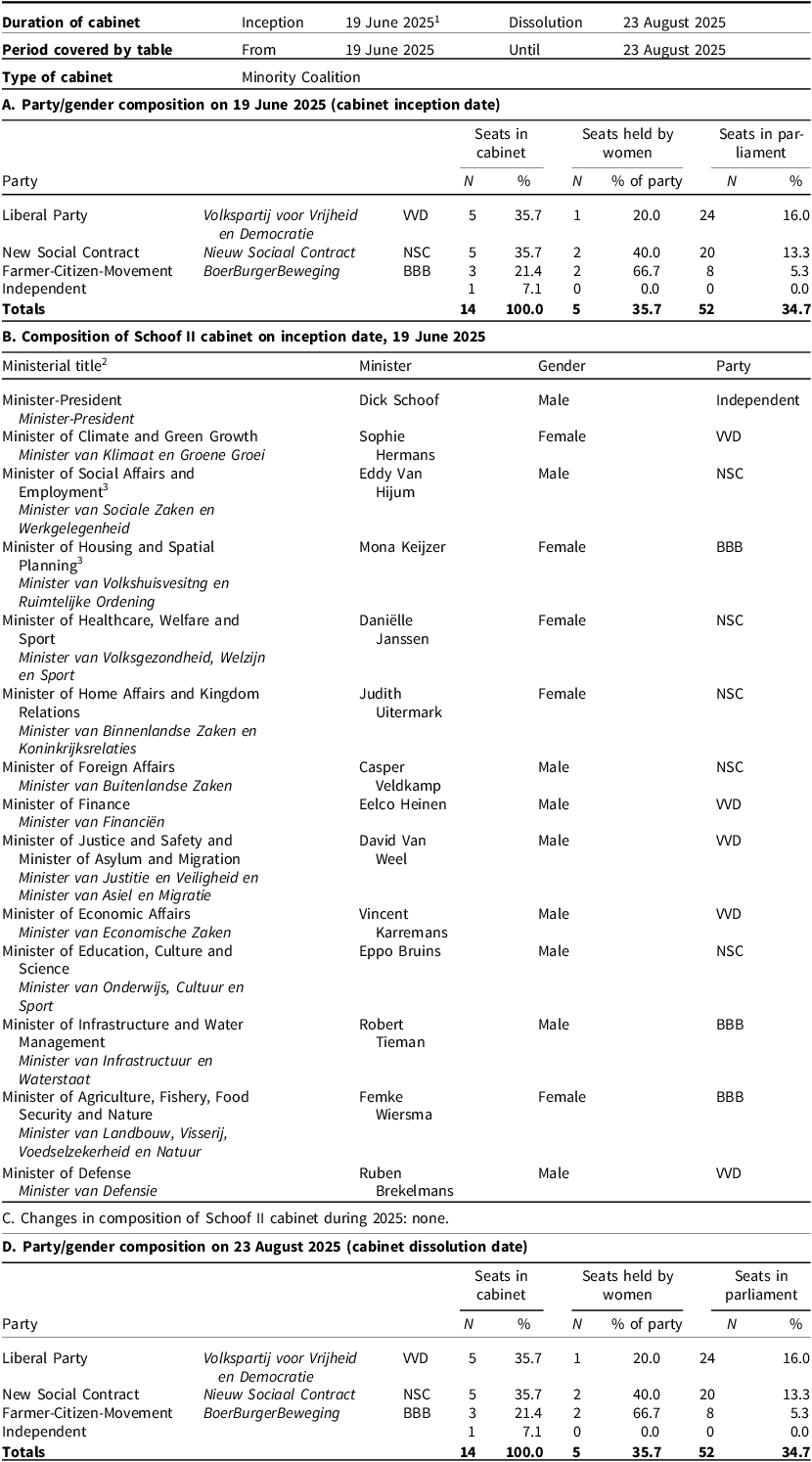
With the withdrawal of the PVV, the Schoof II caretaker cabinet of VVD, NSC and BBB took office. The portfolios of the PVV ministers were distributed among the remaining ministerial portfolios on a temporary basis between existing ministers: Justice Minister Van Weel (VVD) took over the migration and asylum portfolio. Finance Minister Heinen (VVD) oversaw the economic affairs portfolio. Climate Minister Hermans (VVD) stepped in for the infrastructure portfolio. Social Affairs Minister Van Hijum (NSC) took over the healthcare portfolio. Foreign Affairs Minister Veldkamp (NSC) took responsibility for the foreign trade and development cooperation portfolio.
All three remaining parties wanted the migration and asylum portfolio for the remainder of the caretaker period. The solution was to split the portfolio among the three parties: Justice Minister Van Weel (VVD) became the primary minister at the ministry, responsible for border protection and asylum policy, Housing Minister Keijzer (BBB) became minister without portfolio, responsible for housing policy for recognised refugees, and the Social Affairs Minister Van Hijum (NSC) also became minister without portfolio in the ministry responsible for the EU Pact on Migration and Asylum.
On 19 June, the new cabinet members were sworn in (see Table 3). The BBB nominated two cabinet members: Robert Tieman, member of the executive at the Delfland Waterboard, became Minister for Infrastructure and Water Management. BBB candidate MP Nicki Pouw-Verweij, who had previously served as an FVD Senator and JA21 MP, became State Secretary for long-term and social care. The NSC nominated the Minister of Health, Welfare and Sport and replaced the minister without portfolio for foreign trade, leaving foreign aid with the Foreign Affairs Minister. They nominated MP Daniëlle Jansen for the healthcare portfolio and Hanneke Boerma for the foreign trade position. The VVD nominated the Minister of Economic Affairs: this post went to Healthcare State Secretary Karremans, who was replaced by MP Judith Tielen. MP Thierry Aartsen became State Secretary for Infrastructure and Water Management.
Cabinet composition of Schoof II in the Netherlands in 2025

Table 3. Long description
The table provides detailed information about the composition of the Schoof II cabinet in the Netherlands in 2025. It includes data on the duration of the cabinet, the period covered by the table, and the type of cabinet. The table is divided into several sections: A. Party/gender composition on 19 June 2025 (cabinet inception date), B. Composition of Schoof II cabinet on inception date, 19 June 2025, and D. Party/gender composition on 23 August 2025 (cabinet dissolution date). Section A lists the parties, their seats in the cabinet, seats held by women, and seats in parliament. Section B lists the ministerial titles, the ministers, their gender, and their party affiliation. Section D repeats the information in Section A but for the cabinet dissolution date. Section B includes the following data: Row 1: Minister-President, Dick Schoof, Male, Independent. Row 2: Minister of Climate and Green Growth, Sophie Hermans, Female, VVD. Row 3: Minister of Social Affairs and Employment, Eddy Van Hijum, Male, NSC. Row 4: Minister for Housing and Spatial Planning, Mona Keijzer, Female, BBB. Row 5: Minister of Healthcare, Welfare and Sport, Daniëlle Janssen, Female, NSC. Row 6: Minister of Home Affairs and Kingdom Relations, Judith Uitermark, Female, NSC. Row 7: Minister of Foreign Affairs, Casper Veldkamp, Male, NSC. Row 8: Minister of Finance, Eelco Heijnen, Male, VVD. Row 9: Minister of Justice and Safety and Minister of Asylum and Migration, David Van Weel, Male, VVD. Row 10: Minister of Economic Affairs, Vincent Karremans, Male, VVD. Row 11: Minister of Education, Culture and Science, Eppo Bruins, Male, NSC. Row 12: Minister of Infrastructure and Water Management, Robert Tieman, Male, BBB. Row 13: Minister of Agriculture, Fishery, Food Security and Nature, Femke Wiersma, Female, BBB. Row 14: Minister of Defense, Ruben Brekelmans, Male, Independent. Section D includes the same data as Section A.
Notes: 1. Between 3 and 19 June 2025, the PVV ministers had already left the cabinet but new ministers had not yet been installed.
2. Several ministers held caretaker responsibility for additional portfolios during 3–19 June 2025.
3. Keijzer and Van Hijum also served as Ministers for Asylum and Migration.
Source: Parlement.com (2026).
Cabinet Schoof III
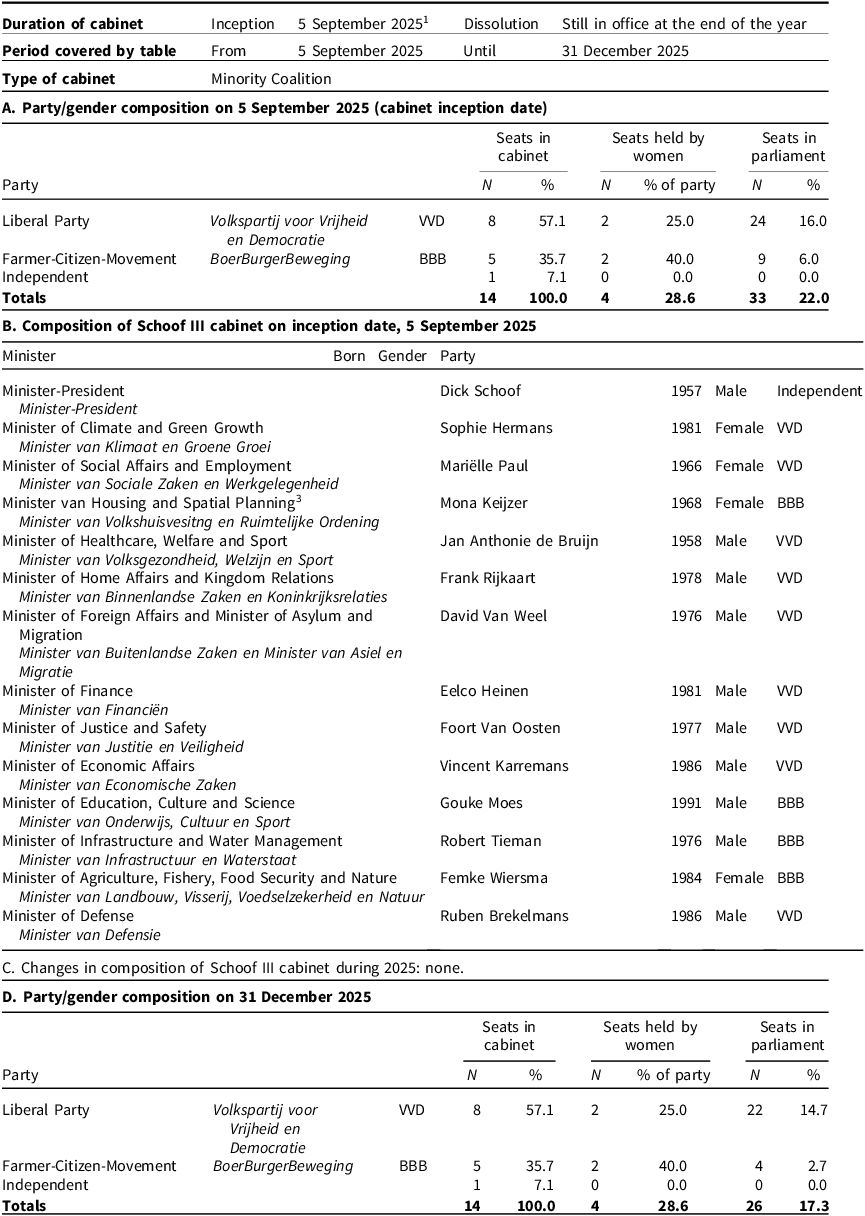
On 22 August, NSC Foreign Affairs Minister Caspar Veldkamp stepped down because he felt he lacked adequate support to increase diplomatic pressure on Israel to stop its escalation of the war in Gaza. His resignation was followed by that of the entire NSC cabinet delegation. They stepped down after a chaotic debate in the House of Representatives, which had been recalled from summer recess to debate Israel’s escalation. Veldkamp had been unable to give a clear account of his position on the motions calling for a ban on imports of products from Israeli settlements in occupied Palestinian territories, as he did not know whether he had sufficient support from the rest of the cabinet.
On 5 September, the new cabinet members were installed (see Table 4). The VVD nominated sitting Justice Minister David van Weel as Foreign Minister. He retained the migration portfolio and was succeeded at the Justice Ministry by former MP Foort van Oosten. The liberals put forward the incumbent Education State Secretary Mariëlle Paul as Minister of Social Affairs and Employment. She was succeeded by Koen Becking, former Chancellor of Nyenrode Business University. The party also nominated the sitting Speaker of the Senate, Jan Anthonie de Bruijn, as Minister of Healthcare, Welfare and Sport. MP Aukje de Vries was put forward as State Secretary for Foreign Trade and Development Cooperation, and former MP Arno Rutte as State Secretary at the Justice Ministry. The BBB put forward member of the South Holland Provincial Executive, Frank Rijkaart, as Minister of Home Affairs and Kingdom Relations, and member of the Groningen Provincial Executive, Gouke Moes as Minister of Education, Culture and Science. BBB Senator Eugène Heijnen became State Secretary of Taxation. Sandra Palmen, who as NSC State Secretary, had been responsible for the benefit redress portfolio, remained in office despite her party leaving the government, and resigned her membership of NSC.
Cabinet composition of Schoof III in the Netherlands in 2025

Table 4. Long description
The table provides detailed information about the cabinet composition in the Netherlands for the year 2025. It is divided into several sections: A, B, C, and D. Section A outlines the party/gender composition on 5 September 2025, listing the Liberal party (Volkspartij voor Vrijheid en Democratie), Farmer-Citizen-Movement (BoerBurgerBeweging), and an independent. It shows the number of seats in the cabinet, seats held by women, and seats in parliament for each party. Section B lists the composition of the Schoof III cabinet on 5 September 2025, including ministerial titles, names, birth years, genders, and parties. Section C mentions changes in the composition of the Schoof III cabinet during 2025. Section D provides the party/gender composition on 31 December 2025, similar to Section A. The table includes specific details such as the number of seats and the percentage of seats held by women for each party, as well as the names and roles of the ministers.
Notes: 1. Between 23 August and 5 September 2025, the NSC ministers had already left the cabinet but new ministers had not yet been installed.
2. Several ministers held caretaker responsibility for additional portfolios during 23 August–5 September 2025.
3. Keijzer also served as Minister for Asylum and Migration.
Source: Parlement.com (2026).
Formation of the Cabinet Jetten
On 4 November, after consulting with the leaders of the parliamentary party groups in the newly elected parliament and as proposed by D66, the Speaker of the outgoing House of Representatives, Martin Bosma (PVV), appointed former Social Affairs Minister Wouter Koolmees (D66) as scout. He met with all prospective parliamentary party group chairs. Koolmees advised the House to start the formation with talks between CDA and D66. On 13 November, former CDA leader Sybrand van Haersma Buma and former D66 Minister of Economic Affairs Hans Wijers were appointed as informateur by the Lower House. Wijers stepped down on 14 November, after a private message in which he called Yeşilgöz a shrew (‘feeks’) became public.
On 2 December, Buma presented an interim report alongside a ‘positive agenda’ drawn up by D66 and CDA, focused on migration, housing, nitrogen, the economy and defence as key policy areas. He then held talks with the leaders of other party groups. On 8 December, he advised D66, CDA and VVD to continue talks, keeping open the option to form both a majority and a minority government. On 10 December, the House appointed Rianne Letschert (D66), the Chancellor of Maastricht University, as informateur. This new round of talks had a deadline of 30 January 2026.
Parliament report
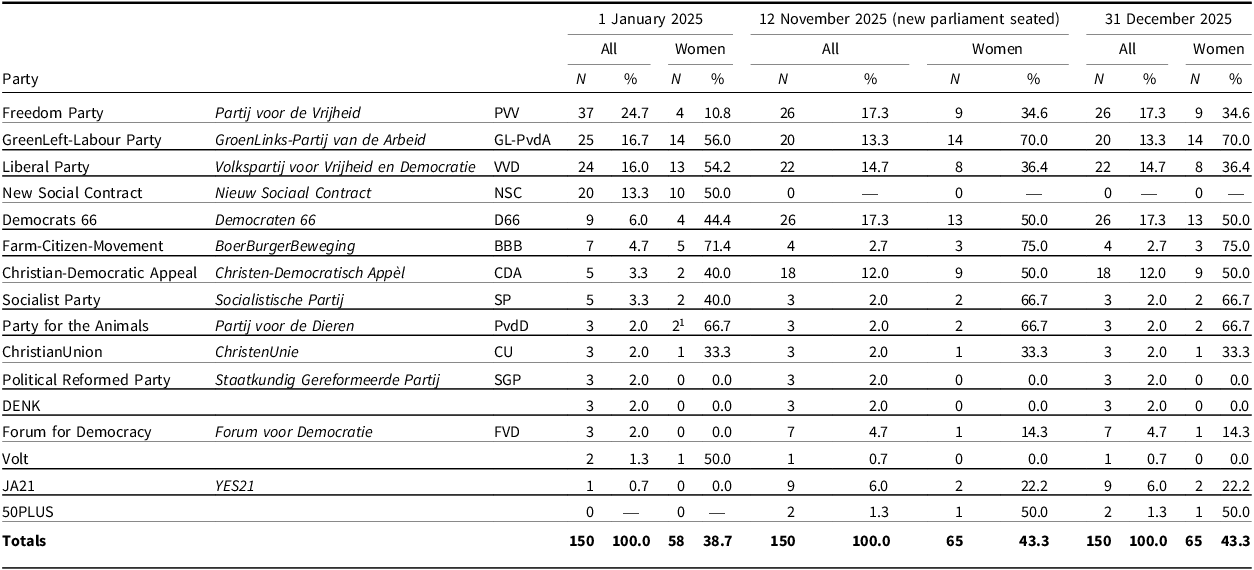
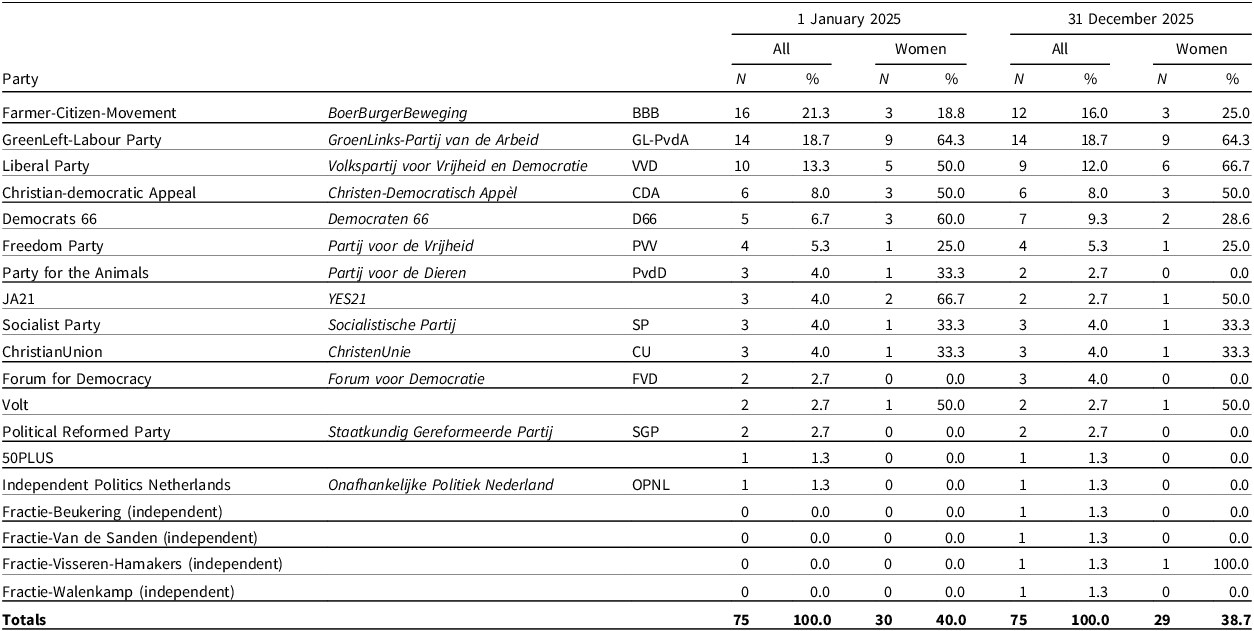
It was not just the House of Representatives that saw major changes following the elections (see Table 5). The Senate saw a high number of MPs leaving their parliamentary party groups (see Table 6). BBB, which had become the largest party in 2023 with 16 seats, lost four seats throughout the year: on 19 May, Eric Kemperman left the BBB over dissatisfaction with the party’s direction, particularly regarding the war in Ukraine. He joined the FVD Senate party group on 9 September. Two senators left the BBB party group to join D66: Robert Croll left on 2 June citing BBB’s position on Israel’s war in Gaza, and Arie Griffioen left on 28 November citing the party’s migration policy. On 23 September, newly returned Senator Pim Walenkamp was not allowed to rejoin the BBB party group.
Party and gender composition of the lower house of the Dutch Parliament (Tweede Kamer der Staten-Generaal) in the Netherlands in 2025

Table 5. Long description
The table presents the party and gender composition of the lower house of the Dutch Parliament (Tweede Kamer der Staten-Generaal) in 2025. It includes data for three specific dates: 1 January 2025, 12 November 2025 (new parliament seated), and 31 December 2025. The table is organized into columns and rows, with columns representing different dates and rows representing different political parties. Each row provides the number and percentage of members of parliament (MPs) for each party, separated by gender. The table has 15 rows and 18 columns. Column headers include the party names, and row labels include the dates and gender categories. Notable parties include the Freedom Party, GreenLeft/Labour Party, Liberal Party, and others. The table shows the number and percentage of MPs for each party and gender category on the specified dates. For example, on 1 January 2025, the Freedom Party had 37 MPs (24.7 percent), with 4 being women (10.8 percent). On 12 November 2025, the same party had 26 MPs (17.3 percent), with 9 being women (34.6 percent). The table provides a detailed breakdown of the composition of the Dutch Parliament over the year 2025, highlighting changes in party representation and gender distribution.
Notes: 1. One of the PvdD MPs is non-binary.
Source: Parlement.com (2026).
Party and gender composition of the upper house of the Dutch Parliament (Eerste Kamer der Staten-Generaal) in the Netherlands in 2025

Table 6. Long description
The table presents the party and gender composition of the upper house of the Dutch Parliament (Eerste Kamer der Staten-Generaal) in 2025. It includes data for two dates: January 1, 2025, and December 31, 2025. The table has 19 rows and 10 columns. The columns are labeled as follows: Party, All (N), All (%), Women (N), Women (%), All (N), All (%), Women (N), and Women (%). The rows are labeled with the names of different political parties. Each row provides the number and percentage of members (All) and women members (Women) for each party on the specified dates.
Source: Parlement.com (2026).
VVD, PvdD and JA21 also saw splits: on 8 October, VVD Senator Cees van der Sanden left the party group citing the party’s illiberal course. In early November, the PvdD Senate party group split in two over the party’s direction: the two senators who disagreed with the party leadership over their focus on human issues, like the wars in Gaza and Ukraine (Niko Koffeman and Peter Nicolaï), retained the official PvdD party group in the Senate, while the senator who supported the party leadership’s line (Ingrid Visseren-Hamakers) continued as an independent senator. On 11 November, the newly installed Senator Toine Beukering who was elected on the JA21 list, did not join the JA21 party group as he had already left the party the previous year in the South Holland provincial council.
Party switches were not limited to the Senate: On 30 July, NSC MP Agnes Joseph left the NSC to join the BBB and she was also given a spot on the party’s electoral list.
Both houses also elected new Speakers. As the Speaker of the Senate, Jan Anthonie de Bruijn, had become Health Minister, his vacancy needed to be filled. The deputy Speaker, GL-PvdA Senator Mei Li Vos, took over temporarily, and was elected to the position on 7 October. On 18 November, the newly elected House of Representatives chose Thom van Campen (VVD) as its Speaker after three rounds of voting.
Political party report
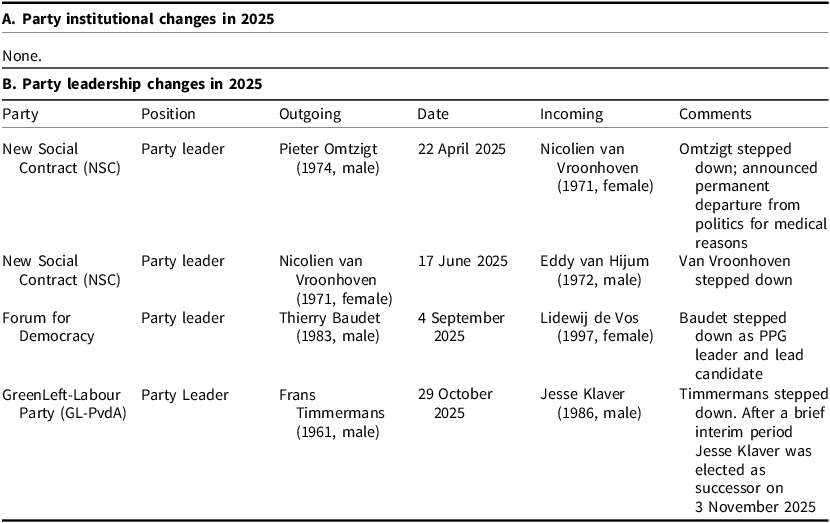
Many parties saw leadership changes in 2025 moving towards the elections and just after (see Table 7). On 18 April, Pieter Omtzigt, the founder and leader of NSC, announced his permanent departure from politics due to medical reasons. He was immediately succeeded as NSC party group leader by Nicolien van Vroonhoven, who had already led the party group during Omtzigt’s earlier absences. Van Vroonhoven initially decided against running for parliament, but changed her mind before ultimately withdrawing again when party members demoted her to fourth place on the electoral list at the party congress on 30 August. On 17 June, NSC selected former Social Affairs Minister and former Vice-Prime Minister Van Hijum as its lead candidate.
Changes in political parties in the Netherlands in 2025

Table 7. Long description
A table showing changes in political party leadership in the Netherlands in 2025. The table has two sections: A and B. Section A is titled ‘Party institutional changes in 2025’ and is marked as ‘None.’ Section B is titled ‘Party leadership changes in 2025’ and contains a table with five columns: Party, Position, Outgoing, Date, Incoming, and Comments. The table has six rows detailing leadership changes. Row 1: New Social Contract (NSC), Party leader, Pieter Omtzigt (1974, male), 22 April 2025, Nicolien van Vroonhoven (1971, female), Omtzigt stepped down; announced permanent departure from politics for medical reasons. Row 2: New Social Contract (NSC), Party leader, Nicolien van Vroonhoven (1971, female), 17 June 2025, Van Vroonhoven (1971, female), Van Hijum (1972, male) stepped down. Row 3: Forum for Democracy (FVD), Party leader, Lidewij de Vos (1997, female), 4 September 2025, Thierry Baudet (1983, male), Baudet stepped down as PPG leader and lead candidate. Row 4: GreenLeft-Labour Party (GL-PvdA), Party leader, Frans Timmermans (1961, male), 3 November 2025, Jesse Klaver (1986, male), Timmermans stepped down. After a brief interim period Jesse Klaver was elected as successor.
Source: Parlement.com (2026).
In response to the early elections, the GL and the PvdA sped up the decision-making process regarding their merger. On 12 June, the GL and PvdA announced the results of two parallel referendums. Members of both parties decided to form a joint list in the upcoming elections and merge after that: turn-out in GL was 63% with 95% support for a common list and 89% support for a merger; turn-out in the PvdA was 59% with 94% support for a common list and 88% support for a merger. During the party congress on 21 June there was a heated debate on the war in Gaza: just before the congress the joint list’s foreign affairs spokesperson announced that the party would no longer support Dutch military exports to Israel, including defensive weapons. This met with resistance from, among others, prominent Jewish PvdA members. After the congress supported the party spokesperson, prominent members of the PvdA (including former MPs, a former minister and a former Speaker of the House of Representatives) left the party. On election night, Frans Timmermans announced his resignation as party leader of the GL-PvdA. After a brief interim period, he was succeeded on 3 November by Jesse Klaver, the former leader of the GL.
Between the fall of the cabinet and the deadline for registering the party candidates’ lists, the political ‘transfer season’ was open: Ingrid Coenradie, who had been State Secretary of Justice and Security for the PVV, joined JA21. Three NSC MPs left their party: one joined BBB (retaining her seat), one joined JA21 and one ran as the lead candidate for the Frisian National Party (Fryske Nasjonale Partij, FNP), a regional party in the province of Friesland. The latter two stepped down from parliament.
In the ethnic-minority interest party DENK, a conflict arose between the parliamentary party group and the party board over the composition of the list of candidates. Party leader Stephan van Baarle briefly stood down as lead candidate, but after an outpouring of support for him, the board stepped down and Van Baarle continued as lead candidate.
On 4 September, Thierry Baudet was replaced as PPG chair and lead candidate by Lidewij de Vos, who had also replaced him as MP during his parental leave.
Institutional change report
No major institutional changes took place in 2025. After early elections were called, the government reform agenda of the Schoof cabinet, including the proposed constitutional court and electoral reform, was put on hold.
Issues in national politics
Four issues dominated Dutch politics: nitrogen policy, migration, the US-EU relationship and the national budget.
Nitrogen
On 22 January, the District Court in The Hague pronounced its verdict in a civil case that Greenpeace had brought against the government: the court decided that the Dutch government’s efforts to meet its nitrogen reduction targets were insufficient. The previous government had had concrete plans to decrease nitrogen pollution but the Schoof Cabinet had scrapped those without replacing them with a new policy to meet those goals (Otjes and De Jonge Reference Otjes and De Jonge2025). On 25 January, the cabinet appointed a ministerial committee to come up with a long-term solution for the nitrogen issue. By the end of April, it presented its plans. These included removing the policy goal of halving nitrogen pollution by 2030, specific measures to encourage cattle farms close to the nature reserve, the Veluwe, to close, and plans for a new licensing system based on the actual quality of nature rather than on modelled estimates.
Migration
Migration had been a prominent topic throughout the year. After months of talks, PVV Minister of Asylum and Migration, Marjolein Faber, introduced the Asylum Emergency Measures Act in March. This bill would, among other things, limit residence permits for recognised refugees to three years and restrict family reunification to nuclear families, excluding unmarried partners and adult children. She also proposed a bill to introduce a two-status system differentiating between refugees who are personally persecuted and those who have a subsidiary protected status (those not personally persecuted but at serious risk if returned to their home country). After the fall of the cabinet over migration policy (see above), the House accepted both bills on 3 July, with broad majorities. The bills were passed including a last-minute PVV amendment criminalising unlawful residence in the Netherlands. A subsequent remedial bill, clarifying that providing humanitarian assistance to undocumented persons would not be a criminal act, was passed by the house in December. Both bills were then sent to the Senate, which had not voted on the bills by year’s end.
Atlantic relations
After the fraught meeting between Donald Trump and Volodymyr Zelenskyy on 28 February, plans for European defence cooperation took centre stage in Europe. On 4 March, Ursula von der Leyen launched a plan to expand European defence spending (Readiness 2030) which included plans for the EU to raise money on the capital markets to lend to member states for defence. On 6 March, EU leaders in a special European Council including Dick Schoof, endorsed von der Leyen’s mandate to work on these plans. On 11 March, the House of Representatives narrowly passed a motion tabled by Joost Eerdmans (JA21), calling on the government not to participate in the plan and to seek an opt-out if necessary. Three of the four coalition parties, PVV, NSC and BBB, voted in favour of this motion, while the VVD was the only coalition party to vote against. After consultations within the coalition, the government decided that it would support Readiness 2030 while expressing reservations about their financing.
Budgetary affairs
On 16 April, the coalition leaders came to an agreement on the spring budget adjustment. Among other things, this resolved a commitment the cabinet had made to opposition parties, including D66, CDA, Political Reformed Party (Staatkundig Gereformeerde Partij, SGP) and the ChristianUnion (ChristenUnie, CU), not to proceed with the planned increase in the value-added tax rate on culture, media and sport (Otjes and De Jonge Reference Otjes and De Jonge2025). The budget adjustments also included an increase in defence spending, additional funding for municipalities, and a freeze on social rents. The additional expenditure was funded by unexpected budget surpluses and by raising government debt. The rent freeze in particular came under scrutiny. The Council of State advised against the bill, noting that it would affect the ability of social housing corporations to invest in home construction. On 3 June, the same day the PVV left the coalition, Housing and Spatial Planning Minister, Mona Keijzer, withdrew the bill, citing the Council of State’s advice, the loss of a parliamentary majority, and the changed political situation.
Data availability statement
The data for this article can be found at the PDY Interactive website: www.politicaldatayearbook.com
Use of AI
Generative AI was used to identify copy-editing.

 Open access

