Introduction
Surgical access to the sphenoid sinus has been a challenge for surgeons. In 1973, Wyllie et al. had asserted that ‘the surgical approach to the sphenoid sinus should be transnasally and never through a craniotomy’.Reference Wyllie, Kern and Djalilian1 Surgical access to the sphenoid sinus has traditionally been performed through a transnasal or external ethmoidectomy approach.Reference Wyllie, Kern and Djalilian1 Over the last two decades, the introduction of advanced imaging techniques and nasal endoscopy has allowed the widespread use of endoscopic approaches to the sphenoid sinus.Reference Gibbons and Sillers2
Although several studies have been conducted on the different surgical approaches to the sphenoid sinus, a search of the English-language literature revealed only one study that discussed the selection of the appropriate surgical approach to the sphenoid sinus.Reference Gibbons and Sillers2 We therefore aimed to use our 13 years of experience to develop an applicable and up-to-date algorithm for selecting the optimal endoscopic surgical approach to benign sphenoid sinus lesions.
Materials and methods
The clinical records of 392 patients, who were endoscopically operated upon for benign sphenoid sinus lesions from September 2000 to September 2013 in Tanta University Hospital, Egypt, and Taiba Hospital, Kuwait, were reviewed. Those with concomitant involvement of other paranasal sinuses were included in the study. The study was approved by the local ethics committee.
Patient data collected included: demographics, nature and extent of the lesion as displayed in computerised tomography (CT) scans and/or magnetic resonance imaging (MRI) scans, and histopathological diagnosis. Surgical approaches, difficulties in identifying the sphenoid sinus ostium and complications were documented.
Radio-pathological categorisation
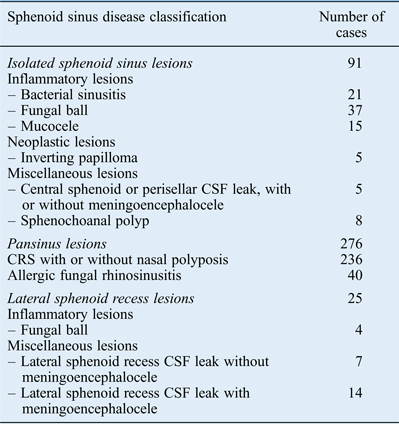
Based on the imaging data, the patients were categorised according to the extent of disease and assigned to one of three groups (Table I). Group 1 comprised patients with isolated sphenoid sinus lesions in which the disease was exclusively limited to one sphenoid sinus. These patients were subdivided into three subgroups based on pathological subtypes: inflammatory, neoplastic and miscellaneous lesions. Group 2 included patients with pansinus lesions, either unilateral or bilateral. Pathologically, all lesions were inflammatory. Group 3 consisted of patients who had evident lateral sphenoid recess lesions. These patients were divided into two pathology subgroups: inflammatory and miscellaneous lesions (Figure 1).
(a) Coronal computerised tomography scan demonstrating soft tissue opacification (indicative of a meningoencephalocele) within the lateral recess of the sphenoid sinus. (b) Coronal, T2-weighted magnetic resonance image showing a temporal lobe meningoencephalocele in the lateral recess of the sphenoid sinus.

Classification of sphenoid sinus disease cases
CSF = cerebrospinal fluid; CRS = chronic rhinosinusitis
Surgical techniques
The study population underwent surgical intervention via one of the following surgical approaches.
Endoscopic transnasal sphenoidotomy
This was conducted as described by Metson and Gliklich.Reference Metson and Gliklich3 Under 0° endoscopic visualisation, the natural sphenoid ostium was enlarged with a J-shaped curette in an inferior and medial direction. Mushroom forceps were used to further enlarge the opening. In case of disturbed anatomy of the sphenoethmoidal recess by disease or previous surgery, perforation of the anterior sphenoid wall paramedially, 10 to 12 mm superior to the choana, was preferred, as described by Wigand.Reference Wigand4
Endoscopic transethmoidal sphenoidotomy
The technique was performed in a similar manner to that described by Metson and Gliklich.Reference Metson and Gliklich3 After endoscopic ethmoidectomy was completed, the inferior one-third of the superior turbinate was cut with turbinate scissors and removed. The sphenoid ostium could be identified between the superior turbinate remnant and the nasal septum, and enlarged with a J-shaped curette and mushroom forceps.
Endoscopic transpterygopalatine fossa sphenoidotomy
The approach was similar to that described by Al-Nashar et al.,Reference Al-Nashar, Carrau, Herrera and Snyderman5 with some modifications as described below. After complete anterior and posterior ethmoidectomy, wide maxillary antrostomy, and wide transethmoidal sphenoidotomy had been performed, soft tissue of the pterygopalatine fossa was coagulated with bipolar diathermy and retracted laterally. The anterior and inferior walls of the sphenoid sinus were then resected with a diamond burr, enlarging the sphenoidotomy in a lateral and inferior direction, until the lateral sphenoid recess could be widely exposed.
Statistical analysis
The analysis was conducted using the SPSS® for Windows statistical software package. Data were expressed as mean ± standard deviation. A p-value of less than 0.05 was considered significant. Parametric tests such as the paired t-test and two-sample t-test were applied for data following or being transformed to a normal distribution. Non-parametric tests such as the Mann–Whitney U test, Wilcoxon signed rank test and chi-square test were employed for data that were not normally distributed.
Results
A total of 392 patients with benign sphenoid sinus lesions were included in our study, consisting of 211 males and 181 females, with an average age of 41.5 years (age range, 14–71 years). All patients were investigated with CT scans of the nose and paranasal sinuses. Magnetic resonance imaging was performed in 119 patients (30.4 per cent). Histopathology was performed in all cases. The median duration of follow up was 23.5 months (range, 18–29 months).
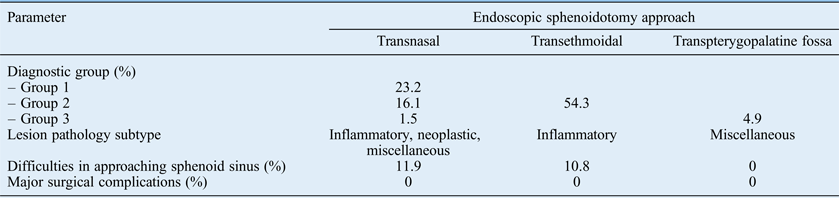
Endoscopic transnasal sphenoidotomy was the approach selected for all group 1 (isolated sphenoid sinus lesion) patients and all patients with inflammatory lesions in group 3 (lateral sphenoid recess lesion group). Sixty-three patients (22.8 per cent) in group 2 (pansinus lesion group) had their sphenoid sinus opened with this approach after eradication of other sinus diseases. Two patients with lateral sphenoid recess cerebrospinal fluid (CSF) leak without meningoencephalocele in group 3 underwent closure of the CSF leak through this approach, but the intervention failed in both cases (100 per cent). The main difficulty with this approach was the narrow space between the middle turbinate and the nasal septum, and the associated problem in mastering the non-inflammatory lateral sphenoid recess lesions. Lateral displacement of the middle turbinate was sufficient in most cases; however, partial middle turbinectomy was performed in 19 patients (11.9 per cent) to gain sufficient access to the anterior sphenoid sinus wall. The lower portion of the superior turbinate was also removed in two cases (1.3 per cent). One patient suffered postnasal bleeding, which was controlled by bipolar diathermy. Synechiae between the middle turbinate and nasal septum were reported in 13 patients (8.1 per cent). No major adverse events were encountered.
Endoscopic transethmoidal sphenoidotomy was carried out in 213 (77.2 per cent) of group 2 patients. It was used in the management of chronic rhinosinusitis with and without nasal polyposis, and allergic fungal rhinosinusitis. Difficulties in identification of the sphenoid ostium were encountered in 9 cases with a small perisellar sphenoid sinus and in 14 patients with recurrent diffuse sinonasal polyposis, with an overall incidence of 10.8 per cent. Synechiae between the middle turbinate and nasal septum were encountered in 15 cases (7 per cent). One patient suffered post-operative epistaxis, which was controlled with further nasal packing. Three patients with no pre-operative history of olfactory disturbances reported hyposmia after surgery. Minimal haematoma of the eyelids was seen in four patients with extensive nasal polyposis. No major adverse events were encountered.
Endoscopic transpterygopalatine fossa sphenoidotomy was used primarily in cases of miscellaneous lesions in group 3 patients (n = 19; 90.5 per cent). It was carried out for the management of lateral sphenoid recess CSF leaks with meningoencephaloceles (n = 14; 100 per cent) or without meningoencephaloceles (n = 5; 71.4 per cent). The approach was also used to revise the two recurrent CSF rhinorrhoea cases after primary closure using an endoscopic transnasal sphenoidotomy approach, with 100 per cent success rate. No surgical difficulties were encountered in approaching the sphenoid sinus. The technique used in our series took between 60 and 90 minutes (mean, 73 ± 10 minutes) in addition to the time of the concomitant functional endoscopic sinus surgery (mean, 43 ± 7 minutes). Dry eye occurred in 12 cases; however, this complaint was transient and relieved in all patients within 1–2 months. One patient with a lateral sphenoid CSF leak with meningoencephalocele (5.3 per cent) suffered a recurrent CSF leak after three months; it was successfully sealed on the second attempt using the same approach. No major adverse events were encountered.
Fifty-four revision surgery cases were included in our study. The choice of the selected approach in all cases was primarily determined according to the radiological location and the suspected pathology of the benign sphenoid lesions, rather than on the basis of being a revision surgery. Difficulties were found in six cases (11 per cent) mainly due to disturbed anatomy. Synechiae were found in five cases (9 per cent). No major adverse events were reported. Revision surgery did not differ from primary surgery in terms of either the surgical difficulties in identifying the sphenoid ostium or in major adverse events (p > 0.05).
The different surgical approaches were compared as regards the diagnostic group and the pathological subtype of the lesion for which the surgical approach was performed, and in terms of the surgical difficulties and complications associated with each surgical approach (Table II).
Comparison between different endoscopic approaches to the sphenoid sinus
Group 1 comprised isolated sphenoid sinus lesion cases, group 2 consisted of pansinus lesion cases and group 3 comprised lateral sphenoid recess lesion cases.
Discussion
Sphenoid sinus surgery represents a challenging task for endoscopic sinus surgeons because of the numerous anatomic variations of the sphenoid sinus, with the potential risk of injury to the skull base, optic nerve and internal carotid artery. This can be avoided by careful pre-operative CT scan evaluation, opening the sphenoid sinus through its natural ostium, and enlargement of the sphenoid ostium in an inferomedial direction to allow visualisation of the superior and lateral sphenoid walls using angled endoscopes before completion of the sphenoidotomy. Endoscopic sphenoid sinus surgery should preserve the normal ventilation and mucociliary clearance of the sphenoid sinus. This involves endoscopic reopening and enlargement of the natural sphenoid ostium, which is the focus of endoscopic sphenoid sinus surgery.
The English-language literature includes several classifications of sphenoid sinus diseases which are based on aetiological categorisation.Reference Wyllie, Kern and Djalilian1, Reference Friedman, Batra, Fakhri, Citardi and Lanza6 In this study, we advocate a new classification of sphenoid sinus diseases based on two factors: disease extent and suspected pathology as displayed by imaging studies (CT and MRI). This classification is helpful in deciding the most appropriate endoscopic approach for benign sphenoid sinus lesions.
The endoscopic transnasal approach was performed in about 40.8 per cent of our patients. It was suitable for the management of isolated sphenoid sinus lesions and inflammatory lateral sphenoid recess lesions with the use of angled endoscopes and curved instruments. It is also helpful in pansinus disease to clear the sphenoid sinus, without the need to resect a part of the superior turbinate. The endoscopic transnasal approach is the most direct approach, as it does not violate other structures. Furthermore, it is safe, as it deals with the medial nasal part of the anterior sphenoid wall, thus avoiding injury to the optic nerve and carotid artery. It is physiological, as it uses the sinus ostium and enlarges it. It has a short surgical time, the wound is fast healing and there are few complications.Reference Kieff and Busaba7 However, the space between the nasal septum and the middle turbinate is in some cases narrow, which makes surgical exposure difficult. This necessitates partial middle turbinectomy, which was carried out in 11.9 per cent of patients in the current study. Theoretically, lateralisation of the middle turbinate could lead to fractures of the basal lamella and ethmoid cells. These potential fractures may eventually lead to sinus pathology. However, we did not encounter such adverse events in our follow up of the patients.
The endoscopic transethmoidal approach was performed in about 54.3 per cent of our patients. It was used for the management of pansinus disease. We do not recommend endoscopic transethmoidal sphenoidotomy as described in the report of Messerklinger's classic technique.Reference Stammberger8 In Messerklinger's innovative technique, the sphenoid sinus is opened in the inferomedial portion of the lateral ethmoid part of its anterior wall. This technique carries difficulties and a risk of complications, particularly in the presence of a hypopneumatised sphenoid sinus or a well-developed Onodi cell. In addition, the created sphenoidotomy will not include the natural ostium, rendering it non-physiological. Hence, we applied the modifications suggested by Metson and GliklichReference Metson and Gliklich3 and Orlandi et al.,Reference Orlandi, Lanza, Bolger, Clerico and Kennedy9 which included resection of the inferior one-third of the superior turbinate and opening the sphenoid sinus through its ostium. This approach is a safe and physiological approach; the sinus is opened through its ostium, thus avoiding injury to important structures in the lateral and superior walls.
Resection of the superior turbinate has been claimed to affect olfaction.Reference Orlandi, Lanza, Bolger, Clerico and Kennedy9 Orlandi et al. stated, ‘We must assume that some olfactory receptors are resected with the endoscopic transethmoidal approach and theoretically could impact the patient's sense of smell’.Reference Orlandi, Lanza, Bolger, Clerico and Kennedy9 However, Say et al. reported olfactory mucosa in about 17 per cent of the inferior one-third of superior turbinate specimens removed during endoscopic transethmoidal sphenoidotomy in their study.Reference Say, Leopold, Cochran, Smith and Greiner10 Although 12 per cent of their patients experienced loss of olfaction, none of the loss could be attributed to the excision of olfactory tissue.Reference Say, Leopold, Cochran, Smith and Greiner10
In this study, 63 patients (22.8 per cent) in group 2 (with pansinus lesions) had their sphenoid sinus cleared through endoscopic transnasal sphenoidotomy, medial to the middle turbinate, after completion of the ethmoid surgery. There were no significant differences between the endoscopic transnasal sphenoidotomy and endoscopic transethmoidal sphenoidotomy approaches used in group 2, either in terms of the surgical difficulties in identifying the sphenoid ostium or in terms of major adverse events. However, although we did not find any significant differences between the sphenoid sinus transnasal or transethmoidal approaches following resection of a portion of the superior turbinate, we advise the use of the first approach whenever applicable as it does not involve the resection of the superior turbinate. Thus, the potential effect that removing a part of the superior turbinate could have on olfaction is not an issue.
The endoscopic transpterygopalatine fossa approach was performed in about 4.9 per cent of our patients with lateral sphenoid recess CSF leaks, with or without meningoencephaloceles. Two patients with lateral sphenoid recess CSF leaks without meningoencephaloceles in group 3 underwent closure of the CSF leak via endoscopic transnasal sphenoidotomy. The CSF leak recurred in both cases (100 per cent). The difference between the endoscopic transnasal sphenoidotomy and endoscopic transpterygopalatine fossa sphenoidotomy approaches in terms of the closure of lateral sphenoid sinus recess CSF leaks was statistically significant. Revision surgery in both cases was conducted using an endoscopic transpterygopalatine sphenoidotomy approach, with 100 per cent success rate.
The endoscopic transpterygopalatine sphenoidotomy approach offers direct and wide exposure of the lateral sphenoid recess. This is because resection of the anterior and inferior walls of the sphenoid sinus provides adequate space for increased surgical manoeuvrability of instruments and reconstruction materials around the defect. Compared with the traditional transcranial approaches, the transpterygopalatine sphenoidotomy approach prevents the risk of complications associated with brain retraction or facial osteotomies.Reference Schmidt, Choudhry, Raviv, Baredes, Casiano and Eloy11 However, dissection in the lateral sphenoid recess carries the risk of injury to the internal carotid artery and the cavernous sinus. This disadvantage is offset by the use of angled endoscopes. Moreover, this approach takes a significant amount of surgical time to perform. The approach employed in our series took less operating time than the endoscopic transpterygoid approach described by Bolger, which requires about 6 hours.Reference Bolger12 The cause of this difference may be the simpler technique used in our series.
About 14 per cent of our cases were revision surgical procedures. However, the choice of the technique was in all cases based on the anatomical extent and nature of the disease, rather than it being a revision surgery. The surgical difficulties and adverse events were comparable in the primary and revision surgical procedures. This makes our proposed algorithm simpler than the algorithm advocated by Gibbons and Sillers, who considered revision surgery as a key parameter in the selection of the sphenoid sinus approach.Reference Gibbons and Sillers2
Our series included patients from two surgical centres. The surgeons who performed the procedures had similar qualifications and experience. As the surgical approach can be highly variable according to surgeon preference, it was thought that the inclusion of two different centres would enrich the results of the study. In fact, two differences were found between the different approaches in the two centres. The first concerned the preference of one centre to perform transnasal sphenoidotomy whenever possible, even after complete ethmoidectomy in pansinus involvement. The other centre preferred transethmoidal sphenoidotomy in all pansinus cases. The second difference concerned the management of two cases with lateral sphenoid recess CSF leak using endoscopic transnasal sphenoidotomy. The CSF leak recurred in both cases, and revision surgery took place in the same centre (as the original surgery) using the endoscopic transpterygopalatine fossa approach.
• Several studies have investigated different surgical approaches to the sphenoid sinus, but only one discussed selection of the most appropriate approach
• This study aimed to develop an applicable, up-to-date algorithm for selecting the optimal endoscopic surgical approach for benign sphenoid sinus lesions
• Radio-pathological categorisation aided development of a useful algorithm
• Endoscopic transnasal sphenoidotomy should be the first choice whenever applicable
• Lateral sphenoid recess non-inflammatory diseases should be managed through the endoscopic transpterygopalatine fossa approach
• Revision surgery does not play a key role in the algorithm
We recommend the algorithm shown in Figure 2, which essentially considers the extent and nature of the disease in selecting the optimal endoscopic approach to benign sphenoid sinus lesions. Isolated sphenoid sinus lesions are ideally approached via endoscopic transnasal sphenoidotomy. Pansinus involvement is preferably approached by endoscopic transnasal sphenoidotomy after eradication of other sinus diseases whenever applicable, or by endoscopic transethmoidal sphenoidotomy. Inflammatory lesions in the lateral sphenoid recess requiring drainage, aspiration or even marsupialisation can be approached via endoscopic transnasal sphenoidotomy. Lateral sphenoid recess non-inflammatory lesions should be accessed via an endoscopic transpterygopalatine fossa sphenoidotomy.
Algorithm for selection of the endoscopic approach to benign sphenoid sinus lesions.
Conclusion
Radio-pathological categorisation aided development of a useful algorithm for selection of the most appropriate endoscopic approach for benign sphenoid sinus lesions. Endoscopic transnasal sphenoidotomy should be the first choice whenever applicable. Lateral sphenoid recess non-inflammatory diseases should be managed through the endoscopic transpterygopalatine fossa approach. Revision surgery does not play a key role in the algorithm.