INTRODUCTION
Methane (CH4) is a greenhouse gas with a global warming potential around 20 or more times that of carbon dioxide (CO2) and its concentration in the atmosphere is increasing (Turner et al. Reference Turner, Frankenberg, Wennberg and Jacob2017). Despite the major global sources of CH4 being now largely identified, their relative contributions to the overall budget remain highly uncertain (Kirschke et al. Reference Kirschke, Bousquet, Ciais, Saunois, Canadell, Dlugokencky, Bergamaschi, Bergmann, Blake, Bruhwiler and Cameron-Smith2013). Radiocarbon (14C) analysis offers a way to address this problem, by providing unique information on the age and source of CH4. For example, CH4-derived from contemporary biogenic activity contains modern 14C signatures, while detectable 14C is absent from fossil CH4 (i.e. indistinguishable from background) due to its great age. Thus, the concentration of 14C in CH4 has been used to determine the biogas-fraction in domestic gas supplies (e.g. Palonen et al. Reference Palonen, Uusitalo, Seppälä and Oinonen2017). Moreover, measurement of the 14C content of CH4 has provided powerful evidence on the contribution of ancient CH4 to contemporary emissions in peatland (Cooper et al. Reference Cooper, Estop-Aragones, Fisher, Thierry, Garnett, Charman, Murton, Phoenix, Treharne, Kokelj, Wolfe, Lewkowicz, Williams and Hartley2017) and marine environments (Sparrow et al. Reference Sparrow, Kessler, Southon, Garcia-Tigreros, Schreiner, Ruppel, Miller, Lehman and Xu2018), giving valuable insights into how these ecosystems are responding to climate change.
At the Natural Environment Research Council (NERC) Radiocarbon Facility (East Kilbride, UK) we have been developing techniques for the 14C analysis of CH4 for over twenty years. Methods for the field collection of samples have been established for aquatic CH4 (Garnett et al. Reference Garnett, Gulliver and Billett2016; Dean et al. Reference Dean, Billett, Murray and Garnett2017), together with CH4 in the surface emissions (Garnett et al. Reference Garnett, Hardie and Murray2012) and sub-surface layers (Garnett et al. Reference Garnett, Hardie and Murray2011) of peatlands. Sample CH4 concentrations can vary widely, from less than 100 ppm to tens of % CH4. Laboratory processing of samples begins with the purification of the gas samples to isolate the CH4 from carbon-containing contaminants; these are almost exclusively carbon dioxide in the typical sample types that we process. This step was initially undertaken using a purely cryogenic approach (Clymo and Bryant Reference Clymo and Bryant2008) but is now achieved using soda lime (which reacts to remove CO2) and/or zeolite molecular sieve (the zeolite adsorbs the CO2, which can be recovered later for analysis if required; Garnett et al. Reference Garnett, Hardie and Murray2011).
14C analysis of CH4 in remote locations is still challenging, particularly when the CH4 occurs at low concentrations, and therefore requires the sampling of many liters of air to meet sample size requirements (typically a minimum of 0.5 mg CH4-C or 1 mL CH4 is required). Samples can be contained inside gas sampling bags (e.g. SKC foil gas bag, SKC Ltd), however, these are generally only recommended for single use, are considered unsuitable for long-term storage (the manufacturer recommends analyzing the samples within 48 hr), and are not suitable for air freight in non-pressurized cargo cabins (SKC literature, SKC Ltd). Whereas CO2 samples can be conveniently concentrated into a small volume of adsorbent such as zeolite molecular sieve (Garnett and Murray Reference Garnett and Murray2013), an equivalent approach does not exist for CH4 (Palonen et al. Reference Palonen, Uusitalo, Seppälä and Oinonen2017). Molecular sieves can efficiently adsorb CH4 when chilled (Kessler and Reeburgh Reference Kessler and Reeburgh2005), but the requirement of cryogenic coolants (e.g. liquid nitrogen) means that such an approach is unlikely to be suitable for sampling in remote locations (the chilled molecular sieve also traps more abundant gases such as nitrogen, and so can be potentially hazardous; Kessler and Reeburgh Reference Kessler and Reeburgh2005). A promising method is the field-conversion of sample CH4 to carbon dioxide and subsequent trapping of the CH4-derived CO2 on molecular sieve (Cooper et al. Reference Cooper, Estop-Aragones, Fisher, Thierry, Garnett, Charman, Murton, Phoenix, Treharne, Kokelj, Wolfe, Lewkowicz, Williams and Hartley2017; Palonen et al. Reference Palonen, Uusitalo, Seppälä and Oinonen2017), although the power-demands to operate a furnace in remote field locations is likely to be a limitation.
Another approach for the collection of CH4 samples is the use of metal air sampling canisters (large glass flasks can also be used but are more fragile and vulnerable to breakage). Although more expensive than gas sample bags, they should provide considerable advantages for sampling in remote locations due to greater robustness and sample storage performance. Here, we describe our latest methods for processing CH4 samples for 14C analysis which have been adapted to facilitate the use of metal gas canisters. We also report the results of tests used to verify the methods and canisters.
METHODS
Description of Sample Processing Methods
Prior to use, storage vessels are cleaned by evacuating to <1 × 10⁻³ mB, flooded with high purity nitrogen gas (purity 99.999%, BOC, UK), and evacuated again to <1 × 10⁻³ mB (Edwards RV5 and RV12 Rotary Vane vacuum pumps fitted with foreline traps to prevent back migration of oil mist). Sampling is performed by using the canister’s vacuum to draw in sample gas via a hydrophobic filter (50 mm diameter PTFE membrane syringe filter, Corning, Germany) which prevents the entry of particulates and liquid water.
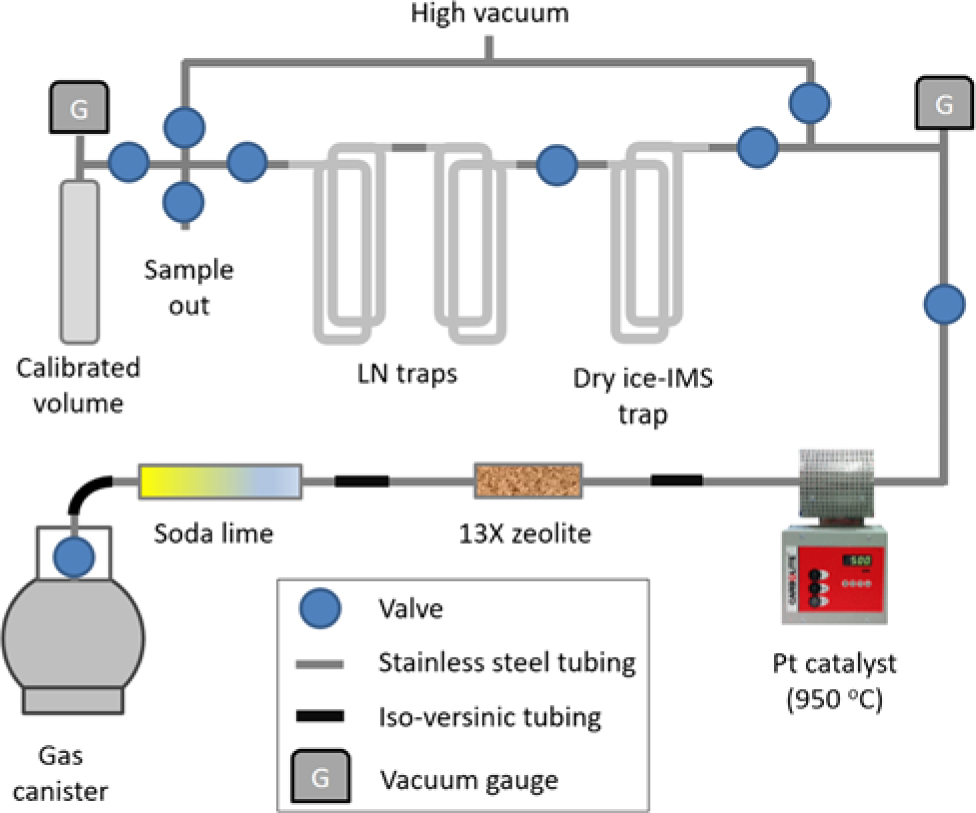
On return to the laboratory, sample CH4 is recovered (as CH4-derived CO2) by connecting the canister to a vacuum rig (Figure 1) and first evacuating the line up to the valve on the gas canister. The rig is constructed from stainless steel vacuum tubing (6 mm o/d) and Swagelok fittings (Swagelok, USA). After isolating the vacuum pump, sample gas is introduced to the rig through a column containing self-indicating soda lime (Fisher Scientific, UK) which removes CO2. The gas then passes through a column of Type 13X zeolite molecular sieve (3–4 g, 1.6-mm pellets, Sigma-Aldrich, UK) which has been prepared by heating (500ºC) and purging with nitrogen (Garnett and Murray Reference Garnett and Murray2013). The molecular sieve provides a secondary trap for traces of CO2 that may have been missed by the soda lime and removes water including that generated from the CO2 reacting with the soda lime. Connections between the canister, soda lime and molecular sieve columns are made using stainless steel and Iso-Versinic tubing (Figure 1; Saint-Gobain, France). Sample CH4 is then combusted to CO2 by reacting with a platinum catalyst (∼8 g platinized alumina beads contained in a quartz glass tube; Johnson Mathey Chemicals, UK) heated to 950ºC (i.e. maximum temperature of the furnace), dried using a slush trap (dry ice with industrial methylated spirits; –78 °C), and the CH4-derived CO2 cryogenically recovered in two liquid nitrogen traps (–196 °C). The vacuum pump is used to draw sample gas from the canister through the rig (slowly at first, by only partially opening the valve to the pump), until a vacuum of ∼1 × 10⁻² mB has been achieved. The recovered CO2 is then transferred to a volume-calibrated cold finger connected to a pressure transducer and the CO2 volume determined. In between samples the heated platinum catalyst is regenerated by flooding with high purity oxygen and then evacuated.
Schematic illustrating the processing of CH4 samples on a vacuum system. LN = liquid nitrogen, IMS = industrial methylated spirits.

Tests Performed to Verify the Reliability of the Sample Processing Methods
Our CH4 processing methods have previously been verified for samples that maintained a constant atmospheric pressure during processing (i.e. when supplied in foil gas bags; e.g. Garnett et al. Reference Garnett, Hardie and Murray2012), or for relatively small gas volumes in glass flasks (∼215 mL, Garnett et al. Reference Garnett, Hardie and Murray2011). We therefore first tested whether the same rig design was suitable when processing gas volumes of greater than 2 L by replacing the gas bags with a 2.2 L glass vessel that was required to be evacuated during the processing of a sample. These initial tests were used to inform on whether the laboratory methods were likely to be reliable for 6 L metal canisters, prior to their procurement. For these tests, we pumped 8 L of outside air into a 10 L foil gas bag and used a gas-tight syringe to add a further ∼100 mL of CO2 (Air Products Ltd, UK) with a 14C content of ∼70%modern (see Stuiver and Polach Reference Stuiver and Polach1977 for the definition of %modern), and ∼20 mL of “fossil” CH4 (BOC Ltd, UK) which we use as an internal laboratory background standard. The gas mixture was then transferred in aliquots into an evacuated 2.2 L glass flask and processed on the rig as described above. Three 2.2 L aliquots were processed from the same gas mixture in the 10 L bag. We chose to use atmospheric air for these tests since it would more closely simulate samples (e.g. containing water vapor), and because the relatively high CH4 standard concentration would mean that atmospheric CH4 would be a small fraction of the total CH4, which we corrected for using:
 $$C{i_{corr}} = {{((C{i_{meas}} \times {V_{meas}}) - (C{i_{atmos}} \times {V_{atmos}}))} \over {({V_{meas}} - {V_{atmos}})}}$$
where Ci is the isotopic concentration (14C or δ13C) of the atmosphere (atmos), measured sample (meas) and sample corrected for atmospheric CH4 (corr). Vmeas is the total volume of CH4-derived CO2 recovered, and Vatmos the volume of atmospheric CH4 in the sample which is calculated from the volume of the sampling vessel and assuming for atmospheric CH4 a concentration of 1.9 ppm, a 14C content of 130%modern and a δ13C of –47‰ (Lassey et al. Reference Lassey, Lowe and Smith2007).
We next tested our methods for analyzing CH4 samples that are smaller than the minimum sample size of 0.5 mg C; this is currently the lower limit for routine samples at the NERC Radiocarbon Facility (East Kilbride). To avoid atmospheric CH4, we created synthetic air by mixing 7 L of nitrogen gas (purity 99.999%, BOC, UK), 1 L of oxygen (purity 99.9995%, BOC, UK) and ∼100 mL of CO2 with a 14C content of ∼70%modern (Air Products Ltd, UK), to which we added ∼2 mL of our “fossil” CH4 (BOC Ltd, UK) internal laboratory standard. We again transferred aliquots of this bulk gas into a 2.2 L glass flask and recovered the CH4 component using the same methods as described above.
To test the 6 L metal canisters (6 L Silonite Canister, Entech Instruments, USA) we performed an identical test to the previous one except with slightly more CH4 to ensure that the recovered sample was routine-sized (i.e. 6 L of gas was transferred into the canister from a foil gas bag containing 7 L nitrogen, 1 L oxygen, 100 mL CO2 and ∼4 mL 14C-dead CH4). We assessed the storage performance of the 6 L metal canisters by preparing two identical standard gases containing ∼5 L N2 and ∼1 L O2 to which ∼4-5 mL of 14C-dead CH4 was directly injected into the canister using a gas-tight syringe. One sample was processed immediately, while the second was left for three months before processing (the longest amount of time that we expect to use the canisters for sample storage).
A final test was undertaken to assess the reliability of the 6 L canisters for processing non-background CH4 samples. Relatively 14C-enriched CH4 was obtained from a biogas plant (GBM, Bristol, UK) and stored in a pressurized cylinder. One aliquot of this gas was analyzed directly through the rig (after being injected into a 1 L bag of O2) and provided the reference value. A second aliquot was injected into a 6 L metal canister prefilled with ∼5 L N2 and ∼1 L O2 and then processed as previously.
The tests described above were used to check the reliability of the new storage and sample purification steps, in addition to the subsequent stages of routine sample processing (e.g. graphitisation). We also analyzed several CH4 standards which served as blanks to test the sample processing under optimized conditions i.e. CO2-free and with minimal storage. These standards, which we term “CH4 blanks” were a mix of ∼5 mL 14C-dead CH4 in ∼1 L high purity O2 that had been freshly prepared in a 1 L foil gas bag prior to being processed by directly connecting the bag to the rig.
After passing through the rig, one aliquot of CH4-derived CO2 from each of the routine sized (>0.5 mg C) samples was used for determining δ13C relative to the Vienna PDB international standard using isotope ratio mass spectrometry (IRMS; Thermo-Fisher Delta V, Germany). For all samples, an aliquot of CO2 was converted to graphite using Fe-Zn reduction (Slota et al. Reference Slota, Jull, Linick and Toolin1987) and measured using accelerator mass spectrometry (AMS). Routine-sized samples were analyzed at the Scottish Universities Environmental Research Centre AMS Facility (East Kilbride, UK) and smaller samples were measured at the Keck AMS Facility (UC Irvine, USA). Following convention (Stuiver and Polach Reference Stuiver and Polach1977), 14C measurements were normalized to δ13C of –25‰ and expressed as %modern, and conventional 14C ages (years BP, where 0 BP = AD 1950). A laboratory background correction of 0.17%modern was applied to the biogas 14C results, based on the long-term record for 14C-dead CH4 standards processed in the lab. No background correction was applied to the other results. Isotope mass balance was used to calculate the mass of modern carbon (100%modern) required to account for the deviation in 14C concentrations above zero in the samples of 14C-dead CH4.
RESULTS
The 14C concentration of routine-sized samples of 14C-dead CH4 recovered from 2.2 L of atmospheric air augmented with 25 mL of ∼70% modern CO2 ranged from 0.26 ± 0.01 to 0.27 ± 0.01%modern (Table 1). Correcting for atmospheric CH4 using isotope mass balance (Equation 1) reduced the 14C contents to 0.12 ± 0.01 to 0.14 ± 0.01%modern (52,615 ± 195 to 53,851 ± 207 BP). The %modern values for these three standards were only slightly greater than for the similarly sized CH4 blank processed at the same time (Table 1).
Results for routine-sized CH4 samples in a glass flask. Composition of the gas mixture was approximately 2.2 L outside air, 4–5 mL 14C-dead CH4 and 25 mL of 70%modern CO2. 14C results presented before and after correcting for atmospheric CH4 (δ13C results were unchanged following this correction).

There was a greater range in 14C content for the small CH4 samples recovered from synthetic air, extending from 0.29 ± 0.01 to 0.74 ± 0.02%modern (47,020–39,440 BP; Table 2). Although the sample with the smallest volume had the highest 14C content, the results did not suggest a strong dependency of 14C content on sample size. Furthermore, when expressed in terms of modern carbon contamination the small samples (0.8–2.0 μg C) had a lower contamination compared to the routine-sized samples (2.7–3.4 μg C).
Results for small-sized CH4 samples in a 2.2 L glass flask. Synthetic air (high purity N2 and O2) was used to which was added approximately 0.5 mL 14C-dead CH4 and 25 mL of 70%modern CO2. NB. δ13C was measured by AMS on sample prepared to graphite and may not be representative of the recovered CH4-derived CO2.

The three samples of 14C-dead CH4 used for testing the 6 L metal canister all gave comparable results (0.11 ± 0.01 to 0.16 ± 0.01%modern; Table 3) and in terms of both 14C content and mass of modern carbon contamination were similar to the 2.2 L glass flask (Table 1; after the latter had been corrected for atmospheric CH4). Although the CH4 stored for 3 months in the 6 L metal canister had a slightly higher 14C content (0.16 ± 0.01%modern) than the reference standard that had been processed immediately (0.13 ± 0.01%modern), the results overlapped at <2 σ analytical uncertainty (Table 3). The biogas CH4 had a 14C content that was just under 100%modern, with the reference gas and sample processed from the canister providing identical 14C concentrations (i.e. within 1 σ; Table 3).
Testing 6 L metal canisters for collection and storage of CH4 samples. Synthetic air (high purity N2 and O2) was used to test CO2 removal and storage performance of the metal canisters (by adding 14C-dead CH4 and 70%modern CO2). Two samples of relatively 14C-enriched CH4 (GBM CH4) were also analyzed, with and without the use of the canister.

DISCUSSION
The routine-sized (>0.5 mg C) CH4 standards processed using our latest procedures all produced very good 14C results, with background-uncorrected 14C ages more than 50,000 BP (Tables 1 and 3). Importantly, the %modern values for these routine-sized samples covered a narrow range from 0.11 ± 0.01 to 0.16 ± 0.01%modern, demonstrating a small (1.9–3.8 μg C) but reproducible contamination that can be reliably accounted for using routine 14C background correction. Indeed, there was very little 14C difference, if any, between routine-sized samples collected in glass flasks or metal canisters, suggesting the vessels performed equally well (although we note that the relative fragility of the glass flask makes it less suitable for fieldwork). Similarly, air mixtures containing additional 70%modern CO2 were not 14C-enriched showing that the soda lime and molecular sieve traps are very effective at removing potentially contaminating CO2 (Tables 1 and 3). Similar 14C concentrations have been reported by previous researchers for 14C-dead CH4 samples. For example, Sparrow and Kessler (Reference Sparrow and Kessler2017) reported a 14C blank of 0.23 ± 0.07%modern (0.24 μg C) for their CH4 preparation system, and Elder et al. (Reference Elder, Xu, Walker, Schnell, Hinkel, Townsend-Small, Arp, Pohlman, Gaglioti and Czimczik2018) quantified modern 14C blank in their CH4 processing apparatus to be ∼1.5-2.5 μg C (which compares to 0.5–3.8 μg C for our samples). Palonen et al. (Reference Palonen, Uusitalo, Seppälä and Oinonen2017) measured a 14C content of 0.06 ± 0.07%modern for natural gas (after applying a background correction of 0.4 ± 0.1%modern).
The CH4 sample recovered from the metal canister after 3 months storage was slightly higher in 14C content compared to an identical sample processed immediately. This might suggest limitations on the use of these canisters for the storage of CH4 samples. However, the 14C result for the stored CH4 sample differed by <2 σ compared to the control canister and was similar in 14C content compared to the routine-sized glass flask samples. We therefore consider there to be insufficient evidence to suggest that the canister is unsuitable for long-term storage of CH4 samples, and indeed, given that most of the CH4 samples that we process are relatively young (<5000 years BP), we conclude that the storage performance of the canister is acceptable for our purposes.
The 14C %modern values of the small-sized samples were higher compared to the routine-sized samples (Table 2), indicating that further improvements are necessary to reliably date sub-milliliter CH4 samples that are close to background. However, we note that the mass of carbon inferred from the 14C measurements is lower in the small-samples compared to the routine-sized. That the 14C content of the CH4 blank was significantly lower than the other small samples might suggest incomplete removal of the 70%modern CO2 that was added to the latter. However, it could alternatively be derived from impurities in the N2 that was present in the synthetic air but not the CH4 blank.
While the results presented here support the reliability of our methods for accurate measurement of CH4, several limitations need to be acknowledged. Firstly, though our methods reliably remove CO2, which we believe is by far the most likely contaminant of our sample types, other contaminants could occur, albeit in far smaller quantities (such as carbon monoxide and non-CH4 hydrocarbons e.g. ethane). It is possible that the molecular sieve used in our processing line may remove some of these contaminants if present (e.g. Rege et al. Reference Rege, Yang and Buzanowski2000). Alternatively, if the contaminants have a similar 14C content to the sample CH4 (e.g. due to a common source) then small traces of them will not significantly change the 14C results. Nevertheless, in cases where contaminants are of concern, steps should be taken to remove them. For example, carbon monoxide can be removed using a metal catalyst (Palonen et al. Reference Palonen, Uusitalo, Seppälä and Oinonen2017) or by oxidation followed by adsorption on molecular sieve (Sparrow and Kessler Reference Sparrow and Kessler2017); non-CH4 hydrocarbons can be removed in liquid nitrogen cooled traps at 223 torr (Sparrow and Kessler Reference Sparrow and Kessler2017).
Additionally, in our trials we predominantly used 14C-dead CH4 to assess the reliability of our methods because it is readily available and being 14C-dead provides a sensitive test for non-14C-dead contaminants which we consider are most likely (e.g. atmospheric CO2 and CH4). To detect 14C-dead or depleted contamination would require a relatively 14C-enriched CH4 standard. Unfortunately, to our knowledge an equivalent non-background 14CH4 standard is not available (see also Pack et al. Reference Pack, Xu, Lupascu, Kessler and Czimczik2015), and hence while the CH4 biogas that we used in our tests provided identical results for canister and non-canister processed samples, they do not provide independent verification of the true 14C content of this gas. However, using the same rig and almost identical sample processing methods we have previously demonstrated reliability of our methods; CH4 produced from decomposing leaves in a small anaerobic digester had the same 14C content as atmospheric CO2 in the year of collection (Garnett et al. Reference Garnett, Gulliver and Billett2016).
In our suite of tests, the δ13C values that we obtained for our internal laboratory CH4 standard ranged from –46.2 ± 0.3 to –41.5 ± 0.3 ‰ for IRMS measurements. These inconsistent δ13C values are unlikely to be a result of contamination, otherwise we would not have achieved such reproducible and low %modern results for the same standards. Instead, isotopic fractionation seems a more likely explanation. This could have been caused by incomplete combustion of CH4 during sample processing, although we think that this explanation is unlikely. Instead, we believe that fractionation probably occurred through not isotopically equilibrating the gas mixtures during their transfer from the 10 L foil gas bag to the glass flask. Hence, there was a pattern whereby the first two aliquots of the standard gases were relatively 13C-depleted, and the residual gas used for the third aliquot was 13C-enriched (Tables 1 and 2). Which of the above explanations is correct could have been resolved with accurate measurement of CH4 yield. Unfortunately, we were unable to obtain accurate yields because: (a) preparation of the standard gases using the syringe did not allow us to accurately determine the volume of gas used, and (b) our CH4 standard gas was not 100% pure (the syringe was cleaned by flushing with high purity oxygen and small amounts of this were progressively introduced to the CH4 standard from “dead space” within the syringe). Nevertheless, fractionation due to either process would not impact the 14C measurements, since these were normalized according to convention, and therefore corrected for fractionation (Stuiver and Polach Reference Stuiver and Polach1977). Our future development program will aim to identify and eliminate the cause of this isotopic fractionation.
In conclusion, the results presented here demonstrate the reliability of our methods for measuring the 14C content of CH4. Tests on the 6 L metal canisters support their suitability for collection and storage of CH4 samples, which will be especially beneficial for sample collection in remote locations. Future development will focus on further improving the quality of results with a focus on smaller sample sizes.
ACKNOWLEDGMENTS
We thank staff at the NERC Radiocarbon Facility, UC Irvine and SUERC AMS Facility. We are grateful to the UK Natural Environment Research Council for funding and to Cameron Macintyre for providing CH4 standard material. We thank an anonymous reviewer for comments which led to an improvement in the manuscript.