





Introduction
Micromammals (i.e. those belonging to the orders Scandentia, Eulipotyphla and Rodentia) have a significant role in ecological systems as a key food source of various predators (Morand et al., Reference Morand, Krasnov, Poulin, Degen, Morand, Krasnov and Poulin2006). Furthermore, some species of rodents have a direct negative impact on agriculture and the food industry (Brown et al., Reference Brown, McWilliam and Khamphoukeo2013). The high abundance that some wild micromammal populations can sustain, especially in the case of the rodents, makes them an important reservoir for several pathogens and parasites (Mihalca and Sándor, Reference Mihalca and Sándor2013; Tomassone et al., Reference Tomassone, Berriatua, De Sousa, Duscher, Mihalca, Silaghi, Sprong and Zintl2018; Rodríguez-Morales et al., Reference Rodríguez-Morales, Shehata, Parvin, Tasnim, Duarte and Basiouni2025). In Spain, previous surveys in diverse species of wild rodents and shrews have investigated the presence of zoonotic pathogens such as Bartonella spp. (Cevidanes et al., Reference Cevidanes, Altet, Chirife, Proboste and Millán2017; Abreu-Yanes et al., Reference Abreu-Yanes, Abreu-Acosta, Izquierdo-Rodríguez, Martin-Carrillo and Foronda2020), pathogenic Leptospira spp. (Foronda et al., Reference Foronda, Martin-Alonso, Del Castillo-Figueruelo, Feliu, Gil and Valladares2011; Millán et al., Reference Millán, Cevidanes, Chirife, Candela and León-Vizcaíno2017; Ruiz et al., Reference Ruiz, Rodríguez-Pastor, Escolar, Alonso and Millán2026), diverse cyst-forming coccidia (Fernández-Escobar et al., Reference Fernández-Escobar, Millán, Chirife, Ortega-Mora and Calero-Bernal2020), Leishmania infantum (Millán, Reference Millán2018; Barbero-Moyano et al., Reference Barbero-Moyano, Gonzálvez, Caballero-gómez, Carbonara, Yusuf, Martínez, Mendoza-Roldán, Quevedo-Muñoz, Guerra, Soriano, Crailsheim, Greco, Otranto and García-Bocanegra2026) and Cryptosporidium spp., Giardia duodenalis and Enterocytozoon bieneusi (García-Livia et al., Reference García-Livia, Martín-Alonso and Foronda2020; Vioque et al., Reference Vioque, Dashti, Santín, Ruiz-fons, Köster, Hernández-castro, García, Bailo, Ortega, Olea, Arce, Chicharro, Nieto, González, Viñuela, Carmena and González-barrio2022), to name some examples.
Sarcocystis (Apicomplexa) is a genus of protozoan parasites with a 2-host life cycle. Commonly, both hosts are part of prey–predator ecological relationships in which the prey is an intermediate host (IH) of Sarcocystis spp. and the predator is the definitive host (DH) (Markus et al., Reference Markus, Killick-Kendrick and Garnham1974; Dubey et al., Reference Dubey, Calero-Bernal, BM, CA and Fayer2015). The IH is infected by consuming sporocysts of Sarcocystis spp. from the environment. After ingestion, the parasite exits the digestive tract and enters the host’s bloodstream. It undergoes development through various species-specific stages, ultimately forming either microscopic or macroscopic sarcocysts in the muscles or central nervous system (CNS) of the IH (Markus et al., Reference Markus, Killick-Kendrick and Garnham1974; Fayer, Reference Fayer2004). DHs become infected by consuming tissues of IHs containing fully mature sarcocysts. Within the intestines of the DH, Sarcocystis spp. undergo further development, culminating in the production of mature oocysts containing sporocysts, which are subsequently excreted in the faeces (Markus et al., Reference Markus, Killick-Kendrick and Garnham1974; Fayer, Reference Fayer2004). Usually, the biggest negative impact of the Sarcocystis infection is experienced by the IH (Lindsay and Dubey, Reference Lindsay and Dubey2020). The level of pathogenicity depends on the Sarcocystis species: some are mostly asymptomatic, while others can cause weakness, fever, weight loss, internal bleeding and even death (P et al., Reference Dubey, Calero-Bernal, BM, CA and Fayer2015; Lindsay and Dubey, Reference Lindsay and Dubey2020).
Over 40 Sarcocystis species have been reported to use rodents as IHs, whereas only two species, Sarcocystis russuli and Sarcocystis attenuati, are known to utilize shrews as IHs (Pak et al., Reference Pak, Sklyarova and Dymkova1991; Hu et al., Reference Hu, Sun, Guo, Zeng, Zhang and Tao2022). Research on Sarcocystis in both rodents and shrews remains sparse. The limited number of studies on this topic may be attributed to two primary factors. Firstly, previous research has frequently reported a prevalence of Sarcocystis in rodents and shrews below 10%, potentially reducing research interest (Svobodová et al., Reference Svobodová, Voříšek, Votýpka and Weidinger2004; Grikienienė, Reference Grikienienė2005; Bentancourt Rossoli et al., Reference Bentancourt-Rossoli, Moré, Soto-Cabrera, Moore, Morrell, Pedrana, Scioli, Campero, Basso, Hecker and Scioscia2023). Secondly, methodologies commonly employed in such studies often require tissue quantities that surpass the total body mass of these small IHs, making their application impractical (Dubey et al., Reference Dubey, Calero-Bernal, BM, CA and Fayer2015). Recent emergence of molecular study methods allows researchers to eliminate these issues. Some studies used blood to detect Sarcocystis spp. (Martin et al., Reference Martin, Decker-Franco, Romero, Carletti, Schnittger and Florin-Christensen2016; Moustafa et al., Reference Moustafa, Shimozuru, Mohamed, Taylor, Nakao, Sashika and Tsubota2017; Decker Franco et al., Reference Decker Franco, Romero, Ferrari, Schnittger and Florin-Christensen2018; Kamani et al., Reference Kamani, Harrus, Nachum-biala, Gutiérrez, Mumcuoglu and Baneth2018; Usluca et al., Reference Usluca, Celebi, Karasartova, Gureser, Matur, Oktem, Sozen, Karatas, Babur, Mumcuoglu and Taylan Ozkan2019; Huaman et al., Reference Huaman, Pacioni, Forsyth, Pople, Hampton, Helbig and Carvalho2021; Prakas et al., Reference Prakas, Gudiškis, Kitrytė, Bagdonaitė and Baltrūnaitė2024a); meanwhile, others modified a muscle digestion method to pool samples (Prakas et al., Reference Prakas, Stirkė, Šneideris, Rakauskaitė, Butkauskas and Balčiauskas2023).
Currently, molecular studies most commonly target four different genetic loci: the 18S rRNA, 28S rRNA, ITS1, and cox1. The largest database comprises ribosomal RNA sequences; however, 28S rRNA sequences are generally more variable than 18S rRNA sequences (Lee & Muthu Reference Lee and Muthu2021). Phylogenetic trees based on D2/D3 regions of 28S rRNA broadly reflect the topology of trees inferred from full 28S rRNA (Mugridge et al., Reference Mugridge, Morrison, Jäkel, Heckeroth, Tenter and Johnson2000); therefore, informative data can be acquired from partial gene sequences. Meanwhile, 18S rRNA sequences are highly conservative and, in cases of abundance of different DNA, may lead to amplification of another parasite DNA (de Mendonça, Reference de Mendonça2018; Usluca et al., Reference Usluca, Celebi, Karasartova, Gureser, Matur, Oktem, Sozen, Karatas, Babur, Mumcuoglu and Taylan Ozkan2019). ITS1 sequences are superior for identification of closely related Sarcocystis species; however, the database for comparison is limited and, furthermore, several reports noted difficulty obtaining ITS1 sequences (Máca, Reference Máca2020; Aryan et al., Reference Aryan, El-azazy, Juozaitytė-Ngugu, Šneideris, Tahrani, Butkauskas and Prakas2025). The mitochondrial cox1 gene is a sensitive mitochondrial marker, especially suited for the identification of ungulate Sarcocystis spp. (Gjerde, Reference Gjerde2013); however, due to its conserved nature, cox1 sequences derived from closely related rodent Sarcocystis spp. may sometimes appear identical (Jäkel et al., Reference Jäkel, Raisch, Richter, Wirth, Birenbaum, Ginting, Khoprasert, Mackenstedt and Wassermann2023).
In Spain, only a single study investigated the presence of Sarcocystis spp. in wild micromammals (Fernández-Escobar et al., Reference Fernández-Escobar, Millán, Chirife, Ortega-Mora and Calero-Bernal2020). That study revealed the presence of at least 3 unknown Sarcocystis spp. and a remarkable prevalence in white-toothed shrews (Crocidura russula) in periurban areas of the north-east of the country. The objective of our work is to deepen the knowledge of the prevalence and species richness of Sarcocystis spp. in the most abundant micromammals in Mediterranean Spain. Furthermore, we aimed to determine the influence of biotic and abiotic factors in the parasite occurrence.
Materials and methods
Field methods
Micromammals were live-trapped in each one of the four seasons in 2022 (winter: 2nd February–17th March, spring: 19th April–27th May, summer: 5th–22nd July and autumn: 8th–25th November) in riparian habitats along the Ebro River, Zaragoza, Autonomous Region of Aragón (Northwest Spain; 41°36′16″ N 0°49′21″ W; Figure 1). Six study sites were selected in each of two types of habitats: remnants of natural riparian forests and agricultural fields in the boundaries of the natural areas. These forests are characterized by ash trees (Fraxinus sp.), black poplars (Populus sp.), tamarisk shrubs (Tamarix gallica), willow trees (Salix sp.), and common reed grasses (Phragmites australis). Crops are mostly devoted to alfalfa, wheat, and barley. Rodents were trapped with Sherman traps (H.B. Sherman Traps, Inc., Tallahassee, Florida). A mixture of wheat flour and vegetable oil was used as bait and a piece of hydrophobic cotton as nesting material. Traps were set up in the evening and inspected in the morning for 4 consecutive days. Animals were transferred without handling to a plastic bag and weighed using a Pesola scale to the nearest 0.5 g and anesthetized with a combination of ketamine (Domtor©, Esteve, Barcelona, Spain) and medetomidine (Imalgene©, Merial, Barcelona, Spain) (Chirife and Millán, Reference Chirife and Millán2014). Animals were then euthanized by bleeding and necropsied in detail, sexed, aged, and measured. A total of 371 individuals were included in the study: 222 Algerian mice (Mus spretus), 82 wood mice (Apodemus sylvaticus) and 67 white-toothed shrews (shrew hereafter).
Map of Spain (top right) showing the location of the study area and the capture sites along the mid-Ebro River near Zaragoza city (main map).

Figure 1 Long description
Map of Zaragoza city displaying sampling locations along the Ebro River. Red dots indicate sampling sites in agricultural areas, while blue dots represent sites in natural areas. The map includes geographic coordinates and a scale bar indicating 0 to 2 kilometers. An inset map of Spain shows the location of the study area, marked with a red rectangle. The Ebro River flows through the central part of the map, with sampling sites distributed along its course. The map provides detailed geographic context with roads and urban areas visible around Zaragoza.
DNA processing: Extraction, amplification and sequencing
Tissue samples (heart, lung and brain) of each individual were pooled, and DNA was extracted using Qiagen DNeasy Blood & Tissue kit (Qiagen, Valencia, CA, USA) following the manufacturer’s instructions. The presence of Sarcocystis spp. was investigated using nested PCR (nPCR) targeting 28S rRNA and cox1. In order to amplify 28S rRNA sequences, an external primer pair of Sgrau281/282 and internal primer pair of Sgrau283/284 were used (Prakas et al., Reference Prakas, Stirkė, Šneideris, Rakauskaitė, Butkauskas and Balčiauskas2023). Meanwhile, for cox1 sequences, primer pairs were SF1/SR5 and SgraucoF1/SgraucoR1, respectively (Prakas et al., Reference Prakas, Stirkė, Šneideris, Rakauskaitė, Butkauskas and Balčiauskas2023).
All PCR reactions were carried out in 25 µL reaction volume. The first reaction tube contained 12.5 µL of Dream Taq PCR Master Mix (Thermo Fisher Scientific Baltics, Vilnius, Lithuania), 7.5 µL of nuclease-free water, 0.5 µM of each primer and 4 µL of the template DNA. In the second reaction, 12.5 µL of Dream Taq PCR Master Mix, 9.5 µL nuclease-free water, 0.5 µM of each primer and 2 µL of first reaction products were used. In both reactions, water was used for negative controls and was added instead of template DNA. Sarcocystis myodes DNA extracted in a previous study was used as a positive control in this work (Rudaitytė-Lukošienė et al., Reference Rudaitytė-Lukošienė, Jasiulionis, Balčiauskas, Prakas, Stirkė and Butkauskas2022). Initial PCR amplification was carried out using the following thermal protocol: initial denaturation at 95 °C for 5 min, followed by 35 cycles of 35 s at 95 °C, 45 s at 59–61 °C (temperature dependent on the annealing temperature of primers), followed by 55 s at 72 °C and the final extension for 7 min at 72 °C. Second PCR amplification was conducted following an identical protocol. Products of both PCR reactions were visualized by gel electrophoresis on 1% agarose gels. Alkaline phosphatase FastAP and exonuclease ExoI (Thermo Fisher Scientific Baltics, Vilnius, Lithuania) were used to purify all the positive samples collected during this study. Purification was carried out by following the manufacturer's instructions. Sanger sequencing was conducted using Big-Dye® Terminator v3.1 Cycle Sequencing Kit (Thermo Fisher Scientific, Vilnius, Lithuania) and the 3500 Genetic Analyzer (Applied Biosystems, Foster City, CA, USA). Both forward and reverse primers of the second PCR reaction were used for the sequencing.
Molecular, phylogenetic and genetic analysis
The sequences obtained in this study were compared with Sarcocystis spp. sequences uploaded to the NCBI GenBank database (http://blast.ncbi.nlm.nih.gov, accessed on 12 September 2025). MEGA12 v.12.0.11 software was utilized to conduct phylogenetic analysis (Kumar et al., Reference Kumar, Stecher, Suleski, Sanderford, Sharma and Tamura2024). Both 28S rRNA and cox1 sequences were aligned using the MUSCLE algorithm. Phylogenetic trees were constructed using the maximum likelihood (ML) method. The best-fitting model for each alignment was determined using the MEGA12 Find Best DNA/Protein Models (ML) function. The Hasegawa–Kishino–Yano (HKY) model was used to construct the 28S rRNA trees, while Tamura 3-parameter (T92) model was used to construct the cox1 tree. The construction of each phylogenetic tree was performed with a bootstrap value of 1000. MEGA12 v.12.0.11 was used to calculate pairwise genetic distance within groups and between groups, using Tamura 3-parameter model and partial deletion option in the initial set-up. Sequences generated throughout the present study are accessible in the NCBI GenBank database under accession numbers PZ023993–PZ024015 (cox1) and PZ035443–PZ035472 (28S rRNA).
Statistical analysis
A binomial generalized linear model (GLM) with logit link function was used to evaluate the effects of species, habitat, season, and sex on the probability of Sarcocystis spp. infection in R 4.4.1 (R Core Team, 2024). Age was not included in the models due to the high proportion of missing values, particularly in the shrew, which would substantially reduce sample size. Sex was retained as a potential explanatory variable because missing data were limited. Function ‘Anova’ of the package ‘car’ was used for the analyses of deviance, and function ‘summary’ was used to determine coefficients of the model. The initial model included biotic factors, including species (wood mouse, Algerian mouse, shrew) and sex (female and male), and abiotic factors, including habitat (natural and agricultural) and season (spring, summer, autumn and winter) as independent variables. Since the Algerian mouse was the most abundant species, a binomial GLM was also run for this species only, including habitat and season as independent variables. Model selection was based on Akaike’s information criterion (AIC) value with a backward-selection procedure using the function ‘stepAIC’ in R to identify the most parsimonious model.
Sarcocystis diversity (Species richness, Shannon’s H index, dominance) was evaluated using PASTv4.03 software (Hammer et al., Reference Hammer, Harper and Ryan2001).
Results
Observed prevalence of Sarcocystis spp
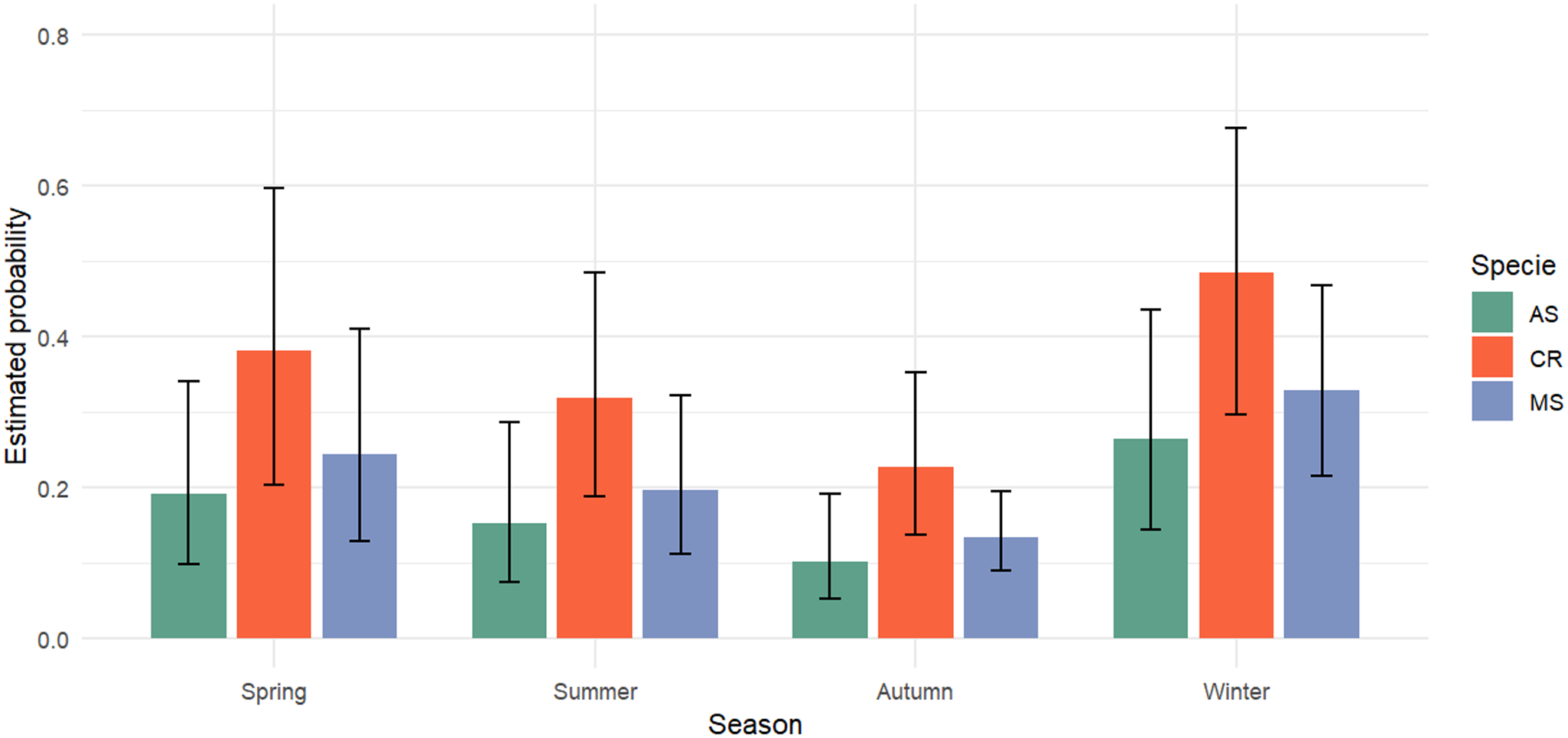
Sarcocystis spp. DNA presence was detected in the 3 species investigated (Table 1). Overall, the prevalence of Sarcocystis sp. in the population was 19.9% (95% CI = 16.0–24.4). The final GLM retained species and season as explanatory variables for Sarcocystis spp. prevalence (Table 1). The prevalence rates ranged from 0% to 43.8% (95% CI = 20.8–69.5), depending on the host species and season (Table 1). Infection probability differed significantly among seasons (Chi2 = 11.20, d.f. = 3, P = 0.012), whereas species showed a marginally non-significant effect (Chi2 = 5.59, d.f. = 2, P = 0.061). The odds of infection were significantly higher in winter than in autumn (OR = 3.18, 95% CI = 1.59–6.34). Prevalence was significantly higher in the shrew (28.4%) than in the wood mouse (17.1%) and the Algerian mouse (18.5%). Likewise, the shrew showed significantly higher odds of infection than the wood mouse (OR = 2.60, 95% CI = 1.13–5.96), whereas infection probability in the Algerian mouse did not differ significantly from that in the wood mouse (Table 2 and Figure 2). Overall, the type of habitat did not have any significant effect on the probability of infection. In natural habitats, the prevalence of Sarcocystis sp. ranged from 15.7% to 26.5% and in agricultural areas from 19.4% to 30.3%.
Estimated probability of Sarcocystis spp. infection in the micromammal community. Bars represent the mean predicted probability (±95% confidence intervals) based on a binomial generalized linear model including season and habitat as the explanatory variables. AS, wood mouse (Apodemus sylvaticus); CR, white-toothed shrew (Crocidura russula); MS, Algerian mouse (Mus spretus).

Sarcocystis spp. prevalence in micromammals in different seasons and habitats

Table 1 Long description
Prevalence of Sarcocystis infection is reported as infected out of examined animals, with percent prevalence and a 95% confidence interval, for three micromammal species plus an overall total. Across all samples, white-toothed shrews show the highest overall prevalence at 28.4% (19 of 67), compared with 18.5% in Algerian mice (41 of 222) and 17.1% in wood mice (14 of 82); overall prevalence is 19.9% (74 of 371). By season, overall prevalence is highest in winter at 32.2% (19 of 59) and lowest in autumn at 14.7% (29 of 197). Species patterns vary by season: wood mice are highest in winter at 43.8% and drop to zero in summer; Algerian mice peak in winter at 30.8% and remain at 30.0% in summer; shrews are zero in winter but near 30% in summer and autumn. By habitat, overall prevalence is similar in natural areas at 19.0% (27 of 142) and agricultural areas at 20.5% (47 of 229), with shrews higher than both mouse species in each habitat. Confidence intervals are wide where sample sizes are small, especially for shrews in winter and spring, so those seasonal comparisons are less precise.
Estimated coefficients of the fitted binomial generalized linear model for the probability of Sarcocystis spp. infection by species and season

Table 2 Long description
Binomial model coefficients summarize how host species and season relate to the probability of Sarcocystis infection, with estimates, standard errors, z values, and p values. Winter shows a clear positive association with infection probability, with a statistically strong p value. C. russula also has a positive association and is statistically significant at the lowest significance level. M. spretus has a small positive estimate but is not statistically significant. Spring and summer have positive estimates but do not reach conventional statistical significance. The intercept is strongly negative and highly significant, indicating a low baseline infection probability for the reference species and reference season. Results reflect associations relative to the model’s reference categories and do not by themselves establish causation.
SE, Standard error.
* p < 0.05,
*** p < 0.001.
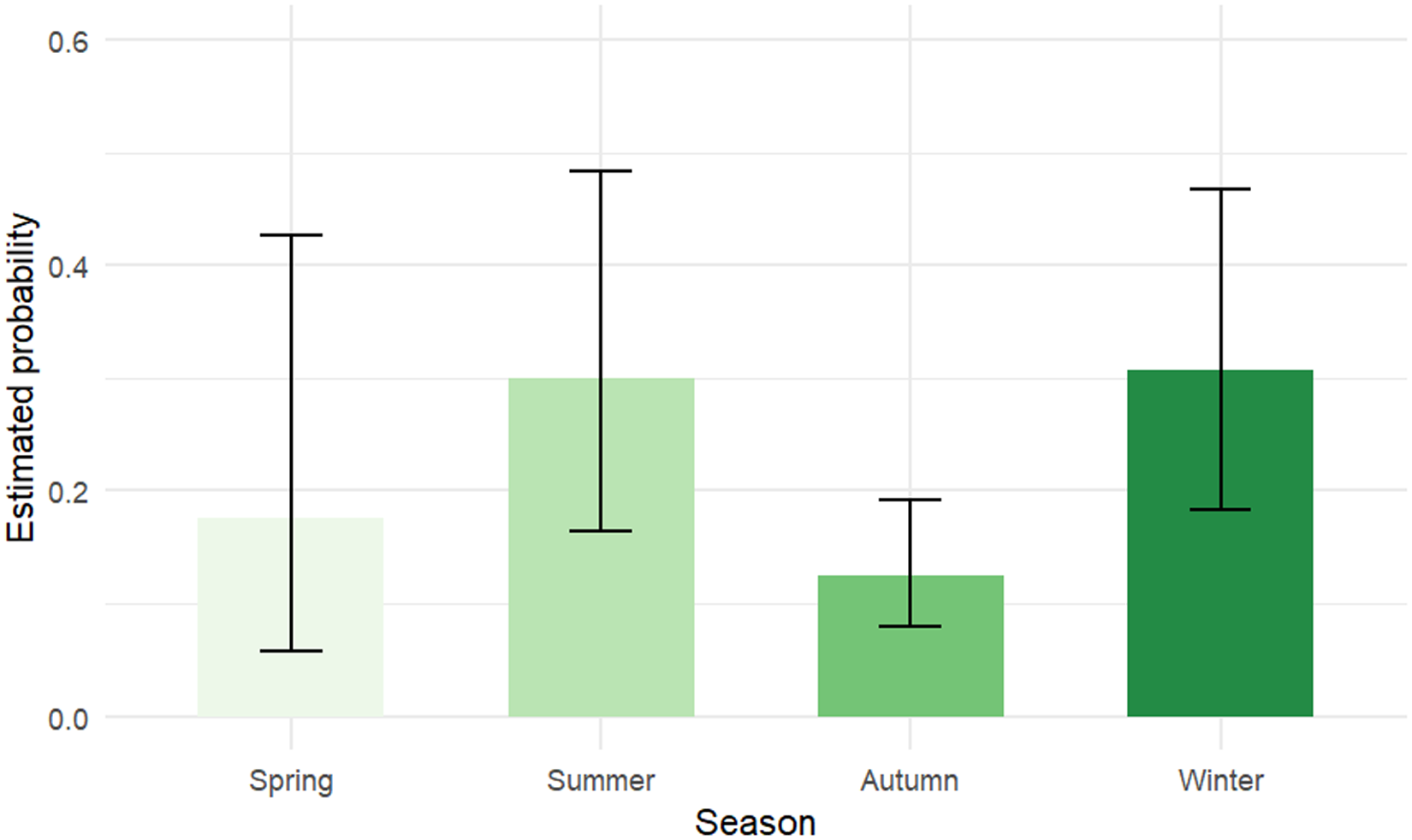
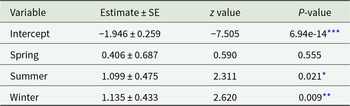
Regarding the model run exclusively for the Algerian mouse, the risk of infection was higher in winter and in summer, with increases of 3.36 and 3.56 times, respectively, compared to autumn (Table 3 and Figure 3).
Estimated probability of Sarcocystis spp. infection in the Algerian mouse (Mus spretus) across seasons. Bars represent the mean predicted probability (±95% confidence intervals) based on a binomial generalized linear model including season as the only explanatory variable.

Estimated coefficients of the fitted binomial generalized linear model for the probability of infection by Sarcocystis spp. in Algerian mouse (Mus spretus) by season

Table 3 Long description
Binomial generalized linear model coefficients estimate how season relates to the probability of Sarcocystis infection in Algerian mouse. The intercept is negative and highly statistically significant, indicating low baseline infection probability in the reference season. Spring has a small positive estimate with a large standard error and a non-significant p-value, suggesting no clear difference from the reference. Summer has a positive estimate with a statistically significant p-value, indicating higher infection probability than the reference season. Winter also has a positive estimate with a statistically significant p-value and is slightly larger than summer, suggesting the strongest seasonal increase among those tested. Results are based on model estimates and uncertainty, so effect sizes should be interpreted alongside standard errors and p-values.
SE, Standard error.
* p < 0.05,
** p < 0.01,
*** p < 0.001.
Molecular characterization of Sarcocystis spp
Initial 28S rRNA nPCR analysis revealed 74 samples positive for Sarcocystis spp. Although all samples were purified and sequenced, 27 yielded insufficient data because the acquired sequences were either short or contained multiple double/polymorphic peaks. Nineteen of these sequences were 94.9–100% similar to Sarcocystis spp. that utilize snakes in their lifecycle, namely Sarcocystis pantherophisi, Sarcocystis singaporensis and Sarcocystis cf. zuoi (Supplementary Table S1). Five sequences shared a 97.2–100% similarity with Sarcocystis sp. M12-147E, while the last three sequences contained polymorphic peaks throughout the whole chromatograms; thus, no comparative analysis could be done. These 27 sequences were included in the assessment of the prevalence of Sarcocystis spp. but excluded from subsequent sequence and phylogenetic analysis.
BLASTn analysis of 47 pure 28S rRNA sequences revealed that they could not be confidently classified as any currently named Sarcocystis species. Instead, these sequences were assigned to 11 different Sarcocystis lineages (Table 4). The distinction was made based on genetic similarity values, and lineages were considered distinct if the difference between sequences exceeded 2%.
Sarcocystis lineages identified in this study and the percentage similarity of their 28S rRNA sequences to those of the most closely related species

Table 4 Long description
Sarcocystis lineages are listed with GenBank accession ranges, counts of sequences and genotypes, within-lineage 28S rRNA similarity, and percent similarity to the closest named Sarcocystis species based on matches meeting a quality cutoff of 90 or higher. Six snake-associated lineages (RodES1Sna to RodES6Sna) include 1 to 21 sequences each and show close matches to S. pantherophisi at roughly 90.7 to 93.1 percent, while their similarity to S. strixi and Sarcocystis cf. strixi is lower, mid 80s. RodES2Sna is most similar to Sarcocystis cf. zuoi and S. muricoelognathis at about 94 to 96 percent, with a lower match to S. singaporensis around 89.5 to 90.2 percent. Two lineages labeled Mab include RodES1Mab with 5 sequences and very high within-lineage similarity (99.9 percent) and a closest match to a voucher sequence M12–165E near 98.7 to 98.9 percent; RodES2Mab has one sequence and its closest listed matches fall below the stated quality cutoff, so those similarities should be treated cautiously. Three lineages labeled Avc each have one sequence and show the highest closest-species similarities in the table: RodES1Avc matches S. jamaicensis, S. glareoli, and S. microti at about 99.2 to 99.6 percent, and also matches several unnamed Rod lineages at 100 percent but with low quality values. RodES2Avc is closest to S. strixi and Sarcocystis cf. strixi around 92.9 to 93.7 percent, while RodES3Avc is closest to bird-associated species S. lari, S. columbae, and S. halieti around 95.5 to 96.6 percent. Intraspecific similarity is reported only for lineages with multiple sequences and is consistently very high (98.0 to 99.9 percent), while single-sequence lineages have no within-lineage similarity value.
a Sequences of the lineage are the most similar to snake-associated Sarcocystis spp.
b Sequences of the lineage with an undetermined DH.
c Sequences of the lineage are the most similar to bird-associated Sarcocystis spp.
Six of these lineages (Sarcocystis sp. RodES1Sn–Sarcocystis sp. RodES6Sn), comprising 38 sequences, exhibited a 90.7–96.1% similarity to Sarcocystis spp. that utilize snakes as their DH. Two lineages (Sarcocystis sp. RodES1Ma and Sarcocystis sp. RodES2Ma) included 6 sequences that shared 97.0–98.9% similarity to a sequence of Sarcocystis sp. voucher M12-165E. The remaining 3 lineages (Sarcocystis sp. RodES1Av, Sarcocystis sp. RodES2Av and Sarcocystis sp. RodES3Av) comprising 3 sequences exhibited 92.9–99.6% similarity to Sarcocystis spp. that utilize birds as their DH.
Analysis of 28S rRNA sequences revealed 26 unique genotypes. Samples with the unique 28S rRNA sequences were additionally analysed in an attempt to characterize them at partial cox1 gene. A PCR amplification was successful in 23 samples. Unfortunately, cox1 fragments could not be amplified for the Sarcocystis sp. RodES4Sn lineage and for 1 genotype each of Sarcocystis sp. RodES1Sn and Sarcocystis sp. RodES3Sn. Out of the 23 cox1 sequences obtained, 8 unique sequences were identified. The similarity of 28S rRNA sequences among all lineages ranged from 78.7% to 97.8%, while cox1 sequences showed higher similarity, ranging from 93.1% to 99.7% (Tables 5 and 6). Lineages Sarcocystis sp. RodES1Sn, Sarcocystis sp. RodES3Sn, Sarcocystis sp. RodES4Sn and Sarcocystis sp. RodES5Sn were the most closely related, with pairwise differences ranging from 2.2% to 4.6%. Furthermore, 9 cox1 sequences of lineage Sarcocystis sp. RodES1Sn, 1 sequence of lineage Sarcocystis sp. RodES3Sn, as well as lineages Sarcocystis sp. RodES5Sn and Sarcocystis sp. RodES6Sn were 100% identical.
Assessment of genetic differentiation between 28S rRNA sequences of 11 Sarcocystis lineages

Table 5 Long description
Pairwise comparisons among eleven Sarcocystis lineages based on 28S rRNA sequences are summarized, with genetic distance values in the upper-right half and percent sequence similarity in the lower-left half. The tightest cluster is RodES3Sn, RodES4Sn, and RodES5Sn, which share roughly 96.0 to 97.8 percent similarity and have low distances around 0.02 to 0.03. RodES1Sn is also close to this cluster, showing about 95.4 to 97.8 percent similarity to RodES3Sn through RodES5Sn and distances near 0.019 to 0.021. RodES2Sn stands out as the most divergent lineage, with only about 79.4 to 81.5 percent similarity to most others and high distances around 0.157 to 0.198. RodES6Sn is intermediate, with about 90.6 to 92.7 percent similarity to RodES1Sn and RodES3Sn, but much lower similarity near 80.4 to 80.5 percent to RodES2Sn. Among the Ma and Av lineages, RodES1Ma is relatively close to RodES1Av, with about 89.7 to 89.8 percent similarity and a distance near 0.098, while RodES1Av and RodES3Av are very similar at about 95.1 percent similarity and a distance near 0.048. Diagonal cells indicate within-lineage variation where multiple sequences exist, showing very small distances and very high similarity for RodES1Sn, RodES2Sn, RodES3Sn, and RodES1Ma. Blank diagonal entries for several lineages suggest only one sequence was available there, so within-lineage variability cannot be assessed for those cases.
Percentages (%) of sequence similarity are provided below the diagonal line, while pairwise genetic distances are given above the diagonal line. For lineages with 2 or more unique sequences, pairwise genetic distance/sequence similarity (%) values are provided on the diagonal line.
Pairwise genetic distances were calculated for both datasets (Tables 5 and 6). The overall average of pairwise distance across 47 28S rRNA sequences was 0.112, indicating a high sequence divergence in the dataset. Meanwhile, the 23 cox1 sequences demonstrated an overall average pairwise distance of 0.023, indicating a low level of divergence among sequences. Pairwise distances among the 28S rRNA sequences ranged from 0.019 to 0.249, while distances among the cox1 sequences were 0.03–0.073. Overall, data indicate limited suitability of cox1 for species differentiation compared to 28S rRNA.
Phylogenetic analysis of identified Sarcocystis species
As 28S rRNA sequences acquired in this study were highly diverse, two separate phylogenetic analyses were conducted. The first phylogenetic tree included sequences of Sarcocystis sp. RodES1Sn, Sarcocystis sp. RodES2Sn, Sarcocystis sp. RodES3Sn, Sarcocystis sp. RodES4Sn, Sarcocystis sp. RodES5Sn, Sarcocystis sp. RodES6Sn, Sarcocystis sp. RodES1Ma and Sarcocystis sp. RodES2Ma lineages. While sequences of lineages Sarcocystis sp. RodES1Av, Sarcocystis sp. RodES2Av and Sarcocystis sp. RodES3Av were used to construct the second 28S rRNA phylogenetic tree. The HKY + G + I model was used to build the first 28S rRNA phylogenetic tree. The final alignment consisted of 31 individual sequences and 818 nucleotide positions, including the gaps (Figure 4A). The second phylogenetic tree was constructed using HKY + G + I model. The final alignment consisted of 28 sequences and 904 nucleotide positions, including the gaps (Figure 4B). Lastly, the T92 + G model was used to construct the third phylogenetic tree, which included all cox1 sequences obtained in this study. The final alignment consisted of 32 sequences and 618 nucleotide positions, with no gaps (Figure 4C).
Phylogenetic placement of Sarcocystis spp. acquired from micromammals in Spain. The maximum likelihood trees were constructed based on (A), (B) 28S rRNA sequences and (C) cox1 sequences. The sequence of S. hirsuta was used as an outgroup for (A) tree, S. myodes for (B) tree and T. gondii for (C) tree. Posterior probability support values of 70% or higher are indicated next to branches. Origin of sequence: ARG, Argentina; CHN, China; CZE, Czechia; DEU, Germany; ESP, Spain; FIN, Finland; FRA, France; JPN, Japan; LTU, Lithuania; LVA, Latvia; MYS, Malaysia; SGP, Singapore; THA, Thailand; USA, United States of America; acquired from: AS, wood mouse; MS, Algerian mouse; CR, shrew. *Presence of S. glareoli was detected in the intestines of Spanish raptors, **presence of S. funereus was detected in the blood of Lithuanian micromammals.

Figure 4 Long description
Three phylogenetic trees labeled A, B and C depict the relationships among Sarcocystis species based on rRNA and cox1 sequences. Tree A shows Sarcocystis sp. RodES1Sn, RodES2Sn, RodES3Sn, RodES4Sn, RodES5Sn, RodES6Sn, RodES1Ma and RodES2Ma lineages, with branches indicating their evolutionary relationships. Tree B includes Sarcocystis sp. RodES1Av, RodES2Av and RodES3Av, with branches showing connections to other species like Sarcocystis colubrina and Sarcocystis glareoli. Tree C presents cox1 sequences, including Sarcocystis jamaicensis and Sarcocystis myodes, with branches illustrating their phylogenetic placement. Posterior probability support values are indicated next to branches, with values of 70 percent or higher highlighted. The trees include sequences from various countries such as Spain, Lithuania and the United States, acquired from different hosts like wood mice and shrews.
Assessment of genetic differentiation between cox1 sequences of 8 Sarcocystis lineages

Table 6 Long description
Pairwise comparisons among eight Sarcocystis lineages based on cox1 sequences are summarized, with genetic distances in the upper-right half and percent sequence similarity in the lower-left half. The closest pair is RodES1Av versus RodES3Av, showing 99.5 percent similarity and a genetic distance of 0.005. RodES1Sn and RodES1356Sn are also very similar at 99.7 percent similarity and 0.003 distance. RodES2Sn is the most distinct lineage, with similarities around 93.1 to 95.0 percent to others and the largest distances, reaching 0.073 versus RodES3Av and 0.071 versus RodES1Av and RodES2Av. Among the Av lineages, RodES1Av and RodES2Av are close at 98.4 percent similarity and 0.016 distance, while RodES2Av and RodES3Av show 98.6 percent similarity and 0.015 distance. RodES2Ma clusters more closely with RodES1Sn and RodES1356Sn, with similarities of 98.6 to 98.9 percent and distances of 0.011 to 0.015. Values reflect pairwise sequence comparisons only and do not by themselves indicate direction of change or broader evolutionary relationships beyond this gene region.
Percentages (%) of sequence similarity are provided below the diagonal line, while pairwise genetic distances are given above the diagonal line.
All 28S rRNA sequences of Sarcocystis sp. RodES1Sn, Sarcocystis sp. RodES2Sn, Sarcocystis sp. RodES3Sn, Sarcocystis sp. RodES4Sn, Sarcocystis sp. RodES5Sn and Sarcocystis sp. RodES6Sn lineages grouped with other Sarcocystis species that employ snakes as DH in their lifecycle. Notably, these Sarcocystis lineages exhibited a clear divergence, with Sarcocystis sp. RodES1Sn, Sarcocystis sp. RodES3Sn, Sarcocystis sp. RodES4Sn, Sarcocystis sp. RodES5Sn and Sarcocystis sp. RodES6Sn forming a clade with S. pantherophisi, while Sarcocystis sp. RodES2Sn clustered with S. muricoelognathis and S. zamani. Sequences were clearly distinct from the sequences of Sarcocystis sp. RodES1Ma and Sarcocystis sp. RodES2Ma, which formed a cluster with sequence of an undescribed Sarcocystis species (Sarcocystis sp. voucher M12-165E) previously detected in shrew from Spain (Figure 4A). The second phylogenetic tree revealed relationship between 3 identified lineages and Sarcocystis spp. that employ birds as DHs. Sarcocystis sp. RodES1Av grouped with S. microti, S. jamaicensis and S. glareoli, while Sarcocystis sp. RodES2Av was placed together with S. strixi and S. funereus. Finally, Sarcocystis sp. RodES3Av formed a separate branch in the phylogram (Figure 4B).
Based on cox1, lineages Sarcocystis sp. RodES1Sn and Sarcocystis sp. RodES1356Sn were also grouped with S. pantherophisi, as well as S. canis and 2 undescribed Sarcocystis sp. detected in Algerian mouse from Spain and muscles of plains viscacha (Lagostomus maximus) from Argentina (Figure 4C). Meanwhile, lineage Sarcocystis sp. RodES2Sn clustered with the species known as S. zuoi-complex – S. attenuati, S. kani, S. scandentiborneensis, S. zuoi and S. muricoelognathis. Notably, sequences of Sarcocystis sp. RodES1Ma and Sarcocystis sp. RodES2Ma were placed into 2 separate groups with sequences of 2 undescribed Sarcocystis spp. (Sarcocystis sp. M12-178E and Sarcocystis sp. M13-106E) detected in the brains of C. russula. Lastly, Sarcocystis sp. RodES1Av, Sarcocystis sp. RodES2Av and Sarcocystis sp. RodES3Av grouped with other Sarcocystis spp. that utilize birds, rodents and carnivorous mammals as their IHs and birds as their DHs, namely S. lutrae, S. lari, S. jamaicensis, S. glareoli, S. strixi, S. funereus and several undescribed Sarcocystis spp.
Distribution of Sarcocystis lineages in the examined micromammal species
The distribution of Sarcocystis lineages was uneven across all 3 micromammal species (Table 7). The wood mice showed the lowest lineage diversity (S = 2, H = 0.45), with only 2 lineages that were the most similar to snake-associated Sarcocystis spp. identified. Sarcocystis sp. RodES1Sn was detected more often and dominated among positive samples (D = 0.72). In contrast, lineage dominance in the other 2 micromammal species was substantially lower (D = 0.37 in both cases), indicating a more balanced representation of Sarcocystis lineages. The highest lineage diversity (S = 9, H = 1.48) was observed in the Algerian mouse, in which 9 distinct lineages were detected. Of these, five lineages were the most similar to snake-associated Sarcocystis spp., three grouped with Sarcocystis spp. that utilize birds in their lifecycle, and one could not be assigned to any Sarcocystis species with a known DH. Notably, lineages Sarcocystis sp. RodES1Av, Sarcocystis sp. RodES2Av and Sarcocystis sp. RodES3Av were identified only in Algerian mouse samples. Lastly, 5 lineages were identified in shrew samples (S = 5, H = 1.23). Three lineages were the most similar to Sarcocystis spp. that use snakes in their life cycle, while the remaining 2 lineages did not group with any species with a known DH. In Algerian mouse and shrew lineages, Sarcocystis sp. RodES1Sn and Sarcocystis sp. RodES2Sn were detected most often, respectively.
Sarcocystis lineage richness in the Spanish micromammals captured in the mid-Ebro valley

Table 7 Long description
Host species are compared by Sarcocystis lineage richness, lineage types by likely definitive host, and two community indices with confidence intervals. Wood mouse has 2 snake-associated lineages, low diversity at 0.45, and high dominance at 0.72. Algerian mouse has the greatest richness with 9 lineages spanning snake-associated, bird-associated, and one with undetermined definitive host; it also has the highest diversity at 1.48 and lower dominance at 0.37. White-toothed shrew is intermediate with 5 lineages, including snake-associated and undetermined definitive host lineages, with diversity 1.23 and dominance 0.37. Overall, richness and diversity increase from wood mouse to shrew to Algerian mouse, while dominance is highest in wood mouse and similarly lower in the other two hosts. Confidence intervals indicate uncertainty around the diversity and dominance estimates, so small differences should be interpreted cautiously.
S, species richness; H, Shannon’s H index; CI, 95% confidence interval; D, dominance; DH, definitive host.
Discussion
Parasite prevalence and risk factors
There is a limited amount of published data on Sarcocystis prevalence in wild micromammals. The overall Sarcocystis sp. prevalence in the wood mouse analysed in the current study (17.1%) is significantly higher than that reported elsewhere. In wood mice, Sarcocystis microti has been reported only once, with a prevalence of 2.8% in brain tissue from a Czech study (Svobodová et al., Reference Svobodová, Voříšek, Votýpka and Weidinger2004). Another study from Czechia reported a 0.8% prevalence of Sarcocystis in the brain of Apodemus spp. mice (Voříšek et al., Reference Voříšek, Votýpka, Zvára and Svobodová1998). Lastly, two investigations from Germany and Spain, respectively, reported no detection of Sarcocystis spp. in wood mice (Krücken et al., Reference Krücken, Blümke, Maaz, Demeler, Ramünke, Antolová, Schaper and Samson-himmelstjerna2017; Fernández-Escobar et al., Reference Fernández-Escobar, Millán, Chirife, Ortega-Mora and Calero-Bernal2020). However, it should be noted that many of these studies analysed brain tissues, which might have influenced their capacity to detect the parasite. Data on Sarcocystis spp. infecting the Algerian mouse and the shrew are even more scarce. A single study from Spain reported the detection of Sarcocystis spp. DNA in 2/12 brain samples of Algerian mice, while all heart samples tested negative (Fernández-Escobar et al., Reference Fernández-Escobar, Millán, Chirife, Ortega-Mora and Calero-Bernal2020). The results are comparable to the present study, in which 18.5% of the animals were positive for Sarcocystis sp. The same study also reported a 34.5% prevalence of Sarcocystis spp. in white-toothed shrews. DNA of the parasite was detected both in heart and brain samples, with prevalence of 6.9% and 34.5%, respectively (Fernández-Escobar et al., Reference Fernández-Escobar, Millán, Chirife, Ortega-Mora and Calero-Bernal2020). These results are in the range of our study, as the overall Sarcocystis sp. prevalence in the shrews was 28%.
Shrews were more likely to test positive for Sarcocystis spp. than wood mouse and Algerian mouse. Similar differences were observed in the above-mentioned study in Spain (Fernández-Escobar et al., Reference Fernández-Escobar, Millán, Chirife, Ortega-Mora and Calero-Bernal2020). Another study from Czechia reported a higher prevalence of Sarcocystis spp. in muscle samples of common shrews (Sorex araneus) compared with common voles (Microtus arvalis) and bank voles (Clethrionomys glareolus) (Svobodová et al., Reference Svobodová, Voříšek, Votýpka and Weidinger2004). Altogether, these findings point towards a higher exposure risk or susceptibility of the parasite in shrews. Furthermore, other studies have reported differences in detection rate between mice and voles, with mice being less likely to be infected than voles (Grikienienė and Mažeikytė, Reference Grikienienė and Mažeikytė2000; Prakas et al., Reference Prakas, Stirkė, Šneideris, Rakauskaitė, Butkauskas and Balčiauskas2023, Reference Prakas, Gudiškis, Kitrytė, Bagdonaitė and Baltrūnaitė2024a).
A seasonality was observed in the prevalence of three species examined was observed, because the odds of infection were significantly higher in winter than in autumn. These findings are comparable to some studies conducted in Europe, namely, France (Fichet-Calvet et al., Reference Fichet-Calvet, Kia, Giraudoux, Quéré, Delattre and Ashford2004), Czechia (Svobodová et al., Reference Svobodová, Voříšek, Votýpka and Weidinger2004) and the Netherlands (Hoogenboom and Dijkstra, Reference Hoogenboom and Dijkstra1987), where authors noted the lowest prevalence of the parasite in the rodents caught in autumn. Authors argued that the observed pattern may be caused by overwintering individuals, as the probability of parasite infection increases with age and weight. In spring, when uninfected juveniles from the new generation mix with the overwintering cohort, Sarcocystis sp. prevalence appears to drop, even though the underlying infection rate in the population remains stable (Hoogenboom and Dijkstra, Reference Hoogenboom and Dijkstra1987; Fichet-Calvet et al., Reference Fichet-Calvet, Kia, Giraudoux, Quéré, Delattre and Ashford2004; Svobodová et al., Reference Svobodová, Voříšek, Votýpka and Weidinger2004). Such a hypothesis could explain the bimodal increase in Sarcocystis spp. observed in Algerian mice, as this species exhibits two distinct breeding peaks in spring and early autumn (Palomo et al., Reference Palomo, Justo and Vargas2009). On the other hand, no statistically significant differences in Sarcocystis spp. prevalence were observed between samples collected from natural and agricultural environments. A similar lack of difference in prevalence among different types of habitats was reported in studies from France (Fichet-Calvet et al., Reference Fichet-Calvet, Kia, Giraudoux, Quéré, Delattre and Ashford2004) and Lithuania (Prakas et al., Reference Prakas, Stirkė, Šneideris, Rakauskaitė, Butkauskas and Balčiauskas2023). In contrast, in Argentina, significantly higher parasite prevalence was observed in synanthropic than in wild rodent specimens (Bentancourt Rossoli et al., Reference Bentancourt-Rossoli, Moré, Soto-Cabrera, Moore, Morrell, Pedrana, Scioli, Campero, Basso, Hecker and Scioscia2023). In the same study area and the same host species, we did not find differences between habitats in the indirectly transmitted Hydatigera parva (Miljević et al., Reference Miljević, Rajičić, Marco, Blagojević, Rodríguez-Pastor, Bajić and Millán2025), but the prevalence of the directly transmitted pathogenic leptospires was markedly higher in agricultural areas (Ruiz et al., Reference Ruiz, Rodríguez-Pastor, Escolar, Alonso and Millán2026). This indicates that the type of life cycle is likely to influence how pathogens respond to habitat characteristics.
Sarcocystis spp. diversity
Parasite diversity in wood mouse was low: based on 28S rRNA gene sequences, only 2 genetic Sarcocystis lineages were identified in this species and, according to the phylogenetic analysis, both lineages were the most similar to snake-associated Sarcocystis spp. In contrast, the Algerian mouse was positive for the majority of the identified 28S rRNA lineages, with 9 of 11 overall established lineages identified in this host. A previous study conducted in Spain reported a 28S rRNA sequence of an undescribed Sarcocystis in the Algerian mouse, named Sarcocystis sp. M12-147E (MT316757), and showed the highest similarity to snake-associated Sarcocystis spp. (Fernández-Escobar et al., Reference Fernández-Escobar, Millán, Chirife, Ortega-Mora and Calero-Bernal2020). Sarcocystis sp. M12-147E sequence shared 82.4–100% similarity with sequences from the current study, but the alignments were partial, covering only 20–58% of the query region. Consequently, it can be assumed that at least nine separate lineages circulate in the Algerian mouse in Spain, of which five probably utilize snakes as DH. Lastly, 5 28S rRNA lineages were detected in the shrew samples. None of the detected lineages showed a confident match to the 2 sequences (Sarcocystis sp. M12-165E (MT316758) and M13-111C (MT316542)) reported in the previous study from Spain (Fernández-Escobar et al., Reference Fernández-Escobar, Millán, Chirife, Ortega-Mora and Calero-Bernal2020). Sequences obtained from shrews in the previous study shared 82.6–98.9% similarity with sequences from the present study, with partial alignments covering 16–50% of the query region. Consequently, it is suspected that at least five distinct lineages circulate through shrews in Spain. In conclusion, based on 28S rRNA sequences acquired in the current study, there are at least 11 distinct Sarcocystis lineages circulating through the three micromammal species in Spain. Given the limited spatial coverage of our study and the study by Fernández-Escobar et al. (Reference Fernández-Escobar, Millán, Chirife, Ortega-Mora and Calero-Bernal2020), it is not unrealistic to hypothesize that dozens of other lineages are circulating in the Iberian wildlife.
Meanwhile, cox1 sequence analysis identified 8 distinct Sarcocystis lineages across Spanish micromammals. Two lineages were detected in wood mice, while 7 lineages were found in Algerian mice. In the previous study, 2 cox1 sequences (MT418689, MT418685) were obtained from Algerian mice. Unfortunately, limited variability of cox1 marker prevents confident differentiation of those sequences from the lineages identified in the present study. Lastly, four lineages were identified in shrew samples. Similarly, the 12 shrew sequences (MT411016, MT462158, MT462159, MT418686–MT418688, MT418690–MT418693, MT418721, MT418722) from the prior study could not be reliably distinguished due to insufficient cox1 divergence. In summary, reliable discrimination of genetic lineages in micromammals is better achieved using the 28S rRNA than the cox1 gene.
In this study, a total of 11 Sarcocystis genetic lineages were distinguished in analysed micromammals based on 28S rRNA. Due to the relatively arbitrary assignation threshold (>2% pairwise difference in 28S rRNA sequences), these lineages do not necessarily represent distinct species. Lineages Sarcocystis sp. RodES2Sn, Sarcocystis sp. RodES6Sn, Sarcocystis sp. RodES1Ma, Sarcocystis sp. RodES2Ma and Sarcocystis sp. RodES1Av–Sarcocystis sp. RodES3Av exhibited at least 4.9% divergence from each other, indicating they most likely represent separate species. In contrast, it remains unclear how many taxa are represented by the 4 genetic lineages closely related to snake-associated Sarcocystis spp. (Sarcocystis sp. RodES1Sn, Sarcocystis sp. RodES3Sn, Sarcocystis sp. RodES4Sn and Sarcocystis sp. RodES5Sn), which showed only 2.2–4.6% divergence between each other.
Analysis of the more conserved cox1 gene revealed some differences within the lineage Sarcocystis sp. RodES1Sn. This lineage comprises 13 unique 28S rRNA sequences. Nine of them share identical cox1 sequences, which were also identical to those of Sarcocystis sp. RodES1Sn, Sarcocystis sp. RodES3Sn, Sarcocystis sp. RodES5n and Sarcocystis sp. RodES6Sn cox1 sequences. During the analysis, these sequences were designated as Sarcocystis sp. RodES1356Sn. Meanwhile, the remaining 3 sequences exhibited distinct cox1 sequences, which were identical to one another, retaining the name Sarcocystis sp. RodES1Sn during cox1 analysis. These findings indicate that lineage Sarcocystis sp. RodES1Sn may encompass more than one Sarcocystis species, supported by its relatively large number of unique 28S rRNA sequences and up to 2% divergence between them. Similar findings have been reported for other snake-associated Sarcocystis spp., where a cryptic species complex was identified through detailed morphological and molecular analysis of isolated sarcocysts (Jäkel et al., Reference Jäkel, Raisch, Richter, Wirth, Birenbaum, Ginting, Khoprasert, Mackenstedt and Wassermann2023). To confidently determine the number of species circulating in Spanish wild micromammals, in-depth histological and molecular analysis of multiple genetic loci, including ITS1 and full 18S rRNA, is necessary (Verma et al., Reference Verma, Lindsay, Mowery, Rosenthal and Dubey2017a; Hu et al., Reference Hu, Sun, Guo, Zeng, Zhang and Tao2022; Jäkel et al., Reference Jäkel, Raisch, Richter, Wirth, Birenbaum, Ginting, Khoprasert, Mackenstedt and Wassermann2023).
The phylogenetic cluster consisting of 5 28S rRNA lineages, Sarcocystis sp. RodES1Sn, Sarcocystis sp. RodES3Sn, Sarcocystis sp. RodES4Sn, Sarcocystis sp. RodES5Sn and Sarcocystis sp. RodES6Sn showed the highest similarity to S. pantherophisi, a species whose DH is the central ratsnake (Pantherophis alleghaniensis), a snake native to North America (Verma et al., Reference Verma, Lindsay, Mowery, Rosenthal and Dubey2017a). Although this species does not occur in Spain, other Colubridae species are native to the study area. The ladder snake (Zamenis scalaris) is particularly abundant (J. Millán, personal observation), whereas the Southern smooth snake (Coronella girondica) might also be present. Snakes belonging to other taxonomic groups that may also feed upon micromammals include the Western Montpellier snake (Malpolon monspessulanus). These snakes occupy similar ecological niches and have comparable dietary preferences to their North American counterparts and may therefore serve as the DHs of these Sarcocystis lineages. Meanwhile, lineage Sarcocystis sp. RodES2Sn shared the highest similarity to members of the Sarcocystis-zuoi species complex (Qin et al., Reference Qin, Ortega-Pérez, Wibbelt, Lakim, Ginting, Khoprasert, Wells, Hu and Jäkel2024). Representatives of this complex employ a wide range of colubrid snakes as their DHs, and thus more research is needed to narrow down the list of potential hosts (Hu et al., Reference Hu, Meng, Guo, Liao and Song2012; Jäkel et al., Reference Jäkel, Raisch, Richter, Wirth, Birenbaum, Ginting, Khoprasert, Mackenstedt and Wassermann2023; Qin et al., Reference Qin, Ortega-Pérez, Wibbelt, Lakim, Ginting, Khoprasert, Wells, Hu and Jäkel2024). Overall, to clarify the possible role of the snakes mentioned as DHs for these lineages, further studies are required.
Lineages Sarcocystis sp. RodES1Ma and Sarcocystis sp. RodES2Ma clustered with several undescribed Sarcocystis spp. in both 28S rRNA and cox1 phylogenetic analyses. Notably, these sequences were also phylogenetically distant from other mammal–snake- or mammal–bird-associated sequences. Accordingly, we hypothesize that mammals may be involved in the transmission of these two lineages. Unfortunately, currently available data are insufficient to confirm or refute this hypothesis. Lastly, three lineages showed the highest similarity to bird-associated Sarcocystis spp. Similarly to the undescribed Sarcocystis sp. Rod3 detected in Lithuanian rodent samples (Prakas et al., Reference Prakas, Jasiulionis, Šukytė, Juozaitytė-Ngugu, Stirkė, Balčiauskas and Butkauskas2024b), the first lineage reported herein, Sarcocystis sp. RodES1Av, showed the highest similarity to other Sarcocystis species that use micromammals as IHs and raptors of the genus Buteo as DHs. The common buzzard (Buteo buteo) is present in the study area. The second lineage, Sarcocystis sp. RodES2Av, shared the highest similarity with S. strixi, and phylogenetically clustered with S. funereus, strongly suggesting that owls serve as DHs of this lineage (Verma et al., Reference Verma, von Dohlen, Mowery, Scott, Cerqueira-cézar, Rosenthal, Dubey and Lindsay2017b; Máca et al., Reference Máca, Kouba, Langrová, Panská, Korpimäki and González-solís2024). Up to date, 3 species (Sarcocystis dispersa, Sarcocystis sebeki and Sarcocystis cernae) are known to use European micromammals as their IHs and birds of order Strigiformes as their DHs (Černá et al., Reference Černá, Kolářová and Šulc1978; Tadros and Laarman, Reference Tadros and Laarman1979; Hoogenboom and Dijkstra, Reference Hoogenboom and Dijkstra1987). Several nocturnal raptors are present in the study area, including the western barn owl (Tyto alba), the Eurasian eagle-owl (Bubo bubo) and the tawny owl (Strix aluco). The Sarcocystis sp. RodES2Av lineage may represent one of these species or a closely related taxon. Lastly, Sarcocystis sp. RodES3Av formed a separate branch in 28S rRNA phylogram, showing close relationship to Sarcocystis species with birds or predatory mammals as their IHs. Consequently, based on current findings, no DHs can be confidently inferred for this lineage.
A recent study in Spain molecularly analysed intestinal samples from raptors, discovering that they harbour multiple known and undescribed Sarcocystis species, some of which are associated with micromammals (Juozaitytė-Ngugu et al., Reference Juozaitytė-Ngugu, Švažas, Bea, Šneideris, Villanúa, Butkauskas and Prakas2025). Nevertheless, none of them matched the genetic Sarcocystis lineages found in the present study. The results may have been impacted by the research methodology, as the primers used for the second nPCR step in the aforementioned study were different from those used in the current study. Additionally, species detected in the raptor study shared over 99% similarity to S. glareoli, a species that is commonly detected in voles, which are not present in the study area of the present work. Therefore, the results may be affected by regional variation in Sarcocystis spp. richness, as samples for both studies were collected in different areas of Spain.
In summary, the present research revealed several Sarcocystis lineages circulating among Mediterranean micromammals, which may represent novel or yet to be molecularly analysed Sarcocystis spp. This study highlights persistent gaps in our knowledge of the taxonomy, hosts and life cycles of this parasite and emphasizes the need for further research on Sarcocystis spp. prevalence and species richness in Spanish wildlife.
Study limitations
This study provides significant insight into Sarcocystis spp. prevalence and species richness in Spanish micromammals. Nevertheless, several limitations of this study should be acknowledged. Firstly, the heart, lung, and brain tissues of each specimen were pooled before DNA extraction. Due to the pooling approach, a higher prevalence was most likely observed compared to the analysis of separate tissues. Additionally, this method makes it impossible to determine whether Sarcocystis spp. were identified in brain or muscle tissues. Given that micromammals may host Sarcocystis spp. that form sarcocysts within their CNS, distinguishing infected tissues is of great importance (Dubey et al., Reference Dubey, Calero-Bernal, BM, CA and Fayer2015; Prakas et al., Reference Prakas, Bagdonaitė, Jasiulionis, Juozaitytė-Ngugu, Stirkė, Balčiauskas and Butkaustas2026). Secondly, the current study was conducted using nPCR. This method is more sensitive and may reveal more positive samples than conventional PCR or morphological analysis; therefore, prevalence comparison with studies not using nPCR should be taken with caution. Thirdly, the present study relies exclusively on molecular analysis, precluding a detailed morphological distinction and description of the lineages.
Supplementary material
The supplementary material for this article can be found at https://doi.org/10.1017/S0031182026102480.
Data availability statement
Nucleotide sequences of cox1 and 28S rRNA genes from the present study have been deposited in the GenBank database under the accession numbers PZ023993–PZ024015 and PZ035443–PZ035472.
Acknowledgements
We wish to thank several undergraduate students who helped during captures and Jaime Aranda for laboratory support.
Author contributions
Conceptualization: J.M., P.P.; Animal sampling: J.M., R.R.P.; Laboratory work: D.L.B.; Data analysis: R.R.P., P.P., D.L.B.; Writing (original draft): D.L.B., P.P., J.M.; Writing (editing and reviewing): all the authors.
Financial support
This study was supported by Gobierno de Aragón (grant LMP90_21) and the Instituto Agroalimentario de Aragón-IA2 through one of its Research Strategic Lines. R.R.P. was supported by a María Zambrano postdoctoral contract (aid for the requalification of the Spanish University System, for 2021–2023) funded by the Ministry of Universities and the European Union-NextGenerationEU.
Competing interests
The authors declare that there are no conflicts of interest.
Ethical standards
Capture was authorized by Gobierno de Aragón under permit 500201/24/2022/07284 and by the bioethics committee of Universidad de Zaragoza (PI16/22).





 Open access

