Introduction
Clinically depression affects approximately 15% of community-dwelling older adults (Blazer, Reference Blazer2003). Approximately half of these present as a new depressive episode and are diagnosed in people at the age of 60 years or older (Brodaty et al., Reference Brodaty2001). These cases have been referred to as being “late-age onset depression.” Regardless of whether the etiology is early-age onset or late-age onset, depression can have a dramatic impact on the life of older adults and for the broader society (Beekman et al., Reference Beekman, Penninx, Deeg, Beurs, Geerlings and Tilburg2002).
It is important to understand the factors that might contribute to experiencing depression in later life so that strategies for early case identification and management can be developed. Physical activity is thought to be protective against development of depressive symptoms in older adults (Strawbridge et al., Reference Strawbridge, Deleger, Roberts and Kaplan2002), while falls and depressive symptoms have been found to frequently co-exist (Turcu et al., Reference Turcu, Toubin, Mourey, D'Athis, Manckoundia and Pfitzenmeyer2004). The “Behavioral Model,” as outlined by Fiske et al. (Reference Fiske, Wetherell and Gatz2009) depicted that changes in health or physical ability are amongst the constructs within this model which are postulated to lead to limitation of activity performance and participation and then disturbed mood. A negative feedback loop is then established in which low rates of positive outcomes and self-critical cognitions provide a rationale to reduce activity further so as to avoid risk of further failure. Examination of the relationships between falls (which may reflect changes in physical ability), physical activity, and depressive symptoms gives credence to the behavioral model as a potential explanation for the development of late-age onset depression (Fiske et al., Reference Fiske, Wetherell and Gatz2009), although further work is required to understand the directional nature of these relationships. For example, it is not clear if depression causes older adults to fall more often or if people who fall are more likely to be depressed, or if both occur concurrently.
One group of older adults who may serve as a relevant population to investigate these relationships consists of those who are admitted to hospital, especially if they have an extended period of hospitalization (Gluyas et al., Reference Gluyas, Lum, Chong, Borg and Haines2011). These people have been shown to experience poor health outcomes following their discharge to the community. Previous studies have identified that there is a high risk of falls (Davenport et al., Reference Davenport2009), functional decline (Sager et al., Reference Sager1996), and psychological morbidity in this period, which can frequently lead to hospital readmission (Haines et al., Reference Haines2015). This study aims to investigate the temporal relationships between depressive symptoms, falls, and participation in physical activities amongst older adults who have been recently discharged from hospital following an extended period of hospitalization.
Methods
Design
This was a prospective cohort study conducted as a part of a broader, mixed methods investigation of psychological morbidity in older adults who have been discharged from hospital (Lalor et al., Reference Lalor, Brown, Robins, Lee, Connor and Russell2015). It included a baseline measurement of demographics, recent falls, depressive symptoms, and participation in physical activities taken just prior to their discharge from hospital (denoted as tn =0). Repeated measures of depressive symptoms, participation in physical activities, self-reported physical capacity, and self-reported falls in the last month were taken at one monthly intervals from the baseline survey with follow-up extending to six months (time points denoted as tn =1,2,3,4,5,6). A range of other outcomes relevant to the broader study was also taken at baseline, for example, measures of social isolation, quality of sleep, management of falls, and depression. This paper focuses on the temporal relationships between falls, participation in physical activities, and depressive symptoms post-discharge.
Participants
Participants in this study were older adults aged ≥65 years, who were admitted to subacute or inpatient rehabilitation wards of Monash Health and Peninsula Health in Victoria, Australia between January 2013 and September 2014. Older adults who had at least a two-week length of stay in hospital were eligible to participate. A minimum of two weeks were selected as it was reasoned that the surgery or illness that precipitated this hospitalization would have been a significant health event likely to have ongoing ramifications for the patient's health and function during the six-month follow-up period post-discharge. We excluded patients with significant cognitive impairment (defined as a score of >13 on the six-item Cognitive Impairment Test) (Brooke and Bullock, Reference Brooke and Bullock1999), hearing or speech impairment sufficient to prevent a conversation, or a discharge destination following hospitalization that was another hospital or a nursing home. There were no exclusion criteria based on English speaking ability. Accredited interpreters were employed as necessary to assist with consent and survey conduct.
Survey instruments
The “Behavioral Model,” as outlined by Fiske et al. (Reference Fiske, Wetherell and Gatz2009), was used to guide selection of survey items and questionnaires. The follow-up assessments measured self-reported falls in the last month, self-reported physical capacity, depressive symptoms, and participation in recreational and household physical activities. The three- and six-month assessments contained additional questions to collect data on outcomes that were related to the broader study.
The Geriatric Depression Scale-Short Form (GDS-SF) (Sheikh and Yesavage, Reference Sheikh, Yesavage and Brink1986) was used to assess symptoms of depression. The sensitivity and specificity of this test ranges from 79 to 100% and 67 to 80%, respectively, in identifying clinical depression in older adults (Lesher and Berryhill, Reference Lesher and Berryhill1994). A higher score represents greater severity of depressive symptoms. A score >5 is suggestive of depression and those with a score >10 almost always have clinically diagnosed depression.
The Phone-FITT household and recreational subscales (Gill et al., Reference Gill, Jones, Zou and Speechley2008) were used to measure participation in household and recreational activities in older adults. This brief survey has been shown to have a high test–retest reliability and moderate validity compared to accelerometry-based measures. The Phone-FITT household or recreational scores are the summative values of self-reported frequency and duration for each activity in the household or recreational activity category. A higher score means a higher level of physical activity.
Closed questions were used to collect data on the occurrence of self-reported falls in the last month. A fall was defined as an event which resulted in the person coming to rest inadvertently on the ground, floor or other lower level (WHO 2017). Participants were asked to self-report their physical capacity using a Likert scale of “can do without difficulty,” “can do but with difficulty,” and “cannot do without someone else” on four physical activities: getting on and off public transport without assistance from someone else; walking up and down stairs without a handrail or assistance from someone else; bending and picking up an object from the floor without the assistance from someone else and moving about their usual place of residence without assistance from someone else. A range of other demographic details were collected from participants at baseline, including pre-existing history of depression.
Procedure
The study was approved by Monash Health and Peninsula Health Human Research Ethics Committee. Consent to participate was obtained from hospital patients who met the inclusion criteria.
Interviewers were trained by the chief investigator T.P.H. in the administration of the surveys. The interviewers were allied health professionals who had not been involved with treatment of the participants. Questions and relevant prompting materials of the surveys were loaded onto an online survey program (www.surveymonkey.com). The participants were interviewed face-to-face in the hospital within 48 h prior to their planned discharge at baseline tn =0, and followed-up at their residence at three months tn =3 and six months tn =6 post-discharge. A telephone survey was conducted at one, two, four, and five months tn =1,2,4,5 post-discharge. Survey data were entered directly by the interviewers into Survey Monkey at the time of the interview using tablet computers. Regular meetings were held between the chief investigator and the interviewers to address problems that may occur during the administration of surveys to ensure uniformity in data collection.
Statistical analyses
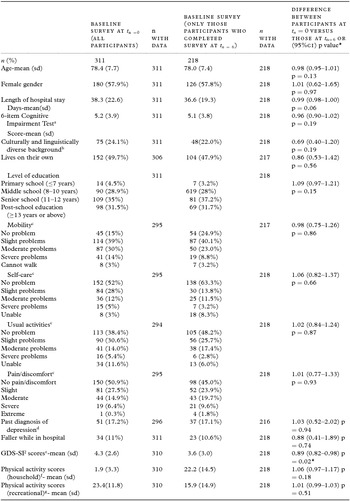
Differences in the baseline data were compared between all participants who completed the survey at tn =0 and those who completed the survey at tn =6 to determine if a particular characteristic measured at baseline predicted completion of the six month follow-up assessment. Logistic regression was conducted using the dichotomous variable of whether the participant completed the survey at tn =6 as the dependent variable and baseline characteristics as independent variable (Table 1).
Baseline characteristics of study cohort at tn =0 and their differences with participants who completed survey at tn =6

* Statistical significance at p < 0.05 from logistic regression with odds ratio OR and 95%CI.
a 0–28, higher scores are more impaired.
b Criteria (any2/3): (i) speaks a main language other than English at home, (ii) born overseas, (iii) identify themselves with a specific culturally group other than Australian or as an indigenous Australian or Maori.
c Collected as part of EuroQol EQ-5D-5L questionnaire.
d Depression diagnosed by general practitioner at baseline.
e Geriatric Depression Scale-Short Form score 0–15, scores>5 is suggestive of clinical depression.
f PhoneFitt household subscale measures household activities participants did over the last week.
g PhoneFitt recreational subscale measures recreational activities participants did over the last week and seasonal activities over the last month.
The low household physical activity score at baseline reflected low activity because the participants were in the hospital when this data were collected.
The higher recreational physical activity score at baseline reflected higher activity because the participants were unlikely to be in hospital over the last month for seasonal activities when this data were collected.
The structure of the analyses undertaken was aimed at investigating three overall questions asked in a pairwise manner of the constructs of depression, falls, and physical activity. To illustrate these three questions would and their corresponding analyses, we selected the pairing of depression and falls. We first wanted to know if falls and depression were associated with each other. We, therefore, examined whether being a faller over the previous month (measured at t n) was associated with depression symptom scores measured at the same time point (t n). Depression symptom scores were used rather than a cut-off score for depression to capture the variation in depressive symptoms at each month. Next, we wanted to know whether having falls preceded a worsening of depression symptoms, thus indicating a temporal (potentially causative) relationship. We, therefore, examined whether being a faller over the previous month (measured at t n) preceded a worsening of depression symptoms over the subsequent month (tn −tn +1). Finally, we wanted to know whether having symptoms of depression preceded subsequent falls, thus indicating a temporal (potentially causative) relationship. To address this, we examined whether depression scores (measured at t n) preceded falls over the subsequent month (measured at tn +1). Logistic regression analyses with data clustered by individual participant utilizing robust standard errors (Freedman, Reference Freedman2006) were employed to examine the first and third questions (with fall as a dependent categorical variable), while linear regression analysis with data clustered by individual participant utilizing robust standard errors was employed to examine the second question (with change in depression score as a dependent continuous variable). These analyses were conducted using outcome data collected across tn =1-6, excluding baseline data to examine the patterns of association post-discharge from hospital.
Analyses examining the relationships between the paired constructs of falls and physical activity were conducted using the same approach. Physical activity was divided into two domains, household and recreational, and analyses were conducted separately for each. This is consistent with the published factor structure of the Phone FITT questionnaire (Gill et al., Reference Gill, Jones, Zou and Speechley2008). The same pattern of analysis was employed to explore the relationships between the paired constructs of depression and physical activity. The association between depression and physical activity was examined using scores for each construct collected at the same time point (tn ). Examinations of potential temporal relationships were undertaken using depression scores collected at one time point (tn ) and change scores between that time point and the subsequent one (tn −tn +1) for physical activity, and vice versa. Again, physical activity scores were divided into separate analyses for household and recreational domain scores, and linear regression analyses with data clustered by individual participant utilizing robust standard errors were employed.
The alpha criterion for statistical testing was set at p < 0.05. Data analyses were undertaken using STATA version 13 (Stata Corp, 2013). Analyses were repeated adjusting for the baseline covariate of pre-existing diagnosis of depression and self-reported physical capacity from tn =1-6 to examine whether these confounded the associations observed.
Transformation for depression scores (GDS-SF), physical activity household, and recreational scores were examined to normalize the data. The regression analyses were re-run with the transformed version of the data. The results obtained were then compared with the original analyses to determine if they have changed the results in any way.
Results
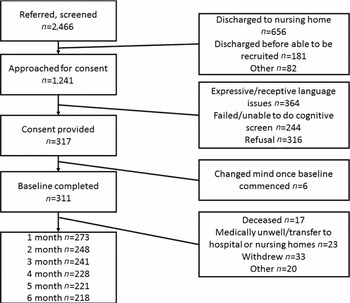
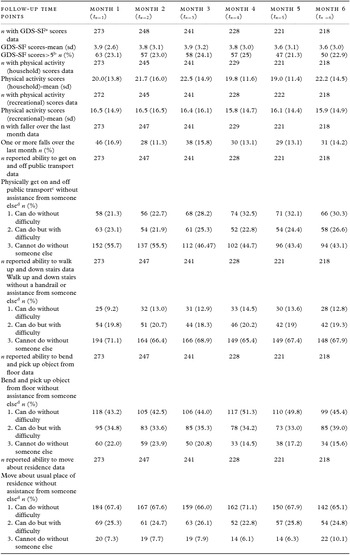
The flow of participants through the study is shown in Figure 1. In Table 1, participants who had a higher mean depression score at baseline were more likely to drop out before the six month follow-up. There were no significant differences in other baseline characteristics between those who did and did not complete the six-month follow-up survey (Table 1). The mean (sd) GDS-SF scores, physical activity scores, proportion of participants who had one or more falls each month and self-reported physical capacity over the follow-up period are presented (Table 2). The mean GDS-SF scores, physical activity household, and recreational scores were positively skewed.
Participant flow through the study.

Geriatric depression scale scores, physical activity scores and fallers over the six month follow-up

a Geriatric Depression Scale-Short Form.
b Geriatric Depression Scale-Short Form scores>5 is suggestive of clinical depression.
c Buses, trams or trains.
d Self-reported physical capacity.
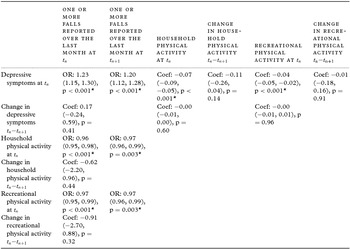
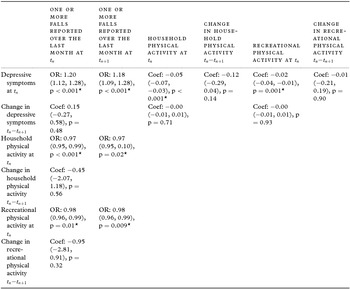
In Table 3, participants experiencing one or more falls during a particular month was associated with having higher scores for depressive symptoms (indicating more depression) at that same assessment point (unadjusted odds ratio OR: 1.23 (1.15, 1.30)). Having higher scores for depressive symptoms at one assessment point was also associated with being more likely to report one or more falls at the subsequent assessment point (unadjusted OR: 1.20 (1.12,1.28)). However, having one or more falls at an assessment point was not associated with change in depression symptom scores between that assessment point and the subsequent one (Table 3). These findings indicate that falls and depression are related, and that having higher levels of depression symptoms precede (and may contribute to) subsequent falls.
Associations between depressive symptoms, falls and physical activity in older adults following discharge from hospital (unadjusted)

*Statistical significance at p < 0.05.
OR: Odds ratio from logistic regression with robust 95% CI and p value (unadjusted).
Coef: Coefficient from linear regression with robust 95% CI and p value (unadjusted).
tn is an assessment time point at any month within the follow-up period, tn +1 is an assessment time point at the subsequent month of tn .
Change scores at tn −tn +1 is the difference between the scores of the variable at any assessment time point and the scores of that variable at the subsequent month.
Analyses involving variables at tn examine association and analyses involving variables at tn with variables at tn +1 or change scores at tn −tn +1 examine temporal relationships.
Reporting higher levels of depressive symptoms was significantly associated with lower levels of household (unadjusted coef: −0.07 (−0.09, −0.05), p < 0.001) and recreational physical activity levels (unadjusted coef: −0.04 (−0.05, −0.02), p < 0.001). However, no temporal relationships, indicating that depressive symptoms preceded changes in physical activity levels or that physical activity levels preceded changes in depressive symptoms, were identified (Table 3).
Being less physically active in terms of household (unadjusted OR: 0.96 (0.95, 0.98)) and recreational activities (unadjusted OR: 0.97 (0.95, 0.99)) was significantly associated with experiencing one or more falls during the previous month, and experiencing one or more falls in the month after the assessment of physical activity indicating that low levels of household (unadjusted OR: 0.97 (0.96, 0.99)) and recreational (unadjusted OR: 0.97 (0.96, 0.99)) physical activity preceded (and may contribute to) subsequent falls. There was no association between reporting falling over one or more times over the previous month and subsequent changes in household or recreational physical activity levels (Table 3).
Repetition of analyses with adjustment for pre-existing diagnosis of depression and self-reported physical capacity over the follow-up period did not change the significance of any association examined (Table 4).
Associations between depressive symptoms, falls and physical activity in older adults following discharge from hospital adjusted for pre-existing diagnosis of depression and self-reported physical capacity

*Statistical significance at p < 0.05.
OR: Odds ratio from logistic regression with robust 95% CI and p value (adjusted).
Coef: Coefficient from linear regression with robust 95% CI and p value (adjusted).
tn is an assessment time point at any month within the follow-up period, tn +1 is an assessment time point at the subsequent month of tn .
Change scores at tn −tn +1 is the difference between the scores of the variable at any assessment time point and the scores of that variable at the subsequent month.
Analyses involving variables at tn examine association and analyses involving variables at tn with variables at tn +1 or change scores at tn −tn +1 examine temporal relationships.
The square root transformation was the best transformation determined to normalize the data for GDS-SF, physical activity household, and recreational scores. The change scores (tn −tn +1) of these outcome data were not transformed because they were normally distributed. Re-run of the analyses improved the normal distribution of the residuals of the regression analyses, however, it did not change the results in a substantive way when compared to the results obtained in Table 3 (analyses not shown).
Discussion
To our knowledge, this is the first study that has examined temporal inter-relationships between falls, physical activity, and depressive symptoms in older adults during the transition from hospital to community-living. All three of these outcomes were found to be associated with each other in non-temporal analyses. When exposed to analysis of temporal relationships, we found that higher levels of depressive symptoms and lower levels of household and recreational physical activity preceded falling over one or more times over the subsequent month. The mechanism of depression potentially causing falls is still unclear but there is evidence showing that postural abnormalities in standing position predispose depressed older adult to falls (Turcu et al., Reference Turcu, Toubin, Mourey, D'Athis, Manckoundia and Pfitzenmeyer2004).
Given our findings, clinical implications of this research are somewhat unclear because of previous research in this field. Our finding that higher depressive symptoms and lower physical activity levels precede falls would indicate that prevention of falls may be achievable with strategies to reduce depressive symptoms and increase physical activity levels. However, one recent trial has reported that a physical activity program delivered to older adults following hospitalization actually increased the rate of falls (Sherrington et al., Reference Sherrington2014), while the use of antidepressants to address depressive symptoms has been found to be associated with increased risk of falls in a recent review (Park et al., Reference Park, Satoh, Miki, Urushihara and Sawada2015). It is possible that there is not one simple management approach that can be used to address these three concurrent problems. Had we demonstrated that falls preceded the development of depressive symptoms and precipitated the lowering of physical activity levels, and then we would have had impetus to address falls as a front-line problem anticipating likely “flow-on” benefits to the mood and physical activity levels of older adults.
Our findings are consistent with previous research that has reported that depressed mood in older adults is often associated with greater levels of physical impairment and lower physical performance, which have also been found to increase risk of falls (Turcu et al., Reference Turcu, Toubin, Mourey, D'Athis, Manckoundia and Pfitzenmeyer2004; Kerse et al., Reference Kerse2008). Other authors have postulated that participation in physical activities may provide a sense of fulfillment, efficacy, and enjoyment thus contributing to a lower risk of depressive symptoms (Teychenne et al., Reference Teychenne, Ball and Salmon2008). However, we did not find that our participants’ depressive symptoms reduced after reporting higher levels of physical activity. It is possible that such an effect may exist, but the magnitude may be too small to be detected in this research. Other authors have reported that involvement in physical activity in later life lowered the risk of future depressive symptoms in community-dwelling adults (Ku et al., Reference Ku, Fox, Chen and Chou2012). It could be that a follow-up period of six months is simply not long enough for this relationship to be established when compared to the decade long follow-up that some of this research work has taken.
Another interesting finding was that depressive symptoms do not appear to inhibit physical activity post-discharge. This is contradictory to the finding that depression in community-dwelling older adults predicted activity restriction (Painter et al., Reference Painter, Allison, Dhingra, Daughtery, Cogdill and Trujillo2012). It is possible that other factors may be more important in determining changes in physical activity following discharge, for example, changes in physical health or the enablement to participate in activity programs through social supports.
There are limitations to this study that need to be considered. It is possible that falls did cause a reduction in physical activity levels and an increase in depressive symptoms, but that these had already taken place prior to the monthly assessment undertaken in this study. This scenario is plausible as depressive symptoms in some older adults have been demonstrated to fluctuate over short periods of time (Ku et al., Reference Ku, Fox and Chen2009). This situation has been manifested as significant associations in our non-temporal analyses, although we could not come to the above stated conclusion as a lowering of physical activity or increase in depression symptoms prior to the fall would also have manifested in the same manner. This conundrum illustrates the difficulties inherent in trying to establish temporal relationships in this area. We cannot be certain if our results have been biased by the systematic drop-outs of participants, who had a higher mean depression score at baseline. It is likely that we have underestimated the proportion of participants who have clinically significant depressive symptoms each month. As this paper is focused on associations between the pairs of variables, we do not know what impact this might have beyond reducing some of our statistical power. Participants with a pre-existing history of medically diagnosed depression at baseline and self-reported physical capacity over the follow-up period may have confounded our examination of these relationships. However, controlling for these variables did not change the results attained. We had also examined time invariant confounding factors, for example, age, gender, length of hospital stay, culturally and linguistics diverse background and hospital falls (analyses not shown). However, these had very little effect on the relationships between the pairwise time changing variables that we were interested in.
Research is required to understand the best approaches to dealing with these interconnected problems in older adults who have recently had an extended period of hospitalization. Physical activity programs in this population have been shown to improve activity levels and function, but may increase falls and have an unknown effect on mood. Anti-depressant use may improve mood but may plausibly increase falls. Non-pharmacological approaches such as cognitive behavioral therapy to manage symptoms of depression in this population may offer an effective approach to management and carry lesser risk of increasing falls. Well-constructed trials though are needed to guide service provision to this complex population.
Conflict of interest
None.
Description of authors’ roles
D.C.A. Lee collected and analyzed the data and wrote the manuscript. T.P. Haines designed the study, supervised data analyses and data collection, and appraised the manuscript. A.F. Lalor coordinated the research conduct, collected data, and appraised the manuscript. G. Russell, R. Stolwyk, T. Brown, and F. McDermott contributed to study conception and critical appraisal of the manuscript for important intellectual content.
Acknowledgments
This work was supported by Beyond Blue: The National Depression Initiative, Victoria, Australia (project ID 12182B). We would like to acknowledge all research assistants who have assisted with data collection.