1. Motivation
For more than 20 years, the OWN survey has collected high resolution optical spectroscopic observations of O and WN stars available from the Southern Hemisphere, for which there was no published indication of multiplicity at the beginning of the project. The OWN goal is determining the binary/multiple status of these stars. More details can be found, for example, in Gamen et al. (Reference Gamen, Barbá, Morrell, Arias and Maíz Apellániz2008), Barbá et al. (2017).
2. Identifying Radial Velocity (RV) Variables
The main outcomes of the OWN Survey are as follows:
-
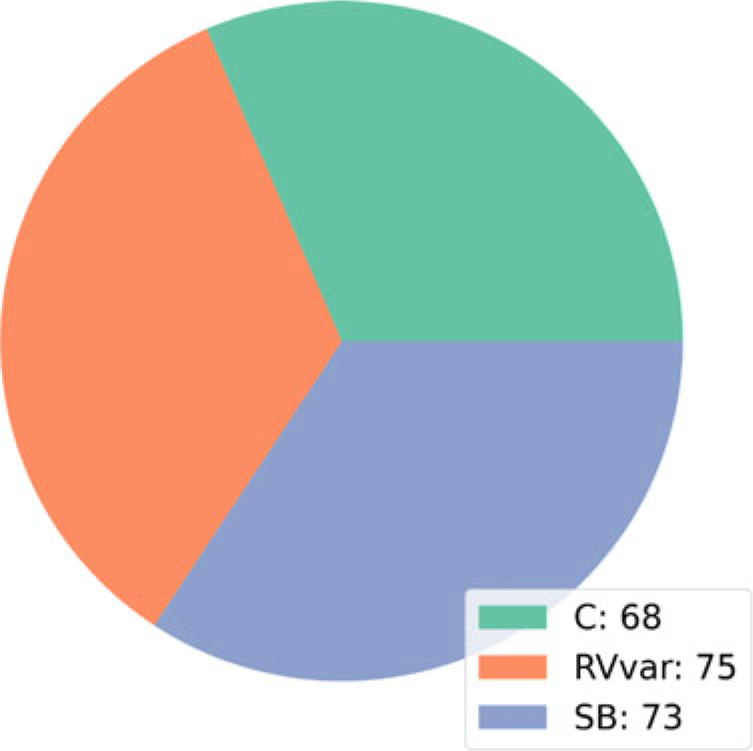
• 73 stars were spectroscopic binaries.
-
• 75 stars showed RV variations between 15 km s
 $^{-1}$
and 19 km s
$^{-1}$
and were considered probable RV variables.
-
• 68 objects showed RV variations
$\lt$
15 km s
$^{-1}$
, and were considered “constant”.


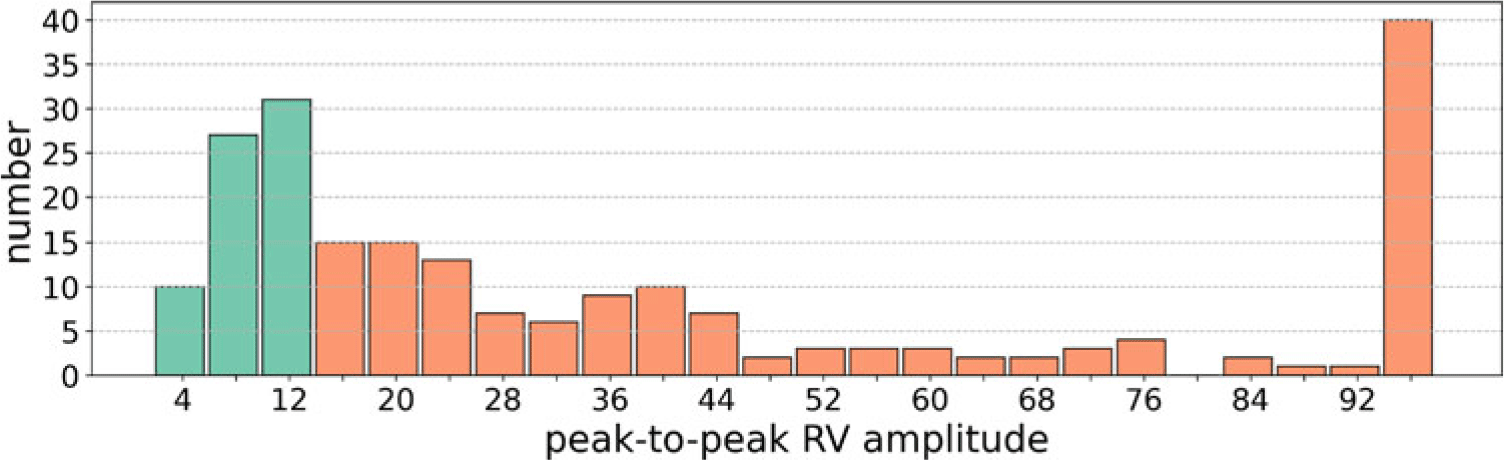
19 km s
 $^{-1}$
is the limit we conservatively adopted to consider a star as variable.
Figures 1 and 2 summarize our results.
Pie chart showing the incidence of spectroscopic binaries, RV variables, and apparently constant RV stars in the OWN sample.

Distribution of the observed RV amplitudes in the stars monitored by the OWN Survey.

3. Mapping the Orbital Periods
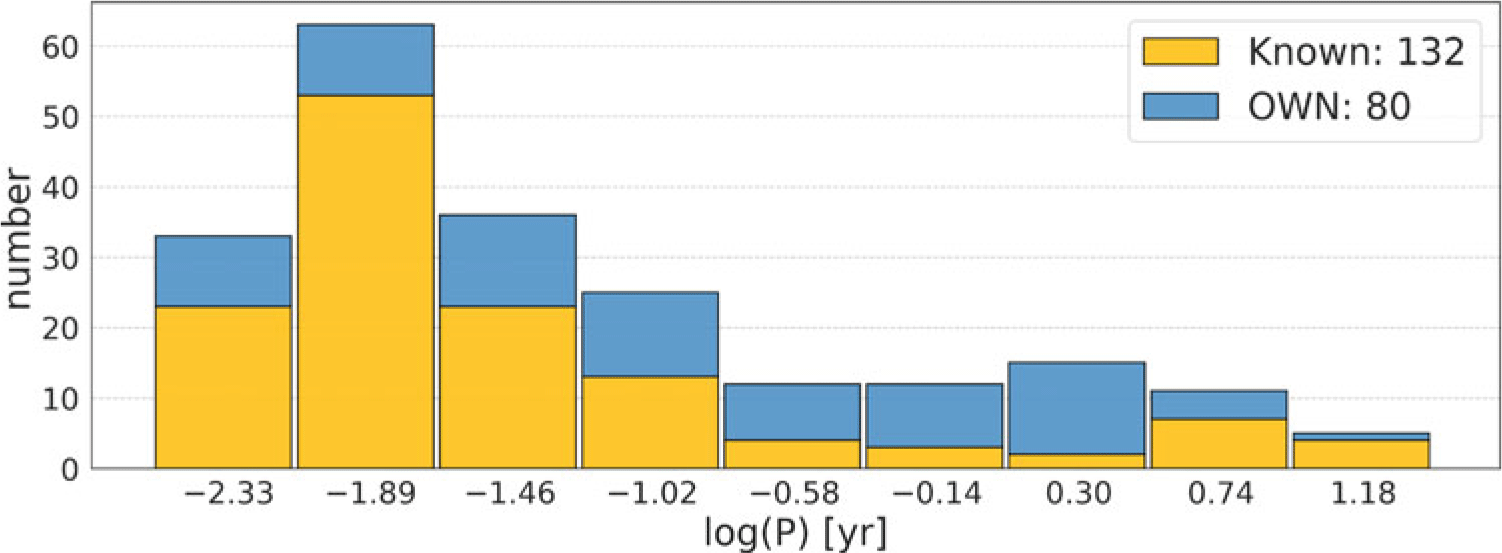
The OWN has proven particularly effective in discovering relatively long-period binary systems, increasing by a factor of three the number of known spectroscopic binaries with periods longer than 30 days for which a reliable orbital solution is available. See Figure 3.
Period distribution of the spectroscopic binaries found by the OWN Survey compared to those previously known.

4. The Orbital Landscape of Massive Binaries
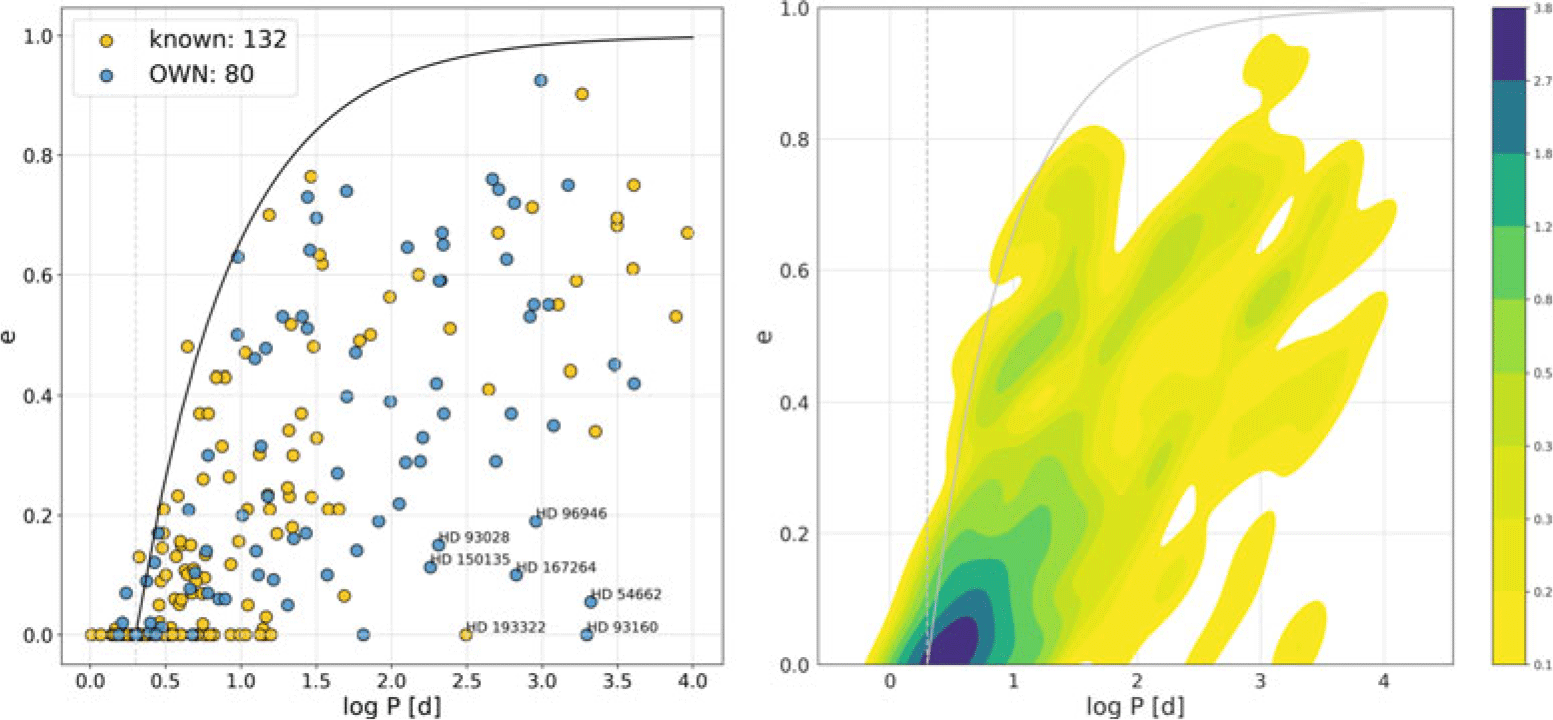
Within the binary sample, compiled from the available literature, systems with long periods and low eccentricity are scarce. According to our knowledge, prior to the OWN survey, only one such case was known. While our observations have increased this number to seven, the trend continues to be observed. Is this an intrinsic property or an observational bias? Our results, combined with those available prior to this project, are presented in Figure 4.
Two ways of visualizing the relation between period and eccentricity in the OWN sample, compared to the previously known spectroscopic binaries: a plot of e vs log(P) for all the known systems (left) and a heat map showing the apparent concentration of short period binaries with low eccentricities (right).

5. WR21a: A Landmark System
WR 21a is one of the most massive stars in our Galaxy. Combining OWN spectroscopic data with TESS observations, we derived absolute masses of 93.2 and 52.9
 $M_{\odot}$
for the O2.5/WN6 and O3 components, respectively (see Barbá et al. (2022)).