Introduction
One of the significant regions of Indian archaeology is the Gangetic valley, home to numerous cities that developed during the first half of the first millennium BCE (Harding Reference Harding2003). The Gangetic valley is an important region for studying plant-based subsistence because it is where agriculture began in India and where the first Indian state was established. These cities also witnessed the evolution of political systems to the state level, trade networks embracing all of North India, and features of Indian society and religion that continue to this day (Harding Reference Harding2003).
Numerous Early Historic sites in the Gangetic valley have been excavated and investigated as per the objectives of the excavators and hypothesis of the then project over the past few decades, providing important insights into settlement patterns, economic contexts, and material culture (Singh Reference Singh2008; IAR 1993, 1996). However, archaeobotanical and palaeoenvironmental datasets remain unevenly available across sites, limiting broader regional reconstruction of agricultural practices and human-environment interactions during the Early Historic period.
The modern town of Rajgir (25°0′N; 85°26′E), situated in the Nalanda district of the eastern Indian state of Bihar, is about 65 km from the state capital Patna. It is one of the most historically significant Early historic cities of ancient India. Surrounded by a massive cyclopean stone wall running across five hills, Vaibhargiri, Vipulagiri, Ratnagiri, Udaygiri, and Song Hill, it served as the early capital of the powerful Magadha kingdom (Jha 2012; Kuraishi 1956; Law 1938; Susmita and Kumar Reference Kumar2024). Rajgir is also known variously as Rajagṛiha or Rajagṛha, Girivraja, Kusagarapura, Vasumati (Jha 2012; Kuraishi 1956; Law 1999; Susmita and Kumar Reference Kumar2024 ). This city was built by King Bimbisara. It is known for long cultural history and preserves a long archaeological sequence widely identified in the ancient city of Rajgriha/Rajagṛha. By the middle of the 4th century BCE, Rajagṛha had emerged as the political and cultural nucleus of Magadha, as attested by various textual traditions (Harding Reference Harding2003). It was also during this period mainly Buddhism and Jainism flourished (Balcerowicz Reference Balcerowicz2015; Harding Reference Harding2003; Singh Reference Singh2021). Therefore, the development of Buddhism and Hinduism in this area was supported by King Bimbisara (Harding Reference Harding2003; Susmita and Kumar Reference Kumar2024). Ajatshatru (491–459 BCE), the son of King Bimbisara, made his fort in Rajagriha (Barba Reference Barba2004). The rise of Rajgir (Rajgriha) also coincides with the Northern Black Polished Ware (NBPW) phase and the emergence of the Mauryan Empire in the late 4th century BCE. Founded by Chandragupta Maurya, the Mauryan Empire became the first political entity to unify much of the Indian subcontinent (Singh Reference Singh2008). Chandragupta’s son Bindusara extended the empire’s frontiers further south into the Deccan, while Asoka the Great (reigning ca. 265–238 BCE, or as some sources state, 273–232 BCE) consolidated and expanded its influence through the conquest of Kalinga (Thapar Reference Thapar1997).
The city was an important centre in Gautama Buddha’s life and is frequently mentioned in Buddhist texts as one of the major sites associated with his Charika (journeys) (Susmita and Kumar Reference Kumar2024). Chinese pilgrims such as Fa-Hian and Xuanzang referred to this city as Kusagarapura, acknowledging its sacred status in Buddhist tradition (Kuraishi 1956; Susmita and Kumar Reference Kumar2024). Rajagrha holds a revered place not only in Theravada Buddhism, as the birthplace of the Pali canonical literature, but also in Mahayana Buddhism, which holds that the Buddha delivered several Mahayana sutras from Griddhakuṭa (Vulture’s Peak) (Harding Reference Harding2003; Jain Reference Jain2016; Susmita and Kumar Reference Kumar2024). However, the devastating aftermath of the Kalinga War prompted Ashoka’s transformation from a conqueror to a proponent of Dhamma (righteousness) and Buddhist ideals (Mahadevan Reference Mahadevan2002; Thapar 1997). His reign marked a new chapter in Indian history, characterized by the state patronage of Buddhism and the dissemination of its ethical and philosophical principles across the subcontinent and beyond. Thus, the historical and archaeological legacy of Rajgir, situated at the heart of ancient Magadha, intertwines with the rise of the Mauryan Empire and the spiritual efflorescence of Buddhism, reflecting a period that laid the foundations for one of the most transformative epochs in India’s cultural history.
Rajgir occupies a distinctive geomorphological position: a valley bound by low ridges/hills with several perennial springs (Harding Reference Harding2003). This micro-topography and access to springs have long been argued to have influenced settlement density, ritual landscapes and agricultural potential in the local landscape. The maximum temperature in this area during summer is 44 ºC, and in winter it drops below 6 ºC. Annual rainfall in the area is about 1860 mm (Mahadevan Reference Mahadevan2002). The western disturbances that originate in the Mediterranean cross Bihar from December to February, bringing rain and cold winds, which are favourable for winter (rabi) crops. Rajgir, situated in the eastern part of northern India, is considered one of the most important ancient cities.
Discussion
Archaeological investigations in Rajgir, district Nalanda, initiated in the mid-20th century and continuing intermittently thereafter, have revealed stupas, fortification walls, habitational deposits, and a rich assemblage of artefacts (IAR 1993, 1996). These findings collectively attest to continuous occupation from the pre-Iron Age to the NBPW, Mauryan, and late historic phases, underscoring the city’s sustained significance in the cultural landscape of early India. The ceramic assemblage from the region offers insights into patterns of cultural continuity and technological developments between the Mauryan and Kushan periods. Surrounding archaeological sites such as Ghorakatora and Jaufardih have brought to light a diverse range of ceramic traditions, including northern black polished ware (NBPW), black and red ware, grey ware and red ware during Early historic times (800–200 BCE; IAR 2015; IAR 2016). This shows a high degree of craftsmanship and an elite pattern of consumption. The presence of black and red wares at multiple sites indicates their widespread use as utilitarian ceramics, while their continued occurrence into later phases points to cultural continuity into the Kushana period (Tewari and Saxena Reference Tewari and Saxena2013). Excavations at Juafardih have reported copper and silver coins, indicating that a monetised economy was in operation in the region, suggesting that Nalanda was connected to wider economic networks in the Early Historic period. The published reports provide a well-established ceramic, architectural and chronological framework for the region (IAR 1993, 1996; Singh Reference Singh2008). However, multidisciplinary datasets relating to palaeo-agriculture, palaeo-diet, palaeo-ecology, and human-environment interactions remain obscure for many Early Historic sites.
The Mauryan Empire was geographically extensive in South Asia, with its power base in Magadha. Archaeologically, the period of Mauryan rule in South Asia falls within the Northern Black Polished Ware (NBPW) phase (Kulkarni et al. Reference Kulkarni, Ingle, Kanungo and Roy2020; Kanungo et al. Reference Kanungo, Roy, Ingle, Kulkarni, Upadhyay and Vikrama2024). During the Mauryan period, the integration of the region into a large imperial framework likely contributed to administrative organisation, infrastructural development, and increased interaction with other parts of the subcontinent. In the subsequent Kushana period, there is evidence of continued activity, including the expansion of trade networks and the circulation of coins. These developments are reflected in the archaeological record through the presence of fine ceramics such as northern black polished ware, the remains of brick-built structures and religious monuments. Sculptural remains depicting Buddhist and Brahmanical deities demonstrate the coexistence of multiple religious traditions in the region and suggest that Rajgir remained an important religious and artistic centre throughout the Mauryan and Kushana periods (Harding Reference Harding2003; Tewari and Saxena Reference Tewari and Saxena2013; Nayan and Ranjan Reference Nayan and Ranjan2014).
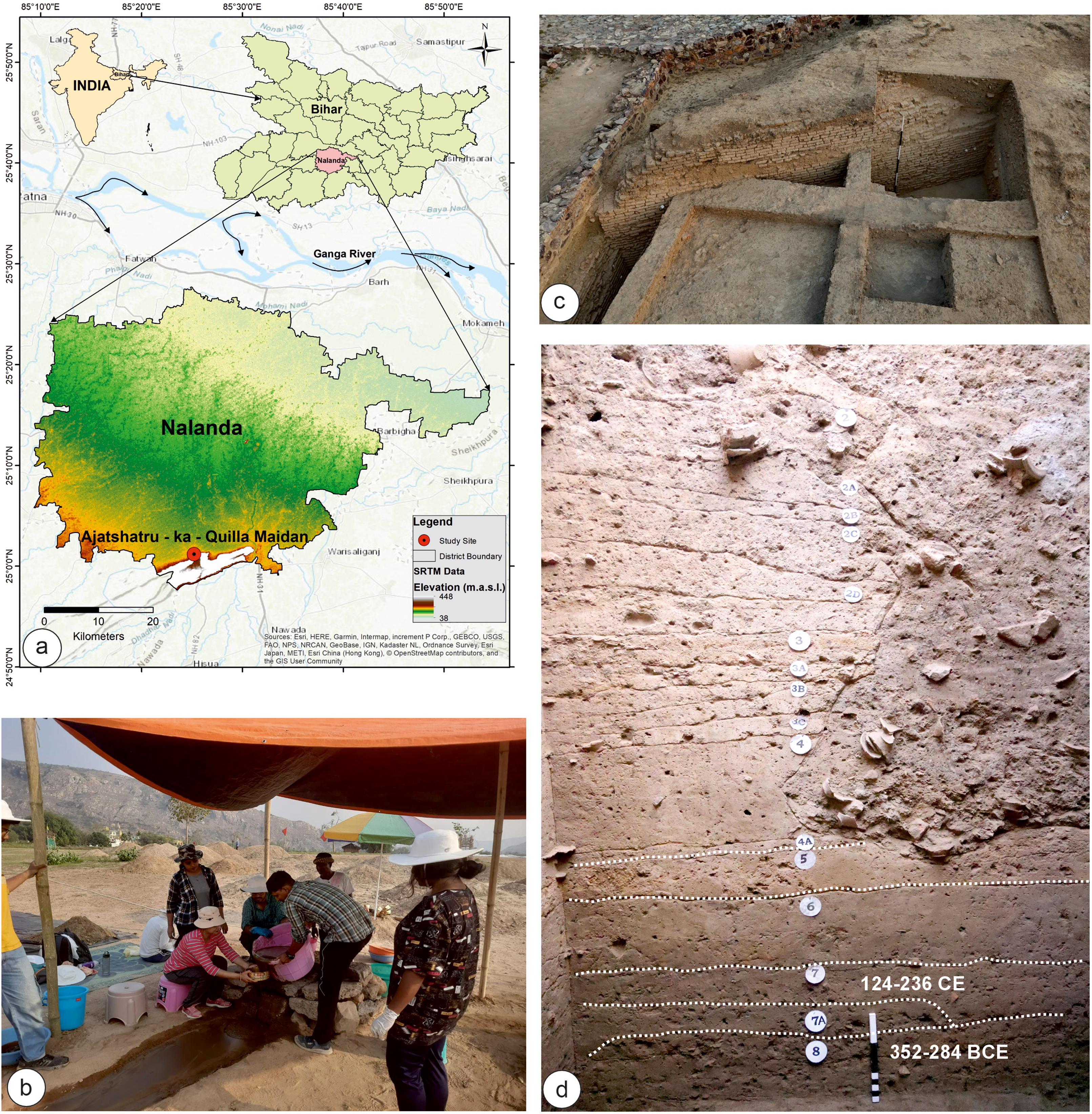
Excavation at Ajatshatru-ka-Quilla Maidan (lat. 25º02′N; long. 85º42′ E), also referred to as New Rajgriha, in Rajgir, Nalanda, Bihar was carried out by Archaeological Survey of India, excavation branch III, Patna during 2023–2024, and revealed a cultural sequence extending from the Mauryan phase through the Sunga-Kushana period (Figure 1a–d). It is believed that the Ajatshatru-ka-Quilla Maidan was developed during the reign of King Bimbisara or, more prominently, by Ajatshatru (6th–5th century BCE). It represents an important phase in the urban and military planning of ancient Magadha, reflecting fortified settlement patterns and political consolidation. The site represents a fortified urban centre that witnessed successive occupational phases marked by changes in pottery traditions and structural activity.
a. Map showing location of archaeological site Ajatshatru-ka- Quilla Maidan. b. On-site floatation for recovery of botanical remains. c. Aerial view of trench layout. d. Excavated trench YB3 showing cultural layers (white dots) and AMS dates.

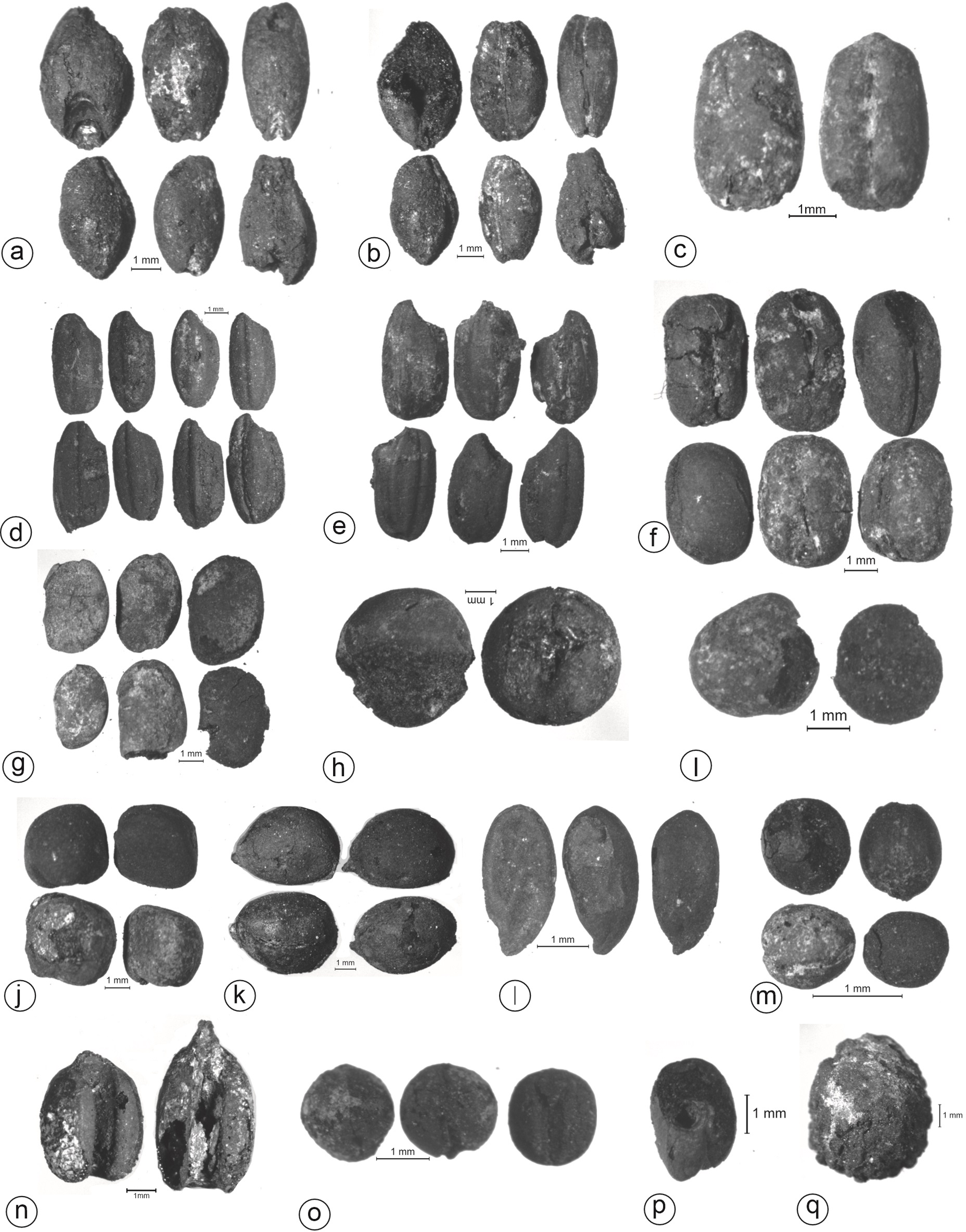
Thus, Ajatshatru-ka-Quilla Maidan offers an opportunity to explore the interconnections between subsistence, climate and society. Therefore, a systematic archaeobotanical sampling was undertaken at Ajatshatru-ka-Quilla Maidan to reconstruct the agricultural economy and environmental background during cultural phases. In all, 18 samples were collected from 900 L of soil sediment that was floated during excavation for the recovery of carbonized plant remains using the water flotation/wet-sieving technique. This method, based on the density difference between organic and inorganic materials, allows the effective separation of macroremains such as seeds, grains, and chaff fragments from the soil matrix, thereby enhancing the range and quality of botanical material retrieved from archaeological contexts. Floated samples were sorted, and 6321 grains/seeds belonging to 17 taxa were recovered and identified up to genus/species level based on morphological characters and photo-documented under Leica Z6APO stereo binocular microscope (Figure 2).
Cultivated and wild taxa recorded from Ajatshatru-ka-Quilla Maidan: a–b. Hordeum vulgare (barley), c. Triticum aestivum (wheat) d–e. Oryza sativa (rice) f. Macrotyloma uniflorum (horse gram), g. Vigna radiata (green gram) h. Lens culinaris (lentil), i. Pisum arvense (field pea), j. Lathyrus sativus (grass pea), k. Gossypium arboreum/herbaceum (cotton), l. Linum usitatissimum (linseed), m. Scleria sp., n. Coix lachryma-jobi (Job’s tear), o. Vicia sp., (common vetch), p. Tradescantia sp. q. Ziziphus nummularia (jujube).

For direct AMS radiocarbon dating, carbonized grains from stratified cultural deposits of the Mauryan and Kushana periods, based on ceramic assemblages and structural remains, were segregated, as the grains provide precise timing of their adoption/cultivation. The grains (Oryza sativa/Vigna radiata) were dated by accelerator mass spectrometry (AMS) radiocarbon dating at Isotoptech Zrt., Debrecen, Hungary (lab code DeA). Calibration was conducted using the probability method in OxCal v 4.4.4 (Bronk Ramsey et al. Reference Bronk Ramsey, Adolphi, Austin, Bard, Bayliss, Blaauw, Cheng, Edwards, Friedrich, Heaton, Hogg, Hua, Hughen, Kromer, Manning, Muscheler, Palmer, Pearson, Reimer, Reimer, Richards, Scott, Southon, Turney and Wacker2023) with the IntCal20 data set to assess calendar ages (Reimer et al. Reference Reimer, Austin, Bard, Bayliss, Blackwell, Ramsey, Butzin, Cheng, Edwards, Friedrich and Grootes2020). The 2σ range presented corresponds to 95.4% confidence limits. The obtained dates support the cultural phases at the site in trench YB3/II (Table 1).
14C AMS radiocarbon dates of carbonized grains from Ajatshatru-ka-Quilla Maidan archaeological site, Rajgir, Nalanda, Bihar.

Table 1. Long description
A table with two rows and six columns detailing radiocarbon dates of carbonized grains from the Ajatshatru-ka-Quilla Maidan archaeological site. The columns are labeled Trench/quadrant/strata/depth, Lab ref no., Material, 14C date (BP), Calibrated age (95.4% probability), and Culture. Row 1: Trench/quadrant/strata/depth, YB3/II/7/110–390 cm; Lab ref no., DeA-51417; Material, Oryza sativa; 14C date (BP), 1862 ±25; Calibrated age (95.4% probability), 124–236 CE; Culture, Kushana. Row 2: Trench/quadrant/strata/depth, YB3/II/8/488–500 cm; Lab ref no., DeA-51416; Material, Oryza sativa; 14C date (BP), 2153 ±26; Calibrated age (95.4% probability), 352 BCE–284 BCE; Culture, Mauryan.
A number of ancient habitational settlements, extending from the Neolithic period onwards, have been explored in the alluvial plains of Ganga valley. In Bihar only Neolithic Chirand (2200–1800 BCE) in the alluvial plain of Ganges (Narain Reference Narain1970; Verma Reference Verma1970–1971), Senuwar (2500–1800 BCE) in the Kaimur ranges, Manjhi on the bank of Ghaghra River (Roy Reference Roy1987) have been excavated and studied for a plant-based subsistence economy (Saraswat Reference Saraswat and Singh2004; Srivastava Reference Srivastava2001; Vishnu-Mittre 1972).
Farming, herding and foraging provided the subsistence base for early farming communities. Rice is the local crop of this region and is assumed to have been domesticated indigenously. The Ganga valley also received large number of crops of indigenous (Vigna radiata, Vigna mungo, Macrotyloma uniflorum, Brassica juncea, Sesamum indicum, Gossypium sp. etc.), West Asian (Hordeum vulgare, Triticum aestivum, Lens culinaris, Pisum arvense, Cicer arietinum, Lathyrus sativus, Linum usitatissimum, Carthamus tinctorius etc.) and African origin (Sorghum bicolor, Eleusine coracana, Pennisetum glaucum) cultivated by the Harappan (Indus) in northwestern part of India either due to direct or indirect contact (Pokharia et al. Reference Pokharia Anil, Sharma, Tripathi, Mishra, Pal, Vinay and Srivastava2017; Saraswat Reference Saraswat2005). The direct AMS radiocarbon dating of barley grains from Lahuradewa, Senuwar and Damdama affirms that these grains were under cultivation since 3rd millennium BCE (Pokharia et al. Reference Pokharia Anil, Sharma, Tripathi, Mishra, Pal, Vinay and Srivastava2017; Saraswat Reference Saraswat2005). The Neolithic culture in this region can be assigned to a general time-bracket of 2700–1800 BCE, characterized by the use of stone and bone implements. Food grains from the Neolithic Chirand included hulled barley (Hordeum vulgare), dwarf wheat (Triticum sphaerococcum), rice (Oryza sativa), lentil (Lens culinaris), field-pea (Pisum sativum) and grass-pea (Lathyrus sativus) (Vishnu-Mittre 1972). Food grains from Senuwar include cultivated forms of rice (Oryza sativa), barley (Hordeum vulgare), dwarf wheat (Triticum sphaerococcum), jowar millet (Sorghum bicolor), finger-millet (Eleusine coracana), lentil (Lens culinaris), field-pea (Pisum sativum) and grass-pea (Lathyrus sativus). In addition to these crop remains, farmers in the following Neolithic-Chalcolithic Period (l800–1500 BCE) also opted for the cultivation of bread-wheat (Triticum aestivum), chick-pea (Cicer arietinum), green-gram (Vigna radiata) and horse-gram (Macrotyloma uniflorum) (Saraswat Reference Saraswat and Singh2004). The eastward migration of wheat, barley, lentils, field peas, chickpeas, linseed, etc., suggests contact between Neolithic farmers and cultures in north-western India (the Indus region). Efforts should be made to identify elements that serve as indicators of the leading margins of innovation waves. The problem of the diffusion and dispersal routes of these West Asian crops in the Neolithic context of Bihar is at present not easy to understand.
The Chalcolithic (1800–1200 BCE) phase appears to have a Neolithic beginning and to persist into a later period. So far, there is little information on the plant economy. At Senuwar, remains of rice, barley, wheat, jowar-millet, chickpea, green-gram, field-pea, lentil, grass-pea, horse-gram, linseed, sesame and safflower have been found from the Chalcolithic levels characterised by black and red ware industry (Saraswat Reference Saraswat and Singh2004).
Towards the end of the second millennium BCE, the discovery of iron was by far the most important factor that heralded a new era in the cultural advancement of the Indian subcontinent. A new motivation and technology emerged with the use of iron as a principal metal. In Bihar, excavation work at Manjhi, on the bank of the Ghaghra in Saran District, has revealed the occupational phases of the Iron-using Black Slipped Ware and Northern Black Polished Ware cultures (Roy Reference Roy1987). Food grains of rice, barley, bread wheat, green gram, and field pea have been preliminarily examined from the Northern Black Polished Ware culture (ca. 800–200 BCE) at this site, which continued from the preceding cultures (Srivastava Reference Srivastava2001). A similar type of field-crops has been reported during Early historic times at Uren, Lakhisarai, indicating conducive environmental conditions for agriculture in the region (Yadav et al. Reference Yadav, Srivastava, Bhattacharya, Mishra and Pokharia Anil2024).
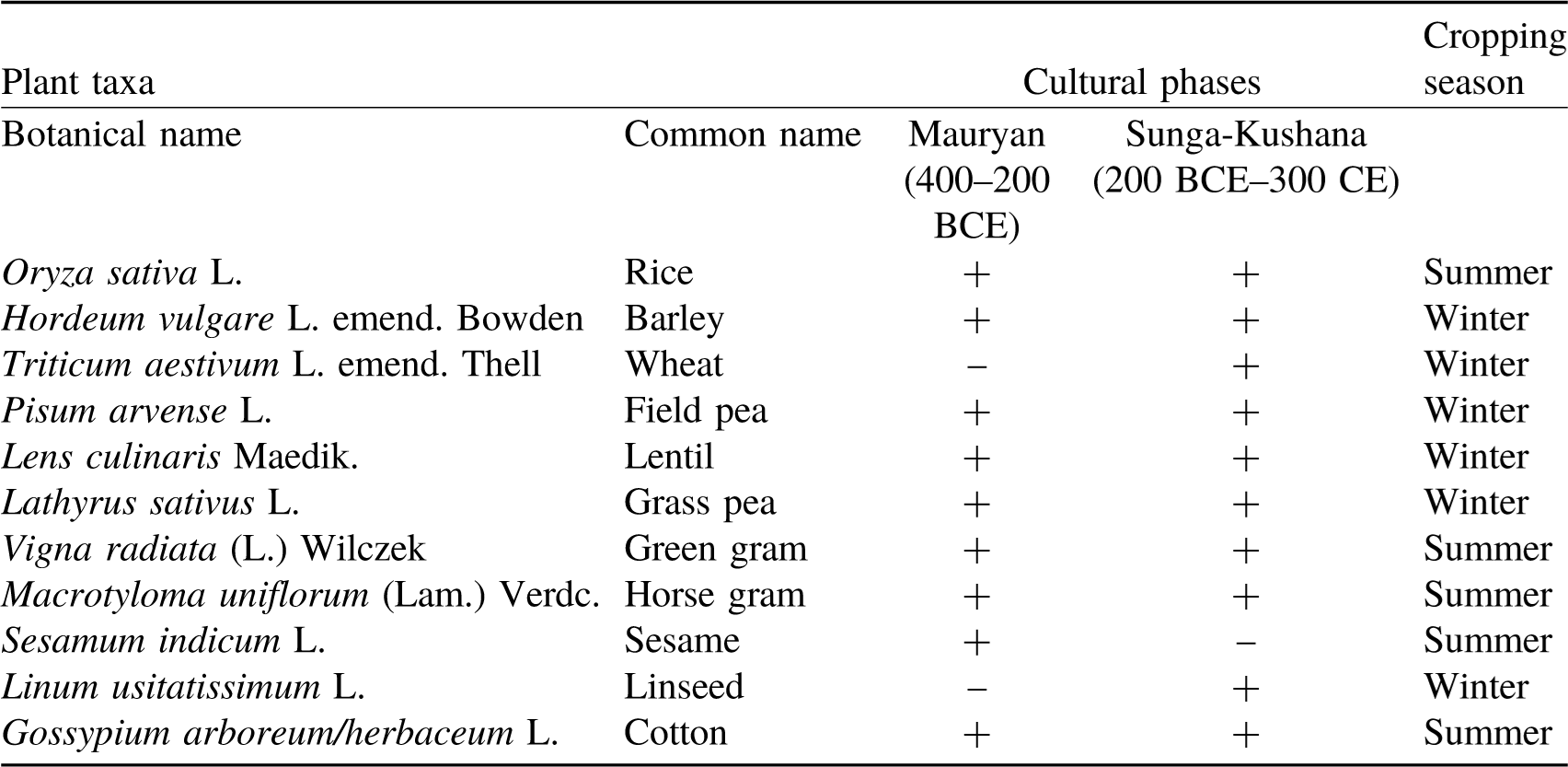
Analyses of macrobotanical remains at Ajatshatru-Ka-Quilla-Maidan have revealed a diverse range of cereals, pulses, oil-seeds and fibre-yielding plants, including summer viz. Oryza sativa (rice), Vigna radiata/mungo (green/black gram), Macrotyloma uniflorum (horse gram), Gossypium sp. (cotton), and winter season crops viz. Hordeum vulgare (barley), Triticum aestivum (wheat), Lens culinaris (lentil), Pisum arvense (field pea), and Linum usitatissimum (linseed), along with a few weeds and wild taxa (Table 2; Figure 2). The evidence provides insights into a range of taxa exploited by early inhabitants of the Mauryan Empire and the Sunga-Kushana culture spanning from about the beginning of the 4th century BCE to the 3rd century CE. The occurrence of both winter (rabi) and summer (kharif) crops during the Mauryan Empire and the Sunga-Kushana period indicates a double-cropping pattern. This pattern refers to the practice of cultivating two different crops consecutively on the same piece of land within a single year, typically aligned with seasonal cycles (e.g., summer and winter). Rabi crops or spring-harvested crops are planted in the winter and watered by winter rains, whereas kharif crops are planted in the summer, during or after the monsoon, and harvested in the fall. It is advantageous to environmental conditions having significant winter precipitation and high summer rainfall, and reflecting agricultural continuity and crop diversity from preceding cultures in the region. The combination of cereals, pulses, oil and fibre crops suggests surplus agricultural production in order to support a growing population, typical of the Early Historic urban cities in India. Furthermore, the presence of pulses suggests that the settlers rotated crops to maintain soil productivity, as Rhizobium bacteria in the root nodules of leguminous plants fix atmospheric nitrogen. Morphometrically, the short and broad grains of rice recovered may be Oryza sativa spp. japonica type (Figure 2e). Rather than being viewed solely as a biological phenomenon, this pattern can be understood within a broader framework of long-distance exchange and interaction networks between South Asia and Southeast Asia. The presence of South Asian crops such as Vigna radiata, Sesamum indicum, Macrotyloma uniflorum, and African-origin Lablab purpureus at archaeological sites like Khao Sam Kaeo and Phu Khao Thong on the Thai -Malay Peninsula further indicates sustained transregional trade and cultural exchange between South Asia and Southeast Asia from Mauryan times onwards (Castillo et al. Reference Castillo, Tanaka, Sato, Ishikawa, Bellina, Higham, Chang, Mohanty, Kajale and Fuller2015, Reference Castillo, Bellina and Fuller2016). These botanical assemblages strongly suggest that agricultural commodities, along with associated knowledge systems, were transmitted through established maritime and overland trade routes. Epigraphic evidence from Southeast Asia similarly indicates early and ongoing contact with the Indian subcontinent between the 3rd century BCE and the 1st century CE (Wongsathit et al. Reference Wongsathit, Mangmeesukhsiri and Khatshima2023).
Summary of stratigraphic findings from Ajatshatru-ka-Quilla Maidan, Rajgir, Nalanda, Bihar.

Table 2. Long description
A table with four columns and eleven rows, including a header row. The columns are labeled ‘Plant taxa’, ‘Common name’, ‘Cultural phases’, and ‘Cropping season’. The ‘Plant taxa’ column lists botanical names such as Oryza sativa L., Hordeum vulgare L. emend. Bowden, and Triticum aestivum L. emend. Thell. The ‘Common name’ column lists names like Rice, Barley, and Wheat. The ‘Cultural phases’ column is divided into two sub-columns: Mauryan (400-200 BCE) and Sunga-Kushana (200 BCE-300 CE), with ‘+’ and ‘-’ indicating presence or absence of the plant taxa. The ‘Cropping season’ column lists seasons like Summer and Winter. Notable trends include the presence of Rice and Green gram in the Summer season and Barley, Wheat, and Lentil in the Winter season across both cultural phases.
(+) Indicates presence; (-) Indicates absence
Conclusion
Thus, the archaeobotanical assemblage from Ajatshatru-ka-Quilla Maidan during the Mauryan–Kushan period (ca. 4th century BCE–3rd century CE) provides insights into agricultural continuity in ancient Magadha, facilitated by a conducive environment and an alluvial landscape inherited from the preceding Neolithic, Chalcolithic, and Iron Age periods.
To understand subsistence, ecology, and regional climate systems, on- and off-site soil sampling is needed for multi-proxy studies to explore the relationships among culture, climate, and subsistence in the near future. The present study fills a gap in our knowledge of prevailing agricultural strategies during Early Historic times in the Ganga valley.
Acknowledgments
We are thankful to the Director, Birbal Sahni Institute of Palaeosciences, Lucknow, India, for providing facilities to complete the study. RY (Ruchita Yadav) and AKP (Anil Kumar Pokharia) are thankful to the Director General, Archaeological Survey of India, for permission and financial support for the collaboration and fieldwork. We are also thankful to the associate editor, Prof. Ravi Bhusan, and the reviewer for their valuable suggestions, which helped improve the manuscript.