Introduction
Female sexual functioning (FSF), commonly defined as function related to sexual desire, subjective and genital arousal, orgasm and pain, is an important component of women's lives, associated with both relationship quality and overall wellbeing (e.g. Laumann et al. Reference Laumann, Paik and Rosen1999; Naeinian et al. Reference Naeinian, Shaeiri and Hosseini2011). Female sexual dysfunctions (FSDs; sexual function difficulties combined with distress) are common among adult women, reported at rates between 21% and 28% in premenopausal adult women depending on function (desire 28.2%, arousal 22.6%, lubrication 20.6%, orgasm 25.7% and pain 20.8%; for meta-analytical estimates on prevalence of FSDs in premenopausal women, see McCool et al. Reference McCool, Zuelke, Theurich, Knuettel, Ricci and Apfelbacher2016). However, treatment options for FSDs have been shown to vary in efficacy (Frühauf et al. Reference Frühauf, Gerger, Schmidt, Munder and Barth2013), and the aetiology of FSDs is poorly understood.
Twin studies (Witting et al. Reference Witting, Santtila, Rijsdijk, Varjonen, Jern, Johansson, von der Pahlen, Alanko and Sandnabba2009; Burri et al. Reference Burri, Greven, Leupin, Spector and Rahman2012) have shown that most of the variation in FSF is due to non-shared environmental factors (i.e. non-genetic effects unique to the individual) which probably include lifestyle factors that are changeable. Little is, however, known about the temporal stability of FSF. To date, only a handful of population-based studies have assessed changes in FSF longitudinally. These studies have almost exclusively focused on peri- and postmenopausal women, and specifically sexual desire, reporting a decline in sexual desire (Hällström & Samuelsson, Reference Hällström and Samuelsson1990; Koster & Garde, Reference Koster and Garde1993; Howard et al. Reference Howard, O'Neill and Travers2006; Dennerstein et al. Reference Dennerstein, Guthrie, Hayes, DeRogatis and Lehert2008), an increase in sex-related pain (Dennerstein et al. Reference Dennerstein, Guthrie, Hayes, DeRogatis and Lehert2008; Avis et al. Reference Avis, Brockwell, Randolph, Shunhua, Cain and Greendale2009) and a decrease in arousal and orgasmic function (Dennerstein et al. Reference Dennerstein, Guthrie, Hayes, DeRogatis and Lehert2008). Menopausal transition and ageing are, however, associated with a range of psychological and physiological factors, such as hormonal changes and medical conditions (e.g. cardiovascular and metabolic conditions) that probably affect FSF (Dennerstein & Hayes, Reference Dennerstein and Hayes2005; Nappi & Lachowsky, Reference Nappi and Lachowsky2009).
Moreover, women with FSDs often report suffering from more than one dysfunction. It has been proposed that this co-morbidity may result from causal relationships between different FSDs, for instance so that insufficient lubrication would cause pain during vaginal intercourse, or vice versa, that the anticipation of pain might interfere with lubrication (Witting, Reference Witting2008). Two recent studies have looked at possible causal relationships between different FSFs. The first study (Burri et al. Reference Burri, Hilpert and Spector2015) examined FSF over a time span of 4 years in a population-based sample of 241 pre- and postmenopausal women. Among the FSFs studied, the authors found significant effects of desire, arousal and orgasm on future FSFs. Moreover, temporal stability estimates suggested moderate variability in FSF over time. The second study (Pakpour et al. Reference Pakpour, Yekaninejad, Pallich and Burri2015) used ecological momentary assessment (EMA; multiple reports collected from the same individuals close in time) to assess cross-domain effects for specific FSFs over 6 weeks in a convenience sample of 206 women. The authors included orgasm function and sexual satisfaction as predictors and found significant associations between these and all other functions studied (desire, arousal, lubrication, orgasm, satisfaction and pain).
Previous studies also suggest that partner-specific factors, such as relationship duration and sexual compatibility, affect FSF (Klussmann, Reference Klussmann2002; Witting et al. Reference Witting, Santtila, Varjonen, Jern, Johansson, von der Pahlen and Sandnabba2008b ). If partner-related factors are indeed important contributors to FSD aetiology, it is also plausible that temporal stability and patterns of causal relationships between specific sexual functions might differ as a function of relationship status.
The existing population-based longitudinal studies on FSF each present some disadvantages: small sample sizes, limited sample and hence generalizability (e.g. clinical samples, only menopausal women) and incomplete study design (i.e. only some FSFs included). Using a longitudinal design and a population-based sample of 2173 pre-menopausal women, we aimed to examine temporal stability and possible causal relationships between different FSFs. As partner-specific factors could influence these associations, analyses were further conducted separately for women who were in a relationship with the same partner, a new partner or single at the second time point.
Method
Participants
The sample comprised of responses from 2173 female twins and sisters of twins who had participated in two waves of a large-scale Finnish population-based study: the Genetics of Sex and Aggression study conducted in 2006 (mean age 25.5 years, s.d. = 5.0 years) and 2013.
The original data collection was carried out in 2006 and targeted all twins aged 18–33 years and their over-18-year-old siblings living in Finland at the time (for a detailed description of this sample, see Johansson et al. Reference Johansson, Jern, Santtila, von der Pahlen, Eriksson, Westberg, Nyman, Pensar, Corander and Sandnabba2013). All participants in the data collection were identified from the Finnish Central Population Registry. A total of 7680 female twins and 3983 sisters were contacted by mail and asked if they were interested in completing a sexuality-related questionnaire. A total of 6200 women completed the questionnaire either by mail or online through a secure web page, resulting in a response rate of 53.2%. In 2013, women in the first data collection who had declared an interest in participating in future studies were contacted again by mail and asked if they were interested in participating in a follow-up study. Of these 5197 women, 2173 participated by completing an online questionnaire through a secure web page, resulting in a response rate of 41.8%. These women constituted the sample of the present study. Since the mean age of the participants was relatively low at both time points, confounding effects of hormonal changes relating to menopause were avoided (the average age of menopause is 51 years; te Velde et al. Reference te Velde, Dorland and Broekmans1998).
An ethical research permit was obtained for both data collections from the Ethics Committee of Åbo Akademi University, in accordance with the Helsinki Declaration. The purpose of the study was clearly described and the voluntary and anonymous nature of the participation emphasized. Written informed consent was obtained from all participants at both time points.
Measures
The Female Sexual Function Index (FSFI; Rosen et al. Reference Rosen, Brown, Heiman, Leiblum, Meston, Shabsigh, Ferguson and D'Agostino2000) self-report questionnaire was used to assess sexual function. The FSFI has repeatedly demonstrated good validity and reliability in different settings, including the Genetics of Sex and Aggression data collection from 2006 (Rosen et al. Reference Rosen, Brown, Heiman, Leiblum, Meston, Shabsigh, Ferguson and D'Agostino2000; Wiegel et al. Reference Wiegel, Meston and Rosen2005; Witting et al. Reference Witting, Santtila, Jern, Varjonen, Wager, Höglund, Johansson, Vikström and Sandnabba2008a ). The FSFI includes 19 items, which assess FSF over the past 4 weeks in six subdomains. These are: desire, subjective arousal, lubrication, orgasm, sexual satisfaction and sex-related pain. The questions are scored on a Likert-type scale ranging from 1 to 5 for some of the items, with lower scores indicating decreased sexual function, and from 0 to 5 for some of the items with the supplementary option ‘no sexual activity/did not attempt intercourse’ (see Rosen et al. Reference Rosen, Brown, Heiman, Leiblum, Meston, Shabsigh, Ferguson and D'Agostino2000 for complete listing of FSFI items and response options). We added the response option ‘no partnered activity’ to items 14 and 15, analogous with the response options of other items, which was given the value of 0.
The FSFI has been criticized for categorizing persons who have not engaged in any sexual activity during the past 4 weeks as dysfunctional by default (Meyer-Bahlburg & Dolezal, Reference Meyer-Bahlburg and Dolezal2007). In addition, some of the participants in the present study had responded inconsistently regarding sexual activity. We employed a conservative approach to address these potential confounders; thus responses to items 3–15 and 17–19 from participants with at least one ‘no sexual activity’ response, responses on items 14, 15, 17–19 from participants with at least one ‘no partnered activity’ response and responses on items 17–19 for participants with at least one ‘did not attempt intercourse’ response were considered missing values. That is, responses from women without sexual experience required for the specific FSFI domain were excluded from statistical analyses.
Cronbach's α (internal consistency) showed high reliability for all six domains on both time points (α’s ranging from 0.77 to 0.92). Due to a technical error in the data collection phase, one pain-related question was omitted from the 2013 data collection (item 18: ‘Over the past 4 weeks, how often did you experience discomfort or pain following vaginal penetration?’). Thus, this item was excluded from all subsequent analyses in the present study (i.e. the sexual pain factor was measured by two items, instead of three both in 2006 and 2013). Despite this, the composite variable measuring sexual pain at the two time points had good reliability: Cronbach's α was 0.80 in 2006, and 0.88 in 2013. To control for dependence between members of the same family, only one individual from each family was randomly included in the internal consistency analyses (n = 1733). An extended evaluation of the psychometric properties of the FSFI in the same sample (the 2006 collection), including exploratory and confirmatory factor analyses, can be found in Witting et al. (Reference Witting, Santtila, Jern, Varjonen, Wager, Höglund, Johansson, Vikström and Sandnabba2008a ).
Statistical analyses
For the analyses, we used structural equation modelling (SEM; using the Mplus version 7.3 software package: Muthén & Muthén, Reference Muthén and Muthén1998–2012). This method accounts for measurement error through the use of latent factors, accounts for the within-time covariance between factors, and allows for models with several dependent variables simultaneously.
Because the sample did not fill all the requirements for multivariate normality, the maximum-likelihood estimation with robust standard errors (MLR) was used. Missing data were handled using full information maximum likelihood. Since the sample consisted of twins and siblings of twins, we controlled for familial dependence in all analyses using family ID as a clustering variable. Age was included as a covariate in all models. Mplus output files, including covariance matrices, are available as online Supplementary material.
Due to the large sample size and subsequent risk of type I error, the χ2 test was not used to assess model fit. Cut-off levels for approximate fit indexes considered to indicate an acceptable model fit were root mean square error of approximation (RMSEA) < 0.05, standardized root mean square residual (SRMR) < 0.08, comparative fit index (CFI) ⩾ 0.90, and Tucker–Lewis index ⩾ 0.90.
Measurement invariance
To test for measurement invariance between the two time points, we parameterized the models using the fixed factor method for longitudinal data (Little, Reference Little2013). In the null model (Little, Reference Little2013, p. 113–114), showing how much information is available in the observed data matrix, all covariances were fixed to 0, and variances and means for each variable were constrained to be equal over time. In the configural invariance model, the expected pattern of loadings was specified for each construct at each time point. In the weak invariance model, the factor loadings of corresponding indicators were constrained to be equal over time. In the strong invariance model, the factor loadings and intercepts of corresponding indicators were constrained to be equal over time. When comparing measurement invariance models, we used 0.01 as a cut-off for acceptable change in CFI, as suggested by Cheung & Rensvold (Reference Cheung and Rensvold2002), and 0.03 (weak invariance) and 0.01 (strong invariance) as cut-offs for acceptable change in SRMR, as suggested by Chen (Reference Chen2007).
Full-sample models
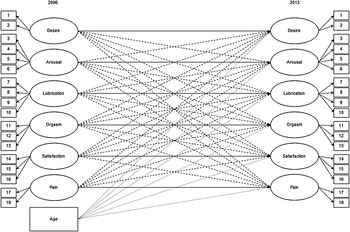
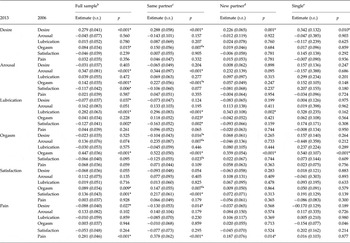
Possible causality between domains and temporal stability were calculated using a cross-lagged longitudinal design. A simplified model of the path analysis structure is presented in Fig. 1. First, we created a model which estimated the relationship between the domains over time (cross-time/cross-domain paths) and the temporal stability of the domains (cross-time/within-domain paths) by freely estimating all paths. This model was based on the measurement invariance analysis. Second, we inspected possible causal relationships between domains found in this model by pairwise equation of cross-time/cross-domain standardized paths (e.g. so that the path from desire 2006 to pain 2013 and the path from pain 2006 to desire 2013 were equated). We then compared the equated models with the free model using the Satorra–Bentler scaled χ2 difference test for MLR (Satorra & Bentler, Reference Satorra and Bentler2001). If equating paths resulted in a decrease in model fit, it would indicate that the paths indeed differed from each other. Note that the analyses resulted in two different kinds of p values: one describing the significance of the specific parameters in the freely estimated model (reported in Table 3) and one describing model fit for the equated models (reported in Table 4).
Simplified figure of the path analysis structure of the Female Sexual Function Index (FSFI) subdomains. Ellipses illustrate latent factors, squares illustrate observed variables and arrows between these illustrate factor loadings. Numbers represent the corresponding item number in the FSFI. In the structural part of the model, arrows with solid lines illustrate temporal stability of the subdomains and arrows with dashed lines illustrate cross-time/cross-domain associations. Age (grey lines) and biological kinship (not shown) were included in the model. Within-time correlations, measurement error and residual variance are not shown.

Relationship status group models
In order to investigate whether temporal stability and possible causal paths were influenced by relationship status, we looked separately at women who were in a relationship with the same partner at both time points, women who were in a relationship with a new partner in 2013 (either no relationship in 2006 or relationship with another person), and women who were single in 2013 (either single at both time points or in a relationship in 2006 but not in 2013). The procedure was the same as for the full-sample analyses, but relationship duration was further included as a covariate in these analyses in order to differentiate between relationship duration and partner-specific factors (i.e. we were interested in partner-specific factors).
Results
Measurement invariance
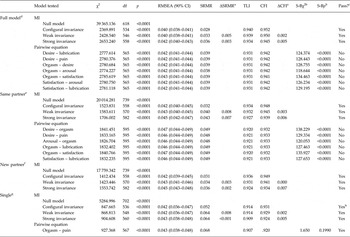
Stepwise measurement invariance results are presented in Table 1. Model fit statistics supported the use of strong invariance (i.e. equality of factor loadings and intercepts across time) in both the full sample and separately for the three relationship status groups. For single women, two of the lubrication items were allowed to correlate to obtain acceptable model fit, and one negative residual variance estimate for a pain item was fixed to 0. The strong measurement invariance model was subsequently used in the analyses assessing temporal stability and possible causal paths.
Stepwise model fit statistics for tests of measurement invariance across 2006 and 2013 and when equating significant parameter estimates

df, Degrees of freedom; RMSEA, root mean square error of approximation; CI, confidence interval; SRMR, standardized root mean square residual; TLI, Tucker–Lewis index; CFI, comparative fit index; S-Bχ2, Satorra–Bentler scaled χ2 difference test; S-Bp, p value for Satorra–Bentler scaled χ2 difference test; MI, measurement invariance across time points.
a In the MI comparisons, ΔCFI (change in CFI) and ΔSRMR (change in SRMR) were used to compare fit of models.
b In the pairwise equation comparisons, the S-Bχ2 and S-Bp were used to compare fit of the constrained model with the strong MI model.
c Yes indicates that the change in model fit between the compared models was acceptable and that this model should thus be used.
d All participants (n = 2173) included.
e Women who were in a relationship with the same partner at both time points (i.e. in 2006 and 2013; n = 964).
f Women who were in a relationship with a new partner in 2013 (n = 873).
g Women who were single in 2013 (n = 336).
h An estimated negative residual variance for one of the pain items was fixed at zero at both time points. Two lubrication items were allowed to correlate at both time points.
Full-sample analyses
Descriptive statistics
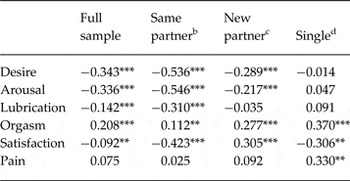
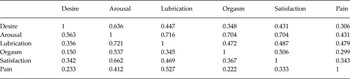
Factor mean differences between 2006 and 2013 are presented in Table 2. Women reported significantly less desire, arousal, lubrication and sexual satisfaction, and higher orgasm function in 2013 compared with 2006. Sex-related pain did not differ significantly between time points. Within-time correlations for the latent factors are presented in Table 3. All correlations were higher in 2013 except the one between lubrication and arousal. The highest correlations were found between the sexual arousal domain and four of the other domains: lubrication, satisfaction, orgasm and desire.
Female Sexual Function Index latent factor mean differences between 2006 and 2013 for the full sample and for different relationship status groups a

a As latent factor (i.e. domain) means were fixed to 0 in 2006, mean differences between the two time points were calculated as a relative estimate to 0, where a negative value in 2013 indicated a decrease in sexual function and a positive value indicated an increase in sexual function.
b Women who were in a relationship with the same partner at both time points (i.e. in 2006 and 2013).
c Women who were in a relationship in 2013 but not with the same partner in 2006.
d Women who were single in 2013.
** p < 0.01, *** p < 0.001.
Within-time correlations for the latent factors of the Female Sexual Function Index in the full sample a

a Correlations below (above) the diagonal are from the year 2006 (2013). All correlations were significant (p < 0.001).
Temporal stability
Cross-time/within-domain standardized estimates are presented in Table 4. Temporal stability of the domains was considerably low. Orgasm was the most stable domain, with approximately 20.0% (β 2 = 0.200) of the variance in the orgasm domain in 2013 being explained by the orgasm domain in 2006, whereas sexual satisfaction was the most unstable domain with approximately 1.8% (β 2 = 0.018) of the variance in the satisfaction domain in 2013 being explained by the satisfaction domain in 2006.
Cross-time standardized estimates for the Female Sexual Function Index subdomains in the full sample and in different relationship status groups a

s.e., Standard error.
a Standardized parameter estimates were used. Age was controlled for in all analyses. Relationship duration was controlled for in the partnered groups. Due to a technical error in the 2013 data collection, only items 17 and 19 of the pain domain were used in the analyses.
b All participants (n = 2173) included.
c Women who were in a relationship with the same partner at both time points (i.e. in 2006 and 2013; n = 964).
d Women who were in a relationship with a new partner in 2013 (n = 873).
e Women who were single in 2013 (n = 336).
f Reciprocal association.
* Results were significant after model fit testing.
Possible causal paths
Cross-time/cross-domain standardized estimates are presented in Table 4. Pairwise equation of significant paths (as described in the Statistical analyses section and presented in Table 1) did not result in acceptable model fit compared with the freely estimated model, indicating that the paths differed from each other.
The following significant paths were found: desire had a unidirectional negative effect on lubrication and pain (i.e. greater desire predicted lower lubrication function and more pain), orgasm had a unidirectional positive effect on desire, arousal and satisfaction (i.e. higher orgasm function predicted higher desire, arousal and satisfaction) and satisfaction had a unidirectional negative effect on arousal and lubrication.
Relationship status group analyses
Descriptive statistics
In 2013, 44.4% (n = 964) reported that they were currently in a relationship with the same partner as in 2006, 40.2% (n = 873) reported that they were currently in a relationship but with a new partner, and 15.5% (n = 336) reported that they were currently single. Factor mean differences between 2006 and 2013 are presented in Table 2. Women who were in the same relationship at both time points reported less desire, arousal, lubrication and satisfaction, and higher orgasm function in 2013 compared with 2006. Pain did not differ significantly between time points. Women who were in new relationships in 2013 reported less desire and arousal, higher satisfaction and higher orgasm function in 2013. Pain and lubrication did not differ significantly between time points. Women who were single in 2013 reported less pain and satisfaction, and higher orgasm function in 2013. Desire, arousal and lubrication did not differ significantly between time points.
Temporal stability
Cross-time standardized estimates for the different relationship status groups are presented in Table 4. For women in the same relationship at both time points, temporal stability ranged from 0.217 (satisfaction) to 0.522 (orgasm). The arousal path was not significant. For women in new relationships in 2013, temporal stability ranged from 0.187 (pain) to 0.359 (orgasm). The arousal and satisfaction paths were not significant. For single women, orgasm and desire were the only significant paths, with standardized estimates of 0.540 and 0.342.
Possible causal paths
Cross-time/cross-domain effects were found for women in the same relationship at both time points and for single women. Pairwise equation of significant paths resulted in acceptable model fit for the path found in single women (the one from orgasm to pain), indicating that the paths from pain to orgasm and orgasm to pain did not differ significantly from each other. For women in the same relationship at both time points, the following significant paths were found: desire had a unidirectional negative effect on pain, satisfaction had a unidirectional negative effect on lubrication, and orgasm had a unidirectional positive effect on lubrication, and reciprocal associations with desire (so that higher orgasm function predicted higher desire, but higher desire predicted lower orgasm function), arousal (so that higher orgasm function predicted higher arousal and vice versa) and satisfaction (so that higher orgasm function predicted higher satisfaction, but higher satisfaction predicted lower orgasm function).
Discussion
In the present study, FSF showed to be considerably variable over a time-frame of 7 years, and relationship status played a key role in predicting temporal stability and between-domain effects in FSF over time. In the full sample and for women in a relationship with the same partner at both time points, orgasm, desire and satisfaction were found to be the main predictors of other FSFs, however, with small effect sizes. Orgasm and desire were the only factors to show temporal stability independently of relationship status, suggesting that these functions differ fundamentally from the others.
Full-sample analyses
In the data collected in 2013, women reported less desire, subjective arousal, lubrication and satisfaction, but higher orgasm function. Pain scores did not differ significantly between time points. This is to some extent consistent with previous cross-sectional and longitudinal studies showing that desire problems increase with age (Hällström & Samuelsson, Reference Hällström and Samuelsson1990; Koster & Garde, Reference Koster and Garde1993; Howard et al. Reference Howard, O'Neill and Travers2006; Dennerstein et al. Reference Dennerstein, Guthrie, Hayes, DeRogatis and Lehert2008). Our findings concerning sexual pain and orgasm function are inconsistent with previous longitudinal studies reporting decreased orgasmic function (Dennerstein et al. Reference Dennerstein, Guthrie, Hayes, DeRogatis and Lehert2008) and increased pain (Dennerstein et al. Reference Dennerstein, Guthrie, Hayes, DeRogatis and Lehert2008; Avis et al. Reference Avis, Brockwell, Randolph, Shunhua, Cain and Greendale2009), although it should be noted that these study samples consisted of menopausal women. All within-time correlations were higher in 2013 than in 2006, suggesting that co-morbidity of FSDs increases with age. Perhaps worth noting, higher age is confounded with relationship duration, which is associated with lower sexual desire (Fugl-Meyer & Fugl-Meyer, Reference Fugl-Meyer and Fugl-Meyer1999; Witting, Reference Witting2008). Nevertheless, all correlations between desire and other domains remained higher than in 2006 when controlling for relationship duration in 2013.
Using the clinical cut-off score of 26.55 for FSFI proposed by Wiegel et al. (Reference Wiegel, Meston and Rosen2005), the present study sample had a slightly lower rate of FSDs both in 2006 (25.1%) and 2013 (27.7%) compared with a combined estimate from other studies assessing FSDs with FSFI in general populations of premenopausal women (36.3%, studies n = 31; McCool et al. Reference McCool, Zuelke, Theurich, Knuettel, Ricci and Apfelbacher2016).
In the full-sample analyses, only 2–20% of the variance was explained by previous sexual function in the particular domain. Temporal stability was lower for all FSFI domains compared with the study by Burri et al. (Reference Burri, Hilpert and Spector2015), where the authors reported temporal stability rates of 0.33 to 0.64 in both premenopausal and postmenopausal women over a time period of 4 years (i.e. approximately 11–41% of the variance explained by previous function), except for sexual satisfaction, where no temporal stability was found. The time span in our sample was indeed longer than that of Burri et al. (Reference Burri, Hilpert and Spector2015) which could at least partially explain the differences.
In contrast to Burri et al. (Reference Burri, Hilpert and Spector2015), who found sexual desire and arousal to be the strongest predictors of other sexual functions, we found orgasm, followed by desire and satisfaction, to be the strongest overall predictors of other sexual functions. The effect sizes for cross-time/cross-domain associations were generally small, 0.084–0.142, and most of the variance was explained by something other than previous function in another domain. Surprisingly, the significant path originating from desire predicted decrements in future pain and lubrication scores. A possible explanation for this is that individuals with low sexual desire are less inclined to engage in sexual activities in the first place (and thus may not, for example, notice pain because they only engage in sexual activity rarely, and thus also experience discomfort associated with sexual activity rarely). Similarly, high sexual satisfaction in 2006 predicted less arousal and lubrication in 2013. A possible explanation for this could be that women reporting high satisfaction in 2006 more often continued their relationship compared with those reporting low satisfaction, and hence developed lower function over time. Indeed, being in the same relationship in 2013 was associated with higher satisfaction in 2006 (p < 0.001) and less arousal and lubrication in 2013. These unexpected associations had, however, small effect sizes, and were probably clinically negligible.
Relationship status group analyses
Orgasm and desire were the only domains to show temporal stability independently of relationship status, suggesting that these domains differ fundamentally from the others and that partner-specific factors play a key role when predicting the stability of FSF. No significant longitudinal paths between different domains were detected for women in new relationships, and only one significant path (which could not be confirmed as unidirectional) was found for single women, supporting the importance of partner-specific factors when studying cross-domain effects over time.
Strengths and limitations of the study
The present study has a number of methodological strengths, such as a longitudinal approach which reduces recall bias, a large study sample, validated measures, and use of SEM which accounts for measurement error.
However, the present study also has some limitations. The extensive time-frame of 7 years might not capture short-term fluctuations and effects of FSF. The patterns of causality between variables may be different when they are studied over a long time span compared with if they are studied in the short term. Acute effects could be studied using EMA, as in the study by Pakpour et al. (Reference Pakpour, Yekaninejad, Pallich and Burri2015). In their study, however, orgasm and sexual satisfaction were associated with all other FSFI domains, supporting the findings of the present study. Another limitation of the study concerns the study of sexual functioning and not specifically sexual dysfunctions (i.e. low sexual functioning combined with distress). Temporal stability and causal patterns might indeed differ for women with explicit sexual dysfunctions. Lastly, we did not have data about cohabiting, and analyses on the years lived together could therefore not be conducted. Nor did we have data about the duration of the single women's relationship status, and thus could not correct for singlehood duration in the same way as for women in relationships.
Conclusions and recommendations
Our results suggest that FSF is highly variable over time. Considering this, psychobehavioural treatment interventions focusing on associated environmental factors seem to be promising treatment alternatives for FSDs. In order to improve existing psychobehavioural treatment methods, it would be of importance to identify specific environmental factors that contribute to most of the variance in FSF. Our study suggests that changes in relationship status are of relevance when assessing changes in FSF over time, indicating that psychobehavioural treatment interventions for FSDs should take partner-specific factors into account. This association also differed between specific functions (e.g. orgasm function and desire seem to be independent of partner-specific effects), which advocates tailored interventions for FSDs.
Supplementary material
The supplementary material for this article can be found at http://dx.doi.org/10.1017/S0033291716002488
Acknowledgements
This work was supported by the Academy of Finland (P.J. grant numbers 138291 and 274521).
Declaration of Interest
None.