Hypertension is a known risk factor for the progression of atherosclerosis in adults, along with other well-described cardiovascular risk factors such as obesity, age, and smoking. Hypertension in childhood and adolescence is associated with future risk of cardiovascular disease, but it is unclear whether this is initiated through direct vascular end organ damage at these ages or tracking of blood pressure and other related risk factors into adulthood and consequent acceleration of age-related vascular changes at older ages.Reference Daniels, Loggie, Khoury and Kimball 1 – Reference Juonala, Viikari, Rönnemaa, Helenius, Taittonen and Raitakari 3 Knowing this could help guide management of high blood pressure in children and young people, particularly pharmacotherapy, for which there is considerable reluctance to initiate early treatment because of potential for lifelong therapy and adverse effects. This question has gained particular importance in recent years with the rising prevalence of high blood pressure in children and young people associated with the child obesity epidemic worldwide.
To address this question, we investigated the association between blood pressure and carotid intima-media thickness in children and young people through a systematic review of published evidence. In adults, carotid intima-media thickness measured non-invasively by ultrasound is frequently used as a surrogate marker of atherosclerosis: it has been shown to correlate well with atherosclerosis elsewhere and predicts cardiovascular events.Reference Bots and Sutton-Tyrrell 4 We hypothesised that a greater carotid intima-media thickness in children and young people could be indicative of vascular re-modelling, and therefore used to investigate a direct role of blood pressure in initiating atherosclerosis at younger ages. If a clear association was found between blood pressure and carotid intima-media thickness, our secondary objectives were to explore the potential impact on this association on age, type, systolic or diastolic, and level of blood pressure, and presence of other cardiovascular risk factors, notably obesity, as these would further guide decisions on early initiation of blood pressure control in children and young people.
Materials and methods
A systematic search was conducted for published English-language studies of the association between blood pressure and carotid intima-media thickness in childhood. Databases such as MEDLINE and EMBASE were used, limited from January, 1980 to June, 2013.
The following search terms were used for MEDLINE, and were adapted as necessary for EMBASE: 1. exp Child/, 2. exp Adolescent/, 3. juvenile.mp., 4. exp Infant/, 5. child$.mp., 6. adolescen$.mp., 7. infan$.mp., 8. teen$.mp., 9. P?ediatric$.mp., 10. Pediatrics/, 11. 1 or 2 or 3 or 4 or 5 or 6 or 7 or 8 or 10, 12. hyperten$.mp., 13. prehyperten$.mp, 14. exp Hypertension/, 5. exp Prehypertension/, 16. exp Blood pressure/, 17. 12 or 13 or 14 or 15 or 16, 18. exp Atherosclerosis/, 19. exp Arteriosclerosis/, 20. exp Carotid intima-media thickness/, 21. exp Carotid artery disease/, 22. atherosclero$.mp, 23. arteriosclero$.mp, 24. carotid intima-media thickness.mp, 25. carotid intima-media thickness.mp, 26. exp Carotid Arteries/ and exp Ultrasonography/, 27. Exp Carotid Arteries/us, 28. 18 or 19 or 20 or 21 or 22 or 23 or 24 or 25 or 26 or 27, 29. 11 and 17 and 28, 30. limit 29 to (humans and year=“1980 to Current”).
Articles were eligible for inclusion if they included at least one measurement of blood pressure and at least one measurement of ultrasound-derived carotid intima-media thickness, both measured during childhood (0–19 years), and if a measure of effect size or correlation between the two measurements was included in the manuscript. Both cross-sectional and longitudinal studies were eligible, so long as both blood pressure and carotid intima-media thickness measures were obtained in childhood. Studies were excluded if they did not meet inclusion criteria, or if the population was recruited from specific disease groups such as children with CHD, endocrine diseases, or renal disorders, as the results of such studies may be confounded by disease-specific risk factors. Studies focussing on obese children were also included.
For a preliminary assessment of suitability, two independent reviewers – T.D. and M.H.P. – screened titles and abstracts. If deemed suitable, the full text of the articles was screened to determine whether the article met inclusion criteria. Any disagreements between the two reviewers were resolved by consensus.
Data were extracted using a pre-designed pro forma. For each study, the following was recorded: study population, country of residence, study design, study population recruitment method, subgroups of the study population, mean age, number and sex distribution of the study population, mean systolic and diastolic values blood pressure, blood pressure measurement method, carotid intima-media thickness measurement method, details of relationship between blood pressure and carotid intima-media thickness.
For studies that were eligible, study quality was assessed using 10 pre-defined criteria:
-
∙ Are the hypotheses/aims/objectives clearly described?
-
∙ Are the carotid intima-media thickness and blood pressure measurement methods clearly described?
-
∙ Are the age and sex of the study population clearly described?
-
∙ Have actual probability values been reported for the relationship between carotid intima-media thickness and blood pressure?
-
∙ Does the study include at least a group of subjects who are representative of the general population?
-
∙ Was the source of each group of subjects clearly defined?
-
∙ Was an attempt made to blind those measuring carotid intima-media thickness to the subject’s blood pressure?
-
∙ Was linear regression used, rather than just a simple comparison of means?
-
∙ Was an attempt made to assess the internal validity of the carotid intima-media thickness measurement?
-
∙ Was an attempt made to adjust confounding factors in the analysis of the relationship between blood pressure and carotid intima-media thickness?
Data were synthesised in a narrative manner, and are summarised in tabular form.
Results
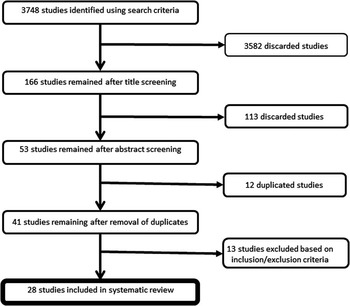
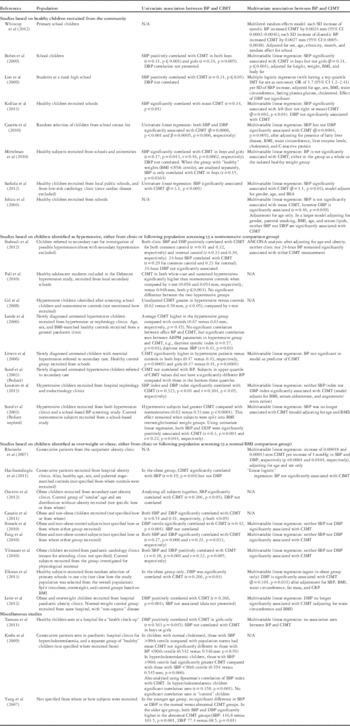
In total, 28 studies were eligible for inclusion in this review (see Fig 1). Detailed descriptions of each study are included in Table 1 (online supplement). Summaries of the main relevant findings of each study are included in Table 1. All included studies were cross-sectional in design – eight of these studies recruited healthy children from the community, a further eight were based on children identified as hypertensive recruited from clinics or following population screening, and nine studies were based on children identified as overweight or obese. A further three studies were miscellaneous: one was based on healthy children seen during a hospital “check-up”, one was based on children identified as having high cholesterol, and one study did not specify how or why the study population was recruited.
Flow diagram indicating the number of studies included at each stage of the inclusion process.

Details of the included studies.

SBP, DBP, BMI, IMT, AlT, GGT, HDL, chol, CRP, ANCONA, ABPM, IQR, ADHD, BSA, DSP
Studies based on healthy children recruited from the community
All eight studies with a healthy study population recruited from the community showed a positive association between carotid intima-media thickness and systolic blood pressure and/or diastolic blood pressure. Only two studies found an association between both systolic blood pressure and diastolic blood pressure and carotid intima-media thickness: Whincup et alReference Whincup, Nightingale and Owen 5 used multilevel random effects modelling to adjust for sex, age, ethnicity, month, and random effect for school, showing an increase of 0.024 and 0.0027 mm for each standard deviation increase in systolic blood pressure and diastolic blood pressure, respectively. Castera et alReference Caserta, Pendino and Amante 6 also showed a positive association between both systolic blood pressure and diastolic blood pressure with carotid intima-media thickness on univariate modelling. However, when multivariate modelling was used to adjust for potential confounders, only systolic blood pressure showed a robust association with carotid intima-media thickness (β=0.0004, p=0.005).
Among all three studies found positive associations between carotid intima-media thickness and systolic blood pressure but not diastolic blood pressure. Lim et alReference Lim, Kim, Lee, Lee, Suh and Ahn 7 used multivariate logistic regression – being in the top quartile of carotid intima-media thickness for age and sex was the outcome variable – showing an odds ratio of 1.7 (95% CI 1.2–2.41) per increase of 1 standard deviation of systolic blood pressure. Kollias et alReference Kollias, Psilopatis and Karagiaouri 8 found that systolic blood pressure was positively correlated with carotid intima-media thickness (r=0.14, p<0.01). After adjusting for age, sex, and other cardiovascular risk factors, however, this association only remained for left-sided carotid intima-media thickness, but not for right-sided or mean carotid intima-media thickness. Mittleman et alReference Mittelman, Gilsanz, Mo, Wood, Dorey and Gilsanz 9 found that systolic blood pressure was positively associated with carotid intima-media thickness in both sexes, but when the analysis was restricted those with “healthy” weights, this association remained only for boys. Systolic blood pressure did not remain associated with carotid intima-media thickness after adjustment for potential confounders using a multiple regression model.
Two studies focussed on systolic blood pressure only and did not present data on diastolic blood pressure. Bohm et alReference Böhm, Hartmann, Buck and Oberhoffer 10 found that systolic blood pressure was significantly correlated with carotid intima-media thickness in both sexes, but when the used multiple regression this association remained only for boys (β=0.31, p⩽0.001). Sarkola et alReference Sarkola, Manlhiot and Slorach 11 found an association between systolic blood pressure and carotid intima-media thickness in both univariate and multivariate models (β=3.1, p<0.001 and β=1.1, p=0.03, respectively).
The study by Ishuzu et alReference Ishizu, Ishimitsu, Yanagi, Seo, Obara and Moriyama 12 found that diastolic blood pressure but not systolic blood pressure was associated with carotid intima-media thickness using a linear regression model; however, in a model adjusting for additional potential confounding factors, this association did not remain significant.
Studies based on hypertensive children
In all, eight studies were based on children identified as hypertensive, recruited either from hospital clinics (five studies), following screening of the general paediatric population (two studies), or a combination of the two methods (one study). The definition of hypertension varied between the studies – for example, if the systolic and/or diastolic blood pressure exceeded the 90th or 95th centile based on height, weight, and sex, or if the systolic blood pressure exceeded 140 mmHg (see online Table 1). Of these eight studies, seven found a positive association between blood pressure and carotid intima-media thickness; however in the four of these studies that adjusted for potential confounders, none found a significant association after adjustment.
Among children referred to secondary care for investigation of possible hypertension, Stabouli et alReference Stabouli, Kotsis, Karagianni, Zakapoulos and Konstantopoulos 13 found that systolic blood pressure and diastolic blood pressure, as well as 24-hour systolic blood pressure were positively correlated with carotid intima-media thickness. After adjusting for obesity and age however, these associations did not remain statistically significant. Lande et alReference Lande, Carson, Roy and Meagher 14 studied children with newly diagnosed untreated hypertension and age, sex, and body mass index-matched normotensive controls from a general paediatric clinic. They found that carotid intima-media thickness was significantly higher in the hypertensive group (0.67 versus 0.63 mm, respectively, p=0.045), but there was no significant correlation between single office blood pressure measurement and carotid intima-media thickness. Ambulatory measurements however, were correlated with carotid intima-media thickness – for example daytime mean systolic blood pressure (r=0.43, p=0.03).
Similarly, Litwin et alReference Litwin, Niemirska and Sladowska 15 studied hypertensive children in secondary care and healthy normotensive controls from local schools. They found that carotid intima-media thickness was higher in the hypertensive group compared with controls (0.47 versus 0.43 mm, respectively in boys, p=0.0001, similar results in girls). After adjustment for possible confounders however, this association did not remain significant. Loureiro et alReference Loureiro, Campino and Martinez-Aguayo 16 found that systolic blood pressure and diastolic blood pressure index were correlated with carotid intima-media thickness in hypertensive children, but this association disappeared when potential confounders were controlled for in a multiple regression model.
Sorof et al published two studies in 2003. The first,Reference Sorof, Alexandrov, Cardwell and Portman 17 studying patients referred to a secondary care hypertension clinic, found no association between blood pressure and carotid intima-media thickness. The second studyReference Sorof, Alexandrov and Garami 18 utilised data from hypertension clinics, but combined them with data on hypertensive children and normotensive controls from a population-based screening study. In contrast to the first study, this study found that the hypertensive subjects had higher carotid intima-media thickness compared with controls (0.62 versus 0.53 mm, p<0.0001). When age and body mass index were taken into account however, blood pressure was no longer significantly associated with carotid intima-media thickness.
Pall et alReference Páll, Juhász and Lengyel 19 used data from children recruited from local schools. In unadjusted analyses, they found that carotid intima-media thickness was thicker in hypertensive subjects (both “white-coat” and sustained hypertensive combined) compared with normotensive controls. Gill et alReference Gil, Sung, Shim and Hong 20 recruited hypertensive children after screening in schools, and in unadjusted analyses they found that carotid intima-media thickness was higher in the hypertensive group than among normotensive controls (0.62 versus 0.5 mm, p<0.05).
Studies based on obese children
A total of nine studies focussed on overweight and obese children. Of these, eight included a normal-weight control group. Four studies recruited children directly from a weight management or obesity clinic, one from a paediatric cardiology clinic, and one from local schools, whereas three studies failed to report from where the subjects were recruited. Of the nine studies, all found a significant association between blood pressure and carotid intima-media thickness; however in seven of these that performed statistical adjustment to control for potential confounding factors, only two found a significant association after adjustment.
Rheiner et alReference Reinehr, Wunsch, de Sousa and Toschke 21 recruited patients from a paediatric obesity clinic. In a multiple regression model adjusting for age and sex, both systolic blood pressure and diastolic blood pressure were significantly associated with carotid intima-media thickness. Leite et alReference Leite, Santos, Monteiro, Gomes, Veloso and Costa 22 also recruited patients from a hospital obesity clinic, and recruited normal-weight controls from hospital clinics for “non-organic disease” such as attention deficit hyperactivity disorder and learning disability. They found that diastolic blood pressure but not systolic blood pressure was correlated with carotid intima-media thickness, but this association did not remain significant after adjusting for waist circumference and body mass index.
Both Hacihamdioglu et alReference Hacihamdioglu, Okutan and Yazgat 23 and Ozcetin et alReference Ozcetin, Celikyay, Celik, Yilmaz, Yerli and Erkorkmaz 24 recruited subjects from obesity clinics and normal-weight controls. Hacihamdioglu et al found that in the obese group only, carotid intima-media thickness was positively correlated with systolic blood pressure but not diastolic blood pressure (r=0.19, p=0.04), but after adjustment for confounders this association did not remain significant. Ozcetin et al found that systolic blood pressure, but not diastolic blood pressure, was correlated with carotid intima-media thickness, but no attempt was made to adjust for confounders in this study.
Three studies recruited both obese and normal-weight children, but did not specify how each group was recruited. Casariu et alReference Casariu, Virgolici and Grebu 25 found that in the obese group only, both systolic blood pressure and diastolic blood pressure were positively correlated with carotid intima-media thickness. Simsek et alReference Simsek, Balta, Batla and Dallar 26 found that in the combined sample, diastolic blood pressure but not systolic blood pressure was positively correlated with carotid intima-media thickness (r=0.42, p<0.001), but this association did not remain in multiple linear regression analyses. Fang et alReference Fang, Zhang, Luo, Yu and Lv 27 similarly found that both systolic blood pressure and diastolic blood pressure were significantly associated with carotid intima-media thickness, but these associations did not remain after adjustment for potential confounders in a multiple regression model.
Among obese children recruited from a paediatric cardiology clinicReference Yilmazer, Tavli and Carti 28 , carotid intima-media thickness was positively correlated with both diastolic blood pressure and systolic blood pressure, but this association disappeared when adjustment was made in a multiple regression model. In obese children recruited from primary schoolsReference Elkiran, Yilmaz, Koc, Kamanli, Ustundag and Ilhan 29 , diastolic blood pressure was positively correlated with carotid intima-media thickness (r=0.266, p=0.03). This association remained significant after adjustment for potential confounders (β=0.301, p=0.031).
Miscellaneous studies
Tamura et alReference Tamura, Suzue, Jitsunari and Hirao 30 found that diastolic blood pressure, but not systolic blood pressure, was positively correlated with carotid intima-media thickness in girls only. This association did not remain significant after adjustment in multiple regression models. Krebs et alReference Krebs, Schmidt-Trucksäss and Alt 31 recruited children with hypercholesterolaemia and a group of healthy controls. They found that in the control group those with higher systolic blood pressure did not have significantly different carotid intima-media thickness compared with the normotensive group. In the hypercholesterolaemic group, those with systolic blood pressure above the 90th centile had higher carotid intima-media thickness than those with lower systolic blood pressure (0.594 versus 0.545 mm, p=0.006). Yang et alReference Yang, Liu, Mi, Tang and Du 32 found that at ages 10–18 years, systolic blood pressure and diastolic blood pressure were significantly higher among those with thickened carotid intima-media thickness, but this association was not detected in younger age groups.
Discussion
This review set out to characterise the relationship between blood pressure and atherosclerosis in children, with the aim of identifying possible indications and thresholds for the pharmaceutical management of paediatric hypertension. On the basis of the 28 studies included, there is consistent evidence for a positive association between blood pressure and carotid intima-media thickness among healthy, hypertensive, and overweight children, in unadjusted analyses. A similar relationship is well-described in adults,Reference Juonala, Viikari, Rönnemaa, Helenius, Taittonen and Raitakari 3 , Reference Yang, Liu, Mi, Tang and Du 32 and hypertension is recognised as a major risk factor for the development of atherosclerosis in the adult population.
Many of the studies included in this review attempted to control for potential confounding factors by adjusting for them in multivariable models. The evidence is mixed for an association between blood pressure and carotid intima-media thickness independent of other cardiovascular risk factors. In the population-based studies of healthy children, the majority – six out of eight – found a positive association between blood pressure and carotid intima-media thickness that remained after adjustment for possible confounders, most commonly obesity and age. In studies of hypertensive and obese populations however, the positive association between blood pressure and carotid intima-media thickness generally disappeared after adjusting for other cardiovascular risk factors.
The lack of positive associations after adjustment for confounding factors in some studies may suggest that blood pressure acts as a surrogate marker for another causal factor in the development of atherosclerosis, for example obesity. It is worth noting however that the group of population-based studies where this association persisted after adjustment for other risk factors were in general the largest and of the highest quality. It may therefore be possible that the studies that did not find an association in adjusted analyses were not sufficiently powered to do so, especially given the strong correlation between multiple cardiovascular risk factors which could result in over-adjustment.
The large group of studies included here varies widely in both quality and methodology. The patient groups included are heterogeneous, and both carotid intima-media thickness and blood pressure have been measured in many different ways. As a result of this, it was not possible to perform any quantitative meta-analysis of the results. Conclusions are also limited by the use of carotid intima-media thickness as a proxy for cardiovascular risk in children; however, cardiovascular events are rare in young people and more robust markers of future cardiovascular are generally unavailable.
In terms of clinical practice, this review does demonstrate some evidence that higher blood pressure is associated with increased carotid intima-media thickness even during childhood; however, with the present data, it is not clear whether this damage to the vasculature is of any clinical significance, as there are limited data linking carotid intima-media thickness in youth to cardiovascular events in later life. In their 2013 review, Juhola et alReference Girerd, Mourad and Copie 33 found that, although hypertension in adulthood was clearly associated with increased carotid intima-media thickness, this did not seem to be influenced by the presence or absence of childhood hypertension. This does not completely negate the influence of childhood blood pressure however, as consistent tracking of hypertension form childhood to adult life is well described, meaning that childhood hypertension may well influence atherosclerosis risk in adult life via an increased risk of adult hypertension.Reference Juhola, Magnussen and Berenson 34 Furthermore, the correlation between childhood and adult hypertension may have contributed to insufficient study power to detect independent effects of the two in studies that tried to do so.
Another aim of this review was to attempt to define at what point blood pressure should be managed with anti-hypertensive pharmaceutical therapy in childhood. There are data to suggest that individuals who are hypertensive in childhood, whose blood pressures normalise by adulthood, have a carotid intima-media thickness that is no worse than those who were never hypertensive.Reference Girerd, Mourad and Copie 33 Although this may indicate that early treatment of hypertension in childhood is worthwhile, to intervene and prevent high blood pressure tracking into later life, the mechanism of the relationship between blood pressure and carotid intima-media thickness remains unclear. In addition, the studies included in this review largely assumed a linear association between carotid intima-media thickness and blood pressure, and none explicitly tested for a non-linear relationship or threshold effect; because of this it is not clear at which threshold carotid intima-media thickness begins to be adversely affected, and the question of when to treat remains unanswered. Further study is needed to answer this question. This would require a large cohort of children with a wide range of blood pressure measurements, but would certainly help guide the decision-making process with regards to anti-hypertensive therapy in children.
Our systematic review was limited by the use of only databases such as MEDLINE and EMBASE. Although we feel this would have included the majority of suitable studies, it is possible that some were missed. We did not attempt to include grey literature, or unpublished studies. We were not able to assess for the effect of publication bias on our results.
In conclusion, our review gave mixed results. On the basis of the largest and highest-quality population-based studies, there is consistent evidence that higher blood pressures are associated with increased carotid intima-media thickness in childhood, even after adjusting for other cardiovascular risk factors. Further study is needed to consolidate this evidence, and further delineate the values of blood pressure at which a clinically significant increase in carotid intima-media thickness is seen. If the level can be defined beyond which blood pressure starts to acutely affect carotid intima-media thickness, this would greatly aid clinicians in initiating pharmacological treatment of hypertensive for cardiovascular disease in children and young people.
Acknowledgement
Authors’ Contributions: Dr Day performed the literature search, screened the potential articles, carried out the initial data collection, drafted the initial manuscript, and approved the final manuscript as submitted. Dr Park also screened the potential articles, reviewed and revised the initial manuscript, and approved the final manuscript as submitted. Dr Kinra conceptualised and designed the study, reviewed and revised the initial manuscript, and approved the final manuscript as submitted.
Financial Support
The authors have no financial relationships relevant to this article to disclose. This study received no specific grant from any funding agency or from commercial or not-for-profit sectors.
Conflicts of Interest
None.
Supplementary Material
To view supplementary material for this article, please visit https://doi.org/10.1017/S1047951117000105