Introduction
Sexual abuse in childhood (CSA) is common (Dinwiddie et al. Reference Dinwiddie, Heath, Dunne, Bucholz, Madden, Slutske, Bierut, Statham and Martin2000; Friedman et al. Reference Friedman, Smith, Fogel, Paradis, Viswanathan, Ackerman and Trappler2002; Bebbington et al. Reference Bebbington, Bhugra, Brugha, Farrell, Jenkins, Lewis and Meltzer2004;May-Chahal & Cawson, Reference May-Chahal and Cawson2005; Pereda et al. Reference Pereda, Guilera, Forns and Gomez-Benito2009). There is consistent evidence of deleterious but relatively non-specific psychiatric sequelae in adulthood. Enhanced risks of depression, personality disorder, post-traumatic stress disorder (PTSD), psychosis, drug and alcohol abuse, bulimia and suicidality have been reported (Coxell et al. Reference Coxell, King, Mezey and Gordon1999; Dinwiddie et al. Reference Dinwiddie, Heath, Dunne, Bucholz, Madden, Slutske, Bierut, Statham and Martin2000; Kendler et al. Reference Kendler, Bulik, Silberg, Hettema, Myers and Prescott2000; King et al. Reference King, Coxell and Mezey2002; Putnam, Reference Putnam2003; Bebbington et al. Reference Bebbington, Bhugra, Brugha, Farrell, Jenkins, Lewis and Meltzer2004, Reference Bebbington, Cooper, Minot, Brugha, Jenkins, Meltzer and Dennis2009; Janssen et al. Reference Janssen, Krabbendam, Bak, Hanssen, Vollebergh, de Graaf and van Os2004; Read et al. Reference Read, van Os, Morrison and Ross2005; Nelson et al. Reference Nelson, Heath, Lynskey, Bucholz, Madden, Statham and Martin2006). The effects seem to be proportionate to the severity and persistence of the abuse (Bulik et al. Reference Bulik, Prescott and Kendler2001; Molnar et al. Reference Molnar, Buka and Kessler2001), and a history of CSA is more prevalent, and may have greater impact, in women (MacMillan et al. Reference MacMillan, Fleming, Streiner, Lin, Boyle, Jamieson, Duku, Walsh, Wong and Beardslee2001; Molnar et al. Reference Molnar, Buka and Kessler2001).
The third national Adult Psychiatric Morbidity Survey (APMS 2007; McManus et al. Reference McManus, Meltzer, Brugha, Bebbington and Jenkins2009; www.ic.nhs.uk/pubs/psychiatricmorbidity07) provides major advantages for quantifying the association of CSA and adult sexual abuse (ASA) with a range of psychiatric disorders. It was based on a large random sample of the English household population, and used standardized methods to establish the diagnosis of specific psychiatric conditions. Moreover, detailed information about CSA and ASA was obtained using a computer-assisted self-completion interview (CASI), which offers significant benefits for eliciting potentially sensitive information.
Our analyses cover common mental disorders, alcohol and drug dependence, and symptoms associated with two disorders in which sexual abuse may have particular significance: PTSD and eating disorders. We predicted that severe forms of abuse would show particularly strong associations with disorder, as would revictimization, defined here as the repetition in adulthood of abuse in childhood. We also hypothesized that the effects of sexual abuse would be moderated by gender, reflecting a greater impact in females. Associations with psychosis, and with borderline and antisocial personality disorder, will be investigated in detail elsewhere.
Method
Sampling
The data used in these analyses were acquired from a random sample of household residents aged ⩾16 years. Unlike the previous surveys in this program (Meltzer et al. Reference Meltzer, Gill, Petticrew and Hinds1995; Singleton et al. Reference Singleton, Bumpstead, O'Brien, Lee and Meltzer2001; Jenkins et al. Reference Jenkins, Meltzer, Bebbington, Brugha, Farrell, McManus and Singleton2009), the APMS 2007 only covered England, and there was no upper age limit. The sample was designed to represent the population living in private households (that is, people not living in communal establishments). Ethical approval for APMS 2007 was obtained from one of the Research Ethics Committees of the National Research Ethics Service appropriate for non-clinical populations.
The survey adopted a multi-stage stratified probability sampling design. Full details of sampling and design are provided by McManus et al. (Reference McManus, Meltzer, Brugha, Bebbington and Jenkins2009). The sampling frame was the small user Postcode Address File. One adult aged ⩾16 years was selected for interview in each eligible household using the Kish grid method (Kish, Reference Kish1965). Fifty-seven per cent of those eligible agreed to take part in an interview. Full interviews were carried out successfully with 7403 people, of whom 7353 completed the self-completion interview section that covered sexual abuse. Fieldwork was carried out between October 2006 and December 2007.
Procedure
The training and briefing of the experienced National Centre for Social Research interviewers selected to work on the first phase of the survey is described elsewhere (McManus et al. Reference McManus, Meltzer, Brugha, Bebbington and Jenkins2009; Bebbington et al., in press). The phase one interview involved computer-assisted personal interviewing (CAPI), with answers entered by the interviewers directly into a laptop. The laptop was given to the participant for the self-completion (CASI) element of the first-phase interview. Respondents knew beforehand that interviewers were unable to see the results of the self-completed parts of the interview, which included questions about different levels of sexual abuse:
(1) Has anyone talked you in a sexual way that made you feel uncomfortable?
(2) Has anyone touched you, or got you to touch them, in a sexual way without your consent?
(3) Has anyone had sexual intercourse with you without your consent?
We identified people who had been sexually abused in childhood (<16 years) or in adulthood (⩾16 years). Those who had been abused in both periods were regarded as having experienced ‘revictimization’.
Non-psychotic psychiatric disorders were assessed in relation to the past week, using the Clinical Interview Schedule – Revised (CIS-R; Lewis et al. Reference Lewis, Pelosi, Araya and Dunn1992). This can be administered by non-clinically trained interviewers, and formed part of the phase one interview. It provides diagnoses of six so-called common mental disorders (CMDs): depressive episode, mixed anxiety/depressive disorder, generalized anxiety disorder (GAD), panic disorder, phobic disorder, and obsessive–compulsive disorder (OCD).
Alcohol dependence in relation to the past 6 months was derived on the basis of responses to two questionnaires, the Alcohol Use Disorders Identification Test (AUDIT; Saunders et al. Reference Saunders, Aasland, Babor, de la Fuente and Grant1993) and the community version of the Severity of Alcohol Dependence Question naire (SADQ-C; Stockwell et al. Reference Stockwell, Sitharthan, McGrath and Lang1994). All respondents with an AUDIT score of ⩾10 were also interviewed with the SADQ-C, which consists of 20 items, covering a range of dependence symptoms scored from 0 to 3 (total score 0–60). A score of ⩾4 is taken to indicate at least mild dependence, and we took this as our threshold for dependence.
Questions about drug use were again located in the CASI part of the interview. Participants who in the past year had used cannabis, amphetamines, crack, cocaine, ecstasy, tranquillizers, opiates or volatile substances were asked five questions designed to assess drug dependence based on the Diagnostic Interview Schedule (Malgady et al. Reference Malgady, Rogler and Tryon1992). These questions covered level of use, sense of dependence, inability to abstain, increased tolerance, and withdrawal symptoms. Endorsement of any of the items in the past year was used to indicate drug dependence.
Screening tests were used to identify possible cases of current PTSD and eating disorders. For PTSD, we used the Trauma Screening Questionnaire (TSQ), a short screening tool (Brewin et al. Reference Brewin, Rose, Andrews, Green, Tata, McEvedy, Turner and Foa2002). The TSQ covers the re-experiencing and arousal features of PTSD, but not criteria related to avoidance and numbing. As the questions were themselves potentially distressing, they were located in the CASI part of the interview. Respondents were first asked whether they had experienced a traumatic event at some time in their life after the age of 16. If so, they rated 10 PTSD items in relation to the past week. Endorsement of six or more of these was taken to indicate a positive screen for PTSD.
The prevalence of eating disorders was estimated using the SCOFF questionnaire (Morgan et al. Reference Morgan, Reid and Lacey1999). This was administered to all APMS 2007 respondents in the CASI part of the interview. A SCOFF score of ⩾2 was taken as a positive screen for eating disorder. Again, this is a screening tool, not a diagnostic instrument.
As with other lay-administered screening tools, the prevalences obtained overestimate the rates of disorder that would be determined by full clinical investigation. This must be borne in mind: people who are positive on the screening instruments described above are therefore referred to as having ‘PTSD symptoms’ or ‘eating disorder symptoms’ respectively. However, it is always worth investigating screen-positive participants as they will tend as a group to share the attributes of those with the full syndrome (e.g. Johns et al. Reference Johns, Cannon, Singleton, Murray, Farrell, Brugha, Bebbington, Jenkins and Meltzer2004).
The identification of psychiatric disorder related to time-frames that were not always the same. Thus, as for CMDs, screening for PTSD related to the past week, whereas alcohol dependence related to the past 6 months, and eating disorders and drug dependence to the past year.
Analytic strategy
Comparisons of the age and sex distribution of the survey sample with the national English population are given in the main survey report (Table 13.5; McManus et al. Reference McManus, Meltzer, Brugha, Bebbington and Jenkins2009). However, the survey data were weighted to take account of survey design and non-response, such that the results were representative of the household population of England aged ⩾16 years. Weighting was necessarily complex, and is described in detail by McManus et al. (Reference McManus, Meltzer, Brugha, Bebbington and Jenkins2009). We used the ‘survey’ commands in Stata 10.0 (StataCorp, 2008), which allow for the use of clustered data modified by probability weights, and provide robust estimates of variance. We describe the variables studied using actual numbers, but proportions and odds ratios (ORs) are weighted.
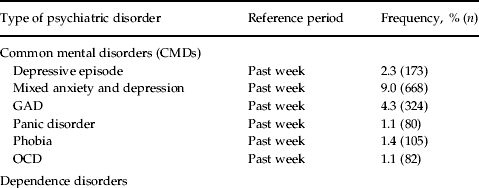
Frequency of psychiatric morbidity in the sample (weighted percentages, true count)

GAD, Generalized anxiety disorder; OCD, obsessive–compulsive disorder; PTSD, post-traumatic stress disorder.
We have already provided evidence that sexual abuse conforms to a meaningful hierarchy of severity (Bebbington et al., in press). To test our hypothesis that the association of abuse with individual psychiatric disorders was proportional to the severity of abuse, we created a variable whose four levels consisted of: ‘no abuse’; uncomfortable talk only; sexual touching, whether accompanied by uncomfortable talk or not; and non-consensual intercourse. By expanding the variable into its levels during logistic analysis, we were able to identify the ORs associated with each level of severity. The results are presented separately for CSA and ASA.
We used accepted criteria to test our hypothesis that sexual abuse would be more strongly associated with disorder in women than in men; that is, the relationship would be moderated by gender (Baron & Kenny, Reference Baron and Kenny1986). Moderation is held to occur when there is an interaction between a factor (here gender) and an independent variable (here CSA) such that the former specifies the conditions under which the latter operates. We provide ORs and population attributable fractions (PAFs) separately for each sex, in relation respectively to contact abuse and to non-consensual sexual intercourse before age 16.
Results
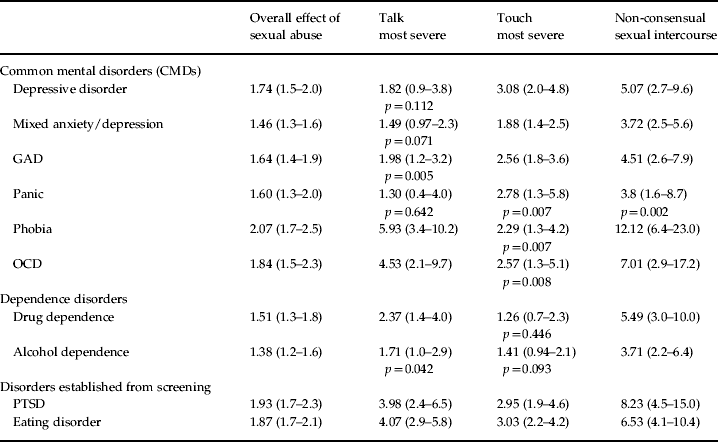
Table 1 lists the weighted prevalence of the chosen disorders so as to provide context to the subsequent analyses. Table 2 presents the overall association of CSA with each disorder, and then the ORs for each individual level denoting the severity of CSA, with ‘no abuse’ as the reference category. (Where no p values are shown, the significance level is <0.0001.) In all cases, the overall association was highly significant (p<0.0001). When we distinguished the different levels of severity, the majority of analyses (18 out of 30) were again significant beyond p<0.0001. In the case of the most severe form of abuse, non-consensual sexual intercourse, all associations were highly significant. The effect of non-consensual touching was non-significant in two disorders (drug and alcohol dependence). Even for uncomfortable sexual talk, the associations were significant for all but depressive disorder, mixed anxiety/depression, and panic. In each disorder, the ORs for non-consensual intercourse were greatest, being particularly large for phobia and symptoms of PTSD. However, our hypothesized severity gradient was less clear when we consider uncomfortable talk and sexual touching. In several disorders, the associated OR was greater for the former than for the latter. The smallest overall associations between abuse and disorder were seen with alcohol and drug dependency, and with mixed anxiety/depressive disorder. The latter is a residual category for cases that do not meet criteria for any other CMD.
The effect of different forms of child sexual abuse (CSA) on adult psychiatric disorder (ORs and 95% confidence intervals)

OR, Odds ratio; GAD, generalized anxiety disorder; OCD, obsessive–compulsive disorder; PTSD, post-traumatic stress disorder.
Reference category: no sexual abuse. p values shown only where they are >0.0001; that is, all others are p<0.0001.
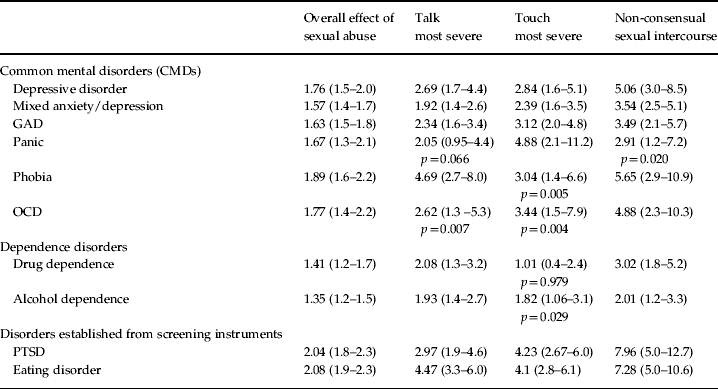
Table 3 presents corresponding analyses for the different forms of ASA. Again the overall associations were all significant beyond p<0.0001. All ORs for non-consensual sexual intercourse were significant at a similar level, except for panic (p=0.02) and alcohol dependence (p=0.007). Non-consensual sexual intercourse was associated with the greatest ORs, for all disorders except panic. In most disorders, the association with uncomfortable talk was less than that with sexual touching.
Adult sexual abuse (ASA) correlates of adult psychiatric disorder (ORs and 95% confidence intervals)

OR, Odds ratio; GAD, generalized anxiety disorder; OCD, obsessive–compulsive disorder; PTSD, post-traumatic stress disorder.
p values shown only where they are >0.0001; that is, all others are p<0.0001.
The ORs varied less with the severity of ASA than in CSA. The association of abuse with alcohol and drug dependence was again the weakest. However, the overall association of abuse with the various disorders was relatively consistent for both CSA and ASA, ranging from 1.35 to 2.1.
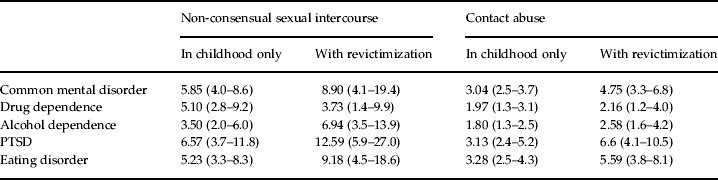
We then analyzed the effects of revictimization (Table 4). We used two definitions of this: in the first, non-consensual sexual intercourse in childhood was repeated in adulthood, whereas the second involved the repetition of childhood contact abuse in adulthood. Whatever the definition, for CMD, and for symptoms of PTSD and eating disorder, the ORs associated with revictimization are approximately double those derived just from childhood abuse. In relation to alcohol dependence, this was only true of abuse involving non-consensual sexual intercourse, and there was relatively little increase in the ORs for contact abuse. There was an anomalous finding in relation to drug dependence: revictimization involving sexual intercourse was in fact associated with a reduction in the OR.
The effect of sexual revictimization on psychiatric disorder (ORs and 95% confidence intervals)

OR, Odds ratio; PTSD, post-traumatic stress disorder.
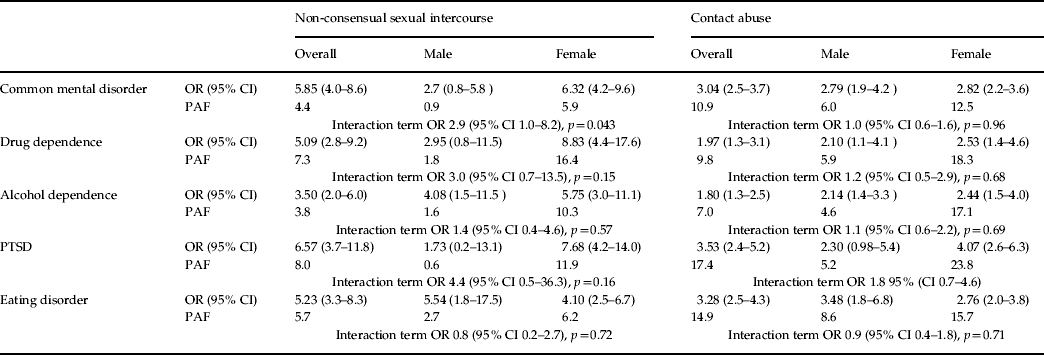
In Table 5 we present the effect of gender on the association between CSA and adult psychiatric disorder. To reduce the number of analyses, we grouped CMDs together, but drug and alcohol abuse, and symptoms of PTSD and eating disorders were analyzed separately. In relation to non-consensual sexual intercourse, the ORs in females were very considerably greater than in males for every condition except eating disorder. Indeed, in males the ORs are non-significant in relation to non-consensual sexual intercourse for CMD, drug dependence and PTSD. For PTSD, this was also the case for contact abuse. There was generally much less effect of gender in relation to contact abuse.
The effect of gender on the association between child sexual abuse (CSA) and adult psychiatric disorder

OR, Odds ratio; CI, confidence interval; PAF, population attributable fraction (%); PTSD, post-traumatic stress disorder.
However, despite the suggestive ORs, formal testing for moderation suggested that gender moderates the impact of CSA only in relation to CMDs, and then only for non-consensual sexual intercourse.
Values for the PAF are also presented in Table 5. This measure effectively combines the frequency of sexual abuse with its impact at the individual level to represent the relationship between sexual abuse and psychiatric disorder at the population level. Because CSA is less frequent in males, and the ORs are smaller, PAF values generally increase the discrimination between males and females. In fact, non-consensual sexual intercourse accounts for little attributable risk in males for any of the disorders, and the PAF is many times greater in females. Because contact abuse is more common than non-consensual sexual intercourse, it is associated with higher PAFs. Indeed, nearly a quarter of cases of PTSD in females can be attributed to the experience of contact abuse in childhood. The highest PAF in males is for eating disorder, whether in relation to non-consensual intercourse or to contact abuse.
It should be noted that our primary presentation is of results unadjusted for sociodemographic attributes. This is because the prevalence of our sexual abuse measures did not vary significantly with sociodemographic status, apart from gender and age (Bebbington et al., in press). Adjustment should therefore be unnecessary. However, to ensure that this assumption was valid, we reran the analyses presented here after adjusting for social class, educational level, ethnicity, and level of household income. This adjustment made no difference to the results: sexual abuse remained a strong determinant of these disorders. Because reports of sexual abuse decrease significantly with the age of the respondent (Bebbington et al., in press), we conducted separate analyses controlling just for age. Again, this had no effect on the strength of the association between sexual abuse and any of the psychiatric disorders analyzed.
Discussion
Sample limitations
This is the third household survey in the British National Psychiatric Morbidity program (Jenkins et al. Reference Jenkins, Meltzer, Bebbington, Brugha, Farrell, McManus and Singleton2009). Over the 14 years separating these surveys, the response rate has declined progressively from 80% to 57%. This reduction has been found in other population surveys (e.g. Kessler et al. Reference Kessler, McGonagle, Zhao, Nelson, Hughes, Eshleman, Wittchen and Kendler1994, Reference Kessler, Berglund, Demler, Jin and Walters2005; Tolonen et al. Reference Tolonen, Helakorpi, Talala, Helasoja, Martelin and Prattala2006). It leads to concerns that samples may be increasingly unrepresentative of the populations from which they are drawn. However, both risk estimates and the associations of disorder with predictors are, at least sometimes, relatively insensitive to response rates that would have until recently been regarded as poor (Batty & Gale Reference Batty and Gale2009; Bergman et al. Reference Bergman, Ahlberg, Forsell and Lundberg2010). In response to these potential worries, we conducted a sensitivity analysis of the effect of response rate on the prevalence of sexual abuse. We divided the whole sample into two by the response rate seen in individual regions. We then compared the ‘any sexual abuse’ CAPI question by this new locational variable, both weighted and unweighted. There was no significant association between location and prevalence. Nor was this due to lack of statistical power: the unweighted prevalences of abuse were close in lower and higher responding areas (5.5% and 4.9%, respectively, p=0.283).
Methodological aspects
Sexual abuse is a sensitive topic, and concerns about the accuracy of reportage, in particular under-reporting, must be taken seriously. Fergusson et al. (Reference Fergusson, Horwood and Woodward2000) assessed the stability of reports of CSA over a 3-year gap. They concluded that people who had not been abused did not falsely report that they had been, but that people who had been abused did not report it every time they were asked. As a result, false negatives may reach 50%. However, this did not materially affect estimates of the relative risk of associated psychiatric disorders (Fergusson et al. Reference Fergusson, Horwood and Woodward2000).
Nevertheless, sensitivity is likely to vary with time, and possibly with age. In addition, not everyone is equally subject to embarrassment or discomfiture. Some of the more minor forms of abuse might be forgotten, discounted or repressed with increasing age and changing perspective. Our category of uncomfortable sexual talk might be an example of this. By contrast, non-consensual sexual intercourse is clearly abuse, and an almost universally illegal one. It is thus more likely to be under-reported than forgotten, and its acknowledgement will depend to an extent on the method of enquiry. The 2007 APMS involved deliberate and strenuous efforts to maintain the quality of information in sensitive areas of the interview, including stressing confidentiality and interviewing participants alone where feasible. In addition, there are particular advantages to CASI. Thus, getting people to complete the questionnaire themselves on a laptop computer and making them aware that the interviewer would have no access to the answer was intended to encourage frankness.
Although the information about abuse and disorder was obtained at a single point in time, in the overwhelming majority of cases CSA ostensibly predates what are, after all, current disorders. For CSA, a causal inference is therefore more defensible than for ASA. It is still subject to the caveat of systematic distortion of reportage, in whatever direction, by people with mental disorders. However, as we pointed out above, they are generally reliable informants.
The issue of repeated abuse is of considerable importance. Because of time constraints on the interview, we were unable to enquire about repeated abuse during childhood. Our measures of revictimization are therefore based on repetition of childhood abuse when the victim is adult (defined as being ⩾16 years old). During adulthood, there is an increased likelihood of reverse causality, as people are at greater risk of sexual exploitation after they have developed psychiatric disorders (Romito & Gerin, Reference Romito and Gerin2002). This should be borne in mind.
Finally, a distinction must be made in relation to PTSD and eating disorders. As described above, these were based on screening scores. This is likely to increase the prevalence obtained. However, it is reasonable to assume that the cases identified in this way share qualities with those that would have been derived from more extended clinical assessment.
Findings
Our results confirm that both CSA and ASA are strongly associated with a wide range of psychiatric disorders. This relationship is dose related, in two ways. First, in every psychiatric disorder, the highest ORs were associated with the group reporting sexual intercourse without consent, clearly the most traumatic form of sexual abuse experience. However, we expected higher ORs for sexual touching than for uncomfortable sexual talk. This was sometimes the case, but with no overall consistency, perhaps because uncomfortable talk may be just as disturbing to the victim as the physical intrusion of touching. Others have found the severity of abuse in childhood increases the risk of adult psychiatric morbidity (Mullen et al. Reference Mullen, Martin, Anderson, Romans and Herbison1993; Kendler et al. Reference Kendler, Bulik, Silberg, Hettema, Myers and Prescott2000, Reference Kendler, Kuhn and Prescott2004; Bulik et al. Reference Bulik, Prescott and Kendler2001; Anda et al. Reference Anda, Felitti, Bremner, Walker, Whitfield, Perry, Dube and Giles2006).
Second, revictimization was associated with an increased frequency of disorder. The exception was in the case of repeat non-consensual sexual intercourse in relation to drug dependence. The combination of non-consensual sexual intercourse before 16 with later repetition generally showed the strongest associations; this was particularly marked in relation to symptoms of PTSD and eating disorder, with ORs of 12.6 and 9.2 respectively.
In general, males are reported to respond less severely than females to given levels of trauma (Tolin & Foa, Reference Tolin and Foa2006; Koenen & Widom, Reference Koenen and Widom2009). It might therefore be expected that the psychiatric disorder/sexual abuse relationship is moderated by gender. In our data, the ORs in relation to non-consensual sexual intercourse were much higher in women in all conditions except eating disorder. The effect of sexual abuse was particularly large for symptoms of eating disorder, but, if anything, the effect of CSA was greater in men than in women. However, formal tests of moderation were only significant for CMDs. The failure to demonstrate moderation elsewhere may represent a Type II error, as considerable statistical power is required to demonstrate interaction terms.
Although ORs provide a measure of the strength of the association between abuse and psychiatric disorder, the PAF represents the proportion of psychiatric disorders that can be ascribed to exposure to sexual abuse. In theory, the PAF indicates how much the prevalence of psychiatric disorder would be reduced if no sexual abuse occurred in the population. As such, it is dependent both on the prevalence of the exposure to sexual abuse in the population and the strength of the association of sexual abuse with disorder. Given that sexual abuse is more common in females (Bebbington et al., in press), the distinction between males and females should be enhanced by using the PAF. This was so for all conditions studied, including symptoms of eating disorder. In other words, at a population level, sexual abuse has a much more important bearing on psychiatric disorder in women than in men. Perpetrators are usually men, and the sensitivity of women to abuse may reflect power relationships between the genders in society at large.
However, the CSA relationship is remarkably non-specific. Others have shown associations with multiple adult psychiatric conditions, including depression, anxiety disorders, personality and eating disorders, substance abuse, suicidal behavior, and psychosis (Polusny & Follette Reference Polusny and Follette1995; Dinwiddie et al. Reference Dinwiddie, Heath, Dunne, Bucholz, Madden, Slutske, Bierut, Statham and Martin2000; Kendler et al. Reference Kendler, Bulik, Silberg, Hettema, Myers and Prescott2000; Bulik et al. Reference Bulik, Prescott and Kendler2001; Molnar et al. Reference Molnar, Buka and Kessler2001; Putnam, Reference Putnam2003; Bebbington et al. 2004,Reference Bebbington, Cooper, Minot, Brugha, Jenkins, Meltzer and Dennis2009; Nelson et al. Reference Nelson, Heath, Lynskey, Bucholz, Madden, Statham and Martin2006; Weich et al. Reference Weich, Patterson, Shaw and Stewart-Brown2009 a). We need to explain why so many different disorders are associated with the same putative etiological agent. Candidates include the frequent co-morbidity between the disorders we studied, and the possibilities that there are multiple pathways linking sexual abuse to different disorders, or that the pathways underpinning the increased risk are operative in many psychiatric conditions. The considerable co-morbidity in our sample has been analyzed in detail by Weich et al. (Reference Weich, Hussey, Pickup, Purdon, McManus, McManus, Meltzer, Brugha, Bebbington and Jenkins2009 b), and its effects on the relationship between sexual abuse and psychiatric disorder will be examined elsewhere.
The association between abuse and PTSD in APMS 2007 is a special and interesting case because of the way it was assessed: PTSD was identified only in relation to adult traumas. Such traumas could, in principle, be instances of ASA. However, if there is, as we demonstrated, a link between CSA and PTSD, this must arise because the CSA has changed the rate of exposure to trauma in adulthood, or the level of response to it in terms of PTSD symptoms. The symptoms cannot be the persistent consequences of the childhood trauma.
Sexual abuse in childhood will generally precede the development of psychiatric conditions identified in adulthood. Thus there must be some mediator linking the abuse with the onset of disorder, often at a considerable remove of time. Likely candidates are mentally intrusive reminders of the abusive experience, psychological processes involving attitudes and beliefs, propensities towards mood disturbance in the face of subsequent experience, and styles of coping that may impair the processing of the original abuse. CSA has extreme adverse effects on self-esteem, self-blame and psychological well-being (Mannarino & Cohen, Reference Mannarino and Cohen1996; Kamsner & McCabe, Reference Kamsner and McCabe2000; Banyard et al. Reference Banyard, Williams and Siegel2001; Murthi & Espelage, Reference Murthi and Espelage2005). People who have been sexually abused often display avoidant coping, which then links to the later development of various psychiatric disorders (Cortes & Justicia, Reference Cortes and Justicia2008; O'Leary, Reference O'Leary2009). Abuse may also modulate the physiological stress response in deleterious ways (Driessen et al. Reference Driessen, Herrmann, Stahl, Zwaan, Meier, Hill, Osterheider and Petersen2000; Heim et al. Reference Heim, Newport, Miller and Nemeroff2000; Read et al. Reference Read, van Os, Morrison and Ross2005; Spauwen et al. Reference Spauwen, Krabbendam, Lieb, Wittchen and van Os2006). Finally, it may create vulnerabilities to later damaging exploitation.
Our results showed that CSA was followed by a significant increase in the risk of ASA. Fifty per cent of those who had experienced abuse under 16 also reported an episode over the age of 16. This revictimization certainly seems to increases the risk of psychiatric disorder over and above the occurrence of childhood abuse alone, as others have found (Gold et al. Reference Gold, Sinclair and Balge1999; Classen et al. Reference Classen, Palesh and Aggarwal2005). The increased risk might be the direct effect of the further abuse. Alternatively, revictimization might merely be a marker of the severity or impact of the original abuse. Of interest, the same psychological attributes predictive of disorder following CSA may also be predictive of revictimization, thus contributing to a malign spiral (Fortier et al. Reference Fortier, DeLillo, Messman-Moore, Peugh, DeNardi and Gaffey2009). Moreover, avoidance of physical and emotional reminders of trauma may interfere with learning about safety judgments, and place the abused person at risk of further victimization (Fortier et al. Reference Fortier, DeLillo, Messman-Moore, Peugh, DeNardi and Gaffey2009). Finally, symptoms of PTSD, depression and anxiety increase vulnerability for revictimization in prospective studies (Messman-Moore et al. Reference Messman-Moore, Brown and Koelsch2005, Reference Messman-Moore, Ward and Brown2009).
Our findings have important clinical implications, first from the sheer prevalence of abuse, and second from the wide range of disorders associated with it. In ordinary clinical practice, it is not routine to ask detailed questions about sexual abuse. As others argue (Read et al. Reference Read, van Os, Morrison and Ross2005), it should be. People who have experienced sexual abuse are often identified by social services and through the criminal justice system, and there is increasing awareness in schools and in primary care. If mediating psychological processes are also maintenance factors, targeting them will have beneficial effects both in treatment and in secondary prevention. Thus, the psychological consequences of abuse may be dealt with before psychiatric disorders emerge, with new treatment developments including rescripting as part of cognitive behavioral therapy approaches (Holmes et al. Reference Holmes, Arntz and Smucker2007; Linden & Zehner, Reference Linden and Zehner2007).
Acknowledgements
E.K. has received funding for some clinical sessions from the National Institute of Health Research (NIHR) Biomedical Research Centre for Mental Health at the South London and Maudsley National Health Service (NHS) Foundation Trust, and the Institute of Psychiatry, King's College London.
Declaration of Interest
None.