Introduction
For effective responses to emergencies, individuals must have the ability to respond and also be willing to participate in the response.Reference McCabe, Barnett and Taylor 1 A growing body of research points to gaps in response willingness among several occupational cohorts with response duties,Reference Errett, Barnett and Thompson 2 - Reference Chaffee 6 including the Emergency Medical Services (EMS) workforce.Reference Dimaggio, Markenson and T Loo 7 , Reference Barnett, Levine and Thompson 8 When individuals do not report to work during an emergency, they increase the response burden for those who are present, potentially compromising the quality and effectiveness of the response.
Willingness to respond becomes particularly important during an influenza or other pandemic, due to increased demands on emergency health workers (eg, distribution and administration of vaccines) and the potential for workforces to be depleted if responders contract influenza or stay home to care for sick dependents. Recent studies have confirmed meaningful disparities in response willingness during an influenza pandemic among varied responder cohorts.Reference Devnani 9 , Reference Barnett, Balicer and Thompson 10 For example, a study of local health department workers in Florida (USA) found that approximately 29% were not willing to report to work during the peak period of an influenza pandemic if their responsibilities included face-to-face contact.Reference Basta, Edwards and Schulte 11 In a survey of hospital workers in Maryland (USA), 28% were not willing to report to work during an influenza pandemic if asked.Reference Balicer, Barnett and Thompson 12 Among health care workers from varied sectors (eg, hospitals and home health care agencies) in Washington State (USA), 11% indicated that they would not report to work during an influenza pandemic.Reference Stergachis, Garberson and Lien 13
While EMS workers are generally more willing to respond during an influenza pandemic than other responder cohorts, gaps in willingness remain. A survey of Australian prehospital emergency medical workers found that 89% were very anxious about working during an influenza pandemic.Reference Watt, Tippett and Raven 14 Barnett et al reported similar findings: 12% of US EMS workers would not report to work if asked to do so during an influenza pandemic, and seven percent would not report to work if required.Reference Barnett, Levine and Thompson 8 These findings are especially worrisome given the critical role that EMS workers play during an influenza pandemic; they may be responsible for prehospital care, including patient triage, administration of vaccinations and antiviral medications, and management of resources.Reference Catlett, Jenkins and Millin 15
Studies have confirmed the potential for certain policies to influence response willingness during emergencies. For example, during an influenza pandemic, absenteeism among hospital workers may be diminished if individuals are granted preferential access to personal protective equipment or pharmaceuticals.Reference Garrett, Park and Redlener 16 Similar findings have been documented for members of the public health workforce and EMS workers.Reference Barnett, Thompson and Errett 5 , Reference Barnett, Levine and Thompson 8 , Reference Basta, Edwards and Schulte 11
Laws can be used to codify informal policies known to impact response willingness, such as preferential access to vaccines for responders during a novel infectious disease pandemic. These laws could take several forms, including a public health emergency declaration at the state level, with consequent implementation of a public health emergency response plan. State law also can codify specific protections or benefits for emergency responders. Although the association of institutions’ informal policies and willingness to respond among vital responder cohorts, such as EMS workers, has received some attention, little is known about the effect of variations in state codified law on willingness to respond in US or other contexts.
This study examined the association between three state-level emergency preparedness laws ((1) ability to declare a public health emergency; (2) requirement to create a public health emergency plan; and (3) priority access to health resources for responders) and EMS workers’ self-reported willingness to respond during an influenza pandemic. The hypothesis that there would be an association between presence of the state-level emergency preparedness laws of interest and willingness to respond among EMS workers was based on previous research.Reference Barnett, Thompson and Errett 5 , Reference Chaffee 6 , Reference Barnett, Levine and Thompson 8 , Reference Devnani 9 , Reference Balicer, Barnett and Thompson 12
Methods
Study Subjects and Design
The National Registry of Emergency Medical Technicians (NREMT, Columbus, Ohio USA), a national EMS certification organization, maintains a database of US EMS workers, including emergency medical responders, emergency medical technicians (EMTs), advanced EMTs, and paramedics. The NREMT annually administers the Longitudinal EMT Attributes and Demographics Study (LEADS). The survey is sent to a nationally representative sample of EMS workers, drawn from the NREMT database. The survey includes 77 items that gather longitudinal information about demographics, rural vs nonrural work/residential location, professional experience, and health topics. The LEADS survey also includes a snapshot survey, modified annually, to gather data about specific topics, such as sleep problems or compensation and benefits.
The NREMT also may elect to field a mid-year survey, which is mailed to those who completed the most recent LEADS survey. Mid-year surveys reflect recommendations from an NREMT-appointed steering committee of EMS workforce researchers. This committee collaborated with the Johns Hopkins Preparedness and Emergency Response Research Center (Baltimore, Maryland USA) to develop a mid-year survey about pandemic influenza in 2009. The survey, which included questions about willingness to respond to an influenza pandemic, was sent to 1,537 individuals who completed the LEADS survey in 2008. The survey's response willingness questions were derived from the Johns Hopkins-Public Health Infrastructure Response Survey Tool (JH-PHIRST).Reference Barnett, Balicer and Thompson 10 For example, respondents were asked to rate their agreement with the following statement: “If I were required by my agency to report to duty in a pandemic flu emergency, I would report.” The mid-year survey was fielded from May 15, 2009 through June 30, 2009 via a mailed survey and accompanying explanatory letter.
Data from the 2009 mid-year survey were merged with data about the presence or absence of three types of emergency preparedness laws in each of the 50 US states: (1) laws that grant states the ability to declare a public health emergency; (2) laws that require states to create a public health emergency plan; and (3) laws that give first responders priority access to health resources, such as vaccines. The process of creating the legal data set has been described in detail elsewhere.Reference Rutkow, Vernick and Gakh 17 In brief, accepted public health law research methods were used to conduct a comprehensive search of state law in all 50 US states for the three laws of interest.Reference Wagenaar and Burris 18 Binary variables were used to indicate the presence or absence of the three laws in each state in 2009. Information regarding the number of federal disaster and emergency declarations by state also was identified for the data set. 19 Each survey respondent provided his or her zip code, which was matched to US census information regarding local poverty level by zip code tabulation areas. 20 , 21 These poverty level percentages were based on 5-year annualized estimates from the 2005-2009 American Community Survey. 22 This information was included to account for the possibility that emergency medical workers serving communities with fewer resources might face additional response challenges.
The American Institutes for Research (Washington, DC USA) Institutional Review Board approved this study and determined that it presented no more than minimal risk.
Statistical Analyses
Demographic questions and willingness to respond statements were formatted as binary variables. The willingness to respond variables indicate a respondent's agreement vs disagreement with the statements. These data were then merged with the percent poverty level, number of federal emergency and disaster declarations, and presence of laws data as described above. Two response willingness contexts were included: willingness to respond if required, and willingness to respond if asked but not required. To enable comparability of the respondent populations included across all analyses, an analysis data set was extracted from the LEADS data set to include respondents with complete data on the variables of interest. Missing data rates for the willingness to respond outcomes were two percent. Gender and organization type had the most missingness (10% and 13%, respectively). The remaining predictors had missingness rates ranging from zero through four percent. Statistical weights were only available for the complete data set, and thus, were not used with the analysis data set.
The distributions of each characteristic in the complete data set and those in the analysis data set were compared. Summary statistics were calculated for the response willingness questions and the predictors of interest. Three types of logistic regression analyses were then performed for each response willingness scenario as the dependent variable. The first type was a univariate analysis with each covariate. The second type of analysis was a full model, which included the presence of one of the laws of interest as the primary predictor, and was adjusted for the following covariates: gender, age, highest education level completed, presence of family dependents, organization type, practice type, years of experience, knowledge of pandemic influenza, locale, percent of population below the poverty level, and number of federal disaster or emergency declarations. The third type of analysis was a more parsimonious model that included the presence of the law of interest and a subset of covariates selected from the full model on the basis of a P ≤ .25 association with the outcome. Analyses were performed with STATA version 13.1 (STATACorp LP, College Station, Texas USA).
Results
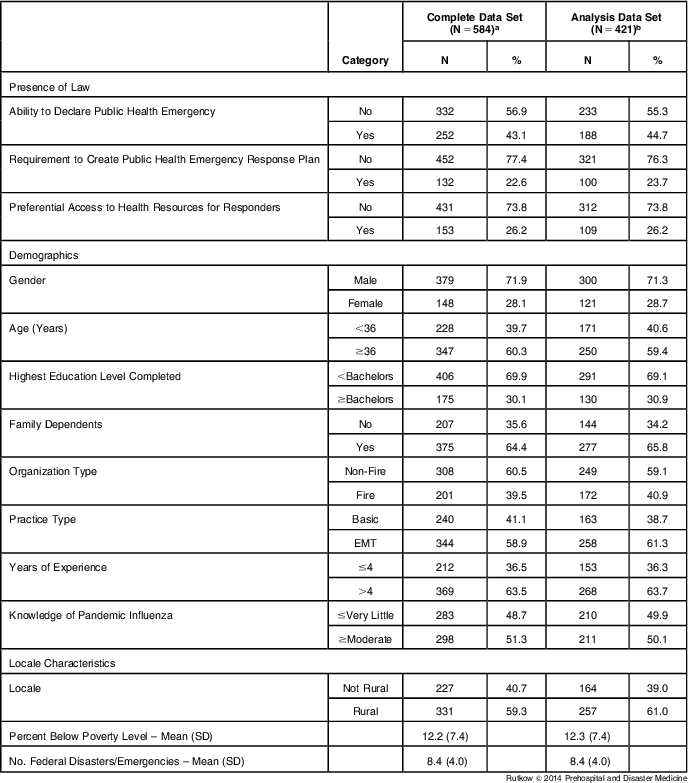
Of the 1,537 EMS workers who completed the 2008 LEADS survey, 753 (49%) responded to the 2009 mid-year survey. Five hundred eighty-six respondents indicated that they primarily provided clinical EMS services. Within this subgroup, 421 had complete data for all study variables. The majority of these were male (n = 300, 71%), older than 36 years of age (n = 250, 59%), held less than a bachelor's degree (n = 291, 69%), had family dependents (n = 277, 66%), worked for a non-fire emergency organization (n = 249, 59%), were EMTs (n = 258, 61%), had more than four years of EMS work experience (n = 268, 64%), and lived or worked in a rural location (n = 257, 61%) (Table 1). The mean percent of the population living below the poverty level in respondents’ locales was 12.3 (SD = 7.4). The mean number of federal emergencies and disasters declared during the previous five years across respondents’ states was 8.4 (SD = 4.0). Participants in the analysis sample did not significantly differ from those excluded from the sample on any characteristics.
Characteristics for Full and Analysis Data Sets

Abbreviation: EMT, emergency medical technician.
aExcludes two cases that did not have zip codes matchable to zip code tabulation areas.
bRespondents with no missing data for willingness to respond statements, demographics, and locale characteristics.
Overall, 188 respondents (45%) lived in a state with a law that permitted a governmental declaration of public health emergency. One hundred (24%) lived in a state with a law that required the state to develop a public health emergency plan. One hundred and nine (26%) lived in a state with a law that granted responders priority access to health resources (eg, vaccines).
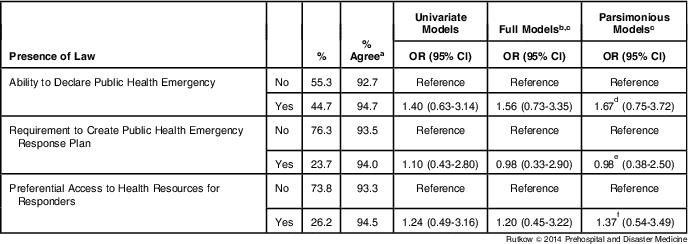
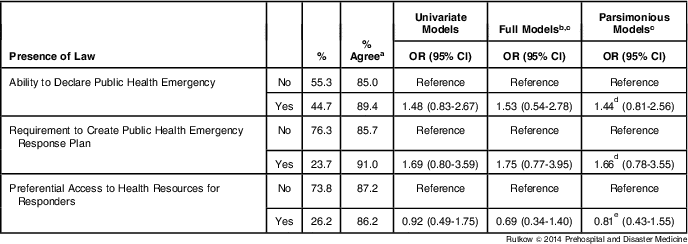
Compared to respondents who lived in states that did not allow the government to declare a public health emergency, those in states that permitted declarations were slightly more likely to agree that they would report to work during an influenza pandemic if required (95% vs 93%). In unadjusted analyses, however, this difference was not statistically significant (OR = 1.4; 95% CI, 0.63-3.14; P = .41). The adjustment for potential confounders showed similar ORs and statistical significance levels (Table 2). Similarly, there was no association between willingness to respond if required and state laws that required the development of a public health emergency plan or state laws granting responders priority access to health resources. Similar results were found for analyses that used willingness to respond if asked but not required as the outcome (Table 3). For example, compared to respondents in states that did not allow for a governmental declaration of public health emergency, those in states that permitted declarations were slightly more likely to agree that they would report to work during an influenza pandemic if asked (89% vs 85%). This difference was not statistically significant in unadjusted analyses (OR = 1.5; 95% CI, 0.83-2.67; P = .19) and lack of significance did not change after adjustment for potential confounders.
Models of Association Between Self-reported Willingness to Respond if Required and Presence of State Laws

aAgreement with willingness to respond if required.
bAdjusted for gender, age, highest education level completed, presence of family dependents, organization type, practice type, years of experience, knowledge of pandemic influenza, locale, percent poverty level in respondent's locale, and number federal disasters/emergencies in respondent's state.
cEach model includes the presence/absence of only one law as the primary predictor.
dAdjusted for practice type, number federal disasters/emergencies, and locale.
eAdjusted for practice type, and locale.
fAdjusted for organization type, practice type, and locale.
Models of Association Between Self-reported Willingness to Respond if Asked, but Not Required and Presence of State Laws

aAgreement with willingness to respond if asked, but not required.
bAdjusted for gender, age, highest education level completed, presence of family dependents, organization type, practice type, years of experience, knowledge of pandemic influenza, locale, percent poverty level in respondent's locale, and number federal disasters/emergencies in respondent's state.
cEach model includes the presence/absence of only one law as the primary predictor.
dAdjusted for percent poverty level, and locale.
eAdjusted for age, education, percent poverty level, and locale.
Respondents who lived in states with either one vs two or more laws of interest were no more likely to be willing to respond to a pandemic influenza emergency, if required or if asked, than respondents in states with no laws of interest (P > .05). A sensitivity analysis was used to investigate the effect of including the presence vs absence of all three laws in regression models. When all three laws were included simultaneously in the model, none were significantly associated with willingness to respond if required or if asked (data not shown).
Discussion
Willingness to respond plays a vital role in ensuring quality emergency responses within the public health and health care systems.Reference McCabe, Barnett and Taylor 1 - Reference Dimaggio, Markenson and T Loo 7 If individuals are not willing to respond when an event such as pandemic influenza occurs, the burden on those who do report to work dramatically increases and affected individuals may not receive timely care and medical services. It is therefore important to identify governmental opportunities to increase willingness to respond among emergency response personnel in the US and other countries, particularly because countries and regions vary in the extent to which they require emergency personnel to respond during disasters. 23 The laws that were considered represent best practices for public health preparedness, as they are either included in the Model State Emergency Health Powers Act 24 or are recommended by the Centers for Disease Control and Prevention (Atlanta, Georgia USA) Advisory Committee on Immunization Practices. 25 Despite this, the analysis of a large, US-based cohort of EMS workers found that the presence of state-level laws permitting the declaration of a public health emergency, requiring the development of a public health emergency response plan, and granting responders priority access to health resources were not associated with willingness to respond.
In general, EMS workers have a high baseline level of response willingness, particularly when compared to other responder cohorts (eg, public health workers).Reference Barnett, Thompson and Errett 5 , Reference Balicer, Barnett and Thompson 12 Because the nature of EMS work inherently requires willingness to respond, the presence of certain state-level laws may not be enough, by itself, to meaningfully influence response willingness in this population. Among other responder cohorts with lower baseline rates of response willingness, however, state-level emergency preparedness laws may have a greater effect.
These findings also may be attributed to a discrepancy between the actual and perceived legal environment by EMS workers. In a study of the local public health and emergency management workforces, Jacobson and colleagues found that knowledge and perception of emergency preparedness laws varied greatly, with “a clear disconnect” between the actual legal environment (ie, codified law and accompanying regulations) and individuals’ perceptions or interpretations of the law.Reference Jacobson, Wasserman and Botoseneanu 26 This raises several implications for the study: (1) EMS workers may have been unaware of the presence of the emergency laws considered in this analysis; (2) EMS workers may have been aware of the laws, but did not fully appreciate or misunderstood their ramifications; and/or (3) EMS workers may have believed certain laws were in place when, in fact, they were not. These discrepancies could be due to several factors, including states’ failure to publicize or implement the laws of interest. It is also possible that, even if the laws were implemented and well understood, they did not affect willingness to respond. Future studies should seek to better understand EMS workers’ perceptions and experiences with emergency preparedness laws in US and international settings.
Limitations
This study's findings should be interpreted in light of its limitations. The 49% mid-year survey response rate introduces concerns about nonresponse bias. This response rate is consistent with previous studies of response willingness among the EMS workforce,Reference Dimaggio, Markenson and T Loo 7 however, and nonresponders to the LEADS survey are demographically comparable to responders.Reference Brown, Dickison and Misselbeck 27 Also, because the LEADS survey weights were not used, study results may not generalize to the entire US EMS workforce. Future studies in representative samples are needed to replicate these results. In addition, although the laws of interest were not associated with willingness to respond, this may have been due to limited power to detect these differences. Because these associations have not been investigated previously, there is not a standard against which to judge whether this study was powered to detect these associations. Studies with larger samples would help clarify this issue. Finally, there are limited types of emergency preparedness laws that have sufficient variation among the 50 states to permit their systematic study. Three were investigated in the present study. Two other laws were considered (laws providing liability protections for responders and laws facilitating intra-state collaboration during emergencies) but they are present in all 50 states, and therefore, could not be used to analyze variation in state-specific willingness to respond. Similarly, there are known responder concerns that are not yet addressed by existing laws (eg, priority access to health services for responders’ families).Reference Barnett, Levine and Thompson 8 , Reference Devnani 9 , Reference Garrett, Park and Redlener 16 If laws were to address these concerns, they might have a significant effect on willingness to respond. Despite these limitations, to the authors’ knowledge, this study is the only systematic analysis of laws’ influence on response willingness within the EMS workforce.
Conclusion
This study found no association between the presence of certain emergency preparedness laws and willingness to respond during an influenza pandemic among EMS workers. While it is possible that these laws have no effect on response willingness, recent research suggests that inconsistencies between the perceived and objective legal environments for EMS workers could be another explanation. This discrepancy could be addressed through educational efforts within the EMS workforce and through more prominent state-level implementation of these laws. Such approaches are important steps toward determining whether state-level emergency preparedness laws are an effective tool to promote response willingness among the EMS workforce.