I. INTRODUCTION
Acid catalysts have been widely used in many industrial processes for producing chemicals.Reference Clark1 Although various types of acids including HCl, H2SO4 and organic acids are effective for the acid-catalyzed reactions, the systems still suffer from major drawbacks such as reactor corrosion, catalyst recycling and post-treatment of waste effluent.Reference Li, Ikura and Ishizaki2 With the development of green chemical processes that are highly demanded due to the environment protection, strong solid acids including transition-metal oxide,Reference Miao, Zhou, Zhao, Liu, Bi, Chou and Zhuo3 heteropoly acids,Reference Lu, Sun and Huo4 polymersReference Mao, Cao, Zhang and Zhang5 and carbon-based acid catalystsReference Van Chuc, Ngoc Quynh, Mascunan, Thi Thu Ha, Fongarland and Essayem6–Reference Thushari and Babel8 with high performance and low production cost are required with an aim of avoiding the corrosion and environmental problems associated with the traditional liquid-like acidic catalysts.Reference Cheng, Qiu, Zhang, Huang, Yang and Fan9,Reference Shanhui Zhu and Fan10 Of the solid acid catalysts explored thus far, sulfonated carbon materials including active carbons,Reference Li, Ikura and Ishizaki2,Reference Santos, de Carvalho Teixeira, da Silva, Cibaka, Araujo, Coelho Oliveira, Medeiros, Brasil, de Oliveira and Lago11 carbon nanotubesReference Guan, Li, Chen, Shi, Gu, Li, Miao, Chen and Ning12 and grapheneReference Zhang, Liao, Mei, Liu, Tang, Fei, Chen, Cui, Liu and Qiao13–Reference Liu, Sun, Zhu, Meng, Qi and Xiao15 have been found to be of potential as highly active yet stable protonic acid catalysts for various acid-catalyzed reactions, such as esterification,Reference Thushari and Babel7,Reference Valle-Vigon, Sevilla and Fuertes16,Reference D’Souza, Vats, Chattree and Siril17 condensation,Reference Liu, Sun, Zhu, Meng, Qi and Xiao15 hydrationReference Okamura, Takagaki, Toda, Kondo, Domen, Tatsumi, Hara and Hayashi18 and hydrolysis.Reference Li, Ikura and Ishizaki2,Reference Wataniyakul, Boonnoun, Quitain, Sasaki, Kida, Laosiripojana and Shotipruk19 The preparation of carbon-based acid catalysts process in most cases requires a high concentration of sulfuric acid or fuming sulfuric at a high temperature, making the process severely energy intensive and environmentally unfriendly.Reference Wataniyakul, Boonnoun, Quitain, Sasaki, Kida, Laosiripojana and Shotipruk19 Sometimes a low S content can be obtained after the sulfonation process due to the lack of active sites on the carbon surface for functionalization.Reference Stellwagen, van der Klis, van Es, de Jong and Bitter20 To promote the application of solid acid catalysts, the development of a new environmentally friendly route to prepare the carbon-based acid catalysts is highly desirable.
Graphene, a one-atom thick sheet made of hexagonally arrayed sp 2-bonded carbon atoms, is the thinnest material with extraordinary mechanical, electrical, thermal, chemical, and optical properties, and may be used as as an ideal support for various functional groups to tune the structure and catalytic performance of graphene.Reference Allen, Tung and Kaner21–Reference Yu, Cheng, Zhang, Zhao, Qu and Shi24 Graphene is the very appealing plat material to be sulfonated in virtue of the structural merits with considerable solubility. Recently, there are some reports on the preparation of graphene-based solid acid catalysts with a high S content on the graphene surface. For example, sulfated graphenes can be synthesized by anchoring the sulfonic acid-containing aryl radicals on graphene,Reference Cheng, Qiu, Zhang, Huang, Yang and Fan9,Reference Ji, Zhang, Chen, Wang, Zhang, Zhang and Fan25 by sulfonating the graphene in Ar with chlorosulfonic acidReference Wang, Wang, Zhang and Tian14 or modified graphene with Oleum under harsh conditions.Reference Mukherjee, Kang, Kuznetsov, Sun, Thaner, Bratt, Lomeda, Kelly and Billups26
In situ polymerization is an effective way to construct a nanocomposite material. This method affords a unique way to bond an initiator on the graphene surface by a chemical reaction and then to use the initiator to trigger an in situ chain growth of the monomers to form a polymer grafted graphene.Reference Mylvaganam and Zhang27,Reference Wu, Xu, Zhang, Chen, Gao and Liu28 Herein, we report a green synthesis method for making graphene-based solid acid catalysts (PSS-RGO) by in situ polymerization of sodium p-styrenesulfonate (NaSS) under controllable and mild conditions. This strategy has its own advantages compared with the previous reports. First, the NaSS could be polymerizd and grafted to graphene in one step under mild conditions. Second, graphene sheets can be used as flat backbones to produce graphene-based molecular brushes by in situ polymerization, which along with the in situ chain growth of the monomers, abundant sulfonate groups could be grafted to graphene sheets. Third, the polymer chains could well maintain the stability of graphene sheets in solution, increasing the accessibility of the reagents to the active sites.Reference Mylvaganam and Zhang29,Reference Kan, Xu and Gao30 The catalytic performance of the as-made PSS-RGO solid acid catalysts was evaluated with the hydrolysis of ethyl acetate and the esterification of acetic acid with ethanol as the probe reactions. It has been found that the as-made PSS-RGO solid acid catalysts show excellent catalytic activities for both reactions. The deactivation mechanism involved was also discussed in this paper.
II. MATERIALS AND METHODS
A. Materials
All the reagents were of analytical grade and used as received without any further pretreatment.
B. Preparation of carbon based acid catalysts
Graphene oxide (GO) was prepared from graphite powder by a modified Hummers’ method.Reference Hummers and Offeman31,Reference Kovtyukhova, Ollivier, Martin, Mallouk, Chizhik, Buzaneva and Gorchinskiy32 For a typical run, 5 g of graphite powder, 25 mL of 98% H2SO4, 5 g of K2S2O8 and 5 g of P2O5 were mixed and maintained at 80 °C for 4.5 h under constant stirring, yielding pre-oxidized samples that was washed with water, and then dried at 80 °C for 12 h. The pre-oxidized graphite powder was dispersed in 180 mL of 98% H2SO4, into which 25 g of KMnO4 was added under vigorous stirring, yielding a mixture solution that was kept in ice-water bath for 2 h. 350 mL of water was added to the mixture that was continually stirred for 2 h at 35 °C, then, 500 mL of water 20 mL of H2O2 solution (30 wt%) were added. This resulted in a suspension that was centrifuged to remove the remaining metal ions and sulfuric acid and then freeze-dried before use.
Reduced graphene oxide (RGO) was synthesized by the chemical reduction of GO (100 mg) with 100 μL of 80% hydrazine hydrate at 95 °C for 24 h.
For preparation of carbon based acid catalysts, The as-made RGO and 1 g of NaSS were added in 100 mL of deionized water, leading to a mixture solution that was sonicated for 1 h. After being purged with high purity nitrogen for 0.5 h to remove oxygen, 0.02 g of K2S2O8 was added into the mixture solution, which functioned as a radical initiator, and the mixture solution was continually stirred at 65 °C for 48 h and washed with deionized water. The black solid (PNaSS-RGO) was added into 100 mL of 4 M H2SO4 and kept for 12 h, and washed with deionized water to get the final product PSS-RGO. For comparison, PSS-CNTs was prepared by the same method with PSS-RGO. 98% H2SO4 reacted with the prepared RGO at 160 °C for 8 h, the sample was donated as S-RGO. 1 g NaSS and the prepared RGO were dispersed in 100 mL of deionized water for 48 h, the product was exchanged Na+ with H+ to get A-RGO.
C. Catalytic reactions
The hydrolysis of ethyl acetate and the esterification of acetic acid with ethanol were selected as test reactions. All the catalysts were evacuated at 100 °C for 1 h to remove the absorbed water before use. The hydrolysis of ethyl acetate was carried out in deionized water (8 mL) and ethyl acetate (0.49 mL) with 40 mg of catalyst at 70 °C for 6 h. For the esterification of acetic acid with ethanol, 0.98 mL of acetic acid, 17.5 mL of ethanol and 30 mg of catalyst was mixed, and reacted at 70 °C for 6 h. The resulting solution was analyzed by gas chromatography (GC) using a capillary column with dimethyl carbonate as the internal standard.
D. Characterization of the prepared samples
Elemental analysis was conducted on Elemental Analyzer Vario EL III (Elementar, Langenselbold, Germany) by combustion method. A Bruker Equinox 55 Fourier transform infrared spectrometer (FT-IR; Bruker, Karlsruhe, Germany) and the Thermo Nicolet iN10 MX micro FT-IR (Waltham, Massachusetts) were used to obtain the information of functional groups. An Oxford X-MAX 20 mm2/50 mm2 energy dispersive spectrometer (EDS; Oxford Instruments, Abingdon, United Kingdom) was used to get the EDS image of the catalyst. A Philips Tecnai G20 transmission electron microscope (TEM; Philips, Almelo, the Netherlands) was applied to get the transmission electron images of all the samples. The X-ray photoelectron spectroscopy (XPS) measurement was performed with Al Kα excitation (800 eV) on the Thermo ESCALAB 250 (Thermo Scientific, Waltham, Massachusetts) to analyze the surface properties quantitatively. Raman spectra were recorded on a Thermo DRX Raman spectrometer (Thermo Fisher, Waltham, Massachusetts) using He–Ne laser at 532 nm as the light source. 1H Nuclear Magnetic Resonance (1H NMR) spectra were recorded on a Varian Inova 400 spectrometer (Varian Medical Systems, Palo Alto, California) using D2O as solvent. The products of the test reactions were analyzed by HP 6890 GC (Agilent Technologies, Santa Clara, California) using a HP-FFAP capillary column.
III. RESULTS AND DISCUSSION
A. Characterization of PSS-RGO
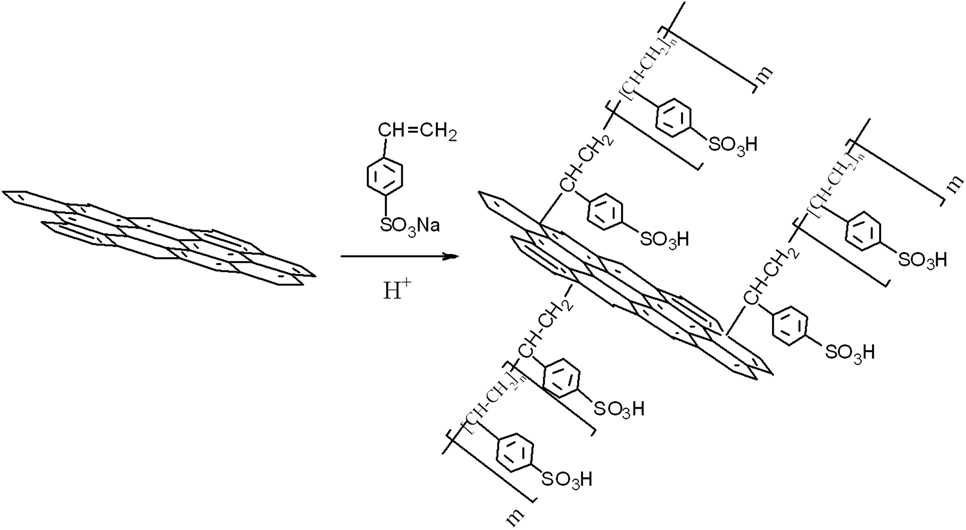
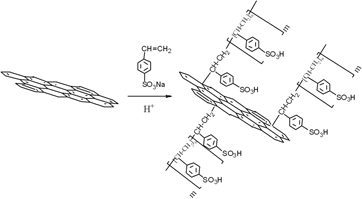
As shown in Fig. 1, the NaSS could be polymerizd and grafted to graphene in one step, and then the Na+ were exchanged by H+ to get the PSS-RGO.
Illustration for the preparation of sulfonated graphene.

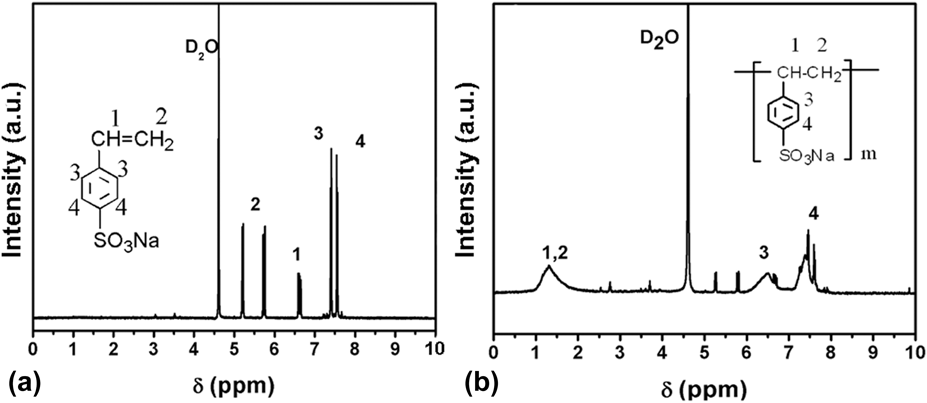
The prepared PSS-RGO sample dispersed well in ethanol, DMF and water (1 mg/mL) compared with raw RGO (Fig. S1). Because of the grafted polymer is same with the free polymer in solvent after polymerization reaction,Reference Kan, Xu and Gao30 the 1H NMR characterization can be used to verify the in situ polymerization of NaSS. Figure 2 shows the 1H NMR spectra of NaSS and PNaSS from the PNaSS-RGO solution. The signals at δ 5–7 ppm and δ 7–8 ppm were assigned to vinyl protons and the meta/ortho aromatic protons of NaSS, respectively.Reference He, Peng, Yu, Han and Wu33 It is noted that, after polymerization reaction of RGO with NaSS, a new broad signal at δ 1–2 ppm appeared, which belong to methylene (–CH2–) and tertiary carbon hydrogen (–CH–) on the backbone of the polymer chains, demonstrating the break of C=C bond in PNaSS. Another two broad signals appeared at δ 6–8 ppm, which means an increase of meta/ortho aromatic protons, indicating the polymerization reaction of NaSS.Reference Coughlin, Reisch, Markarian and Schlenoff34
1H NMR spectra of the NaSS (a) and PNaSS (b) from the PNaSS-RGO solution after polymerization reaction.

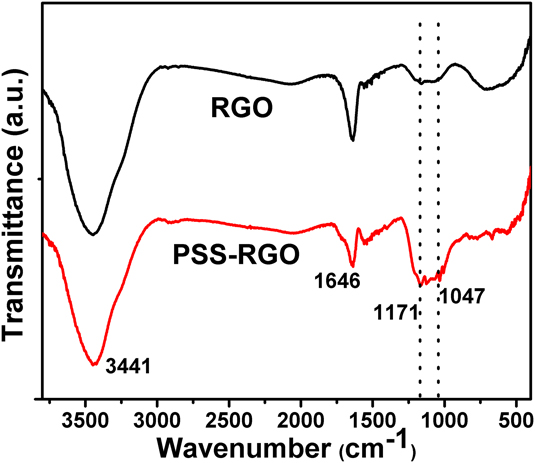
The formation of PSS-RGO can be confirmed by FT-IR measurement. Figure 3 shows the FT-IR spectra of the RGO and PSS-RGO, the broad band in the region 3000–3500 cm−1 is assigned to –OH groups. The peak at 1646 cm−1 for both samples is assigned to the C=C stretching vibration, due to the high degree of graphitization. The additional bands at 1047 and 1171 cm−1 of PSS-RGO are associated with a S=O bond, indicating the successful grafting of –SO3H groups onto RGO.Reference Wang, Wang, Zhang and Tian14 Figure S2 shows the quantitative energy dispersive X-ray spectroscopy (EDS) of the PSS-RGO sample. The density of the element S is associated with the effective acid sites in the sample to acid catalyzed reaction.Reference Ji, Zhang, Chen, Wang, Zhang, Zhang and Fan25 Significant S signals were observed, while no Na signal (near 1.05 keV) was detected, demonstrating the successful exchanging of Na+ for H+. The calculated element S obtained from elemental analysis was 4.9 wt% (Table S1), which was in accord with EDS analysis, corresponding to 1.63 mmol/g H+.
FT-IR spectra of the RGO and PSS-RGO.

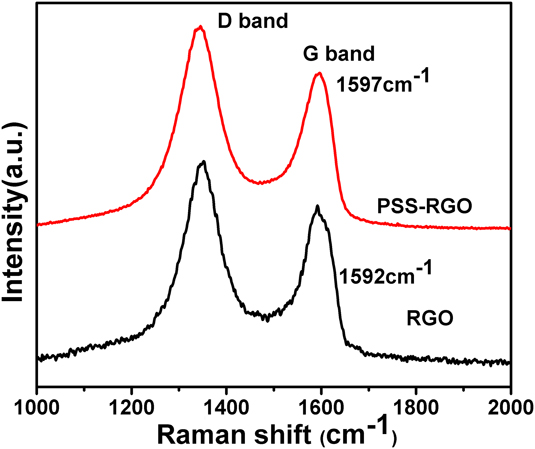
Remarkable structural changes occurred during the chemical processing from RGO to PSS-RGO, reflected in their Raman spectra. Figure 4 shows the Raman spectra of RGO and PSS-RGO. Two distinctive bands at 1351 and 1592 cm−1 for RGO, correspond to the vibrations of sp 3 carbon atoms of defects, namely the disorder band (D band) and the first-order scattering of the E 2g mode for sp 2 carbon lattice (G band), respectively.Reference Zhang, Wang, Li, Wang and Qiu35 The G band of PSS-RGO shifted from 1592 to 1597 cm−1 compared with RGO, due to the sulfonation.Reference Lazzeri and Mauri36 The intensity ratio I D/I G of PSS-RGO (1.30) is slightly higher than that of RGO (1.28), suggesting a decrease in the average size of the sp 2 carbon domains after sulfonation.Reference Wu, Wang, Dong, Zhan, Zhang, Li, Qiao and Qiu37
Raman spectra of the RGO and PSS-RGO.

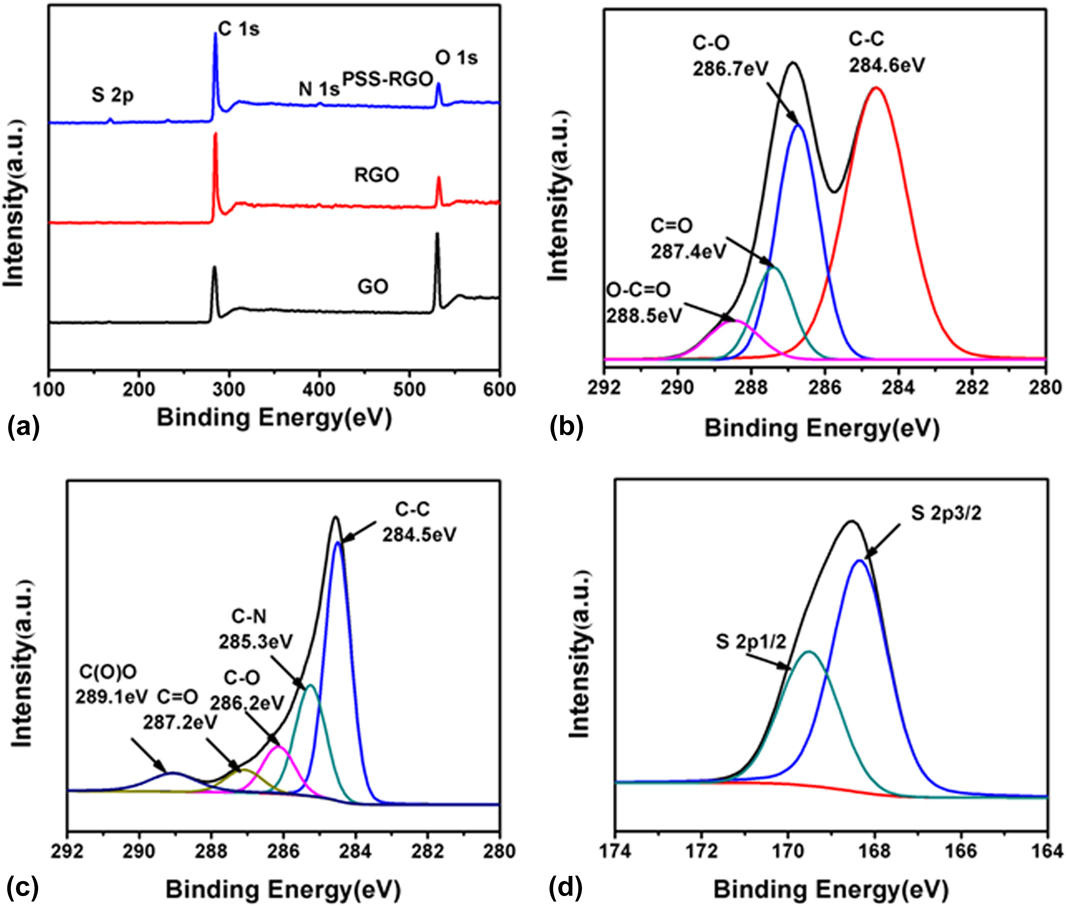
XPS measurements could provide direct evidence of the reduction of GO and element S on the PSS-RGO. Figure 5(a) shows the spectra of GO, RGO and PSS-RGO, all of samples exhibit the C 1s and O 1s peaks at approximately 285 and 534 eV, respectively. It is also noted that the relative intensity of C 1s peak for the RGO and PSS-RGO increased in comparison to that of GO, indicating the successfully conversion of GO to RGO. N 1s signal was observed on the RGO and PSS-RGO, indicating considerable deoxygenation by the reduction process as well as nitrogen incorporation. S 2p signal was observed on the PSS-RGO, showing the –SO3H group was successfully grafted on the RGO. For detailed information, four peaks centered at 284.6, 286.7, 287.4, and 288.5 eV were observed [Fig. 5(b)], corresponding to C–C bond in aromatic rings, the C in C–O bonds, the carbonyl C, and the carboxylate carbon (O–C=O), respectively.Reference Stankovich, Dikin, Piner, Kohlhaas, Kleinhammes, Jia, Wu, Nguyen and Ruoff38 The C 1s XPS spectrum of RGO [Fig. 5(c)] exhibits much weaker peak intensities of these oxygen functionalities than those of GO, indicating most of the oxygen-containing functional groups in GO were successfully removed and the C–C bonds became dominant after reduction. For PSS-RGO, the singal near 169 eV is associated with S 2p peak. As shown in Fig. 5(d) a strong S 2p 3/2 peak and S 2p 1/2 peak appearing at 168.5 eV and 169.9 eV, respectively, should be denoted as –SO3H group.Reference Guan, Li, Chen, Shi, Gu, Li, Miao, Chen and Ning12 TEM images of the RGO and PSS-RGO are presented in Fig. S3. The PSS-RGO remained the wrinkle structure of RGO after sulfonation, indicating that sulfonation didn’t break the structure of RGO.
(a) XPS spectra of GO, RGO and PSS-RGO; (b) C 1s spectra of GO; (c) C 1s spectra of the RGO; (d) S 2p spectra of the PSS-RGO.

B. Catalytic activities of PSS-RGO toward esterification of acetic acid and the hydrolysis of ethyl acetate
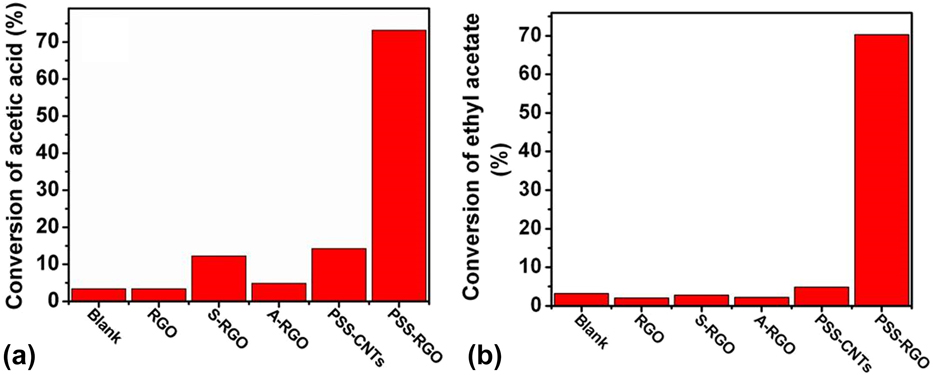
The catalytic activities of the prepared samples were investigated in the esterification of acetic acid [Fig. 6(a)] and the hydrolysis of ethyl acetate [Fig. 6(b)]. PSS-RGO exhibited the highest conversion in both cases (73.2% and 70.3%). It is reported that S content is closely related to the acidity of the sulfonated carbon catalysts.Reference Mo, Lopez, Suwannakarn, Liu, Lotero, Goodwinjr and Lu39 The S content of the different catalysts were summarized in Table S1. The highest S content was observed in PSS-RGO, demonstrating the in situ polymerization of sodium p-styrenesulfonate is an efficient method to graft RGO with high amount of S density.
Catalytic activities of the as-made catalysts in the esterification of acetic acid (a) and the hydrolyzation of ethyl acetate (b).

The recycle tests of PSS-RGO were investigated in the hydrolysis of ethyl acetate, and the conversion of ethyl acetate dropped to 40.4%. Hence, the deactivation mechanism of PSS-RGO catalyst was studied. It’s reported that the main reason for deactivation of solid acid catalysts is the leaching of S-containing moieties during reaction.Reference Wataniyakul, Boonnoun, Quitain, Sasaki, Kida, Laosiripojana and Shotipruk19,Reference Mo, Lopez, Suwannakarn, Liu, Lotero, Goodwinjr and Lu39 Recent research suggested that the accessibility of reactants to sulfonic acid groups in the carbon structure and the acidity of sulfonated carbon materials are closely related to the carbon structure.Reference Liu, Sun, Zhu, Meng, Qi and Xiao15 Therefore, elemental analysis, Micro FT-IR and SEM were performed. The S content was nearly the same in fresh and used PSS-RGO in elemental analysis (4.9 wt% and 4.6 wt%). Micro FT-IR spectra (Fig. S4) shows that the peaks of S=O bond at approximately 1035 cm−1 and approximately 1180 cm−1 appeared on both fresh and the used PSS-RGO, indicating that the leaching of S-containing moieties is undetectable. The XRD patterns of the PSS-RGO before and after reaction in Fig. S5 the amorphous structures of both samples.
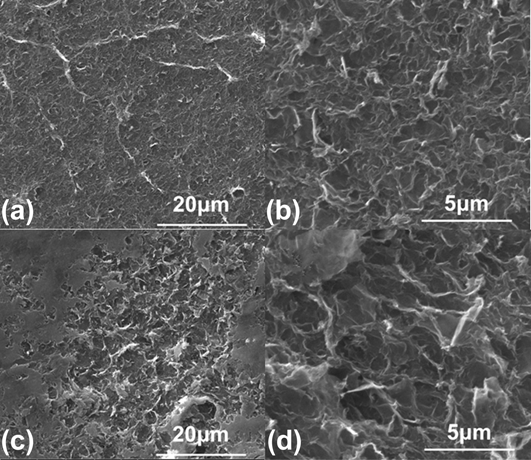
Figure 7 is the SEM images of the PSS-RGO before and after use. It was found that the PSS-RGO layers have severely aggregated after the reaction. These findings imply that, within the scope of our research,due to the stable C–C bonds with the conjugated graphene sheet and the aromatic ring of PSS, the leaching of S-containing moieties is negligible, so the main reason for deactivation of PSS-RGO is not the leaching of S-containing moieties during reaction. Therefore, we proposed that the deactivation mechanism of the PSS-RGO are structural changes caused by the aggregation of the PSS chains and graphene sheets, which lowered the accessibility of the reagents to the active sites.
SEM images of the fresh PSS-RGO (a, b) and used PSS-RGO (c, b).

IV. CONCLUSIONS
In summary, we successfully prepared the ethanol and water soluble PSS-RGO with S content of 4.9% by in situ polymerization of sodium p-styrene sulfonate with RGO under mild conditions. The PSS-RGO was fully characterized by 1H NMR FT-IR, EDS, Raman, XPS, nitrogen adsorption measurement and TEM. The prepared PSS-RGO is quite stable and shows excellent catalytic activity in the tested reactions, viz esterification of acetic acid and hydrolysis reaction. Recycle tests and further characterization of the catalysts proved that the aggregation of the PSS chains and RGO sheets, which caused the structural changes and lowered the accessibility of the reagents to the active sites, was the main reason for deactivation of PSS-RGO in the hydrolysis of ethyl acetate.
Supplementary Material
To view supplementary material for this article, please visit https://doi.org/10.1557/jmr.2018.369.
ACKNOWLEDGMENTS
This work is supported by the Doctoral Scientific Research Foundation of Liaoning Province (20170520263), Fundamental Research Funds for the Central Universities (DUT16RC(3)008 and DUT18RC(4)059).