Introduction
The committee system is not a very popular topic among scholars who investigate the workings of parliamentary democracies, when compared with parties and cabinets. This attention depends (primarily) on two factors: on the one hand, in parliamentary democracies, party membership appears to almost always be an excellent predictor of members of parliament (MPs) behavior, and government membership appears to almost always be an excellent predictor of party strategies. This concern with parties and cabinets is generally supported by data (see, e.g. Carey, Reference Carey2007), but it is nevertheless (partially) misleading.
Before coming to the floor of parliament, a bill must survive a filtering process. As a result, the visible decisions that appear to be affected by parties and governments concern only a small fraction of the issues that MPs could handle a priori (Hug, Reference Hug2010), therefore telling us only part of the story. Indeed, in several countries, many bills (or potential bills) are selected at the committee level. As a result, the distribution of preferences within committees, as well as the committees’ institutional environment, are decisive. Even if it is difficult to evaluate a role that is based primarily on unobservable non-decisions, legislative committees in parliamentary democracy nevertheless matter, although not necessarily in the same way across contexts.
The most sophisticated theoretical models on legislative committees are those developed among rational choice scholars studying the US Congress (see Shepsle and Weingast, Reference Shepsle and Weingast1995 for a review). However, the bulk of such studies share a peculiarity that appears suspicious for comparative political students: the ‘external’ institutional environment is (almost always) considered fixed (Gamm and Huber, Reference Gamm and Huber2002). However, when committees in parliamentary democracies are addressed, this last feature disappears, with multiple electoral systems, party system dynamics, and more than one type of executive–legislative interaction. Thus, comparative research on legislative committees must address a research question largely overlooked by Congress scholars, that is, are committee features affected by the institutional framework of the political system in which they operate, and if so, to what extent?
In the current paper, we will focus on the institutional foundations of committee cohesion. Cohesion – the similarity of committee members’ preferences – represents the most important non-institutional feature that affects committee work. Even if we believe that any type of conflict among views and preferences can be continually resolved via simple majority voting, the relative level of cohesion always influences committee efficiency in decision making. Indeed, the more heterogeneous preferences are, the more strongly minorities will attempt to delay any possible decision. In this sense, a divided committee loses authority and credibility to the floor, and its proposals are more likely to be changed (Fenno, Reference Fenno1973; English, Reference English2003). This outcome occurs irrespective of the formal power allocated to a committee by constitutions.
Committee powers should not be of interest only to legislative scholars, given that they have a rather general effect on how a democracy works. For example, committee cohesion levels deeply affect how electoral results are translated in political decisions in Parliament, or in other words, how citizens’ preferences are translated into policy. By taking advantage of their formal and informal gatekeeping power, cohesive committees can effectively protect the status quo in their respective policy area that they previously helped to create, despite change in citizens’ political preferences (Fenno, Reference Fenno1973). In this sense, a law-making process dominated by committees is likely to be more informed but less affected by public opinion and much more influenced by relatively small and powerful interest groups. Therefore, committee strength, defined by not only rules but also by committee cohesion, affects the prevailing content of the representative relationship between voters and elected officials. Accordingly, the importance of committees in the legislative arena facilitates scholars’ identification of the parliament type (i.e., adversarial or polycentric), and consequently, democracy type prevailing in different countries (Polsby, Reference Polsby1975; Cotta, Reference Maurizio1994; Lijphart, Reference Lijphart1999)
In the following section, by borrowing elements from studies on the committees of the US Congress, particularly the so-called ‘distributive approach’ (Weingast and Marshall, Reference Weingast and Marshall1988; Krehbiel, Reference Krehbiel1991), we will demonstrate how the committee system’s relative degree of preference homogeneity is affected by institutional details that can vary across contexts. In particular, we expect that an MP will have a stronger incentive to join a committee congruent with the interest of her constituency when the electoral system induces her to look for personal consensus in the district, the government agenda-setting power is weak and her seniority is not negligible. This incentive is expected to increase the level of cohesion within that committee.
We will test our hypotheses for the case of Italy from 1979 to 2008. As we will discuss in the second section Italy is an attractive case within which to explore the impact of (changing) institutional details on committee cohesion. In the third section, we will demonstrate how data derived from co-sponsorship can be profitably used to infer MPs’ preferences in a multidimensional policy space. By knowing MPs’ ideal points, we can then assess which factors affect committees’ cohesion. We will address measurement issues in the fourth section. The final sections will be devoted to the presentation and discussion of our findings and their main implications.
Preferences and rules in a distributive framework
Committee cohesion depends on legislators’ choices. According to legislative distributive theories, legislatures are organized to facilitate gains from trade or to institutionalize bargains (Gilligan and Krehbiel, Reference Gilligan and Krehbiel1987). Thus, it is argued that members will gravitate to committees whose jurisdictions are of primary interest to their respective constituents, that is, whose policy domain is more ‘congruent’ with the interests of their constituents (Mayhew, Reference Mayhew1974; Shepsle, Reference Shepsle1978; Shepsle and Weingast, Reference Shepsle and Weingast1981).Footnote 1 For example, according to this logic an Agriculture committee will be mainly composed by MPs elected in agricultural districts sharing a quite similar position in terms of subsidies and credit with farmers regardless of respective party affiliations.Footnote 2 As a result, we should expect committees to be highly homogenous on average, given that all those congressmen who want to be re-elected and represent similar interests find it electorally convenient to self-select into the same committee.
Still, such a propensity also depends on factors that allow committee policy domain congruency with constituency interests to be useful for MPs’ goals. Some of these factors are more easily appreciated from a comparative perspective.
-
(1) Committee agenda-setting power: committee membership should make the difference for anyone who wants to promote constituency interests. That is, law-making rules, legislative organization, and practices must enforce agreements within the committee by protecting these agreements from changes from the floor or other political actors. In other terms, committees must enjoy some degree of agenda-setting power to be of any interest to a ‘distributive’ MP.
-
(2) Electoral incentives: committee members will be more inclined to select purposely a ‘congruent committee’ if their behavior within the committee can be selectively rewarded by the electorate. In this sense, electoral rules matter, given that they link the MP’s re-election goal to the congruency between committee policy domain and constituency interests differently (more or less strongly).
-
(3) Knowledge investment cost: fruitful committee attendance implies a certain level of knowledge of the committee policy domain. The opportunity cost of such knowledge investment changes according to personal features such as an MP’s previous knowledge and experience in the policy domain.
We expect that the propensity to purposely select a committee depends positively on the utility obtained from committee membership. For the sake of simplicity, we can normalize the utility that an MP derives from belonging to a committee whose policy domain is not congruent with the electoral interests of her constituency as 0. Therefore, such a committee will not be deliberately selected. If, conversely, there is policy congruence, a committee could be purposely selected if the utility obtained from committee attendance is greater than 0. More formally, the features of the setting we have just described can be summarized in the following choice function.
A ‘policy congruent’ committee 1 (C1) will be preferred to a ‘non-policy congruent’ committee 2 (C2) if and only if
 $$P\left( {U{\rm 1}{\minus}c} \right){\plus}\left( {{\rm 1}{\minus}P} \right)\left( {{\minus}c} \right)\,\gt \,\left( {U{\rm 2}} \right),$$
where P is the probability that the committee member will be rewarded for the policy congruence of C1, U1 is the reward for policy congruence (assumed by definition to be greater than 0), c is the cost in knowledge investment of belonging to C1, and U2 is the utility of belonging to C2, which we normalize to 0 without loss of generality.Footnote
3
According to that noted above, in turn, probability P depends on committee agenda-setting power, a, and electoral incentives, e. We assume that P=f (a+e). Therefore,
 $0\,\les\, P=\left( {{{a{\plus}e} \over 2}} \right)\les 1$
, where 0⩽a⩽1 and 0⩽e⩽1. Finally, cost, c, is assumed to be inversely related to the level of knowledge of the committee policy domain displayed by the MP. More precisely, we assume that
 $$c={b \over {s1}},$$
where s1 is knowledge of the committee policy domain and b is a fixed cost. We also assume without loss of generality that s1>0 and b>0. The previous Equation (1) can then be rewritten as
 $${{(a{\plus}e)} \over 2}\left( {{U}1{\minus}{b \over {s1}}} \right){\plus}\left( {1{\minus}{{(a{\plus}e)} \over 2}} \right)\left( {{\minus}{b \over {s1}}} \right)\,\gt\, 0.$$
Solving Equation (2), we obtain
 $$\left( {{{(a{\plus}e)} \over 2}{ U}1{\minus}{b \over {s1}}} \right)\,\gt\, 0.$$
The implications of this equation are straightforward. Committee agenda-setting power, ‘personal’ electoral incentives and knowledge of the committee policy domain positively affect committee cohesion, as they make committee attendance more useful and less costly, and thus, an MP’s purposeful selection of a committee more likely.
However, to transform these insights into empirical hypotheses that will be tested, we must properly operationalize the concepts of electoral incentives, committee agenda-setting power and knowledge of the committee policy domain.
Electoral incentives
Electoral rules are crucial in defining the type of interests that will be represented in parliamentary committees. In this respect, electoral systems, as a plurality with single member districts, or proportional with an open list, allow legislators to be directly and individually rewarded or punished by interest groups and voters in the electoral district (Mitchell, Reference Mitchell2000; Sieberer, Reference Sieberer2006). Indeed, in electoral systems in which candidates compete for a personal vote, candidates should be likely to pay attention not only to the demands of their party bosses but also to the interests of their constituency; that is, they face two ‘competing principals’ (Carey, Reference Carey2007). In contrast, in all those situations in which the candidate’s chances of (re)election depend primarily on her ability to move up the rank ordering on a party list (as it occurs under a proportional system with a closed list), the focus should be on the party. In this case, voters and interests groups will have fewer incentives to follow the behavior of people they cannot select and re-select. Accordingly, with the first type of electoral system, we expect a larger e value.
Committee agenda-setting power
Of course, not all legislative committees are ‘born’ equal, and legislative committees in different democracies do not necessarily have the same prerogatives. In the US Congress, after being discussed and voted on within the committee, a bill is discussed and voted on the floor according to rules that the Rules committee has assigned to that bill. Thus, committee agenda-setting power is not a given, but rather, can change from one bill to another, as well as from one committee to another. As a consequence, the choice of rules (more or less restrictive) is directly associated with the causal mechanism that is also used to explain committee composition; that is, committee agenda-setting power (the ‘rules’) is primarily considered a dependent variable (Krehbiel, Reference Krehbiel1991; Cox and McCubbins, Reference Cox and McCubbins2005). Conversely, in the institutional environment of parliamentary democracies, governments not only are the main bill sponsors but also enjoy procedural prerogatives to protect their initiatives from floor changes. This attribute naturally implies that governments contend with committees for agenda-setting power. Precisely for this reason, committee agenda-setting power can be assumed to vary inversely with the government’s agenda-setting power (Doering, Reference Doering1995). In other terms, we can infer committees’ strength from the weakness of the government and vice versa. Therefore, as the agenda-setting power of the cabinet decreases, we expect a larger a value.
Knowledge of the committee policy domain
It is very difficult to assess systematically how much an MP knows about the policy domain of his/her committee. Formal education, as well as professional background, could be misleading when the committee policy domain cannot be directly associated with a profession or a university degree. Moreover, the type of knowledge that makes membership in a given committee more effective for an MP is not merely academic knowledge; it is primarily based upon her interactions with her constituency, interest groups and other MPs. Even if not exhaustive, legislative (and committee) seniority is a good proxy for the level of such knowledge. Therefore, we expect s1 to increase with an MP’s seniority.
We can now explicitly state our hypotheses according to the model discussed above:
H1: The level of committee cohesion increases when the electoral system induces MPs to seek personal consensus in the district.
H2: The level of committee cohesion increases when the government’s agenda-setting power is weak.
H3: The level of committee cohesion increases when an MP’s seniority increases.
Italy: one country in a (strong) comparative research design
The ideal research design for testing the previous hypotheses would involve a large dataset containing information on policy preferences in legislative committees in many different parliamentary democracies. Such a vast archive does not yet exist. However, by focusing on the Italian case over the last 30 years (1979–2008), we are in a condition to effectively run a comparative research design using a single case-study, given that the Italian political system has experienced both (repeated) changes in its electoral system and relevant modification of the government’s agenda-setting power during this time.
During its nearly 50 years of history, the so-called First Italian Republic (1946–94) presented a peculiar combination of the following features: (a) the highest rate of cabinet turnover in Western Europe at more than twice the regional average (Müller and Strøm, Reference Müller and Strøm2000; Curini, Reference Curini2011); (b) considerable political inertia in terms of ‘government formulas’, or in other terms, a lack of substantial alternation (Mershon, Reference Mershon1996; Curini and Pinto, Reference Curini and Pinto2013); (c) legislative committees that have been considered the strongest in the world, after the committees of the US Congress (Lees and Shaw, Reference Lees and Shaw1979, Della Sala, Reference Della Sala1993). This strength is quite apparent: permanent legislative committees have constitutional guarantees with respect to their role in legislation (Italian Const. art. 72), and their activities range from final bill approval to investigative hearings (Della Sala, Reference Della Sala1993).Footnote 4 Not only have most of the bills died in committees but also, for some time, a large majority of laws have been definitively passed in committee without a floor roll call.Footnote 5
The transition toward a new political system began with the bribe scandals, which swept away the government parties, and the approval of new electoral rules in 1993 (Morlino, Reference Morlino1996). A new bipolar party system appeared during the 1994 elections, but it was only following the election two years later (in 1996) that Italy experienced a complete government alternation for the first time in its history (see also Newell, Reference Newell2000 on this point), and the Italian party system changed from pivotal to alternational (Strøm, Reference Strøm2003; Bartolini et al., Reference Bartolini, Chiaramonte and D’Alimonte2004). From then on, the center-left and the center-right coalition have alternated in government four times, and the government has dramatically increased its informal agenda-setting power (Zucchini, Reference Zucchini2011a, Reference Zucchinib) through both a significant increase in the delegations received from parliament and the practice of the so-called maxi-amendment.Footnote 6
The three decades of Italian history we are analyzing have also been characterized by various electoral systems: until 1993, elections were held under proportional representation with an open list; from 1994 until 2001, elections were held under a mixed electoral system, in which 75% of seats were assigned by the ‘first-past-the-post’ system (SMPS) and the remaining 25% were allocated using a proportional electoral system with a closed list; finally, beginning with the 2006 general election, seats were allocated according to a proportional system with a closed list.
Because of the interplay of these two characteristics (a changing party-system dynamic that caused a de facto increase in the government’s agenda-setting power and a varying electoral system), Italy appears particularly suited to the testing of our hypotheses. Moreover, the remaining homogenous institutional setting allows us to control for any idiosyncratic country factors.
Estimating MPs’ policy preferences
Data availability is not the only challenge facing the analysis. The importance of committees depends not only on the decisions they make but also on the issues they ignore, overlook or discuss only very reluctantly. Committee cohesion is an important feature that affects such behaviors, but it must be addressed in terms of the preferences of its members. Otherwise, as we explain below, we take the risk of overemphasizing divisions along party lines by focusing on what is visible but not necessarily more important.
Attempting to estimate empirically MPs’ policy preferences is not an easy exercise. One obvious but somehow misleading method of doing so is to use each MP’s actual voting behavior. This strategy has led to the development of the quite extensive literature in political science that analyzes roll-calls (Hix et al., Reference Hix, Noury and Roland2005; Poole, Reference Poole2005). The problem with this methodology is that in a parliamentary context, by scaling roll-calls, we measure the structure of the ‘revealed behavioral space’ (Hix and Jun, Reference Hix and Jun2009). This aspect implies that MPs’ ideal points so estimated, as well as the latent dimension(s) revealed by their voting behavior, are linked only indirectly to the underlying dimensions of political conflict, and therefore, with the MPs’ ‘original’ preferences (Hall and Grofman, Reference Hall and Grofman1990; Shepsle and Weingast, Reference Shepsle and Weingast1995; Curini and Zucchini, Reference Curini and Zucchini2010). This problem is primarily the outcome of the impact of party discipline (which, on average, is clearly (much) higher in parliamentary democracies than in presidential ones) on MPs’ behavior (Carrubba et al., Reference Carrubba, Gabel and Hug2008).
The most common alternative sources for identifying policy positions are not available in European countries or are completely blind with respect to the preferences of MPs. Party manifestos and/or expert surveys obviously belong to the latter category. Conversely, interest group ratings are absent in European countries.
One possible solution to this riddle is to rely on legislative co-sponsorship. Indeed, as noted in the path-breaking contribution by Aleman et al. (Reference Aleman, Calvo, Jones and Kaplan2009: 91–92), ‘activities that have no immediate policy consequences and do not depreciate the party label are not as tightly monitored by party leaders. Consequently, floor voting choices should more intensely reflect costs of defection imposed by parties than cosponsoring should’. A second advantage of using co-sponsorship pertains to agenda processes. Bill sponsoring occurs at the beginning of the legislative process, and it is usually less affected by strategic considerations than other parliamentary behaviors. Finally, in the Italian Parliament, bill sponsoring is a very frequent, easy activity, which does not require compliance with any special rule or criterion: a bill can be introduced by a single MP or by a group of MPs – the sponsors – at any time in any policy area. Moreover, bills can be sponsored by MPs who belong to different parties, whereas bill sponsoring and co-sponsoring is a behavior that is largely not subject to party discipline.
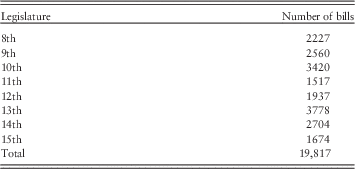
We have collected data provided by the Italian Parliament websiteFootnote 7 on all of the bills introduced in the Italian Chamber of Deputies between 1979 and 2008, that is, the 8th to the 15th Legislatures.Footnote 8 For each bill, we know the name of the sponsor (i.e., the first signature) and all of the other possible co-sponsors. We eliminated from our sample all bills that were not sponsored by MPs and all bills with only one sponsor (given that they do not provide any useful information for the estimation of MPs’ ideal points: see below). This process left us with a sample of 19,817 bills. The relatively comprehensive (and extensive) character of the data helps to ensure that the results of the analysis are not a function of sample bias or period effects. Table 1 summarizes this information.
Number of bills by Legislature sponsored by more than one MP

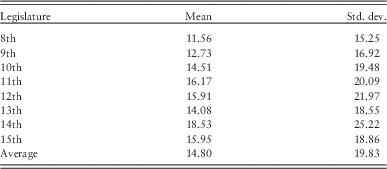
As shown in Table 2 below, in the Italian Chamber of Deputies, the mean number of co-sponsors during the period 1979–2008 was 14.80, whereas 90% of the bills initiated by legislators had fewer than 37 co-sponsors.
Number of sponsors by bill in Italy (1979–2008)

The decision to co-sponsor a bill reveals an MP’s preference for the proposal over the status quo, as well as a special interest in or the attachment of importance to that particular bill. Moreover, although effective voting implements policy, the co-sponsoring of legislation can be viewed as low-cost position taking by MPs who signal to target audiences (e.g., constituents), to fellow representatives, or to both (see Kessler and Krehbiel, Reference Kessler and Krehbiel1996). Consistent with Aleman et al. (Reference Aleman, Calvo, Jones and Kaplan2009), we build an affiliation matrix for each legislature, with each cell indicating the number of times that each pair of legislators co-sponsored legislation. We then used a principal-components analysis and singular-value decomposition on this agreement matrix to extract the ideal-point estimates of the MPs. The underlying idea is that the more (less) any two MPs co-sponsor the same bills, the more they present similar (dissimilar) policy preferences.
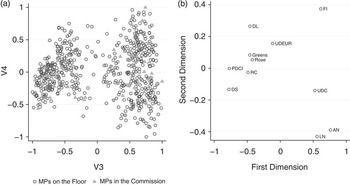
To decide how many components (i.e., dimensions) to retain in each legislature, we rely on the popular Cattell’s scree test. The clear multidimensionality that we find in the political space of the parliament as a whole is confirmed by a visual committee by committee and legislature by legislature inspection of MP positions. In the left panel of Figure 1, we have included an example from the 14th Legislature and focused on the Social Affairs committee for illustrative purposes (data for all the legislatures are available upon request). As observed, the members of the committee are not lined up in any direction more than those in non-member committees. On the contrary, they appear sufficiently well dispersed to eliminate the possibility that only one dimension can summarize all of the policy differences among MPs. In the same graph (right panel), we have also plotted the average party positions in the same legislature: the positions of parties along the horizontal dimension largely resemble a left–right scale, whereas their scores on the vertical dimension refer to their position with respect to the European Union, albeit in a less stark manner.Footnote 9
Distribution of ideal points: floor and MP members of the Social Affair committee (left panel) and average Party positions (right panel): Italian 14th Legislature (2001–06).

Measurement issues
Having estimated MPs’ preferences, we can now assess which factors render MPs more or less distant from one another in a given committee, or in other terms, what affects committee cohesion. In this sense, we have investigated committee cohesion by taking the MP as our main unit of analysis. In particular, dimension by dimension, we have calculated the Euclidean distance separating the position of each MP from the median position in their committee, and we have labeled this variable COMMITTEE DISPERSION. Note, moreover, that in the Italian context, in exceptional cases, an MP can be a member of more than one committee throughout the life of a Legislature. To address this problem, we have decided to duplicate each MP according to her committee membership. For example, during the 10th Legislature, MP Michelangelo Agrusti, belonging to the Christian Democratic party, switched committee membership from the Foreign Affairs to the Defense committee approximately halfway through the Legislature. As a result, in our dataset for the 10th Legislature, the information on Michelangelo Agrusti appears twice. In the first case, his policy position information (obtained through the analysis of his co-sponsorship record) is used to, on the one hand, estimate the median position of the Foreign Affairs committee, along with the policy positions of all the other members of that commission, and on the other hand, calculate the Euclidean distance separating Agrusti’s ideal point from the median position within the Foreign Affairs committee. Agrusti’s policy position is then used similarly for the Defense committee case. On average, throughout the period analyzed here, an Italian MP was a member of 1.4 committees per legislature.
An MP index of committee cohesion, and consequently, an empirical test at the individual level, has a clear advantage over aggregate measures, given that it allows us to include important individual variables that would otherwise be ignored by focusing on committees alone. Doing otherwise can be particularly costly from a theoretical perspective. A good example originates from the electoral rules. As previously discussed, from the 12th to the 14th Legislatures, a mixed electoral system was in force in Italy. Therefore, during this period, the committee members could have been elected either through an electoral system with a limited linkage with the constituency (i.e., with a closed PR system) or through an electoral system in which this linkage was stronger (i.e., with the SMPS). In this scenario, we can discern the relative impact of the electoral rules on preference similarity in the committee only if we examine the individual (MP) level. Moreover, other aspects of individual biographies can be of importance as well, as we will discuss below.Footnote 10 Conversely, this emphasis on MPs’ behaviors does not preclude us from also including party level, as well as systemic level, variables as possible predictors of COMMITTEE DISPERSION while at the same time avoiding any possible risk of ecological fallacy. After all, the observed level of committee cohesion is obtained from the distribution of individual preferences. In this sense, through our measure of dispersion, we focus precisely on this distribution.Footnote 11
Given the way we estimate COMMITTEE DISPERSION, the average level of cohesion within a given committee increases when COMMITTEE DISPERSION decreases, and vice versa. The overall average value of COMMITTEE DISPERSION in our sample is 0.71, with a std. dev. of 0.33. Among the 14 Italian committees, the highest value of COMMITTEE DISPERSION can be found within the Labor committee (0.74), whereas the lowest is found within the Constitutional Affairs committee (0.65). It appears, therefore, that there is a difference among the Italian committees in terms of their policy cohesion, albeit not a dramatic one. We will return to this point below.
Our explanatory and control variables exist at four different levels: systemic, partisan, committee and individual. Our hypotheses focus on three variables: two (ALTERNATION and ELECTORAL SYSTEM) work at the systemic level, that is, across MPs, committees and parties alike, whereas the third (MP tenure) applies at the individual level.
As noted, ALTERNATION is a dummy variable with a value of 0 up to the 12th Legislature and a value of 1 beginning with the 13th Legislature.Footnote 12 As noted, we use ALTERNATION to indirectly estimate the committees’ agenda-setting power: as government agenda-setting power grows with the transformation of the party system from a pivotal to an alternational system, we assume a corresponding decline in committee agenda-setting power (Doering, Reference Doering1995). This process is exactly what has been found in the Italian case (see Zucchini, Reference Zucchini2011b).
With respect to the influence of electoral rules, we have introduced a variable named ELECTORAL SYSTEM that arranges electoral systems in two categories: party-centered systems as PRs with a closed list (ELECTORAL SYSTEM=0) and candidate-centered systems as plurality systems with a single member district and PRs with an open list (ELECTORAL SYSTEM=1). In our case-study, the first situation applies to MPs elected during the 15th legislature and to the MPs elected with the PR quota from the 12th to the 14th legislatures; the second situation applies to the MPs elected with the SMPS from the 12th to the 14th legislatures and the MPs elected from the 8th to the 11th legislatures. This distinction recognizes the different roles played by personal votes in the two types of electoral systems (Carey and Shugart, Reference Carey and Shugart1995; Krehbiel, Reference Krehbiel2000; Wallack et al., Reference Wallack, Gaviria, Panizza and Stein2003). Indeed, as previously discussed, in electoral systems in which candidates compete for personal votes, candidates should be likely to pay more attention to not only the demands of their party bosses but also the interests of their constituency.Footnote 13
We estimate MP tenure in two different ways. First, we compute a general measure of LEGISLATIVE TENURE as the number of times a representative has been a member of the Italian Parliament. The median value of LEGISLATIVE TENURE is 1, whereas ~1 observation out of 2 (44.8%) presents a value of 0. Second, we introduce a measure more directly related to the committee system that we label COMMITTEE TENURE, estimated as the number of legislatures an MP has spent in the same committee. The median value of COMMITTEE TENURE is 0, whereas ~1 MP out of 3 indicates tenure in the same committee that is at least equal to 1.
At the party level, we focus on three variables as control variables. First, we introduce a variable, named CABINET PARTY, that takes a value of 1 for MPs belonging to a cabinet party during a Legislature. Indeed, it is very likely that in each committee, the median position is represented dimension by dimension by an MP supporting the Government (given that the cabinet usually controls a majority in the legislature), implying that all of the MPs supporting the government are also closer to the median position than non-cabinet MPs. Inclusion of the CABINET PARTY variable is therefore advisable when discerning the ‘net’ impact of the other more theoretically sound (and interesting) variables.Footnote 14
Second, we control for parties’ ideological positions (named IDEOLOGICAL POSITION). We use expert surveys to estimate parties’ positions on a general left–right scale (Castles and Mair, Reference Castles and Mair1984; Huber and Inglehart, Reference Huber and Inglehart1995; Benoit and Laver, Reference Benoit and Laver2006). We have normalized all the expert left-right scores on a 0–10 scale to allow for direct comparisons. Our expectation is that MPs belonging to leftist parties will be more ideologically committed and less sensitive to the interests localized in the electoral districts (see Newell, Reference Newell2000).
Finally, the rise of alternation in power after 1994, as well as the change in electoral rules, are not the only alterations that occurred in the Italian political system during that period. The party-system has also changed considerably in terms of its composition since the 1994 election. In particular, the largest party during the Second Republic was a completely new one (Forza Italia, led by Silvio Berlusconi) that presented a within-party organization that is significantly different from that of other more traditional Italian parties (Poli, Reference Poli2001). In this sense, we have introduced a dummy variable that takes a value of 1 for all of the MPs belonging to Forza Italia and 0 otherwise to control for any possible idiosyncratic party-effect that remains unexplained in the model, such as the divergence in party organization and leadership that differentiates Forza Italia from other parties (see Lundell, Reference Lundell2004).
The COMMITTEE DISPERSION level could also be affected by the specific policy domain of a committee or by other features associated with some committees but not others. For example, some legislative committees can play a relevant role as consultants for all of the other committees. By heavily interfering in the other committees’ law-making activities (as well as in government initiatives), this type of committee in fact enjoys stronger agenda-setting power. According to the Italian parliamentary standing orders, the Constitutional Affairs committee certainly belongs in this group of committees. Therefore, we have included as many dummy variables as legislative committees in the Italian chamber of Deputies, and we have decided to treat the Constitutional Affairs committee as our reference category. As noted above, we expect a positive coefficient for all committee fixed-effects in comparison with the Constitutional Affairs committee.
As we are investigating COMMITTEE DISPERSION at the individual level, it is advisable to control for MP variables as well. In this regard, we consider four personal attributes (see Crisp and Desposato, Reference Crisp and Desposato2004; Ferrara, Reference Ferrara2004): three sociological variables concerning gender (GENDER) – a dummy equal to 1 when the MP is a woman; level of education (EDUCATION) – a dummy equal to 1 when the MP possesses a university degree; and AGE. We also include a dummy variable named HIGH-LEVEL POLITICIAN that is equal to 1 when an MP is member of a central party committee or a national party executive board. These representatives are not supposed to give importance to the choice of and attendance at legislative committees, as their re-election is already guaranteed by their role in national party politics. Therefore, we expect a positive relationship between HIGH-LEVEL POLITICIAN and COMMITTEE DISPERSION.
Analysis
Our dataset contains data on MPs that belong to a set of different parties. This inclusion could lead to residuals that are not independent within the same party, violating one assumption of OLS regression (Steenbergen and Jones, Reference Steenbergen and Jones2002). A preliminary analysis strongly lends support to this possibility: a two-level random ANOVA model, intended to decompose the variance in our dependent variables between the two levels (i.e., MPs and parties), indicates that the intra-class correlation is ~19% (P<0.0001). Therefore, we have opted to estimate a random model via maximum likelihood.Footnote 15
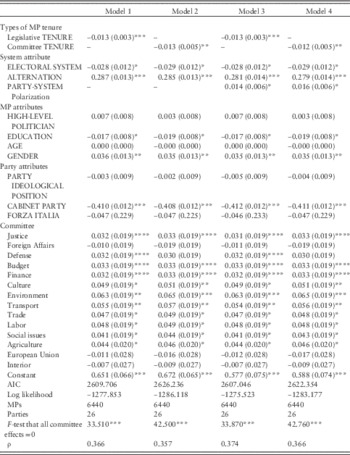
Table 3 reports the four models we have estimated. The difference between Model 1 and Model 2 is that in the former, we have included LEGISLATIVE TENURE instead of COMMITTEE TENURE.
The determinants of COMMITTEE DISPERSION: 1979–08 – random-effects maximum likelihood regression

Standard errors in parentheses.
* P<0.05, **P<0.01, ***P<0.001, ****P<0.10.
All of our hypotheses are supported by the analysis. In both Model 1 and Model 2, a candidate-centered electoral system (ELECTORAL SYSTEM=1), as well as an increased TENURE (committee or Legislative type alike), negatively and significantly affects COMMITTEE DISPERSION, as stated by H1 and H3, whereas ALTERNATION has a very strong effect but the opposite sign (as predicted by H2). In other terms, an increase in the government agenda-setting power captured by the dummy variable ALTERNATION also increases COMMITTEE DISPERSION. In terms of magnitude, ALTERNATION arises as the most substantial one among the three: the transformation from a pivotal to an alternational party system in the Italian case (ALTERNATION=1) in fact increases COMMITTEE DISPERSION by 40% on average. Conversely, a move toward a more permissive electoral system decreases COMMITTEE DISPERSION by 4%. Similarly, an increase by one std. dev. in both types of TENURE alike decreases COMMITTEE DISPERSION by 3%.
Model 3 and Model 4 replicate Model 1 and Model 2, respectively, with the addition of an additional systemic control variable that estimates the overall level of party system polarization across legislatures (following Dalton, Reference Dalton2008) using data related to Italian parties’ positions on the left–right scale derived from expert and mass surveys from 1979 to 2008. Indeed, it could be argued that as the level of PARTY SYSTEM POLARIZATION increases, the same should occur with COMMITTEE DISPERSION given that the average ideological distance among parties increases irrespective of any other consideration. That our hypotheses remain practically intact in this scenario – regardless of the significant, and as expected, positive impact of PARTY SYSTEM POLARIZATION on COMMITTEE DISPERSION – is of course reassuring with regard to the robustness of our results.Footnote 16
Among the control variables, at the party level, only CABINET PARTY has a significant coefficient and behaves according to our predictions, whereas FORZA ITALIA and PARTY IDEOLOGICAL POSITION do not appear to have any significant impact. Of MP’s attributes, EDUCATION indirectly confirms the importance of knowledge in negatively affecting COMMITTEE DISPERSION, a role that we have explicitly tested with the variables relating to tenure. HIGH-LEVEL POLITICIAN exhibits the expected positive sign but fails to reach any significant level, whereas interestingly, GENDER is always positive. In other words, women MPs appear less inclined to cross-party cooperation.
Finally, note that when significant, the committee-dummies are always positive. Remember that the omitted committee (and consequently, the reference category) in the analysis is the Constitutional Affairs committee. This committee exhibits higher agenda-setting power, as it is almost always consulted when a bill is assigned to other committees. Moreover, the committee’s negative opinion can prevent a bill from passing in the committee without a subsequent roll call. Therefore, that almost all of the other Italian committees are relatively less cohesive than the Constitutional Affairs committee indirectly confirms our premise regarding agenda-setting powers. On the contrary the policy content of the committees (covering issues more or less divisive or distributive, for example) does not seem in itself to make them consistently more or less cohesive.
Conclusions
Some years ago, in reviewing the most prominent studies on the US Congress, Gamm and Huber (Reference Gamm and Huber2002: 338) complained that ‘in all of these influential studies, since the institutional setting is fixed, it does not and cannot serve as explanatory variable’. In other words, despite their explicit institutional focus, the larger institutional framework in which these theories on committee systems apply is largely considered a given.
The current paper recognizes the precise role that (changing) general institutions can play in the incentives (and therefore behaviors) of MPs. We have argued in particular that electoral rules and party system dynamics (i.e., the shift from a pivotal to an alternational party system), as well as an MP’s level of knowledge of the committee policy domain, can affect committee cohesion levels. In this respect, we have shown that candidate-centered electoral systems, strong committee agenda-setting power and more legislative experience are all factors that bring MPs closer to the ideological center of the committees, and consequently, make committees more cohesive.
The broader implications of these findings cannot be underestimated. Legislative standing committees exist in almost all parliamentary democracies. Therefore, the presence of committees cannot by itself facilitate understanding differing parliamentary systems. On the contrary, committee cohesion level can and usually does change across contexts while representing a crucial variable that allows the members of a committee to work together effectively (see Arter, Reference Arter2003). By identifying the institutional variables that affect the level of committee cohesion, we can therefore better understand what differentiates the characteristics of the legislative process in various parliamentary democracies and what, despite the significant differences in the formal setting, makes them more similar to the American case, in which committees are strong and influential.
Of course, distributive theories, to which our hypotheses are largely connected, are not the only approach to the study of committee work. The other prominent perspective, as is well known, is the ‘informative approach’ (see Krehbiel, Reference Krehbiel1991). Despite being developed with the US Congress as a reference point, similarly to the distributive approach, this approach can propose interesting hypotheses on how distinct institutional settings can affect the informational role that committees play in favor of the Floor. For example, as party-centered electoral systems prevent the parliamentary recruitment of ‘policy specialists’, we could hypothesize a weak committee agenda-setting power that is independent from party system dynamics and is based upon the (weak) informative role played by committees vis-á-vis the Floor.
To summarize, we believe that the exploration of this and other speculation derived from congressional theories represents a promising direction for future research that aims for a better understanding of the role of committees from a comparative perspective and the impact of different institutional frameworks on this role.
Acknowledgment
The authors thank the participants at the Joint Sessions of Workshops of the European Consortium for Political Research (ECPR), St. Gallen (April 2011) for their helpful comments. Authors’ work was supported by the Italian Ministry for Research and Higher Education, Prin 2009, prot. 2009TPW4NL_002.