


Introduction
Stereotactic body radiotherapy (SBRT) has become increasingly popular for treating low-risk prostate cancer. As tumour cells in the prostate have a low α/β ratio (1·4 to 3 Gy), a large fractional dose is more biologically effective in treating prostate tumours. According to a study conducted by Kalz, Reference Katz1 in low-risk prostate cancer, SBRT with a prescribed dose of 35–36·25 Gy in five daily fractions is an effective treatment with low toxicity.
In early stage I non-small cell lung carcinoma (NSCLC), SBRT is recommended for patients who are medically inoperable or at high surgical risk. SBRT achieves excellent local control (LC), which is almost twice as high as the result expected from the conventional strategy of 6–7 weeks of daily radiotherapy (RT). Reference Singh, Chen and Bergsma2 Reference Bei, Murakami and Nakayama3 A recent study showed that SBRT not only improved LC but also increased overall survival in early-stage NSCLC. Reference Amin, Alam, Baine, Meza, Bennion, Zhang, Rahman and Lin4 Repeat SBRT for isolated local recurrence was also shown to be safe. Reference Kennedy, Gabani, Nikitas, Robinson, Bradley and Roach5
However, the motion of the tumour during treatment hampers the effectiveness of SBRT. While treating prostate tumours, the involuntary motion of the organ during beam delivery can be up to 5 mm. Reference Huang, Dong, Chandra, Kuban, Rosen, Evans and Pollack6 While treating lung tumours, respiratory motion can be up to 10 mm. Reference Quirk, Becker and Smith7 To compensate for such motion during SBRT, a larger planning target volume (PTV) margin may be needed in the planning stage, but it would significantly increase the treatment volume and include more surrounding normal tissue, which inevitably increases the risk of toxicity to normal tissues.
Recently, with the CyberKnife robotic system, Reference Kurup8 SBRT has been used without increasing the PTV margin to compensate for intrafractional motion because of the availability of KV live image guidance during treatment. There are two types of target tracking techniques for SBRT in the CyberKnife System—fiducial tracking and fiducial/Lung Synchrony® tracking. Fiducial tracking is used in CyberKnife prostate SBRT as soft tissue such as the prostate is not visible in the CyberKnife X-ray imaging system. During treatment, two orthogonal X-ray images are acquired within a preset time interval to locate the actual positions of all markers to define the real-time alignment centre. The displacement between the real-time align centre and the planned aligned centre is then calculated, and the CyberKnife system adjusts the robot to track the target accordingly. In this way, fiducial tracking can compensate for tumour motion in organs such as the prostate during treatment. CyberKnife provides the InTempo Adaptive Imaging System for prostate SBRT, which can adapt to patient-specific intrafraction prostate motion by intelligently increasing the imaging frequency during periods of rapid and erratic prostate movement. However, the InTempo Adaptive Imaging System robot limits the number of nodes used during plan delivery to ensure the robot would not block the X-ray exposure during intra-beam imaging in treatment.
CyberKnife also includes the fiducial/Lung Synchrony® respiratory tracking technique, which is suitable for lung SBRT. This technique enables the robot to perform three-dimensional real-time tracking of fiducials/lung tumours that move with respiration. If the lung tumour is dense enough and visible in the CyberKnife kV imaging system, the Lung Synchrony® respiratory tracking technique can be used. If not, then fiducials have to be implanted first to help define the location of the lung tumour, and the fiducial Synchrony® Respiratory tracking technique is used instead. In the fiducial/Lung Synchrony® respiratory tracking technique, during treatment, the CyberKnife system uses infrared markers placed on the patient’s body as external surrogates. Two orthogonal X-ray images are acquired within a preset time interval to locate the three-dimensional positions of the tumour. The Synchrony system then creates correlation models between the positions of the external infrared markers and the tumour position. During treatment with the Synchrony technique, the system moves the robot to track the tumour according to predictions based on live infrared marker positions and the correlation model. This system allows tumours that are subject to respiratory motion to be treated with an accuracy of 2 mm or less during normal respiration. Reference Sumida, Shiomi and Higashinaka9
Recently, Radixact (the next-generation TomoTherapy® System; Accuray Incorporated, Sunnyvale, CA) has also introduced fiducial tracking and Synchrony® tracking based on the successful robotic tracking system of CyberKnife. New hardware components for tracking include an X-ray tube and a flat-panel kV imager. These components are mounted on the gantry of Radixact and are offset by 90° from the megavoltage (MV) imager and beam. This kV imaging subsystem is used to periodically localise the target during treatment by taking several kV radiographs while the gantry rotates. Therefore, sequential monoscopic images provide delayed stereoscopic information. With such stereoscopic information updated during treatment, Radixact can realise motion monitoring in the same way as the CyberKnife system, with the target motion being compensated by shifting jaws and binary MLC instead of the robotic repositioning that occurs in CyberKnife. Reference Schnarr, Beneke and Casey10 A study by Ferris on 13 clinical helical plans regenerated with Radixact Synchrony technique shows that the root mean square error between the Synchrony-modeled positions and the programmed phantom positions was within 1·5 mm, which was similar to that of Cyberknife Synchrony. Reference Ferris, Kissick, Bayou, Culberson and Smilowitz11 Therefore with Synchrony, the margin of PTV in Radixact treatment can be reduced from being ITV-based to the level used in the Cyberknife treatment with Synchrony.
Dosimetric comparisons between helical tomotherapy and IMRT have been documented. Reference Lee, Fang, Chao, Su, Wang and Leung12 However, research on the dosimetric impact of CyberKnife Synchrony® and Radixact Synchrony® is scarce. In this study, we aimed to evaluate which system, CyberKnife or Radixact, with the same PTV margin, can deliver treatment with better target coverage and dose sparing of organs at risk (OARs) when using fiducial tracking for prostate SBRT and Synchrony® tracking for lung SBRT.
Methods
Patients
At our hospital, eight patients with prostate tumours had underwent five fraction SBRT using the CyberKnife fiducial tracking technique between 2017 and 2019, while ten patients were treated with lung five fraction SBRT using the CyberKnife respiratory Synchrony® tracking technique in 2019. They were all chosen for this study without any exclusion criteria.
Treatment planning
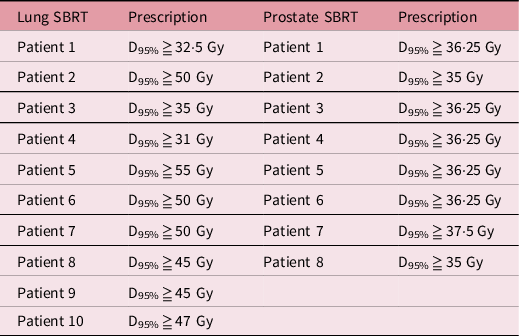
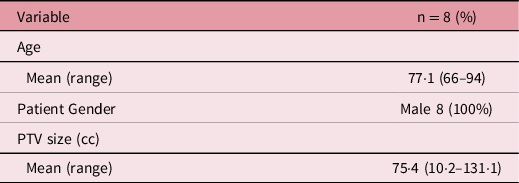
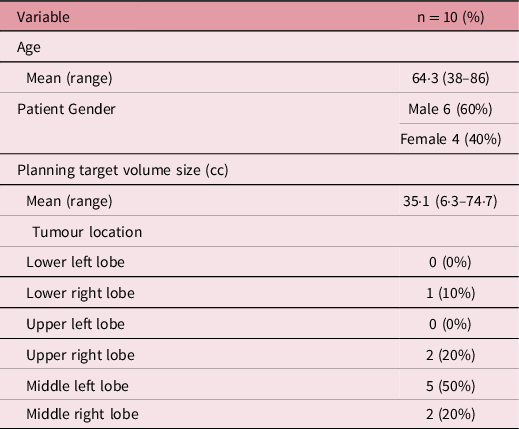
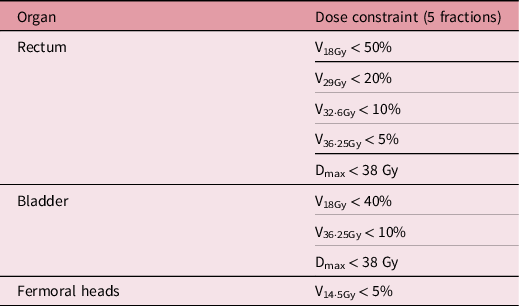
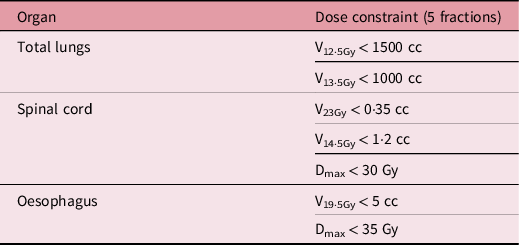
CyberKnife treatments were planned using Accuray Precision v2·0·1·1 (Accuray Incorporated, Sunnyvale, CA). Non-isocentric, non-coplanar and inverse-planning techniques were used. The collimator used was either Iris® or MLC, as determined by the oncologists. The ray-tracing and finite-size pencil beam algorithms were used for dose calculation using Iris® and MLC, respectively. The dose prescriptions to PTV for patients undergoing lung and prostate SBRT are summarised in Table 1, which were all delivered into five fractions. Characteristics of patients in the study are shown in Tables 2a and 2b. All OARs in the treatment plans fulfilled the dose constraints listed in Tables 3a and 3b. Reference Benedict, Yenice and Followill13,Reference Lukka, Bahary and Lawton14
Dose prescription in five fractions to the planning target volume (PTV) for each patient plan in the study

Characteristics of eight prostate patients in the study

Characteristics of ten lung patients in the study

Dose constraints of critical organs at risk in five-fraction prostate stereotactic body radiation therapy

Dose constraints of critical organs at risk in five-fraction lung stereotactic body radiation therapy

Retrospective Radixact plans were created for each patient using the Accuray Precision Planning System V3·1·0 with prescriptions, PTVs and tracking techniques identical to those used with CyberKnife. Before doing retrospective lung SBRT planning on Radixact, the target motion of each patient during CyberKnife treatment was checked by investigating the CyberKnife treatment log files to ensure that the motion amplitude is within ±1·25 cm, the tracking range limit of the Radixact Synchrony® tracking system with a 2·5 cm field width jaw setting. Dynamic jaws field width 2·5 cm and collapse cone convolution dose calculation algorithm were used in Radixact retrospective planning calculaton. The pitch value was adjusted to make the gantry period of the Radixact treatment below 40 s.
All clinical Cyberknife treatment plans and the retrospective Radixact plans were created and reviewed by more than three different independent planners, including either a dosimetrist or medical physicist with relevant experience, to ensure the quality of final treatment plans was sufficient for clinical use. The Radixact retrospective planning was not affected by previously generated Cyberknife plans because retrospective plans were created by planners different from the clinical Cyberknife plans for each patient.
Dosimetric evaluation
In our study, eight retrospective Radixact plans for the prostate and ten retrospective Radixact plans for the lung were created. Each retrospective Radixact plan was compared with the corresponding original CyberKnife treatment plan in terms of the PTV coverage, dose conformity and dose avoidance for OARsReference Oliver, Chen, Wong, Dyk and Perera 15 to evaluate the PTV conformity and coverage in the treatment plans, the new conformity index (nCI) and homogeneity index (HI) were used. In addition, doses to critical organs such as the rectum in prostate cancer patients and the lung in lung cancer patients were compared to assess dose sparing to the OARs between the two treatment systems.
Comparison of target coverage
The nCI and HI for the Radixact retrospective plans and CyberKnife clinical plans were compared. The indices were defined using the following equations:
 $${\rm{nCI}} = {\left( {{\rm{T}}{{\rm{V}}_{{\rm{PIV}}}}} \right)^{\rm{2}}}/\left( {{\rm{TV}} \times {\rm{PIV}}} \right),$$
where TVPIV is the target volume covered by the prescription isodose volume, TV is the target volume and PIV is the prescription isodose volume. Reference Paddick and Lippitz16
 $${\rm{HI}} = {{\rm{D}}_{{\rm{max}}}}/{{\rm{D}}_{{\rm{min}}}},$$
where Dmin is the minimum dose and Dmax is the maximum dose within the target volume.
Comparison of OAR sparing
To evaluate the OAR-sparing effect in lung SBRT between the two treatment systems, the percentage of lung volume treated with ≤12·5 Gy and the Dmax values to the spinal cord and oesophagus were used. In prostate SBRT, the maximum rectal dose, the maximum bladder dose, maximum femoral head dose, V36·25Gy, V32·6Gy, V29Gy, V18Gy of rectum and V36·25Gy, V18Gy of bladder were used. The expected treatment time for both systems was also evaluated.
Statistical analysis
The Wilcoxon signed-rank test was done using Matlab 2020a (The MathWorks, Inc., Natick, Massachusetts, USA) to compare the dosimetric differences between the CyberKnife and Radixact Synchrony® systems. Differences were considered statistically significant at p < 0·05. Bonferroni Correction was done on OAR dose comparisons as a multiple comparison correction.
Results
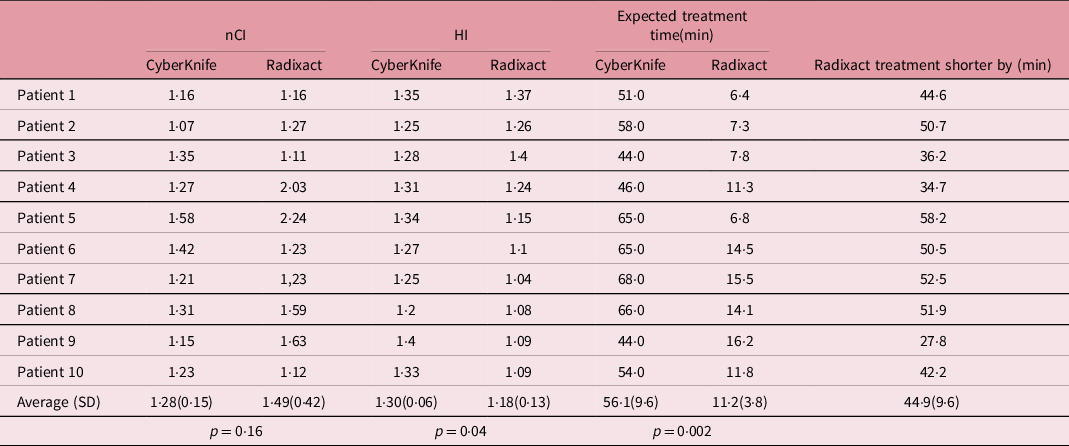
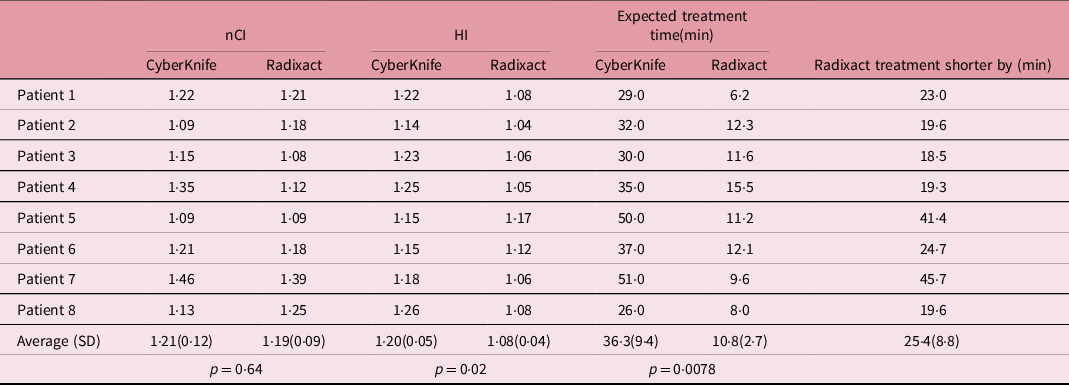
Comparisons of the dosimetric metrics for the PTV, including the nCI, HI and estimated treatment time, for each planning technique, are summarised in Table 4a for prostate SBRT patients and Table 4b for lung SBRT patients. Since nCI and HI of PTV are two independent indexes, no correction was done on the significant criteria (α = 0·05).
New conformity index (nCI) and homogeneity index (HI) of planning target volume of different patients in lung stereotactic body radiation therapy study

New conformity index (nCI) and homogeneity index (HI) of planning target volume of different patients in prostate stereotactic body radiation therapy study. (α should be kept as 0·05 as nCI and HI are two independent indexes)

Lung
The average nCI for the Radixact lung plans was 1·49 ± 0·42 compared with that of the CyberKnife lung plans 1·28 ± 0·15, the difference was not statistically significant (p = 0·16). The average HI values of the CyberKnife lung plans and the Radixact lung plans was 1·30 ± 0·06 and 1·18 ± 0·13, respectively, with statistically significant difference (p = 0·04).
Prostate
In prostate SBRT, the average nCI for the CyberKnife prostate plans was 1·21 ± 0·12, while that for the Radixact lung plans was 1·19 ± 0·09. The difference was not considered statistically significant (p = 0·64). The average HI for the CyberKnife prostate plans was 1·20 ± 0·05, while that for the Radixact lung plans was 1·08 ± 0·04; the difference was statistically significant (p = 0·02).
Treatment time
A much shorter estimated treatment time was observed using the Radixact Synchrony® tracking technique (with average estimated values of 11·2 ± 3·8 and 10·8 ± 2·7 min for Radixact lung and prostate SBRT plans, respectively) than using the CyberKnife Synchrony® technique (with average estimated values of 56·1 ± 9·6 and 36·3 ± 9·4 min for Radixact lung and prostate SBRT plans, respectively). The shortening of treatment time was statistically significant for both treatment sites (p = 0·002 for lung and p = 0·0078 for prostate). It should be noted that the estimated treatment time of the CyberKnife plans included the time interval when the aperture was reshaped at a single node, the travelling time between robot positions, the preset imaging interval (usually every 60 s) and the time for automatic robotic position correction are based on the most recently acquired live images. However, this estimation did not include the patient setup time. The mean Radixact beam-on time considered the 1040 MU/min dose rate and excluded the patient setup time, such as MVCT and kV image verification for Synchrony® model building.
OAR sparing
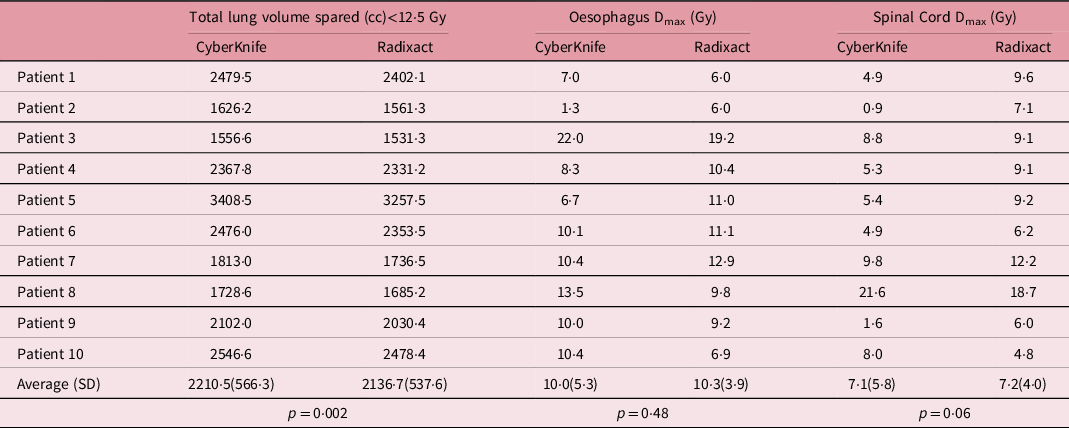
In OAR sparing of lung SBRT treatments as shown in Table 5, α was corrected to be, 0·05/3 = 0·0167. Bonferroni correction was implemented as there were three different comparisons being performed on OARs in lung patients. The overall dose to the lungs was lower in CyberKnife than in Radixact. The lung volume spared in CyberKnife SBRT was larger than that in Radixact SBRT, with an average volume of 2210·5 ± 566·3 cc in CyberKnife and 2136·7 ± 537·6 cc in Radixact. This difference was statistically significant (p = 0·002). The maximum doses, Dmax, delivered to the oesophagus and spinal cord were 10·0 ± 5·3 Gy and 7·1 ± 5·8 Gy, respectively, in the CyberKnife treatments, while those in the Radixact treatments were 10·3 ± 3·9 Gy and 7·2 ± 4·0 Gy. Those differences in the spinal cord Dmax (p = 0·06) and oesophagus Dmax (p = 0·48) between the two techniques were not statistically significant.
Comparison of dose to different organs at risk in lung stereotactic body radiation therapy treatment plans. (α is corrected to be, 0·05/3 = 0·0167. Bonferroni correction was implemented by using the corrected α, total lung volume spared (cc) < 12·5 Gy was a statistically significant parameter)

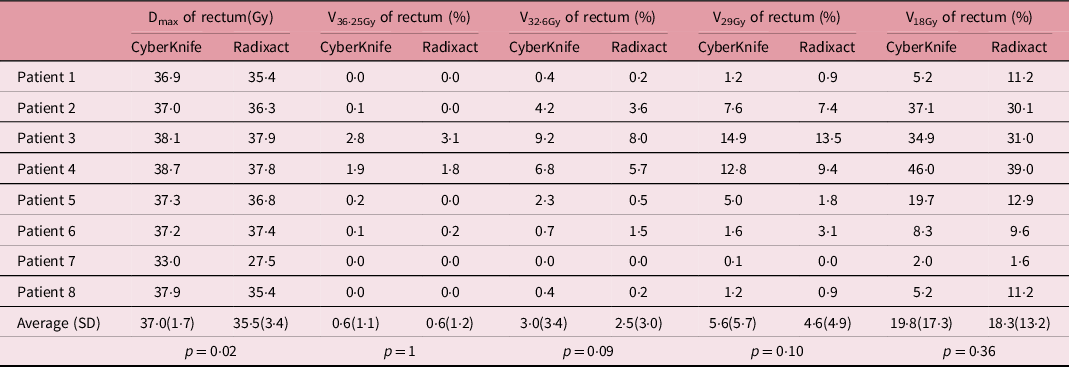
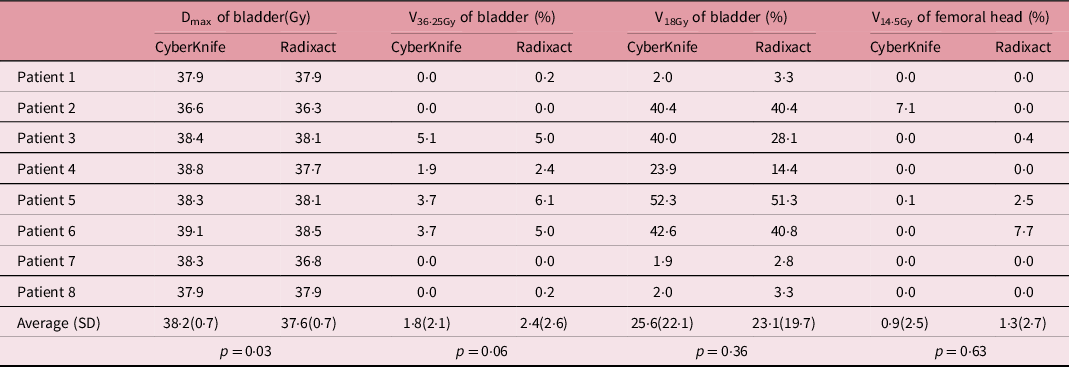
For prostate SBRT treatments as shown in Table 6a and 6b, α was corrected to be 0·05/9 = 0·00556 as there were nine different OAR comparisons. The maximum doses to the rectum and bladder were 37·0 ± 1·7 Gy and 38·2 ± 0·7 Gy, respectively, for CyberKnife, while those for Radixact were 35·5 ± 3·4 Gy and 37·6 ± 0·7 Gy. Such differences were not considered as statistically significant with p = 0·02 for Dmax to rectum and p = 0·03 for Dmax to bladder. The differences between CyberKnife and Radixact in maximum femoral head dose, V36·25Gy, V32·6Gy, V29Gy, V18Gy of rectum and V36·25Gy, V18Gy of bladder were also not statistically significant.
Comparison of dose to rectum in prostate stereotactic body radiation therapy treatment plan. (α is corrected to be 0·05/9 = 0·00556. By using the corrected α, Dmax of rectum has no statistically significant difference)

Comparison of dose to different organs at risk in prostate stereotactic body radiation therapy treatment plans. (α is corrected to be 0·05/9 = 0·00556. By using the corrected α, Dmax of bladder has no statistically significant difference)

Discussion
As shown in our treatment plan comparison between CyberKnife and Radixact Synchrony® in lung SBRT, a non-coplanar technique employed by CyberKnife Synchrony® resulted in lower doses to lungs (p = 0·002), without compromising the coverage and conformity of the dose to the PTV. If more lung volume can be spared from the threshold dose of 12·5Gy in five fractions SBRT, the minimum critical volume constraint (lung volume (cc) receiving<12·5 Gy ≧ 1500 cc) is more likely to be met to preserve lung function. Although HI in Cyberknife plans was more severe, it was acceptable in lung SBRT cases. The shortcoming of this non-coplanar technique in CyberKnife Synchrony® was that the treatment time was approximately five times longer than that of Radixact Synchrony® treatments.
Although Cyberknife Synchrony® produces better SBRT plans for lung tumours, Radixact Synchrony® is still a suitable alternative in case Cyberknife cannot track the tumour clearly in its imaging system. Sometimes when the lung tumour is located at the central region of the lung, the spine may obstruct the view of the tumour in Cyberknife kV X-ray projections at angles 45° and 315° and the Synchrony® tracking cannot proceed. Radixact Synchrony®, without limitation on the gantry angle that kV X-ray images are taken during treatment, can choose to take kV X-ray image at angles with the best visibility of the tumour. Treatment with Radixact Synchrony® real-time tracking is still beneficial for patients since it can spare more lung than conventional ITV-based planning Radixact treatment as the volume of Synchrony® tracking PTV was smaller than the ITV-based PTV.
In prostate SBRT, the difference in the nCI of PTV between CyberKnife and Radixact plans was not statistically significant, but the hotspot of the radiation dose to the PTV was more severe in the CyberKnife plans as the average HI value of Cyberknife plans was larger than that of Radixact plans with a statistically significant difference. On the other hand, the maximum dose difference to rectum and bladder between Cyberknife and Radixact treatments was not statistically significant. CyberKnife non-coplanar beam delivery in prostate SBRT does not have an advantage in organ sparing that we have seen in lung SBRT, which was consistent with the results in the study by Scobioala et al.Reference Scobioala, Kittel, Elsayad, Kroeger, Oertel, Samhouri, Haverkamp and Eich 17 In CyberKnife prostate SBRT planning, InTempo adaptive imaging was chosen to ensure that the robot would not block the X-ray exposure to the detector during treatment for intra-beam imaging, which would limit the number of nodes used during plan optimisation. This limitation would offset the benefit of CyberKnife non-coplanar beam delivery, as observed in the SBRT lung plans comparison.
Although both machines use fiducials for target tracking in prostate treatment, only the CyberKnife Synchrony® fiducial tracking system is capable of tracking the tumour in both translational and rotational directions if more than three fiducial markers are involved. Rotational corrections for the prostate during treatment are very important, as the involuntary motion of the prostate occasionally occurs in rotational directions. According to the study by Xiang et al., 18 during prostate treatment, the intrafractional prostate angular motion of six patients in 18 SBRT fractions was −0·3 ± 2·5°, −0·03 ± 0·74° and 0 ± 1·00° in pitch, yaw and roll, respectively. From the prostate motion data collected from 1,892 registered X-ray images of prostate tracking for six patients, the prostate showed the greatest rotation in the pitch and roll directions, with 4·3% and 4·2% outside margins (±5° for pitch and ±2° for roll), which triggered the interruption of the CyberKnife fiducial tracking system. However, when delivering prostate SBRT with the Radixact fiducial Synchrony® system, the combined jaws and MLC tracking of the machine were only for translational target motion compensation during treatment. On the other hand, our study showed that Radixact prostate treatments were much shorter than CyberKnife prostate treatments; thus, the chance for a rapid involuntary motion of the prostate during treatment was also smaller. Further studies should be conducted to evaluate whether an extra PTV margin may be required to compensate for rotational intrafractional prostate motion in Radixact prostate treatment.
In our study, only Radixact Synchrony® plans with a dynamic jaw width of 2·5 cm were used. A field width of 1 cm was not utilised in the planning comparison because the machine dosimetric performance for Synchrony® with a 2·5-cm field width was satisfactory. According to a study by Guang-Pei Chen on the performance of Radixact Synchrony® treatment, Reference Chen, Tai, Keiper, Lim and Li19 when the jaws were in their extreme positions for target tracking, the delivered dose was decreased for both the 1·0- and 2·5-cm field widths. The average outputs of the beam when the jaws are in extreme positions relative to that when the jaws are at central positions were 0·927 ± 0·002 and 0·984 ± 0·001 for 1·0 and 2·5 cm jaw widths, respectively. Jaw shifting introduced less dosimetric errors for a 2·5-cm field width; therefore, this field width was preferred for Synchrony® treatment planning. A field width of 1 cm should be reserved for cases with large tumour motion. However, the jaw shifting of this field width could introduce dosimetric errors of a few percentages or more, depending on the duration in which the jaws are shifted to their extreme positions to compensate for the target motion.
The limited sample size in our current study may result in insufficient statistical information to show significance in some of the dosimetric parameters. Therefore, further clinical trials with larger sample sizes may be needed to verify the result.
Conclusion
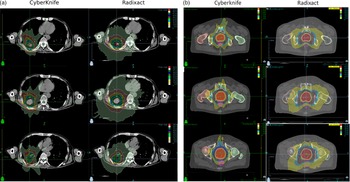
Radixact Synchrony® treatments have a short irradiation time. CyberKnife Synchrony® is more robust for treating targets in lung SBRT. When doing prostate SBRT, Radixact Synchrony® is a more suitable option, as it can produce quality treatment plans comparable to those of CyberKnife in terms of the conformity of the dose to the PTV, but with same OAR doses, shorter treatment times and better HI values (Figure 1a and 1b).
(a) The comparisons of isodose distributions of planning target volume (PTV) and organs at risk (OAR) in three axial planes in one lung stereotactic body radiation therapy (SBRT) patient planned by Precision CyberKnife versus Precision Radixact with Synchrony enabled. (b) The comparisons of isodose distributions of PTV and OAR in three axial planes in one prostate SBRT patient planned by Precision CyberKnife versus Precision Radixact with Synchrony enabled.

Acknowledgements
The Authors would like to thank the great effort of staff of Department of Radiotherapy and the Medical Physics Department of Hong Kong Sanatorium & Hospital, 2 Village Road, Happy Valley, Hong Kong.
Conflict of Interest
‘The authors declare that they have no conflict of interest.’
‘This article does not contain any studies with human participants performed.’
‘This article does not contain any studies with animals performed.’
‘All patients data were anonymous for the retrospective study with approval obtained from the research ethic committee of the Hong Kong Sanatorium & Hospital.’