In an attempt to reduce nosocomial methicillin-resistant Staphylococcus aureus (MRSA) transmission, the Veterans’ Health Administration (VHA) issued a directive in 2007 mandating the use of a MRSA bundle in all acute care settings. The MRSA bundle consists of active surveillance for MRSA nasal colonization in all patients upon each patient movement within the hospital, contact precautions for patients with MRSA colonization or infection, increased emphasis on hand hygiene, and a change in the institutional infection control culture. The Atlanta Veterans’ Affairs Medical Center (AVAMC) fully implemented the MRSA bundle in October 2007. The structure of the MRSA Directive combined with preexisting prospective surveillance for MRSA infections in the AVAMC presented the opportunity to study the molecular epidemiology of MRSA colonization and infection.
A longitudinal evaluation of patients with MRSA colonization and infection allows for a thorough description of the molecular epidemiology of MRSA carriage isolates and the relationship of these strains to those associated with clinical infections. The objective of this study was to longitudinally assess the characteristics and relatedness of colonizing and infecting MRSA strains.
METHODS
The AVAMC healthcare system is composed of an acute care hospital (200 beds) with 8 community-based outpatient clinics and 1 long-term care unit. MRSA nasal colonization screenings at hospital admission and transfer are performed using the Xpert MRSA assay (Cepheid, Sunnyvale, CA), and nasal cultures performed at hospital discharge. Extranasal sites are not routinely screened for MRSA and were not included in this study.
Starting January 1, 2010, all positive nasal surveillance cultures performed at hospital discharge were collected and stored at −70°C in the epidemiology laboratory. Starting January 1, 2011, the partner swabs from all positive admission and transfer MRSA PCR screens (Xpert MRSA assay, Cepheid) were collected and directly inoculated onto Spectra™ MRSA agar (Remel, Lenexa, KS). Isolates were stored at −70°C.
Since October 1, 2005, MRSA clinical cultures from all body sites and corresponding clinical data have been reviewed monthly by the same infectious disease physician (DR). MRSA infections were classified according to the Centers for Disease Control and Prevention criteria.Reference Horan, Andrus and Dudeck 1 This surveillance method captured all MRSA-positive clinical cultures performed at AVAMC healthcare facilities (inpatient and outpatient facilities). Since January 1, 2010, all clinical MRSA cultures have been collected and stored at −70°C.
Using the Veterans Health Information Systems and Technology Architecture (VISTA), all patients with a positive MRSA nasal surveillance culture at hospital discharge from January 1, 2010, to March 31, 2011, were identified. In addition, all patients with a positive nasal surveillance swab at hospital admission or transfer from January 1, 2011, to March 31, 2011, were identified. Patients identified as MRSA colonized were then assessed for MRSA infection by cross referencing them with the MRSA infection database that included data from October 1, 2005, through March 31, 2012. All isolates for patients with both colonization and infection isolates available were typed using pulsed-field gel electrophoresis (PFGE). Patterns were analyzed using Bionumerics v6.5 (Applied Maths, Ghent, Belgium). Pulsed-field types were considered the same if the isolate had a coefficient of similarity of ≥80%.Reference McDougal, Steward, Killgore, Chaitram, McAllister and Tenover 2
RESULTS
From January 1, 2010, through March 31, 2011, 444 patients were identified with a positive nasal MRSA surveillance culture at hospital discharge. From January 1, 2011, through March 31, 2011, 155 patients were identified with a positive MRSA nasal screen at hospital admission or transfer. Together, 503 unique patients were identified with nasal colonization from January 1, 2010, through March 31, 2011.
From October 1, 2005, to March 31, 2012, 2,150 MRSA infections were observed among 1,711 unique veterans; a detailed description of these infections and the associated colonization rates has been previously reported.Reference Stenehjem, Stafford and Rimland 3 Of the 2,150 MRSA infections observed, 665 occurred between January 1, 2010, and March 31, 2012, the isolate collection period.
Of the 503 patients with nasal MRSA colonization, 147 patients (29.2%) had a prior, concurrent, or subsequent MRSA infection identified from the MRSA infection database. Of these 147 MRSA infection events, 115 occurred during the isolate collection period; 77 patients had ≥1 colonization isolate and ≥1 infection isolate available for PFGE typing. Typing of both infection and colonization isolates was not possible in 38 patients due to missing isolates.
From the 77 patients with both infection and colonization isolates available, 390 MRSA isolates were typed: 264 colonization isolates and 126 infection isolates. The mean number of isolates typed per patient was 5.06 (range, 2–18 isolates). The mean number of colonization and infection isolates typed per patient were 3.43 (range, 1–17) and 1.64 (range, 1–6), respectively. The mean time between first and last isolate typed per patient was 251 days (range, 4–783 days).
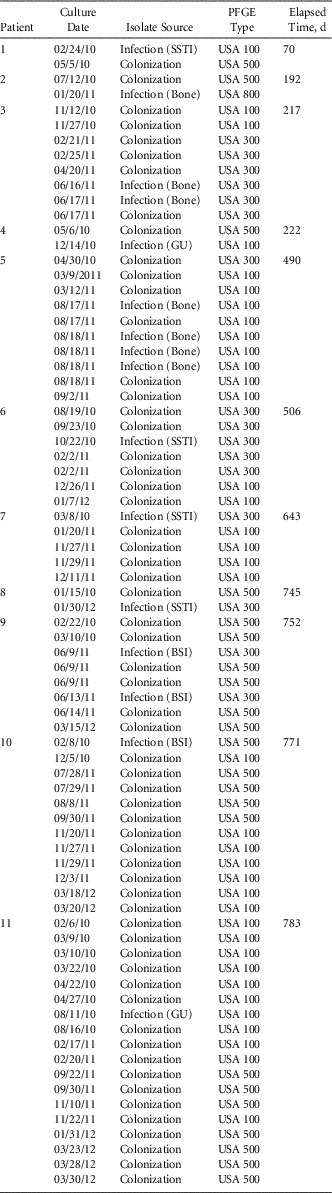
Of these 77 patients, 66 (85.7%) had concordance of all MRSA isolates typed, with the following PFGE type distribution: 33.4% USA 100, 31.8% USA 300, 31.8% USA 500, and 3% other (USA 700 and USA 800). Patients with discordant PFGE results had more isolates typed per patient (6.9 isolates vs 4.8 isolates, P=.034) and had a longer interval between first and last isolate typed (490 days vs 211 days, P=.0002) (Table 1).
MRSA Strain Types and Patterns of Discordance

NOTE. SSTI, skin/soft tissue infection; BSI, bloodstream infection; GU, genitourinary.
DISCUSSION
Using the VHA MRSA Directive as a platform to collect MRSA colonization isolates and an active MRSA infection surveillance program, we evaluated the genetic relatedness of colonization and infection isolates over a 27-month period among Atlanta veterans. With an average of 5 MRSA isolates per patient over an average of 251 days, this is one of the largest longitudinal evaluations of MRSA colonization and infection isolate concordance. We found a high rate of strain concordance (85.7%), consistent with previous reports.Reference von Eiff, Becker, Machka, Stammer and Peters 4 , Reference Wertheim, Vos and Ott 5 Unique to our study is the longitudinal nature of the evaluation with the ability to perform PFGE typing on all available collected isolates. We found patients with strain discordance to have more isolates available for typing and a longer time period from first isolate to last isolate typed.
Based on our data, discordance between colonization and infection isolates may be the result of either a change in the colonizing/infecting strain over time (strain switching) or the presence of concurrent colonization and infection with different strains of MRSA, possibly due to co-colonization. Patients 3 and 6 are examples of strain switching and patient 9 is an example of concurrent colonization and infection with different MRSA types (Table 1). Our analysis is limited by restricting MRSA colonization testing to the anterior nares and the typing of 1 colony from each culture result. Co-colonization with multiple MRSA isolate types has been observed when multiple anatomic sites have been sampledReference Peters, Brooks and McAllister 6 and by typing multiple colonies from the same culture specimen.Reference Cespedes, Said-Salim and Miller 7 In both scenarios, longer duration of follow-up and increased sampling may lead to higher rates of discordance, as was found in our study.
In our cohort of patients with concordant MRSA colonization and infection isolates, isolate types were evenly distributed among 3 PFGE types (USA 100, 300, and 500). The high rate of USA 500 has been demonstrated previously in AtlantaReference Hidron, Kourbatova and Halvosa 8 and contrasts with low rates of USA 500 in a number of national and regional surveillance reports.Reference Limbago, Fosheim and Schoonover 9 , Reference Tenover, Tickler and Goering 10 The high proportion of healthcare-associated MRSA strains (USA 100 and USA 500) is likely a result of sampling a chronically ill population with considerable hospital exposure.
ACKNOWLEDGMENTS
Financial support: This work was supported in part by (1) PHS Grant UL1RR025008 from the Clinical and Translational Science Award program, National Institutes of Health, National Center for Research Resources, and (2) CDC Interagency Agreement (grant no. 07FED706507).
Potential conflicts of interest: All authors report no conflicts of interest relevant to this article. All authors submitted the ICMJE Form for Disclosure of Potential Conflicts of Interest.