Kawasaki disease is an acute febrile rash illness of unknown cause, characterised by systemic vasculitis. Kawasaki disease most commonly affects young children under the age of five, and involves mainly the small arteries, especially the coronary arteries, which can result in coronary artery aneurysms.Reference Newburger, Takahashi and Gerber 1 – Reference Zhang, Zhang and Zhu 3 Over the past 10 years, the incidence of Kawasaki disease as well as coronary artery lesions has significantly increased,Reference Zhu, Liang and Wang 4 and coronary artery lesions have become the most common cause for acquired heart disease in children in developed countries.Reference Freeman and Shulman 5 Recent studies have shown that Kawasaki disease can cause coronary atherosclerosis in adults, even leading to sudden death.Reference Fudazawa and Oqawa 6 , Reference Zhang, Jin and Du 7 The standard treatment regimen for the acute phase of Kawasaki disease involves administering intravenous immunoglobulin 2 g/kg within 10 days of onset and aspirin 50 mg/kg to effectively decrease in duration of fever and reduce the incidence of coronary artery disease.
It is important to note that, according to the literature, 10–25% of children with Kawasaki disease still have fever or recurrence of fever after being relieved, within 36 hours, of the initial intravenous immunoglobulin treatment. Such cases are classified as intravenous immunoglobulin-resistant Kawasaki disease.Reference Zhang and Hu 8 The treatment regimen for children with intravenous immunoglobulin-resistant Kawasaki disease is still controversial. The American Heart Association recommends a second administration of 2 g/kg intravenous immunoglobulin to treat children with initial intravenous immunoglobulin-resistant Kawasaki disease;Reference Zhang, Du and Fu 9 however, this is based on evidence from serial case analyses and case–control studies of poor quality, and is only of evidence level C. Other existing therapies include glucocorticoids therapy, biological agents such as plasmapheresis, protease inhibitors – ulinastatin for injection – infliximab, and other drugs;Reference Tang 10 however, there is no standard therapy for intravenous immunoglobulin-resistant Kawasaki disease. In this study, we performed a meta-analysis of published studies in order to evaluate the effects of a second intravenous immunoglobulin dose compared with glucocorticoids as clinical treatments for intravenous immunoglobulin-resistant Kawasaki disease.
Materials and methods
Inclusion criteria
Studies meeting all of the following inclusion criteria were included: study participants were children with initial intravenous immunoglobulin-resistant Kawasaki disease; the study evaluated comparative effectiveness of re-treatment with intravenous immunoglobulin at 1–2 g/kg versus treatment with glucocorticosteroids; studies contained detailed descriptions regarding basic information of patients, study design, efficacy determination, and whether follow-up was available before drug use; and indications used to evaluate effects included change in body temperature, biomarker levels, and coronary artery lesions detected by ultrasonic cardiogram.
Exclusion criteria
Studies meeting any of the following criteria were excluded: study participants did not have intravenous immunoglobulin-resistant Kawasaki disease; the control group continuously received intravenous immunoglobulin with modified dosing; design was of retrospective nature without a control group or retrospective controlled study without randomised studies; and the intravenous immunoglobulin-resistant patients received other treatments after being treated with intravenous immunoglobulin or steroids.
Efficacy evaluation
Following non-responsiveness to a first intravenous immunoglobulin dosing, the following conditions were considered to be effective during re-treatment: temperature dropped to normal within 3 days without repeatedly rising; and re-examined ultrasonic cardiogram results during follow-up period suggested no coronary artery lesion or coronary artery lesion was alleviated. In this study, a meta-analysis was performed to analyse body temperature change 1-week after treatment and to observe changes in coronary artery aneurysm incidence within 4 weeks after a second intravenous immunoglobulin or glucocorticosteroid re-treatment in children with resistant Kawasaki disease.
Retrieval of literature
Databases used in this study included PubMed (1968–2014), Medline (1950–2014), Elsevier (1998–2014), Springer Link (as of 2014), Ovid (2000–2014), BlackWell (1999–2014), BMJ Journals online (as of 2014), Karger (1890–2014), John Wiley (1999–2014), and Chinese Journal Full-text Database (1990–2014). The cut-off time for all the literature retrieved was February, 2014.
Retrieval strategy involved searching for the following key words in full-text databases in English: Kawasaki disease/mucocutaneous lymph node syndrome/Kawasaki disease/mucocutaneous lymph node syndrome *AND intravenous immunoglobulin/intravenous gamma-globulin/intravenous immunoglobulin/intravenous gamma globulin/immunoglobulin AND resistant/unresponsive/refractory/intractable/failure AND treatment/re-treatment/therapy/management. In order to search for the articles containing therapy for intravenous immunoglobulin-resistant Kawasaki disease, the following key words were also included in searches: Kawasaki disease AND initial intravenous immunoglobulin treatment failure/fail to respond to initial treatment with intravenous immunoglobulin/additional gamma-globulin AND intravenous methylprednisolone/intravenous methylprednisolone/steroid AND treatment/re-treatment/therapy/management.
Original texts were obtained from full-text databases of electronic periodicals.
Quality assessment of literature
Investigators used abstracts to screen literature, extracting and evaluating articles based on basic information, study subjects, design, implementation, and analysis methods.
The sample size, age, diagnostic criteria of Kawasaki disease, the initial treatment, diagnostic criteria of intravenous immunoglobulin-resistant Kawasaki disease, and re-treatment after non-response to intravenous immunoglobulin were obtained from the data extracted from the selected articles.
The quality of included literature was assessed using the Juni scale, according to the following four evaluation criteria of randomised controlled trials: correct randomised method; allocation concealment to avoid selective bias due to random allocation influenced by various factors; blind design; and intention-to-treat analysis when needed. Those studies fully meeting the above-mentioned four requirements were ranked grade A with the possibility of minimum bias; studies partially satisfying any or several of the criteria were ranked grade B with the possibility of moderate bias; failure to meet several or many of the requirements were ranked grade C with the possibility of high bias.
Statistical analysis
Review Manager 5.3 software was used for statistical analysis. Comprehensive analysis of orientation was performed for the results of the selected studies. χ2-test was used for heterogeneity analysis, and p>0.05 showed that no heterogeneity existed among studies. For studies involving enumerated data, the results were stated with relative risk and 95% confidence intervals. The difference was considered to be statistically significant when p<0.05.
Results
General information of study subjects
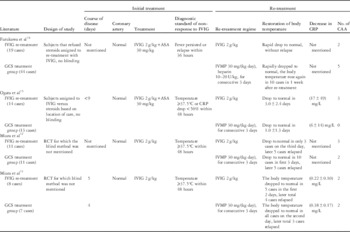
From the medical literature, six studies of intravenous immunoglobulin-resistant Kawasaki disease were identified.Reference Hashino, Ishii and Iemura 11 – Reference Teraguchi, Ogino and Yoshimura 16 Of these, the Hashino et al studyReference Hashino, Ishii and Iemura 11 and Teraguchi et alReference Teraguchi, Ogino and Yoshimura 16 study were excluded because of the following reasons: the control group continuously applied intravenous immunoglobulin with modified dosingReference Hashino, Ishii and Iemura 11 and the intravenous immunoglobulin-resistant patients received other treatments after being treated with intravenous immunoglobulin or steroids.Reference Teraguchi, Ogino and Yoshimura 16 Ultimately, four trials were selected, of which two were randomised controlled trials and the other two were comparative effectiveness studies that did not involve randomisation.Reference Miura, Ohki and Yoshiba 12 – Reference Ogata, Bando and Kimura 15 An overview of the selected studies is listed in Table 1. Participants ranged from 1 to 141 months of age, and in total there were 52 patients in the second intravenous immunoglobulin treatment group and 75 patients in the glucocorticosteroid treatment control group. Kawasaki disease diagnosis was described in detail in each of the selected studies. All the children were diagnosed in accordance with Kawasaki disease criteria established by the “Japanese Kawasaki disease research committee”, and diseases with similar clinical manifestations of Kawasaki disease were excluded. All the studies observed normalisation of body temperature within a specific time frame and the occurrence of coronary artery aneurysms. A 50% decrease in C-reactive protein following 1-week re-treatment was regarded as the index in one article,Reference Ogata, Bando and Kimura 15 as shown in Table 1. Associated covariates such as age, gender, and duration of illness are shown in Table 2.
Initial treatment and re-treatment in the four selected studies.

ASA=acetylsalicylic acid; CAA=coronary artery aneurysm; CRP=C-reactive protein; GCS=glucocorticosteroid; IVIG=intravenous immunoglobulin; IVMP=intravenous methylprednisolone; RCT=randomised controlled trial
Age, gender, and duration of illness on admission.

IVIG=intravenous immunoglobulin; ns=no significant difference.
Quality of the selected studies
Of the two randomised controlled trials and two comparative effectiveness studies, each contained a control group. Of all, two trials did not adopt the blind method, and one did not have allocation concealment; neither blind method nor allocation concealment was mentioned in the remaining two trials. No patients were lost to follow-up or withdrawal; two studies were ranked grade B, and the other two studies were ranked grade C. See Table 3.
Quality assessment of the four selected studies.

Meta-analysis results
Body temperature recovery
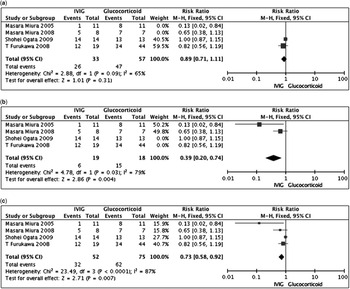
Comprehensive analysis of the selected studies indicated that, following the first dose of intravenous immunoglobulin treatment, body temperatures were more effectively restored in intravenous immunoglobulin-resistant Kawasaki disease patients in the glucocorticosteroid treatment group (62/75, 82.7%) in comparison with patients in the second intravenous immunoglobulin treatment group (32/52, 61.5%), and the difference was statistically significant (relative risk=0.73, p=0.007). See Figure 1.
Forest plot of body temperature recovery with a second intravenous immunoglobulin treatment versus glucocorticoid treatment in children with intravenous immunoglobulin-resistant Kawasaki disease. In these studies, efficacy was measured as body temperature returning to normal without longer relapse. Each ■ represents the relative risk of each study; the horizontal line across represent 95% confidence intervals; ◆ represents comprehensive analysis of the results. In the figure, ◆ having no intersection with a vertical line suggests that the temperatures of intravenous immunoglobulin-resistant Kawasaki disease patients who received glucocorticosteroid re-treatment were more effectively improved compared with intravenous immunoglobulin-resistant Kawasaki disease patients who received a second intravenous immunoglobulin treatment, and the difference between both groups was statistically significant (relative risk: 0.73, 95% confidence interval: 0.58–0.92, p=0.007). ( a ) The results of two comparative effectiveness studies, ( b ) the results of two randomised controlled trials (RCTs), and ( c ) the results of all the four studies.

Coronary artery lesions
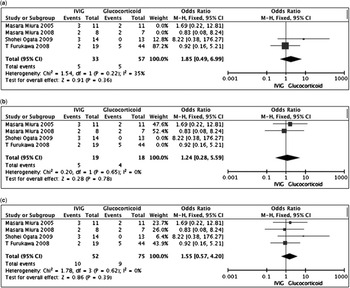
Comprehensive analysis indicated that, after the first dose of intravenous immunoglobulin treatment, no statistically significant difference (odds ratio=1.55, p=0.39) existed between the incidence of coronary artery lesions in the glucocorticosteroid re-treatment group (9/75, 12%) compared with the second intravenous immunoglobulin treatment group (10/52, 19%). See Figure 2.
Forest plot of coronary artery lesions with second intravenous immunoglobulin treatment versus glucocorticoid treatment in intravenous immunoglobulin-resistant Kawasaki disease in children. In these studies, efficacy was determined by the occurrence of coronary lesions. Each ■ represents the odds ratio of each study, and the horizontal line across represents 95% confidence intervals. ◆ represents comprehensive analysis of the results. ◆ having no intersection with a vertical line suggests that there was no statistical difference in the occurrence of coronary lesions between glucocorticosteroid re-treatment and the second intravenous immunoglobulin treatment (odds ratio: 1.55, 95% confidence interval: 0.57–4.20, p=0.39). ( a ) The results of two comparative effectiveness studies, ( b ) the results of two randomised controlled trials (RCTs), and ( c ) the results of all the four studies.

Adverse reactions
Patients undergoing methylprednisolone pulse therapy showed adverse reactions including hypertension, hypothermia, and bradycardia. The adverse reactions of glucocorticosteroids in the studies are detailed in Table 4.
Occurrence of adverse reactions of glucocorticoid therapy in the four selected studies.

Discussion
Coronary artery lesions are the most common and serious cardiovascular complication of Kawasaki disease, and they often persist after the acute phase. They are a major cause of death in children with Kawasaki disease. The occurrence rate of intravenous immunoglobulin-resistant Kawasaki disease reported in the United States this year was 18 to 22%.Reference Yang and Zhu 17 A highly activated immune system and vasculitis are marked features of Kawasaki disease.Reference Zhang, Du and Yang 18 , Reference Onouchi, Suzuki and Suzuki 19 Intravenous immunoglobulin can reduce the abnormal immune response; reduce cytokine levels; suppress endothelial cell activation, immune regulation, and Fc receptor blockers; inhibit antibody formation; neutralise super-antigens of bacteria and viruses; improve clinical symptoms; and alleviate coronary injury.Reference Galeotti, Bayry and Kone-Paut 20 , Reference Kobayashi, Saji and Otani 21 Intravenous immunoglobulin remains the most important and widely used therapeutic to reduce coronary artery lesion incidence. Intravenous immunoglobulin dosing is negatively correlated to coronary artery lesion incidence.Reference Kim, On and Hong 22 , Reference Teraguchi, Ogino and Yoshimura 23
At present, most doctors advocate administering a second intravenous immunoglobulin treatment for patients who are non-responsive to the first dose of intravenous immunoglobulin, but specific re-treatment dosage is inconclusive. Teraguchi et alReference Teraguchi, Ogino and Yoshimura 16 conducted a prospective trial to evaluate the effectiveness of methylprednisolone pulse therapy compared with an additional intravenous immunoglobulin therapy for intravenous immunoglobulin-resistant Kawasaki disease patients. They found that clinical symptoms and laboratory parameters in two-thirds of patients were significantly improved after the second dose of immunoglobulin, whereas methylprednisolone pulse therapy had more treatment failures, characterised by persistent fever or recrudescence of fever. The above findings were very meaningful and informative and would attract further clinical trials in the field, although this study was not included in this meta-analysis, as intravenous immunoglobulin-resistant patients received other treatments after being treated with intravenous immunoglobulin or steroids in the study.Reference Teraguchi, Ogino and Yoshimura 16
Our present study revealed that in 52 cases of second immunoglobulin treatment for intravenous immunoglobulin-resistant Kawasaki disease, the body temperatures of 32 cases dropped to normal within 72 hours, but 20 cases did not respond to treatment, and 10 cases showed the occurrence of coronary artery lesions. Even after following a third round of intravenous immunoglobulin treatment, there still remained cases of non-responsiveness. This may be due to various factorsReference Yan, Wan and Du 24 such as levels of blood neutrophils, C-reactive protein, white blood cells, serum cholesterol, sodium, potassium, etc. before treatment.
At present, a therapeutic regimen of glucocorticoid drugs for patients with intravenous immunoglobulin-resistant Kawasaki disease has been generally accepted.Reference Millar, Manlhiot and Yeung 25 Similar to other vasculitis syndromes, the occurrence of vasculitis in Kawasaki disease patients is associated with vascular endothelial injury and vascular wall damage due to an abnormal immune response. Some humoral factors, especially anti-neutrophil cytoplasmic antibodies, can activate neutrophils, resulting in early vascular injury of Kawasaki disease. Glucocorticosteroids may suppress NF-κB, improve IκB activation, inhibit a variety of cytokines and COX2, and block inflammation.Reference Wang and Cao 26 This is primarily attributable to the fact that glucocorticosteroids act directly on the glucocorticoid receptor in the cell membrane, playing a role in stabilising the membrane and blocking receptor activation. Decreased in vivo cortisol levels in Kawasaki disease children during the acute period provided the theoretical basis for applying glucocorticosteroid treatment in children with Kawasaki disease.Reference Li 27 Miura et al believe that as soon as Kawasaki disease patients display non-responsiveness to immunoglobulin, glucocorticosteroid therapy should be used to rapidly relieve inflammation in patients. Delayed treatment could lead to the persistence of inflammatory cytokines, causing sustained coronary lesions; on the other hand, glucocorticosteroid can further suppress the inflammatory response that immunoglobulins are unable to suppress.Reference Miura, Tamame and Naganuma 28
Hung and ChiuReference Hung and Chiu 29 found that methylprednisolone showed significantly greater efficacy than a third intravenous immunoglobulin treatment in children who were unresponsive to two consecutive intravenous immunoglobulin treatments. Sundel et alReference Sundel, Baker and Fulton 30 found that when methylprednisolone was administered at 30 mg/kg day for 3 days during a standard treatment regimen, patient body temperature returned to normal faster, C-reactive protein and erythrocyte sedimentation decreased more quickly, and length of hospital stay was shortened, with no significant adverse reactions. Ogata et alReference Ogata, Bando and Kimura 15 pointed out that, following non-responsiveness to initial immunoglobulin treatment in children with intravenous immunoglobulin-resistant Kawasaki disease, the use of glucocorticoid drugs could significantly shorten fever time, reduce C-reactive protein levels, and cause high recovery rate of coronary artery aneurysms compared with further immunoglobulin treatment. The present study found that after administration of glucocorticoid re-treatment in 75 initial intravenous immunoglobulin non-responsiveness cases, the body temperatures of 62 patients dropped to normal ranges within 72 hours, but non-responsiveness persisted in 13 cases, and coronary artery lesions occurred in nine cases. Comparisons of the groups suggest that glucocorticosteroids are better for fever reduction compared with the second dose of intravenous immunoglobulin.
Many researchers propose that glucocorticosteroids could help in restoring dilated coronary arteries, but studies also suggest that glucocorticosteroids could facilitate coronary artery lesions.Reference Millar, Manlhiot and Yeung 25 , Reference Zhu, Lv and Ling 31 The present study, however, showed that coronary artery lesions occurred in nine out of 75 cases after glucocorticosteroid treatment with non-response to initial intravenous immunoglobulin treatment. There was no significant difference in the occurrence of coronary artery lesions between the glucocorticosteroid re-treatment group and the second intravenous immunoglobulin re-treatment group.
Methylprednisolone pulse therapy involves some adverse reactionsReference Freeman and Shulman 32 such as hypertension, hypothermia, bradycardia, thrombosis, and even gastrointestinal bleeding. These adverse reactions, however, are mostly temporary, and the majority of children recover without special treatment. In the present analysis, common adverse reactions concomitant with glucocorticoid usage included hypertension, hypothermia, bradycardia, and some rare reactions including gastrocnemius nerve palsy. Most of these patients recovered without special treatment.
The meta-analysis of currently published comparative trials demonstrates that glucocorticosteroids are more effective in restoring body temperature than a second intravenous immunoglobulin treatment in children with intravenous immunoglobulin-resistant Kawasaki disease; however, no statistical difference was found in the incidence of coronary artery lesions between the two groups. Further studies are still needed to confirm the safety and efficacy of corticosteroids.
Nevertheless, the meta-analysis in this study has some limitations. First, there was a limited number of randomised controlled trial studies investigating the re-treatment for children with intravenous immunoglobulin-resistant Kawasaki disease, and each sample size was small. Second, the follow-up periods of each study were relatively short, which resulted in the fact that the defervescence might be only a surrogate outcome for control of the inflammatory response. Therefore, whether glucocorticoid therapy should be used routinely to treat children with intravenous immunoglobulin-resistant Kawasaki disease still needs multi-centre and large sample-sized studies to further evaluate its safety and efficacy.
Acknowledgements
None.
Financial Support
This work was supported by Beijing Municipal Plan for Science and Technology, China (Z131100006813024).
Conflicts of Interest
None.
Ethical Standards
This study was in line with the ethical standards and approved by the Ethical Committee of Peking University First Hospital.