Introduction and background
Worldwide, there are 35.6 million individuals living with dementia, 7.7 million new diagnoses each year, and a projected doubling of prevalence rates every 20 years (World Health Organization, 2016). Dementia is progressive and characterized by a deterioration in cognition beyond that expected in normal aging, along with changes in emotional control, social behavior, motivation, and/or physical ability (Australian Institute of Health and Welfare, 2011; World Health Organization, 2016). The impact of dementia on the individual affected and their family, along with the increasing prevalence has resulted in a greater need for more services, including relocating into nursing homes (Australian Institute of Health and Welfare, 2011; Guideline Adaptation Committee, 2016). In Australia, individuals living with dementia account for 52% of individuals living in nursing homes (Australian Institute of Health and Welfare, 2012). Often these individuals have relocated to a nursing home as they require higher levels of care their family can no longer provide in the home setting due to increased behavioral and psychological symptoms of dementia (BPSD) and poor physical function. Therefore, as the population continues to age and the prevalence of dementia increases so will the demand on nursing homes.
BPSD occur in 70%–90% of individuals living with dementia (Gray, Reference Gray2004). A common BPSD is agitation, which can be defined as “inappropriate verbal, vocal or motor activity that is not judged by an outside observer to result directly from the needs or confusion of the agitated individual” (Cohen-Mansfield, Reference Cohen-Mansfield1986). Agitation causes distress to the individual living with dementia and their family carers, increases carer burden and can result in costly care (International Psychogeriatric Association, 2002). Agitation, like other BPSD, is often mismanaged with over prescription of pharmacological interventions, even though they are known to have limited benefits and have many harmful side effects, such as sedation, dizziness, Parkinsonism, and cerebrovascular accidents (Forbes et al., Reference Forbes, Thiessen, Blake, Forbes and Forbes2013; Livingston, Reference Livingston2014). A recent systematic review which specifically considered non-pharmacological intervention for agitation in individuals living with dementia found insufficient evidence to make any definitive recommendations about physical exercise (Livingston, Reference Livingston2014). This highlights the need for further research to determine if physical exercise is potentially a beneficial intervention that can be utilized when treating agitation in individuals living with dementia.
A decline in physical performance is another symptom of dementia which becomes more apparent in the latter stages. Individuals experience difficulties with balance, mobility, and fine motor skills, which impacts on their ability to maintain independence and complete activities of daily living (ADL) (Telenius et al., Reference Telenius, Engedal and Bergland2015). This may cause the individual living with dementia to feel increasingly agitated and frustrated, contribute to increased carer burden and result in relocation to a nursing home. Recent reviews have shown that physical exercise can have a positive effect on physical function for individuals living with dementia, though improvements or changes were not always significant (Fox et al., Reference Fox, Hodgkinson and Parker2014b; Valenzuela, Reference Valenzuela2012; Brett et al., Reference Brett, Traynor and Stapley2016).
Best practice guidelines recommend non-pharmacological therapies as the first approach to care for individuals living with dementia (Guideline Adaptation Committee, 2016). Physical exercise is an under-utilized strategy for managing and possibly slowing the progression of dementia. There is extensive evidence about the physical and mental health benefits of physical exercise for “healthy” older individuals, including improved mobility, physical function, physical fitness, cognition, mood, and prevention of falls (Garber et al., Reference Garber2011). Systematic reviews found promising, yet limited evidence about the significant benefits for individuals living with dementia in the community and in nursing homes, including reduction in agitation (Forbes et al., Reference Forbes, Thiessen, Blake, Forbes and Forbes2013; Pitkälä et al., Reference Pitkälä, Savikko, Poysti, Strandberg and Laakkonen2013; Brett et al., Reference Brett, Traynor and Stapley2016).
A group setting is often adopted to help improve adherence and compliance to physical exercise interventions; a study specific to individuals living with dementia in nursing homes could not be found, however a study with older individuals in a residential village setting found the group setting was more successful than an individual setting (Cyarto et al., Reference Cyarto, Brown and Marshall2006). However, it is still important that the physical exercises be specific for the needs of individuals. This can be achieved through smaller groups using a multimodal approach targeting strength, balance, and endurance. A multimodal approach was the most successful intervention in systematic reviews that considered physical exercise and activity for individuals living with dementia (Forbes et al., Reference Forbes, Thiessen, Blake, Forbes and Forbes2013; Brett et al., Reference Brett, Traynor and Stapley2016).
A systematic review, a Cochrane review, and a position stand from the American College of Sports Medicine reported a lack of evidence for the optimum parameters of physical exercise interventions, such as type, frequency, length, and intensity, for individuals living with dementia in nursing homes which needs to be addressed through further research (Chodzko-Zajko et al., Reference Chodzko-Zajko2009; Brett et al., Reference Brett, Traynor and Stapley2016; Forbes et al., Reference Forbes, Thiessen, Blake, Forbes and Forbes2013). Research on physical exercise for individuals living with dementia, including in nursing homes is currently lacking even though the prevalence of dementia is increasing along with the demand on nursing homes (Humphreys, Reference Humphreys2012). Agitation has a significant impact on the individual living with dementia, their family, and staff of nursing homes, yet there is limited research on this specific area. Only one study from one of the systematic reviews specifically considered agitation levels of individuals living with dementia in nursing homes (Brett et al., Reference Brett, Traynor and Stapley2016).
The primary aim of this paper were therefore to fully describe a protocol involving a randomized controlled trial (RCT) with a qualitative element, which evaluated the impact and feasibility of a physical exercise intervention on agitation of individuals living with dementia specifically in nursing homes. The effect on physical performance was considered as a secondary aim of this study. The protocol was assessed against the Template for Intervention Description and Replication (TIDieR) Checklist (see Figure 1 published as supplementary material) (Hoffmann et al., Reference Hoffmann2014). In order to achieve the stated aims of the paper, this study sought to (a) measure the effects of physical exercise interventions on agitation among individuals living with dementia in nursing homes (primary outcome measure); (b) measure the effects of the physical exercise intervention on physical performance among individuals living with dementia in nursing homes (secondary outcome measure); (c) compare the effects of altering the frequency and duration of the physical exercise intervention; and (d) understand the feasibility of sustaining the physical exercise intervention for individuals living with dementia in nursing homes. It was hypothesized that (a) both physical exercise intervention groups would show greater improvement in agitation and physical performance when compared to the “usual care” control group, and (b) that the shorter duration, higher frequency would be more suitable for individuals living with dementia in nursing homes, due to the reduced impact on fatigue and pressure for the participants to stay interested in the intervention for the required time.
Randomized controlled trial design.

Method
Study design
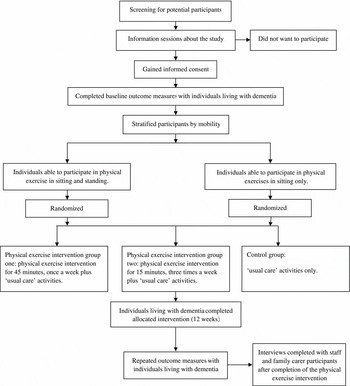
An RCT design was adopted to ensure the features of true experimental design were achieved when determining the effects of the physical exercise intervention on agitation and physical performance: manipulation, control, and randomization, which ensured relative confidence in the genuineness of the results obtained (Polit and Beck, Reference Polit and Beck2011). This part of the study was a three armed, single blinded study (Figure 1). A qualitative component was also utilized alongside the RCT after completion of the intervention, to gain an understanding of the benefits and feasibility of such an intervention from the staff and family carer perspective (Nøst et al., Reference Nøst, Steinsbekk, Bratås and Grønning2016). This study was not classed as a mixed method study as there was no intention to integrate the results from the two components (Lewin et al., Reference Lewin, Glenton and Oxman2009). A multidisciplinary research team, including a physical therapist, nurses, and exercise scientist experienced in working with individuals living with dementia conducted this study.
Ethical considerations
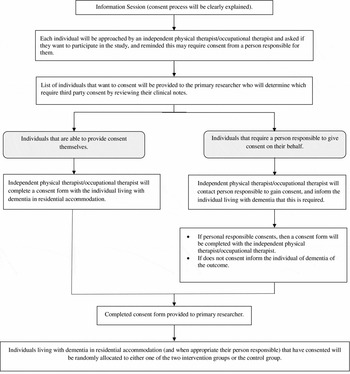
Ethical approval to undertake this study was provided by the host university. Potential participants (individual's living with dementia, family carers, and staff) were invited to attend information sessions led by the primary investigator using posters, and during residents’ and relatives’ meetings. During the information sessions, the study was explained in detail, and there was the opportunity to ask questions during or after. Individuals that attended the information session were then approached by a person independent of the study to gain written consent to participate. Some individuals lacked capacity to provide consent (documented in their clinical notes) and required additional consent from a person responsible to make such decisions on their behalf (Figure 2 outlines the consent process for individuals living with dementia). Throughout the study process consent was applied to gain ongoing consent from all participants (Dewing, Reference Dewing2007).
Consent process for individuals living with dementia in the nursing homes.

Study setting
Two nursing home sites in Adelaide, South Australia, Australia (NH1 and NH2) were selected based on the number of potential participants, and the provision of a suitable area to conduct the physical exercise intervention. NH1 and NH2 were similar in respect to (a) provided high-level care to individuals, including those living with dementia (accounted for 72%–88% of the total population at each site); (b) funded by the Australian government for provision of this service through the Aged Care Funding Instrument (Australian Government, 2014a); (c) met the Australian nursing home accreditation standards (Australian Government, 2014b); (d) had similar management structure, staffing ratios, and staff mix; and (e) serviced by general practitioners and allied health professionals.
Participants
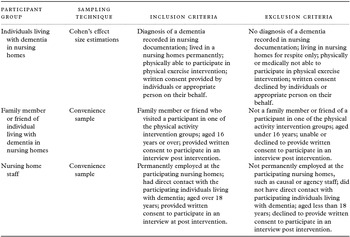
Participants in this study represented individuals living with dementia, family carers, and staff from the participating nursing homes (Table 1).
Summary of participant groups

Individuals living with dementia in nursing homes: randomization of participants for intervention activities
Initially, a power calculation was completed through consultation with a statistician based on two recent studies that used the CMAI to ensure statistically and clinically results may be obtained (Sung et al., Reference Sung, Chang, Lee and Lee2006; Chenoweth et al., Reference Chenoweth2009). However, due to the large discrepancy between the significant scores in the two studies, it was deemed not appropriate by the statistician. Instead Cohen's effect size estimations were used to determine the size of all three groups, which is commonly used in medical and behavioral sciences (Cohen, Reference Cohen1988).
Based on effect sizes as defined by Cohen, each group required 26 participants to show a large effect (0.8). The type 1 error rate was set at 5%. Based on similar studies, we expected a dropout rate of 7.5% from baseline to completion of the intervention (12 weeks) (van de Winckel et al., Reference Van De Winckel, Feys, De Weerdt and Dom2004; Conradsson et al., Reference Conradsson, Littbrand, Lindelöf, Gustafson and Rosendahl2010). Ideally, 28 individuals living with dementia in nursing homes needed to be recruited for each of the three groups to determine if there was a significant difference in the CMAI total score over time or between the three groups. Along with comparison to the control group, it was also important to determine if there would be a difference between the two physical exercise intervention groups to help determine which parameters were more suitable, in line with our first hypothesis.
Individuals living with dementia in NH1 and NH2 had varying levels of mobility. To increase the comparability of results, the study population was sorted into two subgroups: (a) individuals able to participate in standing and walking exercises and (b) individuals only able to participate in sitting exercises. Individuals were then randomly allocated to one of the three study groups after baseline assessments were conducted. This was completed using a random number table by a person independent of the study who was blinded to group allocation to reduce the risk of bias (Randomness and Integrity Services Limited, 2015).
Family carers and staff: convenience sample of participants for qualitative interviews
A convenience sample from all family carers of individuals living with dementia that were randomly allocated to one of the two intervention groups, and staff from NH1 and NH2 were invited to participate in qualitative in-depth interviews (Polit and Beck, Reference Polit and Beck2011). A total of nine family carers and ten staff volunteered to be interviewed. The interviews focused on understanding the effects and feasibility of the physical exercise interventions for individuals living with dementia in nursing homes.
Interventions
Physical exercise intervention
Two physical exercise intervention groups were used in this study: (a) physical exercise intervention group one; physical exercise intervention for 45 minutes once a week; (b) physical exercise intervention group two; physical exercise intervention for 15 minutes, three times a week. The physical exercise intervention developed for this study was designed to determine the effect of physical exercise on agitation. It was informed by a systematic review of the effects of physical exercise on individuals living with dementia in nursing homes, along with the experience and knowledge of the multidisciplinary research team (Brett et al., Reference Brett, Traynor and Stapley2016). The physical exercise sessions were implemented by the primary investigator, a physical therapist that has worked in the aged care sector for five years. They were conducted in small groups (maximum of five participants), enabling the primary investigator to balance the need to simultaneously monitor multiple participants safely and provide sufficient one-to-one support as required.
Exercises were described in simple terms, demonstrated by the primary investigator and provided with hands on support when required to help address any communication and memory difficulties commonly experienced by individuals living with dementia (Brown et al., Reference Brown2015). They were conducted in a sitting room where furniture could be moved to maximize space, and which had doors that were shut to reduce interruptions and noise from other areas to help aid communication and compliance. The sessions were conducted in the morning and afternoon to increase the number of opportunities for participants to attend, thus helping to ensure high adherence.
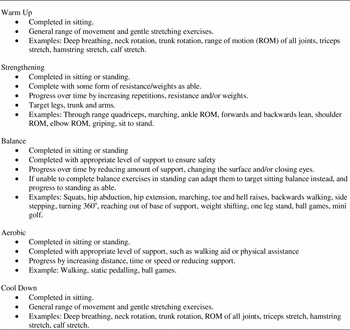
The physical exercise intervention aimed to reduce agitation using a combination of activities that targeted strength, balance, endurance, and flexibility, similar to other studies that have found statistically significant improvements in various health and well-being outcome measures for individuals living with dementia in nursing homes (Brett et al., Reference Brett, Traynor and Stapley2016). Different options were provided for participants, consisting of seated and standing exercises, for each element of the intervention to ensure it was adaptable and responsive to the capabilities and needs of each individual (Figure 3 outlines the physical exercise intervention used in this study). Amendments using the principals of strength and balance training were applied during the intervention to reflect changes in the capabilities of individuals (improvements or declines), such as altering the weight used, the base of support or position. During the exercise sessions, only simple equipment was used, such as hand weights, balls, cones, and static pedals, to ensure it could easily be replicated in the nursing home setting and be cost-effective. Participants were encouraged to exercise at a moderate intensity; however, it was not formally assessed and therefore difficult to determine the actual level of intensity achieved.
Outline of physical exercise intervention.

Usual care control group
The control group participated in usual care already provided at NH1 and NH2 which was similar across both sites as they were owned and run by the same aged care provider. The two physical exercise intervention groups were also encouraged to continue to participate in usual care activities to help control for this variable. Usual care consisted of optional twice daily group activities running for approximately 30–60 minutes, such as seated basic exercise class, carpet bowls, and “armchair activities” (puzzles, craft class, bingo, and quizzes). Intensity of the usual care activities varied from low to moderate. These activities were provided by lifestyle and recreation officers and direct care workers in communal areas such as lounges and dining rooms. All activities provided at the nursing homes involved social interaction, therefore it was not deemed necessary to have a dedicated “social interaction” group as the control. This was similar to 47% of the studies analyzed in a recent systematic review (Brett et al., Reference Brett, Traynor and Stapley2016). One study concluded that the amount of social interaction between the physical exercise intervention group and the usual care group did not appear to influence the results (Luttenberger et al., Reference Luttenberger, Donath, Uter and Graessel2012). The research team concluded that because a unimodal non-pharmacological therapy, which was of a similar intensity to the usual care, had no effect on cognition and behavior, it seemed unlikely that changes seen in the intervention group occurred only because of non-specific factors such as social interaction (Luttenberger et al., Reference Luttenberger, Donath, Uter and Graessel2012).
Data collection
This study consisted of quantitative measures of the effects of the exercise intervention on individuals living with dementia in nursing homes and qualitative interviews about the feasibility of the intervention for long-term sustainability.
Outcome measures
The primary outcome measure used was the Cohen–Mansfield Agitation Inventory (CMAI) to determine the effect of physical exercise on agitation levels of individuals living with dementia in nursing homes. The secondary outcome measures were a range of physical performance measures that are commonly used in clinical practice. They were selected to accommodate the varied mobility and cognitive levels of the participants, and to ensure the different aspects of physical performance were considered: Six Meter Walk Test, Five-Times-Sit-to-Stand (FTSTS) Test, Timed Up and Go (TUG) Test, (Modified) Functional Reach Test, timed static pedaling and number of falls. Interviews with family carers and staff from NH1 and NH2 were also conducted as a secondary outcome measure by the primary investigator to determine the feasibility and value of the intervention. Demographic details were collected for all study participants such as age, gender, and cultural background. For the participants living with dementia in the nursing homes, the type of dementia and number of comorbidities was also collected. The participant's job title was collected for the staff participants that were involved in the interviews.
Primary outcome measure
The CMAI assesses agitation using 29 indicators of agitation, such as “pacing and aimless wandering,” “spitting,” and “intentional falling,” each of which are rated on a seven-point Likert scale of frequency over a two-week period (Cohen-Mansfield, Reference Cohen-Mansfield1991). A shortened form was also created, consisting of 14 agitation behaviors, each rated on a five-point Likert scale of frequency (Cohen-Mansfield, Reference Cohen-Mansfield1991). The CMAI is usually conducted as an interview, but in this study, it was completed as a tally sheet at the end of every shift over two weeks. This method was adopted because staff reported being wary about their ability to recall all the behaviors over two weeks for each participant as shifts vary and the staff rotated around different areas of the nursing homes (Brett et al., in press).
Staff from NH1 and NH2 (direct care workers, registered nurses, and lifestyle and recreational officers) completed the CMAI at the end of each shift over a two-week period. Staff undertook training to use the CMAI prior to data collection, and information sheets about the CMAI and how to complete the tally form was located in each CMAI folder located at every nurse's station. Testing of the CMAI demonstrated it was a valid and reliable tool for assessing agitation among individuals living in nursing homes, which was confirmed by correlations with the Behavioural Syndromes Scale for Dementia (0.52 for day shifts and 0.40 for evening shifts) and the Behavioural Pathology in Alzheimer's Disease (0.43 for day shifts and 0.28 for evening shifts) (Finkel et al., Reference Finkel, Lyons and Anderson1992).
Secondary outcome measures
The physical performance measures, except for number of falls, were assessed by volunteer physical therapists, occupational therapists, and physical therapy assistants independent of study. They were blinded to group allocation and did not have regular contact with participants. Additional training and an information pack on how to use these measures were provided by the research team prior to data collection.
The Six Meter Walk test determined gait speed in this study; which is often used as an alternative to the 10 Meter Walk test due to space limitations and exhaustive nature of the 10 Meter Walk test for frail older people (Tilson, Reference Tilson2010). During the Six Meter Walk Test, participants walk 10 m at a safe, comfortable speed using their normal walking aid if applicable. The central 6 m is timed to eliminate the effects of acceleration and deceleration (Tilson, Reference Tilson2010). The Six Meter Walk test is reliable, feasible, and safe to administer with individuals living with dementia (Ries et al., Reference Ries, Echternach, Nof and Blodgett2009; Blankevoort et al., Reference Blankevoort, Van Heuvelen and Scherder2013). The relative reliability was excellent for this population group (Intraclass Correlation Coefficient (ICC) 0.86). However, the Standard Error of the Mean (SEM) (0.10) and Minimum Detectable Change (MDC) (0.27) were large (Blankevoort et al., Reference Blankevoort, Van Heuvelen and Scherder2013).
The FTSTS test measured lower limb strength and dynamic balance. Participants stand from a standard chair and sit down five times as quickly as they can with their upper limbs crossed over their chest (Bohannon, Reference Bohannon1995). For individuals unable to complete this test, like the participants in this study, it is modified to enable upper limbs to be used. Enabling the use of upper limbs promotes the ecological validity of this outcome measure for use with frail older people (Lindeman, Reference Lindeman2011). Timing commenced when participants started to stand and ceased when they sat on the chair after a fifth repetition. This test is reliable, feasible, and safe for individuals living with dementia in nursing homes (Suttanon et al., Reference Suttanon, Hill, Dodd and Said2011; Fox et al., Reference Fox, Henwood, Neville and Keogh2014a). Its relative reliability is excellent (ICC ranging from 0.80 to 0.97) (Suttanon et al., Reference Suttanon, Hill, Dodd and Said2011; Fox et al., Reference Fox, Henwood, Neville and Keogh2014a) and has adequate absolute reliability (SEM 1.39, Coefficient of Variation ranging from 10.5% to 12.76%, and MDC 2.73) (Suttanon et al., Reference Suttanon, Hill, Dodd and Said2011; Fox et al., Reference Fox, Henwood, Neville and Keogh2014a).
The TUG test assesses lower limb function, balance, mobility, and helps assess falls risk for older people. It requires an individual to stand from a standard chair, walk a distance of 3 m, turn, walk back, and sit down in the chair again, using their normal mobility aid if applicable (Poldsiadlo and Richardson, Reference Poldsiadlo and Richardson1991). Timing commenced after the word “stand” and ceased when participants sit down with their backs resting against the back of the chair. This test is reliable, feasible, and safe for use with individuals living with dementia (Ries et al., Reference Ries, Echternach, Nof and Blodgett2009; Suttanon et al., Reference Suttanon, Hill, Dodd and Said2011; Blankevoort et al., Reference Blankevoort, Van Heuvelen and Scherder2013). It has excellent to moderate relative reliability (ICC 0.76 to 0.99), high individual variability (total sample: SEM 2.48, MDC 4.09), and acceptable absolute reliability (SEM 1.24 to 2.12, CV 9.4%, MDC 2.42 to 5.88) (Ries et al., Reference Ries, Echternach, Nof and Blodgett2009; Suttanon et al., Reference Suttanon, Hill, Dodd and Said2011; Blankevoort et al., Reference Blankevoort, Van Heuvelen and Scherder2013).
The (M)FR test assesses functional balance and stability (Falls SA). In the standard version, an individual stands unsupported and reaches forward as far as possible without moving their feet. The modified version is completed in sitting for those that are unable to stand and reach unsupported. Both versions are completed with a closed fist to increase consistency of measurement (Falls SA). Each participant completed the (M)FR test three times and an average score taken. Both versions were used in this study to accommodate the varied ability of participants. The standard FR test has been tested with individuals living with dementia and found to be reliable, feasible, and safe to conduct with individuals living with dementia (Suttanon et al., Reference Suttanon, Hill, Dodd and Said2011). It has excellent relative reliability (ICC 0.84) and absolute reliability (SEM 1.61, CV 5.7%, MDC 3.15) (Suttanon et al., Reference Suttanon, Hill, Dodd and Said2011). The MFR test has not been tested with individuals living with dementia. A previous study did consider its use with individuals who had a stroke; relative reliability was excellent (ICC 0.94), and it had significant correlation with the Balance Master (motor and function assessments) (Katz-Leurer et al., Reference Katz-Leurer, Fisher, Neeb, Schwartz and Carmeli2009).
TSP was developed by the research team as an additional outcome measure to ensure physical outcome measure data could be generated for participants unable to stand or walk. TSP measured lower limb function and endurance. TSP was completed when participants sat, in a standard chair or wheelchair, in front of a set of static pedals placed against a wall to prevent movement of the equipment during the test. The distance between the chair or wheelchair and pedals was customized for each participant to ensure a full revolution could be independently completed. When required, participants were assisted to place feet onto the pedals. The test required participant to pedal for 30 sec and a score of total number of full revolutions was generated automatically by a counter on the pedal.
The number of falls individuals sustained was recorded in the nursing home setting to monitor this issue. When an individual fell or was found on the floor, an incident form was completed and kept on file. Recording the number of falls in this study provided another measurement of balance. All incident forms related to falls at both sites were reviewed by the research team to determine the number of falls over a 12 weeks; prior to the intervention and during the intervention.
Adherence monitoring
For participants that were allocated to the physical exercise intervention groups, activity logs were completed for each allocated session. Attendance and any reasons for non-attendance were recorded. The activity log was also used to record which exercises were completed, including number of repetitions, aids, and equipment used. This allowed the primary investigator to monitor progress and adapt the exercises as required. Any comments, such as any issues or observations made by the primary investigator or participant were also recorded. At NH1 and NH2, activity logs are completed for each usual care activity conducted to monitor attendance rates, which were accessible by the primary investigator during the intervention to determine what activities participants were involved in alongside the physical exercise intervention.
Study schedule
The study commenced with screening and recruitment of potential participants at NH1 and NH2. All baseline outcome measure, data were collected during a two-week period prior to randomization. Once this was completed, the physical exercise intervention sessions were conducted for 12 weeks; evidence from the literature demonstrated that this would be sufficient time to generate physiological adaptation among frail older people (Bonner et al., Reference Bonner and Cousins1996) and a recent systematic review found significant changes with as little as four weeks of physical exercise (Brett et al., Reference Brett, Traynor and Stapley2016). The primary outcome measure (CMAI) was repeated during the final two weeks of the intervention, and all secondary outcome measures were repeated in the two weeks after completion of the intervention.
Data analysis
Both quantitative and thematic data analysis were conducted to determine the effectiveness and feasibility of the physical exercise intervention for individuals living with dementia in nursing homes. An intention to treat analysis would be used, along with a sensitivity analysis to account for any missing data (White et al., Reference White, Horton, Carpenter and Pocock2011).
Quantitative statistical analysis
There were three groups of individuals living with dementia so ANOVA was used to analyze and compare the means of all three groups for the CMAI and physical performance outcome measures (Bian, n.d.). Changes over time within each group for the CMAI and physical performance outcome measures were analyzed using the paired sample t-test (Aldrich et al., Reference Aldrich and Cunningham2016). Demographic data was analyzed using ANOVA and Chi square (Aldrich et al., Reference Aldrich and Cunningham2016). All tests were conducted with a p value < 0.05 to determine significance. Data analysis was completed using SPSS software, version 12 (Aldrich et al., Reference Aldrich and Cunningham2016).
Thematic data analysis
The qualitative interviews with family carers and staff were analyzed using content analysis and themes were generated to explain the feasibility of the intervention and the benefits perceived. NVivo was used to complete this process (Richards, Reference Richards1999).
Discussion
This study protocol described an RCT with a qualitative component, which evaluated the effects of a physical exercise intervention on agitation of individuals living with dementia in nursing homes. Secondary aims of this study were to consider the effects on physical performance, and specifically compared the effects of a short duration high-frequency physical exercise intervention, to a longer duration less-frequent physical exercise interventions. Another secondary aim of this study was to determine the feasibility of sustaining the physical exercise intervention for individuals living with dementia in nursing homes longer term, through interviews with family carers of individuals living with dementia and staff from the participating nursing homes.
An RCT design was utilized to ensure genuine and trustworthy results were obtained, so conclusions could be confidently drawn about the effects of physical exercise on agitation and physical performance of individuals living with dementia in nursing homes (Polit and Beck, Reference Polit and Beck2011). The research team also wanted to gain a greater understanding of the views and opinions of staff and family carers on physical exercise, to help determine the feasibility and perception of physical exercise for this population group. To achieve this, a qualitative component using interviews was considered the most appropriate method (Foster et al., Reference Foster2014). This component was used alongside the RCT and the results obtained were not intended to be integrated with the RCT results, unlike in a mixed method study (Lewin et al., Reference Lewin, Glenton and Oxman2009). This is an approach which is becoming more common; it can be useful in evaluating the effects of health and social care interventions rather than quantitative methods alone (Lewin et al., Reference Lewin, Glenton and Oxman2009).
Agitation was the primary outcome considered in this study as it is a common BPSD that is highly stressful for the individual, their family, and nursing home staff, and it is frequently mismanaged by overuse of pharmacological interventions in the nursing home setting (Forbes et al., Reference Forbes, Thiessen, Blake, Forbes and Forbes2013; Livingston, Reference Livingston2014). It is important that effective non-pharmacological treatments for BPSD are determined to help reduced the use of pharmacological treatment and associated harmful side effects. Physical exercise need further investigation to determine if it is an effective intervention as current research is limited, preventing definitive conclusions being drawn about its effectiveness for individuals living with dementia in nursing homes (Bowes et al., Reference Bowes, Dawson, Jepson and Mccabe2013; Guideline Adaptation Committee, 2016).
The intervention was evidence-based, using effective elements reported in a systematic review. An important influence was the use of a multimodal approach to physical exercise which consisted of combining elements, such as strength, endurance, balance, and flexibility, as they showed the most benefit (Brett et al., Reference Brett, Traynor and Stapley2016). The nine studies that used this approach and assessed agitation (n = 1) or physical performance (n = 8) found an improvement in the intervention group(s) compared to the control group, which was statistically significant in four of the studies. The option to use both aerobic and strengthening exercises is further supported by research which has found both have a positive effect on brain vascularization and function (Brown et al., Reference Brown2015).
The nursing homes selected were owned and run by the same aged care provider which meant the usual care provided at NH1 and NH2 was based on the same model of care, reducing the influence of this variable as similar resources and services were available to NH1 and NH2 staff to care for individuals living with dementia. The study design was further strengthened by reducing bias through the inclusion of a control group, randomization, blinding (where possible), and the use of assessors independent of the study for all outcome measures.
Another strength was the consideration to alter the parameters to determine the effect this had on the participants, which provided evidence to help determine the optimum parameters for this population group. The parameters selected were determined through the experience of the multidisciplinary research team and discussions with management of the nursing home sites, considering factors such as the frailty of the participants, other activities and daily tasks conducted at the nursing homes, staffing, and feasibility of conducting regular physical exercise classes in the nursing homes permanently. This meant the parameters were set lower than those recommended by the Australian Government Department of Health and Ageing, and the American College of Sports Medicine for healthy older adults. But as outlined in the guidelines, if older individuals are unable to complete the recommended guidelines due to chronic conditions, such as dementia and other comorbidities, they should be as physically active as their abilities and conditions allow (Brown et al., Reference Brown, Moorhead and Marshall2008; Chodzko-Zajko et al., Reference Chodzko-Zajko2009). Previous studies and meta-analysis have shown that low doses of exercise are still beneficial and show improvement in fitness of individuals living with dementia (Buchner, Reference Buchner2007).
A limitation of the study design was the risk of not producing significant results from the limited sample size available as it was a small scale study. The study protocol is also limited by the lack of assessment of the level of cognition/severity of dementia. Cognition was not used as part of the inclusion criteria to prevent limiting the sample size available. It was also not used as an outcome measure as the focus was agitation and physical performance. It would be beneficial to include the level of cognition/severity of dementia in future studies as part of the demographic details, or when stratifying the population prior to randomization to determine if there was a difference in the effect of the physical exercise intervention based on the level of cognition/severity of dementia. The absence of an appropriate outcome measure to monitor the level of intensity participants achieved when exercising was another limitation of this study. Intensity should be formally assessed in future studies to help determine the optimum parameters for individuals living with dementia in nursing homes. A possible limitation for application of this protocol in the clinical setting is issues associated with small groups and time constraints. Small groups were used to help ensure the safety of the individuals during the sessions while allow for one-to-one support as required. This could be overcome by having an assistant when conducting the sessions, which would allow for an increase in participant numbers.
This paper detailed a protocol in accordance with the TIDiER checklist to increase reproducibility, and help to address the issue on how best to manage agitation of individuals living with dementia, potentially reduce pharmacological treatments, and associated harmful side effects. The physical exercise intervention detailed in this study protocol used minimal equipment to help ensure it was cost-effective and easily replicable in nursing homes or other similar settings. There is still significant work to be done in this field of research. The evidence produced from this protocol along with future research, may help to guide practitioners in dementia care to reduce agitation and improve physical performance for individuals living with dementia in nursing homes.
Conflict of interest
The following potential conflict of interest should be stated. The primary investigator worked as a subcontractor physical therapist at one of the sites the study was conducted. The staff at the site were aware of the study, which is outside of the primary investigator's employment so any effect from the study did not influence the employment, and vice versa. They were also not involved in the consent process or completion of all outcome measures.
Description of authors’ roles
All authors provided concept/idea/research design. Lindsey Brett provided writing, data collection, and data analysis. Victoria Traynor, Paul Stapley, and Shahla Meedya provided writing and data analysis.
Acknowledgents
The authors acknowledge the funding received from the University of Wollongong PhD Scholarship.
Supplementary material
To view supplementary material for this article, please visit https://doi.org10.1017/S1041610217000138.