Central to most conventional evaluations of the quality of representative democracy is the idea that government should be responsive to the preferences of its citizens. Footnote 1 As Lisa Disch refers to it, this idea of responsiveness is a “bedrock norm” of representative democracy, which finds its clearest articulation in Hannah Pitkin’s assertion that “representation means acting in the interests of the represented, in a manner responsive to them.” Footnote 2 Though theorizing about the nature of interests and relationships between representatives and constituencies is extensive and nuanced, there is broad normative agreement that in representative democracy the body that makes binding policy decisions should represent the polity as a whole in the processes of deliberation and aggregation. Footnote 3 The problem is that most mechanisms for choosing representatives tend to refract, not reflect, the composition of society, and some groups will always be marginalized, even if not formally. Footnote 4 In the US, for example, despite their legal equality, blacks, women, and the poor are chronically under-represented in most state legislatures and in Congress. Measures to increase the descriptive representation of historically marginalized groups may be necessary to ensure the inclusion of all relevant voices and thus safeguard the legitimacy of both the process and outcome of policy-formulation. Footnote 5
How can such inclusion be obtained? Because electoral rules govern the proximity of the relationship between representatives and the public, one way to alter the responsiveness of a political system is to manipulate these rules. Footnote 6 Another common instrument is a set-aside or quota for the marginalized, although these initiatives are only undertaken where the problem has been acknowledged, and the political will and effective resources exist to institute such policies. Footnote 7 The actions of interest groups and political parties too are critical: Footnote 8 interest groups often give voice to marginalized groups Footnote 9 and political parties are widely recognized as a major, if not the primary, agent governing the degree, for example, of women’s descriptive representation in a political system. Footnote 10 But parties do not make decisions to advance the marginalized in a vacuum. Instead, competition drives parties to adapt their platforms and shift their political and issue positions to attract voters or otherwise gain political power. Footnote 11 Parties also respond to structural pressures from citizen groups and social movements, accommodating new demands as their environment shifts. Footnote 12 Christina Wolbrecht notes that beginning in the early 1960s, the women’s movement in the US, for example, pressured both major parties to shift their positions on women’s rights in ways that maximized the electoral potential of their coalitions. Footnote 13
I consider one particular device for enhancing the inclusiveness and responsiveness of the representative system that has largely been overlooked by scholars to date. The subject is a movement-party, an unusual but not entirely rare institution. In particular, I consider the Northern Ireland Women’s Coalition, which, despite being small, marginal, and short-lived, left its mark on the political system in Northern Ireland, by promoting women’s descriptive and substantive representation in nearly all the other political parties in the system. When the Northern Ireland women’s movement seized the new political opportunities presented by the Northern Ireland peace process in the 1990s to change their repertoire and constitute themselves as a party, they were able to pressure the other parties to grant women access to the political process to a degree never before achieved in Northern Ireland. Through these efforts, women managed to break through the cultural prejudices against women in politics, and change popular and elite attitudes. Yet the mechanisms of this process and the potential it holds for advancing women’s representation, as well as that of other marginalized groups, seem to sit in between the assumptions of the scholarly literature on social movements and that on political parties. As a consequence, its significance has largely been missed by the two literatures.
I aim to bridge the political party and social movement literatures by considering how a party can function as the tactic of contention chosen by a movement. I argue three main points. First, in this instance, the party advanced the women’s movement’s interests far more than was possible through a continuation of protest or outsider activities, and this suggests that party organization may be an under-employed tactic in the repertoires of contention used by social movements. Second, the way the movement had an effect through the party is under-theorized in the literature on social movements because it requires consideration of political party system variables such as party competition and issue-space, which are not typically included in scholarship on the outcomes of social movements. Third, the success of the movement qua party pivoted around its specific goals of access, goals that are not well understood in much of the scholarship on social movements. Access is usually conceptualized as implying situations where the movement’s leaders or spokespersons are consulted in the process of legislating or regulating, but access in this case meant “being in the spaces where decisions are made” Footnote 14 by increasing the descriptive representation of women in the system at large. To achieve this, women formed a political party to blackmail the other parties into granting their own women access as candidates, representatives, and leaders. The conventional electoral success of the party was not their goal; instead, the pressure the party placed on the other parties increased women’s descriptive representation throughout the system and also forced the other parties to change their approach to women’s substantive representation, including giving greater attention to women’s issues in their party platforms. This under-utilized and under-theorized tactic delivered gains with the potential for long-term influence over policy and cultural values. It had the effect of altering the terms of representation and enhancing the inclusiveness of the political process.
The Northern Ireland Women’s Coalition is only one example of a movement-party. Though unusual, more than 50 women’s parties have formed the world over since 1945, in places such as Israel, Belarus, Russia, India, the Philippines, Belgium, and Iran. The experiences of these parties are diverse but in at least two other situations, Iceland and Israel, strong scholarship demonstrates that women’s parties succeeded in drawing public attention to issues of female marginalization and put “gender politics on the political map for the first time.” Footnote 15 In Iceland, in particular, the effect of the women’s party in pressuring the other parties to adapt their behavior and policy commitments to facilitate inclusiveness is well documented. Footnote 16
Green parties and other Left-Libertarian parties are other examples of this phenomenon of movement-party that may alter the pattern of deliberation in society. Though they may fit less well the category of mobilizing historically disadvantaged groups, the Greens’ focus on participatory democracy, inclusion, and deliberation means their experiences of changing dimensions of representation and transferring ideas are in some ways consistent with the more identity-based parties.
I aim also to invite feminist scholars to consider the potential of women’s parties for the advancement of women’s representation in politics. Virtually no scholarship considers the comparative experiences of these parties in a systematic way. Footnote 17 And, though women’s parties are not guaranteed to have the success of the NIWC or the women’s parties in Iceland or Israel, that they can increase women’s descriptive and substantive representation in some instances merits consideration of this as a theoretical potential and a tactical option for women’s movements. It is obvious that feminist advances require engagement with the state. As the work of Kristin Goss and Michael Heaney, Elizabeth Armstrong and Mary Bernstein, and Elisabeth Clemens, among others, makes clear, hybrid institutional forms and institutional innovation are important features of movement development contributing to their success and sustainability. Footnote 18 This kind of organizational innovation may be a critically important tool for feminist advance in some circumstances.
The case of the Women’s Coalition in Northern Ireland exemplifies how movements and parties can interact in the presence of new institutional opportunities. The peace process in Northern Ireland in the 1990s resulted in the crafting of new electoral rules that facilitated party formation and party competition and enhanced the likelihood of the transfer of ideas and practices from one party to another. While some features of this case are necessarily unique to its historical circumstances, there are many other situations where innovation in the electoral system may alter institutional dynamics and present opportunities similar to identity-based movements in support of marginalized groups. Northern Ireland is thus a good case through which to consider the possibilities present when movements undertake to form parties.
To develop these points, I use data drawn from the electoral materials of all Northern Ireland party platforms as well as candidate lists from all elections over a 20 year period, approximately 10 years before and 10 years after the NIWC was founded. The substance of the case is also drawn from extensive review of newspaper coverage in the British Isles of women’s issues and women’s representation in Northern Ireland, as well as interviews with current and former Members of the Legislative Assembly in Northern Ireland, members of the NIWC, Northern Ireland scholars and journalists covering Northern Ireland during the NIWC’s existence and review of the NIWC papers held at the Linen Hall Library in Belfast, Northern Ireland. Footnote 19 Taken together, these sources demonstrate that the movement-party can be a useful mechanism for increasing the inclusiveness of the political system and enhancing its democratic legitimacy. In what follows, I will develop this argument by first considering the three theoretical claims related to the relationship of movements and parties, the concept of access and the contagion effect of parties on each others’ policy positions and behaviors. I will then consider the women’s movement in Northern Ireland, as a social movement, as a political party, and as an agent of change in the other parties in the system.
Social Movements and Formal Institutions Reconsidered
Social movements are commonly defined as collective challenges by people with common purposes in sustained interactions with elites, opponents, and authorities. Footnote 20 Protesting against the dominant dynamic of power in society, movements mobilize groups who do not commonly participate in formal political activity or have few resources with which to do so.
Social movements can be distinguished from other forms of social organizations in that they are conceived of as “outside mainstream political institutions,” “disruptive” and “insurgent,” as opposed to “conventional political activity within [mainstream political institutions].” Footnote 21 For example, John McCarthy and Mayer Zald separate social movements from interest groups by referring to social movement organizations as marginal, less institutionalized, and with fewer routine ties to government. Footnote 22 Paul Burstein distinguishes social movements from political parties and interest groups by the fact that parties are legally incorporated entities with formal institutional roles on ballots and in legislatures. Footnote 23 But movements also differ from interest groups and political parties in that they emerge where groups are marginalized by being denied access “to the very institutions of government with the power to change their conditions.” Footnote 24 With formal institutions closed to them, social movements, then, “become an alternative means to confront institutions, achieve access and bring about change.” Footnote 25 The unconventional and disruptive nature of social movement tactics also helps codify such movements Footnote 26 and there is a strain of social movement scholarship that argues that the secret to their success lies in their disruptiveness, and their ability to avoid being coopted by established institutions. Footnote 27
The predisposition towards conceiving social movements as outside and unconventional has led scholars to see them in tension with other structures of society or as rivals to these structures. Footnote 28 While there is considerable scholarship that looks at how movements develop allies and interact with, influence, and pressure political parties, Footnote 29 as Susan Philips notes, “the traditional view is that interest groups and social movements are in competition with parties.” Footnote 30 Movements and parties have different purposes, movements to represent constituencies and parties to win elections Footnote 31 and each may undermine the efforts of the other to mobilize and represent constituencies. When movements begin to behave like parties and interest groups, this process is usually cast as a process of transition from outside to inside, informal to formal, radical to more moderate, genuine to artificial. To become “insiders”, in some analyses, implies cooptation, moderation, demobilization, and loss. For example, David Meyer and Debra Minkoff describe this transition whereby a movement makes “inroads into institutional politics” as “to some degree turning from protest to more conventional ways of making claims.” Footnote 32 Anne Costain recounts the organizational and theoretical challenges encountered by the women’s movement in the US in its transformation into an interest group, which meant reconciling competing organizational impulses and tensions between the center and the movement’s grass roots. Footnote 33 And there is a common thread of analysis in the scholarship of social movements that considers whether the adoption of formal techniques or relationships “undermines the democratizing potential of a social movement by reconfirming institutional arrangements as the only legitimate repositories of political power.” Footnote 34 In other words, though institutionalization may be a legitimate outgrowth of movement activism, scholars and activists worry that professionalization and formalization may limit the options, resources, and appeal of the movement, and destroy its integrity in the process.
As Philips contends, however, “it is not uncommon for a movement to develop the apparatus to contest elections.” Footnote 35 The African National Congress in South Africa, the Republican Party in the US, and the Nazi Party in Germany formed first as a social movements, and there are many examples of Labor, Green, other Left-Libertarian parties, and even pro-family parties being established to further movement goals. Footnote 36 Herbert Kitschelt even describes a process in Europe whereby social movements were the “first step” towards developing “new vehicles of political mobilization” and “founding new parties” was the second. Footnote 37 Chris MacKenzie specifically develops these themes in his discussion of the fusion of pro-family movement and its political forms in Canada. Footnote 38 And as Kenneth Andrews argues, “formal organizations become a necessary vehicle for advancing a group’s claims” in the policy-making process.” Footnote 39
Furthermore, though social movements are challenges to elites and authorities, the line between social movements and the state is blurry and many scholars have pointed out the theoretical implications of “the state-movement intersection” where the movement and the state meet. Footnote 40 These linkages are often conceptualized in terms of political opportunities theory, the primary point of this approach being that “the organization of the polity and the positioning of various actors within it makes some strategies of influence more attractive, and potentially efficacious than others.” Footnote 41 In other words, movements can take many forms and they have tactical options for mobilization that include a variety of relationships to formal institutions and actors. Footnote 42 For example, many scholars consider the influence that movements have on policy by demonstrating that they are more likely to achieve their goals with allies within the state, or what Sidney Tarrow calls “friends in court.” Footnote 43 And others, such as Lee Ann Banaszak, Mary Fainsod Katzenstein and Dorothy McBride Stetson and Amy Mazur, blur the line still further by considering movement insiders as part of an institution. Stetson and Mazur’s “RINGS” project considers the effects of women’s policy agencies on public policy and Banaszak uses the example of feminist activists within the federal bureaucracy in the US who used their institutional prerogatives to further movement goals. Footnote 44 Their point, in part, is that these women were not just allies of the movement but part of the movement itself, positioned within the state.
However, as Doug McAdam, Sidney Tarrow, and Charles Tilly point out, the maintenance of distinction between social movements and other institutions in society has shaped the trajectory of discussion within each subfield to ignore the contributions of scholarship of the other. Footnote 45 Social movement scholars rarely consider the variables of party competition and issue-space that party scholars consider determinative of much of their analysis. And what literature exists on the formation of new political parties tends to surround institutional and structural features of a political system, such as how the dominance of the old left and the presence of proportional representation facilitate the efforts of new left citizen groups, rather than the origins, agendas, or tactics of these groups, which is the center of much social movement scholarship. Footnote 46 This led McAdam, Tarrow and Tilly to famously call, in 2001, for a redirection of social movement scholarship towards movements as one element in a dynamic of contention that includes more and less formal forms, such as movements, interest groups, parties, and electoral contests. As Jack Goldstone writes, “social movement activity and conventional political activity are different but parallel approaches to influencing political outcomes, often drawing on the same actors, targeting the same bodies, and seeking the same goals.” Footnote 47
My argument aims to bridge the scholarship on movements and parties. It centers on ways that movements can exploit the dynamics of the political party system to increase the access of marginalized groups to the policy making process. Where opportunities exist for new parties to form, a movement may be able to sponsor its own political party and to trigger an adjustment within the other parties in the system that makes those parties more inclusive. I thus build on the narrow body of scholarship that considers movements as parties and expand the social movement literature by considering the movement-party as a means to full inclusion in the political process. Footnote 48 This is relatively novel because, as David Meyer notes, “fundamentally, social movement scholars treat the policy process as a black box within the state, which movements may occasionally shake and upset into action.” Footnote 49 Where the black box has been theorized in the scholarship on social movements, it has tended to be in terms of the needs and interests of the social movement organization’s targets, their antagonists or the elites. Footnote 50 These claims tend to center on the vulnerability of elected elites to ballot concerns. My argument requires theorizing about interparty relationships and party behavior vis-à-vis other parties. It borrows themes from the party literature on the process of contagion, which helps us to see how a small, innovating, and even temporary party can affect the policies and practices of other larger and more established parties in the system. In short, it introduces party competition and issue-space considerations into the understanding of how social movements can achieve their policy and process outcomes.
Without addressing this party literature, social movement scholarship tends to overlook this route through which movements can achieve their policy goals, in particular, the ways that movements of the marginalized can achieve inclusion in the democratic process. My argument suggests that social movements could conceptualize co-optation in a positive way and consider presenting sufficient electoral or political challenge to the other parties to force them to adapt their policies or practices. If the movement is identity based, once the other parties have con-(or sub-)sumed the movement’s party or its members, the movement will have gained representation of their members on the inside. This is an under-recognized path to full democratic inclusion for the excluded or marginalized group.
Re-conceptualizing Access
Most scholars of social movements generally conceptualize them as aiming to achieve both policy goals (“new advantages”) and acceptance of the movement as representative of legitimate interests (“process change”). Footnote 51 According to William Gamson, acceptance can come in the form of consultation, negotiation, recognition and inclusion in the process of policy formation. However, because it is very difficult to measure outcomes outside of policy initiatives, most literature on social movement outcomes has focused on legislation or some other aspect of policy change. Footnote 52 For example, Laurel Weldon’s brilliant comparative work on domestic violence tests the efficacy of women’s movements in shaping policy. Footnote 53 Much less attention is paid to the efficacy of movements in gaining acceptance or access, which is my focus here.
For example, Gamson offers one of the earliest and most comprehensive assessments of movement effects, and although he discusses inclusion as the most complete form of access, describing it as a situation in which “movement leaders or members” are “in positions of status or authority in the antagonist’s organizational structure,” he does not measure inclusion in his regression analyses of movement outcomes. Footnote 54 He also does not theorize about the connections between different forms of access (consultation, negotiation, recognition, and inclusion) or how access and policy goals correlate. Banaszak elaborates on the idea of access and offers a continuum from complete legal exclusion of the group to complete inclusion, but she stops short of considering what full integration or inclusion would look like or how it might evolve. Footnote 55 Andrews terms this the influence-through-access model, but argues it is largely neglected and has few advocates in the social movement literature. Footnote 56
Where access is considered, it is usually conceptualized in terms of elites granting social movements some right to consultation or participation in the process unfolding inside the state. Footnote 57 For instance, Thomas Rochon and Daniel Mazmanian discuss some of the effects movements can have on decision-making processes such as when elites decide to require consultation with citizen groups, creating an ombudsman to review concerns about policy, or mandating the decentralization of authority to new bodies, removed from the executive. Footnote 58 In another example, David Cress and David Snow consider “formal participation of SMO [social movement organization] members on the boards and committees of organizations that are the targets of influence.” Footnote 59 But the access sought by identity-based movements or movements of the marginalized such as the women’s movement in Northern Ireland goes beyond that notion of access; instead of consultation, what is sought is inclusion in the sense of the presence of the previously marginalized in formal political process through leadership roles in political parties, committees, parliamentary bodies, the civil service, etc.
I focus on changes in process or access in part because the women’s movement in Northern Ireland, as in many other places in the world, understood that its policy goals would not be addressed unless it was included in decision-making. The movement’s activists were convinced that women would bring something different to politics and decision-making due to their common experiences in this particularly male-dominated and martial society. They perceived both an injustice in the long-term pattern of their exclusion and a deficit in the quality of deliberation because the unique perspective of women was ignored. Footnote 60 Moreover, the women believed that their descriptive and substantive representation was linked Footnote 61 and that what concrete policy goals the movement possessed would not be translated into policy if some member of their group was not present to advocate for them. Footnote 62 They needed to be made present and the system of representation had failed them in this sense. Footnote 63
Thus access in this case meant having their own seat at the table where decisions were being made. When the party was formed, that “table” was the one at which the peace talks would occur and the only eligible participants were party members. It was clear to these women that their group’s interests would not be represented effectively by any surrogate party. Footnote 64 This was in part because they did not trust the established parties or believe that the established parties shared their priorities and also because they were not sure what the future would hold in terms of how their interests would evolve in a new institutional environment. Footnote 65 Representation of their (not yet fully crystallized) interests required the presence of at least some of their members in the actual negotiations. Their goals, then, were both policy oriented and process oriented; their strategy was to aim for inclusion both for its own sake and in order to gain policy influence. When the Good Friday Agreement was signed and the new institutions of regional self-government were created, the movement redoubled its efforts to ensure the representation of their perspectives in local, regional, and UK-wide legislative bodies, running candidates in elections at all three levels of government.
It is important to note that this meant not just inclusion for members of their organization alone, but collective benefits for all women. Footnote 66 The NIWC sought not just token access for a movement on the outside but full integration of the marginalized group into the institutions of decision-making within the state. The Women’s Coalition in Northern Ireland believed their mobilization as a party and the activities they undertook in political office, as well as the media attention they received, would spur the established parties to increase their own descriptive and substantive representation of women. In this way, this movement-party became a modestly effective mechanism for transforming the pattern of representation and inclusion in Northern Ireland, at least in the legislature. First, the NIWC was what Suzanne Dovi calls a “preferable representative” of women in Northern Ireland, representing the interests, opinions, and perspectives of women, Footnote 67 but also the “linked fate” of the social network. Footnote 68 It was a legitimate representative of the group in its accountability to the group. Footnote 69 The party had deep roots in the women’s movement, was authorized by the movement to act on its behalf, and sought to bridge the worlds of social and political activism. Second, it had liberty to act on behalf of the group as it was autonomous from other political parties, unlike the women’s units of the established parties. Footnote 70 It also encompassed a diversity of group interests, attending to some degree to the concerns expressed by both Laurel Weldon and Iris Marion Young, that representation of interests is a group or collective process that cannot be accomplished by individual representatives alone. Footnote 71 In addition, the movement-party provided a mechanism for addressing the deficiencies of the democratic process, which was biased against the representation of women’s perspectives, and enhancing the justice of this previously exclusive democracy. Footnote 72 Finally, the movement-party also had a spillover or contagion effect on the other parties in the system, which altered the pattern of representation for all women, not just their members or voters. This is critical because the contagion effect facilitated the pluralizing of representation by fostering the expansion of women’s presence in the other political parties. Footnote 73
It is clear from previous scholarship that movements may be one mechanism to achieve inclusion for marginalized groups in decision-making. There is a segment of the scholarship on movements that emphasizes the ability of movements to do this, given a set of political opportunities; they may pressure political parties in the context of elections, Footnote 74 frame issues, Footnote 75 set agendas, construct identities, craft “oppositional consciousness,” Footnote 76 mobilize groups to participate. Footnote 77 And, they may achieve changes in policy processes or institutional arrangements, such as through the introduction of quotas for marginalized groups in legislative office or particular policy agencies or boards created to shape policy on group interests. Footnote 78 Movements may also deepen democracy by facilitating and maintaining connections between representatives and constituents and helping to hold representatives accountable. Footnote 79 Thus, movements may have influence over political processes in ways that advance democratic inclusion through their interaction with other elements of the political environment. Anne Costain even calls for a shift in focus on social movements to emphasize their essence as sustained mobilizations of the marginalized for the purposes of achieving access as “their most salient political characteristic.” Footnote 80
While there is a narrow body of scholarship on movements developing parties, this is rarely theorized as a tactic in a repertoire of contentious collective action, and even more rarely considered as a pathway to inclusiveness. Footnote 81 However, the potential for a movement–party to have this effect is explained by similar logic as other forms of movement mobilization. For example, Weldon argues that movements are effective in producing policy change, and thereby inclusiveness, by producing a collective consciousness, expressing and spreading the views of the marginalized, and enhancing the effectiveness of other institutions. Movement-parties may have all the same theorized effects. Furthermore, though Weldon is skeptical of the efficacy of descriptive representatives on policy, her argument is that female politician representatives cannot be seen to have an effect independent of the strength of the women’s movement in the countries she studies. The tactic of a movement-party presumably would function almost like a manifestation of her interaction term.
However, considering how a social movement with goals of access and inclusion might be successful requires theorizing about the connection of the movement to the structures of political decision-making and to conventional/formal organizations within society. In other words, I consider how a movement-party could affect a movement’s prospects for achieving inclusion of the marginalized in the legislature and in the political parties by considering the dynamics of party interactions.
Contagion Theory
The idea that parties influence the organization, policy positions, and behavior of other parties in a multiparty system has been an acknowledged even if poorly understood aspect of scholarship on parties since Maurice Duverger first described the contagion effect of mass membership parties in 1954. Since then the notion of contagion has been used to describe the transfer of new electoral techniques, Footnote 82 the evolution of “catch-all parties,” Footnote 83 and “cartel parties”, Footnote 84 as well as the expansion of female candidates, Footnote 85 gender quotas, Footnote 86 and party platforms on women's issues. Footnote 87
Contagion from one party to another occurs because parties must compete with other parties for electoral support. To do so effectively, they must adopt the strategies of successful political parties over time in order not to be defeated at the ballot box in future elections. Footnote 88 This assumes that parties are aware of one another's successes and that they have the flexibility and resources to adapt. Footnote 89
As scholars model the choices of party leaders to shift their political commitments, there is debate as to the extent of the information party leaders have before making those decisions, the fluidity of the environment in which they make these choices Footnote 90 and whether parties act by “looking forward strategically” or “look backward and learn from the past.” Footnote 91 It is clear, however, that parties respond “to the shifting affiliations of voters” Footnote 92 by adapting their electoral platforms and policy positions in order to garner the greatest possible electoral support, and that they do so in a context of policy-driven competition with other parties.
Social movement theory must look inside the “black box” and recognize the potential that is represented by this process of contagion. If a movement could form itself into a political party, and spark a process of contagion, it could, potentially, see its core ideological commitments picked up by other parties in the system and spread across all of them. The women’s movement in Northern Ireland, as noted above, took a novel approach as a social movement both to the idea of inclusion and to the utility of a political party. Effectually, it gambled on contagion, anticipating that the creation of a women’s party would pressure the other parties to advance female candidates and discuss women’s issues in their party platforms. We now turn to an explication of this case.
The Northern Ireland Women’s Movement as Movement
Because Northern Ireland lacked accountable regional political institutions, being governed directly by Westminster from 1972 until approximately 2007 and, given that formal lobbying granted legitimacy to a legislature in dispute, collective protest action outside formal institutions was the convention in Northern Ireland. Voluntary participation in general was high and a dense network of associations filled in the “democratic deficit” of direct rule. Footnote 93 Northern Ireland was a thus a “movement society,” in the words of Meyer and Tarrow. Footnote 94
Beginning in the 1970s, women were active around issues of sex discrimination, poverty, poor housing, equal pay, fertility control, childcare, domestic violence, paramilitary violence, the treatment of female prisoners, and civil rights more broadly, including internment and excessive violence by police. Footnote 95 Because the Civil Rights Movement produced a well-developed repertoire for protest and civil disruption in Northern Ireland, the techniques of movement activity and organization were familiar to female activists who marched, picketed, publicized, lobbied, and engaged in direct services, especially towards victims of rape and domestic violence. Most typically, women’s groups during the Troubles articulated a maternalist and essentialist ideology, particularly in the women’s peace movements such as the Derry Peace Women, Women Together for Peace, or Women for Peace; women, as mothers and “care-takers of the family,” were “peace-loving” and “life-giving” in contrast to the “men of violence” and much of the movement organizing surrounded women’s responsibilities, rather than their rights. Footnote 96
Despite this discourse of commonality and the founding of the Northern Ireland Women’s Rights Movement, intersectionality undermined the efforts at collective organization. Footnote 97 Women were chronically divided into many separate organizations because the constitutional question (whether Northern Ireland should remain part of the UK or become part of the Republic of Ireland) and issues of class almost inevitably interfered in attempts to bring women together. Footnote 98 Conflicts, for example, over whether the principal goal should be reform within the British system, such as an extension of the 1967 abortion act to Northern Ireland or the end of British imperial control of Northern Ireland, plagued the attempts to organize the women’s movement across sectarian lines. Protests surrounding the treatment of female prisoners during the dirty protest and the hunger strikes divided feminists who supported the women as women but opposed their paramilitary connections to Republicanism. The Northern Ireland Women’s Rights Movement splintered into multiple organizations, including the prominent (Republican) Socialist Women’s Group. Attempts to build common structures among many different organizations through holding “unity” meetings, successful in the 1970s, foundered in the early 1980s. By the early 1990s, there were “hundreds of women's groups of various types and sizes throughout Northern Ireland, relating to each other through multiple, unstructured networks,” akin to a wagon-wheel without a hub. Footnote 99
Fragmented, challenged by more than the normal range of divisions and pressures, and overshadowed by the ethno-religious conflict, the women’s movement was weak in Northern Ireland throughout the Troubles. Footnote 100 Though organized and engaged in the community and voluntary sectors, women were also almost completely marginalized from the political parties and the nascent structures of decision-making at the beginning of the peace process in the 1990s.
The Northern Ireland Women’s Movement as Party: The Founding of the NIWC
New opportunities in two strands presented themselves to the movement at the same time, however. The peace process coincided with the United Nation’s Fourth World Conference on Women in Beijing in 1995, which involved mobilizing women to attend and preparing multiple reports on local conditions in Northern Ireland. The momentum created by the conference and its Global Platform for Action, which tasked local organizations with implementation, created new expectations for collective action and encouraged more concerted efforts by women’s organizations to pressure the formal institutions. The women’s movement in Northern Ireland, through the Northern Ireland Women’s European Platform (NIWEP), appealed to the established political parties to improve women’s representation in Northern Ireland beginning in 1996. Formal appeals were levied, for example, by NIWEP, in the form of two separate documents sent to each of the political parties in Northern Ireland in the run-up to the elections to the Northern Ireland Forum for Political Understanding and Dialogue in 1996. The documents asked the parties to adopt measures to ensure that women would be represented in the emerging political bodies. These appeals for action were part of the women’s movement’s repertoire in the years prior; however, what followed marked a very pointed change in their approach. When none of the established political parties responded to NIWEP’s papers, leaders of the movement decided to create their own political party. Footnote 101
The electoral cycle in 1996 presented a novel opportunity to the women's movement because it was the first election in Northern Ireland to use a new and enormously inclusive electoral law. In order to ensure that the tiny loyalist paramilitary splinter groups would be engaged in the peace process, the British and Irish governments had agreed that the 10 largest vote-getting parties would have seats in the Forum and thus representation in the talks. As there were only five or six established political parties in Northern Ireland, the law essentially guaranteed the women's movement electoral success.
The NIWC came into being six weeks before the elections. At an open meeting of women's groups from across Northern Ireland, participants “decided that the elections presented an opportunity to draw attention to the under-representation of women in the political discussions about the future of Northern Ireland.” Footnote 102
According to Kate Fearon, “since the political parties were not going to ensure that a women’s voice would be heard, the women who had navigated and negotiated grassroots politics for many years would go ahead and do it themselves.” Footnote 103 It was, as they saw it, “the only opportunity to have our voices heard in Northern Ireland.” Footnote 104
Thrown together quickly, the party represented a range of opinions and women's organizations. Its manifesto stated its goals were “to encourage more women to play an active role in public life, and to nudge traditional politics toward new thinking.” Not explicitly feminist, the organization reflected the essentialist discourse of the Troubles, casting practical, efficacious, community-oriented, and peaceful women as an alternative to the traditional, unimaginative, stubborn, and bellicose men who had perpetuated the conflict. Footnote 105 The party's manifesto emphasized protecting human rights and ensuring equality and inclusion for all groups in the political process. The party revealed its outsider character by being explicitly cross-sectarian and refusing to take a position on the constitutional question of whether Northern Ireland should remain part of the UK (the Unionist position) or become part of the Republic of Ireland (the Nationalist position), which is the principal cleavage in the party system in Northern Ireland. It also pushed very hard for institutional representation for outsider groups by advocating for a Civic Forum of community actors to act as a second chamber in the future legislature of Northern Ireland.
Drawing from women's community groups across Northern Ireland, the NIWC regional list in the Forum election comprised ten women—five Catholic and five Protestant—two business owners, two trade unionists, two academics, two community workers, one woman from the voluntary sector, and one housewife. Footnote 106 The NIWC earned less than one percent of the total 790,000 votes cast but as the ninth-largest party in Northern Ireland, it earned two seats in the 110 member Forum and representation in the multiparty peace talks that followed.
The Role of the NIWC: Policy Outcomes
Without having constituted itself as a party, the women's movement in Northern Ireland would not have had formal representation in the peace talks, nor were there any other women at the table at the outset of the talks. Through its presence, the NIWC was able to secure some policy goals, including gender equality language, passages on victims, integrated education, integrated living, community development, and the Civic Forum in the multiparty, Good Friday Agreement (GFA) signed in 1998.
The inclusion of gender equality language in the GFA (i.e., that women have “the right to full and equal participation”) had two major consequences. First, it became part of the language of section 75 of the Northern Ireland Act 1998 that gave legal effect to the GFA. This act required all public authorities “to have due regard to the need to promote equality of opportunity between people within nine different categories, including women and men.” Footnote 107 Second, the statement that women had the right to full and equal political participation was written subsequently into the Northern Ireland Human Rights Commission’s proposal for a Bill of Rights for Northern Ireland in two places, the preamble and a provision that “public authorities take effective measures to facilitate the full and equal participation of women in political and public life, including, where appropriate, the use of temporary special measures.” Footnote 108
Reflecting its origins, the NIWC also attempted to secure permanent representation for civil society groups in political decision-making. It proposed the Civic Forum, encompassing representatives from different social and economic sectors in a body with decision-making powers. The Forum made it into the GFA in watered down form, not as the second chamber in the legislative branch that the NIWC envisioned but as a talking shop parallel to, but outside, the legislative assembly. When constituted, the Forum was 38 percent female, though it was scuppered shortly after its creation.
The NIWC leveraged its outsider status and its relative lack of party baggage to facilitate negotiations as the talks process unfolded. The facts that it possessed no position on the constitutional question, that it operated with grassroots contacts across the community, and that it remained committed to inclusiveness of all, even extreme groups, gave the NIWC the ability to talk with all groups, at least in private. The NIWC also sought to connect with the civil servants from both governments, acting “as a conduit between civil society and the secretariat,” with whom the NIWC cultivated strong relationships over the two-year process. Footnote 109 In the end, “although roundly derided by many of the male delegates, the two [NIWC delegates] were widely credited with bringing a much-needed dose of practical consensus-building to the fractious talks.” Footnote 110 Secretary of State for Northern Ireland Mo Mowlam described them on the floor of the House of Commons in 1997 as overall a “positive force in the talks process” Footnote 111 and Ruari Quinn of the Irish Government, saluted the role of the NIWC, which, he said, “had brought a new voice to politics in the North.” Footnote 112 Bringing the ethos of an outside, unconventional, community-oriented group, the NIWC used the mechanism of a formal political institution to shape the political process and achieve some of its policy goals.
Once the GFA negotiations were concluded, the NIWC determined that its goals would only be achieved if it participated in the implementation of the GFA. They won two seats in the 108 member Assembly elected in 1998 though they lost these seats in the next election in 2003. In the brief time that the Assembly functioned in this period (2000–2002), the NIWC delegation of Monica McWilliams and Jane Morrice extended the work of the movement in developing the idea and momentum behind the creation of the Northern Ireland Commissioner for Children and Young People. They are also credited with structuring the Assembly's family-friendly working hours in contrast to the late-start of the parent parliament at Westminster.
When tensions between the main nationalist and unionist camps over decommissioning of paramilitary weapons led to a stand-off after the first years of the Assembly, the center collapsed in Northern Ireland politics. All the centrist parties lost support and the NIWC disappeared. The party lost its last elected representative in the local council elections of 2005 and chose to wind down its organization the following year. When it folded, its activists became involved in other aspects of politics created by this period of democratization and institution-building, as government appointees (to the Northern Ireland Human Rights Commission and the Equality Commission), and in programs to advance women’s representation such as Democrashe and the Women in Local Governments initiative.
The Contagion Effects of the Movement as Party: Process Outcomes
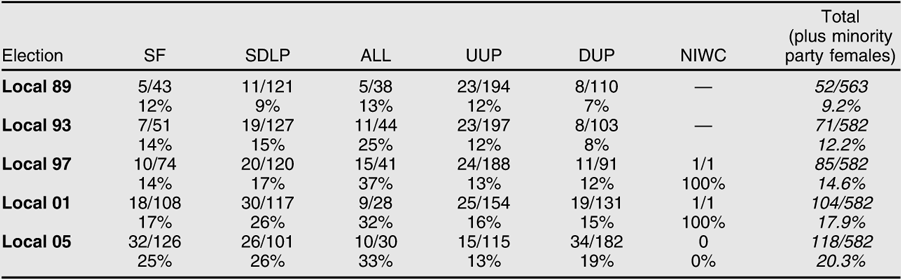
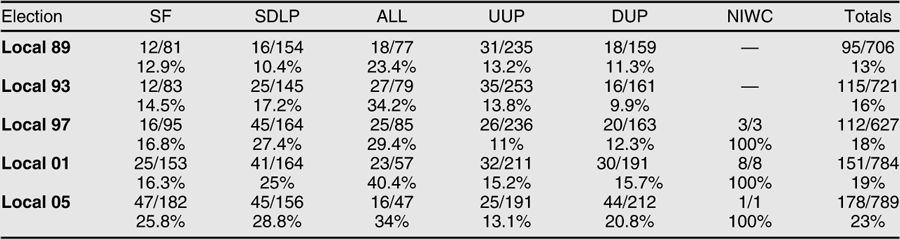
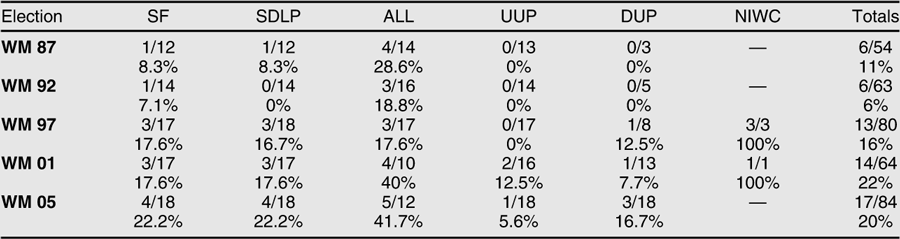
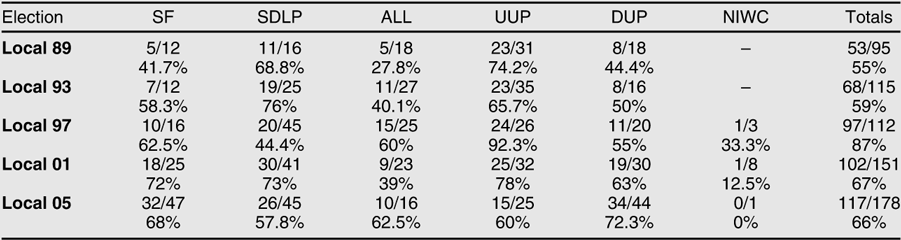
Though the representation of women has not changed dramatically, it is clear that patterns began to shift in the mid-1990s just after the NIWC was formed. At that point, there were no female MPs, MEPs and no regional government in which women could be represented. Women comprised 12 percent of local councilors. But just after the NIWC was formed, the parties began to increase their percentage of female candidates (refer to tables 1 and 2), as well as the seriousness or competitiveness of the women they nominated (refer to table 3). The percentage of female candidates for Westminster saw a huge jump between 1992 and 1997 for Sinn Fein (7 percent to 17 percent) and the SDLP (0 percent to 17 percent), and the number of female SDLP candidates for local election in 1997 nearly doubled. SF and the UUP also advanced the numbers of female candidates in the 1997 local election, though more modestly than the SDLP. By 2001, the number of women running for local elections since 1993 had doubled in the DUP and SF. Women now comprise 20 percent of local councils, 18 percent of the Assembly, 22 percent of Westminster MPs from Northern Ireland, 66 percent of MEPs from Northern Ireland, and 27 percent of the Northern Ireland Executive.
Female elected officials (percent of female councilors in local government)

Female election candidates (percent of female candidates out of total candidates for local party elections)

Female election candidates (percent of female candidates out of total candidates for Westminster Party elections

Success of female candidates (percent female candidates winning out of number of female candidates for local party elections)

The substantive representation of women has also improved, albeit modestly. Most significantly, the established parties began to address the concerns of the women’s movement in their party platforms and election manifestoes beginning in the mid-late 1990s. Whereas none of the mainstream parties mentioned the concerns of the women’s movement (except human rights) in their 1996 campaign literature, by the next electoral cycle after the NIWC was created, there was an explosion of interest with SF, SDLP, Alliance, UUP, and PUP, all referring to the importance of recognizing women's equality, the gender (im)balance in public appointments, and the necessity of gender-mainstreaming. SF, SDLP, UUP, and PUP also called for greater support for childcare for working parents. Footnote 113 In addition, in the 1997 local elections SF called for expansion of child care and recognition of women's equality. Finally, in the mid-late 1990s the SDLP, UUP, and DUP all produced separate documents on women in politics, after the formation of the NIWC.
The NIWC was successful in improving the descriptive and substantive representation of women and placing gender equality on the agenda of the other parties in the system, despite never attaining more than 1 percent of the vote (or 2 percent support in popular opinion, according to the Northern Ireland Life and Times Survey). Close analysis of the complicated transfer process of the single-transferable vote system gives a better sense of the popular appeal of the NIWC than their low total of first-preference votes. Though the NIWC won only two seats in the 1998 elections and was only electorally competitive in five of the 18 districts in the 1998 and 2003 elections to the Assembly, it drew voters from all parties, except the DUP. First-preference votes for NIWC candidates that were then transferred when the candidate was deemed elected or unelectable helped secure four SDLP seats, four UUP seats, two Sinn Fein seats, and one Alliance seat. The party thus appealed to voters across almost the entirety of the ideological spectrum and this appeal created the potential for their influence on the other parties in the system.
Evidence that the NIWC had effect on the other parties in the system can be found in newspaper accounts of the time. For example, in 1996 David Sharrock in the Daily Mirror observed that “the coalition has forced the male-dominated main parties to take the size of their female contingent seriously.” In 1997, Nuala Haughey with the Irish Times argued that “the NIWC sent the other parties scrambling for women within their ranks to push in front of the cameras.” In 1998, Stryker McGuire and Barry White, writing for Newsweek, observed that “the real transformation in the role of women in Northern Ireland politics began in 1996 with the formation of McWilliams's Women's Coalition.” Martina Purdy, who covered politics for the BBC, in an interview with the author acknowledged the effect of the NIWC: “I think the NIWC was really, really important for getting the mainstream parties to promote women . . . . I would give them [the NIWC] a lot of credit for getting the traditional parties to wake up and realize that they needed women on the ticket.”
Even some politicians from other parties acknowledged the effects of the NIWC. For example, Dawn Purvis, the former leader of the PUP, recognized that the NIWC helped to change attitudes about women in politics in the other parties in an interview with the author, saying, “What the NIWC did was actually prove that the public do vote for women . . . the NIWC and the PUP pressing equality and human rights has had an impact on the other parties . . . . They [the NIWC] highlighted the fact that we did have underrepresentation of women.” Footnote 114 Patricia Lewsley, NI Commissioner for Children and Young People, who was an SDLP councillor and MLA before being appointed, commented in an interview with the author about the importance of the NIWC in raising public consciousness, asserting that the NIWC “highlighted the issue of women in politics or the lack of it.” In fact, Joan Carson of the UUP revealed the pressure the NIWC placed on other parties when she publicly denounced the attention being paid to them by the US First Lady. Footnote 115 And, Arlene Foster, who defected from the UUP because it would not advance women and is currently a DUP Minister, acknowledged in an op-ed in the Irish News, that the NIWC put pressure on the UUP: “The lack of women active in political life in Northern Ireland was an issue which really came to the fore in the Forum elections of May 1996 [i.e., in the weeks after the NIWC was formed]. At that election I was election agent for the Ulster Unionist Party (UUP), and above all other questions the one which kept popping up again and again was why there were not more women in politics.” Footnote 116
It is clear that influencing the other parties was a key part of the women’s movement strategy in forming the NIWC. As founding member and former NIWC MLA Monica McWilliams noted in an interview with the author, the NIWC intended to leverage its position to pressure the other parties on the gender issue: “We had certainly thought we’d be a sufficient threat to them to put more women forward and to take the issues seriously.” May [now Baronness] Blood, argued, for example, in 1997 that “a major spin-off from the party has been the promotion of women into public roles by the other parties.” Footnote 117 Kate Fearon, active in the movement, argued that the initial breakthrough for the women’s movement occurred with the founding of the party and the 1996 campaign: The NIWC campaign in 1996 “put pressure on political parties to select women candidates and address women’s issues.” Footnote 118 Tahnya Barnett Donaghy of Queen's University alluded to how this contagion unfolded by explaining that “amongst other things, the NIWC were successful in gaining media attention and bringing the issue of women’s political under-representation into the mainstream political debates for the first time in Northern Ireland’s history. This in turn provided an impetus for party women to argue for a greater representation within their own ranks.” Footnote 119 Fearon supports this claim noting that “one immediate impact of the NIWC was that the issue of women's political participation was placed firmly on the map of electoral politics. Women delegates from other political parties began to attain higher profiles within their parties.” Footnote 120
It is significant to note, as well, that acceptance of women as political figures changed dramatically over this period. For example, the NIWC bore the brunt of the elite male resistance to women in politics in the Forum: according to the Forum record, the NIWC's two members (Monica McWilliams and Pearl Sagar) were “mooed”, referred to as “whingeing”, “whining”, “silly”, “feckless”, “cows”, “scum”, and “stupid women”, told to “get back to the kitchen”, go home “and breed”, and “stand by their men”, among other comments leveled at them by members of that body. By the time the Assembly was convened in December 1999, however, there were no comments that extreme aimed at women politicians in the chamber. In fact, in 2000, Jane Morrice from the NIWC was made Deputy Speaker of the Assembly by a vote of that body, which indicates the extent to which cultural values had shifted. The transition in the treatment of women's movement members in this period shows the extent to which their inclusion became accepted over time.
Contagion in Northern Ireland: The Movement-Party and the Path to Access
The causal mechanism for achieving changes in the patterns of women’s access to political power in Northern Ireland involves the movement-party placing pressure on the other parties in ways that changed the internal dynamics of the other parties. As leaders of the movement make clear, the point in forming the party was not to be a successful political party per se so much as it was to use the mechanism of the formal process to gain access for women to positions of decision-making in other parties. The movement gambled that in creating a party and adopting an insider or conventional tactic, they could reinforce the nascent elements within the other parties that sought to advance women’s representation. The intense media coverage the party received, in part due to its novelty but also to its diligent and deliberate efforts to engage the media, and its experiences in the negotiations that led to the Good Friday Agreement, both drew attention to the lack of representation of women in the other parties and demonstrated that women could exercise (formal) political power effectively. Footnote 121 Both strategies increased the expectation that the leadership of the other parties would respond or look as if they did not support women within their own organizations. This opened them to criticism from women’s advocates within their own parties, to the perception that they were unwilling to promote women or address their issues, as well as to electoral pressures in critical constituencies during elections with great uncertainty. To be clear, not many female politicians from the other parties supported the efforts of the NIWC but as the comments cited above indicate, many also grudgingly acknowledged that the NIWC made it easier for them to make the same arguments to their party’s leadership about the need to include women’s voices and women’s organizations in their structures or risk losing the moral high ground. The consequence was that the established parties began to adapt their policies and practices to encompass more female representatives and address women’s issues in their party platforms. The process of learning and the organizational change this process prompted in the other parties could not be reversed and the movement’s goals of increasing women’s representation became co-opted by the other parties. With key elements of its agenda in place, the party then dissolved in the period of increased polarization that followed in Northern Ireland.
Regrettably, there is no smoking gun that would allow us to say with all certainty that it was the efforts of the movement-party that advanced women's acceptance and inclusion in this way. What has been presented here, however, is a time line showing co-occurrence in the correct temporal order (i.e., that women's descriptive and substantive representation in the formal representative institutions and in the other political parties in Northern Ireland improved after the NIWC was created), testimonials from journalists, scholars, and activists, as well as members of other political parties, citing the pressure that the NIWC placed on the other parties to improve their record on women representatives and their profile on women's issues, and evidence using vote counts that the electoral pressure of the NIWC was real, if only marginal.
The argument that the NIWC was causal in this progression may be strengthened further by evidence that no similar patterns of progress can be noted in either the Republic of Ireland or the United Kingdom in this same time frame. Presumably, if global trends in favor of women's inclusion could explain the changes in Northern Ireland, similar advances might be observable in Northern Ireland's sister and parent states. With the single exception of the election in which the UK Labour Party introduced all-women short lists for its candidates, however, women's representation in the Dail and Westminster remained flat in this period. In Ireland, the Labour Party, Fianna Fail and Fine Gael did not increase their descriptive representation of women until after the NIWC was created. Sinn Fein, the only party to contest elections in all three areas of Northern Ireland, the Republic of Ireland, and the UK, in 1997 ran a far higher percentage of female candidates in Northern Ireland (24 percent) than in the other jurisdictions (18 percent for UK Parliament and 13 percent for the Irish Dail), indicating that something unique was happening in Northen Ireland at this time.
It is also important to acknowledge that the NIWC was formed because the established political parties would not agree to include female representatives or ensure that women's perspectives were included in the talks about the future of Northern Ireland. That they rushed to do so only after the NIWC was created suggests that their change of heart had something to do with the pressures the NIWC placed on their electoral and public calculus. And, again, the perception of multiple observers, as cited above, was that the movement-party was critical to this change.
The potential for the movement as party to be successful likely hinged on the electoral uncertainty of the period in which the major parties on both sides of the constitutional divide (the UUP and SDLP) lost their dominance of their communities, the main party in the center (the Alliance Party) lost half of its electoral support, and the loyalist paramilitary parties (the Progressive Unionist Party) rose and collapsed in this relatively short amount of time. Arguably, this made the situation even more ripe for influence by a small, flash-in-the-pan party as all of the parties felt some degree of vulnerability to the uncertainty of the new system and the new electoral law and each was eager to reach out to new constituencies and maximize its electoral support. The mechanism of the party allowed the women’s movement in Northern Ireland to maximize the impact of this uncertainty.
Conclusion: The Movement-Party as a Venue for Inclusion
The women’s movement in Northern Ireland struggled for decades to achieve policy changes that reflected women’s perspectives and process changes related to women’s full inclusion in mainstream politics. Empowered by international experiences sponsored by the UN and the EU, and frustrated by their lack of influence, they were able to recognize and seize the opportunities presented by the structural changes of the peace process to form their own political party. Though tiny and marginal (the party never received more than 1.5 percent of the vote), the NIWC managed to improve women’s descriptive and substantive representation in Northern Ireland by pressuring nearly all the other parties in the system to advance women candidates and address women’s issues. They did this through a process called contagion, which explains the transfer of ideas or practices from one party to another in a multiparty system on the basis of party competition, whereby parties adapt to compete with one another more effectively at the ballot box. In sum, the women’s movement used the tactic of the political party to achieve greater inclusion for women in the institutions of decision-making in Northern Ireland.
I use the example of the NIWC to broaden the literature on social movements, calling attention to the utility of a political party for a social movement and the need for research on social movements to incorporate theoretical elements from the literature on party change. This case study illustrates that political parties can be very useful to social movements, not solely as inside actors, who might take the movement’s position in a political contest or court case, but because a movement-party can take advantage of the dynamics of contagion and pressure the other parties to change their behavior or practices.
This conceptualization of a party as a means to challenge other actors blurs the line between inside and outside actors central to the debates about social movements. It also suggests a reconceptualization of notions of inclusion, access, or acceptance. In much of the literature on outcomes of social movements, this is usually approached in terms of an elite-granted special position for movement actors in the process of policy making. However, in the case of a political party, where elections are competitive, the party may manipulate the electoral fears of elites in other parties about loss of their own popular base to shift the patterns of access within the political parties themselves. Inclusion in this context means members of the marginalized group the movement represents become full-fledged members of multiple parties’ leadership as candidates and other party officials.
There is much about Northern Ireland’s history and politics that could render the NIWC experience unique, but the dynamics of Northern Ireland politics and society are also relatively typical of situations of communal conflict in other parts of the world. What made a women’s party possible in Northern Ireland at this juncture in history clearly stemmed from the creation of new electoral laws, first for the Forum and then for the Assembly, which lowered the barriers to party formation and also disrupted the patterns of party support established by majoritarian electoral laws. However, this experience is also not unique to Northern Ireland, as electoral laws are fluid constructs and many societies adapt their laws in response to changing political and social dynamics. It is in such moments that a movement-party may become a feasible tactic.
The choice of a movement to use a party, clearly conditioned on the availability on new resources with which to do so and the success of such a decision for movement outcomes may be governed by the type of social movement. Identity-based movements, such as ethnic, linguistic, religious, racial, or gender-based movements on behalf of otherwise marginalized groups, whose goals include full participation or inclusion in decision-making are the most appropriate types of social movements for this tactical approach, though contagion of ideas and policy items may also be at work when issue-based movements form political parties, such as has happened with Green parties in Western Europe.
In deeply divided societies, where the movement represents a segmental identity, the division between groups will limit the ability of an identity-based party to pressure the other parties in the system. Because women cut across all the other groups in society, the party was able to augment the position of women’s groups already present in all the other parties. Footnote 122 In this case, the movement-party created an umbrella under which advocates for similar claims in the other parties found shelter. That the issue of inclusion for women had cross-cutting appeal was likely critical to the success of the NIWC and may be a significant constraint on other movements seeking to use this tactic under alternative conditions.
The Northern Ireland case thus opens up many avenues for further research combining social movement scholarship and party scholarship. For example, it is likely that larger, more competitive parties are more vulnerable to contagion effects, and that hierarchically-organized parties are more able to respond to such pressures than are smaller or more horizontally-organized parties. Is it also likely that the window for party formation and contagion processes may be narrow or brief and non-recurring (i.e., that movement-parties are short-lived and singular) and future research should consider the parameters of these opportunities. But the case of the women’s movement in Northern Ireland suggests that it is valuable for social movement scholars and those interested in broader theoretical problems of democratic representation to re-examine the link between parties and movements. The juncture where parties and movements meet may present new pathways to responsiveness and new insights into how systems of representation can facilitate inclusion of previously marginalized groups.
Kimberly B. Cowell-Meyers is Assistant Professor of Government at American University (kcowell@american.edu). She is the author of Religion and Politics in the Nineteenth Century: The Party Faithful in Ireland and Germany (Greenwood Press, 2002) and several articles in Political Studies, Perspectives on Politics, PS: Political Science and Politics, Politics & Gender, Women, Politics & Public Policy among other journals. Her research focuses on social movements, women in national and state legislatures, and political parties. This research was funded through a grant by American University and supported by the Centre for the Advancement of Women into Politics at Queen’s University, Belfast. I am enormously grateful to Jeffrey Isaac as well as the anonymous reviewers from Perspectives for their extremely thoughtful comments and to Ross Moore of the Linen Hall Library and Sehar Razuiddin, now at the National Democratic Institute, for their able assistance. I am also very much indebted to the many female and male leaders in Northern Ireland who shared their time and knowledge with me and who inspired me to write this piece.