In July 1939, a group of Palestine-born Jews, including key public figures and communal leaders, gathered in Jerusalem for the first meeting of the Natives of the Yishuv Federation (NYF; in Hebrew, Hitahadut Bney ha-Yishuv). NYF was a political movement that sought to represent Jews of the “Old Yishuv” as an increasingly marginalized population in Palestine.Footnote 1 In contrast to other movements and civil associations with similar aims, the NYF was not ethnically defined (e.g., Sephardi or Yemenite). Rather, it brought together a number of Palestine's established Jewish communities under the category of “natives” (bney ha-arets or ha-Yishuv), clearly positioning themselves against European Zionist elites while relying on Ottoman practices of communal political organization that were viewed by the Zionist leadership as a direct threat to its authority.Footnote 2 The NYF's core members belonged to the pre-Zionist Ashkenazi communities of Jerusalem. Joined by leading Sephardi figures, they also sought to draw closer the Yemenite, Georgian, and other communities. The federation claimed the independent status of a recognized political actor with its own social, economic, and cultural institutions, tied to a specific constituency. This rather radical position combined the struggle for native Jews’ political power with views of a shared Arab Jewish existence in Palestine, which were often expressed by the NYF founder and leader, Dr. Israel Ben-Zeʾev, in meetings and in correspondence with high Zionist officials.
Israel Ben-Zeʾev (Wolfensohn) was born in 1899 to a middle-low class religious family from the pre-Zionist Ashkenazi community of Jerusalem. He moved to Cairo in his early twenties to pursue an academic career in Islamic Studies and Arabic at the Egyptian University, integrating into a local milieu of Nahda intellectuals (a movement of Arab cultural renaissance) that formed around the renowned scholar and educator, Taha Husayn. Passionately admired by Ben-Zeʾev as a major cultural center, Cairo became his new home, where he lived with his family, studied, taught, and published for almost two decades. During this time, Ben-Zeʾev established himself as a respected scholar worldwide, including in Germany, where he completed a second doctorate. Yet, in Palestine, where he resettled on the eve of World War II to serve as the first supervisor of Arabic studies in the Jewish education system, he remained on the margins of the academic Orientalist field, unable to obtain a tenured position at the Hebrew University, much like other non-European locally born scholars.
On the one hand, Ben-Zeʾev's experiences can be seen as representative of many others from the late Ottoman Jewish elite who faced growing political and cultural marginalization in Palestine. Indeed, I discuss these shared experiences, and as well highlight the tensions and conflicts within this group. Yet, as I show below, Ben-Zeʾev's trajectory, unique in itself in many respects, including his ethnic and socioeconomic background, points to a different political path. Unlike other native Jews who aligned with Labor Zionist institutions in the position of 'expert mediators', he refused to play this role, which meant adopting a position external to Arab society as an object of expertise.Footnote 3 Ben-Zeʾev was not interested in merely reviving a long-gone pre–World War I era; rather, he was an active member of a regional milieu of Nahda intellectuals whose members saw themselves as a modernizing force in their societies.
Moreover, Ben-Zeʾev and his allies in Palestine used the term “native” to promote a concrete political cause which came to subsume both Ashkenazim and Sephardim of the "Old Yishuv" who were committed to fighting for greater access to power and resources and to promoting a vision of a shared Arab–Jewish life in Palestine. These actions joined Ben-Zeʾev's main project of advancing scientific and public knowledge about Arabic language and culture and the role of Jews therein through academic institutions and educational programs whose very existence challenged the hegemony of the Hebrew University and the Zionist leadership. In that he differed from many in the native Jewish intellectual elite who sought recognition in the circles of Hebrew cultural modernization.
A growing body of scholarship has greatly advanced our understanding of the sociopolitical history of Jews in early 20th-century Palestine by studying the ways in which they practiced their imperial citizenship and belonging through political representation and discourse, alongside Christians and Muslims.Footnote 4 Drawing on sources from the Ottoman imperial archives and on local administrative records, recent studies have uncovered other structural and material forms of Ottoman belonging among Palestine's Jews, such as holding administrative positions, promoting municipal projects of infrastructure, and struggling over public resources.Footnote 5 This article joins recent work on the persistence of empire in the lives of social groups and individuals, which has examined the ways that late Ottoman elites in the Middle East made sense of the empire's fall, recalibrating visions and prospects for the future while drawing on Ottoman practices and institutions.Footnote 6
Studying Palestine's local Jews in the post-Ottoman period, historians have explored the connection between the marginalization of this population by the Zionist movement and the exclusion of certain forms of cultural production and political visions of a shared homeland that had been rooted in a local landscape of Ottoman reform and Arab Nahda.Footnote 7 These studies have examined the wide array of perspectives and strategies among local Jewish elites facing these processes, including direct challenges to the Zionist institutions’ exclusive authority over Palestine's Jews, sometimes by individuals who identified themselves as “natives of the country” (yelidey ha-arets) in the early mandate period.
This article builds on and further develops this literature by looking at how the category of "native" Jews was constructed and used to represent a distinct political group among Palestine's Jews in a specific historical context of power dynamics and conflicts in the 1940s. During this time of war-induced economic boom, Palestine witnessed the emergence of new social spaces for Arab–Jewish interaction, a new Arab left, and Jewish opposition to increasing post-war Zionist demands for statehood and partition.Footnote 8 Studying the case of the NYF shows that for some Ottoman Jerusalem-born Jews identifying as native vis-à-vis the Zionists in the 1940s was not merely discursive practice, but rather was at the basis of a political struggle they led as part of a “popular civic movement,” as its founder defined it. This movement of mainly Ashkenazi Jews from Jerusalem's pre-Zionist communities invites a reconsideration of this less well-known group's position in local sociopolitical structures in the mandate period and after 1948.
Highlighting the institutional and material contexts in which locally born Jews interacted with the Zionist establishment, I examine how claims for “nativeness” functioned in concrete conflicts with Zionist political and academic institutions, beyond the level of written statements in the press and official documents.Footnote 9 This relational approach helps to contextualize the social practices and self-understanding of local Jews, foregrounding the tensions and conflicts within that group and showing that the range of positions they could take vis-à-vis Zionism was shaped by structural constraints, mainly their dependence on dominant institutions such as the Jewish Agency for funding, resources, and political support. This was especially true in light of the demand of Zionist institutions for loyalty, which in practice meant accepting their exclusive authority and refraining from independent action.
And yet, it would be wrong to assume that Ben-Zeʾev and his allies from the local intellectual community acted or understood themselves only (or mainly) through their conflicts with the Zionist institutions.Footnote 10 I analyze Ben-Zeʾev's lifelong project to train new generations of Arab Jewish engaged intellectuals in the context of a regional Arab cultural movement. During his time in Cairo he belonged to a social milieu of Nahda intellectuals acting to “modernize” their scholarly fields and society in general through cultural and educational initiatives, as late as the 1940s and 1950s. I show that his cultural projects in Palestine, including opening an Arabic library, a research institute on Jews in Islamic history and Arabic literature, and a training program for Arabic teachers in Jewish schools, relied on his concrete experience in Egyptian academia during the interwar period and were part of a broader Nahda movement.
More specifically, through these projects, Ben-Zeʾev was hoping to construct a place for Jews of the Arab world as both an object of research and as scholars in the local academic system. In Cairo, he dedicated his publications and much of his public work to advancing knowledge about the contribution of Jews to Arab history, culture, thought, and language among his Arab colleagues and interlocutors. After he resettled in Palestine, these efforts turned into an overall cultural program to establish institutions and create resources for the study of Arabic Jewish literature and history as a scientific field in its own right. This type of knowledge, he argued, was purposefully neglected by Orientalists, especially at the Hebrew University. It is in this context that his confrontation with the university's Institute of Oriental Studies is analyzed: Ben-Zeʾev criticized European Jewish Orientalists not only for the exclusion of native Jewish scholars from the ranks of the university, but also for marginalizing the study of Arab Jewish history and literature in favor of "classical" Arabic literature by Muslims. This was one among many battles he waged against the Hebrew University Orientalists, as will be discussed below.
This article draws on family papers kept by one of Ben-Zeʾev's daughters, alongside previously unused archival material. . The latter consists of Ben-Zeʾev's private papers, covering his time in Egypt (1920s and 1930s) and the years he functioned as supervisor of Arabic in Palestine/Israel (1940 to 1964), including numerous autobiographical and other personal notes, drafts of his scholarly work, minutes from NYF meetings, and extensive personal correspondence with professors and colleagues based in Palestine, Cairo, Germany, and the US.
In addition to this large variety of private papers, I follow the official paper trail documenting the looting of Palestinian books during the 1948 war, focusing on Ben-Zeʾev's struggle against the Hebrew University and the Ministry of Education over the fate of these books that he had partly collected and assembled in Jaffa. This conflict formed part of an older, fierce debate concerning the politics of (specifically Orientalist) knowledge, that is, who gets to hold, manage, produce, and disseminate knowledge, and which types of Orientalist knowledge should be promoted. Ben-Zeʾev opposed the treatment of the looted Palestinian books as dead cultural artifacts in the published work of a closed professional milieu at the university, struggling to keep them for use in his public educational projects and as part of a local, living Arab culture—albeit that by this point the books’ original owners were being displaced from their land and homes and this very culture was undergoing massive destruction.
A Jewish Nahḍāwī
Israel Ben-Zeʾev (Wolfensohn) was born on 24 August 1899 to a religious family of Ashkenazi Prushim from the Old Yishuv in Ottoman Jerusalem's Meʾa Sheʿarim neighborhood.Footnote 11 This neighborhood was one of the first to have been built outside the city walls, alongside Yemin Moshe, Sheikh Jarrah, and Bab al-Sahira.Footnote 12 This period in Jerusalem, by then a sanjak capital, was a time of lively urban cultural and political activity for local elites, who led educational, scientific, and infrastructural projects that were fashioned as modern. At the same time that local Jewish communities competed over power and jurisdiction within a political structure based on distinct communal organization, the different Jewish elites shared a commitment to the Ottoman discourse and cultural project of reforming their coreligionists. The children of elite families who settled in new neighborhoods outside the city walls attended the schools of the Alliance Israélite Universelle and later of the German Ezra Society (Hilfsverein). Some of them became active participants in the Nahda movement alongside their Muslim and Christian neighbors. As Ben-Zeʾev recalled later in his life, he grew up as an Arabic-speaking Jew in a heterogeneous city that gradually became a local center of Arabic cultural production in which he sought to integrate as part of an urban modernizing intellectual elite.Footnote 13
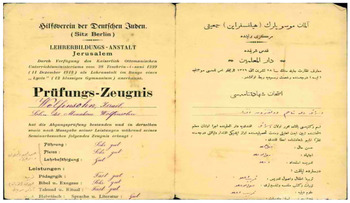
In his early youth, Ben-Zeʾev was educated in Jewish religious institutions. With his father's support, he left the ʿEts Hayim yeshiva to enroll at the Laemel School and the teachers training college of the German Jewish Ezra Society, where he studied Hebrew, Arabic, Ottoman Turkish, German, English, and French, as well as sciences and history (Fig. 1). There he met some of the figures who would have a long-lasting influence on his life and work. These were local Jewish intellectuals and educators acting in the nahḍāwī culture of the time.
Israel (Ben-Zeʾev) Wolfensohn's Ottoman-German Ezra diploma, 1916 (ISA, P-2531/1)

In 1919, Ben-Zeʾev was admitted to the newly founded prestigious Arab teachers training college, Dar al-Muʿallimin, in Jerusalem.Footnote 14 He mentioned proudly (and wistfully) in his later autobiographical notes that he was “the first and last Jew to have attended this Arab institution,” given the separation under British rule between the Jewish education system which came under the Jewish National Council (Vaʿad Leumi) and the public education system that included Muslim and Christian schools.Footnote 15 Ben-Zeʾev studied there under prominent scholars and poets like Maʿruf al-Rusafi and Isʿaf al-Nashashibi. He remained in contact with some of them, as well as with graduates who later worked as teachers and educators in Palestine and became Arab nationalist activists. As I discuss later, Ben-Zeʾev's experience at Dar al-Muʿallimin had a major influence on the educational projects he designed in the 1940s.
After his graduation, Ben-Zeʾev left for Cairo with his wife in 1922 to pursue a doctorate in Islamic faith and Arabic at the Egyptian University. In his later notes, he described this choice too as unusual, since most local Jews pursued their academic training in Europe. For Ben-Zeʾev, as a product of local elite education in the spirit of the Nahda, moving to a major cultural and intellectual center such as Cairo was an unrivaled opportunity.Footnote 16 A relatively young institution (founded in 1908), in the early 1920s the Egyptian University employed distinguished local scholars such as Taha Husayn and Ahmad Amin, alongside some of Europe's renowned Orientalists.Footnote 17 Ben-Zeʾev completed his studies there in 1927, under the supervision of Husayn, who would remain an important inspiration for the young Jewish scholar, not only for his intellectual grandeur but also as a devoted educator and humanist who promoted a project of nahḍāwī reform in Egypt's academic and public education system, with the university's Faculty of Arts at the forefront.Footnote 18 Ben-Zeʾev's dissertation, Tarikh al-Yahud fi Bilad al-‘Arab (The History of Jews in Arabia), was published with a preface by Husayn addressed to “the enlightened public” (jumhūr al-mustanīrīn).Footnote 19 It was followed by several other publications in Arabic on Arab Jews and on Semitic languages, which he completed while teaching at the Egyptian University and at Dar al-ʿUlum, a government-run teacher-training theological institution (later incorporated into the university).
During this period Ben-Zeʾev established contacts with prominent German Orientalists who visited and taught at the Egyptian University, such as Enno Littmann, with whom he consulted about the prospects of pursuing a second doctoral degree in Germany. He also knew, like other local junior academics, that a doctorate from a European university was almost necessary to obtain a permanent academic position in his field. Ben-Zeʾev enrolled in the Oriental seminar at Frankfurt University, one of the world's leading institutions at the time.Footnote 20 There he completed his doctoral studies in 1933 under the supervision of the acclaimed Jewish Orientalists Josef Horovitz and Gotthold Weil.
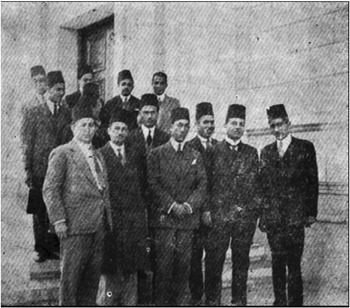
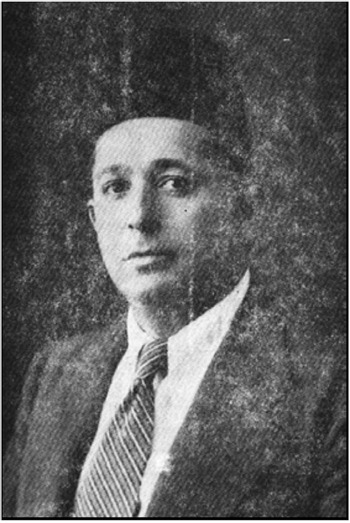
Throughout the 1930s, Ben-Zeʾev taught Judaism at the Egyptian University as well as Semitic languages at Dar al-ʿUlum and also gave lectures at al-Azhar. Some of his students became active scholars and educators in Palestine, Egypt, and Iraq after their graduation, like Rashid ʿAli al-ʿUbaydi and Ishaq Musa al-Husayni (Figs. 2 and 3).Footnote 21 Ben-Zeʾev continued to correspond with former students and other colleagues throughout the region, discussing, among other things, the possibility of pursuing research and teaching opportunities in Damascus, Baghdad, and Jerusalem. In particular, he hoped to be hired by the Hebrew University's Institute of Oriental Studies. But, like other scholars from the Palestine-born elite who remained on the margins (or entirely outside) of the newly formed academic milieu in Jerusalem, he never managed to get a footing at the German-dominated Hebrew University.Footnote 22
Ben-Zeʾev (first row on the left) and his students at the Egyptian University (Wolfensohn, Kaʿb al-Ahbar, 10)

Ben-Zeʾev as a lecturer at the Egyptian University in the 1930s (Ibid, 12)

Ben-Zeʾev's work won the esteem of scholars in Europe, the US, and the Middle East, as indicated by the extensive correspondence in his archives, in which colleagues requested his advice and help. During his time in Cairo, he published several books in Arabic under the name Abu Zuʾaib, in which he addressed both the milieu he identified with, that of “enlightened Easterners” (al-sharqīyyin al-mustanīrīn) and foreign and European Orientalists (al-mustashriqīn or ʿulamaʾ al-ifranj). Probably the more well known of them is Tarikh al-Lughat al-Samiyya (The History of Semitic Languages), which he hoped would be a useful academic and educational resource for “the enlightened writers, scholars, and teachers in secondary and post-secondary schools in the lands of the East.”Footnote 23
In a sense, Ben-Zeʾev's own biography was written into his scholarly work, as he was trying to establish himself within the Muslim Arab–dominated intellectual milieu in Cairo as well as in the European-dominated Orientalist discipline more broadly. His dissertation on Jews in Arabia criticized European Orientalist narratives about the hostile treatment of Jews under early Islam and instead elaborated on the active participation of Jews in political, economic, and cultural life in the Hijaz. He also was fascinated by Kaʿb al-Ahbar, the famous 7th-century Jewish convert to Islam, on whom he wrote his 1933 German dissertation. A few years later, he founded the Society for Historical Research of Egyptian Jews with the affluent Yusuf Qattawi, then head of the Jewish community in Cairo. The society funded Ben-Zeʾev's book, the first of its kind in Arabic, on the iconic philosopher Musa Bin Maymun (Maimonides). The book was accepted with much enthusiasm by local intellectuals as one that analyzed the writings and life of Maimonides as an Arab Egyptian Jewish scholar, in line with the nationalist trend that was becoming popular among local Jews (known as tamṣīr).Footnote 24
In her analysis of Nahda discourse, Lital Levy argues that “Jewish contributions to ancient Near Eastern history as well as to modern science, culture, and industry were recognized by readers and editors and recuperated as part of the Nahda's discursive negotiation of identity.”Footnote 25 As a number of works have recently shown, studying Jewish thought and poetry in pre-Islamic times and in Muslim Spain (al-Andalus) stood at the center of the intellectual endeavors of nahḍāwī Jews.Footnote 26 Among these intellectuals were the Jerusalem-born brothers Yitzhak Yehezkel Yahuda (1863–1941) and Abraham Shalom Yahuda (1877–1951) and their cousin David Yellin (1864–1941). Ben-Zeʾev saw himself as leading the younger generation in this lineage of Jewish nahḍāwī scholars, whom he knew from his youth in Jerusalem. In essays he wrote about them after his return to Palestine in 1939, Ben-Zeʾev situated their trajectory and work within a broader Nahda movement in the region. According to Ben-Zeʾev, Yellin and the older Y. Y. Yahuda were deeply influenced by the writings of Nasif al-Yaziji, Ibrahim al-Yaziji, and Butrus al-Bustani, and already at a young age began to study these new works alongside classical texts such as the Maqamat of al-Hariri and Ibn Khaldun's Muqaddima, in addition to the Qurʾan. The younger A. S. Yahuda followed in their footsteps.Footnote 27 In these texts, Ben-Zeʾev specifically references Samawʾal ibn ʿAdiya as an important “Arab-Jewish” (ʿAravi-Yehudi) pre-Islamic poet who served as a source of inspiration for these Jerusalemite intellectuals. Notably, in reviewing the latter's prolific work, which included both Arabic- and Hebrew-language studies and translations, Ben-Zeʾev gives greater weight to their Arabic contributions. This may not be surprising given his own preference to publish in Arabic, which had to do with his self-positioning within Arab scholarly discourse, rather than modern Hebrew renaissance or Jewish modernity.Footnote 28
Ben-Zeʾev had a special relationship with A. S. Yahuda, an Orientalist trained in Germany (under the famous philologist Theodor Noeldeke) who spent most of his life as an academic in Europe and the US and yet maintained a deep and ongoing interest in political and academic matters in Palestine. A lengthy correspondence between them from the 1940s (when Yahuda lived in New York and Ben-Zeʾev in Jerusalem) reveals the fierce criticism they shared of the Zionist leadership and the Hebrew University's Institute of Oriental Studies (IOS) for marginalizing native Jews, and particularly the milieu of native scholars and their political and cultural views that stood in opposition to the Zionist colonial-separatist agenda.Footnote 29 Ben-Zeʾev admired Yahuda and hoped to gain his support in his political and cultural projects, including the opening of a New York branch of his political movement of native Jews as well as a research institute on Arabic Jewish literature in pre-Islamic times and in Muslim Spain, on which I elaborate in the next sections.
For Yahuda there was a clear connection between his own rejection by the Hebrew University (his appointment to the IOS was canceled in 1920) and the rejection of his critical political views and intellectual project to revive the Jews’ Andalusian legacy as part of a general modernization of the Arab East.Footnote 30 He also resented Ben-Zeʾev's exclusion from the IOS by the “ministers of Mount Scopus” (sarey Har ha-Tsofim) who, he asserted, “look down on natives of this country [bney ha-arets] as lacking the pure ‘scientificality’ [madaʿiyut], which they inherited from the Germans.”Footnote 31 In a period when the field of oriental studies in Palestine was being institutionalized and its boundaries defined, Ben-Zeʾev's project to advance the study of Arab Jewish history and culture through new institutions was seen as contradictory to the dominant knowledge production models in the IOS (i.e., the exclusive focus on Muslim Arab classical literature and thought) and even as a challenge to its hegemony in the field. These power dynamics and tensions also existed among native Jews, who took part in boundary-making in their fields of knowledge.Footnote 32 Such tensions existed, for example, between Ben-Zeʾev and the only native Orientalist at the IOS, Yosef Yoel Rivlin (1889–1971).Footnote 33
Looking at Ben-Zeʾev's trajectory and experience in this broader cultural and political context helps to avoid reading his activities in 1940s Palestine backward from the perspective of the upheaval of 1948. Instead, it allows us to understand them as part of a lifelong project to educate Jewish and Arab audiences about the centrality of Jewish history, culture, and thought to Arab modernization, and vice versa. After his return to Palestine in 1939, Ben-Zeʾev acted to re-create a shared space for Arabs and Jews around Arab culture from a position inside the Muslim Arab intellectual milieu to which he worked so hard to belong, rather than the colonial logic of displacement to which most intellectuals, educators, and bureaucrats in the Zionist establishment adhered.
A New Generation of Arab-Jewish Intellectuals
Ben-Zeʾev was appointed supervisor of Arabic in Palestine's Jewish schools in 1940. As part of his comprehensive cultural project, he saw as a model David Yellin's “way to the Arabic” from his early days in Jerusalem studying the Qurʾan, Arabic grammar, and classical literature under private Muslim tutors through his engagement with the writings of the great Nahda figures Yaziji and Bustani, until he became an Arabic teacher and a scholar of medieval Arabic Jewish literature.Footnote 34 For Ben-Zeʾev, the Nahda was an ongoing intellectual and educational project, which he sought to promote in Palestine following his mentor Taha Husayn, by introducing new educational programs and institutions of knowledge production.Footnote 35 In this way, he hoped to advance both scientific research and public discourse about Arabic culture and history, with a particular focus on the role of Jews therein.
Already in his first years in office, Ben-Zeʾev initiated significant changes in the official educational program, opened intensive training courses for Arabic teachers, and established an Arabic library for these teachers that he planned to open later to the general public. One of his long-lasting projects was the standardization of Arabic studies in elementary and secondary schools and integration of the colloquial language into the curricula. He introduced new textbooks, including several of his own. One of these books, dealing with advanced colloquial Arabic, he dedicated to A. S. Yahuda. The latter thanked Ben-Zeʾev, adding excitedly that “no one else could have written such a book neither among the Arabs nor the Jews.”Footnote 36 Furthermore, at least half of the Arabic lessons in school curricula were now devoted to the spoken language. The contents of the final secondary school exams in Arabic were changed as well: whereas previously they had focused on “classical material [such as] Quran, texts, and numerous grammar rules, some of which are not even studied in Arab schools,” Ben-Zeʾev inserted “useful material” as well as an oral component. Referring to the heavy impact of German philological models on existing Arabic teaching programs which had been developed by Hebrew University professors and students, Ben-Zeʾev claimed that the exclusive focus on the “classical material” was “a fatal mistake” as it was merely oriented toward preparation for academic studies, rather than for daily use.Footnote 37 Instead, he believed that Jewish students should be provided with the necessary skills to use the language for their “real and practical needs in life.”Footnote 38 Unlike the pre–World War I era, “when most of Palestine's Jews knew how to speak Arabic from personal contact and close relations with the Arabs,” he explained, now there was a special imperative for Jewish youth to learn the colloquial language before they learned how to read, since “children do not learn Arabic as a dead language for scientific purposes. They learn it to be able to read, write, and speak.”Footnote 39
Ben-Zeʾev's frequent clashes with the prestigious schools that were connected to the Hebrew University, institutionally as well as through the staff they shared, revolved around their elitist approach and tendency to ignore the education department's instructions. Deeply involved in shaping the programs of these schools, the university often waved its admission requirements for students, allowing them privileged access to its highly selective programs. The confrontation between Ben-Zeʾev and IOS professors continued throughout the 1940s. The latter acted, he explained, as if their teaching programs and methods were superior although many of their students, who “came from abroad” (baʾu lanu mi-ḥuts la-arets), that is, Ashkenazi Jewish immigrants, suffered from many shortcomings as Arabic teachers. They lacked the necessary “practical knowledge” and experience in teaching; in fact, whereas some were “lacking in their accent,” others “do not even know how to speak Arabic.”Footnote 40
In contrast, Jewish teachers of Middle Eastern origin who used "modern" methods in class were praised by Ben-Zeʾev in his reports both as “proficient” and having “an excellent accent.” In his eyes, such teachers were among the few who were capable of training students in the “proper Arabic accent.”Footnote 41 An opposite view to his was represented by a senior IOS professor who doubted that Jewish teachers from Arab countries could even understand basic “pedagogical and general educational principles.”Footnote 42 In addition to Middle Eastern Jews, Ben-Zeʾev believed it was necessary to employ Arab teachers in Palestine's Jewish schools and in his teacher training courses. Indeed, most trainees and teachers in his courses were Arabs and Sephardi Jews.Footnote 43 His position stood in contrast to that of the education department officials, who believed that only Jews should be employed as Arabic teachers.Footnote 44
In Ben-Zeʾev's vision, these ingrained, almost natural skills were essential components of the habitus of his ideal Arabic teachers, those who would train the next generations of students and educators in Palestine. Hoping to construct intensive three-year programs modeled on Dar al-Muʿallimin (where he studied from 1919 to 1921), the Arabic teacher training courses he designed were intended not only to provide practical teaching skills, but more importantly to produce intellectuals who would be well-versed in various aspects of the modernized Arab (Jewish) culture he sought to expand. Graduates of his courses developed a deep knowledge of Arab culture through genuine interest and daily engagement with classical and modern literature, history, and Islam. The courses included both "classical" and "practical" materials that were usually taught in Arabic by Arabs and Middle Eastern Jews, including Ben-Zeʾev himself: one-hour lessons each week were devoted to Arabic grammar, paleography, literature, philosophy, and the Qurʾan, in addition to three weekly hours on the spoken language, one hour on Arab folklore, one or two hours of practice giving presentations in Arabic, and two more hours of reading and discussing newspapers.Footnote 45 Lessons on classical literature and philosophy were often based on Arabic texts by pre-Islamic or Andalusian Jewish writers (or modern studies about them), for example A. S. Yahuda's annotated Arabic edition of Ibn Paquda's al-Hidaya ila Faraʾid al-Qulub (Hovot ha-Levavot).Footnote 46 In this way, Ben-Zeʾev hoped to produce cadres of Arab Jewish intellectuals (ḥakhamim-ḥoḳrim) who would help expand the knowledge of Arabic for scholarly and practical usage in its fuller and deeper context of a modern Arab Jewish culture, and who would themselves become active participants in cultural production in Arabic.Footnote 47
To produce and expand this knowledge, Ben-Zeʾev sought to establish the necessary institutional framework, in addition to training a cadre of scholar educators and designing a comprehensive educational program. For this purpose, he planned to open a research institute for the study of Jewish literature in Arabic and the history of Jews in “the Islamic East” from the early centuries to the present. He explained the rationale behind this initiative to Yahuda: “The reason is that, from the day it was founded, the Hebrew University on Mount Scopus has deliberately (be-zadon) neglected Jewish literature in Arabic (sifrut Yisrael be-ʿAravit),” from “Spain and other Islamic countries.” Like Orientalists in Europe, he added, those at the Hebrew University had given place only to Muslim Arabic literature.Footnote 48
Finally, Ben-Zeʾev planned to establish the first “modern Islamic library” in Jerusalem for the general public, including Arab and Jewish intellectuals. He obtained some funding from the Jewish community in Cairo, which he used to open a smaller library for the trainees in his Arabic teacher courses, but for a larger, public Arabic library he needed greater support, which he failed to get from the Jewish Agency.Footnote 49 Ben-Zeʾev described his library project as necessary and unique: “There is no such library in the Yishuv. The university's library is too remote and does not operate during the evenings.”Footnote 50 In this he did not merely refer to the physical inaccessibility of the university's library (although its geographic location on Mount Scopus was indeed quite detached from the rest of the city) but also implied that most of the local population, the literate and educated included, did not belong to the academic community, which was a small, predominantly Jewish Ashkenazi elite. Moreover, the books that Ben-Zeʾev had assembled for his library represented a much larger variety of materials and fields of knowledge, including those that were dominant at the university following German Orientalist models, that is classical Arab literature, theology, philology, and Islamic law, alongside modern Arabic literature and science. Ben-Zeʾev's library was planned to function as a shared intellectual sphere for all those who considered themselves part of Arab culture, including, but not only, academics.
To what extent was Ben-Zeʾev able to realize his numerous plans from within the Zionist establishment? The decision to appoint a full-time supervisor of Arabic took place in the context of a growing sense of urgency within the Yishuv starting in the late 1930s to spread the knowledge of Arabic among Jews, with an emphasis on the spoken language, for a variety of instrumental and security-oriented purposes, a mission that was taken up by the political department of the Jewish Agency.Footnote 51 Yet, the funding that the latter allocated to Arabic studies was quite limited and, unsurprisingly, Ben-Zeʾev's radical cultural project was not on its agenda. In his twenty-five years in office, he was unsuccessful in his attempts to raise support for his modern Islamic library, research institute, and comprehensive three-year teacher training courses. Also, his new Arabic studies program was fully implemented in Jewish schools only earlier on, in the 1940s.Footnote 52 Trying to push for greater autonomy and power led to clashes with high Zionist officials .Footnote 53 As we will see below, the 1940s were a time when different social groups and individuals, representing different cultural and political visions, still negotiated their place vis-à-vis the Zionist leadership.
Political Mobilization Among “Native” Jews
Ben-Zeʾev's efforts to promote Arab Jewish history and literature as a specialized area of study coincided with the development of political claims for recognition of Jewish "natives" as a distinct social group with its own separate institutions. Ben-Zeʾev founded the Natives of the Yishuv Federation (NYF) upon his return to Jerusalem in 1939. He was its elected president and a permanent member of its cultural committee. He hoped to use the resources and framework of the NYF to advance his grand cultural project, especially to raise funds for an Arabic library and for the production of textbooks and other materials on Arab Jews, alongside other initiatives that were not supported by the institutions of the Yishuv.
In contrast to other associations of locally born Jews, which were usually defined by ethnic belonging (e.g., Sephardi, Yemenite), the NYF aimed to serve as an official political, economic, and cultural institutional framework for native Jews (yelidey ha-arets; rather than European immigrants) from various local communities. It was composed of leaders and members of the Old Yishuv Jerusalem-based Ashkenazi and Sephardi communities, also seeking to incorporate into its representational structure the Yemenite, Georgian, and Bukharan communities. The federation's executive committee agreed to divide all positions equally between Ashkenazim and Sephardim, including the office of vice president, which would be shared by two individuals, one from each community. The prominent Sephardi leader, Eliyahu Elyachar, was invited to serve as a vice president, but he preferred to represent the NYF vis-à-vis the Zionist leadership and the British government through its political committee.Footnote 54 David Yellin, who was seventy-five years old at the time, served as a founding figure of the federation, although his role was mostly symbolic.
Other organizations of Old Yishuv Ashkenazi communities usually acted as family associations whose work focused on social gatherings and genealogical study. Uninterested in another such “bourgeois organization,” as Ben-Zeʾev saw them, he explained in an earlier meeting with other public figures from the native families of Jerusalem why he insisted on taking a different political path with the NYF: “Your small organization cannot represent my broad claims. Here [you] gather over a cup of tea . . . embarrassed to mix with the masses, to think their thoughts and feel their pain. I am interested in reforming the Old Yishuv broadly and in elevating its social and national level. You, however, are interested in studying the past . . . I have decided to create a popular civic movement [tnuʿa ezraḥit ʿamamit].”Footnote 55
As part of its political agenda, the NYF claimed an independent position of representation, based on communal organization patterns that survived from the Ottoman period. Seeking to combat the systematic discrimination of native Jews by the institutions of the Yishuv, the NYF opened its own workers’ association, sick fund, educational programs for youths, and a financial aid fund for needy members.Footnote 56 This was a rather risky—and radical—position for any new Jewish organization since such attempts were usually delegitimized by the Jewish Agency and in the general Zionist discourse as “separatist.”Footnote 57 Independent organizations that also advocated for a shared Jewish–Arab homeland, like the NYF, were treated with particular suspicion. NYF members were thus concerned about the implications of representing such a clear critical position. The dilemma concerning their official standpoint on “the Arab question” and their position vis-à-vis the Zionist institutions and the British government had been raised already in one of the first meetings: “It would be dangerous to oppose the policies of the Jewish Agency on these questions, but on the other hand if we support the Agency we would be enslaved [meshuʿbadim] by it.”Footnote 58 These concerns continued to echo in NYF meetings throughout the 1940s, after its members were accused by the Jewish Agency for being separatist (mitbadlim) because of their decision to run their own workers’ association.Footnote 59 Another instance followed Ben-Zeʾev's letter to the Jewish National Council's president in July 1940, calling on the Jewish people “to sacrifice some of its national aspirations for the sake of establishing relations with the Arab world.”Footnote 60
One year after its establishment, the NYF had 925 members. Ben-Zeʾev sought to expand its operations throughout the country and even abroad. He planned to open a branch in New York under the leadership of A. S. Yahuda. The two agreed to promote this cause during Ben-Zeʾev's planned visit to New York in the summer of 1947 by organizing a conference to discuss possible operative action. Ben-Zeʾev decided not to inform the “national institutions” of the purpose of this travel.Footnote 61 Yahuda believed that the NYF should take a leadership role in the Yishuv “against outside takeover [histarerut] and against the rule of the fund collectors [meʾasfey ha-ksafim],” that is, the leading Zionist institutions, as well as to “find a way to unite the Arabs with the Jews against any rule that aims to separate between you two.” He added grimly that he had tried to advance this cause for decades, “when most Arabs were on our side,” but was betrayed by Old Yishuv representatives who “followed Chaim Weizmann's politics” despite his warnings.Footnote 62
These grand plans aside, the only significant NYF branch outside of Jerusalem was opened in Tel Aviv. Interestingly, although the main Jerusalem branch represented a rather radical political line, in Tel Aviv things developed quite differently. By the last decade of the mandate period, Tel Aviv had become the main economic hub of Palestine's Jewish population. Its development as both an important center of Labor Zionist activity and as home to the largest Jewish financial and real estate enterprises prompted the rise of a social milieu of business families, closely connected to the Zionist parties, which included the old Sephardi merchant families of Jaffa (and those who left Jerusalem) alongside recent immigrants.Footnote 63
The NYF branch in Tel Aviv, which was headed by Yosef Yitzhak Rivlin, a merchant and financier from the established Rivlin family of Jerusalem, included among its members many from the business elite of Tel Aviv and the area. These were usually lawyers, bankers, accountants, and judges who also were members of Rotary, an international cultural club for white-collar professionals, which opened its branches in Palestine in the early 1930s. Unlike the NYF in Jerusalem, the Tel Aviv branch had a strong financial basis. It was composed of both European immigrants and native Jews, whereas in Jerusalem Ben-Zeʾev remained reluctant to accept members who were not born in Palestine. Furthermore, the Tel Aviv leadership constantly criticized Ben-Zeʾev for admitting hundreds of poorer members to the organization in Jerusalem, many of them unemployed and in need of support. Finally, the Tel Aviv branch generally abstained from the more radical political Jerusalem line, which combined the cause of political representation for native Jews and the preservation of the older structure of leadership, composed of recognized heads of the local communities.
These social and political divisions reflected in many ways the broader tensions that existed among Sephardi elites in this period. Eliyahu Elyachar, one of the leaders of the Sephardi community in Jerusalem and a key member of the NYF also was consistent in his criticism of the Zionist institutions, which he saw as unable and unwilling to truly represent the needs of the Sephardi population in Palestine. In Tel Aviv, however, the Sephardi Community Council (Vaʿad ha-ʿEda ha-Sfaradit), whose members belonged to the Jewish business elite, had a different political orientation.Footnote 64 They believed in the integration of Sephardim into the Zionist movement and in accepting the latter's authority over their institutions. Bitter struggles continued in the 1940s and 1950s between Elyachar and Bechor Shitrit, the chair of the council in Tel Aviv and his supporters. Whereas the latter accused Elyachar and other Jerusalem leaders of encouraging separatism among Sephardim (and in the Yishuv in general), Shitrit was presented by his rivals as an obedient servant of the Labor Zionists, acting for his own personal advancement at the expense of the Sephardi population.
Sephardi leaders who joined the ranks of the Jewish Agency, MAPAI, and the Histadrut were often employed in these institutions’ special departments for Arabs and Oriental Jews.Footnote 65 Among them were Yehuda Burla, an important Hebrew writer, who headed the Histadrut's Arab department, and Avraham Khalfon, the leader of the Sephardi Community Council in Haifa and the Histadrut's organizer of Arab workers in the city. The strategies employed by the Zionist institutions to block any political organization that rejected their dominance ranged between sabotage and co-optation and often entailed their direct involvement within such organizations through recruited clients, usually individuals with a local power base who proved loyal and useful in curbing the power of such organizations. These strategies—which were not always successful—were used by the Histadrut throughout the mandate period.Footnote 66 They continued into the post-1948 era, directed toward the Mizrahim.
The Jerusalem Sephardi Community Council gradually lost its power in the 1940s. It seems that the council in Tel Aviv surpassed that of Jerusalem due largely to its financial and political links with (and dependence on) Zionist institutions, mainly the Jewish Agency. By the time the provisional government of the State of Israel was formed in May 1948, it was Shitrit who was appointed by Ben-Gurion as the national Sephardi representative.Footnote 67
A similar process was experienced by the NYF around 1948. From being a potentially significant actor in the Jewish political realm in the early 1940s, by the end of the decade the NYF had become a small, underfunded movement whose activities became more and more limited to representing the needs of locally born and mostly poor Jerusalemites before the municipality, occasionally organizing cultural events discussing the legacy of native Jews. Although it managed to grow significantly within its first several months, an enduring problem was its weak financial basis, with increasing numbers of members who were unable to contribute to the organization's funds.
An important turning point for the NYF was 1944. After much deliberation, Ben-Zeʾev decided to run for the Assembly of Representatives (the elected parliamentary assembly of the Yishuv) and so not to join the Sephardi boycott of these elections. The boycott followed MAPAI's refusal to maintain the electoral system of curiae in which seats were reserved for each community within the Jewish population. Ben-Zeʾev suffered a major blow in these elections: not only did the NYF receive only 0.12 percent of the votes, its decision to run also cost it its connections with the Sephardi Community Council in Jerusalem, and in particular with Elyachar, Ben-Zeʾev's long-time political ally.Footnote 68
“Abandoned” Books and Changing Sociopolitical Landscapes
Among the Palestinian property that was confiscated during the 1948 war and labeled “abandoned property” (rekhush natush) were tens of thousands of Arabic books and manuscripts looted from private houses, schools, and churches in Jerusalem, Jaffa, Haifa, Nazareth, Ramla, Lydda, and elsewhere by officials of the custodian of absentee property and Hebrew University Orientalists and librarians.Footnote 69 As in the case of other types of Palestinian property, books also were looted by individuals, a widespread occurrence that the authorities struggled to prevent.Footnote 70 Some of the books collected by state agencies were sold off as paper waste because of their contents (“containing materials against the state”) or due to lack of storage facilities. Many others were resold to Arab schools after their content was approved by education ministry officials.Footnote 71 The rest were stored for preservation and cataloging.
As soon as news about the vast quantity of “abandoned” textual treasures spread, the Hebrew University library (the Jewish National and University Library) appointed a special team to collect them. This team concentrated mainly on West Jerusalem, where it managed to gather no less than 30,000 Palestinian books and manuscripts.Footnote 72 The organized plunder of Palestinian books by the university library was part of its general efforts “to appropriate the intellectual assets of cultures and legacies that [Zionism] has rejected” and sought to place under its control.Footnote 73 But this operation had very material and practical aspects too. Shortly after the books reached their new home, some were used by professors at the Institute of Oriental Studies to make new scientific discoveries in their own academic publications.Footnote 74 Eliyahu Ashtor, who like many of his colleagues and students at the IOS also worked at the university library's Oriental department, played a key role in this operation.Footnote 75 Ashtor used his connections with Zionist officials such as Joshua Palmon, the prime minister's advisor on Arab affairs, to obtain the private libraries of elite Palestinians from the custodian of absentee property.Footnote 76
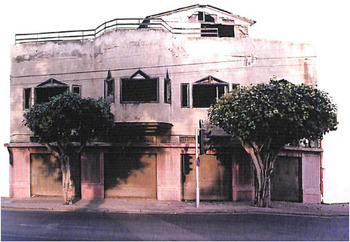
Given the university's structural connections with Zionist institutions and its strong political position, its project to seize Palestinian books was supported by the government from its inception, against “inappropriate” attempts to compete with its library. Still, amid the turmoil of war, the university was not able to extend its efforts beyond Jerusalem. Ben-Zeʾev, who expressed his concern in official correspondence regarding books which were “dumped in abandoned houses, yards, alleys and dumpsters,” saw this as an opportunity to save them and to realize the library project he had been planning for years.Footnote 77 He was now offered the support of the new Ministry of Minorities (established as part of the provisional government) to collect Palestinian books outside of Jerusalem, especially in Jaffa, whose Palestinian population was forced to leave in 1948 almost in its entirety. These books were stored in a formerly owned Palestinian house in Jaffa, which was officially named “The Arab Library of the State of Israel” (Ha-Sifriya ha-Aravit shel Medinat Yisrael; Fig. 4).
The Arab Library in Jaffa (picture taken in 1997). Tel Aviv-Jaffa Municipality, Archive of Engineering Administration, Building File no. 3000/005, p. 17.

From the day it was established, the library served Ben-Zeʾev as a workplace and a home. He moved there with his wife and two younger daughters.Footnote 78 To the tens of thousands of new books, he added his personal collection of Arabic books and newspapers. Ben-Zeʾev divided the books into nine categories: history, geography, law, science, religion, classical Arabic literature, modern Arabic literature, language, and press. Together with his assistant, David Tsemah, an Iraqi Jewish immigrant, Ben-Zeʾev was enthusiastically preparing for the grand opening of the library, which he imagined would take place in an official ceremony attended by government and military officials, Muslim and Christian religious leaders, Hebrew University faculty, local press, and even foreign consuls. He also planned to inform UNESCO of the new institution. In line with his pre-1948 plans for an Arab library, Ben-Zeʾev modeled his Jaffa library on the Royal Library in Cairo, hoping it would serve all Arabic readers, especially “Jewish teachers of Arabic, the Arab intelligentsia, orientalists and scholars.”Footnote 79
The collection of books in Jaffa by Ben Zeʾev was met with growing resentment by the university's Orientalists and librarians, who were determined to bring the Palestinian books to the only place they deemed proper for them, the university library. Within a few years they managed to bring about the demise of Ben-Zeʾev's library, obtaining some seven thousand books from its collections. They were assisted in this process by several government ministries and officials (in addition to Palmon), especially Ben-Zion Dinur (Dinaburg) and Eliezer Rieger, who had served as senior professors at the university until their appointments as heads of the education ministry in 1951.Footnote 80 With the latter's authorization, university professors and librarians made frequent visits to Ben-Zeʾev's library, screening it for “important” books they wished to have at their disposal. One year later, in late 1952, the Arab Library in Jaffa was finally closed down, despite Ben-Zeʾev's protests, without ever being opened to the public.
A quick look at a list of 111 “important books” (sfarim ḥashuvim) from Ben-Zeʾev's library prepared by IOS professors indicates that most were classics in the genres of Islamic law and theology, philology, early philosophy, and literature, in accordance with German models of academic Orientalist knowledge.Footnote 81 Ben-Zeʾev considered these same books essential to his library as well, although along with many titles in modern Arabic literature, which he thought would be of interest to the educated Arabic-speaking public in general, not just academics. As in his other conflicts with the university's German Orientalists, such as over Arabic teaching or the marginalization of Jewish Arabic literature, which revolved around knowledge and access to it, the struggle over looted books, as Ben-Zeʾev saw it, concerned the monopolistic practices and elitist approach of his rivals, who sought to take over the books and place them in the already secluded university library for the use of a small elite, as well as their treatment of the books as dead artifacts detached from their local living culture.
As Ben-Zeʾev was making grand plans for his library, most of the Arabic-speaking educated public for which it was intended had been forced to leave what had become Israeli territory. The owners of the looted books belonged to the political, economic, and intellectual Palestinian elites of Jerusalem, Jaffa, Haifa, and other urban centers, who had themselves engaged with the Nahda. Among them were the educators and writers Khalil Sakakini and Khalil Baydas, as well as prominent figures like ʿAbd al-Bari Barakat, president of the Arab Chamber of Commerce; Yusif Haykal, the mayor of Jaffa; Nimr al-Khatib, head of the Arab Higher Committee in Haifa; ʿAwni ʿAbd al-Hadi, lawyer and politician; and many others.Footnote 82 Eventually, aside from those that were sold or destroyed, the books reached the shelves of the university library; none of them were returned to their original owners.
The critical turning point for the Jaffa library was the dismantling of its only patron, the Ministry of Minorities, less than two years after its establishment in May 1948. The initial role of this ministry was to serve as “[the minorities’] spokesmen and go-between with the rest of the Government.” Bechor Shitrit was appointed as its head because of his “distinctive and colorful” personality “unmistakably formed by the Orient,” and for being a loyal Sephardi leader who opposed “separatism.”Footnote 83 Yehuda Burla headed the ministry's Department of Culture, Education and Propaganda (Hasbara). Despite the loyalty of these Sephardi figures, MAPAI leaders realized that allowing them to run a separate ministry dedicated to Palestinians’ issues was risky and quickly acted to close it down.
In the broader context of the Nakba and military rule over Palestinians, combined with the major influx of Arabic-speaking Jews from Middle Eastern countries, the role of Sephardi Jews as expert mediators in the nascent “liberal settler state” was being reevaluated.Footnote 84 Indeed, this was a time of great uncertainty concerning the political belonging or citizenship of old and new Arabic-speaking Jewish populations. What was the role of native Jewish elites in the new state, and how did they figure in its colonial strategies of population management? If citizenship can be seen as a differential “set of rights and entitlements, obligations and possibilities for action…. shaped by power structures, struggles, and social experiences,” how was the native Jewish elite's citizenship shaped in the early years of the new state?Footnote 85 The marginality of native Jews as a social group that had lost its relevance as a political actor by 1948 intersected with the impossibility of Ben-Zeʾev's cultural project quite explicitly. MAPAI's decision to dismantle the Ministry of Minorities was preceded by intense debates in the new government over the management of the remaining Palestinian population.Footnote 86 MAPAI leaders feared that the existence of a separate ministry for Palestinian issues could lead to de-facto recognition of the Arab population as a national collective.Footnote 87 They also were concerned about granting undue power to Sephardi leaders. It seems that the very qualifications that in the eyes of the government made this native Jewish elite suitable for the position in the first place also were those that shaped its suspicion toward them.
Shitrit and others from the locally born elite who managed to integrate into the new Israeli establishment were placed in structurally inferior positions within it. By the third Knesset (1955) the Sephardi and Yemenite parties had been dismantled. Shitrit, who headed the list of Sephardi and Oriental Jews until the second Knesset (1951), joined MAPAI and remained in the limited role of minister of police. As one of MAPAI's leaders stressed: “The Sephardi minister cannot have big[ger] pretensions.”Footnote 88 Increasingly, the very possibility of those Jews who had been on the margins of Jewish politics before 1948 acting as politically independent groups in the new state was effectively eliminated. This move was meant to ensure their loyalty to the state and at the same time their exclusion from political power.
“Native Jews”: Between Identification and Political Strategy
More than a story about the marginalization of Palestine-born Jews by the Zionist establishment, tracing the trajectory of Israel Ben-Zeʾev and his ongoing Nahda project reveals a formative chapter in the construction of "native" Jews as a sociopolitical group and of Arab Jewish studies as a specialized field of knowledge, as the two coalesced in a series of struggles for recognition, representation, and political power in the 1940s. The failure of these projects, manifested in the NYF's defeat in the 1944 elections and the closing of the Arab Library in Jaffa, highlighted the narrowing range of possibilities for action among local Jews who refused to accept the position designated to them within the Zionist colonial-national framework, as power brokers, mediators, or “experts on the Arabs.” In contrast to those who joined the Zionist institutions in the mandate era and were incorporated into the new state apparatus, such as Shitrit and Burla, Ben-Zeʾev never accepted these roles. His interest in Arab culture was neither instrumental nor purely scholarly; rather, he saw himself as a native, politically engaged intellectual who belonged to a larger community of scholars and educators in the Arab world. At the center of his vision of Jewish life in the Middle East stood his fantasy about opening a library comparable to the Royal Library in Cairo, in addition to a Jewish version of the Dar al-Muʿallimin. Lacking political and financial support, he managed to establish the library he had long planned only in the specific conjuncture of 1948. Ironically, and quite literally, it was on the ruins of Palestinian cultural and national life that this project of a shared Arab–Jewish space was constructed. Long after the library was closed down, within the ever more limited space for Arab Jewish action as he understood it, Ben-Zeʾev continued to promote academic and public knowledge of Arabic and modern Arab culture.
Ben-Zeʾev remained on the political margins of the late Ottoman Jewish elite, whose position in the new state changed significantly. The NYF dramatically lost its power from the late 1940s, but in the following decades it remained consistent in its focus on political struggle over equal access to public resources and representation for local marginalized groups among native Jews and increasingly also Mizrahi families who immigrated in the 1950s and 1960s. One of NYF's ongoing campaigns concerned a demand for affordable housing in Jerusalem for this population, which according to Ben-Zeʾev had long been discriminated against and purposefully left in poverty and distress.Footnote 89 Although some have publicly identified as native Jews to claim recognition for their ancestors’ role in the development of the Yishuv, for others this form of identification was a key strategy in a broader, ongoing political struggle long after 1948.
Acknowledgments
I am grateful to Zachary Lockman, Gadi Algazi, Benny Nuriely, and Liat Kozma for their meticulous reading and invaluable comments on earlier versions of this article. My special thanks to Joel Gordon for his generous editorial help, support, and thoughtful advice, as well as to the three anonymous reviewers for their many insightful contributions to this manuscript. I dedicate this article to Iris Agmon and Avi Rubin, who guided this research in its very early stages almost a decade ago. The writing of this article was financially supported by the Posen Society of Fellows.