Non-technical Summary
A new fossil genus and species of the net-winged beetle family Lycidae, Domipteron gaoi, is reported from Miocene (15–20 million years ago) Dominican amber. The fossil is attributed to the tribe Calopterini based the phylogenetic analyses.
Introduction
Calopterini (Lycinae) are a tribe of net-winged beetles endemic to the New World (Bocakova, Reference Bocakova2003, Reference Bocakova2005). The generic taxonomy of Calopterini was revised by Bocakova (Reference Bocakova2003), who later also conducted the first phylogenetic analysis of the tribe based on adult morphology (Bocakova, Reference Bocakova2005). Bocakova (Reference Bocakova2005) indicated two monophyletic clades in her analyses, Acroleptina + Calopterina and Eurrhacina. Eurrhacini were later separated as an independent tribe from Calopterini by the molecular study of Bocak and Bocakova (Reference Bocak and Bocakova2008). A similar disjointed relationship between Eurrhacini and Calopterini was also recovered by Masek et al. (Reference Masek, Motyka, Kusy, Bocek, Li and Bocak2018) based on an expanded dataset. However, these two studies used only a few gene markers, and the relationships within Lycinae were relatively unstable. Thus, further studies are needed to clarify the precise phylogenetic placements of Calopterini and Eurrhacini.
Numerous new extant genera and species of Neotropical Lycidae have been described and placed in Calopterini and Eurrhacini since the revision by Bocakova (Reference Bocakova2003) (e.g., Nascimento and Bocakova, Reference Nascimento and Bocáková2010a, Reference Nascimento and Bocakovab, Reference Nascimento and Bocakova2017, Reference Nascimento and Bocakova2019, Reference Nascimento and Bocakova2022, Reference Nascimento and Bocakova2023; Ferreira and Ivie, Reference Ferreira and Ivie2018; Ferreira, Reference Ferreira2020; Ferreira and Silveira, Reference Ferreira and Silveira2020). Particularly, the genus Falsoceratoprion Ferreira, 2022 was first described based on a fossil species from Miocene Dominican amber (Ferreira and Tettamanzi, Reference Ferreira, Solodovnikov, Ivie and Kundrata2022) and was later found to be present in the Recent fauna as well (Ferreira and Ivie, Reference Ferreira, Barbosa, Bocakova and Solodovnikov2023).
The fossil record of Calopterini is extremely sparse. Only a single species, Falsoceratoprion fumagalliae Ferreira, 2022, as mentioned above from Dominican amber has been documented to date. Here we report another fossil of Calopterini from Dominican amber, which represents a new genus and species.
Material and methods
Material
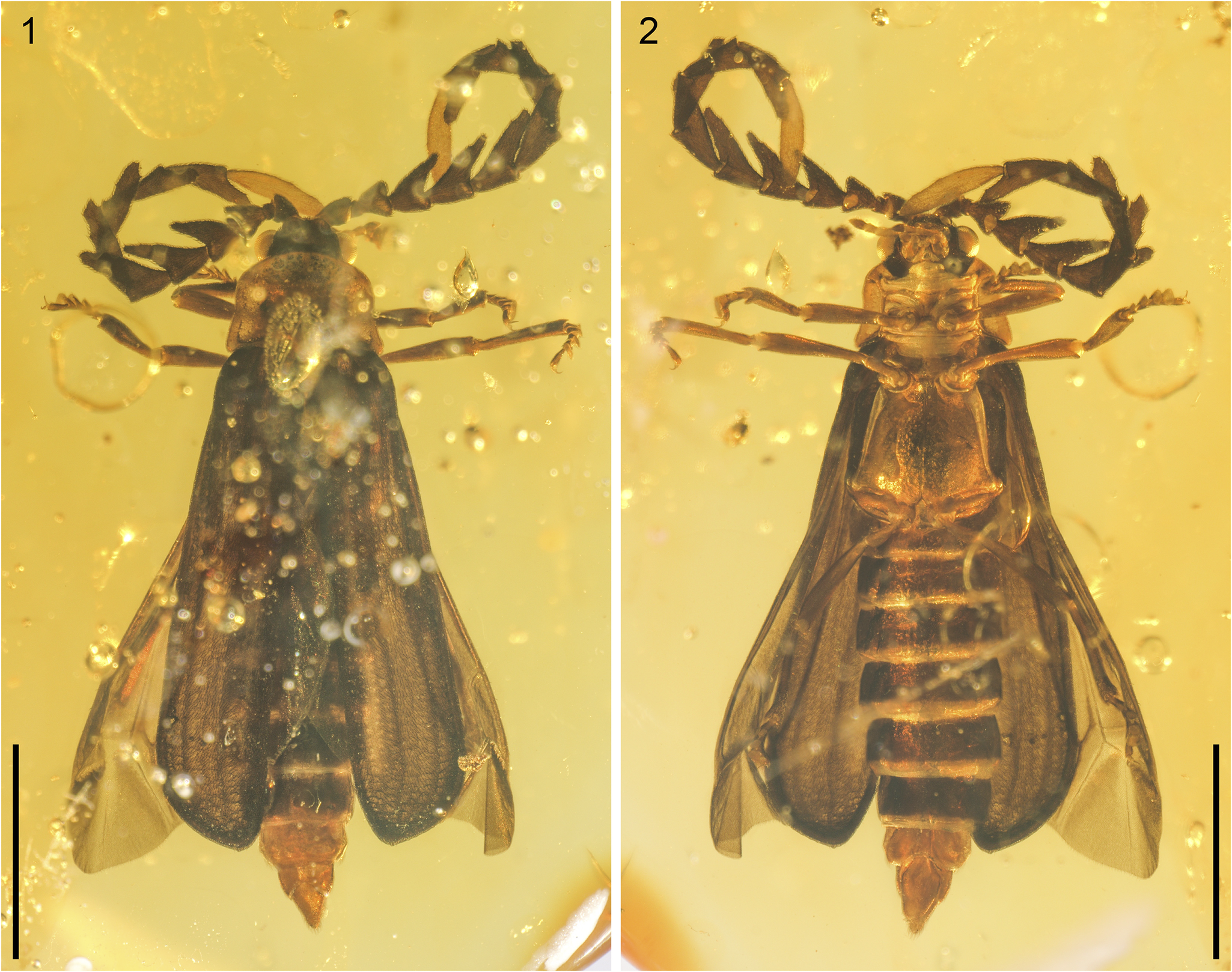
The Dominican amber specimen studied herein (Figs. 1–4) originated from the Los Brachos amber mine (19°32′N, 70°37′W) near La Cumbre, Santiago, Dominican Republic.
General habitus of Domipteron gaoi n. gen. n. sp., holotype, NIGP205048, under incident light: (1) dorsal view; (2) ventral view. Scale bars = 2 mm.

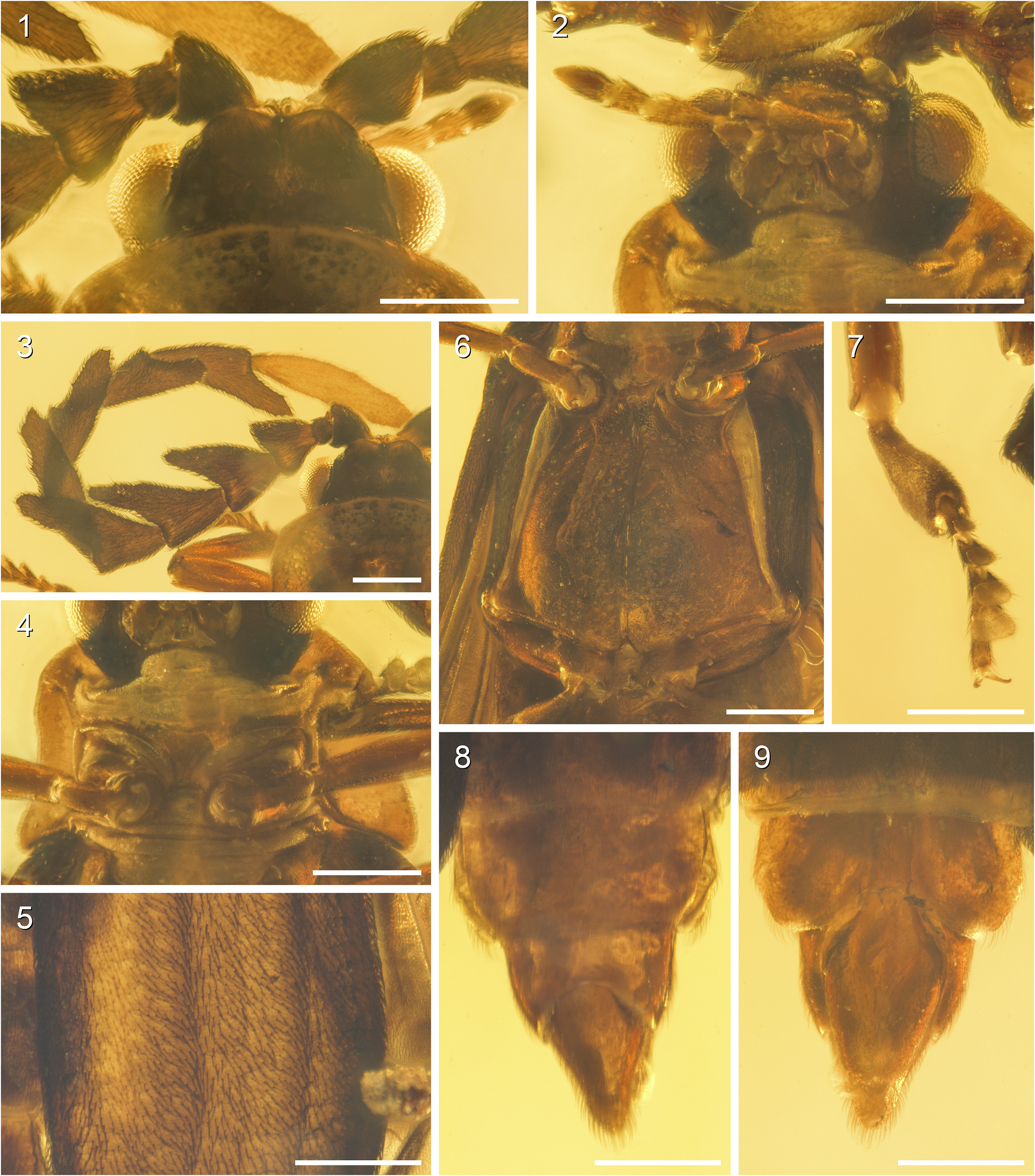
Details of Domipteron gaoi n. gen. n. sp., holotype, NIGP205048, under incident light: (1) head, dorsal view; (2) head, ventral view; (3) antenna; (4) prothorax, ventral view; (5) elytron, dorsal view; (6) mesothorax and metathorax, ventral view; (7) mid leg, ventral view; (8) abdominal apex, dorsal view; (9) abdominal apex, ventral view. Scale bars = 400 μm.

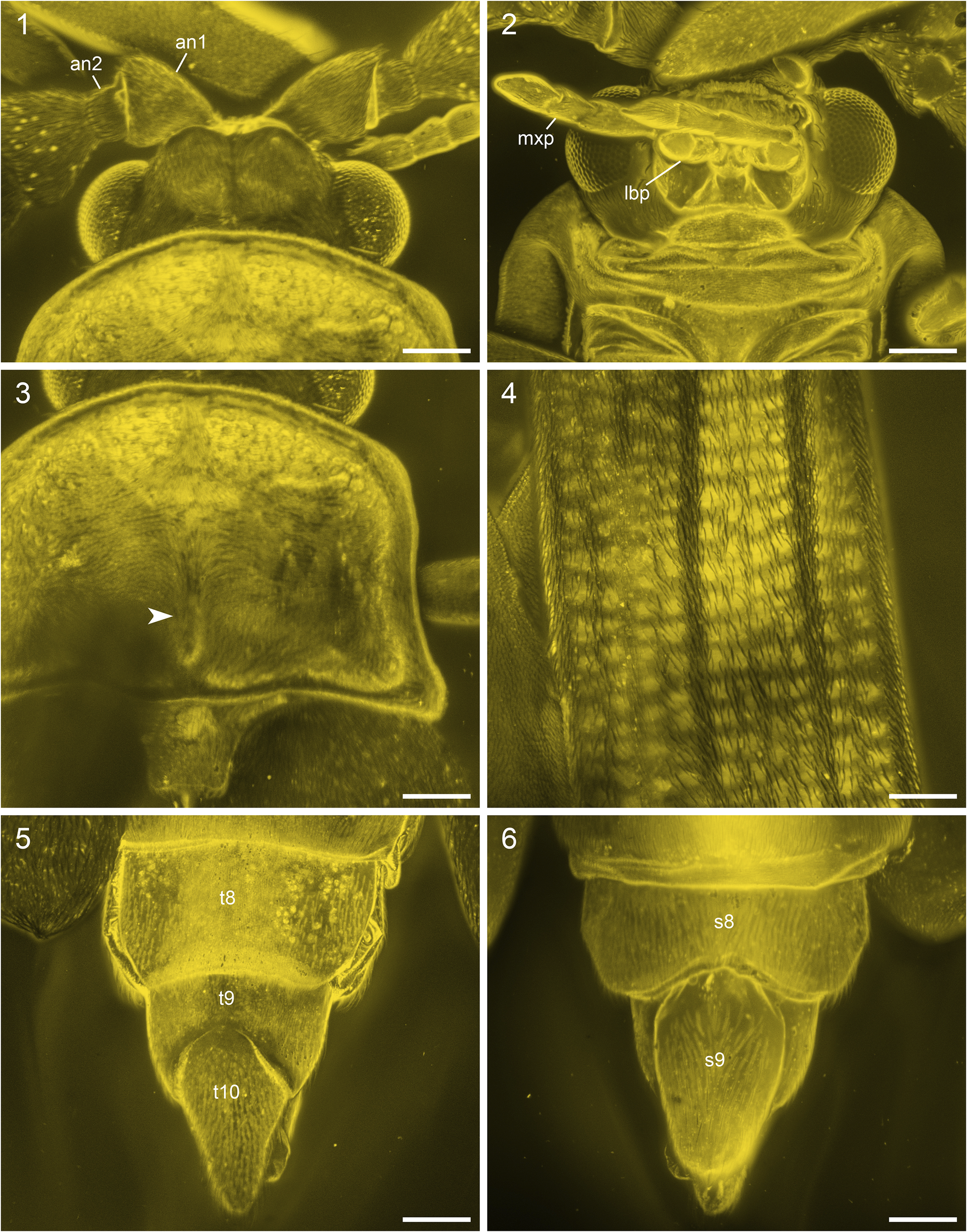
Details of Domipteron gaoi n. gen. n. sp., holotype, NIGP205048, under confocal microscopy: (1) head, dorsal view; (2) head, ventral view; (3) prothorax and scutellum, dorsal view, with arrowhead indicating pronotal areola; (4) elytron, dorsal view; (5) abdominal apex, dorsal view; (6) abdominal apex, ventral view. an1, 2 = antennomeres 1, 2; lbp = labial palp; mxp = maxillary palp; s8, 9 = abdominal sternites VIII, IX; t8–10 = abdominal tergites VIII–X. Scale bars = 200 μm.

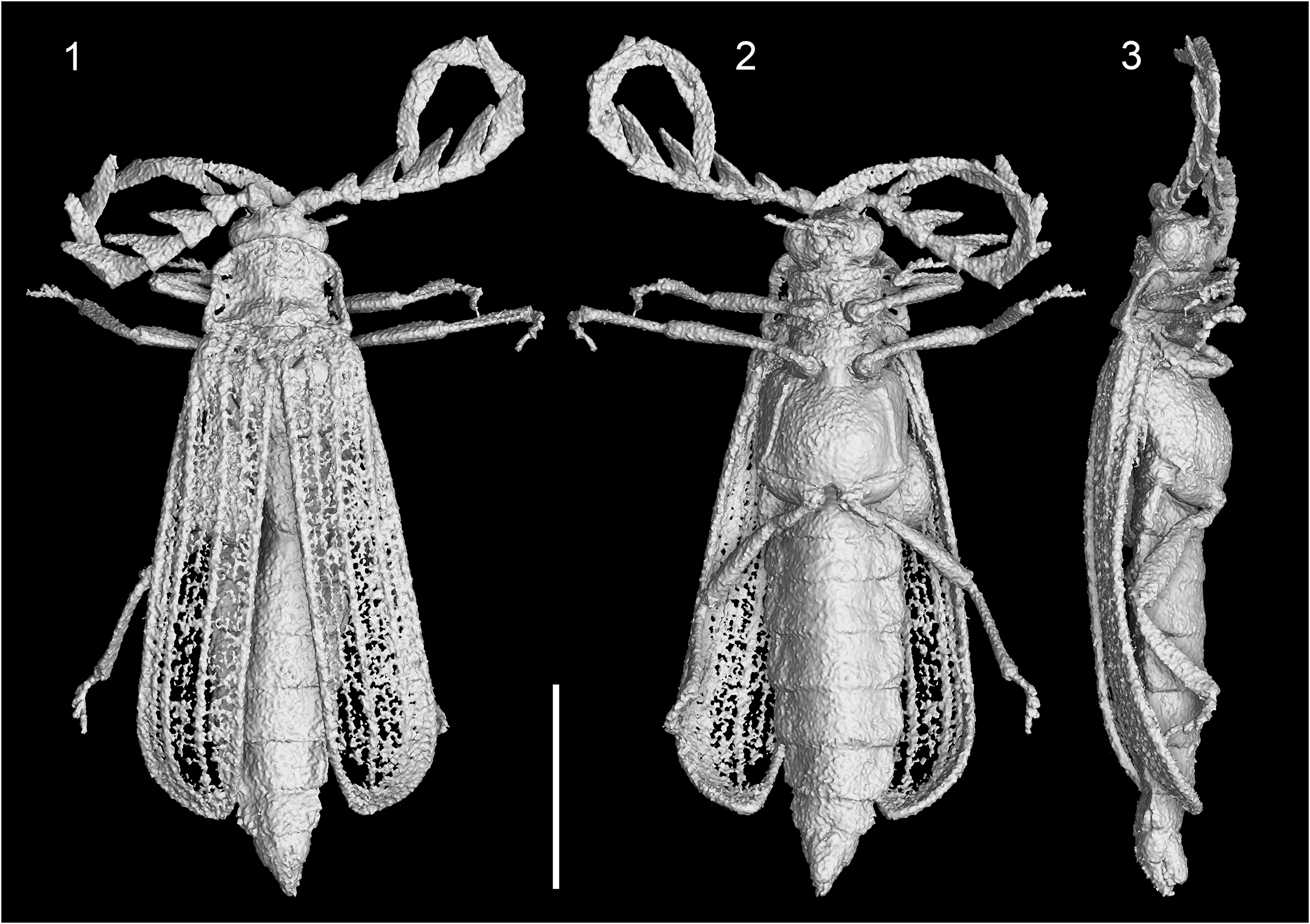
X-ray microtomographic reconstruction of Domipteron gaoi n. gen. n. sp., holotype, NIGP205048: (1) dorsal view; (2) ventral view; (3) lateral view. Scale bar = 2 mm.

Fossil imaging
Photographs under incident light were taken with a Zeiss Discovery V20 stereo microscope and stacked in Helicon Focus 7.0.2 and Zerene Stacker 1.04. Confocal images were obtained with a Zeiss LSM710 confocal laser scanning microscope, using the 561 nm (DPSS 561-10) laser excitation line (Fu et al., Reference Fu, Li, Su, Cai and Huang2021), and were manually stacked in Adobe Photoshop CC. Microtomographic data were obtained with a Zeiss Xradia 520 Versa 3D X-ray microscope at the micro-CT laboratory of NIGP and analyzed in VGStudio MAX 3.0. Scanning parameters were as follows: isotropic voxel size, 10.412 μm; power, 3 W; acceleration voltage, 40 kV; exposure time, 3.5 seconds; projections, 2001. Images were further processed in Adobe Photoshop CC to adjust brightness and contrast.
Measurements and description
The measurements were generally based on the micro-CT reconstruction. The morphological terminology generally follows Bocakova (Reference Bocakova2003), Kazantsev (Reference Kazantsev2005), and Lawrence and Ślipiński (Reference Lawrence and Ślipiński2013).
Phylogenetic analyses
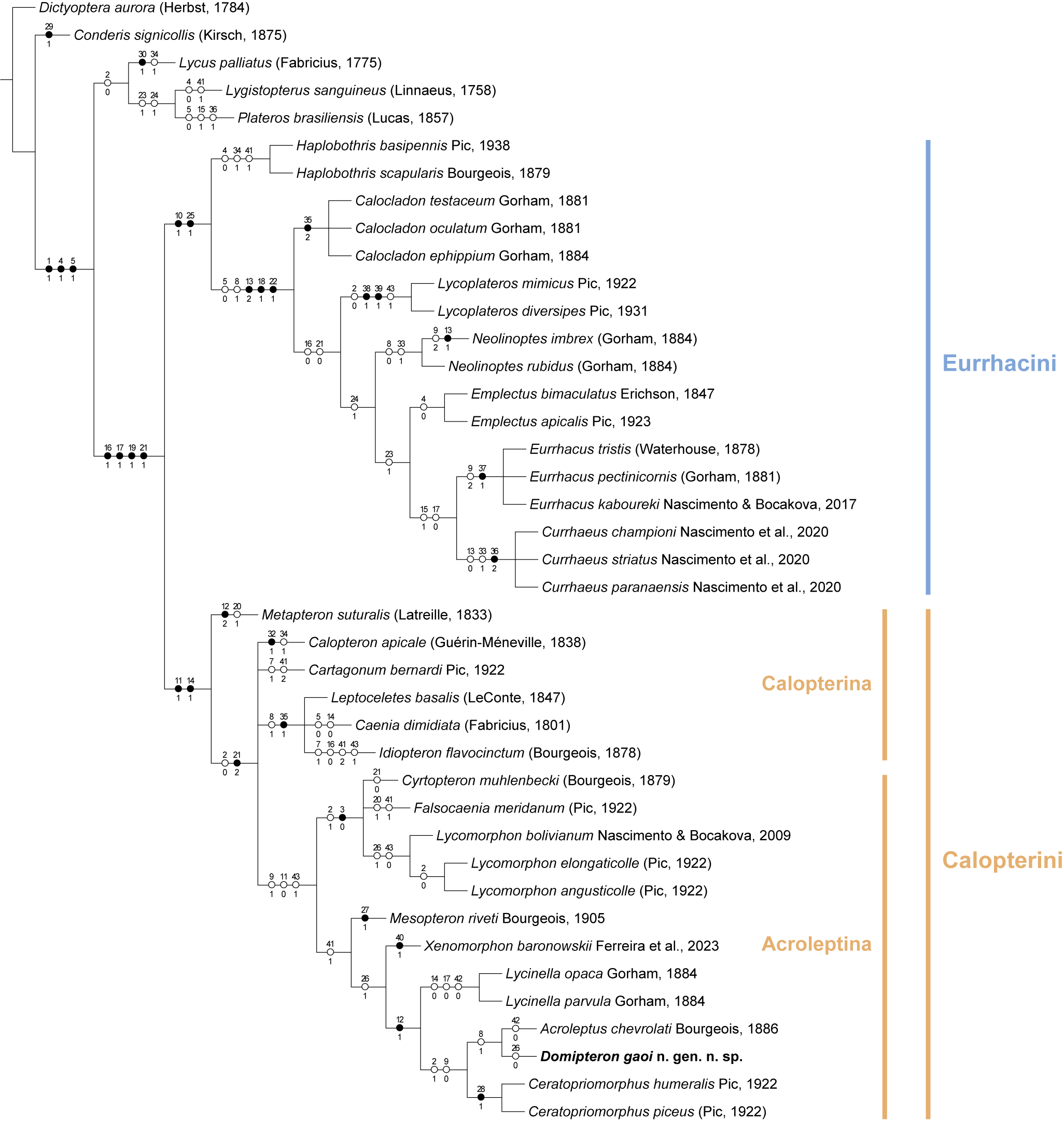
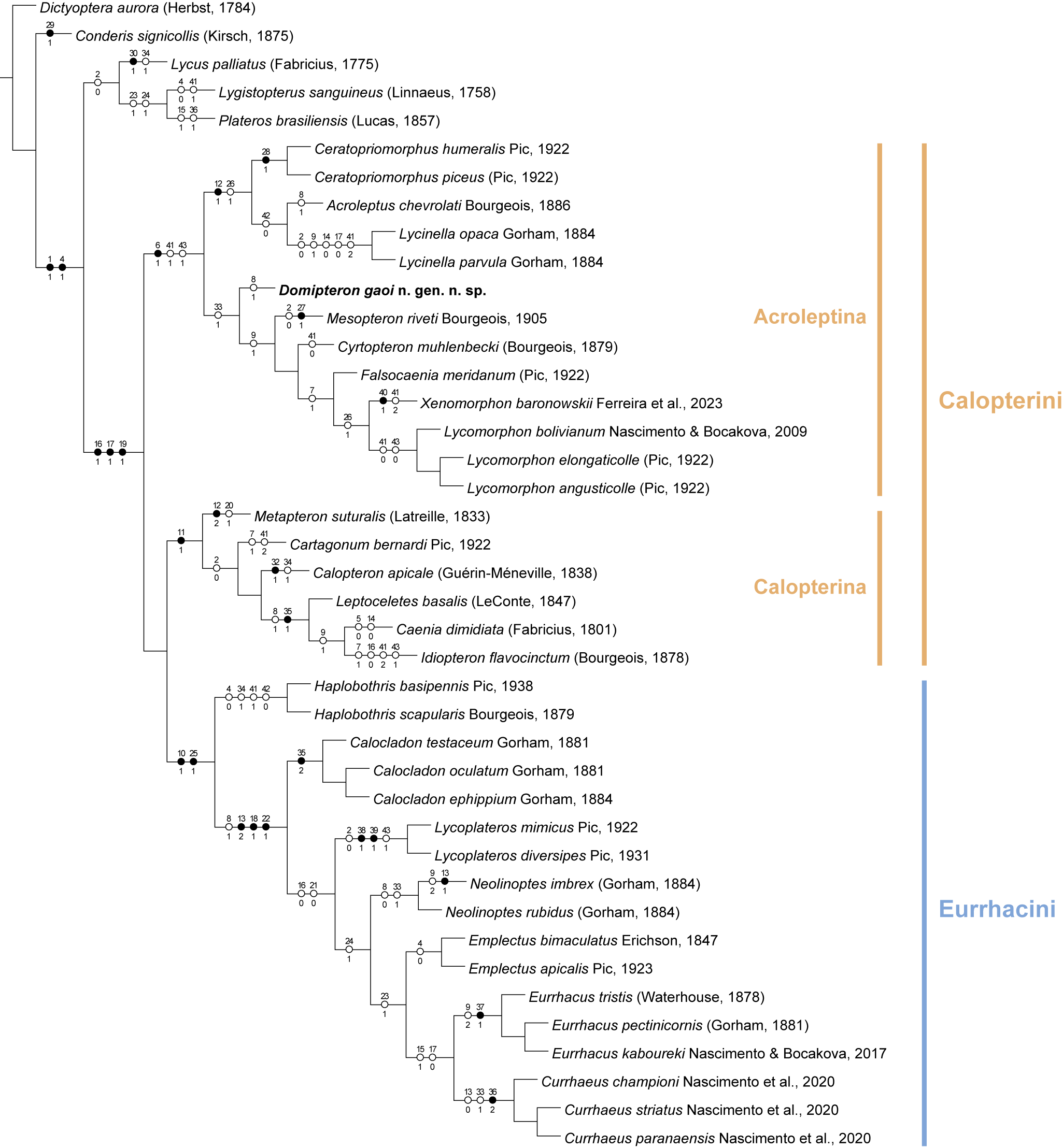
To evaluate the systematic placement of Domipteron n. gen., we conducted a morphology-based phylogenetic analysis (Appendix 1). The character list and data matrix of extant species were taken from Ferreira et al. (Reference Ferreira, Barbosa, Bocakova and Solodovnikov2023), whose dataset was modified from Bocakova (Reference Bocakova2005) and Nascimento et al. (Reference Nascimento, Bressan and Bocakova2020). Parsimony analyses were performed under both equal and implied weights using the program TNT 1.5 (Goloboff and Catalano, Reference Goloboff and Catalano2016). All characters were treated as non-additive. The concavity constant was set to 12, as suggested by Goloboff et al. (Reference Goloboff, Torres and Arias2018) and Smith (Reference Smith2019). Most parameters were set as default in the “new technology search,” while the value for “find min. length” was changed from 1 to 500. A majority-rule consensus was calculated for the analysis under equal weights. Character states were mapped onto the tree with WinClada 1.00.08. The trees were graphically edited with Adobe Illustrator CC 2017.
Repository and institutional abbreviation
The amber specimen is deposited in the Nanjing Institute of Geology and Palaeontology (NIGP), Chinese Academy of Sciences, Nanjing, China.
Systematic paleontology
Order Coleoptera Linnaeus, Reference Linnaeus1758
Family Lycidae Laporte, Reference Laporte1838
Subfamily Lycinae Laporte, Reference Laporte1838
Tribe Calopterini Green, Reference Green1949
Subtribe Acroleptina Bocakova, Reference Bocakova2005
Genus Domipteron new genus
Type species
Domipteron gaoi n. sp.
Diagnosis
As for the type species.
Etymology
The generic name is formed based on Dominican Republic, the locality of the type species, and Calopteron, the type genus of Calopterini. The name is neuter in gender.
Remarks
The new genus displays mixed characters of Calopterini and Eurrhacini, but it can be separated from all other genera of Calopterini and Eurrhacini by the combination of following characters: antennae weakly pectinate in males, terminal maxillary palpomere cultriform, shorter than palpomere 2, pronotum with lenticular longitudinal areola, and each elytron with 10 longitudinal puncture rows, with three costae more or less well marked (costae between puncture rows 4 and 5 and rows 8 and 9 well marked along full elytral length; costa between puncture rows 2 and 3 well marked in anterior part of elytra).
Domipteron gaoi new species
Holotype
NIGP205048, adult male (NIGP).
Diagnosis: adult male
Head largely visible dorsally (Figs. 2.1, 3.1). Antennae weakly pectinate (rami of antennomeres 4–10 roughly as long as corresponding antennomere stems); terminal antennomere with brighter color (Fig. 2.3). Terminal maxillary palpomere cultriform, shorter than palpomere 2 (Fig. 3.2). Pronotum with basal lenticular longitudinal areola, bordered by weak carinae (Fig. 3.3). Elytra with subparallel sides, not widened apically; each elytron with 10 longitudinal puncture rows; costae between puncture rows 4 and 5 and rows 8 and 9 more strongly developed than others (Figs. 2.5, 3.4).
Occurrence
Los Brachos amber mine located near La Cumbre, Santiago, Dominican Republic; La Toca Formation, Miocene (20–15 Ma) (Iturralde-Vinent and MacPhee, Reference Iturralde-Vinent and MacPhee2019).
Description
Body elongate, about 6.7 mm long and 2.2 mm wide (when elytra closed); humeral width about 1.7 mm.
Head narrower than anterior pronotal edge, dorsally largely visible, posteriorly partially covered by pronotum, with paired protuberances above antennal insertions. Eyes protuberant, moderately large, well separated; interocular distance about 1.7 times as long as eye diameter. Antennae with 11 antennomeres; antennomere 1 moderately short and wide; antennomere 2 small; antennomere 3 subtriangular, larger than antennomere 1; antennomeres 4–10 slightly increasing in length towards apex, weakly pectinate, each with ramus arising from whole lateral edge of antennomere stem and not clearly distinguished from it (boundary between ramus and stem unclear), roughly as long as antennomere body; antennomere 11 lanceolate, with brighter color. Maxillary palp 4-segmented; palpomere 4 cultriform, flattened apically, shorter than palpomere 2. Labial palp 3-segmented; palpomere 3 truncate and flattened apically.
Pronotal disc subtrapezoidal; anterior edge slightly arcuate; lateral edges subparallel in anterior half, weakly divergent posteriad in posterior half; posterior edge weakly bisinuate, without distinct medial projection, with scutellum largely visible; dorsal surface with weak basal lenticular longitudinal areola, bordered by weak carinae, fading anteriorly. Prosternum subtriangular; portion in front of coxae as very narrow bar. Scutellar shield with posterior edge broadly and weakly emarginate. Elytra elongate, with subparallel sides, not widened apically; each elytron with 10 longitudinal puncture rows; costae between puncture rows 4 and 5 and rows 8 and 9 (counted from elytral suture) well marked along full elytral length; costa between puncture rows 2 and 3 well marked in anterior part of elytra. Mesoventrite transverse; posterior margin rounded. Metaventrite broad and elongate; discrimen (at least almost) complete. Hind wings well developed. Legs slender. Tibial spurs not identified, either absent or small and not clearly thicker and longer than surrounding setae. Tarsi all 5-segmented; tarsomeres 1–4 with progressively larger ventral lobe. Pretarsal claws simple.
Abdomen with eight ventrites. Ventrite 7 (sternite VIII) with posterior edge arcuately emarginate. Ventrite 8 (sternite IX) tapered posteriorly, rounded at apex. Abdominal spiracles located dorsally on pleural membrane.
Etymology
The species is named after Mr. Yu-He Gao, who kindly donated the type specimen for our research.
Remarks
Domipteron gaoi n. gen. n. sp. is the fifth species of Lycidae described from Dominican amber. Among the previously described species, Falsoceratoprion fumagalliae also belongs to Calopterini (Ferreira and Tettamanzi, Reference Ferreira and Tettamanzi2022). The remaining three species from Dominican amber, Cessator anachronicus Ferreira and Ivie, 2022, C. brodzinskyi Ferreira and Ivie, Reference Ferreira and Ivie2017, and Electropteron avus Kazantsev, Reference Kazantsev2020, all belong to Leptolycini (Ferreira and Ivie, Reference Ferreira and Ivie2017; Kazantsev, Reference Kazantsev2020; Ferreira et al., Reference Ferreira, Solodovnikov, Ivie and Kundrata2022).
Discussion
Our phylogenetic analyses grouped the new fossil with the subtribe Acroleptina of the tribe Calopterini (Figs. 5, 6). The results are compatible with their biogeography: Calopterini are known in both extant and Miocene fauna of the West Indies (Peck, Reference Peck2005; Ferreira and Ivie, Reference Ferreira and Ivie2023), while Eurrhacini are not present in the West Indies, and their distribution range seems to be mainly restricted to South and Central America. Nevertheless, the current morphological data for Eurrhacini and Calopterini do not seem to be very reliable to ground a phylogenetic hypothesis (with low support and susceptible to character selection and coding) (Bocakova, Reference Bocakova2005; Nascimento et al., Reference Nascimento, Bressan and Bocakova2020; Ferreira et al., Reference Ferreira, Barbosa, Bocakova and Solodovnikov2023; Nascimento and Bocakova, Reference Nascimento and Bocakova2024). Moreover, the important genital characters diagnosing Eurrhacini and Calopterini (Bocakova, Reference Bocakova2005; Nascimento et al., Reference Nascimento, Bressan and Bocakova2020) are not available for the fossil. Further molecular studies based on genome-scale data could potentially provide a more robust phylogenetic framework of Eurrhacini and Calopterini and help identify better apomorphies characterizing the clades in these two tribes. This would be helpful to evaluate the placement of the fossil more accurately in the future.
Phylogenetic placement of Domipteron gaoi n. gen. n. sp., based on majority-rule consensus tree from parsimony analysis under equal weights.

Phylogenetic placement of Domipteron gaoi n. gen. n. sp., based on parsimony analysis under implied weights.

Supplementary material
To view supplementary material for this article, please visit https://doi.org/10.1017/jpa.2024.72.
Acknowledgments
We are grateful to Y.-H. Gao for donating the amber specimen, S.-P. Wu for help with micro-CT reconstruction, R. Huang for help with confocal microscopy, and J.-J. Tang for help with widefield microscopy. Two reviewers provided helpful comments on the manuscript. Financial support was provided by the National Natural Science Foundation of China (42222201, 42288201). Y.-D.L. is supported by a scholarship granted by the China Scholarship Council (202108320010).
Competing interests
The authors declare no competing interests.
Data availability statement
The original confocal and micro-CT data are available in the Zenodo repository (https://doi.org/10.5281/zenodo.13820382).