


What are the essential values of democracy, understood in its original and minimal sense as collective self-governance by citizens?Footnote 1 Leading ancient and modern political theorists, both friends and critics of democracy, have proclaimed democracy's core values to be liberty and equality (Plato and Aristotle: Robinson Reference Robinson2011, 223; moderns: Rawls Reference Rawls2001, 2). Liberty and equality are preserved by democracy in that constitutional rules of democratic states protect the political liberties and the political and legal equality of citizens. More fundamentally, liberty and equality are necessary conditions of democracy. Citizens lacking the freedom to associate with one another as they choose, or to express their views to one another, do not govern themselves. If citizens lack an equal say in salient matters of public significance, or equal standing before the laws, governance is not genuinely a collective enterprise. This article argues that dignity is democracy's third core value. Dignity might be regarded as subsidiary to liberty and equality, insofar as its role is to enable their fullest realization. But, like liberty and equality, dignity is necessary for collective self-governance and must be preserved by democratic rules.Footnote 2
Dignity is a necessary condition for democracy because citizens require dignity if they are actually to govern themselves. Self-governance requires not only that citizens be free, but also that they be willing and able to act as free citizens. It requires not only that they be equal in standing, but also that their standing be high. When citizens live with indignity, or live with the knowledge that by exercising participation rights they risk indignity, they are unable to make effective use of political liberty. Even if they are equal to one another in formal participation rights and before the law, citizens suffering or at risk of indignity do not enjoy the high standing necessary for true collective self-governance. Lowly (humiliating or infantilizing) circumstances preclude the activities of speech, choice, and execution demanded of self-governing citizens. Moreover, self-governance requires ready access to reliable information and stability over time. Dignity ensures that relevant information is made public. It stabilizes democracy by mediating between demands of liberty and equality, forbidding libertarian neglect of basic needs and egalitarian paternalism alike. Democracy without secure dignity is at best a fragile construct. At worst it is a façade masking the despotism of entrenched and unaccountable elites. Like equality and liberty, dignity stands in a reciprocal relationship to democracy, sustaining and sustained by it. Dignity makes democracy robust: Democratic institutions defend dignity, whereas the habits of dignified citizens provide behavioral foundations for defending democracy and for improving institutions over time.
The importance of dignity to normative theory has recently been underscored by moral philosophers and political theorists. Charles Taylor has emphasized the importance of dignity, as Hegelian recognition, in sustaining group rights. Stephen Darwall argues that recognition–respect is second-personal in that it demands your recognition that I am owed an account of your behavior. George Kateb draws attention to the dangers posed by local civic commitments to universal human dignity. Jeremy Waldron (Reference Waldron2009), in particular, has shown that the distinctly modern, Western, and fully moralized Kantian conception of human dignity as intrinsic worth without price is best understood as generalizing an earlier social and aristocratic conception of dignity as equal high standing. This article extends the theoretical literature on dignity, by showing that the two relevant features of democracy's dignity are nonhumiliation (having respect as a moral equal) and noninfantilization (having recognition as a choice-making adult) and by elaborating the taxonomy of aristocratic dignity.Footnote 3 Definitional and taxonomic elaboration allows us to specify the kinds of dignity necessary to sustain democracy as collective self-governance.
Aristocratic social dignity is incompletely moralized: Those who deserve dignity are thought to suffer a wrong when treated with indignity, but the choice of whether or not to come to the aid of those wrongly subjected to indignity is determined in part by perceived self-interest. Parsing aristocratic dignity into three analytically distinct subtypes predicts when self-interested individuals will defend another's dignity. It thereby enables a better understanding of the relationship between incompletely moralized aristocratic dignity and fully moralized human dignity, and of the relationship of each kind of dignity to democracy.
This article explains the mechanisms—rules, norms, and social habits—whereby people and institutional resources are reliably mobilized in defense of persons threatened with humiliation or infantilization, so that the regime of dignity is sustained over time. It shows how a democratic commitment to equality of standing can be strengthened by public recognition of extraordinary merit. It demonstrates how dignity regulates competing demands of the strongest forms of liberty and equality. Finally, it enables us to answer, at least provisionally, the question, raised most pointedly by George Kateb (Reference Kateb2011), of whether deep local commitments of citizens can be made compatible with the universal human dignity of individuals.
My normative argument is situated within nonideal political theory in that I assume social agents whose motivations are incompletely specified by moral requirement or permission, and whose actions are guided but not fully determined by rules.Footnote 4 I do not seek to specify all that justice demands, or the conditions under which the demands of justice might fully be met. My argument is weakly eudaemonistic, in assuming that some conditions of life, prominently including indignity, are incompatible with lives that go well. It is meant to show how human lives may go relatively better under collective self-governance. It explains how those choice-worthy conditions could be self-sustaining in a population of fairly rational individual agents—people who are concerned (although not uniquely) with pursuing (if not necessarily with maximizing) expected utility.Footnote 5 The agents assumed here are ordinary persons, neither uniquely motivated by narrow self-interest nor fully altruistic moral saints (Kahneman Reference Kahneman2011; Wolf Reference Wolf1982).
My approach to examining dignity as a core democratic value is both analytic and historical. Simple two- and three-player games illustrate each of the several dignity regimes. The games assume fully rational and fully informed agents with (or lacking) ranked preferences over possible outcomes. Formal game theory unrealistically assumes that each player knows each other player's preferences (or the probability distribution over possible preferences), and it employs a conception of instrumental rationality stronger than that assumed for the ordinary human agents discussed earlier (Shepsle Reference Shepsle2010). But formalization is helpful for illustrating whether each regime of dignity does, or does not, rest on a foundation of predictable individual behavior. I also present case studies drawn from ancient Greek (and thus pre-Christian and a fortiori pre-Enlightenment) literature and history. Turning to antiquity for examples of aristocratic dignity allows us to assess different regimes of dignity in an era before fully moralized universal human dignity, or legal rules associated with it, had entered the picture. This in turn enables us better to understand the relationship of dignity to democracy in our own era, in which incompletely and fully moralized conceptions of dignity are co-present, and potentially conflated or confused. Distinguishing which among several kinds of dignity are required to sustain minimal democracy is a step toward the more ambitious goal, gestured at in the Conclusions, of specifying the kinds of dignity appropriate to liberal democracy.
The method employed here draws on historical case studies, but abjures historicism: the assumption that history provides a full and adequate account of humanly possible conditions. Historicism is incompatible with the sort of nonideal normative political theory developed here (and certainly with ideal theory as well). Historical case studies are, in contrast, valuable to nonideal political theory if they help us better to explain the conditions that sustain relatively choice-worthy political regimes—for example, the mechanisms that preserve regimes in which dignity is reliably secured for an extensive population. Approached in this way, history is not a constraint on theory; it puts flesh on the bones of both normative and positive political theory.
The rest of this article proceeds as follows. The first section distinguishes among four kinds of dignity (human dignity and three varieties of aristocratic dignity) and establishes their common core in an equal high standing characterized by freedom from threats of humiliation and infantilization, and secured by interpersonal respect and recognition. The second sketches dignity's domain by comparing universal human dignity with its most distant aristocratic analogue, traditional meritocratic dignity. Both meritocracy and universal human dignity are compatible with democracy, but neither is grounded in the predicted behavior of the agents assumed here.
The third section argues that extending dignity as equal high standing, from those possessing extraordinary merit to a body of peers, sustains a regime in which dignity is reliably secured among peers. Elite peerage is incompatible with democracy in that it preserves the option, and fosters the practice, of humiliating and infantilizing the many nonpeers who remain outside the bounds of dignity. When equal high standing is further extended to a socially diverse body of citizens, however, dignity becomes a core value of democracy. Civic dignity resembles elite peerage in that dignity becomes a public good shared by a group of persons who recognize and respect one another as equals, entailing common responsibility for, and rational interest in, the defense of one another's dignity. But a civic-dignity-preserving regime is hostile to the public expression of superiority insofar as it involves the humiliation of others. The fourth section shows how dignity, as democracy's third core value, regulates state policy and officials. A commitment to noninfantilization requires a principle of open access to information, and adjudicates between the competing demands of libertarians for policies maximizing liberty as freedom to choose and of egalitarians for maximizing equality of outcome or opportunity.
The fifth section, a historical case study of the behavioral effects of civic dignity in classical Athens, illustrates how democracy and civic dignity were mutually sustained in an era before human dignity was recognized as a universal right. The case study illustrates the legal and behavioral imperatives of a democratic regime of citizen dignity, and the reciprocal relationship between the expected behavior of citizens and laws providing immunity from indignity. The case study also demonstrates why certain constrained aspects of meritocratic dignity remain important to the preservation of a participatory democracy over time. Finally, it shows that a regime of civic dignity may, for instrumental reasons, legally protect the dignity of noncitizens without embracing the universalizing and moral imperative of inherent human dignity. The article concludes by suggesting that, although different kinds of dignity are necessary for sustaining minimal democracy and liberalism, the kinds of aristocratic dignity necessary for democracy as collective self-governance by citizens are compatible with dignity as a universal attribute of humanity.
TAXONOMY AND DEFINITION OF DIGNITY
Waldron (Reference Waldron2009) has highlighted the conceptual similarities between universal human dignity and aristocratic dignity, an older, analytically murky, and incompletely moralized conception of high standing monopolized by a privileged elite. He suggests, I think correctly, that human dignity generalizes to all humanity, as a right, the high standing formerly reserved as a privilege for a few. The generic features of aristocratic dignity are that (1) high standing is valued; (2) those who have it in equal measure are expected to treat one another as equals; (3) it is comparative and relational, contrasting the high status of some to the relatively lower standing of others. Aspects (1) and (2) of aristocratic dignity are also characteristic of human dignity; aspect (3) obviously is not. Taking Waldron's two kinds of dignity as a point of departure, we can make further progress by distinguishing the following three conceptually and historically distinct kinds of aristocratic dignity:
Meritocracy: Dignity as differential high standing arising from special merit.Footnote 6 Traditional meritocratic dignity is aristocratic dignity reduced to its primitive form of individual honor. A society predicated on merit alone is inherently unstable when high standing is assigned to individuals, by other individuals, on the basis of placement on one or more of an indeterminate number of only partially overlapping continua of desert. In such cases, equality of high standing is at best fragile and ephemeral. Yet meritocratic dignity captures an important social value widely shared outside traditional meritocracies: under the right circumstances, outstanding merit in the provision of public goods deserves special regard. Recognition of merit is just in the basic sense of treating like cases alike, and, by extension, unlike cases differently. Some features of meritocracy may, therefore, be required by justice.
Elite peerage: Dignity as equal high standing among a small body of elite peers. Elite peerage, typical of medieval and early modern European societies, is the most familiar of the three forms of aristocratic dignity. It is the kind of aristocratic dignity with which Waldron was primarily concerned. Elite peerage differs from meritocratic dignity in that high standing is based on a few readily identifiable social features. Those who are equal in wealth or in ancestry (e.g.) are peers, regardless of their possession of other valued or disvalued characteristics (courage, wisdom, etc.). Although elite peerage can be stable over time (North, Wallis, and Weingast Reference North, Wallis and Weingast2009, 30–76), it ossifies dignitary privileges in ways that are patently unfair and harmful. It benefits a few who are merely lucky (their status and wealth are inherited, requiring no individual effort or merit), while exposing all others to indignity. Elite peerage lacks meritocracy's attractive feature of recognizing individual excellence achieved through effort in various domains of endeavor. Elite peerage is not addressed in detail in this article, because the features of aristocratic dignity relevant to democracy are adequately captured and analytically distinguished by focusing on meritocratic and civic dignity—and on how these resemble, differ from, and may be made compatible with universal human dignity.
Civic dignity: Dignity as equal high standing among an extensive and socially diverse body of citizens. Civic dignity, the form of dignity with which this article is primarily concerned, may be understood as elite peerage regrounded in explicitly political relations and extended to a broad and diverse set of persons. Alternatively, it may be understood as a stabilized extensive meritocracy in which the varieties of merit are multiplied and different types of merit are nonrival (merit is the basis of equality, not superiority). Recognizing civic dignity as a kind of aristocratic dignity underlines its problematic (from the point of view of liberalism) exclusivity and relationality. Like elite peerage, for example, equal high standing among citizens may be based, in part or in full, on birthright: Citizenship may be denied to those born to noncitizen parents, or outside the territorial boundaries of the state, or outside the ethnic boundaries of the nation. Civic dignity stabilizes democracy by facilitating mobilization in defense of those whose dignity is threatened. The equal high standing of citizen dignity can be modeled as a robust and dynamically self-enforcing equilibrium among rational agents, and it can, historically, be sustained in a population of citizens who remain socially unequal in various ways (e.g., income and wealth). Dignity that is held in common by an extensive yet bounded body of citizens stands between the personality (partiality) and hyperexclusivity of traditional meritocratic and elite peerage forms of dignity and the impersonality (neutrality) and universality of human dignity.
The distinguishing features of each of the four kinds of dignity are clarified by the following questions: How is high standing grounded? Who shares equally in high standing? Who will come to the aid of those whose dignity is threatened? Is the regime of dignity stable, in the sense of being founded on the predictable outcome of simple two- or three-player games? The answers are set out schematically in Table 1.
Four Kinds of Dignity

None of the three varieties of aristocratic dignity can offer an attractive moral alternative to universal human dignity. Civic and meritocratic dignity, without universal human dignity, can ground democracy as collective self-governance, but not liberalism. I will argue that, in stark contrast to antidemocratic elite peerage, both meritocratic dignity and civic dignity are, under the right circumstances, good for democracy in that they enable democracy to develop in ways that, in turn, enable lives to go relatively better. Together they constitute the kind of dignity that is necessary to sustain democracy as collective self-governance. Insofar as collective self-governance is valued, eliminating meritocratic and civic forms of dignity, on the premise that a universalized conception of human dignity is all that is needed for a liberal and democratic society, is therefore a mistake. Insofar as merit and civic engagement are independently valued, the elimination of meritocratic and civic dignity would also entail normative costs. If meritocracy or civic dignity were strictly incompatible with universal human dignity, the logic of the argument developed here would mean that liberalism and democracy are also incompatible. But, as argued in the concluding section, there is no fundamental incompatibility. Indeed a democratic regime grounded in civic dignity may help to promote a recognition that dignity applies to noncitizens, and therefore deserves to be defended beyond the bounds of the civic community (penultimate section: Classical Greece).
Universal human dignity is conceptually more capacious than any of the three varieties of aristocratic dignity, but it shares certain assumptions with each of them: Living with dignity means, figuratively and literally, holding one's head up in the company of others and being properly acknowledged by them. This entails having one's claims recognized and respected by others, having some measure of control over one's life, having a say in decisions, and having some responsibility for one's choices. Like liberty, which has been variously defined by contemporary theorists as “non-interference” (Berlin Reference Berlin1959) or “non-domination” (Pettit Reference Pettit1997; Skinner Reference Skinner1998), some aspects of dignity may best be expressed by what it stands against: The salient aspects of democracy's dignity are nonhumiliation and noninfantilization. In practice, humiliation and infantilization can overlap; humiliation may entail infantilization and the victim of infantilization is often humiliated. Yet each has distinguishing features: We suffer humiliation when we are treated as inferiors, when we must grovel and cringe before the powerful. We suffer infantilization when our public presence goes unacknowledged, when we are unduly subject to the paternalistic will of others, and when we are denied the opportunity to employ our reason and voice in making choices that affect us. Although indignity of either kind may be inflicted by public or private individuals or by corporate bodies, I focus here on humiliation by powerful individuals (second and third sections: Human Dignity/Meritocracy; Civic Dignity) and infantilization by states and their officials (fourth section: Infantilization).
All kinds of dignity rest on a shared assumption that indignity is bad for those who suffer it. I also assume, although I do not argue the point in detail here, that indignity is bad in itself. Indignity entails suffering harms, or being liable to suffer harms, as a consequence of falsely attributed inferiority or immaturity. When I am subjected to humiliation, or endemically at risk of being humiliated, I am treated as a moral inferior. When I am subjected to, or endemically at risk of infantilization, I am assimilated to the category of those presumed incapable of judging and pursuing their own interests. Insofar as an adult life is characterized by humiliation or infantilization, or by persistent fear of being subject to those conditions, it fails to go well. Although dignity may not be a sufficient condition for a life to go well, ceteris paribus, lives lived with dignity go better than lives lived without it. Because we live in communities, structured (although never fully determined) by institutions, and insofar as these institutions are action-guiding rules, the question of how lives may go relatively well, and how the conditions for lives that go well are sustained, is a question for both normative and positive political theory. The best nonideal political regime is the one that most fully and most reliably provides the conditions for lives to go well—including the preservation of dignity. Democracy's claim to be the best nonideal regime is strengthened by its reciprocal relationship with dignity.Footnote 7
The central argument developed in what follows is that indignity is bad for those who suffer it in ways that make it particularly bad for democracy as collective self-governance. Humiliation is incompatible with the sort of liberty necessary to sustain democracy because the individual who suffers or is subject to humiliation is not in a position to employ free speech or free association in the robust manner demanded of participatory citizens. If I know that speaking out or associating with certain others will expose me to humiliation, I am likely to restrain my own speech and forego those associations. I will defer to those in a position to humiliate me, looking for their permission before speaking or associating, cringing and groveling when I fear that the exercise of my formal political liberties might incur their displeasure. If I do enter the public domain with those who humiliate me, I am unrecognized, invisible; my presence is no more acknowledged than that of a servant at a formal dinner.
Likewise, infantilization is incompatible with the sort of equality necessary to sustain democracy. Democracy is a sham if, when I speak in public, my speech is treated as childish babble, if the information and arguments I advance are accorded no respect despite their salience to the topic of public discussion, or if I am denied access to the information necessary to form a reasoned opinion. Democracy is illusory when citizens are kept in a condition of equal tutelage, such that their equal votes are limited to choices among options that have been judged risk-free and have been preapproved by a paternalistic elite. Democracy as collective self-governance is sustained only when citizens securely share genuine high standing—when they are free not merely from active interference in their chosen actions but also from the threat of humiliation, when their voices are heard, when their equal votes count in decisions on salient matters, and when they employ their own judgment in choosing among inherently risk-laden options.Footnote 8
Democracy's dignity may be understood as a nonideal (incompletely moralized) form of autonomy, but it cannot be reduced to an internal psychological state of the individual. Dignity certainly involves self-esteem, and we may retain an irreducible core of inviolable personal dignity as self-respect no matter what we suffer at the hands of others. In practice, however, living with dignity involves the regard in which we are held by others, and how we are treated by them. Our dignity is manifest in how we behave toward others, and in how they behave toward us. The dignity relevant to democracy is, in substantial measure, a matter of the respect and recognition we publicly accord to one another, through our words and our actions.Footnote 9
HUMAN DIGNITY CONTRASTED WITH MERITOCRACY
The contours of dignity's domain can be sketched, in a preliminary way, by contrasting universal human dignity, dignity's most capacious form, with traditional meritocracy. The contemporary moral concept of dignity as a universal attribute of humanity originates in the 18th century with Kant, although it was in some ways anticipated in Greco-Roman antiquity, by Zeno of Citium and later Stoics.Footnote 10 Human dignity as inherent worth is an inalienable right (or the foundational premise of rights), possessed by each individual as an irreducible aspect of his or her humanity. Universal human dignity inverts the highly personalized and exclusive logic of traditional meritocratic dignity in that human dignity is impersonal and is not a scarce resource. It is equitably distributed among all beings possessed of reason. No one can possess more of it than anyone else, and so there is no competition over dignity. The concern for recognition in universal human dignity is omnidirectional: All persons, everywhere, must recognize everyone else's inherent worth, and therefore accord due respect to all others.Footnote 11
Universal human dignity is obviously attractive to liberal intuitions. In the 20th and 21st centuries, those intuitions have been given legal form in national and international law. The universality of human dignity is proclaimed, for example, in Article 1 of the United Nations’ Universal Declaration of Human Rights, in the first paragraph of the German Constitution, and in section 7 of the South African Constitution.Footnote 12 Yet despite the contemporary salience of universal human dignity, despite its prominence in law and the purchase it gains on moral sensibility, there remains the practical question of who will be motivated, and under what circumstances, to act in defense of others’ dignity. Constitutional rules can specify the defense of human dignity as a legal responsibility of governments, as does, for example, the German Constitution. Additionally, individuals and nongovernmental organizations (e.g., Amnesty International) assume responsibilities for defending human dignity. Yet, in practice, human dignity appears too often to be honored only in the breach. The data on human rights violations, gathered by governments and nongovernment organizations, is strong evidence that national and international laws protecting universal human dignity are not universally enforced.Footnote 13
Responsibility for the defense of human dignity is diffuse because human rights are impersonal and only partially specified in law. Some forms of indignity cannot be forbidden by law without impinging on basic individual freedoms. When we step outside the realm of law, human dignity is predicated on a general moral duty to act in its defense, rather than on the perceived interest of particular individuals in so acting. Moral individuals (in Kant's sense) will, in principle, be reliably motivated by moral duty to defend the rights of all others in the absence of any self-interest. Yet in practice such individuals may be too few to secure human dignity where the law falls short. As is the case of highly personalized meritocratic dignity, but for the opposite reason (strong impersonality rather than strong personality), we may find that, when laws forbidding rights violations are not enforced, and when violations of dignity fall outside the law, no one leaps to the defense of those suffering indignity.
Moral responsibility, in the absence of self-interest, may be insufficient to motivate the defense of victims of indignity. The motivation problem arises when a potential defender of another's dignity does not reliably prefer the state of the world in which the other's dignity is defended, at a cost to the defender, to a world in which the other's dignity is lost. This situation can be modeled as the first of a series of games between two players (Figure 1, with Table 2). Table 2 lists the preference orderings for the two-person games discussed in this section and the next, whereas Figure 1 specifies the game form for each of these two-person games.
Preference Orderings for Two-player Dignity Games, with Equilibrium Path and Predicted Outcome

Notes: Predicted outcome in italics. The order of Person 1's preferences is held constant for each two-party game considered here. The order of Person 2's preferences vary according to the game. Game form is illustrated in Figure 1.
Two-player Dignity Game Form
Notes: Preference orderings for each version of the game are listed in Table 2. Dotted line is the equilibrium path for Elite Peerage: Offense against a nonpeer. Dashed line is the equilibrium path for Elite Peerage: Offense against a peer and for Civic dignity.

Four different situations (with two variants of the third), corresponding to the four kinds of dignity, are modeled as separate two-player games, based on different assumptions about how dignity operates in a community. The players and the sequence of moves are the same in each game. Person 1's preferences are identical in each game, so all the cells of Table 2, column (1) are the same: Because Person 1 prefers a world in which he can freely humiliate others, his best outcome is “dignity lost”; next is “no challenge to dignity”; worst is “dignity defended.” The preferences of Person 2, however, vary across the situations, so each row in Table 2 represents a different game. In each game, Person 1 (P1) is the potential offender; Person 2 (P2) is the potential defender. P1 moves first, choosing either to humiliate or to respect a third party. If P1 humiliates, P2 defends or ignores the offense. If P1 respects the third party, the outcome is “no challenge to dignity.” If P1 humiliates and P2 defends, the outcome is “dignity defended.” If P1 humiliates and P2 ignores the offense, the outcome is “dignity lost.”
In the Universal human dignity game (Table 2, row 1), the third-party potential victim of P1's offense is physically distant from P2 and unrelated to her by personal or political ties. P2 is the ordinary, neither wicked nor saintly, individual described in the Introduction. She does not approve of humiliation. Her best outcome is “no challenge to dignity,” but she does not have stable preferences over the other two outcomes. Despite her disapproval of humiliation, ignoring the distant offense costs P2 little, whereas defense is costly (discovery of the offense, funding a defense, etc.). If P2 defends she may gain from the knowledge of having fulfilled a moral duty, but the cost may outweigh any gain. Her decision thus hinges on a calculation in which the balance could swing either way. Her preference ordering remains obscure to P1 ex ante, and P2's choice could go either way (defend or ignore). This game therefore has no single equilibrium path and no predictable outcome because P2 may or may not defend, P1 may or may not humiliate, and any of the three outcomes is possible.Footnote 14 The universal dignity regime thus lacks a foundation in predictable social behavior. This game does not attempt to account for the behavior of persons (e.g. sincere Kantians) who are consistently motivated by moral duty or pure altruism alone. In the real world, some individuals do reliably come to the defense of the dignity of distant others, and they may be so motivated. Yet the persistence of human rights violations suggests that the world lacks enough such reliable defenders to sustain universal human dignity in practice, and thus that the problem of inconsistent defense, illustrated by the game, is real.Footnote 15
In contrast to universal human dignity, traditional meritocratic dignity is not a moral theory but a set of customary practices. In meritocratic dignity an individual's high standing arises from his or her possession of characteristics regarded by relevant observers as especially meritorious. Individual high standing is contextual in that a characteristic that is highly valued in one context (say ferocity in battle, or cleverness in business) may be disvalued in other contexts (among friends and family, in times of peace). Because it is contextual all the way down, high standing in a traditional meritocratic society can be sustained across contexts only by personalized relations: Family, friendship, patronage, and enmity condition one's standing, and thus how one is treated by others.Footnote 16 Meritocratic dignity is not merely a historical relic, but is clearly manifest as a defining social value in certain archaic societies. The society depicted in Homeric epic is a case study in which the distinguishing features of meritocratic dignity—its grounding in personal relations and the fragility of equality at the top—are brought starkly to the fore.Footnote 17
In a system of meritocratic dignity, my standing is determined by the place I hold in a hierarchy of merit, and on others’ acknowledgement that I am worthy of that place. Meritocratic dignity admits of equality among those of equally high rank. Yet true equality is acknowledged only among those who are, in a given context, equal in every relevant particular. This is unproblematic when the community in question is voluntarily entered into, embedded in a dignity-protecting state or societal culture (Kymlicka Reference Kymlicka1995, 76), and when the relevant particulars are well specified. An obvious example is standing in an academic community, where the relevant particulars include agreed-upon standards of scholarship. In such noncomprehensive communities, the individual's dignity is not dependent on the hierarchy of merit; a mathematician may not be highly ranked by other mathematicians and yet may be immune from the sorts of humiliation and infantilization that undermine democratic citizenship. By contrast, in a traditional, comprehensive, meritocratic society, merit and dignity are tightly linked.
In Homeric society the relevant particulars include (but are not limited to) ancestry, military prowess, number of retainers, beauty, and wealth. Equality among elites is precarious because the there is limited room at the top and because the ultimate goal is to excel overall, to be “best.” The fraught question, “who is the best of the Achaeans?” (Agamemnon because he commands most men? Achilles because he is the greatest warrior?) drives the action of Homer's Iliad (Nagy Reference Nagy1979). The question of preeminence can only be answered contingently, based on changing contexts and ongoing competitions. In the agonistic system of meritocratic dignity, recognition arises from vertical relationships, from structured inequality and patronage. Those beneath me in the hierarchy must offer me their deference: They must recognize my superiority, as I must offer deference to and recognize the superiority of those above me. Cooperative relations among persons of similarly high rank (e.g., Agamemnon and Achilles) are possible, but cooperation is always threatened by shifting contexts and by the results of ongoing contests initiated by those seeking to establish who is best.Footnote 18
Meritocratic dignity is a scarce social resource and is distributed by high-stakes contests. Establishing and preserving my dignity is ultimately my own responsibility. I must be able to demonstrate that I deserve my place and only those with whom I have a strong personal relationship (e.g., my kinsmen and my clients—in the Iliad, Agamemnon's brother or Achilles’ Myrmidons) can be trusted to help me to defend it. Because my dignity is fragile, I must remain vigilantly alert to possible slights and affronts, as others seek to increase their social standing at my expense. I must be ready to protect my dignity against any hint of presumed superiority from those I regard as my peers. As a result, social interaction among elites in Homeric society is marked by incessant feuding, dueling, and insult contests (Martin Reference Martin1989).
Threats also arise from below and so I must enforce deference from those beneath me on the social scale. Society is therefore characterized by systematic expressions of disrespect (sometimes ritualized and sometimes violent) toward inferiors, who must be “kept in their place” if they are not to threaten the standing of those above them (e.g., Odysseus’ beating of Thersites in Iliad book II: Saxonhouse Reference Saxonhouse2006, 1–2). Examples of how meritocratic dignity leads to political crisis are described in myth and documented in history. Mythical examples include Achilles’ catastrophic anger (motivated by Agamemnon's appropriation of his war-prize) in the Iliad. Historical examples include Julius Caesar's choice in 49 BCE to overthrow the Roman Republic rather than to accept a slight to his dignity (Latin: dignitas). Footnote 19
The two-player Meritocratic dignity game (row (2) in Table 2) resembles the previous game. Person 1 (an aristocrat) moves first, choosing to respect (outcome: no challenge) or humiliate a third party of indeterminate standing. If P1 humiliates, Person 2 (another aristocrat) defends (outcome: dignity defended) or ignores (outcome: dignity lost). P1 has the usual preference ranking: dignity lost, no challenge to dignity, dignity defended. P2 in this game has no stable preference ordering because his preferences over the three outcomes are entirely determined by context: by his assessment of status (his own, P1's, the victim's) and by the characteristics he most values (ancestry, prowess, etc.). Thus, as in the case of universal human dignity, the game may have varied outcomes, including humiliation of the third party, depending on varied circumstances. Some combinations of context and characteristics lead P2 to defend; but in others, P2 will ignore. If P1 knows P2's assessment of context and characteristics in advance, P1 will choose to humiliate in those circumstances that P2 will choose to ignore. But the contextual variants are so numerous and fluid as to make the outcome of each play of the game unpredictable ex ante. This game demonstrates that meritocracy, as a regime of dignity, involves a constant risk of humiliation and conflicts over offenses to dignity.
Despite their sharp differences, human dignity and meritocracy are both readily understood as high standing. As modeled by the two-person games, and demonstrated by the evidence of modern rights violations and the example of Homeric society, neither human nor meritocratic dignity (in and of itself) readily produces a world in which ordinary social agents are reliably motivated to come to the aid of those whose dignity is threatened. The attractions of universal human dignity are obvious. As the enduring popularity of Homer's epics may attest, there is also something intuitively attractive about a system of value in which achieving excellence is a primary goal, and in which special respect and recognition are accorded to extraordinary accomplishment. I will suggest, later (third and fifth sections: Civic Dignity and Classical Greece), that some aspects of meritocracy can be made compatible with a minimal democracy, once the special privileges of merit are circumscribed by the demands of civic dignity—and ultimately be made compatible with liberal democracy (Conclusions), once the privileges of civic dignity are circumscribed by the demands of human dignity. Civic dignity, although falling far short of universality, radically extends the ambit of those who enjoy high standing, and does so in a way that produces predictable outcomes and self-enforcement.
CIVIC DIGNITY: MOTIVATION AND MOBILIZATION
Given its inherent instability, meritocratic dignity (in the Greek world and perhaps elsewhere) tended to morph into elite peerage, in which equal high standing is based on a limited and hierarchically ordered set of relatively stable attributes, notably ancestry and wealth. Those possessing the relevant attributes in a certain degree can regard others possessing the same attributes to a similar degree as their social peers. As such, they are equally worthy of sharing in political power, and ready to act in the defense of one another's dignity.Footnote 20 In the game of Elite Peerage: Offense against a peer (row 3a in Table 2), Person 1 (a peer) moves first and has his usual preferences. Person 2 (another peer) defends or ignores, resulting in the usual outcomes. P2 in this game most prefers “no challenge to dignity.” Based on short run considerations alone, P2 probably sees the costs of coming to the defense of the third party as higher than the benefits, but because he understands that failing to defend will lead to a situation in which he (and his fellow peers) are worse off in terms of dignitary offenses, he ranks “dignity (of a fellow peer) defended” over “dignity lost.” Because if P1 humiliates, P2 will defend, in order to avoid his worst outcome (dignity defended) P1 chooses to respect, which is the equilibrium path (Figure 1: dashed line). “No challenge” is the predicted outcome, and the game is solved (in subgame perfect Nash equilibrium). Elite peerage thus has secure foundations in rational choice when the situation concerns a potential threat to the dignity of a peer.
Equality of high standing among a small body of peers addresses the problem of destabilizing contests aimed at establishing who is best. But the stability of the agreement among peers results in a stable regime of indignity for those who are not peers. The Elite Peerage: Defense against a nonpeer game (row 3b in Table 2) is similar to the previous game, except that the third-party potential victim of Person 1's humiliation is a nonpeer. In this case Person 2 (a peer) shares P1's (a peer's) preference ordering, ranking “dignity (of a nonpeer) lost” above other options, and thus will choose to ignore if P1 humiliates. The loss of the nonpeer third party's dignity, most preferred by both players, is the predicted outcome. The equilibrium path (Figure 1: dotted line) is P1: humiliate, P2: ignore. Elite peerage therefore has foundations in rational choice when the threat is to a nonpeer, just as it has when the threat is to a peer. As noted earlier, medieval and early modern aristocracies took this elite peerage form, and it is the form of aristocratic dignity assumed by Waldron (Reference Waldron2009). Elite peerage need not detain us here, because stability, its one valuable feature from the viewpoint of democracy, is captured by civic dignity.
Civic dignity scales up elite peerage by extending the equal high standing once reserved to a small and socially homogeneous elite to a larger and more socially diverse body of citizens. Like elite peerage, a community based on civic dignity can be stable, based on individual choices. The Civic Dignity game (row 4 in Table 2) is identical in form to the Elite Peerage: Offense against a peer game. Person 1 has his usual preferences; his potential victim is a citizen. Person 2 (a citizen concerned with threats to his own dignity) ranks “no challenge” first, but prefers “dignity (of another citizen) defended” to “dignity lost. ” As in Elite Peerage: Offense against a peer, P1 settles for his second choice; the predicted outcome is “no challenge to dignity,” and the equilibrium path is respect (Figure 1, dashed line).
In a variant of the Civic Dignity game we may assume that P2 is incapable, individually, of successfully defending the dignity of a third party against P1's violation. The “no challenge” outcome will be sustained, however, if P1 and P2 know that many other citizens will support P2's defense. Clear rules specifying what constitutes a threat to dignity and readily available procedures for mobilizing support of defense against offenses (e.g., trial by jury) can facilitate collective action against a powerful violator by many preference-sharing citizens. So, too, can elite rivalry. Let us assume that P2 is an elite rival of the powerful P1, and that both P1 and P2 value public recognition.
The situation in which collective action against a violator is facilitated by institutions and elite rivalry is modeled in a final three-player game of Civic Dignity with Elite Rivals (Figure 2). Person 1 (a powerful elite citizen) moves first, choosing to respect or humiliate a weaker third party. If P1 humiliates, Person 2 (an elite citizen who requires aid of others if his defense is to succeed) chooses to defend or ignore. The third player is a Demos with decision authority over cases of illegally inflicted indignity, and over distribution of public honors. If P1 respects, Demos honors P1 or honors no one. If P1 humiliates and P2 ignores, Demos chooses whether to honor P2 or not. If P2 defends by bringing P1 to trial, Demos convicts or acquits P1. “Dignity defended” is the outcome if P1 humiliates, P2 defends, and Demos convicts. “Dignity lost” is the outcome if Demos acquits, or if P2 ignores the offense (whether or not P2 is honored). The outcome is “no challenge” if P1 respects (whether or not he is honored).
Three-player Civic Dignity with Elite Rivals Game
Notes: Players 1 and 2 are elite rivals. Player 3 is Demos. Preference orderings are shown as quantitative payoffs to each player (1, 2, 3). Dashed line is the equilibrium path. Dotted line is the equilibrium path of the two-person game (played by 2 and 3) if 1 goes off the path by choosing to humiliate. Dash-dotted line is the equilibrium path if 2 goes off the path by choosing to ignore after off-path 1 humiliates.

The preference order of each player over the final outcome of the game is based on quantities listed in Figure 2. The quantities for each outcome represent the value of different outcomes for each player (P1, P2, Demos): 5 is excellent; 0 is neutral; -5 is terrible. Each player seeks his highest payoff, in light of the anticipated moves of the other players. P1's best outcome (payoff of 5) is to humiliate freely and see his rival (P2) denied honors; the assumption is that honors for P2 were proposed, but rejected by Demos. Next best (3) is acquittal; this is inferior to his best outcome because of the cost of undergoing the trial. Third (2) is to forgo humiliating but to gain valued public honors; the assumption is that P1, like P2, does desire public honors. Fourth (-1) is to gain the outcome of freely humiliating only at the high cost of seeing his rival honored. Fifth (-2) is to forgo challenging dignity without gaining honors; the assumption is that no honors were proposed. Worst (-5) is to incur the very high cost of a legal conviction. P2's best outcome (payoff of 5) is to gain honors without cost to himself. His next best outcome (4) is to defeat his rival and enhance his own reputation by gaining a conviction in the trial. Third: He is indifferent (0) to a world in which dignity is unchallenged and no one is honored. Fourth best (-2) is being denied honors. Fifth (-3) is seeing his rival honored. Worst (-5) is P1's acquittal, meaning that his rival gains his preferred outcome and gains in reputation at P2's expense. Demos most prefers (payoff of 5) the situation in which there is no challenge to dignity and prosocial behavior by elites is honored; Demos prefers honoring over not-honoring because honors are expected to enhance elite generosity. Next best (4) is no challenge to dignity without granting honors. Third best (3) is convicting a violator: The gains (the spectacle of the trial, public revenue from fines) exceed the costs of mounting a trial. Fourth (-2) is an acquittal in the trial: Although Demos’ authority has been asserted by holding a trial, P1 may violate again. Fifth (-3) is for dignity to be lost without a trial and P2 to be denied honors. Worst (-5) is for dignity to be lost and P2 to be honored despite his egregious failure to engage in the prosocial action of defense.
The equilibrium of this game is as follows: Because Demos’ preferences will lead P2 to defend if P1 humiliates, P1's best option is “no challenge (and being honored),” which is the predicted outcome. The equilibrium path (Figure 2 dashed line) is P1: respect, Demos: honor P1. As in the other games with solutions, this game is Nash subgame perfect. If P1 goes off the equilibrium path by choosing to humiliate, in the resulting two-party subgame the equilibrium path (Figure 2 dotted line) is P2: defend, Demos: convict, and the predicted outcome is “dignity defended.” “Dignity lost” is the predicted outcome only if P2 goes off path by ignoring the offense when off-path P1 humiliates; in this case the equilibrium path is “not honor 2” (Figure 2 dash-dot line). This extended game illustrates how institutional mechanisms (Demos as collective actor) and elite norms (intra-elite rivalry and desire for honors) help to provide behavioral foundations for civic dignity.
In its capacity to motivate defense against indignity, and thus to sustain a predictable outcome of “no challenge” to the dignity of others, civic dignity resembles elite peerage when the issue is a threat to a peer. Civic dignity is a form of aristocratic dignity because citizenship remains, by definition, an exclusionary category: Citizens enjoy a privileged status, and some people (at a minimum, young children) are not citizens. Yet civic dignity resembles human dignity, and is distinguished from other manifestations of aristocratic dignity, in its hostility toward public expressions of superiority involving humiliation of others, potentially even when those expressions are aimed at noncitizens.
Like meritocratic dignity, civic dignity historically emerged as a set of customary rules and practices, rather than as a moral theory (penultimate section: Classical Greece). Yet in contrast to traditional meritocracy, the rules of civic dignity were canonized in law. Thus, although civic and meritocratic dignity are forms of aristocratic dignity, both their associated rules and their practices differ. As we have seen, human dignity rests neither on personal nor on political relationships among people, whereas meritocratic dignity is predicated on intensely personalized relationships. Civic dignity is predicated on a political relationship: a shared status of political equality among a body of citizens—a defined set of persons who are jointly committed to the preservation of a public domain (a politeia, or res publica), but who are not all social peers and who lack personal ties with many of their fellow citizens. Civic dignity is available to and protected by free citizens who have an equal opportunity to participate in a public domain of decision and action. Because civic dignity is grounded in political relations, but not in personal relations, it cannot be reduced to either meritocratic or human dignity.Footnote 21
The ambit of civic dignity appears generous when compared to highly exclusive meritocratic or elite peerage forms of aristocratic dignity, yet parsimonious when compared to universal human dignity. Historically (penultimate section: Classical Greece), civic dignity extends and stabilizes the equal high standing typical of elite peerage. Civic dignity is robust insofar as it is sustained by rational self-interest, well-known and well-respected rules, and by internalized norms and habitual behavior developed as a result of living according to those rules. Dignity is transformed in the civic realm, from a scarce resource distributed by competitive games, to an abundant common-pool resource sustained by coordination among those with shared interests in its preservation. By building common knowledge among citizens, and providing incentives for individuals to act in the public good, civic dignity resists devolution into a commons tragedy.
In common with other forms of dignity, an individual's civic dignity is sustained by having the recognition and respect of others. Civic dignity differs from meritocratic dignity in that its defense is the collective responsibility of an extensive yet clearly defined set of people, the citizens, who do not all share personal ties. Recognition that their lives do indeed go better under a regime of civic dignity, on the part of the majority of citizens who would be denied high standing under a meritocratic or elite peerage regime, provides a rational motive for defense of the civic regime. Mobilization is facilitated by rules (formal law and custom) defining behaviors that constitute violations, specifying remedies, and thereby enabling citizens to coordinate actions against violators. The institutions established by the community must provide both well-understood mechanisms and adequate incentives for individuals (public officials or otherwise) to come to the defense of those suffering harms to dignity (e.g., the victims of hate crimes). When the rules are properly structured, any member, or group of members, of a civic community suffering indignity can expect aid from fellow citizens—most obviously in the guise of his or her civic peers sitting as a jury in a court of law, but potentially in the form of direct and collective action by the citizenry.Footnote 22
Because calling to account individuals or corporate bodies that seek to humiliate others entails risk (retaliation by the violators and their allies), it demands a certain level of courage. The defense of civic dignity therefore requires a corresponding virtue of civic courage (Balot Reference Balot2004). Yet civic dignity does not place an extraordinary burden of courage on individual citizens: No one need be supercourageous so long as other citizens can and will coordinate their actions, by establishing and supporting rules that enable a ready response to threats to dignity. As a citizen of a community with well-structured rules, I can reasonably expect members of my community to act (and to have acted, preemptively, by establishing the right institutions) in defense of my dignity. They do so, in part, because they recognize that it is in their own interest as individuals who may in turn be threatened by the arrogance of the strong, who are concerned with the defense of their own dignity, and who recognize that defense of dignity requires the aid of fellow citizens. Civic dignity is thus at once virtuous, reciprocal, and rational.Footnote 23
In civic dignity the responsibility of a group of civic peers to maintain the dignity of each and all is specified in law and in political culture. The law serves as a focal point (the term is that of Sowell Reference Sowell1980) enabling the actions of officials and citizens to be effectively coordinated (Weingast Reference Weingast1997). Because the mutuality of responsibility for responding to threats to dignity is common knowledge, when I choose to act in another's defense I can assume that my choice accords with the preferences and interests of my fellow citizens, and that my actions will be coordinated with theirs. By coming to another's defense I am not, therefore, naively subjecting myself to a “sucker's payoff.” And so, once again, our collective dignity, as a citizen body, is guaranteed by the rational commitment of each individual to the system that guarantees his or her own welfare.
Sustaining a regime of respect and recognition among an extensive population of diverse individuals entails a second civic virtue: self-restraint (in classical Greek ethics, sōphrosunē). As citizens, we ought voluntarily to restrain ourselves from self-aggrandizing actions that compromise another's dignity. Once again, rationality limits the demands placed on individual virtue. As citizens, we rationally restrain ourselves from arrogant behavior for three overlapping reasons: First, because we know the rules and expect that we will be punished for infractions. Next, because we have come to believe that it is in our real, long-term interest to deny ourselves short-term gratification at the expense of the dignity of others. And third, because we have internalized dignity as a norm, acting arrogantly is no longer a source of pleasure: We are no longer gratified by behaving in ways that humiliate or infantilize others.Footnote 24
The key to sustaining a regime of civic dignity is a joint commitment to, and an agreement on the definition of, right action with respect to dignity and threats to it. That commitment and agreement are strengthened when we recognize that our dignity is sustained through coordination rather than (as in the meritocratic regime) competition over a scarce resource. Mutual recognition of our common interest in sustaining the system of civic dignity leads each of us to assume some responsibility for doing so. Each of us acknowledges that we have some duties to one another and to the community, and we each grasp that doing our duty is also a rational choice, given the established institutional conditions. If each of us does the right thing, acts rationally, and thus fulfills those duties, then our dignity is sustained in common. If we coordinate our behavior by using legal rules as focal points for aligning choices and actions, then no one is left unprotected—no matter how individually weak he or she may be.
The system is reinforced by reputation effects when citizens join in blaming and sanctioning those who fail to do their part in sustaining the regime of dignity, while praising and rewarding those whose service in its defense is outstanding. Civic dignity retains space for recognizing extraordinary merit and for according special respect and honor to those who manifest it. Civic dignity need not be opposed to the desire to excel or to the expectation that one will be appropriately recognized for achievement. An appropriately restrained version of competitive meritocracy may flourish within a regime of civic dignity, so long as the drive to excellence remains oriented toward prosocial ends.
Likewise, the concern for defense of dignity among a body of citizens need not dull the concern felt by citizens for the dignity of those outside the citizen body. Indeed, citizens have a rational interest in protecting the dignity of noncitizens when their lives are bound up with those of noncitizens, or when citizens are not readily distinguished from noncitizens. In order to defend citizen interests, a democracy may extend legal protection beyond the ranks of the citizens themselves (Ober Reference Ober2005, chap. 5). Complacent or vicious forms of localism may emerge within a body of citizens (Kateb Reference Kateb2006). But by the same token, sensitivity to threats to civic dignity may lead to, or sharpen, recognition of the value of human dignity (Conclusions).
This section has explained how civic dignity is sustained as a self-enforcing equilibrium by the choices of citizens faced with threats against their own and others’ dignity. Each individual acts in ways that sustain the regime of dignity at least in part because each reasonably expects that his or her own life will go relatively better when affronts to dignity reliably provoke a defensive response. Common knowledge of the rules forbidding violations of dignity promotes coordination and encourages individual initiative, and thus enables effective collective action among social actors. The main focus so far has been on nonhumiliation and on the threats to dignity arising from powerful individuals. The next section focuses on noninfantilization and threats to dignity arising from excessive paternalism or neglect on the part of a state or its agents.
NONINFANTILIZATION: OPTIMIZING LIBERTY AND EQUALITY
To be treated as an adult, without paternalistic intervention, is to be free to make decisions that entail risks of a sort that a parent would rightly seek to prevent a young child from taking, and to access information that a parent might keep from a child. The parent reasonably assumes that the child is likely to make relatively poor risk assessments as a result of an incompletely developed capacity to weigh potential costs against anticipated benefits or to make appropriate use of information. The parent's protective role will often include withholding certain kinds of information that might lead the young child to act in ways likely to harm himself or herself (e.g., how to turn on a stove, start a car, or load a gun). The adult citizen cannot be assumed to have an infallible capacity to assess risk or to process information. A democratic state may seek to protect adult citizens against some risks without infantilizing them. It may keep some information secret for legitimate reasons of state security. Yet because dignity is a necessary condition of democracy, a democratic state cannot be a paternalistic state; it must allow citizens to make their own choices.Footnote 25
Making one's own choices in various domains (e.g., politics, finance, occupation, interpersonal relations, sport) entails risk. Taking risks, and accepting the consequences of making inherently risk-laden choices, is a basic condition of acting as a dignified adult and as a responsible citizen. If we are to live with dignity we must, therefore, have the opportunity to make, and participate in making, risk-laden choices that affect us and our communities in important ways. Adults are expected to make generally better assessments than are young children. Yet we can never completely control our environment; everyone is chronically exposed to error and the vagaries of fortune. When making choices, we try to calculate risk by reasoning, communicating, and assessing the plans of others. Our assessments are imperfect and contingency may upset the most careful calculation (Kahneman Reference Kahneman2011). But assessments of risk remain fairly rational insofar as they are based on good reasons and good information. Information comes to agents in various ways; the information needed to assess risk comes from both private and public sources. In a civic community, important public information includes well-publicized rules and common knowledge of norms and habits.
Civic dignity protects each citizen's authority to make personal choices affecting himself or herself and, acting as a participatory citizen, to make public choices affecting the community. It enables adults to act as adults in using information and assuming risks. The role of civic dignity in forbidding the sorts of infantilization that would deny adults the opportunity to make risk-laden private and public choices is what enables democracy's dignity to play a beneficial regulatory role in respect to democracy's other two core values. Noninfantilization allows the optimization of liberty and equality by preventing the hypertrophy of either value when it threatens to treat adults as childlike wards. The demands of noninfantilization push back against the emergence of an intrusive nanny state bent on eliminating all vestiges of inequality on the one hand, and against the willful perpetuation of gross inequalities in the name of individual liberty on the other.
Living with dignity means that each of us must be free to make choices in various inherently risk-laden domains. We must have the option to decide whether to do something or not and whether to vote for this or that candidate or policy, based on our own assessment of risk and advantage. Our dignity is preserved—we avoid the indignity of being treated as children who must be protected from knowing things that might lead us to take excessively risky courses of action—when each of us has adequate access to information relevant to our choices. Given the importance of public information in risk assessment, citizens (especially those serving in public office) are responsible for making relevant information available to one another. Our dignity is threatened by deceptions that trick us into accepting personal risks (e.g., dangerous investment decisions) or collective risks (e.g., dangerous public policies) that we would not have undertaken had we been in possession of better information.
Deception and obfuscation are especially destructive of dignity when perpetrated by public authorities. Officials infantilize citizens when they deny them access to relevant information, or present them with false information, e.g., when obscuring the risks inherent in a given course of private investment or public policy.Footnote 26 Yet, on the other hand, dignity is also threatened by public-authority paternalism that purports to eliminate all effects of chance and risk from our lives or choices. A system of public authority that deprives individual citizens of the opportunity to take certain courses of action or to vote in favor of them, based on their individual assessments of risk, assaults their dignity by treating them as wards, in need of a government-appointed guardian because of a presumed incapacity to employ reason and information when making choices important to themselves and to their community.Footnote 27
As we have seen (Introduction), liberty (of choice, especially in respect to speech and association) and equality (of standing and opportunity, especially in respect to law and public decision-making) are necessary conditions for democracy. But how does a democracy choose the correct course when the demands of liberty and equality come into conflict? How ought democratic citizens to choose among policy options when freedom and equality cannot simultaneously be maximized? The threat that paternalism offers to dignity provides one line of argument against mandatory forms of egalitarianism that seek to eliminate the effects of chance from people's lives entirely, whether by radically limiting the power of individuals to make their own risk-laden choices, or by completely obviating the effects of those choices. Policy that attempts to expunge all effects of chance upon opportunity (e.g., by eliminating all effects of upbringing or educational attainment), or that attempts to enforce perfectly equal outcomes, requires extensive paternalistic interventions in people's lives, interventions that patently violate noninfantilization. Civic dignity is based on the equal public standing of citizens as members of a political community, but it sets strict limits on the scope of public paternalism as a legitimate means to achieve the end of distributive equality. Nonideal democratic theory that is attentive to the value of dignity can therefore supplement arguments within ideal theory (notably Rawls's ordinal ranking) for why liberty's claims must sometimes trump those of equality.Footnote 28
By the same token, however, civic dignity requires a government to provide all citizens with resources adequate to enable them to make consequential public and private decisions and otherwise to participate as citizens by taking up inherently risk-laden political roles in their community. Individuals who are deprived of the basic material goods necessary for them to live decently and to plan for the future are at least as limited in their choices as are the wardlike subjects of a nanny state. Redistributive public welfare policies that ensure that all are provided with adequate food, shelter, security, education, and health care promote dignity by enhancing the opportunity for individuals to make meaningful personal choices, take calculated risks, and participate in the public domain. Securing the dignity of citizens requires public provision of resources adequate to ensure individual citizens both the opportunity for a reasonable level of calculated private risk-taking, and the opportunity for participation in public affairs. Dignity thus provides a bulwark against excessively strong forms of free-market libertarianism. Dignity limits individual liberty insofar as it is necessary to ensure that all citizens can make consequential choices and participate fully, as citizens, in their community. In so doing, it provides the basic material goods necessary for lives to go reasonably well.
By resisting extremes of liberty (state neglect) or equality (state paternalism), the regime of dignity seeks a middle ground in which each individual enjoys as much liberty and as much equality as is compatible with a dignified life for all. Focusing on democracy's dignity therefore offers democratic theory a principled way to manage the opposing demands of egalitarian and libertarian conceptions of justice.
DIGNITY AND DEMOCRACY IN CLASSICAL GREECE: CASE STUDY
Nonideal theory, as exemplified by this article, is not bound by the limits of history, yet is free to make use of illustrative historical cases. It is not an argument against an otherwise valid nonideal political theory that no such society has (so far) existed. Yet showing that a society did or does exist that (albeit imperfectly) manifests the features predicted by the theory refutes any claim that the theory is fantastic in that it violates human nature. This section takes classical (fifth/fourth century BCE) Athens as a case study of how civic and meritocratic dignity were institutionalized in an era before human dignity had been recognized—and a fortiori, before national or international law was based on a premise of universal human rights. The Athenian case animates the formal models sketched previously, by demonstrating how real people made choices within a realm of civic dignity and how they described their own and others’ motives.
Civic dignity, as a concept and as a set of rules, developed in classical Athens in close association with democracy. In the immediate aftermath of the Athenian Revolution of 508 BCE, all adult males then resident in Athenian territory became citizens—that is, full sharers in the community, holders of substantial immunities and participation rights. In effect, the sociologically diverse citizen body collectively took for itself, jointly and severally, the high standing once reserved for a few members of an elite peerage of birth and wealth. Other adult residents of Athenian territory (women, resident aliens, and slaves) were subject to Athenian law and were active participants in a common culture. As in every Greek city-state, they were denied civic rights; they did not have the right to vote or to participate otherwise in politics, as free and equal citizens. Yet, despite these restrictions, dignity was promoted and defended by what was, historically an expansive conception of citizenship. Athenian concern for civic dignity was manifest in both democratic rules and political culture.Footnote 29
Because in Athens there was no property qualification for full citizenship, some citizens were richer and better educated—and thus had greater access to social power—than others (Ober Reference Ober1989). In light of the survival of meritocratic ideals among the elite, there always remained the danger that the stronger members of the society would seek to humiliate their weaker fellows. State officials might seek to adopt paternalistic policies, or neglect to provide citizens with basic needs, thereby infantilizing citizens. If it were to be sustained, civic dignity thus had to be actively defended by laws, and the laws backed by habits of behavior. The development of democratic Athenian law and public discourse can be understood, at least in part, as an ongoing campaign to build a social order with the institutional and behavioral resources adequate to protect the dignity of all citizens.
The development of democracy at Athens did not drive out meritocratic dignity, but it changed the way in which honor was gained and how claims to merit special consideration could legitimately be expressed in public. With the consolidation of democracy, traditional meritocratic value terms (e.g., eugeneia: high birth-status, kalokagathia: inherent excellence manifested in physical beauty, andreia: manly courage) were appropriated by democratic discourse (e.g., in Assembly and law courts) and generalized as characteristics appropriately manifested by all citizens. Democratic rules and ideology emphasized the conjoined values of liberty (eleutheria) of the citizen and equality among citizens (key terms were isonomia: equality before the law, isopsēphia: equality of vote, isēgoria: equality in respect to public speech). The laws of the democracy (notably the law against hubris, considered in what follows) criminalized the expression of social superiority (humiliation by word and deed), which had been a behavioral foundation of archaic meritocratic and elite peerage systems (Saxonhouse Reference Saxonhouse2006). Wealthy Athenians were now expected to exercise self-restraint in speech and action. If they sought special recognition, they were expected to demonstrate their meritorious love of honor (philotimia) by providing public goods in excess of their legal obligations. The community in turn expressed its appreciation with public expressions of approval: most notably, inscriptions recording honorific public decrees recognizing the generosity and public spirit of public benefactors.Footnote 30
A speech of prosecution, written by the orator–politician Demosthenes as prosecutor in a criminal trial in 346 B.C.E., provides a window into the democratic Athenian understanding of the roles played by law, collective action, and elite initiators of legal process in maintaining civic dignity. The defendant, a prominent Athenian politician named Meidias, was accused of violating the norm of nonhumiliation—Demosthenes repeatedly describes Meidias's public behavior as hubris: willful and harmful infliction of humiliation upon another. In the conclusion of his speech, Demosthenes reminded the citizen–jurors of the security (bebaiotēs) in which each Athenian “goes on his way”:
Consider: in a moment, when the court rises, each of you will go away home, not wondering whether it will be someone friendly or someone unfriendly who will meet you on the way, or if he will be big or small, or if he will be strong or weak, or anything of that sort. Why so? Because in his heart [each citizen] knows, and is sure, and has put his trust in the constitution, that no one will take hold of him, or be insolent to him, or hit him. (Against Meidias 21.221)
Demosthenes's point is that the individual citizen can walk down the streets of Athens with his head up because he trusts in the formal rules governing the behavior of others. He can go about his public and private business without worrying about threats to his dignity. And this was true, according to Demosthenes, because of Athens's democratic constitution—because the democracy established laws forbidding the infliction of humiliation on others.
Yet law was not enough, in and of itself. Rules and the habit of acting in support of them must be mutually reinforcing. In his peroration, Demosthenes offers a theory of how legal institutions enable the mobilization of citizens in collective action to support the public domain. His description is an eloquent elaboration of the game-theoretic logic underlying the preservation of civic dignity (Figure 1 and Table 2 row 4: Civic Dignity game):
For in fact, if you cared to consider and investigate the question of what it is that gives power and control over everything in the polis to those of you who are jurors at any given time . . . you would find that the reason is not that you alone of the citizens are armed and mobilized in ranks, nor that you are physically the best and strongest, nor that you are youngest in age, nor anything of the sort, but rather you'd find that you are powerful through the laws. And what is the power of the laws? Is it that, if any of you is attacked and gives a shout, they'll come running to your aid? No, they are just inscribed letters and have no ability to do that. What then is their motive power? You are, if you secure them and make them authoritative whenever anyone asks for aid. So the laws are powerful through you and you through the laws. You must therefore stand up for them in just the same way as any individual would stand up for himself if attacked; you must take the view that offenses against the law are common concerns. . . . (Against Meidias 21.223– 25)
Here Demosthenes emphasizes that it is only when the ordinary citizens act together in defense of the threatened individual, coordinating their actions by the signal provided by the legal violation, that the dignity-preserving equilibrium is sustained.
In the passage quoted earlier, Demosthenes envisions direct collective action by the citizenry. But in many other passages in the speech, Demosthenes calls attention to his own choices in bringing Meidias to trial.Footnote 31 He emphasizes the risks that he, as voluntary prosecutor, willingly undertook. The trial was initiated as a result of an insult that Demosthenes himself sustained at Meidias's hands (Meidias struck Demosthenes in the Theater of Dionysus, while Demosthenes was serving as chorus producer for his tribe). Yet in his speech of prosecution, Demosthenes emphasizes that Meidias was a public enemy because he habitually sought to humiliate others, in word and deed. Demosthenes is also unambiguous about his own expectation of public honors as a result of his public-spirited action in bringing Meidias to trial. He makes a point of recounting how his own individual excellence (wealth, education, speaking ability) was consistently used for public purposes, and explaining that his motivation was both to defeat his rival and to be granted honors by his fellow citizens. Thus, the speech as a whole may be read as an elaboration of a three-player Civic Dignity with Elite Rivals game (Figure 2), and it helps to demonstrate how elements of meritocracy can serve to sustain civic dignity within a democracy.
Demosthenes's description of a world in which relatively poor and weak citizens went about their daily business with their heads held high, unafraid of threats to dignity, contrasts sharply with the situation in predemocratic Athens. The archaic Athenian poet–lawgiver Solon (early sixth century B.C.E.) described evil conditions (which he sought to correct by his laws) in which wealthy and powerful Athenians, acting as elite peers, enslaved their poorer fellows, while weak Athenians “trembled at the whims of their masters” (quoted in [Aristotle] Constitution of Athens 12.4). As predicted by the game of Elite Peerage: Offense against a nonpeer, elite peers perpetuated a regime of indignity for nonpeers. Solon's sharply framed poetic phrase conjoins humiliation (trembling) with infantilization (subjection to the master's whim). By seeking to end those conditions of systematic humiliation and infantilization, Solon's law code set Athens on the road to civic dignity. Three generations later, in 508 B.C.E., the ordinary people of Athens rose up in arms, defying elite leaders and risking vengeance by the powerful Spartans, to establish a regime of greater collective dignity. They rose up against the threat of returning to conditions under which free men would tremble at the whims of masters, and in anticipation of a community in which the equal high standing of citizens would be secure.
The result was a new democratic political order that, over the next 180 years, systematically promoted mutual respect and recognition among citizens, while enhancing opportunities for public participation and private risk-taking across the citizen population. The democracy enforced laws criminalizing willful disrespect (hubris). It promoted mutual recognition by bringing together citizens from different walks of life in new institutions (artificial tribes, an agenda-setting council, people's courts: Ober Reference Ober2008a: 118–67). Important information was prominently publicized (Hedrick Reference Hedrick1999). Strong forms of state paternalism were restrained by laws protecting privacy and property (Hansen Reference Hansen, Ober and Hedrick1996). Pay for public service was sufficient to provide for basic needs and, by instituting new forms of social insurance (e.g., support for orphans and the handicapped), the democracy enabled citizens to take more calculated risks, individually and collectively (Ober Reference Ober2008a, 254–58).
One indication that Athens's democratic regime effectively defended civic dignity is the absence of evidence for personal patronage at Athens. Other ancient societies, including citizen-centered yet nondemocratic Sparta and Rome, were firmly grounded in humiliating and infantilizing patron–client relationships (Wallace-Hadrill Reference Wallace-Hadrill1989). Although both Sparta and Rome developed forms of citizenship, dignity remained fundamentally a matter of elite peerage. In contrast, historians have searched in vain for systematic patron–client relationships in democratic Athens, where a strong form of civic dignity was the norm (Millett Reference Millett1989).
Elite attachment to inegalitarian features of meritocratic dignity was never eliminated at Athens. In his late classical satiric work, The Characters (26.5), Theophrastus introduces us to “The Oligarchic Man” who parrots Homer on the value of monarchy and feels indignant when “some scrawny unwashed type” sits next to him in the citizen Assembly. Theophrastus's Oligarchic Man is an impotent figure of fun, but in two antidemocratic coups d'état of the late fifth century, disaffected elites ferociously attacked civic dignity. They launched their assault by seeking to manipulate public information in ways intended to infantilize their fellow Athenians. In 411 the oligarchs employed terroristic assassination deliberately aimed at undermining common knowledge of political preferences among citizens. Once in power they rewrote the citizenship lists, but withheld the essential public information of “who is now a citizen?” Likewise, the oligarchic Thirty who took control of the government in 404 stripped citizenship from most Athenian natives, withdrew all legal protections from noncitizens, and arbitrarily struck men from the citizen rolls. Noncitizens were then subject to arbitrary confiscation of property, exile, and execution. The goal of the Thirty was a return to a predemocratic society in which the weak would once again tremble at the whims of a few elite peers.Footnote 32
It is not accidental that after the Athenian democrats overthrew the Thirty, the restored democracy was dedicated anew to equal high standing and clear public rules.Footnote 33 The Athenian regime of democratic law and culture remained focused, in the first instance, on civic dignity for citizens and defended by citizens. Yet dignity was, at least in principle, defended well beyond the ranks of citizens. In the same speech (21.48–50) in which he reminded jurors of the meaning of their secure possession of civic dignity, Demosthenes noted that Athenian law protected “any person, either child or woman or man, free or slave,” against intentional disrespect (hubris) and other unlawful (paranomon) treatment. Demosthenes notes that the Athenians “do not think it right to treat with disrespect even the slaves whom they acquire by paying a price for them, but have publicly made this law to prevent it.”Footnote 34
The law to which Demosthenes refers dates back at least to the fifth century B.C.E., because “The Old Oligarch”—an anonymous antidemocratic writer of the later fifth century—points out to his intended elite readers, that in Athens “you” are not permitted (oute . . . exestin) to hit slaves and foreigners at will. Nor, he adds, will an Athenian slave stand aside for you in the road. The Old Oligarch explains the law against hitting at will as a sort of public risk insurance. He points out that lower-class Athenian citizens could not be readily distinguished, by dress or appearance, from slaves and resident foreigners. Hence, he says, if powerful men were allowed to please themselves by striking slaves or foreigners at will, they might mistakenly strike an Athenian citizen. And so, claims the Old Oligarch, it was in order to ensure their own security that the Athenian citizenry forbade mistreatment of slaves and foreigners.Footnote 35
We cannot hope to recover the actual motives and intentions of the legislator who wrote the Athenian law against hubris to include noncitizens, or of the Athenian citizens who affirmed it. Regardless of the Athenians’ actual legislative intent, their extension of some legal protection to noncitizens points to how the recognition of dignity as a general attribute of persons might arise from active defense of civic dignity as a public good. The idea that each human being naturally possesses an inherent dignity was subsequently developed and widely disseminated by the ancient Stoics. Stoicism began with Zeno of Citium, who lived as a resident foreigner in Athens beginning in about 300 B.C.E.—an era in which perhaps half of the Greek city-states had democratic governments. If we had more than mere fragments of Zeno's Republic, we might be able to say more about whether (and if so, how) the historical experience of civic dignity affected the philosophical recognition of the concept of inherent human dignity.Footnote 36
It is not impossible that Zeno was influenced by Athenian civic practice, but it is a chronological certainty that classical Athenian civic practice was uninfluenced by Zeno, and so Athens remains a “pure” case of how dignity was manifest in a democratic regime in an era before the recognition of dignity as an attribute of humanity. If concern for civic dignity remains an important motivating force in modernity, we might expect to find examples of modern collective action and elite choice that track those of the ancient Athenians. Yet motivations of modern social agents are likely to be “noisy” for our analytic purposes, insofar as they arise, not only from the imperatives of civic dignity but also from the moral reasons and laws of universal human dignity.
Finally, it is important to remember the context in which Athenian civic dignity developed. The fact that the Athenian hubris law extended (at least in principle) protection of dignity beyond the population of those with a monopoly on civic rights certainly does not prove that ancient Athens was morally praiseworthy; among its other failings, Athens remained a slave society and denied women the benefits of political freedom and equality. The Athenian law against hubris does show that a democracy lacking the resources of human dignity need not be doomed to a rigidly parochial conception of politics, in which the dignity of citizens is simply traded off against the systematic humiliation and infantilization of all others.Footnote 37 But the lives of Athenian noncitizens did not go as well as they would have, had the extension of immunities been more complete. Modern theorists can learn much from premodern case studies, but nostalgia for a civic regime pertaining before universal human dignity was recognized would be poorly motivated indeed.
CONCLUSIONS: FROM MINIMAL TO LIBERAL DEMOCRACY
Starting from the premise that universal human dignity generalizes to all of humanity the high standing once reserved for elite peers (Waldron Reference Waldron2009), I have sought to show that distinguishing between meritocratic, elite-peerage, and civic forms of dignity allows us to be clearer about the relevant features of aristocratic dignity. Some, but not all, of those features seem compatible with a liberal democracy committed to universal human dignity. Traditional elite peerage is incompatible with human dignity: restricting dignity to a few peers is too readily predicated on systematically humiliating and infantilizing nonpeers. But there is reason to suppose that suitably restrained forms of civic and meritocratic dignity can coexist with a commitment to universal human dignity and so with strong, contemporary forms of liberalism.
The generalization of high standing to a socially diverse citizenry in the context of democracy was accomplished, perhaps for the first time in history, in ancient Athens. It was accompanied by the extension, in law, of certain immunities beyond the body of citizens. Athenian history offers no basis for a historicist claim that a regime of civic dignity will always extend protection to noncitizens, much less that the experience of civic dignity in democracies is a necessary precondition for coming to recognize the moral demands of human dignity. Nevertheless, it seems a reasonable (if as yet untested) proposition that civic dignity, defended by laws passed in democratic assemblies and by associated norms and behavioral habits, might serve as one sort of bridge: from a regime in which high standing is narrowly restricted to small bodies of elite peers who preserve their high standing by inflicting indignities on others, to a regime in which the right to dignity is recognized as a common possession of all humanity. It could do so first by shattering the illusion of naturalness (because apparent inevitability) of elite peerage and then by demonstrating that equal dignity is sustainable among persons who are unequal in obvious ways (with respect to wealth, strength, beauty, virtuousness, and so on). There is, in any event, no theoretical or historical reason to suppose that a regime of civic dignity necessarily precludes recognition of the human dignity of all.Footnote 38
In a liberal democracy, citizens will recognize that their moral duty to others extends beyond their interest in preserving civic dignity at home. The question remains of how that recognition will be translated into action. The argument developed earlier, based on formal models and historical cases, suggests that there is good reason for democratic proponents of human dignity to promote the perpetuation of constrained aspects of meritocratic and civic dignity. The elimination of meritocratic and civic forms of dignity would unnecessarily sacrifice the independent values of merit and civic engagement and would negatively affect the incentives of self-interested individuals to act in defense of the dignity of others. The defense of dignity in a democracy is, as I have also argued herein, a public good. Recognition of special merit in the provision of public goods, and the coordination of many people in actions that promote public goods, augment the law in sustaining and furthering a regime of dignity. Without the motivation of a special yet restrained place for the recognition of outstanding merit in public goods provision, fewer individuals will take a leading role in defending the dignity of others. Without rules and habits enabling citizens to defend their own dignity by joining in aiding and sanctioning others, fewer people will mobilize in the defense of the dignity of others. And as a result, the chances of bridging the gulf between universal human dignity as a moral ideal and as a realistic expectation would be that much worse.
So long as sustaining democracy as collective self-governance is independently valued (Anderson Reference Anderson, Christiano and Christman2009; Ober Reference Ober2007b), and so long as civic and meritocratic dignity do continue to play essential roles in sustaining modern democracies, fully moralized universal human dignity, despite its close association with contemporary liberalism, cannot simply replace aristocratic dignity. There is no reason to hope for that replacement, if we assume that constrained aspects of aristocratic dignity are compatible with human dignity. Indeed, if the argument (previously, fourth section: Infantilization) for civic dignity as a regulatory principle promoting the optimization of liberty and equality is accepted, we will have an independent reason to wish to preserve civic dignity. The compatibility thesis allows the conclusion that, although distinctly different kinds of dignity are the necessary conditions for (minimal) democracy and for liberalism, there is no need to choose between civic/meritocratic and human forms of dignity, or between liberalism as a commitment to universal rights and democracy as collective self-governance by citizens.
It is not too much to hope that reasoned arguments in favor of universal human dignity will gain ever greater purchase on moral sensibilities, such that disinterested behavior in support of others’ dignity, motivated by moral duty, will become an expectation that must be taken into account by social actors. Meanwhile, insofar as citizens recognize that in an increasingly globalized world, their interests are increasingly intertwined with the fate of distant others, the moral imperative to defend human dignity abroad may hope to draw on norms and habits of defending civic dignity locally. Movement in the direction of realizing universal human dignity will depend on well-enforced regimes of national and international law. Enforcement will depend on a general recognition of moral duty that is backed by individual motivation and by collective capacity to mobilize. In nonideal theory, motivation and capacity to mobilize remain grounded, to some degree, in perceptions of self-interest. Interest and duty conjoin when citizens internalize norms of dignity and develop the habit of defending others’ dignity. The nonideal theory of dignity developed here suggests that a stable regime of universal human dignity might draw on habits of acting in the defense of others’ dignity locally, while extending the habit of defense across national and international jurisdictions.
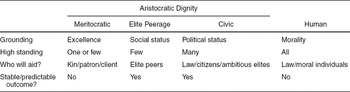
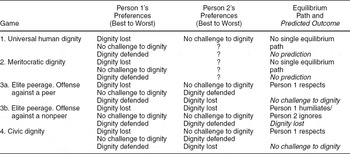
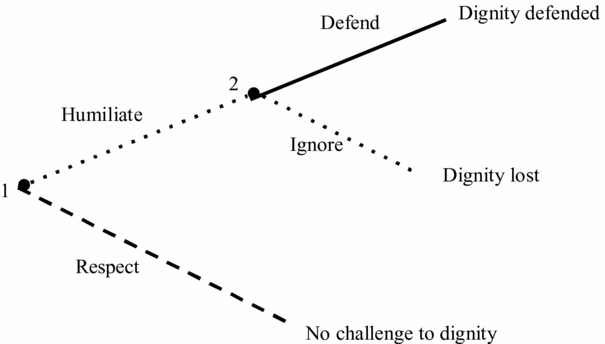
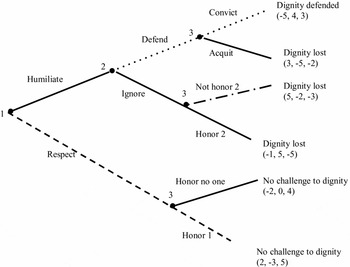



Comments
No Comments have been published for this article.