Introduction
Goat milk has various benefits to human health and thus has become an alternative food for people who are allergic to cow's milk (Lock and Bauman, Reference Wu and Huber2004; Tudisco et al., Reference Tudisco, Grossi, Addi, Musco, Cutrignelli, Calabrò and Infascelli2014). In particular, goat milk has about 20% short-chain fatty acid (SCFA) and 55% medium-chain fatty acid (MCFA) contents (Sanz Sampelayo et al., Reference Sanz Sampelayo, Chilliard, Schmidely and Boza2007), and therefore can easily be digested in the human body (Jenness, Reference Jenness1980). Goat milk is also rich in conjugated linoleic acid (CLA), however CLA can be produced in the human body if trans-18 : 1 is available in the diet. CLA has anti-carcinogenic, anti-catabolic and antioxidant characteristics and efficiently enhances the immune system and reduces cholesterol level (Devery et al., Reference Devery, Miller and Stanton2001). In addition, CLA increases insulin sensitivity and accelerates the transfer of fatty acids (FA) and glucose from the fat tissue to muscle tissue, thus reduces body fat (Ip et al., Reference Ip, Briggs, Haegele, Thompson, Storkson and Scimeca1996; Pariza et al., Reference Pariza, Park and Cook1999; MacDonald, Reference Macdonald2000; Belury et al., Reference Belury, Mahon and Banni2003). About 400 mg CLA per day is recommended to have health benefits; however, usual diets may supply less than 200 mg CLA per day (Ritzenthaler et al., Reference Ritzenthaler, McGuire, Falen, Shultz, Dasgupta and McGuire2001). Therefore, increasing CLA content is an important issue for ruminant-originated foods. Dietary manipulation was reported to be a good strategy for increasing CLA and other beneficial FA (n-3 FA) in milk fat (Kitessa et al., Reference Kitessa, Gulati, Ashes, Fleck, Scott and Nichols2001; Chilliard et al., Reference Chilliard, Ferlay, Rouel and Lamberett2003; Bernard et al., Reference Bernard, Shingfield, Rouel, Ferlay and Chilliard2009; Toral et al., Reference Toral, Frutos, Hervás, Gómez-Cortés, Juárez and de la Fuente2010; Martínez Marín et al., Reference Martínez Marín, Gómez-Cortés, Gómez Castro, Juárez, Pérez Alba, Pérez Hernández and de la Fuente2011). The dietary factors that influence milk CLA and trans11-18 : 1 (vaccenic acid, VA) composition are gathered under two main categories: (1) diets providing lipid precursors (C18 : 2 or C18 : 3) for CLA and/or trans-18 : 1 formation in the rumen; (2) diets that modify the microbial activity associated with PUFA hydrogenation in the rumen (Chilliard and Ferlay, Reference Chilliard and Ferlay2004). Combinations of these factors induce large variations in milk CLA, and VA concentrations and strong interactions are encountered among forages, starchy concentrates and lipid supplements (Griinari et al., Reference Griinari, Dwyer, McGuire, Bauman, Palmquist and Nurmela1998). On the other hand, dietary forage level affects ruminal biohydrogenation and FA composition (Piperova et al., Reference Piperova, Sampugna, Teter, Kalscheur, Yurawecz, Ku and Erdman2002). Linoleic acid and linolenic acid are the predominant unsaturated FA in forages (Harfoot and Hazlewood, Reference Harfoot, Hazlewood, Hobson and Hobson1997), with α-linolenic acid concentrations as high as 50–75% of the total lipid fraction (Hawke, Reference Hawke, Butler and Bailey1973). Fish oils are rich in n-3 FA and inhibit ruminal reduction of VA and promote the outflow of VA that is subsequently desaturated into cis-9, trans-11 C18 : 2 (rumenic acid, RA) in the mammary gland (Lock and Bauman, Reference Lock and Bauman2004). Hydrogenated palm oil or calcium soaps of palm oil have C18 : 2, a precursor of cis-9 trans-11 CLA and VA in the rumen and have any n-3 FA. These oils are usually used as dietary supplements in intensive dairy sheep and goat farming systems. Thus, an oil source with a low PUFA concentration (palm oil) was used in this study to better elucidate the effects of forage levels on the fatty acid composition of milk.
It was hypothesized that supplementation of diets with fish oil rich in n-3 may improve the fatty acid composition of milk through increasing CLA and n-3 PUFA concentrations. Also, it was hypothesized that increasing forage levels may also improve the fatty acid composition of milk through increasing CLA and n-3 PUFA concentrations. The objective of the study was set to determine the effects of different roughage levels and oil sources on performance, milk composition and FA profile of dairy goats.
Materials and methods
Animals, experimental diets and management
In the experiment, the animals were selected from a herd with 200 caprine and were allocated to treatment groups based on milk yield, body weight (BW), age and lactation stage. The experimental procedures were approved by the Animal Care Committee of Erciyes University in Turkey.
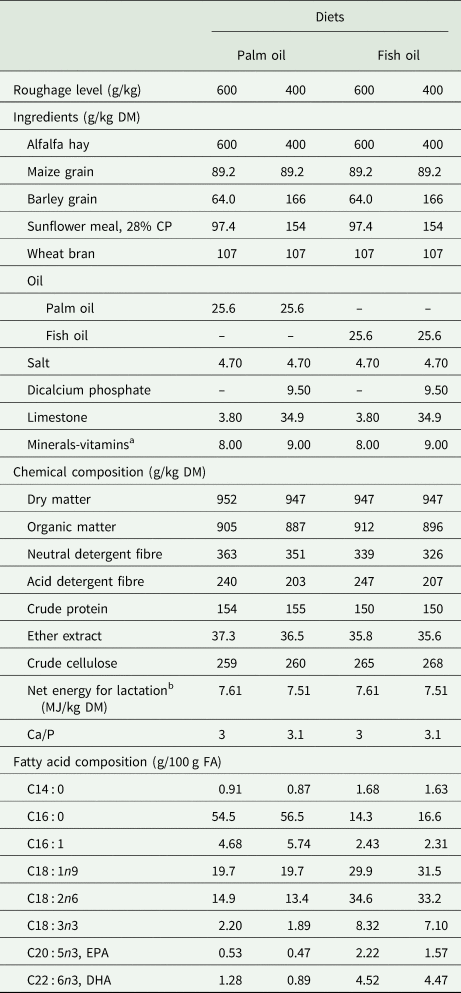
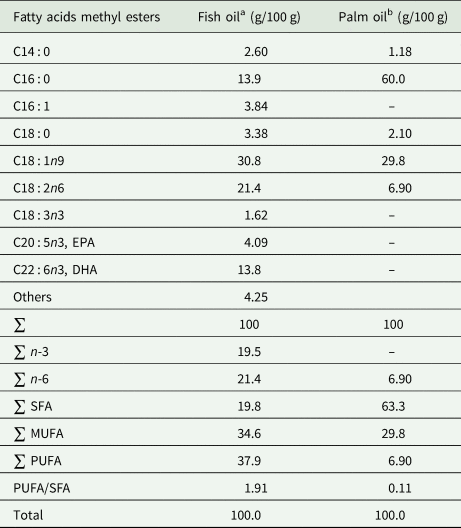
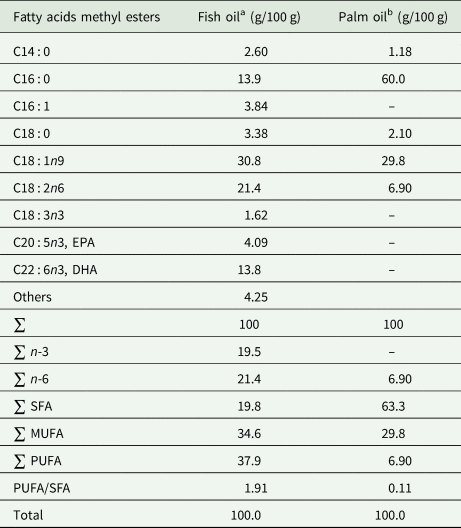
For the experiment, 40 Aleppo goats with a 47.23 ± 1.7 BW, mean parity of 2.53 ± 0.8 (multiparous) and 25 ± 5 days in lactation at the beginning of the experiment were used. The goats were allocated to four experimental diet groups (10 animals/diet) based on alfalfa hay and concentrate feeds. Experimental diets were arranged as 600 g/kg dry matter (DM) alfalfa with palm oil (25.6 g/kg) or with fish oil (25.6 g/kg); and 400 g/kg DM alfalfa with palm oil (25.6 g/kg) or with fish oil (25.6 g/kg) (Table 1). The fatty acid composition of oils is shown in Table 2. The goats were fed with the experimental diets for three-weeks of adaptation period and six weeks of the experimental period.
Ingredients and chemical composition of experimental diets

a Minerals-vitamins mix (Kavimix VM602 Kayseri, Turkey) declared as containing (per kg pre-mix): Vit-D3, 1.500.000 IU; Vit-A, 12.000.000 IU; Vit-E, 30.000 mg; Se, 200 mg; Mn, 50.000 mg; Co, 200 mg; I, 800 mg; Fe, 50.000 mg; Zn, 50.000 mg; Cu, 10.000 mg.
b Calculated according to TSE.
Fatty acid compositions of oils used in the experiment
a It is originated from salmon. Colour: dark yellow, structure: in liquid form.
b Colour: light yellow, structure: mini pearls, Basic/substance: fractionated triglycerides of palm fat.
Throughout the experiment, the goats were fed individually. They were housed in a barn with paddocks that included individual metabolic crates (2 m × 1.5 m size) and ground litter. The diets were offered ad libitum. The oils were added in the concentrate diet and mixed with a mixer immediately before mixing the total mixed ratio (TMR) weekly, and clean water was always available with automatic waterers. The experiment was conducted during the summer season (from May through the end of July).
Measurements and sampling procedures
Throughout the experiment, BW, body weight gain (BWG), milk yield and feed intake were determined weekly after the adaptation period. The feed conversion ratio (FCR) was calculated as the average daily dry matter intake (DMI) divided by average daily milk yield (g/g). Representative roughage and concentrate samples were collected every week during the experiment, and sub-samples were used to determine the DM content after 48 h at 103 °C. Sub-samples were also subjected to chemical composition and FA analyses. Goats were milked twice a day at 08.00 and 18.00 h and milk yields were recorded as a group based. Milking was performed in a vacuum line system, equipped with milking units per individual crates. The individual goat milk yields were recorded (over three consecutive milking per week) and individual milk sub-samples were collected during 42-day experimental period for chemical composition (totally 14 times every third day). The milk samples were stored at 4 °C with a preservative tablet (one tablet (18 : 8 mg Bronopol and 0.30 mg Natamycin)/40 ml milk) until they were analysed. The total solids (TS), solid non-fat (SNF), fat, protein, lactose, casein, urea, density, acidity, free fatty acid (FFA), citric acid and freezing point depression (FPD) were analysed by mid-infrared spectrophotometry (Milko Scan, Foss Electric, Hillerod, Denmark). Additional aliquots of unpreserved milk samples were stored at −20 °C, freeze-dried and composed in accordance with an a.m. and p.m. milk production to determine the FA composition (totally seven times every sixth day during the experiment). Goat BW were measured biweekly throughout the experiment.
Chemical analysis
Feed ingredients were analysed for organic matter, ether extract, neutral detergent fiber (NDF) (Van Soest et al., Reference Van Soest, Robertson and Lewis1991), acid detergent fiber (ADF) (AOAC, 1990; method 973.18) and total N (AOAC, 1990; method 988.05). The NDF was assayed without sodium sulphite and α-amylase, and it was expressed with residual ash (the latter was also used for the ADF).
For milk FA composition analysis, the lipid in 100 mg of freeze-dried milk was directly methylated using 2 ml of 0.5 M sodium methoxide in anhydrous methanol with 1 ml of hexane, 1 ml of methanol/HCl (95 : 5 vol/vol) was added. The FAME was recovered in 1.5 ml of hexane, washed with 3 ml of aqueous (6% wt/wt) K2CO3, and analysed using gas chromatography. The FAME profile for a 0.6 μl sample at a split ratio of 1 : 50 was generated using a gas chromatograph (Schimadzu, GC 2010 plus) equipped with a flame ionization detector (Schimadzu), split injection on a 60 m, i.d. = 0.53 mm RTX-200 (Restek) column, and H2 as the carrier and fuel gas. The FAME were separated using a temperature gradient program (Chilliard et al., Reference Chilliard, Rouel and Guillouet2013), and the peaks were identified based on comparisons of retention times with authentic standard (Supelco #37, Supelco Inc., Bellefonte, PA, USA and CLA standard, cat # 16413 Sigma-Aldrich).
Calculations and statistical analyses
The apparent transfer efficiency of total fat, C18 : 1, C18 : 2, C18 : 3n-3 C20 : 5n-3 (eicosapentaenoic acid, EPA), and C22 : 6n-3 (docosahexaenoic acid, DHA) was calculated as follows:
Transfer efficiency of total fat = [(g milk fat yield × % fat in milk)/(g DM intake × % fat in the diet)] × 100.
Transfer efficiency of FA = [(g milk fat yield × % FA in milk)/(g DM intake × % FA in the diet)] × 100 (Wright et al., Reference Wright, Holub and McBride1999).
This experiment used a 2 × 2 factorial design with ‘oil source’ and ‘forage level’ as the two factors and experimental data were analysed by repeated measures analysis, using the MIXED procedure of SAS (version 9.1, SAS Institute Inc., Cary, NC) and using a covariance structure based on Schwarz's Bayesian information model fit criteria. Analysis of variance for repeated measurements was performed according to the following model:

In this model, Yijkl represents the tested variable, μ is the overall mean, αi is the fixed effect of roughage leveli (400, 600 g/kg), βj is the fixed effect of oil sourcej (fish oil, palm oil), γk (αi + βj) is the random effect of the goatj (i,j = 1 to 10) nested in the treatment, δij is the interaction between roughage level and oil source, ζl is the day within the week as a repeated factor l(l = 1 to 7, 14), and Eijkl is the residual error. Significant differences were declared at P < 0.05, and tendencies at P < 0.10.
Results
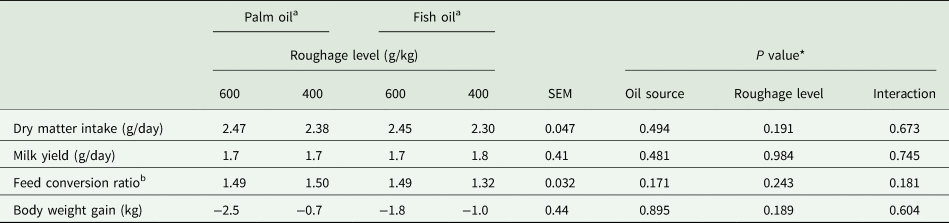
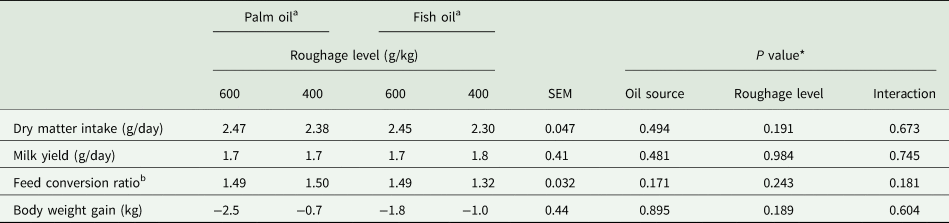
The effects of dietary roughage levels and oil sources on DMI and animal performance are provided in Table 3. The DMI, milk yield, FCR and BWG were not affected significantly by the dietary treatments and their interactions.
Effects of diet roughage levels and oil sources on animal performance
a Fatty acid composition presented in Table 2.
b The data calculated as: average daily dry matter intake/average daily milk yield.
* P value for main effects of oil sources (palm, fish), roughage levels (400, 600) and the interactions between oil source and roughage level; n = 10/treatment.
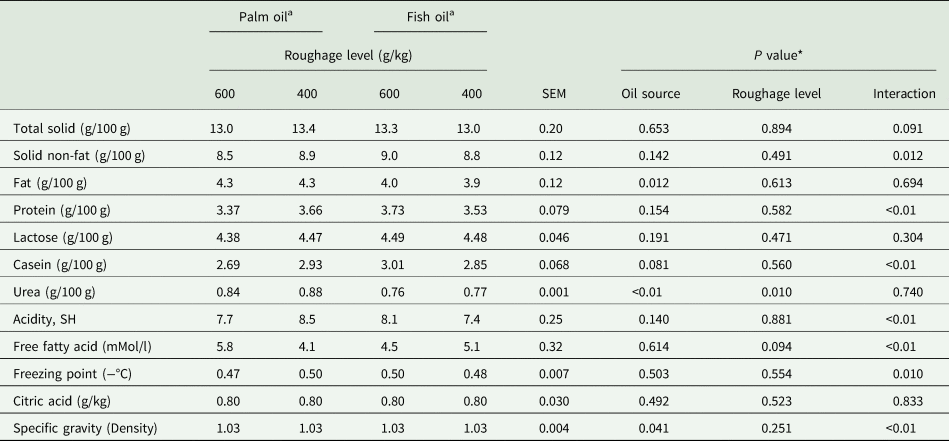
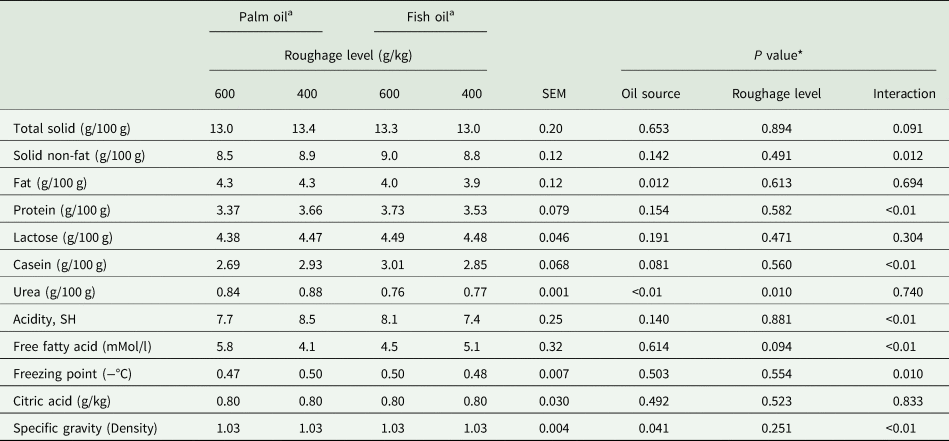
The effects of dietary roughage levels and oil sources of diet on milk physicochemical composition are provided in Table 4. The milk TS, lactose and citric acid yields were not affected significantly by the treatments. On the other hand, the milk fat and urea content significantly decreased with fish oil diet, but the milk density significantly increased with fish oil supplemented diet. Milk urea contents decreased with increasing roughage levels of the diet. The SNF, protein, casein, acidity, FFA, FPD and density were not significantly affected by the oil sources and roughage levels of the diet, however, effects of interactions on these parameters were found to be significant.
Effects of diet roughage levels and oil sources on milk physicochemical composition
a Fatty acid composition showed that Table 2.
* P value for main effects of oil source (palm, fish), roughage level (400, 600) and the interaction between oil source and roughage level; n = 10×14/treatment.
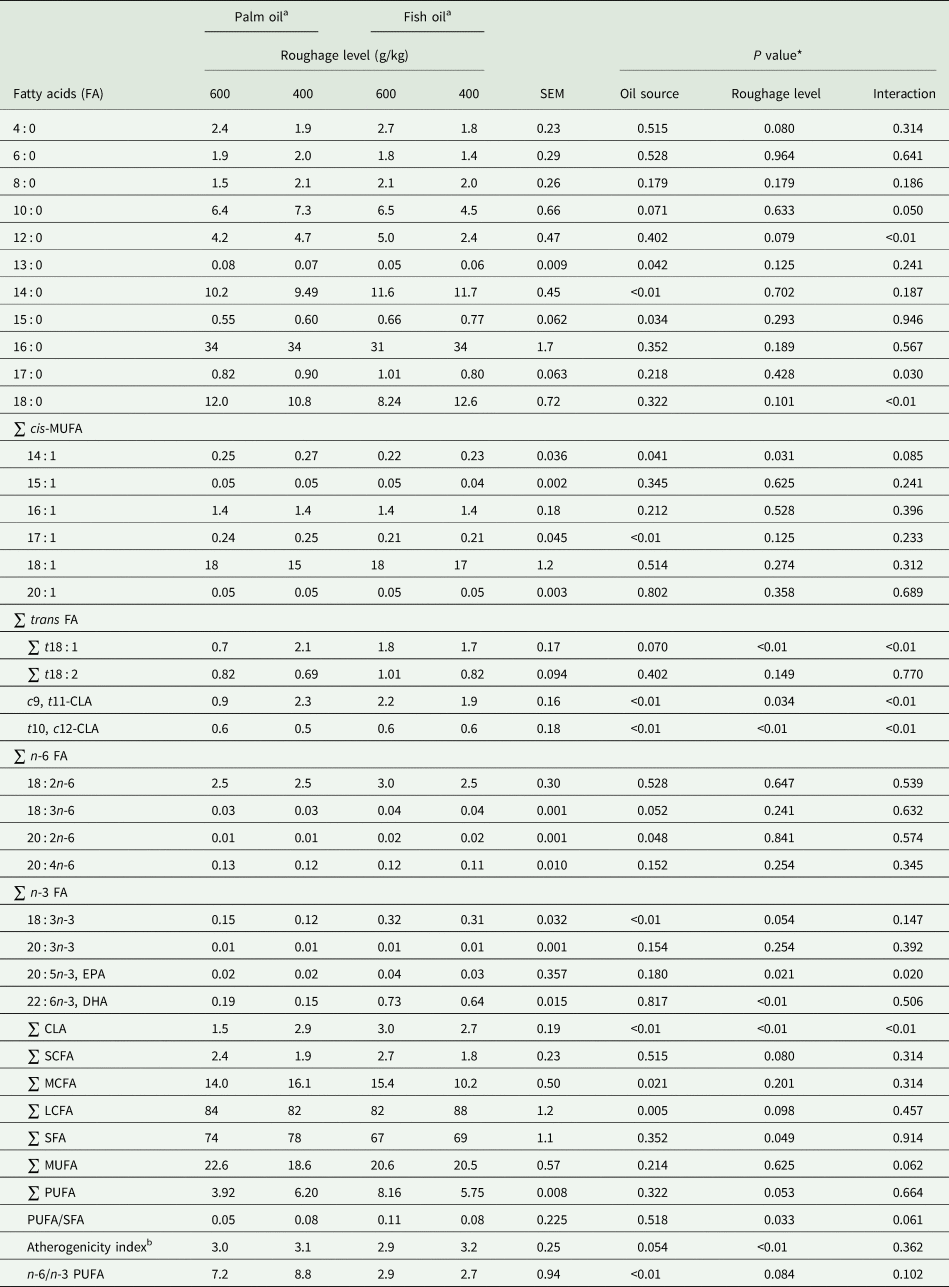
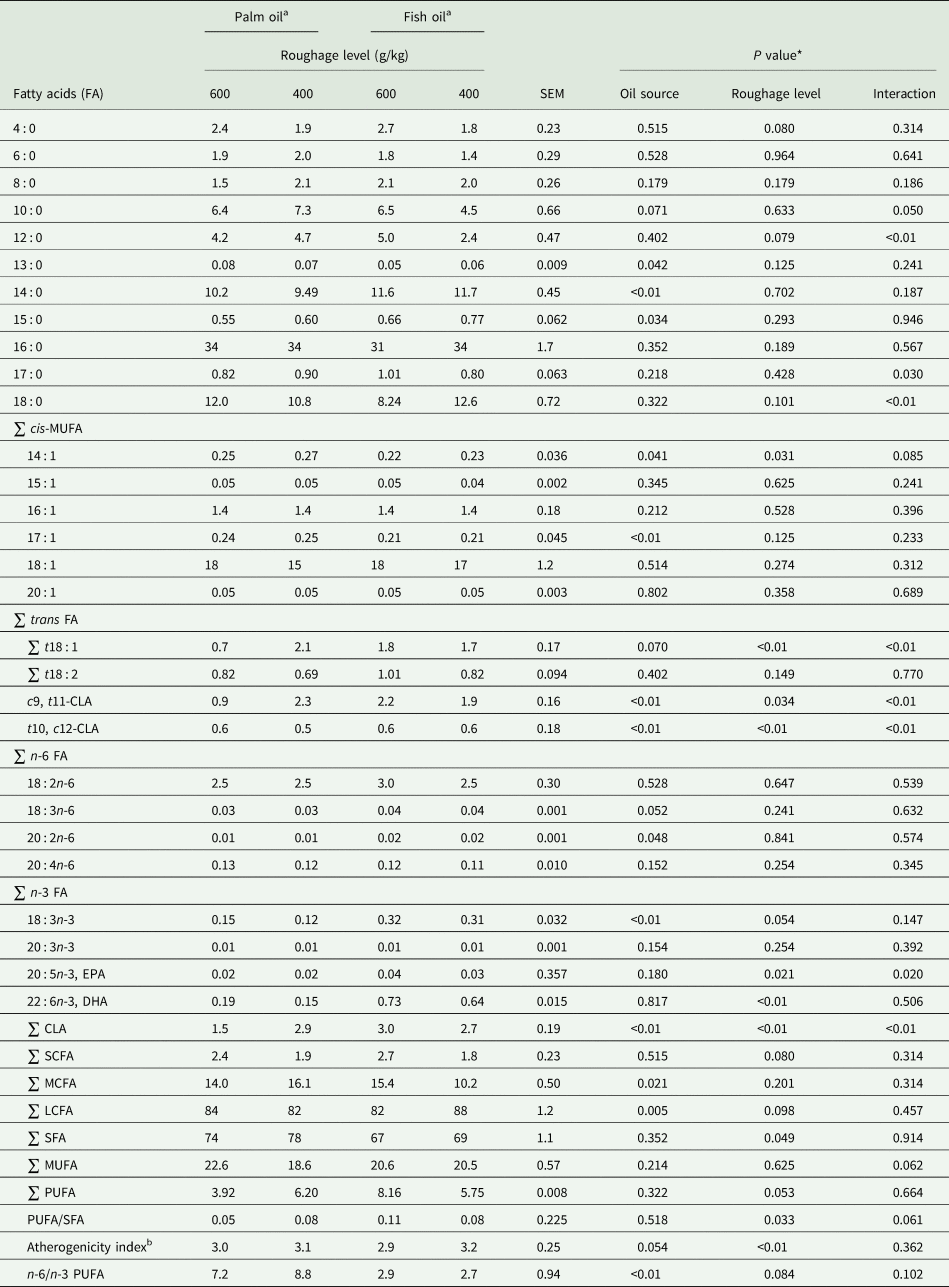
As shown in Table 5, the inclusion of fish or palm oil into diets with different roughage levels altered the milk FA composition. As compared to palm oil diets, concentrations of C14 : 0 and C15 : 0 saturated FA increased significantly with fish oil diet. The C14 : 1 and C17 : 1 concentration in milk decreased with fish oil diet. Considering trans FA, the concentration of 18 : 1 increased by low roughage diet with palm oil. No differences were observed between the treatment groups for C6, C8, C16, ∑t18 : 2, 18 : 2 n-6 and ∑MUFA FA. Contrarily, the fish oil in high-level roughage diet more efficiently increased CLA.
Effects of diet roughage levels and oil sources on milk fatty acid (FA) composition (g/100 g FA)
CLA, conjugated linoleic acid; SFA, saturated fatty acid; MUFA, monounsaturated fatty acid; PUFA, polyunsaturated fatty acid; SCFA, short chain fatty acids; MCFA, medium chain fatty acids; LCFA, long chain fatty acids.
a Fatty acid composition showed in Table 2.
b Atherogenicity index: (12 : 0 + 4 × 14 : 0 + 16 : 0)/ (MUFA + PUFA), (Ulbricht and Southgate, Reference Ulbricht and Southgate1991).
* P value for main effects of oil source (palm, fish), roughage level (400, 600) and the interaction between oil source and roughage level; n = 10×7/treatment.
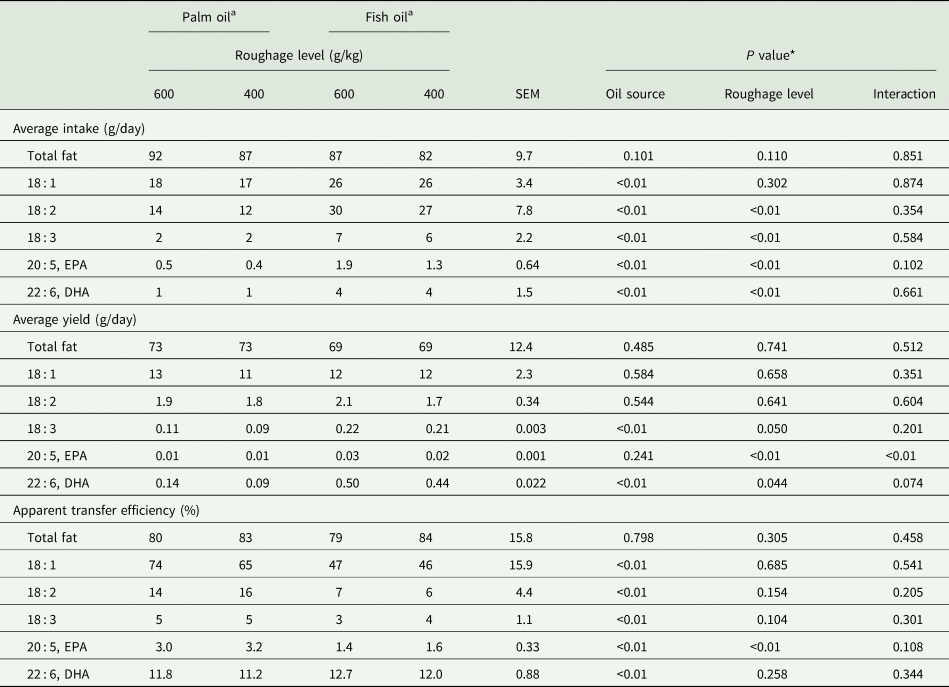
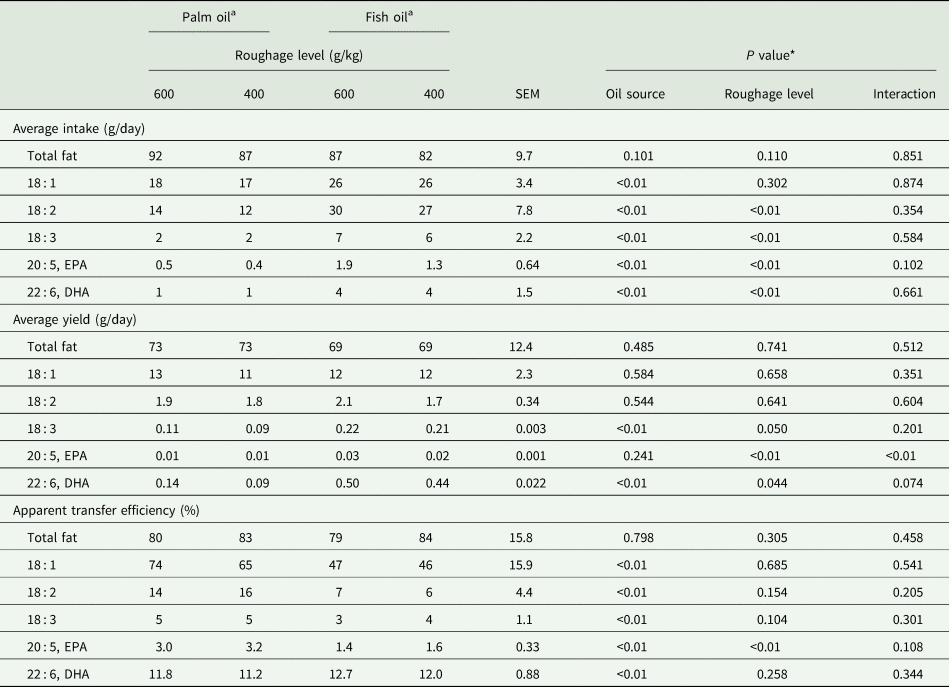
The effects of different roughage levels and oil sources of diet on some FA intake, yield and apparent transfer efficiency are provided in Table 6. Since the same amount of fat was used in the study, the differences in total fat intakes were not significant, but significant changes were observed in FA intakes (18 : 1, 18 : 2, 18 : 3, 20 : 5 and 22 : 6) depending on the FA profiles of fish and palm oil. The average yield for total fat, 18 : 1, 18 : 2 were not affected by the treatment groups, however, EPA increased with high roughage diet, and DHA increased with fish oil diet. The EPA yields were significantly affected by interactions. Effects of the dietary roughage levels and oil sources on the total fat transfer efficiency were not found to be significant, however, the transfer efficiency of 18 : 1, 18 : 2, 18 : 3 and EPA FA decreased and the transfer efficiency of DHA increased with fish oil diet. The roughage levels did not have significant effects on the transfer efficiency of 18 : 1 and 18 : 2 FA, but the low roughage diet increased the transfer efficiency of EPA. The rate of biohydrogenation of DHA decreased with fish oil diet.
Effects of diet roughage levels and oil sources on average intake, yield and the apparent transfer efficiency of fatty acids
a Fatty acid composition showed in Table 2.
* P value for main effects of oil source (palm, fish), roughage level (400, 600) and the interaction between oil source and roughage level; n = 10×7/treatment.
Discussion
The effects of dietary lipids
In this study, DMI, milk yield and FCR were not affected by the dietary lipids. Present fish oil intakes varied between 58.7 and 62.8 g/day. Previous studies showed that DMI was negatively affected by fish oil doses of the diets (Keady et al., Reference Keady, Mayne and Fitzpatrick2000). Doreau and Chilliard (Reference Doreau and Chilliard1997) reported a lower DMI at a high dosage of fish oil supplements (400 ml/day) in dairy cows. It was reported in previous studies that milk yield of cows and ewes were not affected by fish oil (Capper et al., Reference Capper, Wilkinson, Mackenzie and Sinclair2007; Toral et al., Reference Toral, Frutos, Hervás, Gómez-Cortés, Juárez and de la Fuente2010). Otaru et al. (Reference Otaru, Adamu, Ehoche and Makun2011) reported that an addition of 4% palm oil in concentrate diet increased daily milk production by 29%.
In this study, milk fat content decreased with fish oil diets (3.91–4.31, g/100 g). Several previous studies (Donovan et al., Reference Donovan, Schingoethe, Baer, Ryali, Hippen and Franklin2000; Keady et al., Reference Keady, Mayne and Fitzpatrick2000) reported decreasing milk fat content with fish oil supplemented diet at different doses. This can be explained by the change in the conditions of the rumen and the change in the amount of unsaturated FA in the diet (Griinari and Bauman, Reference Griinari and Bauman1999). Eknæs et al. (Reference Eknæs, Chilliard, Hove, Inglingstad, Bernard and Volden2017) reported increasing milk fat contents with palm oil diets in goats. In this study, the fish oil diet decreased the milk urea content. The reduction of milk urea content was attributed to fish oil-induced decrease in proteolyzes and the number of proteolytic bacteria in the rumen. Loor et al. (Reference Loor, Ueda, Ferlay, Chilliard and Doreau2005) reported that when the lactating dairy cows were fed with 2.5% fish oil, ruminal protozoa counts were higher as compared to 5% linseed + soybean and 5% sunflower oil. Oil resulted in lower proteolytic bacteria counts possibly resulting from an increase in protozoa as observed in cows fed with linseed or soybean oil compared to fish oil (Loor et al., Reference Loor, Ueda, Ferlay, Chilliard and Doreau2005).
In this study, the total concentration of MCFA decreased and long-chain FA (LCFA) increased with fish oil diets and an increase was also achieved in PUFA/SFA ratio with fish oil diets. Feeding with an increased amount of dietary LCFA was reported to increase the concentration of LCFA in milk fat and inhibit the de novo synthesis of SCFA and MCFA in the mammary gland (Palmquist et al., Reference Palmquist, Beaulieu and Barbano1993). The atherogenicity index tended to decrease and n-6/n-3 PUFA ratio decreased (from 8.01 to 2.81) with fish oil diet. The low n-6/n-3 PUFA ratio in milk fat in fish oil diets agrees well with the results of Martínez Marín et al. (Reference Martínez Marín, Gómez-Cortés, Gómez Castro, Juárez, Pérez Alba, Pérez Hernández and de la Fuente2011). It is recommended that the n-6/n-3 PUFA ratio be lower than 4 (Simopoulos, Reference Simopoulos2008) in fats for human consumption.
In this study, the apparent transfer efficiency of C18 : 1, 18 : 2, 18 : 3 n3 and EPA decreased with fish oil diet. The apparent transfer efficiency of EPA and DHA were low (1.42–12.72%) thus it was considered that these FA were extensively biohydrogenated. There are few studies reporting the effects of diet roughage levels on EPA and DHA of goat milk. The apparent transfer efficiency of these two FA from diet to milk was low (4–5%) because of high ruminal biohydrogenation (Kitessa et al., Reference Kitessa, Gulati, Ashes, Fleck, Scott and Nichols2001). The extent of C18 : 3 n-3 biohydrogenation in animals has been reported to be similar to a number of other studies where values of between 85 and 100% were reported (Murphy et al., Reference Murphy, Uden, Palmquist and Wiktorsson1987; Klusmeyer and Clark, Reference Klusmeyer and Clark1991). However, since this FA is one of the FA that undergoes the most intensive biohydrogenation, it reduces the transfer efficiency of the milk fat (Harfoot and Hazlewood, Reference Harfoot, Hazlewood, Hobson and Hobson1997). It was also reported that the C18 : 3 n-3 FA had the lowest apparent transfer efficiency (Glasser et al., Reference Glasser, Ferlay, Doreau, Schmidely, Sauvant and Chilliard2008). Similar to the literature, the apparent transfer efficiency of EPA was very low (1.42–3.17%).
The effects of roughage levels
Roughage level may affect the performance parameters, however, in this study, the diets were prepared as isocaloric and isonitrogenous. A study showed that DMI was not affected by two different forage/concentrate ratios (75/25 and 60/40 DM) in ewes (Mele et al., Reference Mele, Buccioni, Petacchi, Serra, Banni, Antongiovanni and Secchiari2006). Schmidely and Andrade (Reference Wu and Huber2011) reported similar DMI for low (45% diet DM) and high (65% diet DM) concentrate diets. Also, the milk yield was not affected by the roughage level. It was reported in a previous study that milk yield of cows and ewes were not affected by different forage : concentrate ratio in the diet (Gama et al., Reference Gama, Garnsworthy, Griinari, Leme, Rodrigues, Souza and Lanna2008).
In this study, diet roughage levels did not affect milk fat concentration. Similar diets with high forage level (60% of grass silages on total DM) did not have significant effects on milk fat (Shingfield et al., Reference Shingfield, Ahvenjärvi, Toivonen, Äröla, Nurmela, Huhtanen and Griinari2003). Lock and Shingfield (Reference Wu and Huber2004) reported that milk fat was affected by over 60% of the concentrate level in the diet. Milk urea content decreased with high roughage diet. However, milk protein fractions and casein did not vary between the treatments.
In this study, the concentrations of EPA and DHA in milk fat were significantly higher in high roughage diet than in high concentrate diets. The effects of the forage level were more remarkable in fish oil-supplemented diets. The milk fat SFA concentration was positively affected by high roughage diets, but fish oil diet did not have significant effects on the milk fat SFA concentrations. Also, PUFA and PUFA/SFA tended to increase with high roughage diets. The atherogenicity index was significantly reduced in high roughage diets because of a decrease in total SFA levels. Similar to our results, Pirondini et al. (Reference Pirondini, Colombini, Mele, Malagutti, Rapetti, Galassi and Crovetto2015) found that the greatest SFA concentration in cow milk with low concentrate diets.
The apparent transfer efficiency of 18 : 1, 18 : 2, 18 : 3 and DHA FA were not influenced by the roughage levels of the diet. The apparent transfer efficiency of EPA increased with a high concentrate diet. It was reported that a high concentrate diet reduces the biohydrogenation of this FA (Harfoot and Hazlewood, Reference Harfoot, Hazlewood, Hobson and Hobson1997). In another study, Doreau and Ferlay (Reference Doreau and Ferlay1994) found no relationship of the dietary forage/concentrate ratio with the milk fat C18 : 3 n-3 concentration and the ruminal biohydrogenation rate of this FA.
The apparent transfer efficiency of EPA was lower in low roughage diet, which could be explained by the effects of the forage level on the rumen bacterial community (Weimer et al., Reference Wu and Huber2010). It is reported that fish oil and easily degradable starch in the diet reduce the apparent transfer efficiency of FA by ruminal biohydrogenation (Bernard et al., Reference Bernard, Mouriot, Rouel, Glasser, Capitan, Pujos-Guillot, Chardigny and Chilliard2010). In another study, the apparent transfer rates of n-3 FA from fish oil to milk varied with the type and level of dietary starch and higher apparent transfer rates of n-3 FA from fish oil to milk were observed in fed with the easily degradable starch source (Toral et al., Reference Toral, Rouel, Bernard and Chilliard2014). Overall, the results indicated relevant interactions between oils and forage level on transfer efficiency and biohydrogenation of FA; however, the available information remains limited, and further research is warranted.
The effects of the interaction between lipid and roughage levels
Dietary fish oil or roughage level did not affect protein contents. However, interactions (oil source and roughage level) had significant effects on milk protein and protein fractions (casein) (P = 0.03), with a more pronounced increase in high roughage diet with fish oil than high roughage diet with palm oil. Similar results were also reported by Keady et al. (Reference Keady, Mayne and Fitzpatrick2000) for fish oil diets with different starch concentrations. Similar interaction effects of dietary oil source and forage level were also reported by Pirondini et al. (Reference Pirondini, Colombini, Mele, Malagutti, Rapetti, Galassi and Crovetto2015) and Mir et al. (Reference Mir, Goonewardene, Okine, Jaegar and Sceer1999). Sutton (Reference Sutton1989) showed that oil supplementation to the diet generally caused a decrease in milk protein concentrations since the increase in milk yield was not supported by sufficient availability of amino acids in the mammary gland (Wu and Huber, Reference Wu and Huber1994). In this study, fish oil diet increased the density of milk and interactions (oil source and roughage level) had significant effects on milk density. Milk density largely depends on protein and fat-free dry matter; thus, the use of fish oil was thought to decrease milk fat content. Similar results were also reported by Chornobai et al. (Reference Chornobai, Damasceno, Visentainer, De Souza and Matsushita1999). It is also known that the density of milk could vary with milk protein content and immunoglobulin levels (Morin et al., Reference Morin, Constable, Maunsell and McCoy2001).
Milk fat t18 : 1 and c9, t11-CLA concentrations increased with low roughage diet and interactions with fish oil diet had significant effects on milk fat t18 : 1, c9, t11-CLA, t10, c12-CLA and ∑CLA concentrations. Also, fish oil was found to be more effective in increasing milk fat ∑CLA concentration than the roughage level in the diet. In this study, c9 t11-CLA, t10 c12-CLA, and ∑CLA increased with fish oil diet since fish oil contains high PUFA concentrations. Franklin et al. (Reference Franklin, Martin, Baer, Schingoethe and Hippen1999) reported that total CLA in milk fat increased with the supplementation of unprotected marine algae as compared to the control diet. It was previously shown that supplements of plant oils in combination with fish oil was more effective in increasing t11-18 : 1 and c9, t11-CLA concentrations of goat milk (Bernard et al., Reference Bernard, Toral, Rouel and Chilliard2016). Mosley et al. (Reference Mosley, Mosley, Hatch, Szasz, Corato, Zacharias and McGuire2007) reported that the concentrations of c9, t11 CLA and trans 18 : 1 isomer in milk fat linearly decreased with the addition of palm oil to the diet. Overall, in many other previous studies and this study, interactions (oils and the roughage levels) had significant effects on milk fat trans FA concentrations in ruminant species (Toral et al., Reference Toral, Rouel, Bernard and Chilliard2014). The interaction had significant effects on milk fat EPA concentration. Milk fat DHA concentration was higher in high concentrate diets with fish oil. Shingfield et al. (Reference Shingfield, Reynolds, Lupoli, Toivonen, Yurawecz, Delmonte, Griinari, Grandison and Beever2005) showed that milk EPA, DHA and 18 : 3n-3 decreased and milk 18 : 2n-6 increased with the forage type and oil source interactions.
Conclusions
Fish oil can be used with different roughage levels to improve milk FA composition without affecting DMI, milk production and animal performance. Dietary roughage level had no clear effect on milk FA composition; however, for increasing CLA in milk, fish oil with high concentrate diets was found to be more effective than the other treatments. Diets with added fish oil resulted in higher apparent transfer efficiency of DHA in milk than in diets without fish oil. On the other hand, high roughage diet improved milk quality parameters through increasing EPA, DHA, SFA, PUFA, PUFA/SFA and atherogenicity index. However, the low roughage diet increased the apparent transfer efficiency of EPA. In conclusion, the dietary roughage level was considered as an important designator of milk quality when a supplement of fish oil and palm oil was supplied to goats.
Acknowledgements
The authors thank Kevser Kahraman (Abdullah Gül University, Faculty of Engineering, Department of Food Engineering) who helped to get dry milk samples with freeze-dryer. They also thank Erciyes University Agricultural Faculty Animal Science Department 2015 summer internship students and ERÜTAM (Erciyes University Agricultural Research Center) for their support and help in the preparation of TMR and care of goats throughout the experiments. This paper is a part of the PhD thesis of Selma Büyükkılıç Beyzi.
Financial support
The study was supported by the Scientific Research Projects Department of Erciyes University (with the Ph.D. project number: FDK-2015-5922).
Conflict of interest
The authors declare no conflicts of interest.
Ethical standards
The experimental procedures were approved by the Animal Care Committee of Erciyes University (EUHADYEK) with 15/58 decision number.