




No CrossRef data available.
Article contents
The effects of distraction on prospective remembering following traumatic brain injury assessed in a simulated naturalistic environment
Published online by Cambridge University Press: 23 January 2006
Abstract
The aim of this investigation was to assess deficits in prospective remembering following chronic traumatic brain injuries (TBI), under conditions of high and low distraction. We constructed a virtual shopping precinct from photographs, sounds, and video segments linked together. The street was divided into halves, a low distraction zone and a high distraction zone (with increased visual and auditory noise). Twenty persons with TBI (7 severe, 7 very severe, 6 extremely severe) and 20 matched controls completed ongoing and prospective memory tasks while “walking” along the street. In the ongoing task, participants were given ten errands to complete with a checklist accessible at any time. The prospective component required responding to three targets that appeared repeatedly. As predicted, the TBI group performed both the ongoing and the prospective components of the street task poorly compared with the controls and was more affected by distractions. The results suggest that the real-life deficits in memory skills reported by persons with TBI may become more apparent when remembering engages executive processes and that computer simulations can be used to construct sensitive measures of practical memory abilities. (JINS, 2006, 12, 8–16.)
Keywords
Information
- Type
- Research Article
- Information
- Journal of the International Neuropsychological Society , Volume 12 , Issue 1 , January 2006 , pp. 8 - 16
- Copyright
- © 2006 The International Neuropsychological Society
INTRODUCTION
One significant challenge for persons with traumatic brain injury (TBI) reintegrating themselves into the community is the inability to recall delayed intentions—that is, failures of prospective remembering. Being unable to keep appointments or complete simple errands can profoundly affect independent living. Studies using a range of tasks have demonstrated that prospective memory (PM) dysfunction is a relatively common consequence of brain disease and TBI (e.g., Cockburn, 1995; Groot et al., 2002; Knight et al., 2005; McDaniel et al., 1999; Shum et al., 1999). Because of their functional significance, the accurate assessment of PM impairments is often a priority in the process of neuropsychological rehabilitation (Fleming et al., 2005).
In general, prospective memory refers to the ability to enact an intention at a particular time or in response to a particular cue in the future (Ellis & Kvavilashvili, 2000; McDaniel & Einstein, 2000). The issue of precisely what constitutes a measure of PM, and how prospective remembering differs from retrospective recall (memory for past events), has been a matter of some discussion in the literature (Ellis & Kvavilashvili, 2000; Graf & Uttl, 2001; Roediger, 1996; Smith, 2003). It is generally agreed, however, that a procedure designed to test PM requires the interruption of an absorbing ongoing task to perform actions when a predesignated cue appears. A typical experimental PM task might involve instructing participants to classify letter strings as words or nonwords (the ongoing component), while making a different response whenever one of a learned list of target words appears amongst the letter strings (the prospective component). The usual PM experimental procedure (e.g., McDaniel & Einstein, 2000; Smith, 2003) has many aspects in common with vigilance, dual task, and multitasking paradigms. The method used in the present study was designed as a naturalistic analogue of the laboratory-based procedures used for studying prospective remembering. The stimuli comprised a series of linked photographs and sounds that were constructed to create a nonimmersive shopping precinct, which we have labelled the virtual street. Participants are able to move along the street, and in and out of shops, to complete experimenter-generated instructions. In this case, the ongoing component involved completing a list of shopping errands with the aid of a checklist, while the prospective component required the interruption of this to respond to three target cues that appeared repeatedly throughout the task.
The computer-based platform for the PM task was constructed as a means of assessing memory for delayed intentions in persons with brain impairments in a standardised manner, using naturalistic stimuli to enhance ecological validity (Titov & Knight, 2005). The overarching objective of the programme of research of which this study is a part was to develop a procedure that provides a bridge between standard neuropsychological tests, which measure components of cognition in a relatively “process-pure” way, and individualised behavioural tests set in the real world (e.g., Alderman et al., 2003; Wilson, 1999). Although both these approaches to assessment are of value, they also both have limitations. Neuropsychological testing using standardised tasks in the clinic may not uncover the difficulties that some TBI patients experience in their everyday lives with prioritising multiple competing tasks, analysing complex naturalistic stimuli, and ignoring compelling auditory and visual distractions. On the other hand, behavioural tests are difficult to standardise, and time-consuming to implement, and their construction often presents the clinician with a variety of practical challenges. The increasing sophistication of computer software is providing interesting opportunities to build virtual environments, which can be used to evaluate functional deficits in persons with brain injuries (e.g., Brooks et al., 2004; Rizzo et al., 2004) and to aid in the rehabilitation process (e.g., Brooks et al., 1999).
Both clinical and experimental reports have established that PM failure is a common consequence of TBI that may persist long after the patient has recovered from the acute effects of the injury (Ponsford et al., 1995; Wilson, 1999). The underlying cognitive processes responsible for the problems TBI patients experience recalling delayed intentions are likely to vary, depending on the brain structures that are compromised by the injury (McDaniel et al., 1999). In many cases, the damage to medial-temporal or diencephalic memory circuits causes a significant degree of amnesia, resulting in the patient forgetting even the most simple instructions after only a few minutes of filled delay. More subtle memory impairments are likely to make completing complex PM tasks difficult, especially in noisy real-world environments. In other patients, damage to prefrontal structures resulting in attentional deficits, executive dysfunction, and failures in the initiation and organisation of recall have been implicated in the expression of PM deficits (Cockburn, 1995; McDaniel et al., 1999). Because of the diffuse nature of lesions consequent on TBI, it is probable that many persons presenting for remediation of practical memory problems have both amnesic and executive-attentional impairments as a basis for their dysfunction. One indicator of frontal impairment is the inability to inhibit distraction, and maintain attention on relevant features in the environment, often a significant difficulty for the person with TBI (Ponsford et al., 1995). Patients with neurological damage, who may perform relatively normally on neuropsychological tests in the quiet and focused environment of the clinic, often report considerable difficulty with functioning in settings that are noisy and distracting. For this reason the amount of visual and auditory distraction in the environment was manipulated in the present study to examine the effect on the PM scores of the TBI group.
The present investigation had a number of objectives. The first was the general aim of determining the usefulness of the computer-based testing procedure in the assessment of persons with a history of TBI. The primary motivation for constructing our measure is to explore methods of enhancing the ecological validity of neuropsychological assessment by incorporating real-life visual images and sounds into controlled and standardised testing procedures. Our computerised assessment procedure evolved from earlier attempts at measuring prospective remembering ability where participants watched video footage of street scenes, during which they were required to recall predesignated tasks when the footage showed prespecified shops (McDermott & Knight, 2004; Titov & Knight, 2000, 2001). The computer-based street environment allows the simulation of the experience of walking along the main street of a shopping precinct and preliminary versions have been used to study the effects of old age and TBI on memory (Farrimond et al., 2006; Titov & Knight, 2005). The project had two aims that were more specific. One was to determine whether long-term survivors of a TBI would show persisting deficits in prospective remembering on a task that is within the compass of most uninjured persons to complete with a moderate to high degree of accuracy. The second objective was to determine whether the PM abilities of persons with TBI are more susceptible to the effects of distraction than those of the comparison group.
METHODS
Research participants
The TBI group was composed of 20 persons (16 male, 4 female) with brain injury living in the community. This group were members of a participant panel resident in the South Island of New Zealand, who had sustained a TBI after the age of 16, necessitating hospital admission, with no history of other neurological disease or psychiatric condition, prior to or since the time of injury. The TBI panel participants were originally recruited to take part in studies of the long-term consequences of TBI from amongst members of head injury support groups with ongoing difficulties in adjustment post injury. In each case the TBI had occurred more than four years previously, with an average time since injury of 13.35 (SD = 7.64) years. At the time of testing on this occasion all participants endorsed at least 8 symptoms on a 15-item list of current problems with cognition (e.g., difficulty remembering things, problems with concentration, difficulty remembering what was said, problems learning new information). The hospital records of all participants were examined and the recorded period of loss of consciousness (LOC) and posttraumatic amnesia (PTA) determined. The mean duration of LOC was 153.67 hours (SD = 243.86), and the mean recorded period of posttraumatic amnesia (PTA) was 23.05 days (SD = 25.41). Using Jennett and Teasdale's (1981) classification of injury severity, seven had severe injuries (PTA between one and seven days), seven had very severe injuries (PTA between one and four weeks), and six had extremely severe injuries (PTA > four weeks). (PTA data were unavailable for one case, so injury severity was conservatively estimated as equal to recorded LOC for the severity classification.) Further details of the injury severity of the TBI group are given in Table 1. The average age of the group was 44.95 years (SD = 11.94), and the mean years of education was 12.53 (SD = 2.11). The entire TBI group were either employed or studying prior to injury; however, eight (40%) were unemployed at the time of testing.
Injury characteristics of TBI group

The control group comprised 20 (16 male, 4 female) volunteers, with no history of neurological or psychiatric disorder, substance abuse, or concussion in the past six months, recruited from the community, with educational and occupational backgrounds similar to the TBI group. Each control participant was recruited to match a TBI participant for age and gender, by approaching the workplaces with individuals of similar occupational or training background to the TBI participant. The average age of the control group was 43.35 years (SD = 11.91), and their average years of education was 12.40 (SD = 2.16). In all, 19 of the controls were employed at the time of testing; the remaining control participant was retired. All participants described themselves as white European, and there were no significant differences between the groups in average age, t (38) = .42, or total years of education, t (38) = .18.
Measures
Virtual street
The virtual street has been described in detail elsewhere (Titov & Knight, 2005). The street was created by taking a series of 1500 photographs every few metres inside and outside shops and business in the downtown shopping precinct of Palmerston North, a city of 100,000 in the North Island of New Zealand. Images from this city were chosen because all the participants were unfamiliar with the shopping area (no participant had ever resided in Palmerston North or any town nearby), thereby countering any individual differences due to familiarity with the virtual street environment. Using a Web-design package (Microsoft FrontpageTM), the photographs were linked together, and appropriate background sounds such as the noise of traffic or the sound of footsteps, added. A participant can move along the street by pressing buttons on a navigation bar, situated below the visual images of the street, corresponding with different directions, including left, right, and forward. The user interface is a touchscreen connected to a laptop computer, which runs the programme (Microsoft FrontpageTM via a Web server).
Each view of the virtual street (comprising sound and visual images) is described as a “Page,” and the Web server records the route followed and time in each location. By pressing the relevant buttons on the navigation bar a participant can “walk” from Page to Page, seeing and hearing the stimuli that they might experience in real life. To walk from one end of the street to the other requires over 90 steps or Pages, during which the participant will walk past 34 shops or offices frontages. It is possible to enter 26 of the shops or businesses (in some cases it was not possible to photograph the interior of some businesses, such as banks, for practical or security reasons). Access to the interior is via the “Enter Shop” button; once inside this changes to an “Exit Shop” button, which can be used to leave. In order to reach the counter, it is necessary to press the Forward button six times (causing six successive pictures of the interior to appear) until the “Approach Counter” button appears. If this button is pressed, a Page is accessed that includes a visual image of a shop assistant, who greets them and asks what they would like; in response to the auditory cue, participants are expected to recall the appropriate errand.
For the present study, the street was divided into two zones of high and low distraction with an equal number of shops that could be entered in each zone. In the low distraction condition, the only sounds were footsteps and the occasional traffic noise, and the images within the Pages did not move. In the high distraction condition, the photographs of the street and shop scenes have video footage of actors superimposed on them, creating the impression of a busy street scene with many moving passers-by. In addition, the sounds were louder and included brief segments from radio news and weather broadcasts, sounds of car horns, and rock and rap music. Once the test is completed, data are extracted from the Web server to provide a detailed record of the participant's activities, including the number of Pages accessed and time taken to complete each errand.
Neuropsychological measures
All participants completed the Self-Report Version of the Dex Questionnaire (DEX; Wilson et al., 1996), a 20-item questionnaire focusing on the symptoms of dysexecutive syndrome. Items are rated on a five-point scale from never (0) to very often (4). Participants also completed the Logical Memory Subtest from the Wechsler Memory Scale-III, and the Ruff 2 & 7 Selective Attention Test (Ruff & Allen, 1996).
Procedure
Participants were tested individually in a session lasting between 1 and 2 hours and compensated for the travel costs associated with attending. Following administration of the DEX, participants completed a training procedure using a street sequence created from images of a city different to that used in the subsequent assessment. During the training participants were instructed in the use of the touchscreen to navigate around the virtual street completing errands such as walking into shops and purchasing items. All of the skills required to complete the assessment were introduced and practiced during the training procedure. All participants completed the training procedure successfully within 10 minutes.
For the prospective component of the study, participants were given the following scenario: They were asked to imagine that they were employed by the local city council as a street inspector, and that as they walked from one end of the street to the other, they were required to complete three tasks. These tasks were selected to be the kind activity that an inspector might have, reporting stray dogs, checking food licences, and monitoring vehicle-loading zones. The three instructions given were (with the number of times each item occurred in each distraction zone given brackets): 1. Walk into all the shops that sell food and ask whether they have a current food license (n = 3). 2. When you hear a dog barking, tell me the name of the shop in front of you (n = 4). 3. If you see a person carrying a box, tell me the name of the shop in front of you (n = 4).
Items 1 and 3 required attending to visual cues, while item 2 had an auditory cue. The total number of possible targets in each half of the street was 11, providing a total along the entire street of 22. The researcher first read aloud each of these tasks; these were repeated by the participant, who was then invited to ask any questions. Participants were then given a recall test to ensure they had accurately encoded the instructions. The three instructions were repeated until the participant was able to recall them all correctly. Participants were instructed that were to pay careful attention to the images and sounds they saw and heard as they walked along the street, and to respond whenever they noticed the appropriate cue.
Participants then received instructions about the ongoing task. They were told that while they were carrying out the three inspection tasks, they also had some personal errands to complete as they walked along the street (Appendix A). The researcher first read aloud each of the instructions for the errands, and these were repeated by the participant. They were then informed that the list of errands was available by pressing the Checklist button on the navigation bar, but that the order of the errands on the list differed from the order that they would appear along the street. Participants were encouraged to use the Checklist button as often as they wanted to. After answering any questions, the researcher read aloud the rules that the participant was expected to follow as they walked along the street (Appendix A). These were repeated by the participant, who was informed that these rules were also available by pressing the Checklist.
The direction participants walked along the street was counterbalanced to control for order effects; half the participants in each group were randomly assigned to begin at the low distraction end of the street, while the other half began at the high distraction end. The researcher observed and recorded the responses and behaviour of the participant as they navigated along the street, while the computer server recorded the specific movement of the participant including frequency and timing of using the Checklist. The test ended when the participant reached the other end of the street.
After completing the virtual street procedures the following tests were administered during the same testing session. Participants first completed the immediate recall Logical Memory subtest (LM I) of the WMS-III, and the Ruff 2 & 7 Selective Attention Test. Finally, the delayed free recall trial of the Logical Memory subtest (LM II) was administered. The Ethics Committee of the University of Otago approved all procedures.
RESULTS
Ongoing task
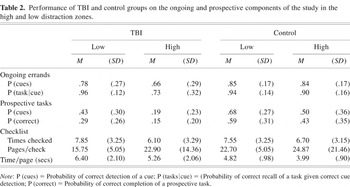
Participants were asked to complete a total of 10 errands, half in each distraction zone with a checklist available to reduce reliance on retrospective recall processes. For each participant, the probability of correctly noticing a cue for action [P (Cue)] was expressed as a proportion of the total number of cues to be detected (n = 5). It should be noted that it is possible to obtain a perfect score on this variable by indiscriminately entering every shop. Participants were instructed not to do this and no person adopted this strategy. Although shops were occasionally entered that were not designated in the instructions, these confusions were typically understandable (e.g., entering the wrong travel shop to purchase airline tickets). Task recall was counted as correct if the participant entered the correct shop and correctly recalled the action (e.g., buy) and the object (e.g., shoelaces). The number of tasks correct was then determined and expressed as a proportion of the number of cues noticed, denoted by P (task|cue). This procedure was adopted because recognition of a cue is a necessary precursor to the correct recollection of the action. Means and standard deviations for the probability correct data are given in Table 2. The performance of the control (M = .89) and TBI (M = .87) groups was comparable in the low distraction condition, but the TBI group's ability to notice cues and recall the associated tasks was significantly affected by the high distraction condition (M = .70), whereas the control group (M = .85) was less affected.
Performance of TBI and control groups on the ongoing and prospective components of the study in the high and low distraction zones.

Because of the heterogeneity of variances resulting from the positively skewed distributions of scores for the control group, and the TBI group in the low distraction condition, the more conservative nonparametric Mann-Whitney U test was used to assess between group differences. There were no significant differences between groups in the low distraction condition. In the high distraction condition, however, there was a significant P (cue) difference, U = 127, p < .05, between the TBI group (rank sum = 337) and the control group (rank sum = 483). There was a trend towards a significant difference on the P (task|cue) variable, U = 472, p < .05, which should be noted given the lack of power of the nonparametric test. In summary, the TBI participants were able to complete the ongoing shopping task at a level comparable to the controls, but only when no distraction was present.
Prospective component
Participants were given three target cues and actions to complete and these appeared 11 times in each distraction zone. The mean probability of correctly noticing one of the prospective cues, P (cues), and the probability of both noticing the cue and acting as instructed, P (correct), are presented in Table 2 for each group. In effect, these two variables represent two methods of scoring a correct response; P (correct) is a more stringent criterion for a correct response than just noticing the repeated cues. Since on the prospective component of the task the probability of giving a correct response if the cue was detected was high for both groups, the probability of correct recall when the cue was noticed was not computed. These two variables were analysed with separate two-factor Group × Distraction condition ANOVAs. For cues noticed, there were significant effects of Group, F(1,38) = 11.07, MSE = .14, p < .001, and Distraction, F(1,38) = 32.25, MSE = .03, p < .0001, but no interaction, F(1,38) = .30, MSE = .03. For Probability Correct, there were also significant effects of Group, F(1,38) = 14.21, MSE = .08, p < .001, and Distraction, F(1,38) = 36.67, MSE = .01, p < .0001. This interaction was also not significant, F(1,38) = 3.94, MSE = .02. As is apparent in Table 2, the performance of the TBI group in completing the prospective tasks was poor, and possibly because of floor effects, was not significantly affected by distraction.
Checklist use
The frequency of Checklist use in each section of the street (Table 2) was analysed with a two-factor ANOVA where Group (TBI vs. control) was the between subject factor, and distraction condition (low vs. high) was a repeated measure. Although there was a significant main effect for Distraction, F(1,38) = 5.89, MSE = 5.74, p < .02, no other effects were significant. Since Checklist use may have been influenced by the total number of pages accessed, the total number of Pages viewed in each zone was divided by frequency of checklist use to give a Pages/Check index. A two-factor ANOVA produced similar results, although using this variable distraction was no longer significant, F(1,38) = 3.31, MSE = 131.17, p > .05. As illustrated in Table 2, these results indicate that both TBI and control participants checked the list of instructions in very much the same way.
Time taken
The mean time per Page for each section of the street (Table 2) was analysed with a 2-factor ANOVA where Group (TBI vs. Control) was the between subject factor, and Distraction condition (Low vs. High) was a repeated measure. There was a significant main effect for Distraction, F(1,38) = 18.83, MSE = 1.04, p < .0001, and for Group, F(1,38) = 9.72, MSE = 4.169, p < .01, but no significant Group by Distraction interaction. These results indicate that the TBI group spent longer inspecting Pages than the control group, and both TBI and control participants spent less time on each Page in the high distraction zone than in the low.
Neuropsychological tests
In addition to the PM task, participants also completed three standardised neuropsychological measures. As a direct measure of retrospective recall, the Logical Memory subtests (LM I, LM II) of the Wechsler Memory Scale-III were administered. The raw scores were used in the subsequent analyses. There was no difference between the TBI (M = 19.40, SD = 7.44), and the control (M = 21.45, SD = 5.68) groups on the First Recall Total score on LM I. Similarly, on the delayed administration (LM II), there was no difference between the TBI group, (M = 15.95, SD = 9.16), and the control group, (M = 20.11, SD = 8.55) on the Recall Total score, t (36) = 1.44, p =.16. On the Ruff 2 & 7 Selective Attention Test, the TBI group (M = 45.13, SD = 7.80) was significantly slower than the control group (M = 63.11, SD = 9.67), t (33) = 5.98, p < .0001, on the Total Speed measure. There was, however, no significant difference in Total Accuracy between the TBI (M = 47.75, SD = 8.71) and the control (M = 45.26, SD = 10.99) groups. As expected, the DEX total scores differed significantly between the TBI (M = 29.78, SD = 12.31) and the control (M = 17.05, SD = 9.16) groups, t (35) = 3.56, p < .005.
For the TBI group, correlations between the test scores and performance on the prospective remembering component of the street task are given in Table 3 for the probability of correctly noticing the three repeated cues, P (cues), and for noticing the cues and correctly responding, P (correct). In the low-distraction condition, the scores on Logical Memory subtests were correlated significantly with number of correct responses in the low distraction condition, but with the addition of more distraction stimuli to the environment, this association disappeared. Performance in the high distraction condition was correlated with total scores on the DEX questionnaire. None of the correlations with the Ruff Selective Attention Test were significant. The same general pattern of results was apparent for the control group (Table 3), except that there were no significant correlations with DEX score.
Correlations between the neuropsychological tests and prospective component scores for the TBI and normal control (NC) groups

DISCUSSION
In this study the performance of a group of long-term survivors of brain injury on a novel prospective remembering task was compared with a carefully matched group of controls. Our overall objective was to determine whether the virtual street prospective remembering task would be useful in the assessment of persons with TBI and sensitive to the difficulties that many of them report experiencing when completing memory-related tasks in everyday life. An additional aim of the study was to determine if it was possible to vary levels of distraction within the street environment and to document the effects of this on the memory performance of persons with a history of TBI.
The findings of this investigation clearly demonstrated the sensitivity of virtual street performance measures to the long-term effects of TBI. This was in contrast to the absence of differences between the two groups on the Logical Memory subtests (LM I and LM II) of the WMS-III, a well-established procedure for assessing explicit memory failure in persons with neurological impairments. By this psychometric standard, the persons with TBI were not more memory impaired than the controls. On both the ongoing and prospective components of the virtual street task, however, the TBI group performed more poorly than the control group. Taken together, these results suggest that after a long period of recovery, persons with TBI may perform tests of memory normally, particularly in favourable testing conditions, but when memory performance is tested in ways that require the use of strategic processes in distracting environments, the real-life deficits that they experience become apparent. On the ongoing component, when given a list of 10 errands, the TBI group completed fewer of the tasks than the controls, despite being able to check the list at any time. This was somewhat unexpected since the TBI patients had the list of errands available to them at all times if they chose to check it. This situation was intended to simulate the real life situation where the person has a list of instructions that they can access when they choose to aid memory. The difference between the groups cannot be simply attributed to failure to use the checklist, since the list was accessed equally often by the two groups. It could, however, be a consequence of a failure to use the list sufficiently often to compensate for memory difficulties. It may be that the persons with TBI were not sufficiently self-aware of their impairments to make adequate use of the Checklist.
The failure of the TBI group on the ongoing task was characterised by their inability to notice the relevant shops when the level of visual and auditory noise was high. In the quieter zone of the street, their performance was normal, and their probability of recalling the task when they noticed the cue was comparable to the controls. This suggests that their deficits were not a consequence of an inability to perform the cognitive processes necessary to attend and recall when asked to do so under optimal conditions. When the visual and auditory noise level increased in the high-distraction zone, however, both their ability to notice the cues, and to a lesser extent, recall the correct action, deteriorated, whereas the controls' performance was largely unaffected. The practical significance of this finding needs to be emphasised: It is important to evaluate the performance of persons with TBI in situations that take account of the circumstances that apply in everyday life. The neurologically impaired person, who can appear to carry out memory tasks normally in the quiet of the clinic, may be significantly impaired in noisy or unfamiliar environments.
The primary focus of the investigation, however, was on the prospective component of the task. Participants set off down the street with three repeated targets, whose criteria they had all learned before they left, to which they were to respond. On this task, the performance of the persons with TBI was markedly inferior to that of the controls; indeed four of this group reported seeing none of the 22 targets. There was no interaction between group and level of distraction, although this was likely to be the consequence of floor effects attributable to the overall poor performance of the TBI group. Both groups were affected by the increase in distraction, but the proportion of targets noticed in the higher distraction condition relative to those noticed in the low condition was less for the TBI group (.44) than for the controls (.73). Overall these findings confirm the conclusion from several other laboratory-based studies using similar experimental procedures (e.g., Groot et al., 2002; McDaniel et al., 1999) that TBI can have a lasting effect on the recall of delayed intentions, and extends it to a situation where naturalistic stimuli are used as the targets for recall.
It is important to note that although the analyses were conducted on the ongoing and the prospective components separately, the interaction between the two tasks the participants were asked to complete can not be ignored. In this case, as Smith (2003) has observed in relation to laboratory-based studies of PM, the ongoing task is not neutral with respect to the utilisation of cognitive resources and so prospective remembering procedures are akin to dual task paradigms. Accordingly the results on the task need to be considered as a whole. In the low distraction condition, the TBI group managed to complete the errands with the aid of the checklist normally, but could not carry out the prospective tasks at the same time. When they moved to high distraction condition, the TBI group had difficulty doing both tasks together with a significant decline in the errands completed and a decline in the number of prospective tasks completed. Increasing the amount of distraction had little effect on the controls performance. Thus the overall conclusion to be drawn from the data is that combining increased distraction with completion of a prospective remembering and ongoing memory task has a greater effect on the TBI group that the controls. Finally it is important to bear in mind that the pattern of the results is a consequence of the relative difficulties of the ongoing and prospective components, and the importance assigned to them by the participants. Examining differences in strategy in multitasking situations (Shallice & Burgess, 1991) is a fruitful area for further research with neurologically impaired patients using the virtual street procedure.
The relationships between performance on the virtual street measures and the other neuropsychological test scores in Table 3 are of interest. In general, individual differences in performance on the prospective component in the low distraction zone were associated with scores on the Logical Memory subtest, for both groups. This suggests that more of the variance in prospective remembering is explained by immediate and delayed retrospective memory under favourable conditions than when distraction increases and other cognitive abilities come into play. For the TBI group, performance in the high-distraction zone was strongly predicted by individual differences on the DEX questionnaire, a measure of self-reported symptoms of dysexecutive syndrome. For the control group, whose performance was not as greatly affected by the high-distraction condition, correlations between PM performance and Logical Memory test scores remained elevated although not significant, whereas the comparable correlations for the TBI group were much lower. Overall, this pattern of correlations suggests that as the demands of the task become more complex because of the need to counter the effects of increased distraction, executive deficits become more apparent and explain the difficulties experienced by the persons with TBI. Confirming these findings using standardised tests of executive functioning is an important future research priority. Neither the Total Speed nor Accuracy measures on the Ruff Selective Attention Test predicted the ability of participants to notice cues. This is likely to be a consequence of the fact that the Ruff test is primarily a measure of vigilance, in that there is no ongoing task and the retention of the targets places no significant load on memory, whereas noticing in the virtual street involves a far more complex interplay between attention and working memory.
The Virtual Street test used in the present study was designed as a means of bridging traditional neuropsychological tests with their emphasis on process pure assessment and real life behavioural experiments with individual participants. Our experience with the procedure was encouraging, and provides an impetus for future psychometric development. It proved possible to create zones with different levels of distraction, which impacted on the memory performance of both controls, and persons with TBI. The differential effects of distraction on the two groups were apparent in the scores on the ongoing task, and similar trends were apparent in the prospective task. Participants found the test engaging and the complex nature of the task was sensitive to the kind of symptoms that persons with TBI experience. This assessment strategy has a number of important strengths. These include the use of naturalistic visual and auditory stimuli, and the incorporation of realistic distractions that make the street scene similar to actual familiar or unfamiliar environments. The use of the touch screen controls the pace at which the person can move about, so that the actual time to pass down a section of the virtual street is comparable to the time it would take to walk along the real street. The touch screen also makes it possible to know precisely how long it takes to process a particular scene and to measure whether patients slow appropriately when the environment becomes more complex or if they spend excessive time engaging with distracting stimuli. Although the version of the virtual street reported here is clearly a simple prototype, there is considerable scope for using this procedure to assess a variety of real-life circumstances that require patients to use higher-order executive processes.
ACKNOWLEDGMENTS
The development of the virtual street environment was supported by a grant from the Marsden Foundation of the Royal Society of New Zealand. The conduct of the study was supported by funding from the Neurological Foundation of New Zealand.
APPENDIX A
Instructions: Errands in high distraction zone 1. Go to FB and buy a leather wallet. 2. Go to A and buy a pillow. 3. Go to the O and buy a t-shirt. 4. Go to W and enquire about the price of an atlas. 5. Go to ANZ and collect travel tickets.
Errands in low distraction zone: 6. Go to R and buy a silver ring. 7. Go to YH and enquire about the price of baseball caps. 8. Go to F and buy a pair of shoelaces. 9. Go to H Hairdressers and book a haircut. 10. Go to F and buy a photo album.
Rules: 1. Do not turn around and walk back to shops that you have passed. 2. If you realise that you have accidentally walked past a shop, tell me as soon as you remember. 3. Only give me information that I have asked for. 4. Do not repeat any tasks from the practice trials. 5. Only do tasks that have been specified.
References
REFERENCES
Alderman, N.,
Burgess, P.W.,
Knight, C., &
Henman, C.
(2003).
Ecological validity of simplified version of the multiple errands
shopping test.
Journal of the International Neuropsychological Society,
9,
31–44.Google Scholar
Brooks, B.M.,
McNeil, J.E.,
Rose, F.D.,
Greenwood, R.J.,
Attree, E.A., &
Leadbetter, A.G.
(1999).
Route learning in a case of amnesia: A preliminary investigation
into the efficacy of training in a virtual environment.
Neuropsychological Rehabilitation,
9,
63–76.CrossRefGoogle Scholar
Brooks, B.M.,
Rose, F.D.,
Potter, J.,
Jayawardena, S., &
Morling, A.
(2004).
Assessing stroke patients' prospective memory using virtual
reality.
Brain Injury,
18,
391–401.CrossRefGoogle Scholar
Cockburn, J.
(1995).
Task interruption in prospective memory: A frontal lobe
function?
Cortex,
31,
87–97.Google Scholar
Ellis, J. &
Kvavilashvili, L.
(2000).
Prospective memory in 2000: Past, present, and future
directions.
Applied Cognitive Psychology,
14,
S1–S9.CrossRefGoogle Scholar
Farrimond, S.J.,
Knight, R.G., &
Titov, N.
(2006).
The effects of aging on a prospective remembering task using
naturalistic stimuli.
Applied Cognitive Psychology,
20,
(in press).CrossRefGoogle Scholar
Fleming, J.M.,
Shum, D.,
Strong, J., &
Lightbody, S.
(2005).
Prospective memory rehabilitation for adults with traumatic brain
injury: A compensatory training programme.
Brain Injury,
19,
1–10.Google Scholar
Graf, P. &
Uttl, B.
(2001).
Prospective memory: A new focus for research.
Consciousness and Cognition,
10,
437–450.CrossRefGoogle Scholar
Groot, Y.C.T.,
Wilson, B.A.,
Evans, J., &
Watson, P.
(2002).
Prospective memory functioning in people with and without brain
injury.
Journal of the International Neuropsychological Society,
8,
645–654.Google Scholar
Jennett, B. &
Teasdale, G.
(1981).
Management of head injuries.
Philadelphia, PA:
F.A. Davis.
Knight, R.G.,
Harnett, M., &
Titov, N.
(2005).
The effects of traumatic brain injury on the predicted and actual
performance of a test of prospective remembering.
Brain Injury,
19,
27–38.Google Scholar
McDaniel, M.A. &
Einstein, G.O.
(2000).
Strategic and automatic processes in prospective memory retrieval: A
multiprocess framework.
Applied Cognitive Psychology,
14,
S127–S144.CrossRefGoogle Scholar
McDaniel, M.A.,
Glisky, E.L.,
Rubin, S.R.,
Guynn, J., &
Routhieaux, B.C.
(1999).
Prospective memory: A neuropsychology study.
Neuropsychology,
13,
103–110.CrossRefGoogle Scholar
McDermott, K. &
Knight, R.G.
(2004).
The effects of aging on a measure of prospective remembering using
naturalistic stimuli.
Applied Cognitive Psychology,
18,
349–362.CrossRefGoogle Scholar
Ponsford, J.,
Sloan, S., &
Snow, P.
(1995).
Traumatic brain injury: Rehabilitation for everyday adaptive
living.
Hove, England:
Erlbaum.
Rizzo, A.A.,
Schultheis, M.,
Kerns, K., &
Mateer, C.
(2004).
Analysis of assets for virtual reality applications in
neuropsychology.
Neuropsychological Rehabilitation,
14,
207–239.CrossRefGoogle Scholar
Ruff, R.M. &
Allen, C.A.
(1996).
Ruff 2 & 7 Selective attention Test.
Odessa, FL:
Psychological Assessment Resources.
Roediger, H.L.
(1996).
Prospective memory and episodic memory. In
M. Brandimonte,
G.O. Einstein, &
M.A. McDaniel (Eds.),
Prospective memory: Theory and applications, (pp.
149–155).
Mahwah, NJ:
Erlbaum.
Shallice, T. &
Burgess, P.W.
(1991).
Deficits in strategy application following frontal lobe damage in
man.
Brain,
114,
727–741.CrossRefGoogle Scholar
Shum, D.,
Valentine, M., &
Cutmore, T.
(1999).
Performance of individuals with severe long-term traumatic brain
injury on time-, and event-, and activity-based prospective memory
tasks.
Journal of Clinical and Experimental Neuropsychology,
21,
49–58.CrossRefGoogle Scholar
Smith, R.E.
(2003).
The cost of remembering to remember in event-based prospective
memory: Investigating the capacity demands of delayed intention
performance.
Journal of Experimental Psychology: Learning, Memory, and
Cognition,
29,
347–361.Google Scholar
Titov, N. &
Knight, R.G.
(2000).
A procedure for testing prospective remembering in persons with
neurological impairments.
Brain Injury,
14,
877–886.Google Scholar
Titov, N. &
Knight, R.G.
(2001).
A video-based procedure for assessing prospective memory.
Applied Cognitive Psychology,
15,
61–83.3.0.CO;2-Y>CrossRefGoogle Scholar
Titov, N. &
Knight, R.G.
(2005).
A computer-based procedure for assessing prospective remembering in
cases with neurological injuries: The virtual street.
Brain Injury,
19,
315–322.CrossRefGoogle Scholar
Wilson, B.A.
(1999).
Case studies in neuropsychological rehabilitation.
New York:
Oxford University Press.
Wilson, B.A.,
Alderman, N.,
Burgess, P.W.,
Emslie, H., &
Evans, J.J.
(1996).
Behavioural assessment of the dysexecutive syndrome.
St. Edmunds, UK:
Thames Valley Test Company.

Injury characteristics of TBI group
Performance of TBI and control groups on the ongoing and prospective components of the study in the high and low distraction zones.

Correlations between the neuropsychological tests and prospective component scores for the TBI and normal control (NC) groups
 You have
Access
- 48
- Cited by