


1 Introduction
The classical Bertini theorem states that if a projective scheme X over an algebraically closed field is smooth, then a general hyperplane section H of X is also smooth. Many variants of this theorem have been established; for instance, it is known that if X is reduced (resp. normal, Cohen-Macaulay, Gorenstein), then so is H. Furthermore, in characteristic zero, the argument presented in Reid’s paper ([Reference Reid13]) implies that certain classes of singularities in the minimal model program possess a similar property. Specifically, if X has only log canonical (resp. klt, canonical, or terminal) singularities, then the same property holds for H. In this paper, we consider the case of positive characteristic, and pose the following question:
Question 1.1. Let k be an algebraically closed field of characteristic
 $p>0$
and
 $X \subseteq \mathbb {P}^N_k$
be a subvariety of
 $\mathbb {P}^N_k$
. If X has only log canonical (resp. klt, canonical, terminal) singularities, does a general hyperplane section H have the same properties?
If X is two-dimensional, then the assertion in Question 1.1 holds true, as X has only isolated singularities. Likewise, if X is three-dimensional with terminal singularities, then the question is confirmed for the same reason. However, the remaining cases, even in dimension three, are more intricate. Note that Reid’s argument is not applicable in positive characteristic due to the Bertini theorem’s failure for base point free linear systems. Recently, an affirmative answer has been provided in [Reference Sato and Takagi15] using jet schemes and F-singularities, in the case where X has canonical or klt singularities and is three-dimensional, while requiring p to be greater than
 $5$
in the klt case.
In this paper, we give an affirmative answer to the log canonical case and klt case in dimension three with
 $p>3$
.
Theorem A (Corollary 5.2)
Let
 $X \subseteq \mathbb {P}^N_k$
be a three-dimensional normal quasi-projective variety over an algebraically closed field k of characteristic
 $p>3$
. If X has only log canonical (resp. klt) singularities, then so does a general hyperplane section H of X.
It is worth noting that the result is novel even in the klt case, as in [Reference Sato and Takagi15], the case where
 $p=5$
was beyond the scope of the investigation.
Our approach to prove Theorem A relies on an idea of [Reference Caterina, Greco and Manaresi2]. We examine the closed subscheme
 $\mathcal {X}$
of the product
 $X \times _k (\mathbb {P}^N_k)^*$
whose closed fiber over
 $(\mathbb {P}^N_k)^*$
at a closed point
 $H \in (\mathbb {P}^N_k)^*$
coincides with the hyperplane section
 $X \cap H$
. To verify that a general closed fiber of
 $\mathcal {X}$
is log canonical (resp. klt), we need to show that the generic fiber
 $\mathcal {X}_{\eta }$
is geometrically log canonical (resp. geometrically klt) over the function field
 $K((\mathbb {P}^N_k)^*)$
. (See Proposition 5.1 for more details). However, since the natural map
 $p : \mathcal {X}_{\eta } \to X$
has geometrically regular fibers, if X is log canonical (resp. klt), then so is
 $\mathcal {X}_{\eta }$
. Furthermore, we also know that
 $\mathcal {X}_{\eta }$
is geometrically normal over
 $K((\mathbb {P}^N_k)^*)$
([Reference Caterina, Greco and Manaresi2]). This leads to the following question:
Question 1.2. Let S denote a two-dimensional geometrically normal variety over a field K that is not necessarily perfect, and suppose that S has log canonical (resp. klt) singularities. What is a sufficient condition for S to be geometrically log canonical (resp. geometrically klt) over K?
It should be noted that in characteristic
 $2$
or
 $3$
, there exist instances of geometrically normal surface singularities
 $(s \in S)$
over a field K with the residue field isomorphic to K that are log canonical (resp. klt) but not geometrically log canonical (resp. geometrically klt) over K (Example 4.6). However, in Section 4, it is observed that such examples do not occur in characteristic larger than
 $3$
. To be precise, we prove the following theorem.
Theorem B (Corollary 4.5, Corollary 4.16)
Let X be a two-dimensional geometrically normal variety over a field k of characteristic
 $p>3$
and
 $x_1, \dots , x_n \in X$
be the non-smooth points of X over k. Suppose that X is log canonical (resp. klt) at
 $x_i$
and the residue field
 $\kappa (x_i)$
of X at
 $x_i$
is separable over k for every i. Then X is geometrically log canonical (resp. geometrically klt) over k.
By a standard argument, Theorem A follows from Theorem B.
Notation. Throughout this paper, all rings are assumed to be commutative and with unit element, and all schemes are assumed to be Noetherian and separated. In this paper, a ‘variety’ over a field k is an integral separated scheme of finite type over k.
2 Preliminaries
This section provides preliminary results needed for the rest of the paper.
2.1 Singularities in the MMP
In this subsection, we recall the definition and basic properties of singularities in minimal model program (or MMP for short).
Throughout this subsection, unless otherwise stated, X denotes an excellent normal integral scheme with a dualizing complex
 $\omega _X^\bullet $
. The canonical sheaf
 $\omega _X$
associated to
 $\omega _X^{\bullet }$
is the coherent
 $\mathcal {O}_X$
-module defined as the first nonzero cohomology of
 $\omega _X^\bullet $
. A canonical divisor of X associated to
 $\omega _X^\bullet $
is any Weil divisor
 $K_X$
on X such that
 $\mathcal {O}_X(K_X) \cong \omega _X$
.
Remark 2.1. While there is ambiguity in the choice of a dualizing complex or a canonical divisor, there are often standard choices as follows.
-
(1) If X is of finite type over a field k with the structure map
 $\pi : X \to \operatorname {Spec} k$
, then we always set
$\omega _X^{\bullet } : = \pi ^! (\mathcal {O}_{\operatorname {Spec} k })$
. By adopting this convention, the following property holds by [17, Lemma 0EA0]: if X is a geometrically normal (cf. Definition 2.5 below) variety over a field k, then we have where
$$\begin{align*}\omega_X \cong (\Omega_{X/k}^{\wedge \dim X})^{**},\end{align*}$$
$^{**}$
denotes the reflexive hull.
-
(2) We fix a canonical divisor
$K_X$
of X associated to
$\omega _X^\bullet $
, and given a proper birational morphism
$\pi :Y \to X$
from a normal integral scheme Y, we always choose a canonical divisor
$K_Y$
of Y that is associated to
$\pi ^! \omega _X^{\bullet }$
and coincides with
$K_X$
outside the exceptional locus
$\mathrm {Exc}(f)$
of f.


Definition 2.2. A proper birational morphism
 $f: Y \to X$
from a regular integral scheme Y is said to be a resolution of singularities of X. A resolution
 $f:Y \to X$
is said to be a log resolution if the exceptional locus
 $\mathrm {Exc}(f)$
of f is a simple normal crossing divisor.
First, we give the definition of singularities in the MMP that makes sense in arbitrary characteristic.
Definition 2.3. Suppose that X is
 $\mathbb {Q}$
-Gorenstein (that is,
 $K_X$
is
 $\mathbb {Q}$
-Cartier).
-
(i) Given a proper birational morphism
$f:Y \to X$
from a normal integral scheme Y, we write
$$\begin{align*}K_{Y/X} : = K_Y- f^*(K_X). \end{align*}$$
For each prime divisor E on Y, the discrepancy
$a_{E}(X)$
of X at E is defined as
$$\begin{align*}a_{E} (X) : = \operatorname{ord}_E( K_{Y/X}). \end{align*}$$
-
(ii) We say that X is log canonical (resp. klt) at a point
$x \in X$
if
$a_E(\operatorname {Spec} \mathcal {O}_{X,x}) \geqslant -1$
(resp.
$>-1$
) for every proper birational morphism
$f:Y \to \operatorname {Spec} \mathcal {O}_{X,x}$
from a normal integral scheme Y and for every prime divisor E on Y. We say that X is log canonical (resp. klt) if it is log canonical (resp. klt) for every
$x \in X$
.


Remark 2.4. Suppose that X is
 $\mathbb {Q}$
-Gorenstein and there exists a log resolution
 $f: Y \to X$
. Then for a point
 $x \in X$
, the following are equivalent:
-
• X is log canonical (resp. klt) at x.
-
•
$a_E(X) \geqslant -1$
(resp.
$>-1$
) for all prime divisor E in Y whose center
$f(E)$
contains x. -
• There exists an open neighborhood
$U \subseteq X$
of x such that U is log canonical (resp. klt).


Given a property
 $\mathcal {P}$
of local rings, we say that a scheme X satisfies
 $\mathcal {P}$
at
 $x \in X$
if the stalk
 $\mathcal {O}_{X,x}$
satisfy
 $\mathcal {P}$
.
Definition 2.5. Let X be a scheme over a field k and
 $x \in X$
be a point. We say that X is geometrically
 $\mathcal {P}$
at x if for every finite field extension
 $\ell $
of k, the base change
 $X_{\ell } : = X \times _{k} \ell $
satisfies
 $\mathcal {P}$
at any point
 $y \in X_{\ell }$
lying over x.
Remark 2.6. Let X be a scheme of finite type over a field k and we set
 $\mathcal {P} : = $
‘regular’ (resp. ‘
 $(R_n)$
’ for some fixed n, ‘normal’, ‘reduced’, ‘irreducible’, ‘integral’). It is known that the following are equivalent:
-
(a) X is geometrically
$\mathcal {P}$
over k. -
(b)
$X \times _k \ell $
satisfies
$\mathcal {P}$
for every finitely generated field extension
$\ell $
of k. -
(c)
$X \times _k \ell $
satisfies
$\mathcal {P}$
for every field extension
$\ell $
of k. -
(d)
$X \times _k \overline {k}$
satisfies
$\mathcal {P}$
, where
$\overline {k}$
is the algebraic closure of k.


We refer to [17, Lemma 037K] when
 $\mathcal {P}=$
‘irreducible’, and to [17, Lemma 038U, 038X and 02V4] when
 $\mathcal {P}=$
‘
 $(R_n)$
’.
Definition 2.7. Let
 $(Y, D)$
be a pair of a Noetherian integral scheme Y over a field k and a reduced divisor D on Y. We say that
 $(Y,D)$
is geometrically SNC over k if for every finite field extension
 $\ell $
of k, the pair
 $(Y_{\ell }, D_{\ell })$
of the base change
 $Y_{\ell } : = Y \times _{k} \ell $
and the flat pullback
 $D_{\ell }$
of D is a SNC pair.
Lemma 2.8. Let X be a variety over a field k and
 $f: Y \to X$
be a log resolution of X such that the pair
 $(Y , \operatorname {Exc}(f))$
is geometrically SNC over k. If X is
 $\mathbb {Q}$
-Gorenstein and klt (resp. log canonical), then X is geometrically klt (resp. geometrically log canonical) over k.
Proof. Let
 $\ell $
be a finite field extension of k. We first show that
 $X_{\ell }$
is normal and
 $\mathbb {Q}$
-Gorenstein. Since
 $\ell $
is flat over k, if X satisfies the Serre condition
 $(S_m)$
for some
 $m>0$
, then so is the base change
 $X_{\ell } : = X \times _k \ell $
. However, since Y is smooth over k, so is X around the locus where f is isomorphic. Therefore,
 $X_{\ell }$
satisfies the
 $(R_1)$
-condition, too. We also note by [17, Lemma 0E9U] and Remark 2.1 (1) that one has
 $\nu ^* \omega _{X} \cong \omega _{X_{\ell }}$
; here,
 $\nu : X_{\ell } \to X$
is the natural morphism. Therefore,
 $X_{\ell }$
is
 $\mathbb {Q}$
-Gorenstein.
In order to show that
 $X_{\ell }$
is klt (resp. log canonical), we consider the following Cartesian diagram:

We note that
 $f_{\ell }$
is a log resolution of
 $X_{\ell }$
by assumption. By Remark 2.4, it is enough to show that
 $a_E(X_{\ell })>-1$
(resp.
 $\geqslant -1$
) for every exceptional prime divisor
 $E \subseteq Y_{\ell }$
. Let
 $F : = \mu (E) \subseteq Y$
be the image of E by the finite morphism
 $\mu $
. Since F is an exceptional prime divisor over X, it follows from the assumption that F is smooth over k. Therefore, the coefficient of
 $\mu ^*F$
at E is one. Combining this with the equation
 $$\begin{align*}K_{Y_{\ell}/X_{\ell}} = \mu^*(K_{Y/X}), \end{align*}$$
we conclude that
 $a_F(X_{\ell }) = a_E(X)> -1$
(resp.
 $\geqslant -1$
), as desired.
2.2 Curves
In this paper, a curve is a (not necessarily regular) integral projective scheme C over a field k with
 $\dim C=1$
.
For a curve C over k, the arithmetic genus
 $g(C)$
is defined by
 $$\begin{align*}g(C) : = \frac{ \dim_k(H^1(C, \mathcal{O}_C))}{\dim_k(H^0(C, \mathcal{O}_C))} \in \mathbb{N}_{\geqslant 0}. \end{align*}$$
For a coherent sheaf
 $\mathcal {F}$
on C, we write
 $$\begin{align*}\chi(C/k, \mathcal{F}) : = \dim_k (H^0(C, \mathcal{F})) -\dim_k (H^1(C, \mathcal{F})). \end{align*}$$
For a Weil divisor
 $D = \sum _{i=1}^n a_i P_i$
on C, we define the degree of D over k by
 $$\begin{align*}\deg_{C/k}(D) : = \sum_{i=1}^n a_i \dim_k ( \kappa(P_i)) \in \mathbb{Z}, \end{align*}$$
where
 $\kappa (P_i)$
is the residue field of C at
 $P_i$
. This defines the homomorphism
 $$\begin{align*}\deg_{C/k} : \operatorname{Pic}(C) \to \mathbb{Z}. \end{align*}$$
See [Reference Fulton5, Subsection 1.4] for more details.
We recall the Riemann-Roch theorem on a curve.
Lemma 2.9. Let C be a (not necessarily regular) curve over a field k and L be an invertible sheaf on C. Then the following hold:
-
(1)
$\chi (C/k, L) = \deg _{C/k}( L ) + \chi (C/k, \mathcal {O}_C)$
. -
(2) If we have
$H^0(C, \mathcal {O}_C)=k$
and C is Gorenstein, then we have
$$\begin{align*}\deg_{C/k}(\omega_C) = 2 g(C) -2. \end{align*}$$


Proof. The assertion in (1) follows from [Reference Fulton5, Example 18.3.4]. For (2), it follows from Serre duality that
 $$\begin{align*}\chi(C/k, \omega_C) = -\chi(C/k, \mathcal{O}_C) =g(C) -1. \end{align*}$$
Then the assertion follows from (1).
2.3 Surface singularities and dual graphs
Definition 2.10. We say that
 $(x \in X)$
is a normal surface singularity if
 $X=\operatorname {Spec} R$
is an affine scheme with a dualizing complex where R is a two-dimensional excellent normal local ring and if x is the unique closed point of X.
First, we recall the definition and basic properties of intersection numbers. Let
 $(x \in X)$
be a normal surface singularity and
 $f :Y \to X$
be a proper birational morphism from a normal integral scheme Y with the exceptional divisor
 $\operatorname {Exc}(f)=\sum _i^n E_i$
. For a Cartier divisor D on Y and an exceptional Weil divisor
 $Z= \sum _{i} a_i E_i$
on Y, we define the intersection number
 $(D \cdot Z)$
as follows:
 $$ \begin{align*} (D \cdot Z)= \sum_{i} a_i \deg_{E_i/\kappa(x)}(\mathcal{O}_Y(D) |_{E_i}), \end{align*} $$
where
 $\kappa (x)$
is the residue field of X at x. We say that D is f-nef if
 $D \cdot E_i \geqslant 0$
for all i.
Definition 2.11. A resolution
 $f: Y \to X$
of a normal surface singularity
 $(x \in X)$
is called minimal if a canonical divisor
 $K_Y$
is f-nef.
Remark 2.12.
-
(i) A minimal resolution of a normal surface singularity exists by [Reference Kollár9, Theorem 2.25].
-
(ii) Let
$f: Y \to X$
and
$f': Y' \to X$
be minimal resolutions and
$\mu : W \to X$
be a resolution which factors through both Y and
$Y'$
. Then it follows from [Reference Kollár and Mori10, Theorem 3.52 (2)], combining with the rigidity lemma (cf. [Reference Debarre3, Lemma 1.15]), that Y is isomorphic to
$Y'$
; that is, a minimal resolution is unique up to isomorphism.


In this paper, a graph is a
 $\mathbb {Z}^3$
-weighted undirected multigraph.
Definition 2.13. Let
 $(x \in X)$
be a normal surface singularity,
 $f: Y \to X$
be the minimal resolution with the exceptional divisor
 $\operatorname {Exc}(f) = \sum _{i=1}^n E_i$
.
-
1. A dual graph of
$(x \in X)$
is a graph whose set of vertexes is
$\{E_1, \dots , E_n\}$
, the number of edges between
$E_i$
and
$E_j$
is
$(E_i \cdot E_j) \in \mathbb {N}$
and the weight at
$E_i$
is
$(\dim _{\kappa (x)} H^0(E_i, \mathcal {O}_{E_i}), g(E_i), (E_i^2)) \in \mathbb {Z}^3$
. -
2. We define the parameter r of the dual graph of
$(x \in X)$
by
$$\begin{align*}r : = \min_{i} \dim_{\kappa(x)}(H^0(E_i, \mathcal{O}_{E_i})) \in \mathbb{N}_{\geqslant 1}. \end{align*}$$


Remark 2.14. With the above notation, the intersection numbers
 $(E_i^2)$
and
 $(E_i \cdot E_j)$
are divisible by
 $r_i : = \dim _{\kappa (x)}(H^0(E_i, \mathcal {O}_{E_i}))$
. Moreover, since f is minimal, we have the inequality
 $(E_i ^2) \leqslant -2 r_i$
.
Notation 2.15. Let
 $f: Y \to X$
be the minimal resolution of a normal surface singularity
 $(x \in X)$
with the exceptional divisor
 $\operatorname {Exc}(f) = \sum _{i=1}^n E_i$
. We draw the dual graph of
 $(x \in X)$
as follows:
-
• For each i, we represent the vertex
$E_i$
with a circle . -
• Within each circle corresponding to
$E_i$
, we write the number
$-a_i : = (E_i^2)$
, the number
$g_i: = g(E_i)$
below the circle, and the number
$r_i: = \dim _{\kappa (x)}(H^0(E_i , \mathcal {O}_{E_i}))$
above the circle. If one has
$g_i=0$
(resp.
$r_i=1$
,
$a_i=-2r_i$
), then we omit writing
$g_i$
(resp.
$r_i, a_i$
).
-
• If the intersection number
$(E_i^2)$
is not determined, we denote it by . In other words, the symbol ‘
$*$
’ can take any integer divided by
$r_i$
and smaller than or equal to
$-2r_i$
(cf. Remark 2.14). -
• For each
$i \neq j$
, we draw
$e: = (E_i \cdot E_j)$
-parallel lines between the circles corresponding to
$E_i$
and
$E_j$
. We also draw as if
$e \geqslant 4$
or if e is not an explicit number.

 .


 . In other words, the symbol ‘


 if

3 Lemmata on curves
In this section, we prove some results about a curve over a (not necessarily algebraically closed) field with arithmetic genus zero or one, which we will need in Section 4. Some of the results may be known to experts (even if it is not defined over an algebraically closed field), but we include their proofs here for convenience.
3.1 Smoothness of geometrically integral curves
Lemma 3.1. Let C be a curve over a field k with
 $g(C)=0$
. We assume that one of the following holds:
-
(i) C is geometrically integral over k, or
-
(ii) C is Gorenstein,
$K : = H^0(C, \mathcal {O}_C)$
is separable over k and there exists an invertible sheaf L on C such that the integer
$\deg _{C/k}(L)/ \dim _k(K) $
is an odd number.


Then C is smooth over k.
Proof. We first assume (ii). Noting that C has a K-scheme structure and
 $\deg _{C/K}(L) = \deg _{C/k}(L)/\dim _k (K)$
, it follows from [Reference Kollár9, Lemma 10.6 (2), (3)] that C is isomorphic to
 $\mathbb {P}^1_{K}$
, which is smooth over K. Combining this with the separability of K over k, the assertion holds.
We next assume (i). Let
 $C' : = C \times _{\operatorname {Spec} (k)} \operatorname {Spec} (\overline {k})$
be the base change of C to the algebraic closure
 $\overline {k}$
of k. By the flat base change theorem, we have
 $H^1(C', \mathcal {O}_{C'})=0$
. Therefore,
 $C'$
is a curve over
 $\overline {k}$
with arithmetic genus zero; that is,
 $C'$
is isomorphic to
 $\mathbb {P}^1_{\overline {k}}$
. Since
 $C'=C \times _k \overline {k}$
is smooth over
 $\overline {k}$
, it follows from [17, Lemma 02V4] that C is smooth over k.
We next consider the singularities of curves with arithmetic genus one. It follows from Tate’s genus change formula ([Reference Tate19], cf. [Reference Schröer14], see also [Reference Zs and Waldron12] and [Reference Ji and Waldron8]) that a regular geometrically integral curve C of genus one is smooth if the characteristic is larger than
 $3$
. In the next proposition, we also discuss the case where C is not regular.
Proposition 3.2. Let C be a geometrically integral curve over a field k with
 $g(C)=1$
and the characteristic
 $\mathrm {ch}(k)$
of k larger than
 $3$
. Then one of the following holds:
-
(1) C is smooth over k, or
-
(2) there exists a non-regular point
$Q \in C$
such that
$\kappa (Q) \cong k$
and
$C \setminus \{Q\}$
is smooth over k.


Proof. By Theorem 3.4 below, we may assume that C is not regular. Let
 $\nu : \overline {C} \to C$
be the normalization. Since
 $\nu $
is birational and C is geometrically integral,
 $\overline {C}$
is geometrically irreducible and geometrically
 $(R_0)$
over k. This shows that
 $\overline {C}$
is geometrically integral over k, which implies that
 $H^0(\overline {C}, \mathcal {O}_{\overline {C}}) = k$
. Therefore, the short exact sequence
 $$\begin{align*}0 \to \mathcal{O}_C \to \nu_* \mathcal{O}_{\overline{C}} \to \mathcal{F}:=\nu_*\mathcal{O}_{\overline{C}}/\mathcal{O}_C \to 0 \end{align*}$$
induces the exact sequence
 $$\begin{align*}0 \to H^0(C, \mathcal{F}) \to H^1(C, \mathcal{O}_{C}) \to H^1(\overline{C}, \mathcal{O}_{\overline{C}}) \to 0. \end{align*}$$
Since
 $H^0(C, \mathcal {F}) \neq 0$
and
 $\dim _k H^1(C, \mathcal {O}_C)=1$
, we conclude that
 $$\begin{align*}\left\{\begin{matrix} g(\overline{C})=0 , \text{ and}\\ \dim_k H^0(C, \mathcal{F})=1. \end{matrix}\right. \end{align*}$$
The former statement implies that
 $\overline {C}$
is smooth (Lemma 3.1 (1)). By the latter condition,
 $\nu $
is an isomorphism outside a single k-rational point, which completes the proof.
3.2 Geometric reducedness of curves
In this subsection, we give sufficient conditions for curves with genus zero or one to be geometrically reduced. We first consider the genus zero case.
Lemma 3.3. Let C be a curve over a field k with
 $\mathrm {ch}(k)> 2$
and
 $g(C)=0$
. We further assume that C is Gorenstein and the field
 $H^0(C,\mathcal {O}_C)$
is separable over k. Then C is geometrically reduced over k.
Proof. After replacing k by
 $H^0(C,\mathcal {O}_C)$
, we may assume that
 $H^0(C, \mathcal {O}_C)=k$
. By [Reference Kollár9, Lemma 10.6 (3)], C is isomorphic to a conic in
 $\mathbb {P}^2_k$
. If C is not geometrically reduced, then there exists a purely inseparable finite field extension
 $\ell $
of k such that the pullback
 $\mu ^*C$
of the divisor C by the natural morphism
 $\mu : \mathbb {P}^2_{\ell } \to \mathbb {P}^2_k$
has a coefficient divided by
 $p:= \mathrm {ch}(k)$
. Since
 $p>2$
, this is a contradiction to the fact that
 $\mu ^* C$
is linearly equivalent to
 $\mathcal {O}_{\mathbb {P}^2_{\ell }}(2)$
.
We next consider the genus one case.
Theorem 3.4 [Reference Zs and Waldron12, Theorem 1.1], cf. [Reference Tanaka18, Proposition 9.11 (2)]
Let C be a regular curve over a field k with
 $\mathrm {ch}(k)> 3$
and
 $g(C)=1$
. We further assume that the field
 $H^0(C,\mathcal {O}_C)$
is separable over k. Then C is smooth over k.
Definition 3.5. An excellent local ring
 $(A,\mathfrak {m})$
is a node if there exists an isomorphism
 $$\begin{align*}\widehat{A} \cong R/(f) \end{align*}$$
of rings where
 $(R,\mathfrak {n})$
is a regular local ring of dimension
 $2$
and
 $f \in \mathfrak {n}^2$
is an element such that
 $\overline {u f} \in R/\mathfrak {n}^3$
is not a square in the ring
 $R/\mathfrak {n}^3$
for every unit
 $u \in R$
.
Remark 3.6. The above definition differs slightly from that in [Reference Kollár9, Paragraph 1.41]. Below, we provide some clarifications regarding this distinction:
-
(1) The two definitions are genuinely distinct when considered over a non-algebraically closed field. For instance,
$A = \mathbb {R}[[x,y]] / (-x^2 + y^3)$
is a node under the definition in [Reference Kollár9, Paragraph 1.41], but not under the present definition. -
(2) Nevertheless, certain properties established in [Reference Kollár9] remain valid for our definition. For example, as stated in [Reference Kollár9, Theorem 2.31], if
$(x \in X)$
is a normal excellent surface singularity and
$(X, B)$
is log canonical with B a reduced divisor, then B is either regular or a node (in the sense of Definition 3.5). The proof is analogous but relies on Lemma 3.7 below, rather than [Reference Kollár9, Claim 1.41.1].


Lemma 3.7. Let
 $(A, \mathfrak {m}, \kappa = A/\mathfrak {m})$
be an excellent reduced local ring of dimension one,
 $\overline {A}$
the integral closure of A in its total ring of fractions, and
 $J \subseteq \overline {A}$
the intersection of all maximal ideals of
 $\overline {A}$
. Then the following conditions are equivalent:
-
(1) A is a node (in the sense of Definition 3.5).
-
(2)
$J \subseteq A$
and
$\dim _{\kappa } (\overline {A}/J) = 2$
.


Proof. Since A is excellent,
 $\overline {A}$
is finite over A and
 $\widehat {A}$
is reduced. Furthermore, the base change
 $R := \overline {A} \otimes _A \widehat {A}$
is the normalization of
 $\widehat {A}$
. The natural homomorphism
 $$\begin{align*}\overline{A}/\mathfrak{m}\overline{A} \to R/\mathfrak{m} R\end{align*}$$
is an isomorphism, as it is the base change of the isomorphism
 $A/\mathfrak {m} \xrightarrow {\sim } \widehat {A}/\mathfrak {m}\widehat {A}$
. Consequently, the quotient ring
 $R/JR$
is isomorphic to
 $\overline {A}/J$
, which is a finite product of fields. Combining this with the fact that every maximal ideal of R lies over a maximal ideal of
 $\overline {A}$
, we deduce that
 $JR$
is the intersection of all maximal ideals of R. By replacing A with
 $\widehat {A}$
, we may assume that A is complete. In particular, by the Cohen Structure Theorem, A is a quotient of a regular local ring.
The implication (2)
 $\Rightarrow $
(1) follows similarly to the proof of [Reference Kollár9, Claim 1.41.1] (observe that J is a principal divisor, as
 $\overline {A}$
is a finite product of DVRs by [Reference Huneke and Swanson7, Proposition 4.3.2], which implies that the associated graded ring
 $\mathrm {Gr}_J(\overline {A})$
is isomorphic to
 $(A/J)[t]$
).
For the converse implication (1)
 $\Rightarrow $
(2), since the order of
 $f \in R$
is two, if
 $x, y$
are sufficiently general generators of the maximal ideal
 $\mathfrak {n} \subseteq R$
, we can express f as
 $$ \begin{align} f = u x^2 + v xy + w y^2, \end{align} $$
where
 $u, v, w \in R$
and u is a unit. Moreover, the polynomial
 $\overline {u}T^2 + \overline {v}T + \overline {w} \in \kappa [T]$
is irreducible or has two distinct roots in
 $\kappa $
, as
 $\overline {u^{-1}f} \in R/\mathfrak {n}^3$
is not a square.
Equation (3.1) implies that if y is a zero divisor in A, then x is also a zero divisor, contradicting the assumption that A is reduced and one-dimensional. Thus,
 $x/y$
belongs to the total ring of fractions of A. By the dimension formula ([Reference Huneke and Swanson7, Theorem B.5.1]), every maximal ideal of
 $B := A[x/y]$
has height one. Since we have
 $$\begin{align*}B \cong A[T]/(uT^2 + vT + w, yT - x), \end{align*}$$
the quotient ring
 $B/\mathfrak {m} B$
is either isomorphic to
 $\kappa \times \kappa $
or a degree-two field extension of
 $\kappa $
. As
 $\mathfrak {m} B$
is a principal ideal
 $(y)$
, the ring B is integrally closed. Thus, we have
 $B=\overline {A}$
and
 $J = (y)$
, which implies (2).
Lemma 3.8. Let
 $(A, \mathfrak {m}_A, \kappa )$
be a Noetherian local domain which is a node and
 $a \in \mathrm {Frac} (A)$
be an element in the fraction field
 $\mathrm {Frac} (A)$
of A. We assume that the characteristic
 $p : = \mathrm {ch}(\kappa )$
of
 $\kappa $
is larger than
 $2$
. If we have
 $a^p \in A$
, then one has
 $a \in A$
.
Proof. We first note that the following diagram

is a Cartesian diagram of A-modules since the kernels of vertical maps are isomorphic. By Lemma 3.7, the quotient ring
 $\overline {A}/(\mathfrak {m}_A \cdot \overline {A})$
is isomorphic to
 $\kappa \times \kappa $
or a field extension
 $\ell $
of
 $\kappa $
with
 $[\ell : \kappa ]=2$
. We note that in the latter case,
 $\ell $
is separable over
 $\kappa $
since we have
 $p \neq 2$
.
In the first case, it follows from the above Cartesian diagram that
 $$\begin{align*}A \cong \{ x \in \overline{A} \mid p_1(x) = p_2(x) \in \kappa \}, \end{align*}$$
where
 $p_i : \overline {A} \to \kappa $
is the projection to the i-th component. Since we have
 $a^p \in A$
, one has
 $p_1(a^p)=p_2(a^p) \in \kappa $
. Therefore, we have
 $p_1(a)^p = p_2(a)^p \in \kappa .$
This proves that
 $p_1(a)=p_2(a) \in \kappa $
, and hence,
 $a \in A$
.
In the latter case, we have
 $$\begin{align*}A = \{ x \in \overline{A} \mid \text{the image }\overline{x} \in \ell =\overline{A}/(\mathfrak{m}_A \cdot \overline{A})\text{ of }x\text{ is contained in the subfield }\kappa\}. \end{align*}$$
Since we have
 $a^p \in A$
, the element
 $\overline {a^p} \in \ell $
is contained in
 $\kappa $
. Combining this with the separability of the extension
 $\ell \supseteq \kappa $
, we conclude that
 $\overline {a} \in \kappa $
, which proves the assertion.
Proposition 3.9. Let C be a curve over a field k with
 $\mathrm {ch}(k)>2$
and
 $H^0(C, \mathcal {O}_C) = k$
. Assume that
 $\mathcal {O}_{C,P}$
is regular or nodal for every closed point
 $P \in C$
. Then there exists no inseparable finite extension of k contained in the function field
 $K(C)$
.
Proof. Assume that the assertion is not true. Then there exists an element
 $a \in K(C)$
such that
 $a \in k^{1/p} \setminus k$
. Since C is integral, we may consider
 $\mathcal {O}_{C,P}$
as a subrings of
 $K(C)$
for every closed point P. Then it follows from the sheaf condition for
 $\mathcal {O}_C$
that we have the equation
 $$\begin{align*}H^0(C, \mathcal{O}_{C}) = \bigcap_{P \in C} \mathcal{O}_{C,P}. \end{align*}$$
Therefore, there exists a closed point
 $P \in C$
such that
 $a \not \in \mathcal {O}_{C,P}$
and
 $a^p \in \mathcal {O}_{C,P}$
. If P is a regular point, then this is a contradiction because
 $\mathcal {O}_{C,P}$
is integrally closed. Otherwise, it is also a contradiction by Lemma 3.8.
Corollary 3.10. Let C be a curve over a field k with
 $H^0(C, \mathcal {O}_C)=k$
,
 $g(C)=1$
and
 $\mathrm {ch}(k)>2$
. We further assume that C is not regular, but every non-regular point is a node. Then C is geometrically reduced over k.
Proof. Let
 $\nu :\overline {C} \to C$
be the normalization of C. We set
 $\ell : = H^0(\overline {C}, \mathcal {O}_{\overline {C}})$
and
 $\mathcal {F} : = (\nu _*\mathcal {O}_{\overline {C}}) / \mathcal {O}_C$
. By taking the global section of the short exact sequence
 $$\begin{align*}0 \to \mathcal{O}_C \to \nu_* \mathcal{O}_{\overline{C}} \to \mathcal{F} \to 0, \end{align*}$$
we obtain the exact sequence
 $$\begin{align*}0 \to k \to \ell \to H^0(C, \mathcal{F}) \to k \to H^1(\overline{C}, \mathcal{O}_{\overline{C}}) \to 0 \end{align*}$$
of k-modules. By counting dimension, we have
 $$\begin{align*}[\ell:k] = \dim_k H^0(C, \mathcal{F}) +[\ell:k] \dim_\ell (H^1(\overline{C}, \mathcal{O}_{\overline{C}})). \end{align*}$$
Since we have
 $H^0(C, \mathcal {F}) \neq 0$
, we conclude that
 $H^1(\overline {C}, \mathcal {O}_{\overline {C}})=0$
. However,
 $\ell $
is separable over k by Proposition 3.9. Therefore, it follows from Lemma 3.3 that
 $\overline {C}$
is geometrically reduced over k, which implies the assertion in the corollary.
4 Geometrically log canonical (resp. geometrically klt) singularities
In this section, we will give sufficient conditions for normal surface singularities to be geometrically log canonical (resp. geometrically klt).
Definition 4.1. Let
 $(x \in X)$
be a normal surface singularity,
 $f: Y \to X$
be a proper birational morphism from an integral scheme Y and
 $\operatorname {Exc}(f) = \sum _{i=1}^n E_i$
be the irreducible decomposition of the exceptional locus.
-
1. We say that f satisfies the
$(*)$
-condition if-
(a)
$E_i$
is a smooth curve over
$\kappa (x)$
for every i, and -
(b) the scheme theoretic intersection
$E_i \cap E_j$
is smooth over
$\kappa (x)$
for every
$i \neq j$
.
-
-
2. We say that f satisfies the
$(**)$
-condition if there exists an étale surjective morphism
$\varphi : X' \to X$
from a scheme
$X'$
such that the base change
$f^{\prime }_{x'}: Y \times _X \operatorname {Spec}(\mathcal {O}_{X',x'}) \to \operatorname {Spec}(\mathcal {O}_{X',x'})$
of f satisfies the
$(*)$
-condition for every closed point
$x' \in X'$
.


Lemma 4.2. Let X be a two-dimensional normal variety over a field k. We assume that the following conditions are satisfied:
-
(i) X is smooth over k outside finitely many closed points
$x_1, \dots , x_n \in X$
. -
(ii) For every i, the residue field
$\kappa (x_i)$
of X at
$x_i$
is separable over k. -
(iii) For every i, there exists a resolution
$f_i : Y_i \to \operatorname {Spec}(\mathcal {O}_{X,{x_i}})$
which satisfies the
$(**)$
-condition.


If X is log canonical (resp. klt), then X is geometrically log canonical (resp. geometrically klt) over k.
Proof. After shrinking X, we may assume that X is smooth over k outside a single closed point
 $x \in X$
. Moreover, we may assume that there exists a resolution
 $f: Y \to X$
which is isomorphic outside x and whose restriction to
 $\operatorname {Spec}(\mathcal {O}_{X,x})$
satisfies the
 $(**)$
-condition. We note that X is not regular at x since
 $\kappa (x)$
is separable over k ([17, Lemma 00TV]). In particular, we have
 $\operatorname {Exc}(f) \neq \emptyset $
.
It then follows from the definition of
 $(**)$
-condition that there exist an étale morphism
 $\varphi : X' \to X$
from a normal variety
 $X'$
such that
 $\varphi ^{-1}(x)$
is nonempty and the base change
 $f' : Y' : = Y \times _{X} X' \to X'$
of f satisfies the
 $(*)$
-condition after restricting to
 $\operatorname {Spec}(\mathcal {O}_{X',x'})$
for every point
 $x' \in \varphi ^{-1}(x)$
.

Since the morphism
 $\psi : Y' \to Y$
is an étale morphism, the morphism
 $f'$
is again a resolution of singularities and every coefficient of
 $K_{Y'/X'} = \psi ^*(K_{Y/X})$
(cf. [Reference Sato and Takagi16, Lemma 2.6]) is at least (resp. larger than)
 $-1$
. However, since
 $\kappa (x')$
is separable over k and
 $f'$
satisfies the
 $(*)$
-condition after restricting to
 $\operatorname {Spec}(\mathcal {O}_{X',x'})$
, we conclude that the pair
 $(Y', \operatorname {Exc}(f'))$
is geometrically SNC over k. Therefore, it follows from Lemma 2.8 that
 $X'$
is geometrically log canonical (resp. geometrically klt) over k; that is,
 $X' \times _k \ell $
is log canonical (resp. klt) for every finite extension
 $\ell $
of k. Then the assertion in the lemma follows by applying [Reference Sato and Takagi16, Lemma 2.6] to the étale morphism
 $\varphi \times _k \ell : X' \times _k \ell \to X \times _k \ell $
.
4.1 Rational singularities
In this subsection, we give a sufficient condition for two-dimensional log canonical and rational singularities to satisfy the
 $(**)$
-condition.
Lemma 4.3. Let
 $(x \in X)$
be a normal surface singularity and
 $\ell $
be a finite separable field extension of the residue field
 $\kappa : = \kappa (x)$
. Then there exists an étale surjective morphism
 $\varphi : X' \to X$
from a normal surface singularity
 $(x' \in X')$
such that the residue field
 $\kappa (x')$
is isomorphic to
 $\ell $
.
Proof. Let R be the structure ring of X and
 $\mathfrak {m}$
be the maximal ideal of R. Since
 $\ell $
is finite separable extension of
 $\kappa $
, there exists a monic polynomial
 $g(t) \in \kappa [t]$
such that
 $\ell \cong \kappa [t]/(g)$
. Take a monic polynomial
 $G(t) \in R[t]$
whose image to
 $\kappa [t]$
corresponds to
 $g(t)$
and we set
 $B : = R[t]/(G)$
. Then the natural morphism
 $\varphi : X' : = \operatorname {Spec} (B) \to \operatorname {Spec} (R)$
is a desired morphism.
Proposition 4.4. Let
 $(x \in X)$
be a normal surface singularity. We assume that the following conditions are satisfied:
-
(i) the characteristic
$\mathrm {ch}(\kappa (x))$
of the residue field
$\kappa (x)$
satisfies
$\mathrm {ch}(\kappa (x))> 3$
, and -
(ii)
$(x \in X)$
is a log canonical and rational singularity,


Then the minimal resolution
 $f: Y \to X$
satisfies the
 $(**)$
-condition.
Proof. Let
 $\operatorname {Exc}(f)=\sum _{i=1}^m E_i$
be the irreducible decomposition of the exceptional locus
 $\operatorname {Exc}(f)$
. We consider
 $E_i$
as the reduced closed subscheme of Y.
Take a separable finite extension
 $\ell $
of
 $\kappa (x)$
such that every irreducible component of the base change
 $E_i \times _{\kappa (x)} \ell $
is geometrically irreducible over
 $\ell $
for every i. By Lemma 4.3, there exists an étale surjective morphism
 $\varphi :X' \to X$
from a normal surface singularity
 $(x' \in X')$
with the residue field
 $\ell $
. We note that the base change
 $$\begin{align*}f' : Y' : = Y \times_X X' \to X' \end{align*}$$
of f is again the minimal resolution since
 $K_{Y'/X'}$
is the pullback of
 $K_{Y/X}$
(cf. [Reference Sato and Takagi16, Lemma 2.6]). Therefore, by replacing X by
 $X'$
, we may assume that every irreducible component of
 $\operatorname {Exc}(f)$
is geometrically irreducible.
However, It follows from the classification of the dual graph (Theorem A.3 (1) and (2) below) that we have
 $g(E_i)=0$
and
 $r_i : = \dim _{\kappa (x)} (H^0(E_i, \mathcal {O}_{E_i})) \leqslant 4$
for all i. In particular, each
 $E_i$
is smooth over
 $\kappa (x)$
by Lemma 3.1 (i) and Lemma 3.3.
We next show that the scheme theoretic intersection
 $E_i \cap E_j$
is smooth over
 $\kappa (x)$
for every
 $i \neq j$
. It follows from the classification that
 $(E_i \cdot E_j)$
is either
 $0$
or
 $\max \{r_i, r_j\}$
. We may assume that
 $(E_i \cdot E_j)=r_i$
. Combining the equation
 $$\begin{align*}r_i = (E_i \cdot E_j) = \sum_{P \in E_i \cap E_j} \dim_{\kappa(x)} (\mathcal{O}_{E_i \cap E_j, P}) \end{align*}$$
with the fact that
 $\mathcal {O}_{E_i \cap E_j, P}$
is an algebra over the field
 $K_i : = H^0(E_i, \mathcal {O}_{E_i})$
whose degree over
 $\kappa (x)$
is
 $r_i$
, the scheme theoretic intersection
 $E_i \cap E_j$
is isomorphic to
 $\operatorname {Spec}(K_i)$
. Since the extension degree
 $r_i$
of
 $K_i$
over
 $\kappa (x)$
is not divisible by
 $\mathrm {ch}(\kappa (x))$
, the scheme theoretic intersection
 $E_i \cap E_j$
is smooth over
 $\kappa (x)$
.
Corollary 4.5. Let X be a two-dimensional geometrically normal variety over a field k of characteristic
 $p>3$
and
 $x_1, \dots , x_n \in X$
be the non-smooth points of X over k. Suppose that X is klt at
 $x_i$
and the residue field
 $\kappa (x_i)$
of X at
 $x_i$
is separable over k for every i. Then X is geometrically klt over k.
Example 4.6. In Corollary 4.5, the assumption that p is larger than
 $3$
is optimal. We give counterexamples in characteristic
 $2$
and
 $3$
.
-
(i) Let k be a field of characteristic
$2$
and
$a \in k$
be an element with
$\sqrt {a} \not \in k$
. Then the normal surface is smooth over k outside the origin
$$\begin{align*}X : = \operatorname{Spec}(k[x,y,z]/(z^2+x^3+ay^4+y^7)) \end{align*}$$
$P : =(0,0,0) \in X$
and is klt at x because the dual graph of
$(P \in X)$
is which appears in the classification (Figure A.1) of numerically klt graphs. However, by considering the change of coordinate
$z \longmapsto z+\sqrt {a}y^2$
, the base change
$X_\ell : = X \times _k \ell $
of X to
$\ell : = k(\sqrt {a})$
is isomorphic to
$\operatorname {Spec}(\ell [x,y,z]/(z^2+x^3+y^7))$
, which is not klt and, more strongly, not log canonical.
-
(ii) Let k be a field of characteristic
$3$
and
$a \in k$
be an element with
$ \sqrt [3]{a} \not \in k$
. Then the normal surface is smooth over k outside the origin
$$\begin{align*}X : = \operatorname{Spec}(k[x,y,z]/(z^2+x^3-ay^3+y^7)) \end{align*}$$
$P : =(0,0,0) \in X$
and is klt at x because the dual graph of
$(P \in X)$
is which appears in the classification (Figure A.1) of numerically klt graphs. However, by considering the change of coordinate
$x \longmapsto x+\sqrt [3]{a}y$
, the base change
$X_\ell : = X \times _k \ell $
of X to
$\ell : = k(\sqrt [3]{a})$
is isomorphic to
$\operatorname {Spec}(\ell [x,y,z]/(z^2+x^3+y^7))$
, which is not log canonical.


4.2 (Twisted) cusp singularities
In this subsection, we give a sufficient condition for (twisted) cusp singularities to satisfy the
 $(**)$
-condition.
Lemma 4.7. Let Y be a Noetherian integral scheme with
 $\dim Y = 2$
and
 $Z, E$
be reduced Weil divisors on Y with no common component. We write
 $Z \cap E = \{P_1, \dots , P_n\}$
. We assume that the pair
 $(Y,Z+E) $
is SNC around
 $P_i$
for every i. Then the ring
 $H^0(Z+E, \mathcal {O}_{Z+E})$
is naturally isomorphic to the subring
 $$\begin{align*}\{ (s,t) \in H^0(Z, \mathcal{O}_Z) \times H^0(E, \mathcal{O}_E) \mid s(P_i) = t(P_i) \in \kappa(P_i), \ \forall i\} \end{align*}$$
of
 $H^0(Z, \mathcal {O}_Z) \times H^0(E, \mathcal {O}_E)$
, where
 $s(P_i)$
(resp.
 $t(P_i)$
) is the image of s (resp. t) by the natural morphism from
 $H^0(Z, \mathcal {O}_Z)$
(resp.
 $H^0(E, \mathcal {O}_E)$
) to the residue field
 $\kappa (P_i)$
.
Proof. Let
 $f_i$
and
 $g_i$
be the natural surjections

for every i. We first show that the following diagram

is Cartesian. In other words,
 $H^0(Z+E, \mathcal {O}_{Z+E})$
is naturally isomorphic to the subring
 $$\begin{align*}A: = \{(s,t, \alpha_1, \dots, \alpha_n) \in B \mid \forall i, \ s_{P_i}=f_i(\alpha_i) \text{ and } t_{P_i}=g_i(\alpha_i)\} \end{align*}$$
of the ring
 $$\begin{align*}B : = H^0(Z,\mathcal{O}_Z) \times H^0(E, \mathcal{O}_E) \times \prod_i \mathcal{O}_{Z+E, P_i} ,\end{align*}$$
where
 $s_{P_i}$
(resp.
 $t_{P_i}$
) is the stalk of s (resp. t) at
 $P_i$
. Let
 $\varphi : H^0(Z+E, \mathcal {O}_{Z+E}) \to B$
be the natural morphism. Since
 $\varphi $
is obviously injective, it is enough to show that
 $\mathrm {Im}(\varphi )=A$
. Take an element
 $(s,t,\alpha _1, \dots , \alpha _n) \in A$
. Let
 $Z^{\circ }$
and
 $B^{\circ }$
be the open subschemes of
 $Z+E$
defined by
 $$ \begin{align*} Z^{\circ} : = Z \setminus \{P_1, \dots, P_n\}, &\text{ and}\\ E^{\circ} : = E \setminus \{P_1, \dots, P_n\}. & \end{align*} $$
We write
 $s^{\circ }$
(resp.
 $t^{\circ }$
) as the restriction of s (resp. t) to
 $H^0(Z^{\circ }, \mathcal {O}_Z) \cong H^0(Z^{\circ }, \mathcal {O}_{Z+E})$
(resp.
 $ H^0(E^{\circ }, \mathcal {O}_E) \cong H^0(E^{\circ }, \mathcal {O}_{Z+E})$
). For every i, take an open neighborhood
 $U_i \subseteq Z+E$
of
 $P_i$
and a section
 $u_i \in H^0(U_i, \mathcal {O}_{Z+E})$
whose stalk at
 $P_i$
coincides with
 $\alpha _i$
. Since we have
 $s_{P_i} = f_i(\alpha _i) = (u_i|_{Z})_{P_i}$
, after shrinking
 $U_i$
, the restrictions of s and
 $u_i$
to
 $U_i \cap Z$
coincide. Therefore, we have the equation
 $$\begin{align*}s^{\circ}|_{U_i \cap Z^{\circ}} = u_i|_{U_i \cap Z^{\circ}} \in H^0(U_i \cap Z^{\circ}, \mathcal{O}_{Z+E}). \end{align*}$$
Similarly, after shrinking
 $U_i$
, we have
 $$\begin{align*}t^{\circ}|_{U_i \cap E^{\circ}} = u_i|_{U_i \cap E^{\circ}} \in H^0(U_i \cap E^{\circ}, \mathcal{O}_{Z+E}) \end{align*}$$
for every i. Since
 $Z+E = Z^{\circ } \cup E^{\circ } \cup U_1 \cup \dots \cup U_n$
is an open immersion, the local sections
 $s^{\circ }, t^{\circ }, u_1, \dots , u_n$
patch together to give a global section
 $u \in H^0(Z+E, \mathcal {O}_{Z+E})$
, as desired.
We next show that for every i, the following diagram

is Cartesian, where the vertical maps are the natural surjections and
 $\Delta : \kappa (P_i) \to \kappa (P_i) \times \kappa (P_i)$
is the diagonal map. By the assumption,
 $R : = \mathcal {O}_{Y, P_i}$
is a two-dimensional regular local ring, and if
 $x \in R$
and
 $y \in R$
are defining equations of Z and E at
 $P_i$
, respectively, then
 $x, y$
is a regular system of parameter of R. Since we have
 $$\begin{align*}\mathcal{O}_{Z+E, P_i} =R/(xy),\ \mathcal{O}_{Z,P_i} =R/(x) \text{ and } \mathcal{O}_{E, P_i} = R/(y),\end{align*}$$
it is straightforward to verify that the diagram (4.2) is Cartesian.
By combining the Cartesian diagrams (4.1) and (4.2), we obtain the Cartesian diagram

which completes the proof.
Proposition 4.8. Let
 $(x \in X)$
be a normal surface singularity. We assume that the following conditions are satisfied:
-
(i)
$(x \in X)$
is log canonical, and -
(ii) the dual graph of
$(x \in X)$
is a cusp with parameter
$r \geqslant 1$
and length
$n \geqslant 3$
; that is, the number of vertices is
$n \geqslant 3$
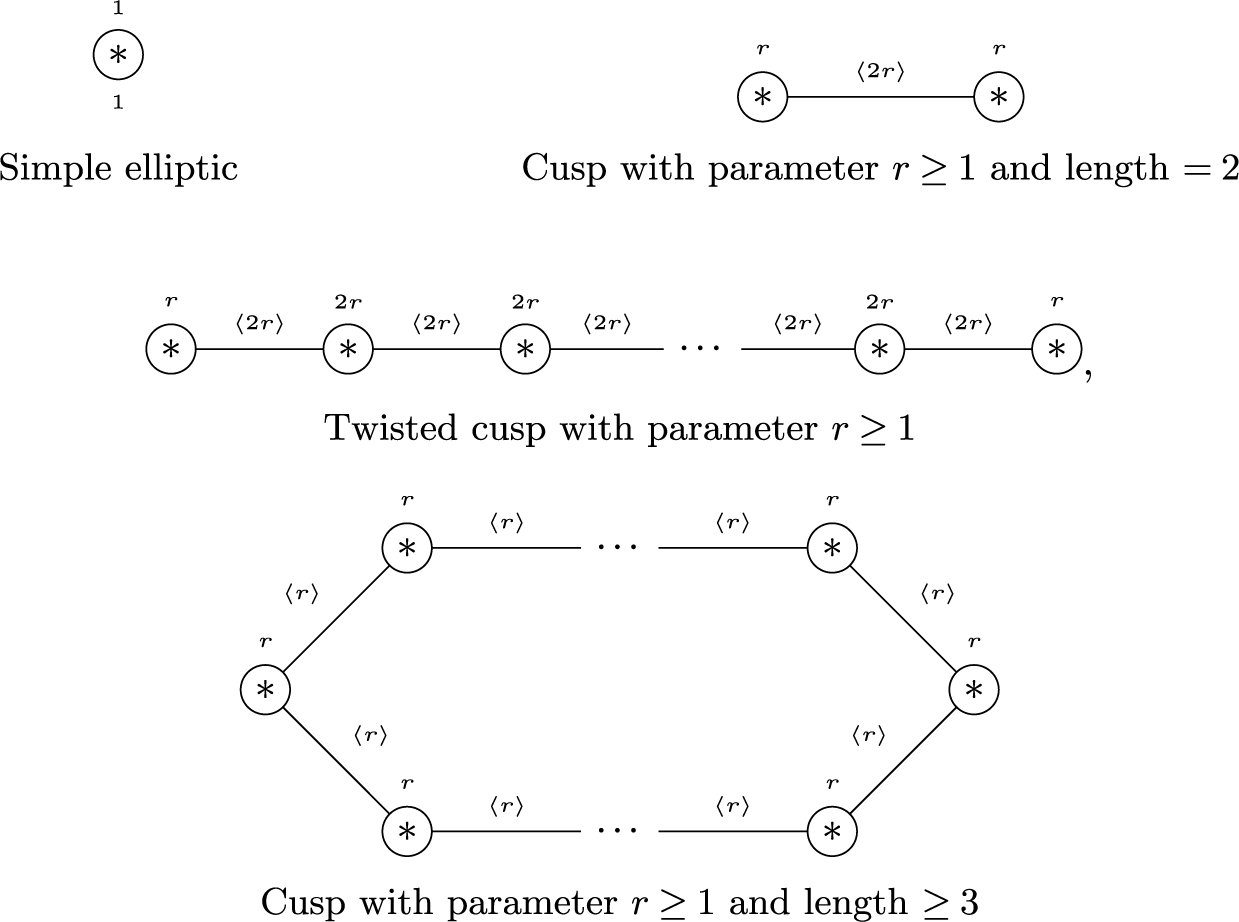
and the shape is as follows (cf. Notation 2.15):


Then
 $H^0(E_i, \mathcal {O}_{E_i})$
is a cyclic extension of
 $\kappa (x)$
for every vertex
 $E_i$
. In particular, the minimal resolution
 $f: Y \to X$
satisfies the
 $(*)$
-condition.
Proof. Let
 $\operatorname {Exc}(f) = \sum _{i=1}^n E_i$
be the irreducible decomposition, and we write
 $K_i : = H^0(E_i , \mathcal {O}_{E_i})$
. After renumbering, we may assume that
 $E_i \cap E_{i+1}$
is nonempty for all
 $i=1,2, \dots n$
, where we set
 $E_{n+1} : = E_1$
. We note that in the case where
 $n \geqslant 4$
, it follows from the shape of the dual graph that
 $E_i \cap E_j \cap E_k$
is empty for every
 $i<j<k$
. The same holds even in the case where
 $n=3$
, because
 $(x \in X)$
is log canonical.
However, for every i, it follows from the equation
 $$\begin{align*}(E_i \cdot E_{i+1})=[K_i:\kappa(x)] = [K_{i+1}:\kappa(x)]=r\end{align*}$$
that the following properties hold:
-
(1)
$E_i$
and
$E_{i+1}$
intersects transversally at a single point
$P_i$
, -
(2) the natural morphism
$f_i : K_i =H^0(E_i,\mathcal {O}_{E_i}) \to \kappa (P_i)$
is an isomorphism, and -
(3) the natural morphism
$g_i : K_{i+1} =H^0(E_{i+1},\mathcal {O}_{E_{i+1}}) \to \kappa (P_i)$
is an isomorphism, where we set
$K_{n+1} : = K_1$
.


We write
 $$\begin{align*}Z : =E_1+\cdots + E_{n-1} = E - E_n.\end{align*}$$
By repeatedly applying Lemma 4.7, the natural restriction morphism
 $h_i : H^0(Z, \mathcal {O}_Z) \to H^0(E_i,\mathcal {O}_{E_i}) = K_i$
is isomorphic for every
 $i=1,2, \dots , n-1$
. It again follows from Lemma 4.7 that we have the isomorphism
 $$\begin{align*}H^0(E,\mathcal{O}_E) \cong \{(s, t) \in H^0(Z,\mathcal{O}_Z) \times K_n \mid f_{n-1}(h_{n-1}(s)) = g_{n-1}(t) , \ g_n (h_{1}(s)) = f_n(t) \} \end{align*}$$
as
 $\kappa (x)$
-algebras. Since
 $f_i, g_i, h_i$
are isomorphic, this
 $\kappa (x)$
-algebra is isomorphic to the invariant subring
 $H^0(Z,\mathcal {O}_Z)^\sigma $
of
 $H^0(Z, \mathcal {O}_Z)$
, where the isomorphism
 $$\begin{align*}\sigma : H^0(Z,\mathcal{O}_Z) \xrightarrow{\sim} H^0(Z,\mathcal{O}_Z) \end{align*}$$
of
 $\kappa (x)$
-algebras is the composite map

Therefore,
 $H^0(Z, \mathcal {O}_Z)$
is a cyclic extension of
 $H^0(E, \mathcal {O}_E)$
. Since
 $H^0(E, \mathcal {O}_E)$
is isomorphic to
 $\kappa (x)$
by [Reference Kollár9, Corollary 10.10], we obtain the first assertion. We now apply Lemma 3.1 (ii) to obtain the second assertion.
Remark 4.9. With the notation above, we further assume that
 $r \neq 1$
. Since
 $K_i : =H^0(E_i, \mathcal {O}_{E_i})$
is isomorphic to
 $K_1$
and
 $K_i$
is a Galois extension of degree r over
 $\kappa (x)$
, we have the isomorphism
 $K_i \otimes _{\kappa (x)} K_1 \cong K_1^{r}$
. Therefore, the following properties hold.
-
1.
$E_i \times _{\kappa (x)} K_1 \cong \coprod _{i=1}^r \mathbb {P}^1_{K_1}$
. -
2. Let
$\varphi : X' \to X$
be an étale morphism from a normal surface singularity
$(x' \in X')$
whose residue field
$\kappa (x')$
is isomorphic to
$K_1$
(Lemma 4.3). Then the dual graph of
$(x' \in X')$
is a cusp with parameter
$1$
and length
$rn$
:


Proposition 4.10. Let
 $(x \in X)$
be a normal surface singularity. We assume that the following conditions are satisfied:
-
(i)
$\mathrm {ch}(\kappa (x))> 2$
, -
(ii)
$(x \in X)$
is log canonical, and -
(iii) the dual graph of
$(x \in X)$
is a twisted cusp with parameter
$r \geqslant 1$
and length
$n \geqslant 3$
; that is, the dual graph is where the number of vertices is
$n \geqslant 3$
. (cf. Notation 2.15).


Then there is an étale morphism
 $\varphi : X' \to X$
from a normal surface singularity
 $(x' \in X')$
whose dual graph is a cusp with parameter
 $1$
:

In particular, the minimal resolution
 $f: Y \to X$
satisfies the
 $(**)$
-condition.
Proof. As in the proof of Proposition 4.4, we can take an étale morphism
 $\varphi : X' \to X$
from a normal surface singularity
 $(x' \in X')$
such that every exceptional prime divisor of the minimal resolution of
 $X'$
is geometrically irreducible over
 $\kappa (x')$
. It is enough to show that the dual graph
 $\Gamma $
of
 $(x' \in X')$
is a cusp with parameter
 $1$
.
We first note that
 $(x' \in X')$
is again log canonical and not rational since
 $\varphi $
is étale. Moreover, since the base change
 $f' : Y' \to X'$
of f is the minimal resolution of
 $(x' \in X')$
, the number of the vertexes of
 $\Gamma $
is at least three. Therefore, it follows from the classification (Theorem A.3 (3) below) that
 $\Gamma $
is either a cusp with length
 $\geqslant 3$
or a twisted cusp with length
 $\geqslant 3$
. In the former case, since every exceptional prime divisor in
 $Y'$
is geometrically irreducible, the parameter is one by Remark 4.9.
In the latter case, take an exceptional prime divisor
 $E_i \subseteq Y'$
such that the extension degree
 $[H^0(E_i, \mathcal {O}_{E_i}) : \kappa (x')]$
is divisible by two. It then follows from the assumption
 $\mathrm {ch}(\kappa (x)) \neq 2$
that
 $H^0(E_i, \mathcal {O}_{E_i})$
is not purely inseparable over
 $\kappa (x')$
. Therefore,
 $E_i$
is not geometrically connected over
 $\kappa (x')$
, which is a contradiction to the choice of
 $\varphi $
.
Proposition 4.11. Let
 $(x \in X)$
be a normal surface singularity. We assume the following conditions are satisfied:
-
(i)
$\mathrm {ch}(\kappa (x))> 2$
, -
(ii)
$(x \in X)$
is log canonical, and -
(iii) the dual graph of
$(x \in X)$
is a cusp with parameter
$r \geqslant 1$
and length
$2$
; that is, the dual graph is


Then the minimal resolution
 $f : Y \to X$
satisfies the
 $(**)$
-condition.
Proof. Let
 $f: Y \to X$
be a minimal resolution and
 $\operatorname {Exc}(f) = E_1 \cup E_2$
be the irreducible decomposition. Since we have
 $$\begin{align*}2r = (E_1 \cdot E_2) = \sum_{P \in E_1 \cap E_2} \dim_{\kappa(x)} \mathcal{O}_{E_1 \cap E_2, P} \end{align*}$$
and
 $\dim _{\kappa (x)} \mathcal {O}_{E_1 \cap E_2 , P}$
is divisible by r, one of the following holds:
-
(1)
$E_1$
and
$E_2$
transversally intersects at two points
$P,Q$
such that
$$\begin{align*}[\kappa(P):\kappa(x)] = [\kappa(Q): \kappa(P) ] = r. \end{align*}$$
-
(2)
$E_1$
and
$E_2$
transversally intersects at a single point P such that
$$\begin{align*}[\kappa(P):\kappa(x)] =2r. \end{align*}$$
-
(3) The scheme theoretic intersection
$E_1 \cap E_2$
is non-reduced, and
$E_1 \cap E_2$
is a single point P such that
$$\begin{align*}[\kappa(P): \kappa(x)] =r. \end{align*}$$


In the first case, the proof is similar to that of Proposition 4.8. In the second case, the assertion follows from the similar argument as in Proposition 4.10.
We consider the third case. Since we have
 $K_{Y}+ (E_1+ E_2) = f^*K_X $
(cf. Theorem A.3 (3) below), the pair
 $(Y, E_1+E_2)$
is log canonical at P. Therefore, it follows from [Reference Kollár9, Theorem 2.31] (see also Remark 3.6) that the pair
 $(Y,E_1+E_2)$
is SNC at P, which is a contradiction since
 $E_1 \cap E_2$
is non-reduced.
4.3 Simple elliptic singularities
In this subsection, we give a sufficient condition for simple elliptic singularities to satisfy the
 $(**)$
-condition. We recall that a normal surface singularity is simple elliptic if the dual graph is the following:

Definition 4.12. Let
 $(x \in X)$
be a simple elliptic singularity and E be the exceptional prime divisor of the minimal resolution. We say that
 $(x \in X)$
is simple regular elliptic if E is regular, and is simple nodal elliptic otherwise.
Proposition 4.13. Let
 $(x \in X)$
be a normal surface singularity. We assume the following conditions are satisfied:
-
(i)
$\mathrm {ch}(\kappa (x))> 3$
and -
(ii)
$(x \in X)$
is log canonical and simple regular elliptic.


Then the minimal resolution
 $f: Y \to X$
satisfies the
 $(*)$
-condition.
Proof. The assertion follows from Proposition 3.4.
Proposition 4.14. Let
 $(x \in X)$
be a normal surface singularity. We assume the following conditions are satisfied:
-
(i)
$\mathrm {ch}(\kappa (x))> 3$
, -
(ii)
$(x \in X)$
is log canonical and simple nodal elliptic.


Then X admits a resolution of singularities which satisfies the
 $(**)$
-condition.
Proof. Let E be the exceptional divisor of the minimal resolution
 $f: Y \to X$
. We first consider the case where E is not geometrically irreducible. As in the proof of Proposition 4.4, we may take an étale cover
 $X' \to X$
, such that the exceptional locus of the minimal resolution
 $f \times _X \operatorname {id}_{X'} : Y \times _X X' \to X'$
of
 $X'$
is not irreducible. Noting that
 $X'$
is again log canonical and non-rational, the dual graph of
 $X'$
is one of the graph in Figure A.4 below (see Theorem A.3 (3) below). Therefore, it follows from Propositions 4.8, 4.10, 4.11 that the minimal resolution f satisfies
 $(**)$
-condition.
We next consider the case where E is geometrically irreducible over
 $\kappa (x)$
. Since the pair
 $(Y,E)$
is log canonical, every singular point of E is a node by [Reference Kollár9, Theorem 2.31] (see also Remark 3.6). It then follows from Corollary 3.10 that E is geometrically reduced over
 $\kappa (x)$
. Therefore, by Proposition 3.2, there exists a non-regular
 $\kappa (x)$
-rational point
 $P \in E$
such that E is smooth over
 $\kappa (x)$
outside P. Let
 $g: Z \to Y$
be the blowing up along P. Then it is straightforward to show that the composite
 $f \circ g : Z \to X$
satisfies the
 $(*)$
-condition.
Corollary 4.15. Let
 $(x \in X)$
be a normal surface singularity. We assume the following conditions are satisfied:
-
(i)
$\mathrm {ch}(\kappa (x))> 3$
and -
(ii)
$(x \in X)$
is log canonical.


Then there is a resolution
 $f: Y \to X$
which satisfies the
 $(**)$
-condition.
Proof. The assertion follows from the classification (Theorem A.3 (2), (3) below) combining with Propositions 4.4, 4.8, 4.10, 4.11, 4.14 and 4.13.
Corollary 4.16. Let X be a two-dimensional geometrically normal variety over a field k of characteristic
 $p>3$
and
 $x_1, \dots , x_n \in X$
be the non-smooth points of X over k. Suppose that X is log canonical at
 $x_i$
and the residue field
 $\kappa (x_i)$
of X at
 $x_i$
is separable over k for every i. Then X is geometrically log canonical over k.
5 Bertini type theorem for log canonical (resp. klt) threefolds
In this section, we prove the main theorem of this paper.
Proposition 5.1. Let
 $\pi : \mathcal {X} \to T$
be a quasi-projective morphism between varieties over an algebraically closed field k. We assume the following conditions are satisfied:
-
(i) The geometric generic fiber
$\mathcal {X}_{\overline {\eta }} : = \mathcal {X} \times _T \operatorname {Spec}(\overline {K(T)})$
admits a log resolution
$g: Y \to \mathcal {X}_{\overline {\eta }}$
which is a projective morphism. -
(ii) The generic fiber
$\mathcal {X}_{\eta } : = \mathcal {X} \times _T \operatorname {Spec}(K(T))$
is geometrically log canonical (resp. geometrically klt) over
$K(T)$
.


Then the fiber
 $\mathcal {X}_t$
is log canonical (resp. klt) for a general closed point
 $t \in T(k)$
.
Proof. Since
 $\mathcal {X}_{\overline {\eta }}$
is quasi-projective over
 $\overline {K(T)}$
and g is projective, there exist a finite field extension L of
 $K(T)$
and a Cartesian diagram

where h is projective. It follows from the faithfully flat descent of regularity ([Reference Matsumura11, Theorem 23.7]) that h is a resolution of
 $X_L$
. After replacing L by its finite extension, we may assume that every stratum Z of
 $\operatorname {Exc}(h)$
with a reduced structure is geometrically integral over L. We note that Z is smooth over L since the base change
 $Z \times _L \overline {K(T)}$
of a stratum Z is isomorphic to some stratum of
 $\operatorname {Exc}(g)$
. After replacing T by its normalization in L and
 $\mathcal {X}$
by
 $\mathcal {X} \times _T S$
, we may assume that there exists a projective log resolution
 $h: Y' \to \mathcal {X}_{\eta }$
such that the pair
 $(Y', \operatorname {Exc}(h))$
is geometrically SNC over
 $K(T)$
.
However, it follows from the fact that
 $\mathcal {X}$
is quasi-projective over T and h is projective that there exists a nonempty open subset
 $U \subseteq T$
and a Cartesian diagram

where
 $\mu $
is a projective morphism. Therefore, after shrinking T, we may assume that there exists a log resolution
 $\mu : \mathcal {Y} \to \mathcal {X}$
such that every stratum of the pair
 $(\mathcal {Y}, \operatorname {Exc}(\mu ))$
is smooth over T and maps surjectively onto T. Moreover, since the generic fiber
 $\mathcal {X}_{\eta }$
is assumed to be
 $\mathbb {Q}$
-Gorenstein and normal, we may shrink T so that T is smooth and
 $\mathcal {X}$
is normal and
 $\mathbb {Q}$
-Gorenstein.
Since the locus where the fiber is geometrically normal is constructible ([Reference Grothendieck4, Proposition 9.9.4]), the fiber
 $\mathcal {X}_t$
is normal for a general closed point
 $t \in T$
. For such t, it follows from [Reference Hartshorne6, Exercise II. 5.16 (d) and Theorem 8.17] and Remark 2.1 (1) that we have
 $$ \begin{align*} \omega_{\mathcal{X}_t} \cong (\omega_{\mathcal{X}}|_{\mathcal{X}_t})^{**}, \end{align*} $$
where
 $^{**}$
denotes the reflexive hull. Similarly, we have
 $\omega _{\mathcal {Y}_t} \cong \omega _{\mathcal {Y}}|_{\mathcal {Y}_t}$
, which implies that
 $$\begin{align*}(K_{\mathcal{Y}/\mathcal{X}})|_{\mathcal{Y}_t} = K_{\mathcal{Y}_t/\mathcal{X}_t}. \end{align*}$$
Since the support of the relative canonical divisor
 $K_{\mathcal {Y}/\mathcal {X}}$
is contained in
 $\operatorname {Exc}(\mu )$
, every irreducible component of the support is smooth over T and maps surjectively onto T. Therefore, the set of all coefficients of
 $K_{\mathcal {Y}_t/\mathcal {X}_t}$
coincides with that of
 $K_{\mathcal {Y}/\mathcal {X}}$
. The assertion now follows from Remark 2.4.
Theorem 5.2. Let
 $X \subseteq \mathbb {P}^N_k$
be a three-dimensional normal quasi-projective variety over an algebraically closed field k of characteristic
 $p>3$
. If X has only log canonical (resp. klt) singularities, then so does a general hyperplane section H of X.
Proof. Let
 $\mathbb {P}^* : = \mathbb {P}^N_k$
be the dual projective space and
 $\mathcal {Z} \subseteq \mathbb {P}^N_k \times \mathbb {P}^*$
be the universal family of hyperplanes of
 $\mathbb {P}^N_k$
– that is, the reduced closed subscheme of
 $\mathbb {P}^N_k \times _k \mathbb {P}^*$
such that the set of closed points of
 $\mathcal {Z}$
coincides with
 $$\begin{align*}\{(x,H) \in \mathbb{P}^N_k(k) \times (\mathbb{P}^*)(k) \mid x \in H \}. \end{align*}$$
Let
 $\mathcal {X}$
be the scheme theoretic intersection
 $\mathcal {Z} \cap (X \times \mathbb {P}^*)$
. We note that a general hyperplane section of X is none other than a general closed fiber of the second projection
 $$\begin{align*}p_2: \mathcal{X} \to \mathbb{P}^*. \end{align*}$$
Since the generic fiber
 $\mathcal {X}_{\eta }$
is a hypersurface of the three-dimensional variety
 $X \times _k \operatorname {Spec}(K(\mathbb {P}^*))$
over
 $K(\mathbb {P}^*)$
, it is two-dimensional. Given that any two-dimensional variety admits a log resolution which is a projective morphism, by Lemma 5.1, it suffices to show that the generic fiber
 $\mathcal {X}_{\eta }$
is geometrically normal and geometrically log canonical (resp. geometrically klt) over the function field
 $K(\mathbb {P}^*)$
.
Take a (not necessarily closed) point
 $P \in \mathcal {X}_{\eta }$
, and we set
 $x: = \pi (P) \in X$
, where
 $\pi : \mathcal {X}_{\eta } \to X$
is the morphism obtained by the first projection. It then follows from the proof of [Reference Caterina, Greco and Manaresi2, Theorem 1] that the fiber
 $\pi ^{-1}(x)$
is geometrically regular both over
 $\kappa (x)$
and
 $K(\mathbb {P}^*)$
.

By Corollary 4.5 and Corollary 4.16, it suffices to prove that if
 $\mathcal {X}_{\eta }$
is not smooth over
 $K(\mathbb {P}^*)$
at P, then the following properties hold:
-
(a) P is a closed point of
$\mathcal {X}_{\eta }$
, -
(b)
$\mathcal {X}_{\eta }$
is log canonical (resp. klt) at P and -
(c) the residue field
$\kappa (P)$
is separable over
$K(\mathbb {P}^*)$
.


Case 1: We first consider the case where X is regular at x. In this case, take a finite field extension L of
 $K(\mathbb {P}^*)$
and a point
 $Q \in \mathcal {X}_L : = \mathcal {X}_{\eta } \times _{K(\mathbb {P}^*)} L$
over P. Since the fiber of the first projection
 $\mathcal {X}_L \to X$
at x is isomorphic to the regular scheme
 $\pi ^{-1}(x) \times _{K(\mathbb {P}^*)} L$
, it follows from the ascent of regularity ([Reference Matsumura11, Theorem 23.7]) that
 $\mathcal {X}_L$
is regular at Q. Therefore,
 $\mathcal {X}_{\eta }$
is smooth over
 $K(\mathbb {P}^*)$
at P, and there is nothing to say.
Case 2: We next consider the case where X is non-regular at x. Since
 $\pi : \mathcal {X}_{\eta } \to X$
is flat, we have the dimension formula ([17, Lemma 00ON])
 $$\begin{align*}\dim(\mathcal{O}_{\mathcal{X}_{\eta}, P}) = \dim(\mathcal{O}_{X,x}) + \dim(\mathcal{O}_{\pi^{-1}(x), P}), \end{align*}$$
which implies that
 $\dim \mathcal {O}_{X,x}=2$
, P is a closed point of
 $\mathcal {X}_{\eta }$
and
 $\pi ^{-1}(x)$
consists of a single point P around P. Combining the third property with the fact that
 $\pi ^{-1}(x)$
is geometrically regular over
 $K(\mathbb {P}^*)$
, the residue field
 $\kappa (P)$
is separable over
 $K(\mathbb {P}^*)$
. Similarly, since
 $\pi ^{-1}(x)$
is geometrically regular over
 $\kappa (x)$
, it follows from [Reference Sato and Takagi16, Lemma 2.6 (3)]Footnote
1
that
 $\mathcal {X}_{\eta }$
is log canonical (resp. klt) at P, as desired.
A Classification of dual graphs of numerically log canonical surface singularities
In this appendix, we list up the dual graphs of normal surface singularities which are log canonical (resp. klt). See [Reference Kollár9] for more details.
Definition A.1. Let
 $(x \in X)$
be a normal surface singularity,
 $f : Y \to X$
be the minimal resolution and
 $\operatorname {Exc}(f)=\bigcup _{i=1}^n E_i$
be the irreducible decomposition of the exceptional divisor. Let
 $\Delta _Y$
be the unique
 $\mathbb {Q}$
-divisor on Y which satisfies
 $$\begin{align*}(\Delta_Y \cdot E_i) = - (K_Y \cdot E_i) \end{align*}$$
for all i. We say that
 $(x \in X)$
is numerically log canonical (resp. numerically klt) if every coefficient of
 $\Delta _Y$
is at most (resp. smaller than)
 $1$
.
Definition A.2. A normal surface singularity
 $(x \in X)$
is rational if the minimal resolution
 $f : Y \to X$
satisfies
 $R^1 f_* \mathcal {O}_Y=0$
.
Theorem A.3 [Reference Kollár9]
Let
 $(x \in X)$
be a normal surface singularity,
 $f: Y \to X$
be a minimal resolution,
 $\Gamma $
be the dual graph of X (see Notation 2.15),
 $E=\sum _{i=1}^n E_i$
be the sum of all exceptional prime divisors and
 $\Delta _Y$
be as in Definition A.1. Then the following holds:
-
(1)
$(x \in X)$
is numerically klt if and only if the dual graph
$\Gamma $
coincides with one of the graphs in Figure A.1 below. -
(2)
$(x \in X)$
is rational and numerically log canonical but not numerically klt if and only if
$\Gamma $
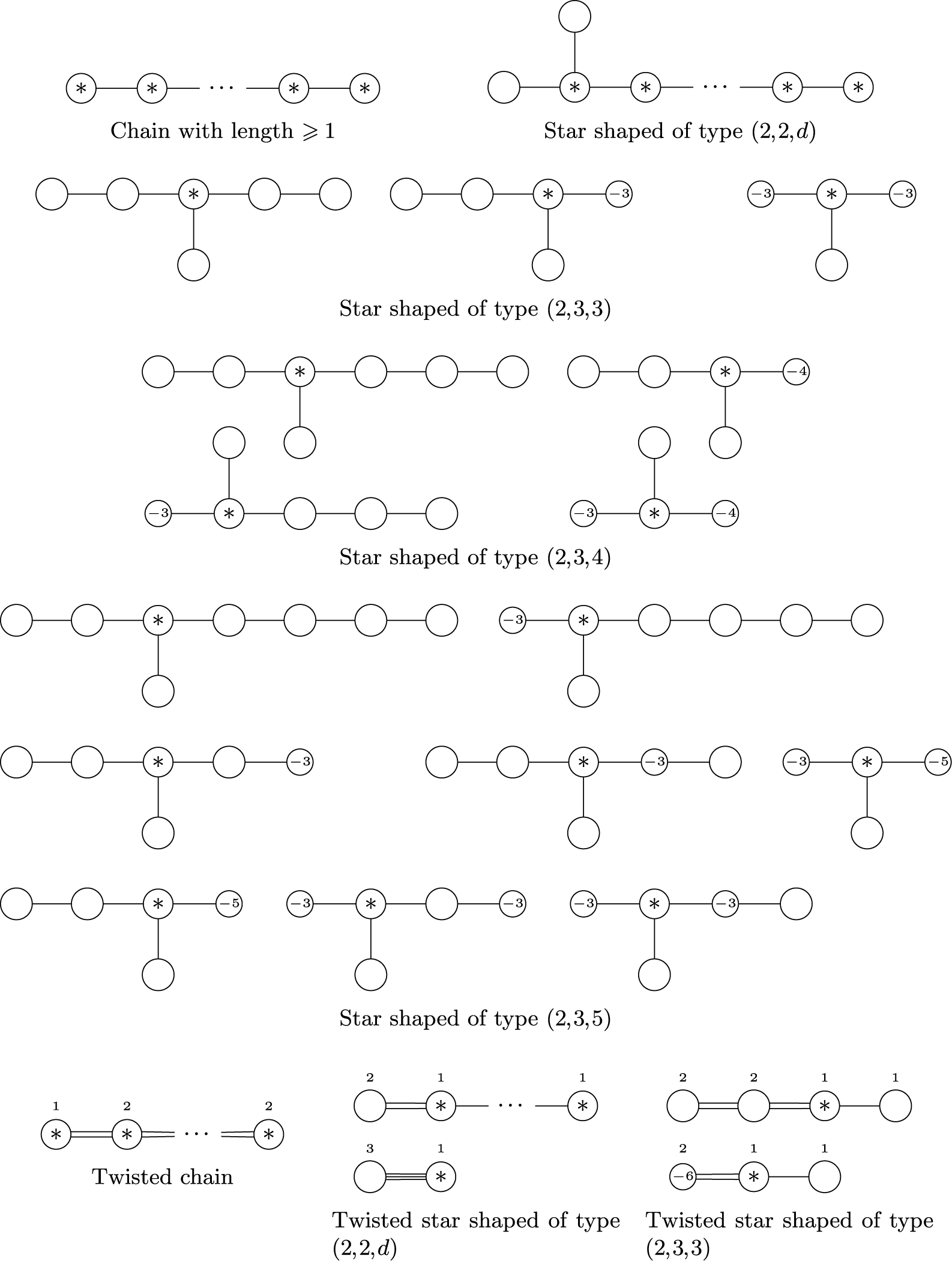
coincides with one of the graphs in Figure A.2 or Figure A.3 below.Figure A.1List of dual graphs of numerical klt singularities.
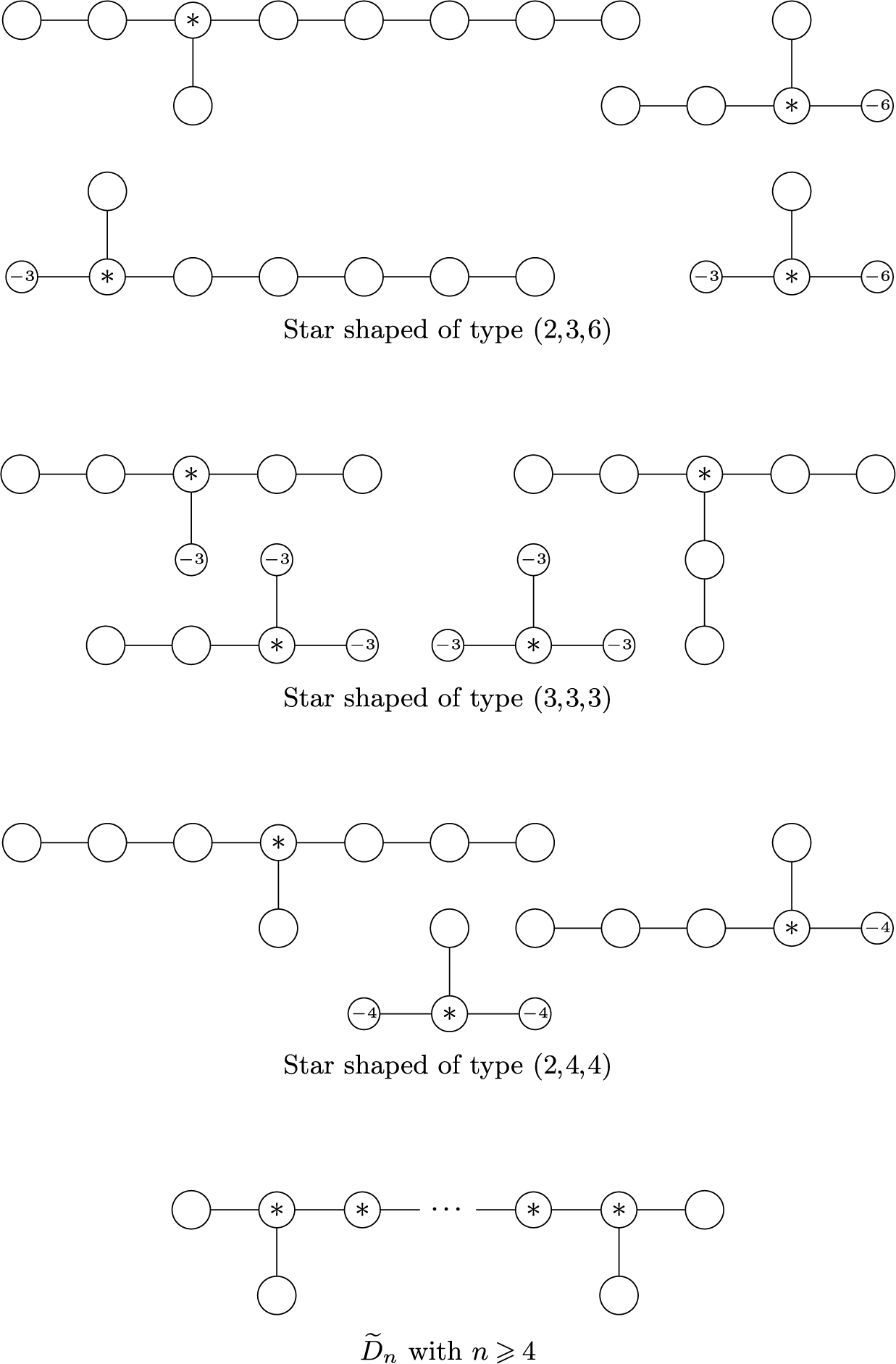
Figure A.2List of non-twisted dual graphs of rational numerical log canonical singularities.
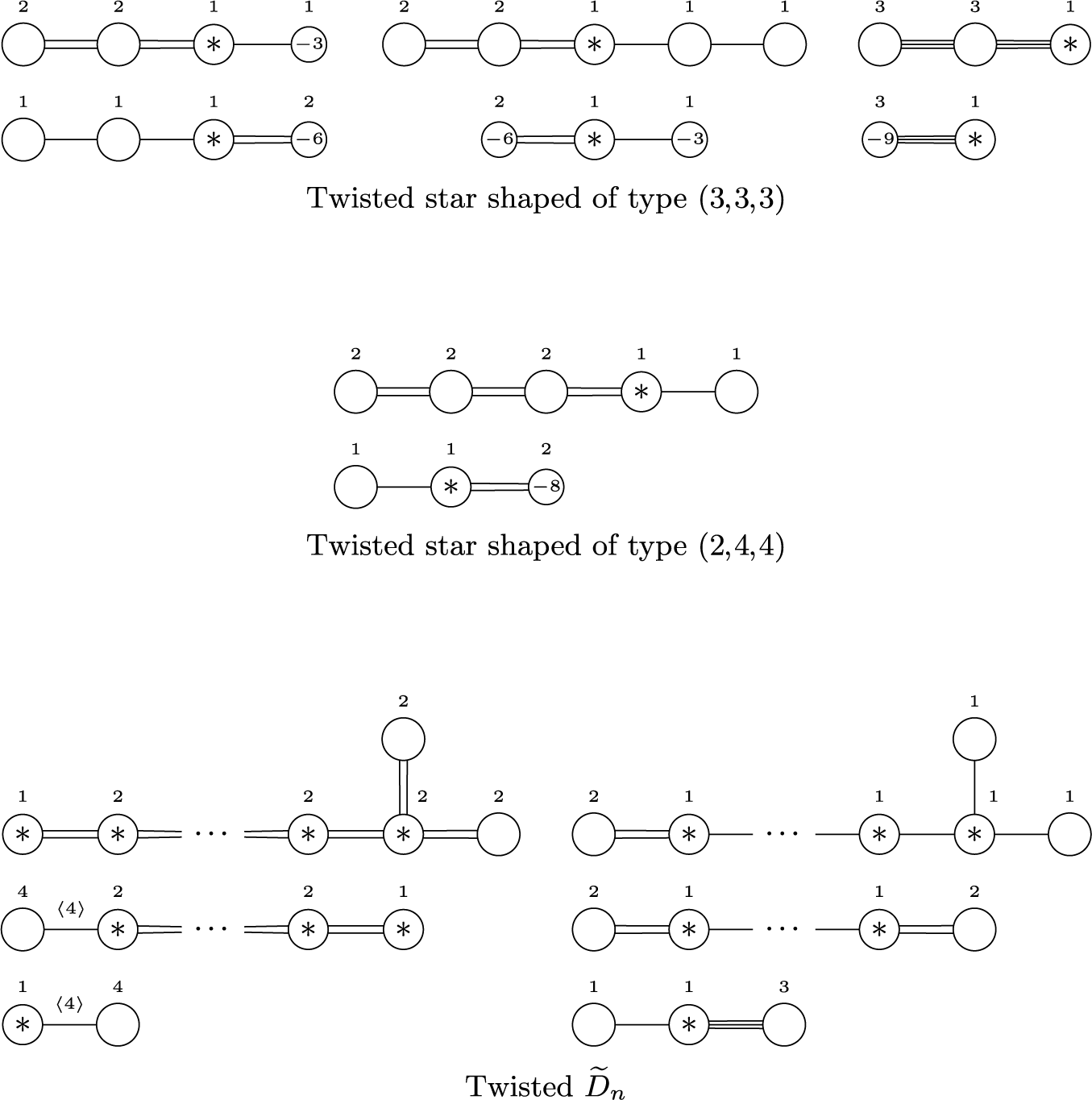
Figure A.3List of twisted dual graphs of rational numerical log canonical singularities.
Figure A.4List of dual graphs of non-rational numerical log canonical singularities.
-
(3) The following are equivalent.
-
(a)
$(x \in X)$
is numerically log canonical, but not a rational singularity. -
(b)
$\Gamma $
coincides with one of the graph in Figure A.4 below. -
(c)
$\Delta _Y=E$
.
-


Proof. We first prove the implication (c)
 $\Rightarrow $
(a) in (3). Since we have
 $\omega _E \cong \omega _Y(E)|_E$
, it follows from the assumption (c) that one has
 $$\begin{align*}\deg_{E/\kappa(x)}(\omega_E) : = \sum_{i=1}^n \deg_{E_i/\kappa(x)} (\omega_E|_{E_i}) = \sum_{i=1}^n ((K_Y+E) \cdot E_i) =0. \end{align*}$$
Noting that Riemann-Roch theorem (Lemma 2.9 (1)) holds true even for reducible curve ([Reference Fulton5, Example 18.3.6]), combining with Serre duality, we conclude that
 $$\begin{align*}\deg_{E/\kappa(x)}(\omega_E) = 2 \chi(E/\kappa(x), \mathcal{O}_E). \end{align*}$$
Therefore, we have
 $$\begin{align*}\dim_{\kappa(x)}(H^1(E, \mathcal{O}_E))=\dim_{\kappa(x)}(H^0(E, \mathcal{O}_E)) \neq 0. \end{align*}$$
It then follows from the exact sequence
 $$\begin{align*}R^1f_* \mathcal{O}_Y \to H^1(E, \mathcal{O}_E) \to R^2f_*\mathcal{O}_Y(-E)=0 \end{align*}$$
that
 $(x \in X)$
is non-rational, which proves the implication (c)
 $\Rightarrow $
(a) in (3). The converse implication (a)
 $\Rightarrow $
(c) follows from [Reference Kollár9, Theorem 2.28]. The rest of the proof follows from [Reference Kollár9, Subsection 3.3].
Acknowledgements
The author wishes to express his gratitude to Professor Shunsuke Takagi for his valuable advice and suggestions. He is also grateful to Professors Teppei Takamatsu, Shou Yoshikawa and Tatsuro Kawakami for helpful comments. He also thanks the anonymous referee for the comments and suggestions that helped to improve the paper. This work was supported by JSPS KAKENHI Grant Number 20K14303.
Competing interest
The author have no competing interests to declare.
Data availability statement
Data sharing not applicable to this article as no datasets were generated or analysed during the current study.