Introduction
Neuropsychiatric disorders in children are a major public health problem; 3.4% of children worldwide are diagnosed with attention deficit hyperactivity disorder (ADHD) and 5.7% with disruptive disorders (Polanczyk et al. Reference Polanczyk, Salum, Sugaya, Caye and Rohde2015). Children with neuropsychiatric problems face social and educational challenges, and interventions including special assistance during education years, therapies and/or appropriate medication incur significant financial burden (Buescher et al. Reference Buescher, Cidav, Knapp and Mandell2014; Le et al. Reference Le, Hodgkins, Postma, Kahle, Sikirica, Setyawan and Erder2014). As childhood neuropsychiatric problems persist into adulthood (Caspi et al. Reference Caspi, Moffitt, Newman and Silva1996; Pihlakoski et al. Reference Pihlakoski, Sourander, Aromaa, Rautava, Helenius and Sillanpää2006), understanding predisposing factors is essential for the development of appropriate preventive measures to enable these children to reach their full potential.
Studies have demonstrated increased symptoms of ADHD (Rodriguez et al. Reference Rodriguez, Miettunen, Henriksen, Olsen, Obel, Taanila, Ebeling, Linnet, Moilanen and Järvelin2008; Rodriguez Reference Rodriguez2010; Buss et al. Reference Buss, Entringer, Davis, Hobel, Swanson, Wadhwa and Sandman2012; Chen et al. Reference Chen, Sjolander, Langstrom, Rodriguez, Serlachius, D'Onofrio, Lichtenstein and Larsson2014; Jo et al. Reference Jo, Schieve, Sharma, Hinkle, Li and Lind2015; Pugh et al. Reference Pugh, Hutcheon, Richardson, Brooks, Himes, Day and Bodnar2016), externalizing, internalizing and aggressive behaviour problems (van Lieshout et al. Reference van Lieshout, Schmidt, Robinson, Niccols and Boyle2013; Antoniou et al. Reference Antoniou, Fowler, Reed, Southwood, McCleery and Zeegers2014; Pugh et al. Reference Pugh, Hutcheon, Richardson, Brooks, Himes, Day and Bodnar2016), affective disorders (Robinson et al. Reference Robinson, Zubrick, Pennell, Van Lieshout, Jacoby, Beilin, Mori, Stanley, Newnham and Oddy2013) and autism spectrum disorders (ASD) (Gardner et al. Reference Gardner, Lee, Magnusson, Rai, Frisell, Karlsson, Idring and Dalman2015; Jo et al. Reference Jo, Schieve, Sharma, Hinkle, Li and Lind2015; Li et al. Reference Li, Ou, Liu, Zhang, Zhao and Tang2015) in children exposed to prenatal maternal obesity. The upward trends in the prevalence of neuropsychiatric disorders including ADHD and autism (Boyle et al. Reference Boyle, Boulet, Schieve, Cohen, Blumberg, Yeargin-Allsopp, Visser and Kogan2011; Atladottir et al. Reference Atladottir, Gyllenberg, Langridge, Sandin, Hansen, Leonard, Gissle, Reichenberg, Schendel, Bourke, Hultman, Grice, Buxbaum and Parner2015) appears to parallel the rise in pre-pregnancy obesity over the same period (Fisher et al. Reference Fisher, Kim, Sharma, Rochat and Morrow2013). If prenatal maternal obesity is truly a new risk factor for the development of increased neuropsychiatric symptoms in the offspring, this adds significantly to the current public health challenges arising from obesity in pregnancy. One in five women are obese during pregnancy [body mass index (BMI) > 30 kg/m2, obese class I; WHO] (Chu et al. Reference Chu, Kim and Bish2009; Heslehurst et al. Reference Heslehurst, Rankin, Wilkinson and Summerbell2010) and maternal obesity is linked to obstetric complications and mortality risk (Norman & Reynolds, Reference Norman and Reynolds2011) and is also a major risk factor for future cardio-metabolic problems in the offspring (Reynolds et al. Reference Reynolds, Allan, Raja, Bhattacharya, McNeill, Hannaford, Sarwar, Lee and Norman2013).
However the association between maternal obesity and childhood neuropsychiatric outcomes have been inconsistent particularly among offspring of overweight and obese class I mothers (Brion et al. Reference Brion, Zeegers, Jaddoe, Verhulst, Tiemeier, Lawlor and Smith2011) and in younger children (van Lieshout et al. Reference van Lieshout, Schmidt, Robinson, Niccols and Boyle2013). The effect of maternal obesity has been argued to be due to genetic predisposition (Chen et al. Reference Chen, Sjolander, Langstrom, Rodriguez, Serlachius, D'Onofrio, Lichtenstein and Larsson2014), although a twin study later concluded that maternal obesity remains an important non-genetic (in utero or common) factor in explaining the variance of children's neuropsychiatric problems (Antoniou et al. Reference Antoniou, Fowler, Reed, Southwood, McCleery and Zeegers2014). Only recent studies have considered obesity-linked obstetric complications (e.g. gestational diabetes) and postnatal factors such as breastfeeding (Buss et al. Reference Buss, Entringer, Davis, Hobel, Swanson, Wadhwa and Sandman2012; Robinson et al. Reference Robinson, Zubrick, Pennell, Van Lieshout, Jacoby, Beilin, Mori, Stanley, Newnham and Oddy2013; Gardner et al. Reference Gardner, Lee, Magnusson, Rai, Frisell, Karlsson, Idring and Dalman2015; Jo et al. Reference Jo, Schieve, Sharma, Hinkle, Li and Lind2015) as potential confounders of the obesity effect on childhood neuropsychiatric outcomes. Moreover, no study has assessed maternal concurrent psychological wellbeing, which may introduce respondent's bias, on the prenatal obesity effect on childhood neuropsychiatric outcomes. This is important since women with obesity have increased odds of anxiety and depression symptoms (Molyneaux et al. Reference Molyneaux, Poston, Ashurst-Williams and Howard2014; Mina et al. Reference Mina, Denison, Forbes, Stirrat, Norman and Reynolds2015), and since increased maternal psychological distress is associated with higher risk of childhood psychopathology (Van den Bergh et al. Reference Van den Bergh, Mennes, Oosterlaan, Stevens, Stiers, Marcoen and Lagae2005; Goodman et al. Reference Goodman, Rouse, Connell, Broth, Hall and Heyward2011; van Batenburg-Eddes et al. Reference Van Batenburg-Eddes, Brion, Henrichs, Jaddoe, Hofman, Verhulst, Lawlor, Davey Smith and Tiemeier2013).
The current work aimed to assess childhood neuropsychiatric problems in children exposed to prenatal maternal very severe obesity (BMI ⩾40 kg/m2, obese class III). We hypothesized that exposure to prenatal very severe obesity would be associated with increased childhood symptoms across multiple neuropsychiatric domains including increased symptoms of ADHD, internalizing and externalizing behaviour, and neurodevelopmental problems. We envisaged that these associations would be independent of the prenatal and socio-demographic confounders identified in previous studies (Rodriguez et al. Reference Rodriguez, Miettunen, Henriksen, Olsen, Obel, Taanila, Ebeling, Linnet, Moilanen and Järvelin2008; Rodriguez Reference Rodriguez2010; Buss et al. Reference Buss, Entringer, Davis, Hobel, Swanson, Wadhwa and Sandman2012; Robinson et al. Reference Robinson, Zubrick, Pennell, Van Lieshout, Jacoby, Beilin, Mori, Stanley, Newnham and Oddy2013; van Lieshout et al. Reference van Lieshout, Schmidt, Robinson, Niccols and Boyle2013; Antoniou et al. Reference Antoniou, Fowler, Reed, Southwood, McCleery and Zeegers2014; Chen et al. Reference Chen, Sjolander, Langstrom, Rodriguez, Serlachius, D'Onofrio, Lichtenstein and Larsson2014; Gardner et al. Reference Gardner, Lee, Magnusson, Rai, Frisell, Karlsson, Idring and Dalman2015; Jo et al. Reference Jo, Schieve, Sharma, Hinkle, Li and Lind2015; Li et al. Reference Li, Ou, Liu, Zhang, Zhao and Tang2015; Pugh et al. Reference Pugh, Hutcheon, Richardson, Brooks, Himes, Day and Bodnar2016), and examined whether they also occur independently of maternal concurrent anxiety and depressive symptoms.
Method
Participant recruitment and consent
The current work was a follow-up of a longitudinal pregnancy cohort of women with very severe obesity (BMI ⩾40 kg/m2 or obesity class III at their first antenatal booking; WHO) and lean controls (BMI 18.5–25 kg/m2) in Midlothian, Scotland, UK (Mina et al. Reference Mina, Denison, Forbes, Stirrat, Norman and Reynolds2015). Maternal BMI was measured by midwives (Mina et al. Reference Mina, Denison, Forbes, Stirrat, Norman and Reynolds2015) and none of the women had pre-existing type 2 diabetes. Ethical approval was obtained from the local research ethics committee (REC: 14/|WS/1046, R&D: 2014/0278) and the study was conducted in the Wellcome Trust Clinical Research Facility (WTCRF), the Royal Hospital for Sick Children, Edinburgh. We screened 357 prospective participants (135 lean, 222 very severe obesity) from the pregnancy study for study eligibility and excluded mothers who had moved out of Midlothian, or whose child was under a child protection register alert.
Supplementary Fig. S1 summarizes the recruitment for the study, including the breakdown of participation through the clinic visits and reasons for attrition. Children with known diagnoses of neuropsychiatric problems were excluded as the follow-up study included neuropsychological assessments that are challenging to complete among children with neurodevelopmental disabilities and could introduce unnecessary distress. Overall we obtained consent from 116 (62 lean, 54 very severe obesity) mother-and-child dyads, but for the current analysis data are only available from 112 (62 lean, 50 very severe obesity) participants as four very severe obesity mothers did not return a complete study package. In those not recruited to the follow-up study, there was a significantly higher proportion of very severe obesity and higher levels of socioeconomic deprivation (Supplementary Table S1).
Questionnaires on child psychiatric and neuropsychiatric symptoms
Mothers completed the Conners’ Hyperactivity Scale (Erhart et al. Reference Erhart, Döpfner and Ravens-Sieberer2008), Early Symptomatic Syndrome Eliciting Neurodevelopmental Clinical Examination Questionnaire (ESSENCE-Q; Gillberg Reference Gillberg2010), the abbreviated Child's Sleep Habits Questionnaire (CSHQ) – adopted for preschool children (Goodlin-Jones et al. Reference Goodlin-jones, Sitnick, Tang, Liu and Anders2008), Strengths and Difficulties Questionnaire (SDQ; Goodman, Reference Goodman1997), and Child Behavior Checklist for 1½- to 5-year-olds (CBCL/1½−5) (ASEBA® by Thomas Achenbach, Burlington, USA).
The Conner's Hyperactivity Scale includes 10 items assessing the severity of ADHD symptoms. ESSENCE-Q is 10-item questionnaire examining the presence of neurodevelopmental syndromes. The CSHQ contains 45 items evaluating eight domains of sleep problems, child's waking, sleeping time on weekdays/weekend and the duration of nap. The CBCL/1½−5 comprises 99 items and SDQ 25 items on child psychiatric problems. The SDQ yields five psychiatric symptom scales (hyperactivity, emotional problems, conduct problems, peer problems, total difficulties) and one scale on the child's strengths. The CBCL/1½−5 yields scores for three main scales (internalizing, externalizing, total problems), eight syndrome scales (emotionally reactive, anxious/depressed, somatic complaints, withdrawn, sleep problems, attention problems, aggressive behaviour, other problems) and five Diagnostic and Statistical Manual for Mental Disorders (DSM)-oriented scales (affective, anxiety, pervasive developmental, attention deficit hyperactivity, oppositional defiant problems). In the analyses, we used the t scores of the CBCL main scales and the raw scores of the syndrome and DSM-oriented scales.
The CBCL (Achenbach & Rescorla, Reference Achenbach and Rescorla2000), SDQ (Croft et al. Reference Croft, Stride, Maughan and Rowe2015), Conners’ (Erhart et al. Reference Erhart, Döpfner and Ravens-Sieberer2008) and CSHQ (Goodlin-Jones et al. Reference Goodlin-jones, Sitnick, Tang, Liu and Anders2008) are well-validated questionnaires with good psychometric properties. The upper age limit for the CCBL is 5 years so nine children aged >5 years did not complete this scale. The ESSENCE-Q scale is a novel, less validated scale currently tested in some cohort studies and was used in this study because if found to have good concurrent validity with the other measures, it would have potential for easy population screening in future studies. Higher scores on each scale indicate higher levels of neuropsychiatric problems.
Sociodemographic, prenatal and postnatal covariates
Prenatal covariates including mothers’ prenatal smoking status, age at first antenatal booking, parity, presence of gestational diabetes mellitus (GDM), infant's sex and gestational age were recorded during pregnancy and infant follow-up (Mina et al. Reference Mina, Denison, Forbes, Stirrat, Norman and Reynolds2015). Infant birthweight was sex- and gestational age-standardized to British population (SDS) using UK-WHO growth chart (http://healthforallchildren.com, version 2.77, 2012, Oxford, UK). The most recent maternal postcode was used to assess socioeconomic deprivation levels of the family, which were grouped into low (score <3) and high (score ⩾4) (McLoone, Reference McLoone2004). Child's age was recorded at the visit. Maternal anxiety and depressive symptoms concurrently when rating the child's neuropsychiatric symptoms were assessed with the Spielberger State-Trait Anxiety Index (STAI, clinical cut-off ⩾39) and General Health Questionnaire (GHQ, clinical cut-off ⩾3), respectively.
Statistical analysis
All statistical analyses were performed using SPSS v. 20.0 (IBM Corp., USA). Data distribution was verified by examining the skewness, kurtosis scores, and histogram, and abnormally distributed data were transformed using various statistical methods where appropriate. Square-root transformation (√) was applied to maternal scores of GHQ and child's scores of ESSENCE-Q, CBCL syndrome scales, CBCL main scales and CBCL DSM-IV-oriented scales. Log to base 10 transformation was applied to CSHQ scales. Natural logarithm transformation was applied to the ‘total difficulty’ component of SDQ. Rank transformation using Blom's formula was applied to gestational age and the ‘Strength’ component of SDQ. Due to the small numbers of mothers who were current smokers during pregnancy, the ‘current smoking’ was merged with ‘ex-smoker’ to make a combined category of ‘smoker’ for the statistical analysis. Unless otherwise indicated, all continuous measures of demographic and neuropsychiatric outcomes were subsequently standardized into z scores to facilitate the comparison of effect sizes.
Descriptive statistics comparing the outcomes of children exposed to maternal prenatal very severe obesity to children of lean mothers were performed using parametric means including Spearman's ρ correlation, Student's t test, and χ² test, where appropriate. Multiple linear regressions were performed using maternal very severe obesity status as the independent variable and children's neuropsychiatric outcomes as dependent variables. The first regression model (model 1) included infant's sex and age-at-visit as covariates. Model 2 included model 1 covariates + maternal socioeconomic deprivation, maternal smoking during pregnancy, age and parity as covariates. This was followed by model 3, which comprised model 2 + maternal gestational diabetes, SDS birthweight and rank-normalized gestational age (using Blom's formula). Finally model 4 encompassed model 3 + maternal concurrent psychological wellbeing, assessed using STAI as a measure of state anxiety and z-GHQ as a measure of depressive symptoms. Univariate general linear model was used to explore interactions between maternal very severe obesity status and infant's sex on child neuropsychiatric problems.
Ethical standards
The authors assert that all procedures contributing to this work comply with the ethical standards of the relevant national and institutional committees on human experimentation and with the Helsinki Declaration of 1975, as revised in 2008.
Results
Mother and child demographics
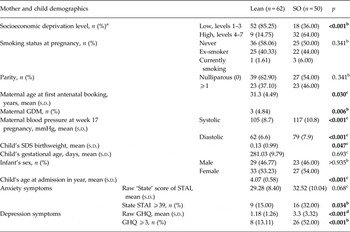
At follow-up very severely obese mothers had significantly higher levels of socioeconomic deprivation (Table 1), consistent with previous findings (Mina et al. Reference Mina, Denison, Forbes, Stirrat, Norman and Reynolds2015). Children of very severely obese mothers were more likely to be exposed to maternal GDM, have higher birthweight and were ±0.42 years older at follow-up than children of lean mothers (Table 1). Very severely obese mothers also had higher levels of anxiety and depressive symptoms (Table 1).
Mother and child demographics

SO, Mothers with very severe obesity; GDM, gestational diabetes mellitus; SDS, British standard deviation score; STAI, State Trait Anxiety Index (min–max = 0–80); GHQ, General Health Questionnaire (minimum-maximum = 0–15).
Bold text: p ⩽ 0.05, underlined text: p ⩽ 0.1.
a Socioeconomic deprivation category is based on postcode in the Midlothian, Scotland (McLoone, Reference McLoone2004).
b χ2.
c Student's t test.
Supplementary Table S2 details the data availability for each item of neuropsychiatric assessment and Supplementary Table S3 the correlations of the covariates with neuropsychiatric measures. Boys had higher scores of Conners’, SDQ total difficulty and externalizing problems. Children with higher socioeconomic deprivation level had higher scores of CBCL externalizing and total problems as well as CSHQ sleep problems. Children who had shorter gestational age had higher scores of SDQ total difficulty and CSHQ sleep problems, whereas children with lower SDS birthweight had higher scores of ESSENCE-Q. Furthermore, children who were exposed to maternal GDM had higher CSHQ sleep problems. Higher maternal state anxiety was correlated with higher measures of all representative neuropsychiatric measures except for CSHQ sleep problems. Higher maternal current depressive symptoms were correlated with higher scores in ESSENCE-Q, SDQ total difficulty and CSHQ sleep problem scores. Socioeconomic deprivation was associated with significantly higher child CBCL externalizing and total problems and increased CSHQ sleep problems. The main neuropsychiatric outcomes were not significantly different according to child's age at visit, parity and smoking status in pregnancy (Supplementary Table S3).
Prenatal maternal very severe obesity is strongly associated with increased childhood neuropsychiatric problems independent of all major confounders
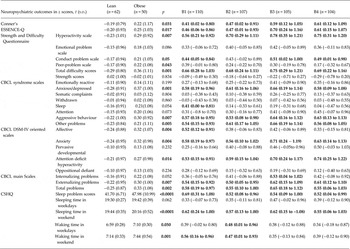
In unadjusted analyses (Table 2), children exposed to prenatal maternal very severe obesity scored significantly higher across the different neuropsychiatric symptom scales. On the general psychiatric problem scales, children born to very severely obese mothers had higher scores for hyperactivity, conduct problems and total difficulties scales of the SDQ. On the CBCL, they had higher externalizing and total problems main scale scores, higher anxious/depressed, aggressive behaviour and other problem syndrome scale scores, and higher DSM-oriented affective, anxiety and ADHD problem scores. Children born to very severely obese mothers also showed higher levels of Conners’ ADHD symptoms and neurodevelopmental problems in the ESSENCE-Q. Children of very severely obese mothers also had more sleep problems, and were more likely to wake up and sleep later at the weekend than the children of lean mothers. The total sleep duration at the weekend among children of very severely obese mothers (mean, s.d. = 11.72 h, 0.75) was similar to that of the lean group (mean, s.d. = 11.73 h, 0.75, p = 0.946).
Prenatal maternal very severe obesity is strongly associated with increased child's neuropsychiatric problems independent of demographic and prenatal confounders and maternal current well-being

ESSENCE-Q, Early Symptomatic Syndrome Eliciting Neurodevelopmental Clinical Examination Questionnaire; CBCL, Child Behavior Checklist; CSHQ, Child's Sleep Habits Questionnaire; SDS, British standard deviation score; GHQ, General Health Questionnaire; SDQ, Strengths and Difficulties Questionnaire.
P, Unadjusted p values from Student's t test. Bold text: p values ⩽ 0.05. The regression output was standardized coefficients for maternal very severe obesity status B1–B4 and their 95% confidence intervals (CI).
B1, Effect of maternal obesity following linear regression adjusted for sex and age at visit; B2, B1 + adjusted for parity at pregnancy, maternal age, maternal smoking status and socioeconomic deprivation level; B3, B2 + adjusted for maternal gestational diabetes, SDS birthweight and rank-standardized gestational age. B4, B3 + adjusted for maternal z scores of State Anxiety and z scores of √ (maternal general depression score).
Square-root transformation (√) was applied to maternal scores of GHQ and child's scores of ESSENCE-Q, CBCL syndrome scales, CBCL main scales and CBCL DSM-IV-oriented scales. Log to base 10 transformation was applied to CSHQ scales. Natural logarithm transformation was applied to the ‘total difficulty’ component of SDQ. Rank transformation using Blom's formula was applied to gestational age and the ‘Strength’ component of SDQ.
All preliminary output prior to regressions was displayed in z scores except output from sleep questionnaire, which is displayed in raw scores. Sleeping and waking time are expressed in hour: minute format.
In model 1 (B1, Table 2), the overall results remained unchanged although the higher SDQ peer-problem score among children of very severely obese mothers was no longer significant. In model 2 which adjusted for demographic factors (B2, Table 2), prenatal maternal very severe obesity remained strongly associated with increased children's neuropsychiatric problems, with the exception on the CBCL syndrome score on sleep problems. In model 3 with prenatal factors as potential causal pathway of very severe obesity, maternal prenatal very severe obesity remains associated with multiple different problem scales (B3, Table 2) and also emerged as a predictor of children's CBCL higher internalizing problems. In model 4, prenatal maternal very severe obesity remained a strong predictor of increased children's neuropsychiatric problems across multiple scales independent of maternal current psychological wellbeing (B4, Table 2).
In exploratory analyses the interaction between maternal SO status and child's sex in SDQ peer-problem scores was significant (F 1,105 = 4.933, p = 0.029), where maternal SO status predicts increased SDQ peer-problem scores in male (B1: 0.73, 95% CI 0.12–1.34) but not in female offspring (B1: 0.09, 95% CI −0.43 to 0.62). This sex difference remained in model 2 [B2male: 0.73, 95% CI 0.04–1.43) but not in model 3, and no other maternal obesity-sex interactions for the other neuropsychiatric symptom scales were found (all p values > 0.05, Supplementary Table S4).
Discussion
The evidence supporting maternal obesity as a predictor of adverse childhood neuropsychiatric outcomes is inconsistent. Here, using multiple validated scales we demonstrated that maternal very severe obesity is a significant predictor of increased general neuropsychiatric problems, externalizing behaviour problems including symptoms of ADHD and aggressive behaviour, sleep problems and neurodevelopmental problems in their children. Pre-pregnancy very severe obesity also predicted higher anxiety problems but had no consistent effects on the main scale internalizing problems. The effects of maternal very severe obesity on child neuropsychiatric problems were independent of socio-demographic confounders, prenatal factors and most importantly, of maternal concurrent symptoms of anxiety and depression. Our findings are in accord with findings from large prospective cohort studies in women with less severe levels of obesity and more limited assessments of neuropsychiatric outcomes (Rodriguez et al. Reference Rodriguez, Miettunen, Henriksen, Olsen, Obel, Taanila, Ebeling, Linnet, Moilanen and Järvelin2008; Rodriguez, Reference Rodriguez2010; Jo et al. Reference Jo, Schieve, Sharma, Hinkle, Li and Lind2015) and with the findings of increased developmental problems in children exposed to obesity-linked metabolic complications in utero (Krakowiak et al. Reference Krakowiak, Walker, Bremer, Baker, Ozonoff, Hansen and Hertz-Picciotto2012).
To our knowledge only one study has specifically analysed outcomes according to combined class II and class III obesity separately from class I obesity and that study also reported significantly increased risks of multiple types of neuropsychiatric problems (SDQ problem total difficulties, emotional symptoms, and peer problems, diagnoses of ADHD, ASD, developmental delay and affective disorders) among the children born to classes II and III obese mothers. A clear segregation of obesity group and the assessment at appropriate age group are critical as previous studies reported absence of associations in the less severe obesity levels [overweight and obese classes I and II (Brion et al. Reference Brion, Zeegers, Jaddoe, Verhulst, Tiemeier, Lawlor and Smith2011), and in younger children (2–3 years old)] where certain neuropsychiatric problems are yet to be manifest (van Lieshout et al. Reference van Lieshout, Schmidt, Robinson, Niccols and Boyle2013). Our findings are consistent with previous observations (Jo et al. Reference Jo, Schieve, Sharma, Hinkle, Li and Lind2015) and support the concept of ‘dose-dependent/saturation’ obesity effect on childhood neuropsychiatric outcomes. However unlike Jo et al. (Reference Jo, Schieve, Sharma, Hinkle, Li and Lind2015) where findings were largely based on maternal report of neuropsychiatric diagnoses, self-reported maternal BMI and a single neuropsychiatric symptom measure (SDQ), we assessed the symptom levels of neuropsychiatric problems using multiple scales and used objectively measured maternal BMI (Mina et al. Reference Mina, Denison, Forbes, Stirrat, Norman and Reynolds2015).
The majority of the previous literature has limited adjustment for maternal concurrent psychological wellbeing as a potential confounder; one study assessed concurrent depression (Buss et al. Reference Buss, Entringer, Davis, Hobel, Swanson, Wadhwa and Sandman2012), another assessed postpartum depression (Rodriguez, Reference Rodriguez2010) and the rest relied on the presence of positive diagnoses of maternal depression in hospital records (Robinson et al. Reference Robinson, Zubrick, Pennell, Van Lieshout, Jacoby, Beilin, Mori, Stanley, Newnham and Oddy2013; van Lieshout et al. Reference van Lieshout, Schmidt, Robinson, Niccols and Boyle2013; Gardner et al. Reference Gardner, Lee, Magnusson, Rai, Frisell, Karlsson, Idring and Dalman2015; Jo et al. Reference Jo, Schieve, Sharma, Hinkle, Li and Lind2015). Most studies collectively report no effect of multiple prenatal/postnatal maternal psychological problems, and accordingly our data suggest that the associations of maternal prenatal very severe obesity and increased child's neuropsychiatric symptoms were independent of maternal concurrent levels of psychological symptoms.
In this study we found a sex–obesity interaction whereby male infants exposed to prenatal very severe obesity were more likely have higher SDQ peer-problem scores than boys born to lean mothers. We are not aware of other studies reporting the child sex-maternal obesity interaction on childhood peer-problems, however our finding is in line with higher externalizing and aggressive behaviour observed generally in boys (Rescorla et al. Reference Rescorla, Achenbach, Ivanova, Harder, Otten, Bilenberg, Bjarnadottir, Capron, De Pauw, Dias and Dobrean2011). Whilst this observation needs to be replicated in larger studies, there is some evidence of sex-specific vulnerability to in utero exposures. For example, the slower rate of cortical development in the male fetus has been postulated to prolong the window of vulnerability to environmental insults, thereby increasing male infant's vulnerability to developing neuropsychiatric conditions in later life (Dunn et al. Reference Dunn, Morgan and Bale2011).
To our knowledge we are the first to report higher levels of early childhood sleep problems in children exposed to pre-pregnancy obesity. The overall trend of later sleeping times in children born to very severely obese mothers may imply the development of an ‘eveningness chronotype’, which is usually more evident in older children but has also been described in early childhood (Simpkin et al. Reference Simpkin, Jenni, Carskadon, Wright, Akacem, Garlo and Lebourgeois2014) and could potentially shorten child's future sleep time during school years. Whether these sleep problems impact on the observed neuropsychiatric problems is unknown, however our findings are in line with previous associations between ‘eveningness chronotype’ and increased child neuropsychiatric problems more generally (van der Heijden et al. Reference van der Heijden, de Sonneville and Swaab2013).
Potential non-genetic biological mechanisms underlying the effect of maternal prenatal very severe obesity to increased childhood neuropsychiatric problems may not be necessarily constrained within gestation. Our findings and those of (Jo et al. Reference Jo, Schieve, Sharma, Hinkle, Li and Lind2015) were independent of maternal GDM, and gestational hypertensive disorders could not independently explain increased affective disorders in children born to obese mothers (Robinson et al. Reference Robinson, Zubrick, Pennell, Van Lieshout, Jacoby, Beilin, Mori, Stanley, Newnham and Oddy2013). Other potential oetiological factors of neuropsychiatric problems include maternal chronic inflammation (Bilbo & Schwarz, Reference Bilbo and Schwarz2012; Brown et al. Reference Brown, Sourander, Hinkka-Yli-Salomaki, McKeague, Sundvall and Surcel2014) and altered prenatal glucocorticoid exposure, either directly through altered placental glucocorticoid barrier (Räikkönen et al. Reference Räikkönen, Pesonen, O'Reilly, Tuovinen, Lahti, Kajantie, Villa, Laivuori, Hämäläinen, Seckl and Reynolds2015) and/or epigenetic modification of glucocorticoid receptors (Heinrich et al. Reference Heinrich, Buchmann, Zohsel, Dukal, Frank, Treutlein, Nieratschker, Witt, Brandeis, Schmidt, Esser, Banaschewski, Laucht and Rietschel2015; Parade et al. Reference Parade, Ridout, Seifer, Armstrong, Marsit, McWilliams and Tyrka2016). In addition, there may be non-biological explanations of the findings. For example, women with very severe obesity in this cohort were known to have increased depressive symptoms during pregnancy and postpartum and to have high socioeconomic deprivation levels (Mina et al. Reference Mina, Denison, Forbes, Stirrat, Norman and Reynolds2015). Furthermore, maternal depression and higher socioeconomic deprivation levels are associated with poorer child-rearing practices (Lovejoy et al. Reference Lovejoy, Graczyk, O'Hare and Neuman2000; Reising et al. Reference Reising, Watson, Hardcastle, Merchant, Roberts, Forehand and Compas2013) that, in turn, have been consistently associated with increased neuropsychiatric problems in children (Reising et al. Reference Reising, Watson, Hardcastle, Merchant, Roberts, Forehand and Compas2013; Yap & Jorm, Reference Yap and Jorm2015; Madigan et al. Reference Madigan, Brumario, Villani, Atkinson and Lyons-Ruth2016). Hence, the combination of socioeconomic deprivation and maternal distress among obese mothers resulting in inadequate and/or compromised child-rearing could be potential non-biological mechanisms that explain the effect of maternal very severe obesity on increased neuropsychiatric problems in children.
The strengths of our study are the prospective cohort design with a very clear definition of very severe obesity, detailed participant characterization including concurrent assessment of maternal anxiety and depressive symptoms, and multiple validated questionnaires measuring neuropsychiatric problems in children. The limitations are that we were unable to fully control for rating biases (parental compared to teacher's rating) and a more reliable estimate of the associations would have been gained with multiple informants. Although we considered maternal current psychological wellbeing we did not specifically determine whether this was due to child's neuropsychiatric problems. However, the reliability of our findings is increased as we administered multiple validated scales and found consistent results. Furthermore, since children under the Scottish child protection register (including due to, but not exclusively, diagnosed neuropsychiatric and/or neurodevelopmental disorders) were excluded from the study and since more very severely obese mothers declined the follow-up. Since the prevalence of preterm birth (Mina et al. Reference Mina, Denison, Forbes, Stirrat, Norman and Reynolds2015) and the proportion of exclusive breastfeeding were very low in our sample, we could not assess their potential confounding role on the associations found. We could not distinguish the effect of paternal factors and/or parental genetic factor. However neither paternal factors (Rodriguez, Reference Rodriguez2010; Brion et al. Reference Brion, Zeegers, Jaddoe, Verhulst, Tiemeier, Lawlor and Smith2011; Buss et al. Reference Buss, Entringer, Davis, Hobel, Swanson, Wadhwa and Sandman2012; Robinson et al. Reference Robinson, Zubrick, Pennell, Van Lieshout, Jacoby, Beilin, Mori, Stanley, Newnham and Oddy2013) nor genetic factors alone (Antoniou et al. Reference Antoniou, Fowler, Reed, Southwood, McCleery and Zeegers2014) appear to fully account for the associations between the prenatal obesity and adverse childhood neuropsychiatric outcomes.
Conclusion
Maternal very severe obesity is a robust predictor of increased childhood neuropsychiatric problems in children. Future studies should focus on whether prenatal intervention and/or management of maternal very severe obesity and/or early postnatal intervention of the child could alleviate childhood neuropsychiatric problems.
Supplementary material
The supplementary material for this article can be found at http://dx.doi.org/10.1017/S0033291716002452.
Acknowledgements
We are grateful to the mother-and-baby participants and the paediatric nurse team especially Joan Thomson in the Clinical Research Facility, The Royal Hospital for Sick Children, NHS Lothian.
We acknowledge funding from Tommy's the Baby Charity. THM is funded by Principal Development Scholarship, Charles Darwin Scholarship and Global Research Scholarship, University of Edinburgh, Scotland. M.L. is funded by the Academy of Finland and University of Helsinki Funds. A.J.D. was supported by Scottish Senior Clinical Fellowship (SCD/09). T.H.M., A.J.D. and R.M.R. acknowledge the support of the British Heart Foundation.
Declaration of Interest
None