I. INTRODUCTION
Dioctahedral smectites are 2:1 aluminosilicate clays with layered structure composed by two tetrahedral sheets sandwiching an octahedral ones. These clays type represents ones of the most important minerals in soils characterized by diverse properties mainly the high cation exchange capacity (CEC), the high specific surface area, high swelling ability, and metal absorption. These advantageous properties make smectite as a promising material in the context of engineered barrier for industrial and nuclear waste disposal (Atun and Bascetin, Reference Atun and Bascetin2004; Malikova et al., Reference Malikova, Marrya, Dufrechea and Turqa2004; Oueslati et al., Reference Oueslati, Karmous, Ben Rhaiem, Lanson and Ben Haj Amara2007, Reference Oueslati, Ben Rhaiem, Lanson and Ben Haj Amara2009a, Reference Oueslati, Meftah, Ben Rhaiem and Ben Haj Amara2009b; Di et al., Reference Di, Zhou and Wang2008; Gupta and Bhattacharyya, Reference Gupta and Bhattacharyya2008; Phothitontimongkol et al., Reference Phothitontimongkol, Siebers, Sukpirom and Unob2009; Cháveza et al., Reference Cháveza, Pablob and Garcíaa2010; Ammar et al., Reference Ammar, Oueslati, Ben Rhaiem and Ben Haj Amara2013; Zamparas et al., Reference Zamparas, Deligiannakis and Zacharias2013). On the other hand, all the specific properties of smectite can be, significantly, altered by environmental perturbations. Indeed, Oueslati et al. (Reference Oueslati, Ben Rhaïem, Lanson and Ben Haj Amara2012) studied the effect of an applied continuous, in situ, hydration–dehydration cycles using variation of %RH (relative humidity) on the cation exchange process of a dioctahedral smectite where results shows that the hydration behavior is affected by the number of hydration–dehydration cycle accompanied by a new organization of the interlamellar space of the host materials. Chalghaf et al. (Reference Chalghaf, Oueslati, Ammar, Ben Rhaiema and Ben Haj Amaraa2013) demonstrate that the intrinsic properties (i.e., CEC and the specific surface area) of Na-rich montmorillonite are affected by applying a hydrous strain. The same authors reveal the effect of the perturbation, created by varying pH solution and continuous heating cycle, in the cation exchange process in the case of Na-rich montmorillonite sample. Indeed, this perturbation type has an obvious effect on the selective exchange process for all stressed samples, in the case of bi-ionic solution with variable concentration. All previous cited studies are performed based on the X-ray diffraction (XRD) profiles modelling approach. In fact, the XRD has been a capital analysis method frequently used to study the hydration properties of these minerals. Following the evolution of the 00l basal reflections position as a function of relative humidity in the case of smectites, the pioneering studies defined different layer type's corresponding to the penetration of 0, 1, 2, or 3 planes of water in the interlayer spaces (Bradley et al., Reference Bradley, Grim and Clar1937; Mooney et al., Reference Mooney, Keenan and Wood1952; Norrish, Reference Norrish1954; Walker Reference Walker1956; Cases et al., Reference Cases, Berend, Besson, Franqois, Uriot, Thomas and Poirier1992; Sato et al., Reference Sato, Watanabe and Otsuka1992; Moore and Reynolds, Reference Moore and Reynolds1997). The recent studies prove that different hydration states usually coexist in the same smectite structure (Ferrage et al., Reference Ferrage, Lanson, Malikova, Plançon, Sakharov and Drits2005a, Reference Ferrage, Lanson, Sakharov and Drits2005b, Reference Ferrage, Kirk, Cressey and Cuadros2007; Oueslati et al., Reference Oueslati, Karmous, Ben Rhaiem, Lanson and Ben Haj Amara2007, Reference Oueslati, Ben Rhaiem, Lanson and Ben Haj Amara2009a, Reference Oueslati, Meftah, Ben Rhaiem and Ben Haj Amara2009b; Lanson, Reference Lanson2011). Such heterogeneities can be quantified using the XRD profile modelling procedure. Indeed, divers work use this method for determining the structural evolution, the relative proportions of the different layer types, and water content of natural or synthetic smectites. Ferrage et al. (Reference Ferrage, Lanson, Micho and Robert2010) studied the evolution of interlayer water amount of synthetic saponites upon dehydration by the XRD profile modelling and water vapour adsorption/desorption isotherms and demonstrate a concordance between the results obtained through the two methods. On the other hand, the effect of the hydration sequence orientation on the structural properties of Hg exchanged montmorillonite is studied by fitting the experimental XRD patterns where the quantitative investigation shows that hydrous perturbation is accompanied by an irreversible gradual growth of the interlayer water molecules content (Ammar et al., Reference Ammar, Oueslati, Ben Rhaiem and Ben Haj Amara2014a).
This work represents a continuation of the work of (Ammar et al., Reference Ammar, Oueslati, Ben Rhaiem and Ben Haj Amara2014a) and aims to characterize the progress of interlayer water adsorption as a function of the relative humidity rates, which varied during a shrinking–rewetting cycle in the case of two dioctahedral smectites saturated by two different monovalent cations. The effect of ionic radius on the retention of interlayer water is investigated to better understand the hydration mechanism of samples when varying %RH. The study is carried out by the means of XRD analysis. This method consists on the comparison of experimental patterns recorded over the cycle to the calculated ones. The water amount evolution for different studied samples is derived from the 00l quantitative XRD investigations.
II. EXPERIMENTAL
Two dioctahedral smectites, which differed by the charge location are selected for this study. The first specimen is the Wyoming montmorillonite SWy-2 originated from Wyoming-USA and the second is the beidellite SbId-1, extracted from Glen Silver Pit De Lamare Mine, Idaho. Both samples are supplied by the Source Clay Minerals Repository of The Clay Minerals Society (Moll, Reference Moll2001). The experimental procedure of the ionic exchange processes used to saturate the exchangeable sites of the host materials by Cs+ and Na+ cations is performed according to a classical protocol (Tessier, Reference Tessier1984) detailed in the first part of this study (Ammar et al., Reference Ammar, Oueslati, Ben Rhaiem and Ben Haj Amara2014a).The obtained specimens are referred as SWy-2–Cs, SWy-2–Na, SbId-1–Cs, and SbId-1–Na, respectively, for the montmorillonite and beidellite saturated by the Cs+ and Na+ ions. Oriented slides are prepared for different prepared complexes to be analysed by XRD along a hydration–dehydration cycle performed in situ by varying relative humidity rates. This task is achieved using a diffractometer installation, which is equipped with an Ansyco rh-plus 2250 humidity control device coupled to an Anton Paar TTK450 chamber. The shrinking–rewetting cycle is realized into process that can be resumed as follows: a dehydration phases is performed at first time by decreasing the RH rates from 80 to 10% RH and followed by a hydration process, by increasing the RH values from 10 to 80% RH (Ammar et al., Reference Ammar, Oueslati, Ben Rhaiem and Ben Haj Amara2014b). A detailed description of the qualitative and quantitative XRD patterns investigations was presented in the first part of this study (Ammar et al., Reference Ammar, Oueslati, Ben Rhaiem and Ben Haj Amara2014a). The profile modelling is achieved using calculated structural models with a water molecule distribution in accordance with the literature description (Sato et al., Reference Sato, Watanabe and Otsuka1992 and Oueslati et al., Reference Oueslati, Ben Rhaiem and Ben Haj Amara2011). The X-ray profile modelling method is based on the algorithms developed by Sakharov et al. (Reference Sakharov and Drits1973) where the theoretical intensities were calculated according to the matrix formalism detailed by Drits and Tchoubar (Reference Drits and Tchoubar1990).
III. RESULTS AND DISCUSSION
In the work of Ammar et al. (Reference Ammar, Oueslati, Ben Rhaiem and Ben Haj Amara2014a), the XRD profile modelling has allowed, following the sequential evolution of different layer types abundances as a function of the %RH for divers studied complexes and showing that the transition from a homogeneous hydrated state to others ones on the crystal scale is a complex phenomenon. The relation between hydration heterogeneities and the number of mixed layer structure (i.e., MLS) used to calculate the XRD patterns are also investigated where the obtained results showed systematic heterogeneity hydration behaviour for all studied specimens at all the relative humidity rates and the nature of the interlayer cation (i.e., Cs+ or Na+). The main purpose of the present part is to characterize the evolution of the interlayer H2O molecule upon the cycle and to determine a link between the %RH, the ionic radius of the exchangeable cation and the water amount rearranged in the structure of different complexes derived through the quantitative XRD investigation detailed in the first part.
A. Evolution of the water content over the shrinking–rewetting cycle
1. Case of the montmorillonite SWy-2
a. SWy-2–Na
The examination of the interlayer H2O molecules progress as a function of the %RH rate in the case of SWy-2–Na complex (Figure 1) shows the appearance of two hysteresis where the first one extends between 35≤ %RH ≤80, whereas the second hysteresis is founded at the lowest humidity range between 35 and 10% RH (Figure 1). Indeed, the decrease of the RH values from 80 to 40% RH, along the dehydration process, is accompanied by a fast shift of the interlayer water amount. By against, a slowly changes is noted for the low relative humidity range. The gradual increase of the RH rates from the extremely dried condition (10% RH) during the second process is accompanied by a slow H2O molecule intercalation growth proving the complex rehydration phenomenon, especially between 10 and 35% RH. In fact, the interlayer water amounts calculated in this RH range are fewer than those calculated along the dehydration process, which can be explained by a new structural reorganization in the interlayer space. A notable change in the water content is observed, when increasing the RH values to 40%, and continued to the almost saturated condition (80%). In fact, over this RH field, a fast insertion of the H2O molecules in the interlamellar spaces is noted and accompanied by an important water amount during the hydration process than in the case of the dehydration procedure.
Evolution of the interlayer water amount according to %RH variation in the case of SWy-2–Na complex.

b. SWy-2–Cs
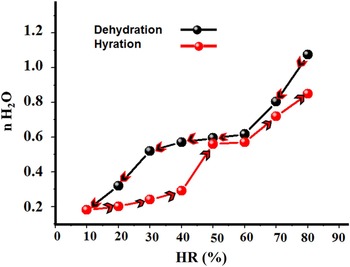
The progress of the interlayer water amounts along the dehydration procedure in the case of SWy-2–Cs complex (Figure 2) is performed along three steps. A gradual disappearance of the H2O molecules from the interlamellar spaces is noted. In effect, a fast decreasing of the water contents is observed between 80≤ %RH ≤60 which is decelerated between 60≤ %RH ≤30.
Progress of the interlayer water amount according to %RH variation along shrinking–rewetting process in the case of SWy-2–Cs complex.

A slow variation in the water amounts towards the lowest RH fields (Figure 2) is distinguished. A different behaviour is observed along the rehydration process and the progress of the interlayer water contents follows others different way along the dehydration procedure. Indeed, by growing the %RH values from 10 to 40, the insertion of the H2O molecules in the structure seems to be hard which is confirmed by the slow water amount variation bringing appearance of a notable hysteresis with a big loop. On the other hand, the continued increase of the relative humidity from 50% RH to the end of the cycle is accompanied by a fast growth of the interlayer water molecule contents. During the studied cycle, the numbers of the H2O molecules calculated through the dehydration process are more important than those determined over the hydration process. Furthermore, it is noted that the SWy-2–Cs complex loose water from the interlamellar spaces at the end of the applied cycle (Figure 2), which prove that material structural properties are affected by the continuous variation of the relative humidity rates.
2. Case of the beidellite SbId-1
a. SbId-1–Na
The water contents variation upon the cycle calculated from the quantitative XRD investigation in the case of SbId-1–Na is represented in Figure 3. The examination of this figure showed a continuous decrease of the interlayer water amount which shift quickly from 80 to 10% RH with the RH values changes. The intercalation of the H2O plane in the structure with increasing %RH rates during the hydration process was characterized by a slow evolution thus the water amounts calculated over this sequence is fewer compared to those calculated over the dehydration procedure. This hydration behaviour incites the appearance of the clear hysteresis, which spreads overall the explored %RH range (Figure 3). This result is probably explained by a structural fluctuation, created with the continuous RH rates changes, over the cycle, inducing a perturbation on the hydration behaviours of the studied specimens.
Evolution of the interlayer water amount according to %RH variation in the case of the SbId-1–Na sample.

b. SbId -1–Cs
The variation of the interlamellar water amounts as function of the %RH values along the shrinking–rewetting cycle (Figure 4) in the case of SbId -1–Cs complex is characterized by the appearance of a clear hysteresis with a big loop founded at a wide RH range spreading between 80 and 10% RH. Indeed, by applying a dehydration procedure (Figure 4) the H2O molecules disappears slowly from structure, but a brief shift is detected toward the lowest RH field between 20 and 10% RH. Along the hydration sequence the interlayer water content is low respected and a different curve of the H2O number evolution upon this process characterized by the truncated water amount at different explored RH values is observed.
Progress of the interlayer water amount according to %RH variation along the shrinking–rewetting process in the case of SbId-1–Cs sample.

The appearance of such hysteresis for different studied smectites is a result of the perturbation on the interlamellar water organization. In fact, the draining and filling of interlayer spaces by H2O molecules is performed in an irreversible way, which can be explained by the structural fluctuation created within smectites structures. In addition, the opening of the interlamellar spaces become hard after decreasing the RH values to the almost dried condition (10% RH) which complicates the hydration procedure.
B. Influence of ionic radius on water retention mechanism
The results deduced through the quantitative XRD analysis shows that the dioctahedral smectites selected for this study (i.e. SWy-2 and SbIb-1) present a different hydration behaviour along the shrinking–rewetting cycle. The size of exchangeable cations is an important factor on determining the amount of water that can be retained in the structure at different %RH rates over the cycle. In fact, the evolution of interlayer water content according to %RH rate the in the case of SWy-Na and SWy-2–Cs [Figures 5(c) and 5(d)] showed clearly that the presence of Na+ cations in exchangeable montmorillonite sites enables the intercalation of the H2O molecules more than in the case of Cs+ cation along the explored RH field. This result is confirmed by the use of the calculated hydration standard deviation (SD) for all specimens, reported in Figure 5. The SD is also useful when comparing the dispersion of two separate data sets that have approximately the same average. The dispersion of the measurements around the mean is narrower in the case of a data set whose SD is smaller. Usually, such an assembly includes comparatively fewer high values or lower values. One selected randomly from a data set whose SD is low may be closer to the average one element of a data set whose SD is higher. By exploiting the given stacked histogram (Figure 6), which focuses the evolution of the SD parameter vs. %RH in the case of all studied complexes, a raised hydration fluctuation is noted in the case of Cs+ cation. This result is interpreted by the effect of the charge location on the exchange process. This problem disappears for the sodium cation and a similar hydration fluctuation is noted in both studied complexes. On the other hand, the investigation of the SD evolution in the case of in the case of SbId-1–Na and SbId-1–Cs, showed that the retained interlayer water amount structures are substantially similar at 80% RH value, whereas a small difference is observed from 30% RH to the almost saturated condition 70% RH [Figures 5(a) and 5(b)].
Average hydration hysteresis (–*–) and the associated SD (——).

Stacked histogram of the hydration SD.

These results are in accordance with literature value which demonstrate that the presence of Na cations with a low ionic radius in both dioctahedral smectites structures allows insertion of H2O molecules unlike the Cs+ ions characterized by a huge size, which restrict the penetration of water in the interlamellar spaces and the hydration of the structures.
IV. CONCLUSION
This paper reports on a detailed the progress of the interlamellar water amount as a function of the relative humidity rates in the case of two dioctahedral smectites saturated by Cs+ and Na+ cations along the shrinking–rewetting cycle. The main results obtained through quantitative XRD investigation show that the continuous variation of the RH rates over the cycle leads to a strong perturbation on the water content within the interlamellar spaces and thus affected their evolutions, which explain the appearance of the clear hysteresis of the explored %RH range for different samples. Moreover, the results suggest that the water retention mechanism of both smectites depends mainly on the size of the interlayer cations. The presence of Cs+ cations in exchangeable sites restricts the intercalation of H2O molecules in the structures of both of the studied samples, which keeps the lowest water amount all over the cycle.
ACKNOWLEDGEMENT
The authors would like to extend their sincere appreciation to the Deanship of Scientific Research at King Saud University for funding this Research group No. (RG - 1435-026).