INTRODUCTION
The literature on African politics is expanding rapidly, not only in the number of publications and substantive issues addressed, but also in the use of methodological approaches ranging from traditional macro-historical descriptive studies to large-N micro-level analysis and, increasingly, experimental techniques. Yet, in spite of all these advances we still lack a good understanding of the ‘nuts and bolts’ of African politics, due to a dearth of good data on the everyday behaviour of politicians. This article contributes to filling that void with a study of the everyday accountabilityFootnote 1 pressures that Members of Parliament (MPs) in Ghana face, and how these pressures shape their behaviour. As an outcome of this largely descriptive venture, the article also engages in a theory-building exercise. The current literature on political clientelism has emphasised factors like the illegitimacy of the state (e.g. Englebert Reference Englebert2000), a lack of credible politicians (e.g. Keefer & Vlaicu Reference Keefer and Vlaicu1997), the role of political machines capable of effective monitoring (e.g. Cox & McCubbins Reference Cox and McCubbins1993; Stokes Reference Stokes2005), the autonomy of brokers (e.g. Beck Reference Beck2008), poverty (Dixit & Londregan Reference Dixit and Londregan1996), and the interaction of poverty and political competitiveness (e.g. Kitschelt & Wilkinson Reference Kitschelt and Wilkinson2007). The following analysis indicates that this large and rigorous literature has nevertheless overlooked the role of informal institutions in shaping political clientelism. While the existing literature finds that political clientelism is an optimal strategy in the context of weak institutions, I suggest that the institution of the office of Member of Parliament in Ghana, while vibrant, is conducive for the provision of private goods in clientelistic networks.
The essay first lays out the typical duties of an MP in single-member districts, and then provides a brief account of the office of Member of Parliament as an institution. The third section offers a descriptive analysis, mapping out the various formal and informal forms of accountability that MPs in Ghana face, while at the same time answering two critical questions: how do MPs prioritise the various accountability demands; and how does this prioritisation affect their behaviour? In two final sections before the conclusion, the article places the empirical findings in the context of the literature on political clientelism, suggesting that the role of strong institutions favouring clientelistic behaviour has been overlooked in the literature, and should be added to the list of explanatory factors for political clientelism.
CORE DUTIES OF A MEMBER OF PARLIAMENT
In presidential democracies where MPs are elected in single-member districts using plurality rules, four core duties are typically associated with the role of the MP: legislation, executive oversight, constituency representation, and constituency service.Footnote 2 Where political clientelism is a prominent feature of the landscape,Footnote 3 provision of private goods in the form of favours, personal assistance, cash handouts and so on is a fifth expected duty. This duty is viewed here through the lens of variations between public, collective, club and private goods. This approach, though unconventional, has the advantage of connecting the analysis of everyday activities of MPs to the established literature on political clientelism, which typically uses the public–private goods framework.
‘Pure’ public goods are non-excludable, non-divisible goods that because of their nature can be expected to be undersupplied by private market forces. Public goods in modern societies are typically valence issues, i.e. goods for which popular preferences are skewed toward the extreme, so that politicians compete not over whether to provide them, but rather over making credible claims that they have the capacity to deliver them (Kitschelt & Wilkinson Reference Kitschelt and Wilkinson2007: 11). Collective goods are ‘impure’ public goods in that they are directed towards a particular collective (such as legislative instruments providing free healthcare for expectant mothers, or general subsidies to sports clubs), but are non-divisible within that group. Club goods are a form of impure public good in which shared goods are used by a smaller collective, a ‘club’ of some sort, such as a village or an organisation. Club goods are excludable and typically also subject to crowding – increased use by members of the club results in interference, such as if too many women want to sell their goods on the local market on Saturdays. Clubs, unlike generic collectives, can regulate such problems by, for example, imposing a fee so those with stronger preferences (or economic strength) can use it more frequently (see e.g. Buchanan Reference Buchanan1965; Sandler Reference Sandler2001: 65–7; Tiebout Reference Tiebout1956). Private goods are excludable down to the level of the individual and, hence, divisible along the same lines. We can now discuss the five possible core duties of representatives elected in single-member districts in terms of provision of various types of goods.
1. Legislation: MPs can chose whether to contribute to the legislative process or not. Having a functioning legislative process enabling the enactment of laws is in itself a public good. If the legislative process is carried out, every citizen ‘enjoys’ it and its ‘consumption’ by one individual diminishes neither the quantity nor the value of this good for another citizen. It is also a ‘lumpy’ public good, in that it is typically provided in big amounts (cf. Taylor & Ward Reference Taylor and Ward1982) rather than incrementally. Activity on the floor of the House as well as in committees requires a minimum number of members present, and before this is achieved no public good is provided, but once the threshold is reached there can in principle be a full provision in terms of legislative activity. The contents of the bills and resolutions usually provide relatively pure public goods (general laws), or collective goods (laws targeting sectoral or other groups). In developing nations such as those in Africa, legislative instruments often also entail provision of club goods, such as enactment of bills providing specific loan instruments to be used for construction of roads between specific locations in particular constituencies, or boreholes or schools in district so and so. The use of legislation to provide private goods for constituents, however, is extremely rare. But again, the focus here is on the legislative process itself, which is a public good.
2. Executive oversight: this second area also provides a public good by its very function. Holding the executive accountable and demanding transparency supposedly enhances its overall performance. In terms of the overall output of goods that are provided by the state, the executive is clearly the dominant actor. Oversight activity focusing on goods for particular constituents, e.g. a borehole or a school building, produces relatively small club goods. Oversight that entails following up on individual constituents' complaints is even more ambiguous. If based on a reasonable and legitimate assumption of wrongdoing on the part of a state institution (e.g. unlawful arrest), the outcome is still a public good in terms of making that state institution perform its function more appropriately and in accordance with the laws – even if it simultaneously produces a private good for the individual citizen. If, on the other hand, oversight is used to influence state institutions (police, courts, etc.) in illicit ways, it produces a private good for individual constituents and simultaneously undermines the public good of a well-functioning state.
3. Constituency representation: this is typically considered a collective good in terms of representing concerns and challenges of a particular area of the country and its people. Naturally, it can become a more impure, i.e. smaller, club good, if and when a member of the legislature performs this function only for a restricted group of constituents.
4. Constituency service: this can be either provision of club goods that again vary with the nature of the service, or it can be concerned with purely private goods. When legislators are entrusted with some form of local development fund (which is becoming increasingly common in Africa), these funds can used for the provision of club goods like roofing sheets for a school, scholarship schemes, community toilets, electrical poles to facilitate electrification of a village, and so on. When the MP is successful in lobbying the government to allocate resources for development projects in his or her particular constituency, the goods are typically collective goods such as roads or schools.
5. Political clientelism: in many settings in the developing world, MPs also produce a series of private goods: personalised assistance, advancement, and benefits for constituents, chiefs, business owners and/or local party activists. These actions are sometimes difficult to distinguish empirically from constituency service, since it can be difficult to tell whether a specific action by an MP delivers something that primarily benefits a ‘club’ of some sort in the constituency, or primarily delivers a private good to an individual. Conceptually, however, the distinction is clear,Footnote 4 and as the following analysis shows, MPs in Ghana themselves have no trouble in differentiating the two categories.
the formal role of the mp in ghana
The present-day Fourth Republic of Ghana was inaugurated on 7 January 1993, and the First Parliament of the Fourth Republic was opened by the then Right Honourable Speaker of Parliament, Justice D. F. Annan. The Constitution (especially Chapter 10) and the Standing Orders of Parliament regulate the formal role of the MP in Ghana. These regulations are fairly standard for legislators in a presidential system with single-member districts, and specify the four formal areas of duty discussed above: legislation, executive oversight, constituency representation and constituency service. There are two other constitutional provisions, however, that merit special mention. First, following the Constitution the president must appoint at least half of his ministers from within the legislature, thus undermining the separation of powers and providing the executive with a powerful instrument of co-optation and subordination of MPs (Lindberg Reference Lindberg2009a).
Second, the office of MP comes with a small ‘slush fund’ for constituency service. Currently 7·5% of state revenues are put into the District Assembly Common Fund (DACF) to be spent on local development by the District Chief Executive (equivalent to a mayor appointed by the president) and the District Assembly (local government) in each district. The MP for each constituency has spending authority over a 5% share of that local fund. At the time of writing, each MP had at his or her disposal the equivalent of about US$34,000 annually from this source. In addition, Ghana is a Heavily Indebted Poor Country (HIPC), and the same decentralised sharing formula was applied to the national HIPC fund, generating about another $9,000 per year. The annual salary including allowances (post-tax and deductions) for MPs is currently about $24,000.Footnote 5
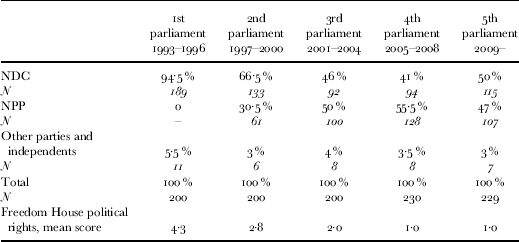
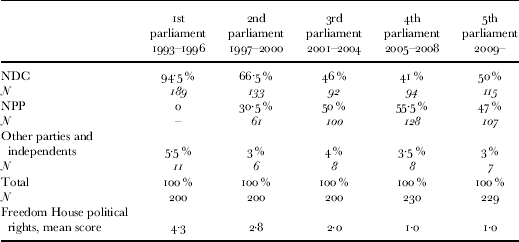
Parliament currently holds three sittings every year, each lasting nine to eleven weeks, i.e. a little more than half of the year. MPs are expected to spend much of the remaining time in their constituencies attending to local issues. There were 200 seats in the legislature from 1993 to 2004, when the number of constituencies was increased to 230. Table 1 displays the number of seats each party has held through the five parliaments in the Fourth Republic.
Number of seats and seat shares of parties 1993–present
Note: One seat remains undeclared after the 2008 election, hence the 229 as total number of seats in the 5th parliament.
Freedom House scores political rights from 7 to 1, with 1 indicating highest level of rights.
Source: Electoral Commission of Ghana and Freedom House.
In brief, the first parliament was essentially a one-party affair after the main opposition party, the National Patriotic Party (NPP), boycotted the legislative elections. Nevertheless, the legislature did assert some independence and, for example, rejected six of President Rawlings' ministerial nominations, as well as fourteen of his bills. The second parliament had a substantial opposition, with the NPP capturing almost a third of the seats. This was, by most accounts, the most vigorous and diligent period of the Fourth Republic. After the NPP take-over in 2001 and during President Kufuor's presidency (2001–8), the autonomy of the legislature as well as its effectiveness as an independent body of legislation, debate and executive oversight was significantly undermined. It is against this background that the present findings are reported, even if the autonomy and strength of the legislature are not the focus here (for details on the above see Lindberg Reference Lindberg2003, Reference Lindberg2009a; cf. Adjetey Reference Adjetey2006).
ACCOUNTABILITY PRESSURES ON MPS – AND HOW DO THEY RESPOND?
So what are some of the accountability demands that MPs in Ghana face, and how do these shape their behaviour? In a series of interviews, MPs were first asked about whether, and if so how, the following eight groups held them accountable: (1) citizens in their constituencies, (2) the local party, (3) the national party, (4) the extended family, (5) chiefs, (6) religious leaders, (7) civil society organisations, and (8) businesses. These questions were semi-structured, so that the nature of the accountability relationship with each group was discussed first separately, and only after that section had been concluded were the respondents engaged in a dialogue about whether it was possible to say that some groups and type of goods were more dominant in their daily work than others. This led to a phase of the interviews where the MP was asked to rank goods and groups in terms of the amount the time and money expended on them. They were then asked how much they, as office holders, felt ‘held accountable’ by various groups (for more on the sample and methodology see the Appendix).
The first regularity is that civil society organisations and religious leaders were unanimously perceived as not holding them accountable to any great extent. Religious leaders ask MPs to attend some functions and perhaps give a modest donation to the church, mosque or equivalent, but that seems to be all. Civil society organisations ‘are critical voices’ but again little is felt in terms of holding MPs accountable. To some extent this also applies to businesses. The increasing role of money in politics is generally acknowledged, with businesses now sponsoring a few candidates' campaigns (expecting something in return), even though this trend is more common among ministers and presidential candidates than ordinary MPs. Among the five remaining groups, MP accountability was rank-ordered as follows.
Rank 1: Personal benefits – clientelistic goods
MPs unanimously report personal assistance and community development as what citizens in their constituencies hold them most accountable for. Personal assistance is also the only form of accountability mentioned with regard to members of the extended family. Personalised clientelism comes in many forms, the most common being monetary assistance – pocket money, for the payment of bills or school fees (very common), for the purchase of food items, monetary assistance for funerals and weddings, or towards start-up cost for small businesses or a farm; the purchase of roofing sheets was also a common request. Less common, but equally as important, are demands for jobs, usually low-skilled jobs in the police (most common) and fire services, the army, or immigration service.
Another cluster of requests for private assistance, common especially in rural areas, pertains to conflict resolution between or among families, villages or tribes, and/or securing the release of individuals from police custody. All respondents claim that they did not interfere with the judicial system, except in cases of wrongful arrests, in which case they are providing a legitimate constituency service, a constituency club good (something I could not verify). But there is a risk of illicit involvement undermining the rule of law.
There was a very clear sense among all interviewees that this form of pressure for personalised benefits had increased sharply between the first and second parliaments (1993–2000), but spiked dramatically over the past four years (2005–8). Various illustrations can be given of this. Campaign spending by incumbents typically increased between two and threefold from 1996 to 2000 (Lindberg Reference Lindberg2003), and this trend has accelerated in the two last election cycles. MPs' election campaigns typically consumed US$3,000 and $10,000 in the 1996 and 2000 races respectively, whereas a typical campaign in 2004 cost the candidate about US$40,000 and in 2008 $75,000, with the most expensive campaign on record estimated by the candidate at $600,000 – a significant amount in a developing nation (Lindberg, forthcoming 2010). For example, cash handouts to sway urban voters amounted in 2000 to about the equivalent of US$0.50, but by 2008 this had risen to US$5–10, a sizeable increase even taking inflation into account. Another example is that in 1992 only a few MPs printed T-shirts; by 1996, most MPs did but only a few hundred, mainly for campaign workers. Beginning from 2000 and especially in 2004 printing T-shirts had become the norm, with MPs printing thousands. By the time of the 2008 campaign, all MPs printed 10,000 or more, and some constituents would not even accept the T-shirts unless they carried brand names like Lacoste.
The personal assistance/benefits type of accountability relationship is the most common in MPs' relationships with their constituents, and the one that puts the most pressure on MPs (according to their own rank orderings), along with the pressure for community development (discussed below). A clear majority of the interviewees rank personal assistance as ‘the thing ordinary constituents hold them accountable for the most’. At the same time, many noted that cash handouts and similar actions have less electoral pay-off than they used to, especially among the youth in urban areas. If this is correct, this part of the clientele is becoming more savvy in using the election campaign as a ‘harvesting season’ as one MP put it, extracting as much as possible from all candidates while avoiding loyalty to the supposed patron. The patrons-cum-candidates who realise this, according to their own account, are seeking to devise new spending strategies that avoid personal goods and instead benefit groups, i.e. club goods.
About half of the MPs report that chiefs in their areas almost exclusively hold MPs accountable for delivery of relevant development projects (more on that below). With regard to what local party activists and executives hold them accountable for, all MPs put personal benefits and assistance, or private goods, at the top. In fact, most of the respondents adamantly complain how instrumental local party executives (parties tend to have one group of executives for each polling station in the constituency) have become in demanding personalised goods in return for their continued support. To exemplify this increase in demand, one MP's story seems to represent the typical situation: in 1992 and 1996 local party executives were given spare parts for bicycles or in some cases used bicycles; by 2000 they all requested new bicycles; in 2004 some started to demand motorbikes; and in 2008 no one asked for bicycles – everyone wanted a motorbike and in some cases even cars. When they ask for money, party executives at constituency level demand the equivalent of US$100–500 on a regular (monthly or bi-monthly) basis. Even the young, unemployed ‘boys’ who help with campaigning demand mobile phones, motorbikes, jobs and start-up capital for their businesses ventures.
So do MPs change their behaviour accordingly? Yes. The two main parties nowadays run primaries in which only the local party executives are enfranchised, giving them enormous leverage to extract personalised goods from candidates. At no point does the accountability relationship between the incumbent MPs and their local party executives seem to be a question of party policy, programmatic ideas, or ideology. The exclusive focus on personalised goods in the accountability relationship between office holders and their local party organisations is perhaps the most worrying trend in this new democracy. The informal norm is that since they made it possible for the MP to come into office, they should now be rewarded with their share. It is an instrumentalisation of party organisation for personal benefit, particularly in ‘safe havens’.
Where do these pressures for personal assistance come from? There are the expected claims from both sides of the aisle that the other party started relying on increasing payments to individual citizens to garner votes. But many also date it from the First Republic (Nkrumah's time), when MPs were a de facto extension of the state and provider of development projects in the rural areas, creating in people's minds a path dependency that has been hard to extinguish. More convincingly, it is also almost unanimously agreed that the clientelistic relationship between MP and constituents stems from the tendency to regard the office of MP as infused with traditional notions of ‘head of family’. In this context, duties are seen to include taking care of constituency members in need. The MP thus has a responsibility to take care of, support, and help when necessary, his or her ‘family’. The moral obligation of an MP couched in these terms, as a person with an obligation to listen to the concerns of members of the family or group, and help in ways he or she can, is very strong, echoing Hyden's (Reference Hyden1983, Reference Hyden2006) ‘economy of affection’. These are the standards according to which modern leaders, as ‘family heads’ of the constituency, are judged, and the sanctions for defection are potentially very damaging. The leader's entire family can be ostracised and this can significantly affect even how children and grandchildren are treated. Leaders who do not fulfil at least some minimum expectations also face the threat of ridicule, shame, harassment, or that members of the family or group simply desert them, leaving them without followers. This logic has now been transposed to the political setting and the role of an MP. The informal institution is a reinterpretation of the father figure who has a moral obligation to solve problems for followers in need. It is not attached to the person in question, as evidenced by the fact that my interviewees uniformly testify that it comes with the office; some of them were surprised to find themselves cast as ‘heads of family’ for the constituency.
In addition, the general perception of ordinary Ghanaians is that whoever is in office is by definition relatively wealthy. In the traditional setting, a wealthier ‘family’ head is expected to ‘drop something’ for everyone who comes near, and give more substantive contributions when there are special needs.Footnote 6 Thus citizens, especially rural folk, feel that they have morally sanctioned claims to the assistance of their MPs. They have a moral right to be listened to and assisted when in need. From the MPs' perspective, it is accordingly in their short-term interest to display wealth, since from the perspective of followers a wealthy benefactor is more likely to deliver than a poor one. Thus showing outward signs of resource-wealth is an important campaign tool inducing more people to be followers, hence voters. It should also be noted that a disproportionate share of the disbursement of personal benefits (in terms of value) seems to go to local party executives. Local party executives are fewer – typically around 100 per constituency – and each vote in the primary elections thus has a higher marginal value.
In short, the traditional institution of a ‘family head’ has been grafted onto the formal institution of the MP. The resulting hybrid institution of the MP is not as weak as one would expect if considering only formal duties like legislation and executive oversight. It is strong, perhaps too robust, just in ways that compel MPs to respond to demands for personalised accountability, which comes in the form of political clientelism.
Yet there are some important variations. The data suggest a clear division between rural and urban constituencies. Whereas most MPs in rural areas report that they cannot deny any but the most outrageous requests from constituents, MPs from urban constituencies typically resist three out of four requests for private goods. This is consistent with findings from previous surveys of voters (e.g. Lindberg & Morrison Reference Lindberg and Morrison2005, Reference Lindberg and Morrison2008). MPs in urban areas know that urban residents instrumentally seek personal benefits from all candidates, but that such gifts do not influence their choices at the polls, which makes it easier for MPs to reject many of these requests. In rural constituencies the need to give at least something, even if only a token, is still a powerful source of pressure because the traditional notion of the head of family is stronger, and the traditional moral obligations are more present.
Rank 2: Constituency service as community development
This is the second most common area of duty for which MPs feel they are held accountable. Constituency service is part of both the formal rules for the MP, and the expectations embodied in informal norms. A little fewer than half of the respondents perceive this to be what ordinary constituents put most emphasis on, and a vast majority feel that this area is what chiefs hold them accountable for. Perhaps surprisingly, office holders do not perceive civil society organisations holding them accountable for this (or anything else). One would have expected, perhaps, that local civil society organisations would hold the MPs accountable for local community development.
The most common collective or club goods for which MPs are held accountable vary according to geographic and socio-economic factors. In coastal areas, MPs are for example expected to ensure that the coastal border control keeps large international fishing boats out of local waters. In North and Upper regions as well as in the areas of germ-infested rivers around the Eastern region, the provision of boreholes is a main consideration, whereas electrification is highly desired in more remote areas. Generally, key demands also include roads, schools, health clinics, toilets, and safe sewage. Pointing to another effect underplayed in the existing clientelism literature, a significant number of MPs found that pressures for private goods from them as ‘family heads’ of the constituency have created positive, strong incentives for them to produce more such collective goods. A prominent example is the new National Health Insurance Scheme, which in principle covers all citizens for a small premium. A few MPs claimed that the sustained and overwhelming pressures on them over the years to pay for an ever increasing number of hospital bills contributed significantly to the decision to create this insurance scheme. In another development where demands for clientelistic politics translate into collective goods, many respondents report that, in order to meet the frequent advances by constituents to pay for schools fees, they have now created scholarship schemes where young students compete and the more talented get their high school fees paid for.
Yet more common is still the perception among MPs that their role as ‘family heads’ puts enormous pressures on them to pay for community development or bring it about by other means (e.g. lobby ministers). MPs have some public resources (the DACF share, HIPC funds) which they often use for school buildings, toilets, roofing sheets, scholarships and boreholes, depending on the needs in the area. But the funds to which they have direct access are limited and do not reach far. Therefore MPs also use a lot of time lobbying ministers and top-level bureaucrats to bring development projects to their constituencies. This is not unique to Ghana or any other African country, but part of the system of ‘pork-barrel’ politics that tends to be more prominent in single-member district systems.
Similarly, chiefs overwhelmingly hold MPs accountable for community development, towards which it seems, especially in rural areas, that chiefs are primarily oriented. Especially in the more rural areas, constituents channel their demands through the chiefs or queen-mothers when they want to put pressure on the MP to ‘bring home’ development projects. This pressure can be quite tangible, as several respondents describe how chiefs send delegations to the MP when Parliament is in session to make inquiries if promised development projects do not materialise soon enough. Chiefs exert considerable powers over MPs from rural constituencies, because they still have significant leverage over rural voting behaviour. MPs in urban areas tend to perceive chiefs as relatively powerless in terms of influencing voting behaviour, and are therefore less responsive to their pressures. Thus, particularly in rural areas, the grafting of the traditional family head institution onto the office of the MP has induced strong pressures to provide at least a significant measure of collective or at least club goods. MPs, in short, go out of their way and use every possible means to provide community development benefits to their constituents as a key strategy to get re-elected.
Rank 3: Constituency representation
A relatively common claim is that the role of MPs as ‘family heads’ makes them more aware of problems in the constituency, thus enabling better representation on the floor of the House. This ‘traditional’ role comes with relatively strong pressures from constituents for MPs to be heard in debates, and seen in the media. This expectation is anchored in the traditional notion that family heads and other leaders must stand up for and speak for their people. Even rural dwellers seem to follow what is reported on TV and the radio, and regard it as very important that ‘their’ MP is seen and heard. The role of the media and access to information is thus critical. Almost all MPs agree that the more the constituents know about what they do in Parliament and in their committees, the more pressure they put on collective goods such as representation when evaluating MPs' performance.
But there is also a clear differentiation between MPs who merely react to existing expectations, and others who invest heavily in educating constituents about the importance of legislative and oversight activities. Reactive MPs seems to be forced to a much larger degree to engage in clientelistic behaviour. MPs who raise the political awareness of citizens in their constituencies reportedly face lower pressures for private, clientelistic, goods as a consequence. This variable cuts across the urban–rural divide, with a clear correlation between the efforts by the MPs to change the nature of accountability relationships in favour of a focus on collective and public, national-level, goods, and the goods they are actually held accountable for. For example, MPs for three of the most rural and poor areas in the sample reported the strongest pressures from constituents on legislative business, whereas several of the office holders from the most urban areas feel little or no pressure in this regard.
MPs who have invested in such citizen-education perceive that it has increased the importance of their legislative activities in the eyes of their constituents, and thus its value for re-election. Rural folks have access to radio and in some areas even television these days, and there is significant coverage of parliamentary business. A few MPs even report that ordinary constituents from rural areas call them on their cell phones to give their opinion on matters before the House, and give feedback on what they heard their MP saying on the floor. MPs who have not engaged in strategic civic education, on the other hand, report that money and personal benefits play a greater and greater part in accountability relationships, while the re-election value of their ‘real’ activities as MPs in the form of constituency representation, executive oversight and legislation has diminished.
None of the office holders finds these pressures to be of decisive importance for re-election, but their significance has nevertheless increased in areas where there is more information and education available. Two MPs for example reported that they knew a few former MPs who had lost their seats primarily due to low performance as representatives voicing constituency concerns at the national scene. About a third of those interviewed also report that they held regular (three to five per year) community meetings to explain legislative business and policy in their areas, and often face questions about new laws and demands to speak up on behalf of their constituents on the floor of the House. These are the MPs who have been most successful in translating the informal ‘family head’ role into pressure for the production of collective goods.
At the same time, the problem of clientelistic provision of private goods is a collective action problem of the prisoner's dilemma type. Everyone has an interest in the production of collective goods, but each individual is always better off free-riding while taking private goods if offered, hence the incentives are stacked in favour of defection rather than cooperation. Yet the MPs who have made inroads into increasing awareness of the costs of failure to provide collective goods are also changing the incentives in favour of collaboration. When more actors are sensitised to the costs associated with defection, it becomes possible to engineer social norms imposing costs on those who defect, thus changing the equation. While the significance of this success in the observed cases should not be overstated, it nevertheless points to the possibility of harnessing traditional institutions grafted onto a modern democratic dispensation, in ways that can effect the production of more public goods and solutions to collective action problems, rather than informal norms undermining formal institutions in favour of political clientelism.
Rank 4: Legislation
None of the MPs reports any significant pressures from constituents, chiefs, the local party, civil society or religious and other community leaders for particular legislation. Legislation is an activity where the accountability relationships are primarily to the executive and to some extent to business and international financial institutions and donors (on loan programmes and related legislation). NPP MPs (before the change of government in January 2009) were under severe and constant pressure from the executive to toe the national party line (defined by the president and his advisors), and deviations were strongly sanctioned through little or no constituency development programmes, and denial of seats on lucrative tender boards and/or board membership of state-owned enterprises, which in turn meant losing out on extra resources crucial for attending to personal constituents' requests. The executive also used ‘brown envelopes’ to reward loyal MPs in general, and specifically used inducements of US$500–2,000 per legislator per occasion, to ensure the smooth passage of bills, loan agreements and presidential nominations. Accountability was about loyalty to the president, and sanctions consisted of concrete material rewards or punishments with serious implications for incumbents' ability to live up to the informal norms of ‘head of family’, and thus by extension to get re-elected. MPs constantly have to secure resources for both constituency development and the provision of private goods to win and hold onto power. The executive branch is aware of this, and uses it to maximum advantage. The effect, however, is that provision of public goods in terms of due diligence in scrutiny of loan agreements, appropriate revision of bills before they are enacted, and active public debate on policy options, has more often than not been compromised.
Rank 5: Executive oversight
This is the least significant area of accountability in practice. Even if pressed, only a few interviewees could find instances of how MPs are held accountable for oversight. There is a small element of this in the representational function, when MPs inquire on the floor of the House about the progress of constituency-specific projects such as roads, bridges and clinics. But these are generally ‘friendly fire’, meant to speed up implementation and to assure constituents that the MP is an active advocate. Oversight is generally very weak in Ghana, and the legislature's role if anything declined over the last two terms of the NPP regime.
It was further undermined by President Kufuor's use of the constitutional provision requiring the president to pick half of his ministers from among MPs. President Kufuor appointed no fewer than eighty-eight ministers and deputies, and went far beyond the 50% requirement in terms of recruiting MPs to these posts. Of all ministers 63% were MPs, compared with exactly 50% during the previous NDC government. Of cabinet ministers 74% were MPs, compared with 24% during the first parliament. In total, 43% of NPP MPs were ministers or deputies. During President Rawlings' second term, fewer than 30% of NDC MPs were ministers or deputies. In addition, President Kufuor created 147 lucrative seats on procurement and tender boards that he could distribute to MPs on the basis of loyalty to him (Lindberg Reference Lindberg2009b). In view of the perks and increased potential for constituency service that came with these positions, the remaining MPs were in effect waiting in line to be appointed at a later stage. In order to be considered, one had to be loyal to the national party line in terms of legislation, and not do any real executive oversight.
In sum, executive oversight is severely underproduced, in part as an effect of weak accountability pressures from constituents and other groups in this area, and partly as a consequence of very strong accountability pressures from the executive in the area of legislation.
HOW DO WE EXPLAIN WHY POLITICIANS DO WHAT THEY DO?
Ghana was a poster-child for economic reform in the 1980s, and quickly became a star-pupil of democratisation in the 1990s, in the eyes of the international community and most scholars. As elected representatives, MPs or their equivalents occupy a vital node in any democratic dispensation. In presidential systems with single-member districts, legislators have critical obligations to check the executive, represent their constituency on the national scene, and find time for constituency service, without allowing this to interfere with their core business of legislating. The descriptive analysis above makes it clear that MPs in one of Africa's most successful new democracies devote a significant portion of their time to producing and distributing private goods to constituents, and much of their remaining time and resources on constituency service, typically in the form of very narrowly defined club goods. Legislating and executive oversight play only marginal roles in their everyday life as parliamentarians. Furthermore, as the present article is one in a series of related works by the author on MPs in Ghana, their constituents and campaign funding, Parliament as an institution, and its relationship to the executive (Lindberg Reference Lindberg2003, Reference Lindberg2009b, forthcoming 2010; Lindberg & Morrison Reference Lindberg and Morrison2005, Reference Lindberg and Morrison2008; Weghorst & Lindberg Reference Weghorst and Lindberg2009), I can confidently say that this analysis, although based on a limited sample of respondents, nevertheless represents a general trend. Furthermore, on the basis of hundreds of previous interviews with MPs and clerks to parliamentary committees in Ghana conducted from 1999 to 2008, two years of participant observation data in the Parliament of Ghana from 1999 to 2001, and many observations made during trips following MPs on their campaign trails as well as everyday trips back to their constituencies, I am in a position to say that legislative activities and executive oversight have diminished in importance over the years for MPs, and an increasing amount of their limited time and resources has been spent on constituency service and distribution of private benefits and goods.
This is worrying from a democratic perspective. But at this point we must stop and ask ourselves: why do MPs in Ghana spend more of their time and resources on clientelism and the provision of narrow club goods? The answer to this question is on one level quite straightforward, and on another complex. The simple answer is that MPs in Ghana tend to conform pretty well to standard assumptions in rational actor frameworks originating from the seminal works of Arrow (Reference Arrow1951), Downs (Reference Downs1957), Neumann & Morgenstern (Reference Neumann and Morgenstern1944) and Olsen (Reference Olsen1965). The typical Ghanaian MP's primary goal is to get re-elected. Each tends to act strategically in pursuit of that goal, while engaged in multiple strategic games. The parameters of those games influence their behaviour, specifically the ways in which MPs try to achieve their overall goal. Hence, since the ordinary citizens in their constituencies primarily hold them accountable for delivery of private goods in the form of personal assistance, cash, social favours, and income-generating activities, MPs spend most of their time and resources on producing these goods. But since this is a very costly strategy, except in extremely poor areas where buying political loyalty is cheaper, MPs also try to accommodate some of these pressures by providing narrow club goods in the form of assistance to villages and townships. In addition, since primary elections are decided by a few electors within the local party, who overwhelmingly require strictly private goods in exchange for loyalty, that is what the candidates provide for this small group of individuals. In short, MPs' behaviour is largely demand-driven, defined by the accountability pressures they face at the micro-level, and legislators act as we would expect strategic actors to do.
But the story is more complex than this simple model. The existing literature on political clientelism is too rich and intricate to review adequately here, but nevertheless offers a few core arguments that we can engage. Based on my previous research, I can testify that political clientelism in Ghana is not the effect of strong political machines capable of effective monitoring of voters' choice, as found by Cox & McCubbins (Reference Cox and McCubbins1993) and Stokes (Reference Stokes2005). Englebert's (Reference Englebert2000) argument is that the root cause of political clientelism in Africa is the widespread popular perception of the state as an illegitimate creation, requiring politicians to mesmerise the populace to acquiesce. Since the state in Africa is associated with colonial rule, abuse of power and oppression, baits like programmatic policy and ideology are not viable options, and politicians turn to political clientelism. Similarly Keefer & Vlaicu (Reference Keefer and Vlaicu1997) posit that political clientelism is a strategy of necessity for politicians lacking credibility. This logic is equivalent to accounts of how political parties (in many parts of the world) differentiate and provide private goods and policy favours primarily to groups who are responsive to material incentives, rather than to constituencies prone to vote on ideological and programmatic grounds (e.g. Lindbeck & Weibull Reference Lindbeck and Weibull1987; Persson & Tabellini Reference Persson and Tabellini2000). Only in Africa, supposedly, almost all voters are predisposed towards material distributions. Following the empirical analysis above, this sits quite well with the perception of MPs that what citizens most of all request are personalised distribution and very narrow club goods. The observation that this is not an immutable situation, however, is also testified and points to mechanisms for incremental institutional change. An individual MP who manages to educate his constituents about the role of the MP, and thus reduces expectations for personal benefits and assistance, changes the incentive structures, which in turn frees up time and money for production of more collective and public goods.
Quite a few scholars attribute such patterns to poverty (e.g. Dixit & Londregan Reference Dixit and Londregan1996). For poor people, immediate improvements of dire material living conditions, even if modest and temporary like a small cash handout or a bag of rice, take priority over more fundamental changes that take a longer time to realise. One reason would be that everyday survival is a prerequisite for anything else. Another reason would be that promises of future improvements are conditioned on many factors, introducing a high level of uncertainty, quite beside the problems of monitoring and enforcement from the point of view of a poor citizen: as the saying goes, a bird in the hand is worth two in the bush. In addition to this, clientelistic distribution is a more attractive strategy for politicians when seeking to persuade poor citizens. The cost of buying political loyalty from a poor person can be assumed to be much lower than beguiling the rich (cf. Stokes Reference Stokes2005). The price, however, can also be expected to vary with the size of the electorate: the larger the number of electors, the smaller the marginal value of each vote.
These theoretical accounts are clearly reflected in the logic of behaviour reported by MPs in Ghana, including the role of relative poverty. Ghana has enjoyed quite dramatic GDP per capita growth over the past fifteen years, and the release of HIPC funds and a series of loan agreements to infrastructural projects resulted in higher wages and living standards for many. It makes sense for MPs to report that the financial burdens of meetings the requests of voters and local party executives have gone up. Yet, the costs have risen far beyond the average level of economic growth. How do we explain this?
Among others, Kitschelt & Wilkinson (Reference Kitschelt and Wilkinson2007) suggest that political competitiveness provides an explanation, and this also makes sense in the Ghanaian case. In safe havens where ordinary voters are irrelevant for the outcome of legislative elections, the now extremely high competitiveness of most primaries has driven up the costs enormously. After that process is over, the candidates use clientelistic goods in the main election mainly to drive up turnout much along the lines suggested by Nichter (Reference Nichter2008) and Dunning & Stokes (Reference Dunning and Stokes2008). In competitive constituencies, MPs report that they use clientelism both to persuade swing voters, and to mobilise people who would, if they vote, support their party, which lends support to earlier findings by scholars such as Magaloni et al. (Reference Magaloni, Díaz-Cayeros, Estévez, Kitschelt and Wilkinson2007).
INTERPRETING THE OFFICE OF MP AS AN INSTITUTION
Yet a vital part of the causal explanation in the Ghanaian case is not captured in the clientelism literature, which tends to assume that state institutions are weak, or at least weak enough to allow for clientelistic strategies to be viable. The empirical analysis above suggests that this may be misleading. The institution of the office of MP in Ghana is not at all weak: rather, it is strong just in ways that promote political clientelism.
The office of MP in Ghana comes with formal duties regarding legislation, executive oversight, and constituency representation and service. In theory, democratically elected office holders should be held accountable by voters for their performance of these formal democratic duties. Yet, there are de facto informal duties with which the MP institution has now been infused, as well as the informal meanings attached to the formal duties of the MP. The MP institution is more than the formal duties, and includes regularised norms that have become institutionalised as reoccurring patterns of accountability relationships expected from any holder of the MP office. The formal side can be observed independently of the individual office holders by analysing the 1992 Constitution, Parliament of Ghana's Standing Orders, records of acts and presidential nominations passed or rejected, salary structures, and the like. The informal norms have to be ‘read’ from the self-reported and observed behaviour of the individual elected as an MP.Footnote 7 By looking at the combination of formal and informal duties for which elected representatives are held accountable, we can establish the ‘real’ hybridised nature of the MP institution.
The full picture is important because, from the theory of games to historical analyses, it has been shown how both formal and informal aspects of institutions shape actors' capabilities and choices (e.g. Axelrod Reference Axelrod1984; Bates Reference Bates1989; Moe Reference Moe1990). Institutions structure choice both by constituting actors (e.g. an individual being Member of Parliament) and by providing incentives for some actions rather than others (e.g. provision of personalised patronage rather than high-quality legislative instruments). Scholars like Cox (Reference Cox1997), Ordeshook (Reference Ordeshook1992), Weingast (Reference Weingast1997) and Vanberg (Reference Vanberg1998) have shown how institutions can be self-reinforcing while having multiple equilibria (cf. Carey Reference Carey2000: 745–6). These are important insights for a study of how the institution of MP in a new democracy like Ghana has merged with pre-existing informal norms, resulting in a hybridised institutional set-up that includes political clientelism as a constitutive part of the institution. Political clientelism in Africa's new democracies may have many historical roots, and may well have originated at some point from demands in society; and it is in all likelihood influenced by the factors evidenced in the existing literature such as poverty, competitiveness, political machines, credibility or legitimacy of politicians. But it is more than that. The evidence from Ghana suggests that political clientelism has become an integral part of the institution of MP itself. Its effects manifest themselves across the continent today, notably in the increasing spread of constituency development funds (van de Walle Reference van de Walle2009). Political clientelism is thus not only a phenomenon to be explained, but increasingly an institutional feature explaining outcomes.
Democracy has come a long way in Ghana since the inauguration of the Fourth Republic in 1993. In the process, the institution of MP has developed a hybrid character, consisting of a combination of standard formal expectations of constituency representation, legislation and executive oversight, and informal norms indicated by being a ‘family head’ of the constituency. Many of the features described above are probably not peculiar to Ghana, or perhaps even to Africa. The hybridisation of the MP's office may thus well indicate a more general phenomenon which has a series of direct and indirect consequences. The summary below is not an exclusive list, and since the negative effects of political clientelism in Africa are so well known, I also take this opportunity to highlight some positive effects of the hybridised MP institution.
The grafting of the informal ‘family head’ institution onto the MP role puts enormous pressures on office holders to be responsive to constituents' needs and priorities, and has also brought in an extra dimension for sanction. While sanction in the formal sense is possible at the ballot box every four years, the informal institution provides everyday tools of shame, harassment, collective punishment of the family, and loss of prestige and status. In effect, the accountability relationship between representative (agent) and citizens (principal) is much stronger than might appear from looking at the formal side of the institution only. There are already some manifest positive effects of this strong accountability relationship. Office holders feel pressured to speak on the floor of the House to bring to bear knowledge of their people's needs on the issues for debate. The norms of ‘parental’ responsibility that force MPs to contribute to the public discourse and constituency representation are positive in effect, even if at this early stage people seem less concerned with what is said by their MP as long as they feel represented. With increased information and civic education, this may become a strong tool for effecting democratic responsiveness and make policy better adapted to the needs of constituents.
Most MPs report that the pressures for personal assistance, besides their negative sides, enhance their knowledge of the problems facing their constituency, which in turn improves their competence as law makers, although it rarely informs executive oversight. The informal institution of being a ‘family head’ also plays an enhancing role in making it a primary concern of MPs to bring development projects to their communities. Here it should also be noted that the traditional duties of the chiefs to represent and look out for their communities, rather than for certain individuals, also seem to play a positive role in promoting the provision of club and collective, rather than private and personal, goods.
A very interesting observation that may force us to refine some of our theoretical models is that the intense pressures for clientelistic accountability for strictly private needs can lead to office holders seeking to provide collective goods. When MPs seek general policy or at least community development solutions, as a means of alleviating some of the pressures for personal benefits arising from unsustainable clientelistic demands, the effect is the provision of collective goods. Widespread pressures to pay for individuals' hospital bills become a national health insurance scheme, invariant demands for payment of school fees become scholarship schemes, and so on. Political clientelism can endogenously undermine the conditions of its own existence.
Among the negative effects are, to mention but a few, the local party organisation members holding MPs accountable for increasingly expensive individual benefits; the executive demanding more or less absolute loyalty; and constituents' accountability pressures making demands on MPs' time and energy. These all act in ways that undermine serious legislative activity and executive oversight. In the case of Ghana, a contributing fact is the use of primaries in the two major parties, and the way these are structured to allow only local party executives to participate.Footnote 8 But part of the problem is also the lack of civic education and access to information which, in combination with poverty, makes clientelism a less expensive means of getting loyal followers than it is in a more affluent society.
In theoretical terms, this analysis suggests that while our existing theoretical models based on rationality assumptions take us a long way to understand the causes and effects of political clientelism, the literature has overlooked an important source of variation. Political clientelism is not necessarily prominent because state institutions are weak, as the current literature suggests. Political clientelism can also be prevalent when institutions are strong, just in ways that favour the provision of private goods.Footnote 9
APPENDIX: SOME METHODOLOGICAL CLARIFICATIONS
The author carried out some about 150 interviews with MPs in Ghana from 1999 to 2007, and also served as a long-term adviser, or ‘Parliamentary Fellow’, from 1999 to 2001. The interviews and observations carried out in this period did not address directly the exact questions that the current project seeks to answer. Therefore, in May 2008, interviews were carried out with eighteen Members of Parliament (MPs) from four different parties. Nonetheless, the 150 or so interviews that preceded this round had much to say about the same topics, and formed an invaluable source of information in preparing the interview guide. In addition, several of the MPs interviewed for this project were also subjects in previous rounds of interviews, and some were also members of committees and caucuses in the Parliament of Ghana with which the author worked as an advisor from 1999 to 2001. So while the sample may seem small, the specific data-gathering exercise in May 2008 was conducted in a context of extensive prior knowledge of the conditions and pressures facing MPs in Ghana. The selection of new interviewees for this round was done with a view to (a) fair representation of the main political parties; (b) talking to more experienced members who may reasonably be assumed to be more knowledgeable about the issues of concern; (c) focus on MPs who could provide a perspective on how things have changed over the years. In part, however, the selection was by chance and determined by availability. Parliament had closed earlier than scheduled when I arrived, so many members were in their constituencies. Many phone calls and a good deal of driving around – as well as spending many hours in Parliament waiting for them to come in for another errand – still made it possible to get a decent sample from all four parties. Since this is an exploratory study aimed at developing hypotheses rather than testing, the sampling is also less of a methodological issue than it would otherwise have been. Yet the sample has representation of all four legislative parties with roughly proportional distribution, and covers most of the ten regions in Ghana, as well as differences with regard to gender, religion, rural and urban constituencies, and MPs who are ministers and those who are not.
The semi-structured interviews were guided by a formula developed in advance, and guarantees of relative anonymity were given to the subjects, meaning that their names are listed at the end of this document but at no point in the text are specific utterances or pieces of information referenced to a particular individual. The key focus was the various forms of accountability pressures they as MPs face and how they respond to them, prioritise, and view their impact on the functions they as MPs are supposed to fulfil. MPs were also asked to specify as much as possible the kinds of private and public goods they have provided to various constituents and others holding them to account. Most interviews also included a discussion of whether there is anything ‘traditional’ about the accountability pressures they face. It should be noted that the word ‘traditional’ in this context in Ghana is non-controversial and comfortably used by both MPs and other citizens, and, as far as it could be determined, it provided a contextually appropriate entry point for this part of the data collection. It is typically used by interviewees to denote something that is currently perceived to be a natural part of Ghanaian socio-cultural norms and practices with historical roots.
The interviews with politicians were supplemented by another set of fifteen new interviews with other persons who could shed further light on these questions and provide other perspectives: members of the Electoral Commission and the Supreme Court, leading party members, senior clerks and staff of Parliament, a couple of local chiefs and donor/diplomatic officers, among others. These were guaranteed anonymity. As far as possible, the information gathered from MPs was cross-checked for general validity and possible political reasons behind the various statements describing their own role and behaviour. In addition, two meetings were held at the Center for Democratic Development-Ghana, with the Director and several of the researchers. Preliminary findings from this study were presented, and alternative interpretations discussed and evaluated, which has also informed some of the interpretations that follow in the analysis. Prior knowledge by the author of the Constitution and the Standing Orders, and much of other relevant regulations as well as the work in the legislature, relieved much of the need for background research. The interviews conducted and data collected specifically for this paper have also been analysed in conjunction with the author's earlier work on the legislature, the MPs and their constituents (e.g. Lindberg Reference Lindberg2003, Reference Lindberg and Barkan2009a; Lindberg & Morrison Reference Lindberg and Morrison2005, Reference Lindberg and Morrison2008).