1 Introduction
In one way or another, historical linguists have always been aware of the limitations inherent to working with linguistic data from bygone ages. One of the most substantial limitations, as Petré points out, is that all speakers of a historical variant of a language are unavailable for psycholinguistic study, essentially leaving researchers with their written records as the sole data source. As such, historical linguists often find themselves taking the role of corpus linguists, trying to understand the workings of a language ‘by studying aggregate data that pools the productions of many speakers and writers – often across different media, genres, registers, and even across different time periods’ (Arppe et al. Reference Arppe, Gilquin, Glynn, Hilpert and Zeschel2010: 3). As Petré points out, the practice of studying language on this aggregate level has dominated the methodologies in historical linguistic studies, and very little attention is paid to the individual level.
This aggregate-level focus contrasts with more experimental approaches to linguistic variation and change, where the relation between individual participants and aggregate or population levels is of more central concern (e.g. Baayen et al. Reference Baayen, Davidson and Bates2008; the studies reviewed in Scott-Philips & Kirby Reference Scott-Phillips and Kirby2010). Drawing inspiration from experimental research, Petré develops a method of ‘experimental corpus study’, in which he uses a large set of ‘found’ corpus data and uses a selected set so that it approximates ‘elicited’ questionnaire data (Arppe et al. Reference Arppe, Gilquin, Glynn, Hilpert and Zeschel2010: 7), aiming to make the most of the – sometimes frustratingly – ‘bad data’ we have (Labov Reference Labov1994: 11). In this response article, I will suggest a complementary approach that can further help to maximally exploit the found historical corpus data in front of us.
2 Why indiviuals matter: mimicking elicited historical data
The method Petré presents is based on a previous study, Petré & Cuyckens (Reference Petré, Cuyckens, Bergs and Diewald2008), in which a mirror set of two constructions was created based on aggregate data. In the present article, however, Petré (this volume) takes this method one step further and applies it to individual language users by compiling a corpus (of minimally 500,000 words) for each author. Each corpus was subsequently searched for progressive [be Ving] followed by a random sample of 100 hits for each author. Subsequently, each randomly retrieved [be Ving] is matched with a mirrored example that contains the same (or equivalent) verb lexeme in the simple present from the same corpus. The appeal of the individualized ‘segregated’ perspective is that it goes beyond descriptive observations about the language as an abstract object, and focuses on teasing out motivated decisions made by individual language users (see Hawkins Reference Hawkins2004). The method is designed to select a set of utterances that are part of the entire body of written outputs of an individual, so that the resulting data set mimics a linguistic questionnaire that could reveal why individuals alternate between [be Ving] and the simple present.
One point that I would like to stress in this response is that, while the method requires the analyst to selectively focus on those utterances where alternation is theoretically possible,Footnote 1 it should not require them to be selective in terms of whether or not the individuals in fact alternate between the two forms. In the context of an actual linguistic experiment with a questionnaire, the possibility in principle always exists that a participant consistently opts for a single variant, which essentially also reveals something about how individual language users deal with alternations. If one is to approach an individual's corpus as a body of completed questionnaires, then, the analyst should allow for the possibility that it is occasionally not possible to create a mirror set for a certain individual because the individual only uses, for instance, the simple present. Indeed, as Petré (this volume) remarks, the ‘main criterion for inclusion was the size of each author's corpus’, and ‘[u]se of present-tense progressive [be Ving] was not a criterion’. Thus, the fact that each corpus allows for sampling a mirror set is not due to the fact that the authors were a priori selected for having variable grammars, but because each author does in fact use [be Ving].
As the methodological design does not include ‘alternates between both variants’ as a selection criterion, the analyst might very well be confronted with the fact that not all individuals alternate, which might raise a number of questions: what if it is the case that a small, considerable, or even large part of the population does not use one of the alternating forms? What kind of clues does that give the analyst about the organisational principles behind the alternation that they are studying? In what follows, I would like to dig into these questions by looking at a concrete example. With this example, I would like to show that it is in many ways undesirable to exclude non-alternating individuals from a study on cognitive motivations behind (changing) alternation pairs. If non-alternating authors are not taken into account, the analyst potentially runs the risk of disregarding an interesting chunk of information that can only be revealed by fully embracing the individual author level.
3 Why all individuals matter: a case study
The particular case I will be focusing on is the competition between two types of deverbal nominalizations in -ing: nominal gerunds (NG), illustrated in (1), and verbal gerunds (VG), illustrated in (2).
-
(1)
-
(a) . . . they shall be pleased to order the Witnesses to be collected, in doing of which there will be very little extraordinary Trouble or Expence. (PPCMBE, 1749)
-
(b) What improvements might also be made are only here proposed to further trial, in order to the having of roses, and perhaps some other flowers. (PPCMBE, 1780)
-
-
(2)
-
(a) Ermine felt her imprudence in having risked the betrayal (PPCMBE, 1865)
-
(b) I was in Court all that day, or the greater part, but I do not recollect being examined on Mr. Hooper's trial. (PPCMBE, 1817)
-
Interestingly, the two forms have presumably been competing over the same functional environments since approximately 1250, when the verbal gerund first arose (Jack Reference Jack1988; Fanego Reference Fanego1996, Reference Fanego2004; De Smet Reference De Smet2008). The examples in (1)–(2) already indicate that the usage profile of nominal and verbal gerunds is not entirely the same: nominal gerunds cannot express secondary tense or voice distinctions and cannot be formed based on the stative verb be, while verbal gerunds seem to do so quite naturally (cf. (2a–b)). Yet there is a considerable amount of functional overlap between the two forms. Consider for instance the gerunds in (3), which are both formed with the base verb eat and both function as a prepositional complement of in.
-
(3)
-
(a) It was rarely observed of Philo, when Adam made that fond Excuse for his Folly in eating the forbidden fruit (PPCEME, 1630)
-
(b) Sir, I never disobey my Father in any thing, but eating of green Gooseberries. (PPCEME, 1696)
-
In the literature on the role of competition in linguistic change, it has been suggested that functional overlap between two (or more) forms in the language system has either one of two outcomes (Traugott & Trousdale Reference Traugott and Trousdale2013: 18). The first outcome is replacement or substitution, with one (or several) of the competing constructions declining (Leech et al. Reference Leech, Hundt, Mair and Smith2009). The other outcome is that both forms are retained. The more traditional assumption when such retention is observed is that both forms continued to exist because the functional overlap between them was sorted out in order to maintain a one-form-one-meaning organisation in the language system (e.g. Mondorf Reference Mondorf2011: 397; Nuyts & Byloo Reference Nuyts and Byloo2015: 34).Footnote 2 In this scenario the competing constructions develop towards a division of labour, as each of the constructions involved comes to be preferred in particular functional niches (Torres Cacoullos & Walker Reference Torres Cacoullos and Walker2009). As Petré’s study indicates, the development towards such division of labour may proceed through various intermediate steps: the progressive first contrasted with the simple present because it was used as a (marked) extravagant form before it became fully associated with non-extravagant ongoing situations.
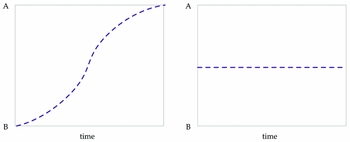
Figure 1 schematically represents the different nature of substitution and retention processes. If a language contains a variant A and a variant B, which are in competition, the picture on the left illustrates a scenario where first only variant B exists, followed by an intermediate stage in which both variants occur. At the final stage, variant B has been replaced entirely by variant A. The picture on the right illustrates a hypothetical case of retention, in which variant A and B exist alongside each other with a relative frequency of roughly 50 per cent for A and B. Both variants continue to coexist as time progresses.
Diachronic substitution and retention in a language

For nominal and verbal gerunds, De Smet (Reference De Smet2008) has suggested that the rise of the verbal gerund constituted a large-scale replacement of nominal gerunds. The functional motivation behind this substitution is attributed to the fact that verbal gerunds are a short (more economic) means of expression, along with the fact that verbal gerunds are more syntactically flexible (De Smet Reference De Smet2008: 60, 95). A similar scenario is proposed in Nevalainen et al. (Reference Nevalainen, Ramoulin-Brunberg and Manilla2011: 12), who suggest (albeit implicitly) that gerunds gradually transform from full abstract nouns with of-phrases into verbal structures. This process of substitution (or transformation) first affected nominal gerunds without initial determiners and in prepositional contexts (by eating (of) the apple, also see (3), (1a) and (2a)), and gradually spread to other contexts (Fanego Reference Fanego2004; De Smet Reference De Smet2013: 138). In more recent research, however, it has been argued that the verbalization of the gerund is perhaps not a clear-cut substitution process, but might in fact be a case of retention and niche-formation. Over the course of early and late Modern English, nominal gerunds have gradually specialized into their own functional niche (Fonteyn et al. Reference Fonteyn, Smet and Heyvaert2015a, Reference Fonteyn, Heyvaert and Maekelberghe2015b), resulting in a tendency towards diagrammatic iconicity with verbal gerunds replacing nominal gerunds in more clause-like functional domains, and nominal gerunds specializing to those functions that are more commonly associated with prototypical nouns (Fonteyn Reference Fonteyn2016).
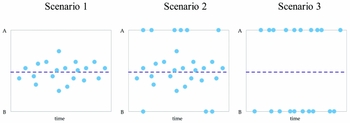
Taken together, it appears that the formal and more recently also the functional-semantic history of the English gerund has been studied quite elaborately at the aggregate level. However, it is not necessarily the case that aggregate-level tendencies accurately (or even roughly) reflect the behaviour of individual language users. This is illustrated in the schematic representation of three hypothetical retention scenarios (through division of labour) in figure 2. If we observe retention (through division of labour) on the aggregate level, it can of course reflect the behaviour of a homogeneous group in which all individuals use the alternation (roughly assigning each form to its specific niche; illustrated in figure 2, scenario 1).
Three artificial scenarios of alternation between variant A and B. The dashed line shows the aggregate-level outcomes, which appear similar in each scenario. The blue dots represent the alternating behaviour of each individual that makes up the population

In a less ideal case, however, the aggregate-level division of labour only represents the behaviour of a part of the entire population. This is illustrated in figure 2 (scenario 2), where a relatively small group of individuals appears to use only one variant, which can be either the new form A (in their study of a range of diachronically changing alternations – including the gerund alternation – these are called ‘progressive individuals’; see Nevalainen et al. Reference Nevalainen, Ramoulin-Brunberg and Manilla2011) or the old variant B (‘conservative individuals’; Nevalainen et al. Reference Nevalainen, Ramoulin-Brunberg and Manilla2011). Finally, in the most extreme case, all individuals are either progressive or conservative, as illustrated in scenario 3. The problem in such a scenario is that the functional–semantic division of labour observed on the aggregate level only exists in the language as an abstract object, and none of the individuals in the corpus actually uses both variants side by side. Consequently, one important question about the historical development of the English gerund that remains unexplored thus far is whether the emerging division of labour described by Fonteyn (Reference Fonteyn2016) exists beyond the aggregate level, and describes an actual cognitive reality for individual language users. To address questions pertaining to the cognition of individual speakers and why the English gerundive system developed the way that it did in more depth, it is important that the aggregate-level findings are considered in light of the behaviour and choices of individual language users.
3.1 Data
In what follows, I will make a brief attempt to segregate the analysis of the aggregate-level findings of studies like that of Fonteyn (Reference Fonteyn2016) by looking at the alternating behaviour of individual authors. Subsequently, I will raise a few questions about what the results mean for the study of alternations. The data presented here have been taken from the Penn Corpus of Early Modern English (PPCEME; Kroch et al. Reference Kroch, Santorini and Delfs2004) and the Penn Corpus of Modern British English (PPCMBE; Kroch et al. Reference Kroch, Santorini and Diertani2010). Both the PPCEME and the PPCMBE are divided into three seventy-year subperiods. I will focus on four sequential time periods: 1570-1639 (E2), 1640–1709 (E3), 1710–79 (L1), and 1780–1850 (L2). These subperiods are the same as those suggested by the corpus developers (Kroch et al. Reference Kroch, Santorini and Delfs2004, Reference Kroch, Santorini and Diertani2010), and genre balance is roughly similar in each of them. For each period I queried all words over four letters ending in -ing (string:\w{2,}ing\b) and subsequently filtered out all participial uses of Ving (progressives, premodifying present participles, etc.), all non-competing gerunds (formed with be, expressing passive voice or secondary tense, etc.), and other irrelevant hits in -ing (e.g. according, painting, evening, . . .).
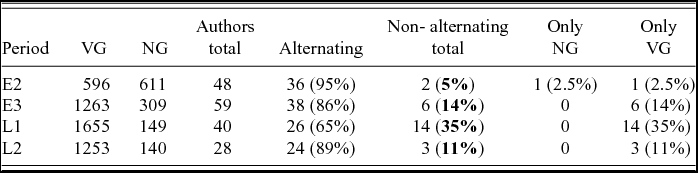
Table 1 lists the absolute frequency of nominal and verbal gerunds attested in the corpus, followed by the number of different authors in each period that used a gerund, the number of individuals that used both nominal and verbal gerunds, and the number of individuals that only used one of the two types. Note that the total number of authors in the Penn corpus for each subperiod is not the same as the total number of alternating and non-alternating authors considered in this case study. There are two reasons for this. First, a small set of authors did not use any type of gerund. In a questionnaire setting, these authors are the equivalent of participants that left the assignment blank. Because these authors did not yield any analysable data, they have been excluded from further consideration. Second, authors whose written output included fewer than five gerunds in total have been excluded to reduce the chance of spurious results.
Frequencies per period

3.2 Discussion
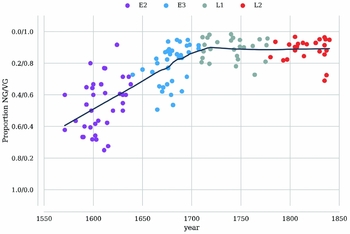
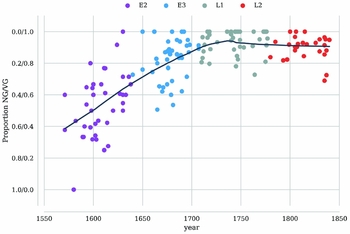
Figure 3 plots the alternating behaviour per individual over the periods under investigation. The smoothed line (Friedman's super smoother; see Friedman Reference Friedman1984) indicates the aggregate-level tendency. Importantly, figure 3 only includes authors that have variable grammars and as such excludes all consistently progressive and conservative individuals.
Diachronic development of the nominal gerund/verbal gerund alternation. The dots represent individual authors. Dots towards the bottom of the graph represent authors who were more inclined to use nominal gerunds, whereas dots towards the top of the graph represent authors who are more inclined to use verbal gerunds. Non-alternating authors are not included.

In the early Modern Period (E2: 1570–1639, E3: 1640–1709), the development resembles a diachronic substitution process (with verbal gerunds replacing the nominal ones), but the proportion stabilizes at roughly 0.1/0.9 in the late Modern period. The vast majority of gerunds are verbal, but the nominal gerund seems to stand its ground in a small usage niche.
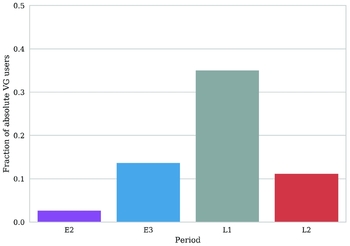
Figure 4, on the other hand, includes the entire set of authors. At first glance, the observed tendency seems largely similar to that in figure 3. However, figure 4 (as well as the frequencies in table 1) indicates that, especially between 1640 and 1779, only a part of the entire population uses both nominal and verbal gerund (see scenario 2 in figure 2). While the number of authors solely using nominal gerunds is quite small and limited to the first period (one author providing more than five tokens, 2.5 per cent of the population between 1570 and 1639), as much as 35 per cent of the entire set of authors use only verbal gerunds between 1710 and 1779.Footnote 3 Put differently, if we attest any sort of functional division of labour between nominal and verbal gerunds in this period, we must be aware that only 65 per cent of the individuals use both forms.
Diachronic development of the nominal gerund/verbal gerund alternation (see figure 3). Non-alternating authors have been included.

Figures such as the ones above raise the question whether one throws out the baby with the bathwater if these non-alternating authors are excluded from the data. The answer to this question is that it depends on a few factors. A closer inspection of the set of non-alternating individuals might reveal that the apparent non-alternating authors are a consequence of ‘bad data’ because the absolute frequency of tokens that they have produced is far from substantial. One way to control for this is to set a minimum number of tokens threshold for each author, or to make sure that a sufficiently large corpus is compiled for each author (see Petré, this volume). Another possible factor to take into account might be that all non-alternating authors have produced texts from a similar genre, which might reveal a genre effect the analyst has to take into account. But if no such circumstances exist, the group of non-alternators might raise more substantial issues. If we find that a (large) share of the population does not abide by the rules we have set out, the motivations and cognitive principles we have uncovered might well not be universal. What does that say about the cognitive reality of the underlying motivations we have discovered? And if we find that the principles that we have described are not universal, how much does that matter?
In the case of the gerund-alternation, I believe that it is perfectly possible that the fraction of non-alternating authors (listed in table 1 and figure 5) reveals something about the status of the division of labour described in, for instance, Fonteyn (Reference Fonteyn2016) in each of the individual time periods. In choosing between linguistic variants, language users are often driven by competing motivations (MacWhinney et al. Reference MacWhinney, Malchukov and Moravcsik2014): on the one hand, principles of economy motivate speakers to opt for the shortest means of expression, while on the other hand iconic principles drive language users to opt for the form that most accurately resembles other linguistic forms in its paradigm (i.e. ‘system pressure’; Haspelmath Reference Haspelmath2014). As already indicated by De Smet (Reference De Smet2008), the rise of the verbal gerund initially constituted a substitution process driven by forces of economy. We could speculate that the growing rate of progressive authors solely using verbal gerunds between 1570 and 1779 might be a reflection of the initial victory of economic motivations.
Diachronic changes in the fraction of non-alternating author solely using verbal gerunds

In the final late Modern period (1780–1850), then, the fraction of non-alternating authors again decreases. While more detailed research on a larger data set is desirable, this could tentatively indicate that by the end of the eighteenth century, other motivations have counteracted the economy-driven substitution process, the majority of language users now starting to assign nominal and verbal gerunds to their own (iconically motivated) niche.
4 Conclusion
As aptly indicated by Petré, aggregate-level studies treating language as an abstract object do not fully comply with the idea that linguistic change is driven by the repeated behaviour of individual language users (see also Croft Reference Croft2000; Scott-Phillips & Kirby Reference Scott-Phillips and Kirby2010). A potentially problematic consequence of studying alternations only on the aggregate level is that one might uncover cognitive–functional divisions of labour between the alternating forms that do not actually characterise motivations adopted by individuals (as in scenario 3, in figure 1, repeated in figure 6 below). As the individual mirror set method presented by Petré focuses on individuals that use both forms simultaneously, it prevents researchers from drawing such problematic conclusions. As it turns out, the linguistic change described by Petré seems to fit the profile of scenario 1, in which all authors alternate in some way or another between progressive [be Ving] and the simple present. The case presented in this response article, however, seems to be more in line with scenario 2, in which the population comprises alternating individuals as well as progressive (and conservative) individuals that consistently use only one variant.
As I see it, the case study and reflections presented in this response suggest two action points for the research agenda of the cognitive historical linguist. First, following Petré, I believe that we have to embrace the fact that there are plenty of I’s in team. Historical linguists interested in revealing cognitive motivations behind linguistic alternations should more often adopt an approach that compares and contrasts aggregate-level with individual-level findings. Second, when studying the diachronic development of alternations on the individual level, we should be careful not to filter out what might be useful data. Reporting the fraction of non-alternating individuals and including their linguistic outputs in the data set is a useful practice, which either supports or raises doubts about the universality of the cognitive principles the study unveils. Either way, it brings us closer to the truth.