Introduction
The growing emphasis on the importance of early identification of and interventions in dementia has led to attempts to define intermediate states between normal aging and dementia (Chertkow et al., Reference Chertkow2007). Mild cognitive impairment (MCI) is predominantly used to categorize this stage. To be diagnosed with MCI, an individual must not meet DSM-IV or ICD-10 criteria for a dementia syndrome, must have self- or informant report of cognitive decline, and should also show evidence of decline over time on objective cognitive tasks and preserved basic activities of daily living, with minimal impairment in complex instrumental functions (Petersen, Reference Petersen2004). Definition of objective impairment is not consistently agreed upon but it has been defined as being one to one-and-a-half standard deviations below the mean (Petersen et al., Reference Petersen, Stevens, Ganguli, Tangalos, Cummings and DeKosky2001; Petersen, Reference Petersen2004). Subgroups of MCI have also been described: “amnestic type”, where memory alone is affected; “amnestic multiple type”, where memory and other cognitive functions are affected; and “non-amnestic type”, where cognitive functions other than memory are affected (Petersen et al., Reference Petersen, Stevens, Ganguli, Tangalos, Cummings and DeKosky2001; Lopez, et al., Reference Lopez, Jagust, DeKosky and Becker2002). These ambiguities in definition are perhaps also why it is difficult to arrive at a clear estimate of prevalence and incidence of MCI. Indeed, in individuals aged 75 years and over, Busse et al. (Reference Busse, Bischkopf, Riedel-Heller and Angermeyer2003) found that prevalence rates ranged from 3% to 20%, depending on the definition applied.
However MCI is defined, there is a high conversion rate to dementia in people with MCI (Grundman et al., Reference Grundman, Petersen and Morris1996). In dementia, there have been a number of studies examining the efficacy of interventions directly targeting cognition such as cognitive training or rehabilitation (e.g. Farinal et al., Reference Farinal2002). Cognitive training involves guided practice on a set of standard cognitive tasks, designed to reflect specific cognitive functions (such as memory), with the aim that practice will restore the underlying impaired function. Cognitive rehabilitation is a collaborative approach that involves developing individualized goals and devising strategies for addressing these. The emphasis is not on improving performance on cognitive tasks per se, but on enhancing functioning in an everyday context. For people with dementia, there is limited evidence for the effectiveness of both approaches (Clare et al., Reference Clare, Woods, Moniz-Cook, Orrell and Spector2003). Consequently, there has been a shift towards studying the impact of such interventions in MCI (Cipriani et al., Reference Cipriani, Bianchetti and Trabucchi2006; Talassi et al., Reference Talassi, Guerreschi, Feriani, Fedi, Bianchetti and Trabucchi2007). Given the primacy of memory in most cases of MCI (Lopez et al., Reference Lopez, Jagust, DeKosky and Becker2002), most intervention studies have concentrated exclusively or largely on amelioration of memory difficulties (e.g. Rapp et al., Reference Rapp, Brenes and Marsh2002; Belleville et al., Reference Belleville, Gilbert, Fontaine, Gagnon, Menard and Gauthier2006; Troyer et al., Reference Troyer, Murphy, Anderson, Moscovitch and Craik2008) and this work is the focus of the current review.
No previous review has focused exclusively on the effects of interventions targeting memory in MCI. Three previous reviews have touched on questions of effectiveness of interventions aimed at general cognition in MCI (Massoud et al., Reference Massoud2007; Belleville, Reference Belleville2008; Jean et al., Reference Jean, Bergeron, Thivierge and Simard2010). A non-systematic review of the effects of cognitive training in MCI (Belleville, Reference Belleville2008) concluded that there was some evidence for the approach in reducing impairment, but that better quality studies needed to be done. However, this review had methodological weaknesses including no detail of inclusion/exclusion criteria and no criteria for evaluation of study quality, meaning that poorly designed and executed studies received the same weight as better designed studies. A systematic review which included cognitive interventions for MCI (Massoud et al., Reference Massoud2007) found that the evidence was insufficient to conclude that organized cognitive intervention was beneficial. However, the review included both pharmacological and non-pharmacological interventions and there were methodological weaknesses. For example, studies that did not distinguish between mild dementia and MCI (e.g. Olazaran et al., Reference Olazaran2004) and those which used the category of “cognitive impairment no dementia” rather than MCI (Tuokko and Frerichs, Reference Tuokko and Frerichs2000), were included.
Pertinent to this review is a recent review of cognitive interventions in MCI (Jean et al., Reference Jean, Bergeron, Thivierge and Simard2010). This study found improvement in just under half of the included studies in objective measures of memory and subjective measures of memory/mood and quality of life. This current review builds upon the work of Jean and colleagues in two main ways. First, whilst addressing many methodological issues, the review by Jean et al. did not include a systematic method for evaluating study quality and did not exclude studies on methodological grounds. In our review, single case studies were excluded and studies were systematically rated for quality. In addition, Jean et al. included studies that evaluated more general cognitive stimulation approaches (e.g. Spector et al., Reference Spector2003). These often stimulate memory more implicitly and have other, more generalized aims (such as improving quality of life). Interventions that are not directly and specifically aimed at improving memory were excluded in this review.
Given the difference in focus of these reviews and their methodological weaknesses, this review aimed to examine the current evidence-base for memory-based interventions for people with MCI. The review focuses only on interventions that are designed to target memory problems, and/or associated activities of daily living. The research questions address the following in people with MCI:
(1) Can memory interventions help people to learn specific information?
(2) Can memory interventions have an impact on objective untrained measures of memory (can they generalize)?
(3) Can memory interventions help compensate for memory impairment?
(4) Can memory interventions improve functioning in everyday life?
Methods
The methodology of Pettigrew and Gilbody (Reference Pettigrew, Gilbody, Michie and Abraham2002) for conducting a systematic review was used as a framework. As the literature concerning the efficacy of memory interventions with MCI is sparse, the inclusion criteria were broad.
Inclusion criteria
• All participants met specific, published MCI criteria (e.g. Petersen et al., Reference Petersen2004).
• Interventions were described as cognitive / memory training, cognitive / memory rehabilitation or memory interventions.
• Interventions were designed to reduce memory impairment or develop compensatory strategies.
• Designs included were RCTs, controlled trials and uncontrolled pre-post studies.
• Articles were published in the English language.
Exclusion criteria
• The sample included participants with dementia.
• MCI sample not distinguished from other ways of defining intermediate cognitive states, such as ‘cognitive impairment no dementia’
• Interventions involved a more generalized “cognitive stimulation” type approach.
Search strategy
The Cochrane database, Medline and Psychinfo were searched in September 2009. The search terms used were (“mild cognitive impairment and cognitive rehabilitation”) or (“mild cognitive impairment and memory rehabilitation”) or (“mild cognitive impairment and memory training”) or (“mild cognitive impairment and cognitive training”). As a second step, potential papers, reports and book chapters were identified from reference lists and a Google search on “Mild cognitive impairment memory cognitive training rehabilitation” was conducted. Finally, titles/abstracts or excerpts were read from all identified studies to ensure they met the inclusion criteria.
Papers which fit the inclusion criteria were examined for quality using criteria appropriate to the study design. For RCTs, the Jadad et al. (Reference Jadad1996) scale was used. Using this methodology, RCTs were scored according to performance in three domains, randomization, blinding and withdrawals and dropouts. The minimum score was 0 and the maximum score 5. Jadad et al. (Reference Jadad1996) found that 99% of poor quality studies score 2 points or less and 71% score more than 2 (Jadad et al., Reference Jadad1996). Therefore a study was designated as good/excellent if it scored above 3, adequate if it scored 3, poor to adequate if it scored 2 and poor if it was below 2.
For other study designs, the York Centre for Systematic Reviews (2001) criteria were used to define a study as poor, adequate or good. This is a list of criteria that non-RCT type studies (e.g. controlled, non-randomized trials and pre-post designs) should meet. The criteria are as follows: (1) Was there adequate description of participants? (2) Was there adequate description of an intervention and who received it? (3) Is measurement likely to be reliable and valid? (4) Are the measures used the most relevant ones for answering the research question? (5) What was the dropout rate and has this introduced bias? (6) Is the length of time long enough to identify changes in the outcome of interest? (7) In studies where two groups are compared, are the groups similar? Were they treated similarly? And if not were there attempts to control for those differences (matching or statistical control)? (8) Was outcome assessment blind to exposure status? In the current review, if a study met all of the criteria it was rated as “good”. If it met half or more it was rated as “adequate”, and if it met fewer than half it was rated as “poor”.
Results
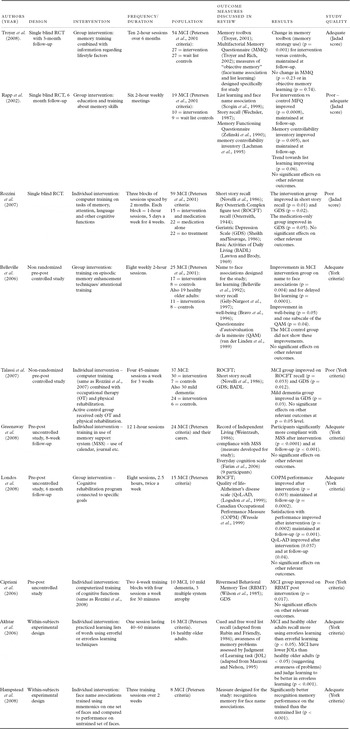
The search identified 226 studies, of which ten were included in the review. The remaining 216 studies were excluded because (a) on reading the abstract/excerpts they were unrelated to the topic for review, (b) they related to MCI but were not intervention studies, (c) they included people with dementia in the MCI sample, (d) they were case studies, or (e) they used categories other than MCI to define the sample, such as “cognitive impairment no dementia”. Of the ten included studies, six were rated as “adequate”, three as “poor” and one as “poor- adequate”. All ten studies are described in Table 1.
Details of the ten included studies

Key for general terms
RCT = randomized controlled trial; MCI = mild cognitive impairment; MMQ = Multifactorial Memory Questionnaire; MFQ = Memory Functioning Questionnaire; ROCFT = Rey Osterrieth Complex Figure Test; GDS = Geriatric Depression Scale; BADL = basic activities of dialing living; QAM = Questionnaire d'autoévaluation de la mémoire; OT = occupational therapy; MSS = memory support system; QoL-AD = Quality of life – Alzheimer's disease scale; COPD = Canadian Occupational Performance Measure; RBMT = Rivermead Behavioral Memory Test; JOL = Judgment of Learning.
Key for study quality
For RCTs: Jadad score 3/5 = adequate; Jadad score 2/5 = poor–adequate; Jadad score 1/5 = poor (Jaded et al., Reference Jadad1996).
For other study types: Four or more of the York Centre criteria met = adequate; fewer than four of the York Centre criteria met = poor.
Results were organized according to the focus of change in an intervention, as specified in the review questions above (i.e. learning specific information, generalization to untrained measures, compensation for memory impairment, effect on everyday life). Where different aspects of a study were pertinent to two or more questions, the different aspects of the study are recorded under the appropriate questions.
(1) Can memory interventions help people learn specific information?
Two studies (Akhtar et al., Reference Akhtar, Moulin and Bowie2006; Hampstead et al., Reference Hampstead, Sathian, Moore, Nalisnick and Stringer2008) looked at the ability of people with MCI to learn specific new information and the conditions under which this was best achieved. These studies did not examine generalization to other non-trained measures and were thus not looking at reducing impairment.
There is adequate evidence that people with MCI can learn new verbal information (Akhtar et al., Reference Akhtar, Moulin and Bowie2006) and faces (Hampstead et al., Reference Hampstead, Sathian, Moore, Nalisnick and Stringer2008), despite showing poorer learning than controls. This learning is aided by using errorless learning (Akhtar et al., Reference Akhtar, Moulin and Bowie2006) and mnemonics such as visual imagery and nicknames (Hampstead et al., Reference Hampstead, Sathian, Moore, Nalisnick and Stringer2008). This learning effect may last up to one month (Hampstead et al., Reference Hampstead, Sathian, Moore, Nalisnick and Stringer2008). These findings suggest that implicit learning strategies such as errorless learning can aid recall of specific information. This is perhaps unsurprising as people with dementia can also learn new pieces of information using these techniques (Clare et al., Reference Clare, Wilson, Carter, Breen, Gosses and Hodges2000). The results of the study by Hampstead et al. (Reference Hampstead, Sathian, Moore, Nalisnick and Stringer2008) suggest that, unlike in studies with an Alzheimer's disease sample, the use of compensatory mnemonic strategies can also be used to aid learning of specific information.
The study by Akhtar et al. (Reference Akhtar, Moulin and Bowie2006) also suggested that people with MCI were both aware of their impairment and of the positive effects of errorless learning. This may be important in rehabilitation. As Clare et al. (Reference Clare, Wilson, Carter, Breen, Gosses and Hodges2000) pointed out in their work with mild dementia, a key component of effective rehabilitation is awareness of difficulty and motivation to change, and knowledge of the effectiveness of an intervention may be an important component of this. Such findings suggest that it may be clinically useful to work individually with people using mnemonics and errorless learning strategies to learn specific pieces of information relevant to them, for example the names of people at a day center they attend.
(2) Can memory interventions have an impact on objective untrained measures of memory (can they generalize)?
Three studies examined performance on neuropsychological tests before and after computerized general cognitive (not memory specific) training. Two were case control studies (Cipriani et al, Reference Cipriani, Bianchetti and Trabucchi2006; Talassi et al, Reference Talassi, Guerreschi, Feriani, Fedi, Bianchetti and Trabucchi2007) and a third was an RCT (Rozzini et al., Reference Rozzini, Costardi, Chilovi, Franzoni, Trabucchi and Padovani2007). All studies used similar computerized general cognitive training packages (although Rozzini et al. combined it with anticholinesterase inhibitors) and showed improvement on at least one of their measures of memory in the group who received this intervention. Such improvements in memory were not found in MCI groups who did not receive the intervention or in groups with dementia who did receive the intervention.
Previous meta-analyses with Alzheimer's patients (Sitzer et al., Reference Sitzer, Twamley and Jeste2006) have shown a greater impact on learning (acquisition of information) versus memory (recall of previously learned information over a delay). In the current study, a consistent pattern was not noted with most studies not clearly separating these processes. Where memory, as opposed to learning, was examined (e.g. delayed recall); it should be noted that one study (Rozzini et al., 2008) found no improvement and another (Talassi et al., Reference Talassi, Guerreschi, Feriani, Fedi, Bianchetti and Trabucchi2007) found improvements.
Although this may appear to provide reasonable evidence for computerized training in improving memory in people with MCI, all studies were rated as being of poor methodological quality. In general, drop-outs were not discussed, raters were not blinded, practice effects were not taken into account, and in the case of the two case control studies, participants were not well defined. There is evidence that in healthy older adults, cognitive training is useful (Verhaeghen et al., Reference Verhaeghen, Marcoen and Goossens1992) and all studies reviewed here showed effects on at least one measure of memory impairment in MCI following cognitive training. However, it is not possible to conclude that there is any good evidence for computerized cognitive training in improving memory in MCI, as the methodological problems in these studies particularly bias them towards detecting a difference when none exists (type-1 error). Thus the implication for rehabilitation is that, until further research is done using good quality RCTs, there is no reason to recommend these interventions in clinical practice.
The computerized interventions all focused on general cognitive training and looked at effects on memory. Three other studies took a slightly different approach and looked at the impact of memory focused group interventions for people with MCI. Troyer et al. (Reference Troyer, Murphy, Anderson, Moscovitch and Craik2008) and Rapp et al., (Reference Rapp, Brenes and Marsh2002) were both reasonably conducted RCTs and Bellville et al., (2006) was a case control study.
Rapp et al. (Reference Rapp, Brenes and Marsh2002) reported no changes in objective memory in an MCI group which participated in a group-based memory training intervention, in relation to a waiting list control group, after the intervention or at six-month follow-up, although there was a self-perceived improvement in memory. While this study was an RCT rated “poor to adequate”, the small sample size and consequent low power made it vulnerable to type-2 error. However, the study's findings were replicated in an RCT by Troyer et al. (Reference Troyer, Murphy, Anderson, Moscovitch and Craik2008), rated as “adequate”. They found no difference in memory immediately or at three-month follow-up, following a 12-session group focused on memory strategy learning when compared to a waitlist control group.
It is important to note that despite randomization, the groups in the study by Troyer et al. (Reference Troyer, Murphy, Anderson, Moscovitch and Craik2008) were not matched at baseline. One possible reason for the lack of significant findings may be that the control group had significantly higher Mini-mental State Examination scores (Folstein et al., 1975) at baseline.
In contrast to the results above, Belleville et al. (Reference Belleville, Gilbert, Fontaine, Gagnon, Menard and Gauthier2006) reported medium to large effect sizes for improvement in memory in an MCI group following group-based memory training when compared to a control group. One of the measures that improved (name/face associations) was a learning (acquisition) measure and another of these (delayed list learning) a memory measure. Thus, unlike in the meta-analysis performed by Sitzer et al. (Reference Sitzer, Twamley and Jeste2006), there was not clear evidence of a differential effect on acquisition as opposed to memory. In any case, whilst this study had some strengths methodologically – for example, the authors corrected for type-1 error when using multiple outcome measures – it was a case control study (and it was not clear how well matched the control and intervention groups were). As Rapp et al. (Reference Rapp, Brenes and Marsh2002) and Troyer et al. (Reference Troyer, Murphy, Anderson, Moscovitch and Craik2008) were adequate RCTs, greater weight should be given to these null results, suggesting little effect of group intervention on memory impairment.
(3) Can memory interventions help compensate for memory impairment?
A distinction can be drawn between internal compensatory strategies, such as mnemonics; and external compensatory strategies, such as diaries and memory aids (Sitzer et al. Reference Sitzer, Twamley and Jeste2006). Troyer et al. (Reference Troyer, Murphy, Anderson, Moscovitch and Craik2008) taught both these types of strategy. Although they found no objective memory change, their intervention group did report greater change in the use of appropriate strategies, such as mnemonics and external aids, than controls. This occurred across three settings: at home, in response to scenarios requiring strategy usage and when strategy use was reported by participants after objective testing. The improvement in strategy usage was maintained at follow up. Rapp et al. (Reference Rapp, Brenes and Marsh2002), taught solely internal compensatory strategies and reported the opposite result: strategy usage did not improve in the intervention group. This was unlikely to be due to low power, as controls actually reported more strategy use.
Greenaway et al. (Reference Greenaway, Hanna, Lepore and Smith2008) report on a cohort study evaluating an individualized program teaching the use of a memory management system (essentially a diary and calendar) to people with amnestic MCI and their carers. Compliance with the system improved post training and this improvement was maintained at eight-week follow-up. This study lacked a control group, and intervention providers themselves rated the performance of the clients in learning, which might have biased their ratings. Results of the study by Hampstead et al. (Reference Hampstead, Sathian, Moore, Nalisnick and Stringer2008) provide evidence that internal strategies (mnemonics) can also aid memory for specific information.
The findings of Troyer et al. (Reference Troyer, Murphy, Anderson, Moscovitch and Craik2008) suggest that people with MCI could learn strategies which, in theory, could help them to compensate for their memory difficulties. However, the lack of change in objective memory performance or self-reported memory performance at home, despite increased reported strategy use in both these settings, perhaps indicates that participants could not use these strategies to improve actual memory performance. Further research into the linkages between strategy development and everyday performance would be useful. The finding of Rapp et al. (Reference Rapp, Brenes and Marsh2002) that strategy use was not aided by training was probably not due to a lack of power, but perhaps to a difference between their intervention and that of Troyer and colleagues. Rapp et al. (Reference Rapp, Brenes and Marsh2002) did not focus as explicitly on strategy use in everyday situations and had six sessions as opposed to 12. This suggests that, while interventions to develop compensatory strategies may be clinically useful, they may need to be of sufficient duration. Although lacking a control group, the finding of Greenaway et al. (Reference Greenaway, Hanna, Lepore and Smith2008) that people with MCI could learn to use a memory management system adds to the evidence base for teaching compensatory strategies in MCI. Of note, they were the only authors to have an observer-rated measure, which may be more valid than relying on self report in cognitively impaired individuals (e.g. Clare et al., Reference Clare, Wilson, Carter, Breen, Gosses and Hodges2000).
(4) Can memory interventions improve functioning in everyday life?
Londos et al. (Reference Londos, Boschian, Linden, Persson, Minthon and Lexell2008) report on a cohort study of a group of 15 amnestic MCI patients. They enrolled in an intervention involving training on strategies for managing memory in everyday life and showed increases in self-reported performance and satisfaction with performance of everyday activities. The changes were maintained at six-month follow-up. The participants were well described, as was the intervention, and drop-outs were also discussed. The study lacked a control group, and the fact that the Canadian Occupational Performance Measure is a self-report measure is a limitation as people with cognitive impairments are often not reliable informants. Scores on self-reported measures of cognition in such populations may be more closely related to mood than cognitive function (Bolla et al., Reference Bolla, Lindgren, Bonaccorsy and Bleecker1991), and mood did improve post intervention in this study.
Three other studies examined the self-reported impact of interventions on everyday activities and found few effects. Belleville et al. (Reference Belleville, Gilbert, Fontaine, Gagnon, Menard and Gauthier2006) reported a significant difference in one subscale of a measure of impact. However, other subscales did not change and the results were not corrected for multiple comparisons. Rapp et al. (Reference Rapp, Brenes and Marsh2002) found no improvement in the impact of memory difficulties on everyday life. Troyer et al. (Reference Troyer, Murphy, Anderson, Moscovitch and Craik2008) reported no difference between groups in self-reported impact of memory on everyday life.
Evidence suggests that although people with cognitive difficulties may report on their own functioning, such reports may not be related to their actual functioning (e.g. Klepstad, 2000). In contrast, carer reports of functioning may be correlated with actual functioning (e.g. Ready et al., Reference Ready, Ott and Grace2002). Three studies included informant-reported measures. Rozzini et al. (Reference Rozzini, Costardi, Chilovi, Franzoni, Trabucchi and Padovani2007) and Talassi et al. (Reference Talassi, Guerreschi, Feriani, Fedi, Bianchetti and Trabucchi2007) used the Basic Activities of Daily Living Scale (Lawton and Brody, Reference Lawton and Brody1969) and no change was reported, which was unsurprising as it is designed to assess gross changes in function which are not expected to be affected in people with MCI. Greenaway et al. (Reference Greenaway, Hanna, Lepore and Smith2008) found no change in carer report of everyday functioning on a similar measure, the record of independent living (Weintraub, Reference Weintraub1986). They note, however, that when the E-Cog (Farias et al., Reference Farias, Mungas, Reed, Harvey, Cahn-Weiner and DeCarli2006), a more sensitive measure designed specifically for MCI, was administered to ten participants, there was, “a trend towards significant improvement”.
Discussion
Summary of findings
Ten studies were included in this review. They provide some evidence that memory interventions can help people learn new information, using strategies such as errorless learning. This may have important clinical implications, with the possibility of interventions being designed around learning specific valued pieces of information as has already been done in dementia (Clare et al., Reference Clare, Wilson, Carter, Breen, Gosses and Hodges2000). The finding that mnemonic strategies can also aid learning (Hampstead et al., Reference Hampstead, Sathian, Moore, Nalisnick and Stringer2008) has not been demonstrated in dementia samples. There was less evidence that computerized memory training or group interventions can generalize to reduce the level of impairment as measured by performance on pre-post tests of memory. This is perhaps unsurprising given the lack of evidence for computerized memory training in other populations, such as mild dementia (Clare et al., Reference Clare, Woods, Moniz-Cook, Orrell and Spector2003), and the fact that there is little generalization from computerized cognitive training to untrained tasks in “cognitively normal” individuals (Owen et al. Reference Owen2010). All results should be interpreted with caution, as only one study was an RCT of “adequate” methodological quality (Jadad et al., Reference Jadad1996), and all the remaining studies were of poorer quality.
There is some evidence that it can be helpful to teach internal and external memory strategies to people with MCI. The one study that contradicted this (Rapp et al., Reference Rapp, Brenes and Marsh2002) had a short time frame and taught several different strategies. The more successful interventions were either longer (Troyer et al., Reference Troyer, Murphy, Anderson, Moscovitch and Craik2008), focused on learning a single strategy (Greenaway et al. 2009) or the learning of very specific information with strategies directly related to that information (Hampstead et al., Reference Hampstead, Sathian, Moore, Nalisnick and Stringer2008).
There is, however, controversy about whether interventions aimed at compensatory strategies or enhanced learning of new information can affect performance in everyday life. This perhaps is because, by definition, cognitive difficulties in MCI have little impact on everyday function in the first place. However, other authors suggest that measurement of more subtle disturbances indicates that complex activities of daily living are affected in MCI (Farias et al., Reference Farias, Mungas, Reed, Harvey, Cahn-Weiner and DeCarli2006) and memory interventions may impact on these more complex skills (Greenaway et al., Reference Greenaway, Hanna, Lepore and Smith2008).
Limitations
There was heterogeneity in terms of target population, method of delivery, length of treatment and level of impact, suggesting many possible reasons for results to differ across studies as well as the actual content of the interventions. The main limitation, however, was the poor methodological quality of included studies, limiting the degree to which results can be interpreted and generalized. There are definitional problems with the term MCI, for example a lack of agreement on what constitutes “objective memory impairment” (Chertkow et al., Reference Chertkow2007).The consequent heterogeneity within the concept of MCI implies that samples may have been dissimilar to each other and that this, rather than differences in intervention, may account for varying results between studies. The concept of MCI is perhaps best viewed as capturing a heterogeneous group which may include some people in a dementia prodrome state and others who are not (Chertkow et al., Reference Chertkow2007). Perhaps due to these conceptual controversies, there does not appear to be a clear theoretical framework for explaining the mechanisms of cognitive decline in MCI.
A further limitation is the use, in many cases, of a “treatment as usual/wait list control group”. This means that it is often difficult to separate out the aspect of the intervention that is effective. There is often a lack of consensus about the appropriate control group to use in these types of studies. Finally, although many of the included studies did not base their interventions on a theoretical understanding of the breakdown of memory function in MCI, some of the studies reviewed here (e.g. Hampstead et al., Reference Hampstead, Sathian, Moore, Nalisnick and Stringer2008) have tried to address this and on the basis of such work we have tried above to make clinical and research suggestions.
Future research
A useful avenue in developing future interventions might be the combination of mnemonic strategies and implicit learning procedures, such as errorless learning and spaced retrieval, to enable patients to learn valued pieces of information (e.g. names of people in a day centre). The poor quality of studies examining computerized interventions suggests that further quality studies in this area may be useful. Given that in Alzheimer's disease there is relatively more impact on acquisition processes than overall memory processes (Sitzer et al., Reference Sitzer, Twamley and Jeste2006), future research may use measures of both acquisition and overall memory to assess for differential effects. The use of memory enhancement strategies (e.g errorless learning/spaced retrieval) to learn compensatory strategies (e.g. a diary system) could be examined in future research, which could also examine the ability to utilize these compensatory techniques in everyday life using either behavioral observation or standardized carer report measures. Finally, all future research should employ sound methodology, including long-term follow-up (to establish the maintenance of any benefits) and the more selective use of outcome measures, reducing the chance of type-1 error.
Conclusions
Whilst this review points to potentially promising results in the use of memory interventions for people with MCI, there is no quality, consistent evidence to support any one intervention and further research using more rigorous methodology is urgently required. Clinical interventions should involve strategies which are specific to the patient's context and situation, and should be taught intensively for a reasonable period of time. It may be that learning compensatory strategies may be best achieved using implicit memory enhancement techniques such as errorless learning. While the focus of this review was on memory, mood improved in all the studies where it was measured (Belleville et al., Reference Belleville, Gilbert, Fontaine, Gagnon, Menard and Gauthier2006; Rozzini et al., Reference Rozzini, Costardi, Chilovi, Franzoni, Trabucchi and Padovani2007; Talassi et al., Reference Talassi, Guerreschi, Feriani, Fedi, Bianchetti and Trabucchi2007; Londos et al., Reference Londos, Boschian, Linden, Persson, Minthon and Lexell2008). This suggests the possibility of secondary benefits, possibly through giving people some sense of self-efficacy and control in their lives. Hence, even in the absence of an effective evidence-base, there may be clinical justification for doing such work. The relatively short time-frame of interventions required for a significant improvement is promising for workers in busy clinical settings.
Conflict of interest
None
Description of authors' roles
Joshua Stott designed the study, collected the data, analyzed the results and wrote the first draft of the paper. Aimee Spector commented on and revised several further drafts of the paper.