Introduction
The word consanguinity is an acquired Latin word that comes from the combination of the two words ‘con’ meaning ‘common’ and ‘sanguineous’ meaning ‘blood’. Consanguinity has several degrees: first cousin (e.g. a man’s marriage to a daughter of a paternal uncle, daughter of a maternal aunt, daughter of a maternal uncle, etc.), second cousin (e.g. marriage to a grandchild of a paternal uncle, grandchild of a maternal aunt, grandchild of a paternal aunt, etc.) or third cousin (e.g. marriage to a great-grandchild of a maternal aunt, grandchild of a half-aunt, great-grandchild of a paternal aunt, etc.) (Nouri et al., Reference Nouri, Nouri, Tirgar, Solimani, Yazdani, Zahedi and Larjeni2017). Consanguineous marriage is defined as a union between two individuals who are related as second cousins or closer (Joseph et al., Reference Joseph, Pavan, Ganapathi, Apoorva, Sharma and Jhamb2015). Consanguineous marriage rates vary from one population to another depending on culture, religion and geographic area (Tadmouri et al., Reference Tadmouri, Nair, Obeid, Ali, Khaja and Hamamy2009). First-cousin marriages are the most prevalent type of consanguineous marriage all around the world (Tadmouri et al., Reference Tadmouri, Nair, Obeid, Ali, Khaja and Hamamy2009).
Consanguineous marriage is rare in most Western countries. In Europe, the rate of consanguinity is less than 0.5% (Bittles, Reference Bittles2008). In contrast, the prevalence of consanguineous marriages in the Middle East is very high; for instance, in Jordan it is 35% (Islam et al., Reference Islam, Ababneh and Khan2018). In general, the highest rates of marriages to close relatives are consistently reported among the poorest and least-educated people in society (Bittles et al., Reference Bittles, Grant and Shami1993).
In Saudi Arabia, the prevalence of consanguineous marriage seems not to be decreasing, despite increases in the educational levels of both males and females (Alsuwaida, Reference Alsuwaida2016). A 1997 study reported that the prevalence of consanguineous marriage in Saudi Arabia to be 51.3% (Husain & Bunyan, Reference Husain and Bunyan1997). Ten years later, El-Mouzan et al. (Reference El-Mouzan, Al-Salloum, Al-Hebish, Qurachi and Al-Omar2007) found the total prevalence to be 56%, with the prevalence of first-cousin marriage being 33.6%. Furthermore, a more recent study demonstrated that there was no decrease in the prevalence of consanguineous marriage across generations in Saudi Arabia (Warsy et al., Reference Warsy, Al-Jaser, Albdass, Al-Daihan and Alanzi2014).
Several studies have agreed that consanguineous marriage is a risk factor for congenital anomalies, sickle cell anaemia and thalassaemia (Becker et al., Reference Becker, Al Halees, Molina and Paterson2001; Saeed & Piracha, Reference Saeed and Piracha2016; Zaini, Reference Zaini2016). This highlights the importance of investigating factors enhancing consanguineous marriage to design appropriate strategies to decrease its prevalence in Saudi Arabia.
A study conducted in the Emirates in 2016 revealed that a high education level was unlikely to affect the selection of kin for a spouse among Emirati medical students (Bakoush et al., Reference Bakoush, Nicholls and Denic2016). However, no study to date has been conducted to investigate the effect of educational level on consanguineous marriage among adults in Saudi Arabia. This study was therefore conducted to investigate the current prevalence of consanguineous marriage among educated married adults in Riyadh and to determine its pattern and the factors favouring consanguineous marriage.
Methods
Study population and sample selection
The cross-sectional study was conducted to estimate the overall prevalence of consanguineous marriage among educated married adults in Riyadh, Saudi Arabia. The study was conducted between 17th September 2017 and 12th May 2018. The study population consisted of educated married Saudi adults (both males and females) aged 18–64 years living in Riyadh. The sample size was calculated using the Epi info program V.6. The total number of married Saudi adults aged 18–64 years living in Riyadh was estimated to be 1,888,513 (General Authority for Statistics, 2016). The prevalence rate of consanguineous marriage documented in previous studies was 56% (Al-Abdulkareem & Ballal, Reference Al-Abdulkareem and Ballal1998). The calculated sample size based on these figures was 379 participants with 95% CI. An online questionnaire was designed and distributed through social media. A total of 550 online questionnaires were sent to married adults of both sexes and 417 of them responded. The response rate was 75.8%.
Data collection
A questionnaire was distributed via various social media platforms. This consisted of two main sections. The first section assessed the socio-demographic characteristics of the participants: age (<25, 25–40 and >40 years), sex (male or female), educational level (primary, intermediate, high school or college degree and above), area of residence in the city (East, West, North, South or Centre), family size (≤4, 5–8 or ≥9 household members), monthly income (of all household adults in Saudi Riyals per month; <5000, 5000–9999, 10,000–14,999, 15,000–19,999 or ≥20,000) and working status (working, not working or student). The second section was about consanguineous marriage, either among the studied sample or their parents, and its degree if present (first cousin, second cousin or more distant), family history of consanguineous marriage, personal preference for consanguineous marriage (yes, no or neutral) and awareness about its negative consequences (yes or no).
Statistical analysis
Data were collected, coded and tabulated using SPSS V.23 and Epi info V.6. Analysis of data was done using descriptive and inferential statistics. Descriptive statistics were in the form of frequency tables for categorical variables. Inferential statistics were done by calculating odds ratios and binary logistic regression tests to detect the factors predicting having a consanguineous marriage among the studied sample. A p-value less than 0.05 was considered significant.
Results
Characteristics of study participants
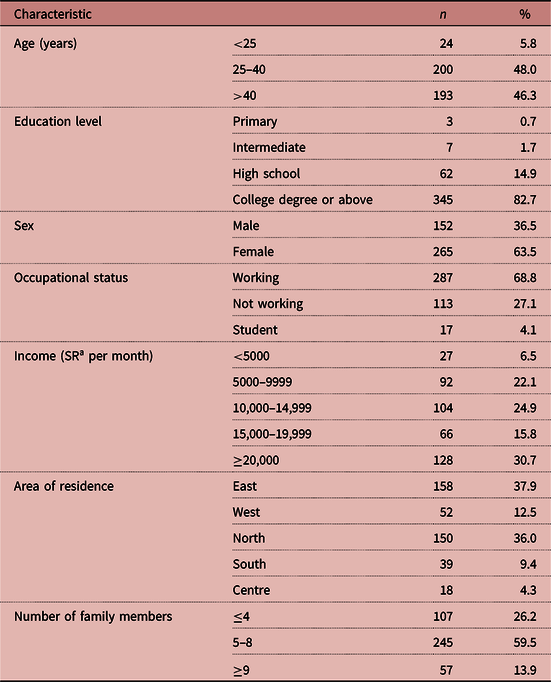
Table 1 shows the socio-demographics characteristics of the study participants. Nearly half were aged between 25 and 40 years, and their education level was generally high. Different categories of income were represented in the participant sample. It is worth mentioning that all five of the main residential sectors of Riyadh City were represented in the sample. This is important because these different areas have different levels of social status. Family size was between 5 and 8 household members for most of the participants; 20% lived in an extended family (several generations of the same family living in the same household) and 80% lived in a nuclear family (two parents living with ‘one or more’ child in the same house).
Socio-demographic characteristics of the study participants, Riyadh City, 2017–18, N = 417

a SR = Saudi Riyals.
Prevalence and determinants of consanguineous marriage
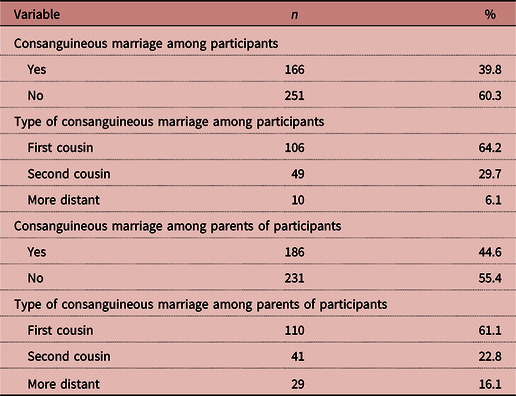
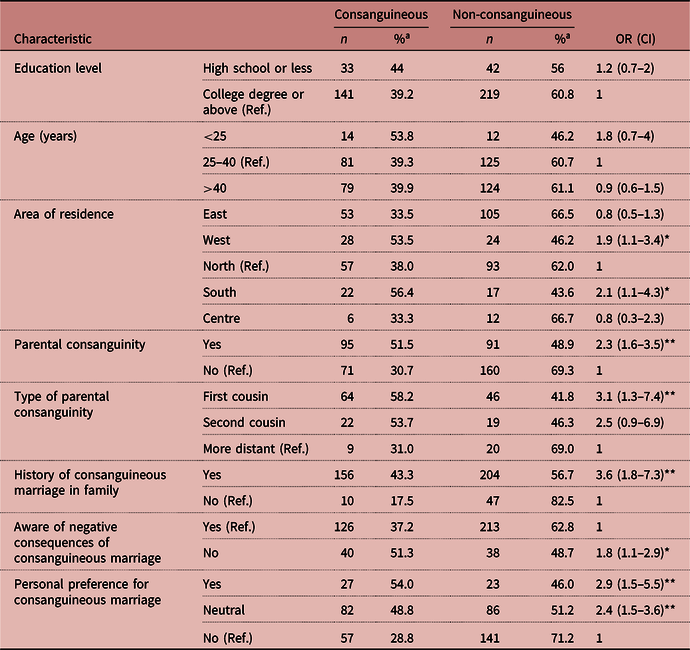
The overall prevalence of consanguineous marriage was 39.8% among the participants and 44.6% among their parents. In both generations, first-cousin marriage was the preferred pattern, and accounted for 60% of all consanguineous marriages in both generations (Table 2). Neither educational level nor age affected the odds of having a consanguineous marriage (see Table 3). Those living in the South or West regions of the city were twice as likely to have a consanguineous marriage than those living in other areas of the city. A consanguineous marriage was three times more likely to occur among those who had a family history of consanguineous marriage or who had consanguineous parents. Also, it was two times more likely to occur among those who were not aware of its negative consequences than among their counterparts.
Prevalence of consanguineous marriage among the participants and their parents

Determinants of consanguineous marriage among study participants

a Row percentage.*p<0.05; **p<0.01.
A personal preference for consanguineous marriage was significantly associated with an increased likelihood of having a consanguineous marriage, increasing the odds by about three times compared with those without a personal preference.
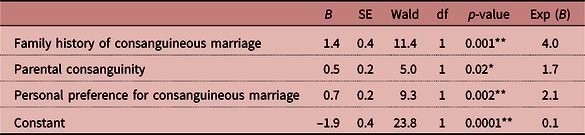
Table 4 shows the results of the logistic regression analysis. The predictors of having consanguineous marriage were: having a personal preference for it, having a family history of a consanguineous marriage and having consanguineous parents.
Logistic regression predicting consanguineous marriage among study participants

*p<0.05; **p<0.01.
Discussion
The study found that the overall prevalence of consanguineous marriage among educated married adults in Riyadh in 2017–18 was still high at 39.8%. The prevalence of consanguineous marriage among the general population in Saudi Arabia has been reported in previous studies. In 1995, a study on 3212 Saudi families living in different areas of Saudi Arabia found its prevalence to be 57.7% (El-hazmi et al., Reference El-hazmi, Al-Suwailem, Warsy, Al-Suwailem, Sulaimani and Al-Meshari1995). Ten years later, similar high rates were reported by El Mouzan et al. (Reference El-Mouzan, Al-Salloum, Al-Hebish, Qurachi and Al-Omar2007). Their study was conducted on 11,554 individuals in different regions of Saudi Arabia and found a prevalence of 56%, with higher rates in rural than urban areas (59.5% vs 54.7% respectively). A slightly lower rate of 52% among married females was reported in a study conducted in the large Saudi Arabian city of Dammam (Al-Abdulkareem & Ballal, Reference Al-Abdulkareem and Ballal1998).
The overall prevalence of consanguineous marriage reported in the present study (39.8%) seems to be lower than the rate reported in previous studies. This can be attributed to the different study populations (general population in other studies vs educated adults living in a big city in the present one). However, the present study demonstrated that this rate reached more than 50% in some areas, such as the West and South sectors of Riyadh (Table 3). This may indicate that the consanguineous marriage rate was still high in 2017–18, even among educated adults in some areas of Saudi Arabia.
When studying the rate of consanguineous marriage in two different generations, the present study did not find a big difference in consanguinity rate between the participants and their parents (39.8% vs 44% respectively). There could be many reasons why consanguineous marriage is favoured in this population. Cultural and social factors are probably more involved than religious ones. Consanguineous marriages are considered to be more stable and have economic benefits (Jaouad et al., Reference Jaouad, Elalaqui, Spiti and Elkerh2009). It is believed that consanguinity will help to strengthen family relationships and enforce family bonds. It may also be favourable for women due to them having better relationships with their in-laws, who can help and support them when they need it. Some prefer consanguineous marriage because they think that it will reduce their financial problems (Hamamy, Reference Hamamy2012).
This high reported prevalence of consanguineous marriage resembles the situation in Oman, where it has reached 50% of all marriages, and in Jordan, where it has reached 50% as well (Khoury & Massad, Reference Khoury and Massad1992; El-hazmi et al., Reference El-hazmi, Al-Suwailem, Warsy, Al-Suwailem, Sulaimani and Al-Meshari1995).
First-cousin marriage was the most prevalent type of consanguineous marriage in both generations in this study. The same pattern was reported in another study investigating consanguineous marriage in different provinces in Saudi Arabia (El-hazmi et al., Reference El-hazmi, Al-Suwailem, Warsy, Al-Suwailem, Sulaimani and Al-Meshari1995); their study found that first-cousin marriage was the preferred pattern in each province. The same pattern has been noted in Iran, where 74% of all marriages have been found to be consanguineous with 60% married to first cousins (Nouri et al., Reference Nouri, Nouri, Tirgar, Solimani, Yazdani, Zahedi and Larjeni2017). Consistent with these findings, a study in Egypt revealed that the most prevalent type of consanguineous marriage in both rural and urban areas was first-cousin marriage (Hafez et al., Reference Hafez, El-Tahan, Awadalla, El-khyat and Abdelgafar1983).
The study found that participant’s level of education did not have a significant effect the prevalence of consanguineous marriage, suggesting that other factors are affecting this. Similarly, a study in Dammam reported that a high level of education did not decrease the prevalence of consanguineous marriage; indeed, it was higher among highly educated females with a college degree than among those with an intermediate level of schooling (41.2% vs 36.6% respectively) (Al-Abdulkareem & Ballal, Reference Al-Abdulkareem and Ballal1998). However, another study in Jordan reported that the higher the level of education of a female, the lower the consanguineous marriage rate (Khoury & Massad, Reference Khoury and Massad1992). This could be because, in the Jordan study, the comparison was done between literate vs illiterate females, but when the educational level was differentiated, the university-educated group behaved like the illiterate group.
The present study found the consanguineous marriage prevalence to differ significantly between geographical areas. Higher rates were recorded in the South region of Riyadh (56.4%), which has a generally lower social level compared with other regions. This demonstrates a possible association between lower social class and increased prevalence of consanguineous marriage. Also, a significant association was found between having a consanguineous marriage and parental consanguinity; those who had consanguineous parents were twice as likely to have consanguineous marriages than those without consanguineous parents, and these odds increased to three times if the parents had first-cousin consanguinity. These findings demonstrate that the tradition of marrying within the family was till a preferred practice in Saudi Arabia in 2017–18. This is comparable to the findings of a study by Warsy et al. (Reference Warsy, Al-Jaser, Albdass, Al-Daihan and Alanzi2014) in Saudi Arabia, who reported that parental consanguinity was significantly associated with increasing consanguineous marriage in daughters (Warsy et al., Reference Warsy, Al-Jaser, Albdass, Al-Daihan and Alanzi2014).
Another factor that showed a significant association with an increasing prevalence of consanguineous marriage was a lack of awareness of its negative consequences. This highlights the importance of making people aware of the negative consequences of consanguineous marriage. This finding is consistent with the results reported by Joseph et al. (Reference Joseph, Pavan, Ganapathi, Apoorva, Sharma and Jhamb2015), who stated that the awareness of associated health hazards could effectively decrease the prevalence of consanguineous marriage.
This study found that having a personal preference for consanguineous marriage was associated with a significantly higher prevalence of consanguineous marriage. Those who had a personal preference for consanguineous marriage were found to be three times more likely to be married to a relative than those without a preference. This finding was more prominent in the logistic regression analysis, where having a personal preference for consanguineous marriage, and a family history of consanguineous marriage, together with parental consanguinity, could be used successfully to predict consanguineous marriage. This indicates that tradition and cultural factors, not educational level, are the main determinants of consanguineous marriage. Hence, changing attitudes is likely to be the key to decreasing this high prevalence of consanguineous marriage in Saudi Arabia.
In conclusion, the prevalence of consanguineous marriage among educated adults in Riyadh was still high in 2017–18, especially among first cousins. The likelihood of having a consanguineous marriage among educated Saudi adults in Riyadh City is not determined by level of education or age. The factors affecting choice of consanguineous marriage are: having a personal preference for consanguineous marriage, having a family history of consanguineous marriage, having parents who are consanguineous themselves, living in the South or West regions of Riyadh City and a lack of awareness of the negative consequences of consanguineous marriage. Consanguineous marriage can be predicted by three variables: a family history of consanguineous marriage, having consanguineous parents and having a personal preference for consanguineous marriage.
Further research is needed to study the level of knowledge and attitude towards consanguineous marriage and their related factors among educated Saudi adults in order to understand how to decrease its rate to prevent the possible negative consequences for offspring. Educational campaigns should be carried out to increase level of awareness of the negative consequences of consanguineous marriage.
Acknowledgments
The authors would like to thank all those who participated in the study for their valuable co-operation. Special thanks go to Mr Abdelrahman Abdelaal and Mr Mohamed Abdelaal for their help in editing this manuscript.
Funding
This research received no specific grant from any funding agency, commercial entity or not-for-profit organization.
Conflicts of Interest
The authors declare that they have no conflicts of interest.
Ethical Approval
This study was approved by the Institutional Review Board (IRB) in Princess Nourah bint Abdulrahman University (IRB log No. 17-0228). The study was fully compliant with the ethical principles set out in the World Medical Association Declaration of Helsinki of 1975, as revised in 2008. The participants were assured that their answers and the information collected from the questionnaire would remain completely confidential and only be used for research purposes. All participants were assured that only the study team would have access to the information provided, and that all would remain anonymous.