Introduction
One-third of the general population is estimated to have an anxiety disorder in their lifetime (Remes, Brayne, van der Linde, & Lafortune, Reference Remes, Brayne, van der Linde and Lafortune2016). A single anxiety disorder is associated with higher levels of healthcare utilisation (Revicki et al., Reference Revicki, Travers, Wyrwich, Svedsäter, Locklear, Mattera and Montgomery2012), elevated suicide risk (Nock, Hwang, Sampson, & Kessler, Reference Nock, Hwang, Sampson and Kessler2010), and significant economic burden (Whiteford, Ferrari, Degenhardt, Feigin, & Vos, Reference Whiteford, Ferrari, Degenhardt, Feigin and Vos2015). From a workforce perspective, people with an anxiety disorder during their lifetime are twice as likely as those without a diagnosis to be unemployed (Mojtabai et al., Reference Mojtabai, Stuart, Hwang, Susukida, Eaton, Sampson and Kessler2015). Furthermore, rates of comorbid anxiety disorders and concurrent mood disorders are also highly prevalent (Lamers et al., Reference Lamers, van Oppen, Comijs, Smit, Spinhoven, van Balkom and Penninx2011), resulting in a further impact to individual quality of life and economic burden (Mojtabai et al., Reference Mojtabai, Stuart, Hwang, Susukida, Eaton, Sampson and Kessler2015; Nock et al., Reference Nock, Hwang, Sampson and Kessler2010; Whiteford et al., Reference Whiteford, Ferrari, Degenhardt, Feigin and Vos2015).
Cognitive behavioural therapy (CBT) for anxiety disorders is efficacious (Heuzenroeder et al., Reference Heuzenroeder, Donnelly, Haby, Mihalopoulos, Rossell, Carter and Vos2004; Hofmann, Asnaani, Vonk, Sawyer, & Fang, Reference Hofmann, Asnaani, Vonk, Sawyer and Fang2012) and national initiatives have been undertaken to improve access to CBT (Pirkis et al., Reference Pirkis, Ftanou, Williamson, Machlin, Spittal, Bassilios and Harris2011). Despite the established efficacy of CBT treatments, average rates of remission following treatment are estimated to be at 48% (Springer, Levy, & Tolin, Reference Springer, Levy and Tolin2018), and a negative relationship between comorbid symptoms and remission rates has been observed in CBT outcomes for adult anxiety disorders (Springer et al., Reference Springer, Levy and Tolin2018). Thus, efficacious treatments still require refinement to improve delivery and accommodate the range of comorbid presenting problems that clients experience.
Transdiagnostic treatments offer an integrative model of treatment and emphasise that broader classifications of emotional disturbance are of greater clinical significance than specific mental disorders (Norton, Reference Norton2008). Transdiagnostic CBT (tCBT) protocols target the core underlying factors that are present across different anxiety disorders and include the efficacious CBT techniques traditionally found within specific-disorder protocols; however, they are conceptualised in a way that does not differentiate by specific disorders (e.g. Barlow, Farchione, Sauer-Zavala, et al., Reference Barlow, Farchione, Sauer-Zavala, Latin, Ellard, Bullis and Cassiello-Robbins2017; Norton, Reference Norton2012a).
Compared to a diagnosis-specific modality, the advantage of a transdiagnostic approach is being able to deliver necessary therapeutic interventions in a manner inclusive of broad symptomatology (Clark & Taylor, Reference Clark and Taylor2009; McManus, Shafran, & Cooper, Reference McManus, Shafran and Cooper2010), and this approach is underpinned by comprehensive theoretical and empirical support (Norton & Paulus, Reference Norton and Paulus2017). Based on a growing body of research, these treatments are efficacious for anxiety (Newby, McKinnon, Kuyken, Gilbody, & Dalgleish, Reference Newby, McKinnon, Kuyken, Gilbody and Dalgleish2015; Pearl & Norton, Reference Pearl and Norton2017) and related disorders such as obsessive-compulsive disorder and post-traumatic stress disorder (OCD, PTSD; Espejo et al., Reference Espejo, Castriotta, Bessonov, Kawamura, Werdowatz and Ayers2016; Norton, Reference Norton2012a), as well as for comorbid diagnoses of depression (Talkovsky, Green, Osegueda, & Norton, Reference Talkovsky, Green, Osegueda and Norton2017). Direct comparisons and meta-analyses of published studies of transdiagnostic treatments show that they are at least as efficacious as diagnosis-specific treatments for treating principal diagnoses (Barlow, Farchione, Bullis, et al., Reference Barlow, Farchione, Bullis, Gallagher, Murray-Latin, Sauer-Zavala and Cassiello-Robbins2017; Newby et al., Reference Newby, McKinnon, Kuyken, Gilbody and Dalgleish2015; Norton & Barrera, Reference Norton and Barrera2012; Pearl & Norton, Reference Pearl and Norton2017) and more effective in treating comorbid diagnoses (Norton et al., Reference Norton, Barrera, Mathew, Chamberlain, Szafranski, Reddy and Smith2013). Research also suggests that compared with the effect of diagnosis-specific CBT, tCBT effects are influenced less by rates of comorbidity (Pearl & Norton, Reference Pearl and Norton2017).
Group-based tCBT (tCBGT; Norton, Reference Norton2012a) has an extensive evidence base, establishing it as an efficacious transdiagnostic treatment compared with waitlist controls (Norton & Hope, Reference Norton and Hope2005) and relaxation training (Norton, Reference Norton2012b). Equivalent treatment effects have been demonstrated when compared with disorder-specific CBT directly (Norton & Barrera, Reference Norton and Barrera2012) and when compared with other transdiagnostic treatments (Newby et al., Reference Newby, McKinnon, Kuyken, Gilbody and Dalgleish2015; Pearl & Norton, Reference Pearl and Norton2017). The treatment is primarily based on two of the most widely researched cognitive and behavioural treatments: cognitive restructuring (CR) and exposure therapy (Deacon & Abramowitz, Reference Deacon and Abramowitz2004; Kaczkurkin & Foa, Reference Kaczkurkin and Foa2015). While group treatments are cost-effective and practical, they are not always suitable and, in some cases, may be contraindicated (e.g. due to interpersonal problems or problematic group dynamics; McEvoy, Burgess, & Nathan, Reference McEvoy, Burgess and Nathan2014). When group and individual CBT formats are compared, they tend to show similar levels of attrition, acceptability, and treatment outcome (Anderson & Rees, Reference Anderson and Rees2007; Brown et al., Reference Brown, Sellwood, Beecham, Slade, Andiappan, Landau and Smith2011; Pearl & Norton, Reference Pearl and Norton2017).
Other tCBT protocols have been developed and evaluated, such as the Unified Protocol (UP; Barlow, Ellard, & Fairholme, Reference Barlow, Ellard and Fairholme2010; Ellard, Fairholme, Boisseau, Farchione, & Barlow, Reference Ellard, Fairholme, Boisseau, Farchione and Barlow2010), typically in an individual delivery format. Both the tGCBT and UP protocols provide recommendations for individual and group-based treatment delivery, respectively, and yet neither protocol has been formally assessed in the opposite format. It is expected that adapting tGCBT to individual format, with minimal modifications made to the content within the protocol, would still be efficacious and potentially advantageous for providers, given that only a single protocol is required to flexibly deliver both group and individual evidence-based tCBT.
The current open trial was purposed with evaluating the efficacy of an individual tCBT based on an established group-based protocol. It was hypothesized that participants would show a significant reduction in anxiety over the course of treatment, as measured by clinicians and through client self-report measures.
Method
Participants
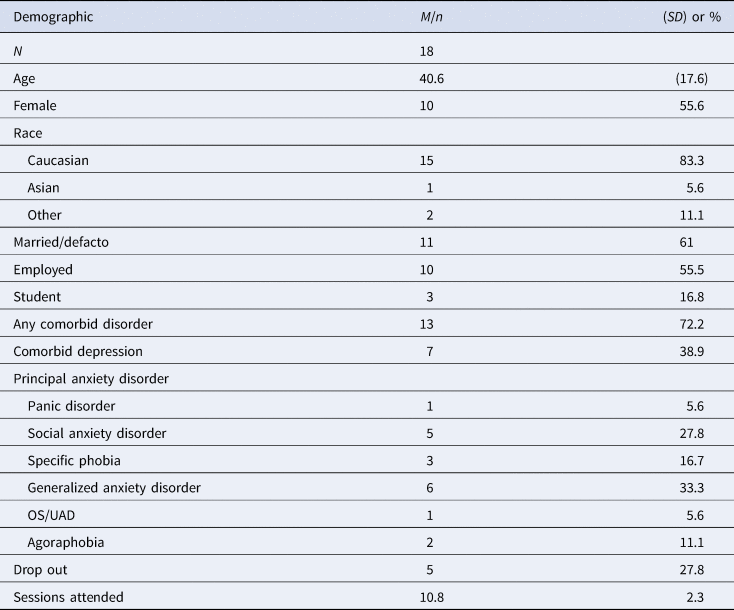
Participants were 18 individuals who presented to a speciality anxiety disorder research clinic, between August 2016 and April 2018 for treatment of anxiety-related disorders. Inclusion criteria were (1) age 18 or older, (2) principal DSM-5 diagnosis of an anxiety disorder, obsessive-compulsive disorder, or post-traumatic stress disorder, (3) adequate English language proficiency, (4) no evidence of neurocognitive conditions that would impact treatment, and (5) absence of intentional suicidal processes, substance use disorder, or other conditions requiring immediate intervention. See Table 1 for the demographic details of the sample.
Demographics, Primary Diagnoses and Drop Out for the Sample of Treatment Initiators

Note: OS/UAD = Other Specified or Unspecified Anxiety Disorder.
Measures
Anxiety Disorder Interview Schedule for DSM-5 (ADIS-5; Brown & Barlow, Reference Brown and Barlow2014). The ADIS-5 is a semi-structured interview designed to assess the presence and severity of DSM-5 anxiety, mood, alcohol and substance use, body dysmorphic, illness and somatic symptom disorders, as well as previous mental health history. It also contains brief screening questions for other differential diagnoses such as hoarding disorders, attention-deficit/hyperactivity, and psychosis spectrum disorders. All interviewers were doctoral students in clinical psychology, trained to reliability standards. Where possible, the same interviewer evaluated the same participant at pre- and post-treatment. Clinician severity ratings (CSRs) are included within the ADIS-5 and were used as estimates of disorder severity, and to estimate overall severity irrespective of specific diagnosis or diagnoses. CSRs quantify the severity of each disorder ranging from 0 (absent) to 8 (very severely distressing/interfering). A CSR of ≥4 (moderately distressing/interfering) was utilised as a cut-off for a disorder of clinical severity. Based on blind double-codings of a random subset of 25% of ADIS-5 interviews, inter-rater reliability for principal anxiety disorder diagnosis showed 100% agreement (ICC = 1.0), and CSR severity ratings showed good reliability (ICC = 0.79).
Clinical Global Impressions Severity and Improvement rating (CGI-S and CGI-I). CGI-S scores were made by the ADIS-5 assessor to estimate the level of overall mental illness, while CGI-I ratings focus on the clinician's assessment of improvement since the baseline CGI-S score at pre-treatment. Clinical judgement is based on the clinician's experience with the respective population. Inter-rater reliability for CGI-S and CGI-I showed good reliability (ICC = 0.79).
The Anxiety Disorder Diagnostic Questionnaire — weekly version (ADDQ; Smith, Paulus, & Norton, Reference Smith, Paulus and Norton2017) is a transdiagnostic measure of anxiety disorder severity. It assesses fear, anxiety and worry, escape and avoidance, physiological symptoms, and distress and interference over the prior week. It contains a mixture of dichotomous (yes or no) items, and items rated on 0–8 scales. All items are summed to compute a total score. ADDQ scores were collected at the beginning of each session, and the internal consistency of items from pre-treatment was observed to be excellent (α = 0.97).
The Beck Depression Inventory Second edition (BDI-II; Beck, Steer, & Brown, Reference Beck, Steer and Brown1996) estimates the severity of depressive symptomatology over the prior 2 weeks with 21 items measured with a Likert scale from 0 to 4. Depression was assessed at the beginning of each treatment session. Cronbach's alpha test of reliability for BDI-II scores was above acceptable (α = 0.84).
The 12-item Short-Form Health Survey (SF-12; Ware, Kosinski, & Keller, Reference Ware, Kosinski and Keller1996) was used as an estimate of quality of life. The SF-12 measures perceived physical and mental health over the prior 4 weeks and yields a Mental Component Subscale (MCS) and Physical Component Subscale (PCS). The summation of the raw scores method was utilised to estimate the subscales, based on recent recommendations against the use of the original orthogonal algorithm approach (Hagell, Westergren, & Årestedt, Reference Hagell, Westergren and Årestedt2017). SF-12 scores were used as an additional index of improvement, complimenting the observed changes on emotional symptoms for the sample, rather than in comparison to weighted population-based estimates. Based on the raw scores, the internal consistency of session-by-session SF-12 scores was observed to be excellent (α = 0.98).
The Treatment Credibility Measure (TCM; Borkovec & Nau, Reference Borkovec and Nau1972) was used, based on a formatted version published in Managing Social Anxiety; Therapist Manual (Hope, Heimberg, Juster, & Turk, Reference Hope, Heimberg, Juster and Turk2000). Using a 10-point Likert scale, the measure includes three items to assess the credibility of the treatment. These items ask the client to rate how logical the treatment appears to them, how confident they feel about the treatment being successful (for eliminating their fear), and the extent to which they would recommend the treatment to someone they know with an anxiety disorder. A further three items gauge the client's subjective rating of current anxiety severity and their estimated level of anxiety post-treatment and 12 months after treatment. The three items relating to credibility were used as an estimate of credibility for the protocol, and participant ratings on the TCM fell in the acceptable range in terms of internal consistency (α = 0.78).
Procedure
Assessment and treatment were conducted at a speciality anxiety disorder research clinic. All methods and procedures were reviewed and approved by the Monash University Human Ethics Research Committee (protocol: CF15/1048-2015000488). Participants were recruited through a local newspaper advertisement, advertisements through social media (e.g. Facebook), and national radio. All potential participants were initially screened over the phone for their suitability for the study. Prior to the assessment, potential participants who were deemed eligible attended a scheduled assessment session and were provided with written research background resources and other documentation to facilitate the informed consenting processes. All participants provided written informed consent prior to the assessment and subsequent treatment. Following the evaluation, participants were allocated a clinician within a 2-week period to begin treatment.
Assessment schedule. The clinician-rated scales (e.g. CSR and CGI-S) were measured at pre- and post-treatment. The CGI-I was measured at post-treatment as an estimate of overall improvement in comparison to pre-treatment severity. The self-report measures, specifically ADDQ, BDI, and SF-12 scales, were measured at the beginning of each session. The TCM was provided at the end of the first session and at the end of session four, in order to gauge any changes in opinion towards the treatment since the beginning, and after exposure therapy was initiated.
Treatment protocol and therapists. Treatment consisted of the delivery of a modified version of the manualised Transdiagnostic Group Cognitive Behaviour Therapy for Anxiety Disorders (Norton, Reference Norton2012a). This 12-session protocol focuses on challenging and confronting feared stimuli and integrates the range of presenting feared stimuli without differentiating by disorder category. Client presenting problems are formulated on an individual case basis, rather than focusing on a specific diagnosis formulation. Participants receive several evidence-based CBT strategies to target their individual hierarchy of fears (e.g. psychoeducation, self-monitoring, CR, and behavioural exposure). The final component of treatment consisted of CR focused more broadly on underlying schemas or core beliefs related to general manifestations of emotion symptoms. This protocol aims to treat the common features of anxiety rather than specific disorders, by targeting shared vulnerabilities such as negative affectivity (Talkovsky & Norton, Reference Talkovsky and Norton2014).
The treatment was fully manualised and includes instruction for developing exposure interventions based on the client's exposure hierarchy (i.e. in vivo, simulated, interoceptive). Overall, the average session structure included the review of between-session CR or exposure practice (e.g. ‘homework’), in-session CR and exposure facilitated by the clinician, and further assigning of CR and exposure homework. Therefore, while the overall structure of the sessions was manualised, the session content is primarily focused on the clients’ individualised exposure hierarchy and their anxiety stimuli. The clinician is also advised to encourage the client to become more active in the in-session and between-session planning for exposure as the sessions progress.
Between-session assignments for CR and exposure practice were facilitated through the completion of a worksheet during sessions. The worksheet prompted the client for their automatic thoughts and responses to the anxiety stimulus that they were planning to confront through exposure. It then prompts to evaluate the helpfulness and accuracy of their thoughts and includes space to develop a reconstructed thought. Finally, a section is allocated for the client to monitor their Subjective Units of Distress (SUDS) before, during, and after the exposure is commenced.
Where necessary, modifications were made to change language that referred to groups or more than one client (e.g. in scripted therapist passages), the removal of group-based activities (e.g. facilitated introductions between participants, collaborative exposure tasks between group participants), and the reduction of session length from 120 to 60 min delivered weekly. Despite this, the original TGCBT protocol was maintained in terms of the structure of treatment components. Therapists in this trial were doctoral-level provisional psychologists under the supervision of the second author. All therapists were trained in the treatment protocol through recorded video observation of previous group tCBT sessions.
Results
Descriptive statistics
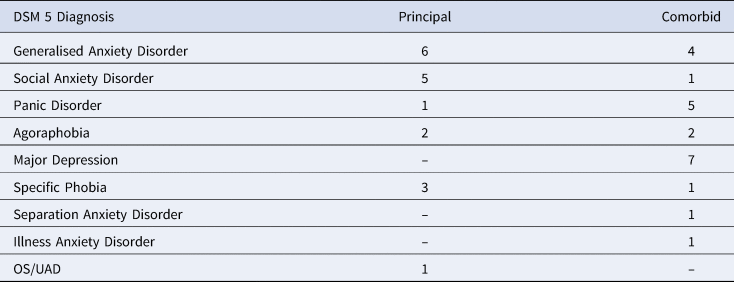
Of the 21 consecutive people assessed, 18 met criteria for the study and 3 were excluded (Anxiety Disorder not principal diagnosis: 1; Neurocognitive condition: 1; Refused: 1). Refer to Table 1 for a breakdown of the principal diagnoses for the treatment initiators. The sample was highly comorbid, with 72% of participants meeting the criteria for at least two diagnoses; refer to Table 2 for the frequencies of each specific DSM-5 diagnoses for the sample. The most common comorbid disorders were major depressive disorder, panic disorder with or without agoraphobia, and generalised anxiety disorder. Six participants did not attend all 12 sessions (33.3%), and five participants (27.8%) did not attend a post-treatment assessment. The average number of sessions attended by the sample (M = 10.83, SD = 2.26).
Frequency of Principal and Comorbid DSM-5 Diagnoses

Note: OS/UAD = Other Specified or Unspecified Anxiety Disorder.
Results on the TCM at pre-treatment showed that participants believed the protocol was logical (M = 9.17, SD = 1.10), it was likely to reduce their anxiety (M = 7.2, SD = 1.80), and that they would be likely to recommend it to others with anxiety (M = 7.89, SD = 1.53). At session four, participants’ ratings were similar to session one on each of these variables (M = 9.19, SD = 1.05; M = 7.81, SD = 1.52; M = 8.56, SD = 1.75, respectively). There were no significant differences between TCM ratings at pre-treatment and at session four, t(15) = −1.38, p = .18.
Primary outcomes
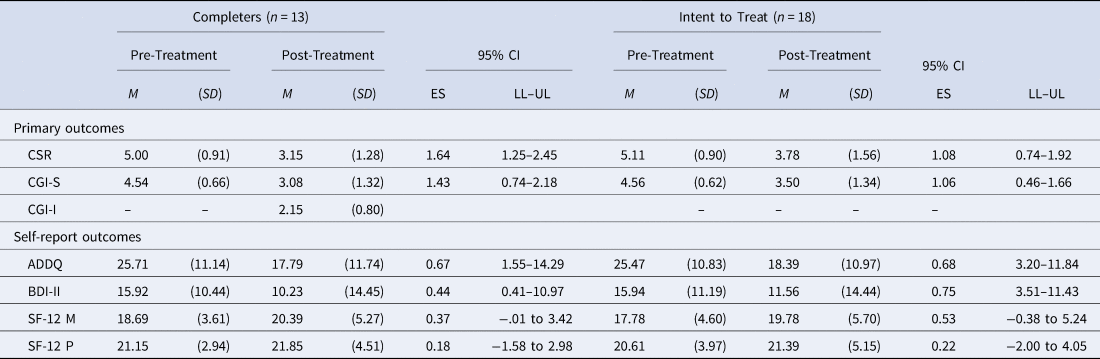
A repeated-measures ANOVA was conducted to compare CSRs between pre- and post-treatment. Refer to Table 3 for means and standard deviations, differences between pre- and post-treatment scores, and confidence intervals for effect sizes. The Hedges’ g statistic was used to correct for bias that is usually expressed when using Cohen's d, and the average standard deviation of repeated measures time points was added to the algorithm's denominator, based on recommendations for repeat measures analyses (Lakens, Reference Lakens2013).
Sample Size, Means and Standard Deviations for Completer and Intent to Treat Samples

Notes: ES = Hedges g effect size estimate; 95% CI LL–UL = 95% confidence intervals, upper-limit and lower-limit.
CSR = Clinician Severity Rating; CGI-S = Clinical Global Impressions — Severity; CGI-I = Clinical Global Impressions — Improvement; ADDQ = Anxiety Disorder Diagnostic Questionnaire; BDI-II = Beck Depression Inventory-II; SF-12 M = Short-Form Health Survey 12 — Mental Health; SF-12 P = Short-Form Health Survey 12 — Physical Health.
For treatment completers, there was a significant effect for time on CSR scores, Wilks’ Lambda = 0.21, F (1, 12) = 45.47, p < .001, g = 1.63. CGI-S scores were also compared from pre- to post-treatment, with a significant effect for time, Wilks’ Lambda = 0.38, F (1,12) = 19.34, p < .01, g = 1.43. Intent-to-treat (ITT) analyses, using the last observation carried forward method, were also conducted. ANOVA for the CSR scores in the ITT sample also produced a significant effect for time, Wilks’ Lambda = 0.43, F (1, 17) = 22.67, p < .001, g = 1.06. For CGI-S scores, ITT analyses revealed a significant effect for time, Wilk's Lambda = 0.55, F (1, 17) = 13.67, p < .01, g = 1.06.
CGI-I ratings of the completer sample (n = 13) indicated that 27.8% of the sample were assessed as much improved, and a further 16.7% of the sample were very much improved at post-treatment. The proportion of those considered to have improved minimally was 38.5%. At post-treatment, 54% of participants who completed treatment were assessed as below the clinical severity rating cut-off score (CSR < 4) for their principal diagnosis. Furthermore, 47% of comorbid diagnoses remitted to subclinical levels following treatment.
Self-report outcomes
To fully utilise the entire sample of treatment initiators, session-by-session data were examined using mixed-effect regression modelling (MRM). The data were fitted to a random intercepts and slopes model, using a maximum-likelihood estimator (MLE). In the first MRM, session-by-session ADDQ scores served as a predictor of change in anxiety over time. Results indicated that the intercept ADDQ score (set at session one) was at the clinically significant range, MLE = 26.41, Wald z = 6.93, p < .001, and the rate of change in ADDQ score was significant, MLE = −0.68, Wald z = −2.64, p < .01. The change in effect size between first and final session ADDQ scores was estimated to be medium (g = 0.68).
In the second MRM, session-by-session BDI-II scores served as predictors of change in depressive symptoms over time. An estimate of mild severity depression was revealed at pre-treatment, MLE = 17.39, Wald z = 3.78, p < .001, and the rate of change in BDI-II scores was significant, MLE = −0.68, Wald z = −4.33, p < .001. Similar to ADDQ, a medium effect size for BDI-II scores between the first and final session was estimated (g = 0.75).
Finally, session-by-session SF-12 data were modelled to maximise the entire data set through the same method. A pre-treatment score for MCS was estimated, MLE = 17.743, Wald z = 1.15, p < .001, with a statistically significant rate of change, MLE = 0.22, Wald z = 0.06, p < .001 and medium effect size (g = 0.53). PCS pre-treatment score was estimated, MLE = 20.84, Wald z = 0.974, p < .001, and a statistically significant rate of change, MLE = .09, Wald z = .04, p < .05, with a small effect size (g = 0.22).
Discussion
The current pilot study sought to evaluate the efficacy of a previously evaluated group tCBT protocol for anxiety disorder, adapted for individual delivery. The results show support for the use of an adaptation of the group tCBT protocol for individual format delivery. Significant reductions in disorder severity and self-reported anxiety and depression symptoms were observed over the treatment. Additionally, a significant improvement to overall self-reported physical and mental health was observed across sessions, and expectedly the physical health change was of a small effect size. As compared with previous open trials, using the same treatment in a group format, similar effect sizes were observed from pre- to post-treatment diagnostic assessments (Norton, Reference Norton2008). Additionally, the change on clinician-rated severity was comparable to that observed in other individual tCBT trials (Ellard et al., Reference Ellard, Fairholme, Boisseau, Farchione and Barlow2010; Pearl & Norton, Reference Pearl and Norton2017).
On self-report measures of anxiety and depression, significant decreases were observed over the course of treatment; and significant increases were observed for estimates of quality of life. Effect sizes for anxiety and depression were medium, which was commensurate with other studies utilising self-report measures in transdiagnostic treatment (e.g., see Pearl & Norton, Reference Pearl and Norton2017). Therefore, as expected, the effects of the intervention from the participants’ perspective resulted in significant decreases in anxiety symptom. Although on average, clients were not responding in the clinically significant cut-off range of depression scores at pre-treatment, depressive symptomatology still showed significant improvement. This suggests that in addition to improvements made to anxiety symptoms as a primary presenting problem, the treatment had a transdiagnostic effect on related emotional disturbance, consistent with the individual case formulation (as opposed to diagnosis-driven) approach of transdiagnostic treatments. Similar reductions in depressive severity have been reported in group tCBT (Talkovsky et al., Reference Talkovsky, Green, Osegueda and Norton2017).
In terms of comorbid diagnoses, the sample represented similar levels of comorbidity to that estimated for naturalistic community samples (e.g. approximately 1.5 diagnoses per person; Brown, Campbell, Lehman, Grisham, & Mancill, Reference Brown, Campbell, Lehman, Grisham and Mancill2001). However, due to sample size, this study's generalisability is limited. Comorbid diagnoses of GAD, SAD, panic disorder, and specific phobia were represented in the sample, as well as comorbid depressive diagnoses. Without the addition of OCD and PTSD diagnoses in the sample, the treatments’ efficacy for anxiety-related disorders require further investigation. Based on the outcomes from previous studies including such disorders in a group format (Espejo et al., Reference Espejo, Castriotta, Bessonov, Kawamura, Werdowatz and Ayers2016; Norton, Reference Norton2012b), it is reasonable to expect similar efficacy, and it is recommended that this adapted protocol is re-evaluated with higher rates of these diagnoses. Finally, given the exclusion of individuals with comorbid substance use disorders, which are commonly comorbid with anxiety disorders, future treatment development and research should be conducted to examine the effectiveness of combined substance use interventions and tCBT for dually diagnosed individuals (see Back & Brady, Reference Back and Brady2008).
Without control or direct comparison to group format treatment, or other CBT variants (e.g. e-based treatment, disorder-specific CBT), the efficacy of individual tCBT is conditional on further evaluation. The scope of the current study was to provide preliminary evidence for the CR and exposure-focused treatment to be formally evaluated in an individual format, while maintaining the overall structure and transdiagnostic focus of the group protocol. Similarly, without longer-term follow-up data available (e.g. 3-month and 6-month data), due to participant attrition and an incomplete data set, the maintenance of treatment gains has not been formally evaluated.
The practical implications of this study are that exposure can be provided by early career psychologists, at an early stage of an individual format tCBT, to good effect across a range of anxiety diagnoses. Additionally, given that neither the treatment structure nor the number of sessions was changed, the broader implications of these results point to the delivery of a flexible-format evidence-based tCBT, without unnecessarily delaying necessary treatment needs while waiting to populate a treatment group. It is recommended researchers elucidate further the potential differences in results by the delivery method, in order to inform both clinicians and their clients about the potential benefits of one approach over another. For instance, a randomised controlled trial examining the outcomes for clients who are provided tGCBT in group or individually may elucidate differences in outcome. Underlying factors that contribute to group or individual treatment acceptance and the potential mediators of change in either format may also differ, which could inform recommendations to clients who present with different risk factors that are addressed more successfully individually than in group treatment. Overall, the current study provided preliminary support for the use of an adaptation of an established group-based tCBT protocol for use with individuals, with minimal modifications required.
Acknowledgements
This study is the result of work supported with resources and the use of facilities at Monash University, Clayton, Victoria, Australia. The views expressed in this article are those of the authors and do not necessarily reflect the position or policy of Monash University. Peter J. Norton receives royalties from Guilford Press for the sale of the published treatment manual used in the current research.
Conflict of interest
The authors declare that there are no other conflicts of interest in this research.