Introduction
Trichinellosis is a worldwide zoonosis caused by parasitic nematodes of the genus Trichinella and, for most authors, it remains an important zoonotic disease on a global level, although its global burden has recently been debated by Devleesschauwer et al. (Reference Devleesschauwer, Praet, Speybroeck, Torgerson, Haagsma, De Smet, Murrell, Pozio and Dorny2015). It can be a serious disease, particularly for elderly individuals for whom severe complications, such as myocarditis or encephalitis, can lead to death (Bruschi & Dupouy-Camet, Reference Bruschi, Dupouy-Camet and Bruschi2014). Trichinella spp. are widespread in wildlife on all continents (except probably Antarctica) and in domestic pigs of many countries (Pozio, Reference Pozio, Dupouy-Camet and Murrell2007). Nowadays, nine species and three genotypes are recognized by molecular analyses of the genus Trichinella; namely, T. spiralis, T. nativa and its related genotype T. T6, T. britovi and its related genotype T. T8, T. pseudospiralis, T. murrelli and its related genotype T. T9, T. nelsoni, T. papuae, T. zimbabwensis and T. patagoniensis. The parasite life cycles are perpetuated by infection of carnivorous and omnivorous animals that represent the most important reservoir. All species can develop in mammals, but T. pseudospiralis can also develop in birds, and T. papuae and T. zimbabwensis also occur in some reptile species (Pozio, Reference Pozio, Dupouy-Camet and Murrell2007). Infections occur in populations used to eating raw or undercooked meat and meat products of different animal origins, mainly pork at the worldwide level (Murrell & Pozio, Reference Murrell and Pozio2011). Consumption of raw bear meat is a non-negligible cause of cases in hunters, travellers and local populations of regions where bear meat is consumed (Bruschi & Dupouy-Camet, Reference Bruschi, Dupouy-Camet and Bruschi2014).
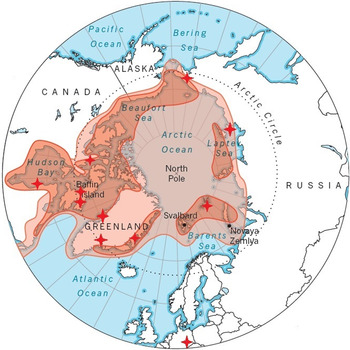
Human cases have been reported after consumption of meat from brown, black or polar bears, not only in Arctic or subarctic regions, but also in temperate regions where brown or black bears can be hunted. We recently reported three human cases of trichinellosis after consumption of polar bear meat by three travellers to Greenland (Dupouy-Camet et al., Reference Dupouy-Camet, Yera, Dahane, Bouthry and Kapel2016) and we will focus in this review only on trichinellosis and polar bears. The polar bear (Ursus maritimus) is the world's largest species of bear and the largest land predator, with the males weighing more than twice as much as the females (350–800 kg vs. 150–300 kg, respectively). In North America, polar bears coexist with the more common black (U. americanus) and grizzly bears (U. arctos horribilis), but have a more restricted area of distribution. The polar bear is a circumpolar species and is found in Arctic regions, where there is access to sea ice throughout much of the year (fig. 1). It is considered to be an endangered species because of reduction of its preferred habitat as a result of global warming (Derocher, Reference Derocher2010; World Wildlife Fund, 2012). In the wild, polar bears usually live to be 20–30 years old. Polar bear populations are found in Canada, Alaska (USA), Greenland, Russian and Norwegian Arctic and on the ice surrounding the North Pole. The global population of polar bears consists of roughly 20,000–25,000 individuals (Museum National d'Histoire Naturelle, 2016). The most prevalent species of Trichinella in the Arctic is T. nativa, with polar bear as the main reservoir (Pozio, Reference Pozio, Dupouy-Camet and Murrell2007), and larvae of this species survive freezing in the muscle of carnivores for several years (Dick & Belosevic, Reference Dick and Belosevic1978; Chadee & Dick, Reference Chadee and Dick1982; Kapel et al., Reference Kapel, Pozio, Sacchi and Prestrud1999; Seymour et al., Reference Seymour, Horstmann-Dehn, Rosa and Lopez2014; Pozio, Reference Pozio2016).
World distribution of the polar bear (Ursus maritimus). In this overlay of the Arctic, darker areas denote higher population density, lighter areas lower density. Red stars indicate the location of reported cases of human trichinellosis linked to consumption of polar bear meat (adapted with permission from Derocher, Reference Derocher2010).

In this review, we will consider the importance of polar bears in the epidemiology of the parasite, and analyse whether they represent a danger for its transmission for humans. Articles and reports were searched in the usual public databases (PubMed, Promed, Google), and also in reviews by Connell (Reference Connell1949), Rausch (Reference Rausch and Gould1970), Jenkins et al. (Reference Jenkins, Castrodale, de Rosemond, Dixon, Elmore, Gesy, Hoberg, Polley, Schurer, Simard and Thompson2013) and Bourée & Dupouy-Camet (Reference Bourée and Dupouy-Camet2016). Briefly, queries were conducted for general terms related to polar bear and trichinellosis, with the following keywords: trichinellosis, Trichinella, polar bear, Ursus maritimus. There were no restrictions on publication dates and the search was completed in October 2016. We have separated the analysis into two periods: before and after 1992, as a taxonomic revision of the genus was published that year, defining T. nativa as a real species and not a variant of T. spiralis (Pozio et al., Reference Pozio, La Rosa, Murrell and Lichtenfels1992). Also, in 1992, the Rome International Trichinella Reference Center was created as a repository for Trichinella strains and as a source of materials and information for international research (Pozio et al., Reference Pozio, La Rosa, D'Ancona, Amati, Mancini Barbieri and De Giacomo2001).
Historical reports until 1992
Animal reports
According to Rausch (Reference Rausch and Gould1970), the first observation of Trichinella in a captive polar bear could have been made as early as 1910 in Germany, but at that time infection was believed to have occurred in captivity. Leiper (Reference Leiper1938) reported the occurrence since 1904 of Trichinella larvae in 3 out of 4 polar bears and in 2 arctic foxes that died in the London Zoo, and he pointed out the risk to explorers and their dogs if polar bear meat was used to replenish food supplies. In 1982 a similar observation was published describing a 14-year-old wild-caught female polar bear at the Melbourne Zoo (McColl & Butler, Reference McColl and Butler1982). In 1934, Parnell detected Trichinella larvae for the first time in wild polar bears from Arctic Canada (Rausch, Reference Rausch and Gould1970). In his review on ‘Trichinosis in the Arctic’, Connell (Reference Connell1949) reported 51% prevalence of infection in all polar bears examined up to that date. Also in 1949, Roth reported 30% prevalence in 19 polar bears from eastern and north-western Greenland. Thorshaug & Rosted (Reference Thorshaug and Rosted1956) found Trichinella larvae in 59% of the 278 polar bears collected between 1949 and 1953 from the region between Novaya Zemlya and Svalbard. In all these reports, the technique of examination was trichinoscopy, e.g. Thorshaug & Rosted (Reference Thorshaug and Rosted1956) examined by compression 12–14 sections from individual specimens, and in cases of a negative specimen, 300–400 additional sections were examined! After artificial digestion of muscle samples, Rausch et al. (Reference Rausch, Babero, Rausch and Schiller1956) reported 52.9% prevalence in 17 polar bears from St. Lawrence Island and from the Arctic coast near Barrow or Wainwright. Muscular larval burdens were light, ranging from 0.4 to only 4.0 larvae/g of tissue. Trichinoscopy examination of polar bears from Svalbard revealed decreasing prevalence from 58% in 1950 to 23–33% from 1966 to 1970 (Larsen & Kjos-Hanssen, Reference Larsen and Kjos-Hanssen1983). Born & Henriksen (Reference Born and Henriksen1990) found 32% prevalence with an average of 9.2 larvae/g by chlorhydropeptic digestion of frozen diaphragm samples of 38 polar bears from north-eastern Greenland.
Human reports
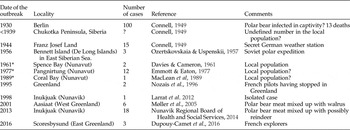
There is a popular opinion that the three Swedish members of Andrée's Arctic balloon expedition of 1897, intending to reach the North Pole, actually died of trichinellosis. After they lifted off from Svalbard in July 1897, the balloon lost hydrogen quickly and crashed on the pack ice after only 2 days (Andrée et al., Reference Andrée, Strindberg and Fraenkel1931; Wikipedia, accessed October 2016). The explorers were unhurt, but faced a gruelling trek back south across the drifting icescape. In October, the group, trapped by the Arctic winter, ended up exhausted on Kvitøya (White Island) in Svalbard and died there. For 33 years, the fate of the Andrée expedition remained one of the unsolved riddles of the Arctic. The chance discovery in 1930 of the expedition's last camp created a media sensation in Sweden, where the dead men had been idolized. The best-known and most widely credited suggestion is that made by Tryde (Reference Tryde1952), a medical practitioner, in his book: The dead on Kvitøya: The truth about Andree. He wrote that the men succumbed to trichinosis, which they had contracted from eating undercooked polar bear meat on which they had largely fed, and reproduced a letter sent to him by Roth, stating to have observed 12 Trichinella capsules by microscopic examination of nine samples of a polar bear carcass found in the explorer's camp. Roth, a Danish parasitologist , invented a famous antibody test using living larvae and performed the first investigations on Trichinella in Greenlandic mammals (Roth, Reference Roth1949; Andreassen, Reference Andreassen1997). The Swedish writer and researcher Uusma (Reference Uusma2014) at the Karolinska Institute partially rejected the theory that trichinellosis killed the expedition members. She noticed that ‘none of the members of the expedition had used the analgesic medications contained in the medicine bow’ found 33 years later. After examining the men's clothes, she concluded that at least one member of the team was killed by polar bears. It is also interesting to consider the balanced opinion of Campbell (Reference Campbell and Campbell1983), 2015 Nobel prize winner in medicine: ‘the explorers did resort to eating raw bear meat; it is highly probable that they suffered from trichinosis, and it is quite possible that the disease was a factor in their failure to survive’. The first documented human outbreak related to polar bear meat occurred in Stuttgart, Germany in 1930. Connell (Reference Connell1949) mentioned that this outbreak ‘seriously affecting some 100 persons and responsible for 13 deaths, was probably of Arctic origin … these cases were traced to the smoked ham of a polar bear, which had been served by an innkeeper. As the bear has been slaughtered in a zoo it was thought at the time that its infection had been acquired in captivity’. The same author also reported an ‘epidemic of trichinosis, which broke out among the personnel of a secret German weather station based on Franz Josef Land during World War II. Some fifteen men who acquired in the spring of 1944 the infection from polar bear meat became so seriously ill that it was necessary to remove them by plane to Norway for hospitalization’. Interestingly, this German secret station has recently been rediscovered by Russian scientists (Simpson, Reference Simpson2016). Connell (Reference Connell1949) also quoted a report in a Russian journal about ‘trichinosis acquired from polar bear on the Chukotka Peninsula, Siberia during the years, immediately preceding world war two’. Ozeretskovskaia & Uspenskii (Reference Ozeretskovskaia and Uspenskii1957) reported three cases that occurred in 1956 amongst the members of a Soviet polar expedition to Bennett Island (De Long Islands) after eating polar bear meat. Cases were also reported in Arctic Canada: two cases in Spence Bay in 1961 (Davies & Cameron, Reference Davies and Cameron1961); 12 cases in Pangnirtung (Nunavik) in 1977 (Emmott & Eaton, Reference Emmott and Eaton1977) and one isolated case in Coral Bay (MacLean et al., Reference MacLean, Viallet, Law and Staudt1989). These outbreaks are summarized in table 1 and their locations are shown in fig. 1.
Number of human cases of trichinellosis related to polar bear meat consumption. Only 63 cases were reported since World War II.

*Date reported and not of the outbreak.
Polar bear trichinellosis in the past 25 years
As mentioned above, the taxonomic revision of the Trichinella genus published in 1992 clearly defined the Arctic species as T. nativa (Pozio et al., Reference Pozio, La Rosa, Murrell and Lichtenfels1992). Before that date, most reports were referring to T. spiralis or Trichinella sp. Searching in the database of the International Reference Center for Trichinella (Pozio et al., Reference Pozio, La Rosa, D'Ancona, Amati, Mancini Barbieri and De Giacomo2001), we found that the 14 isolates obtained from polar bears between 1976 and 2010 all belonged to the genus T. nativa. The geographical origin was known for 10 isolates: 4 were from Svalbard, 2 from Iceland, 1 each from Alaska, Greenland and Canada (Hudson Bay), and 1 from a polar bear from the Berlin Zoo.
Animal reports
Gajadhar & Forbes (Reference Gajadhar and Forbes2010) conducted surveys of wild carnivores in Canada over a 10-year period to determine the prevalence and genotypes of Trichinella. After enzymatic digestion, larvae were found in 65.9% of 85 polar bears (U. maritimus), in 29.4% of 68 grizzly bears (U. arctos) and in 7.3% of 193 black bears (U. americanus). Polar bears were exclusively parasitized by T. nativa whereas grizzly bears were only parasitized by the T6 genotype and black bears by T6 or T. nativa. Interestingly, the highest larval burdens were observed in black bears (117 larvae/g) whereas the mean larval burden was 8 larvae/g for polar bears and 11 larvae/g for grizzly bears. Unfortunately, no statistical analysis was performed to compare these larval burdens. Skirnisson et al. (Reference Skírnisson, Marucci and Pozio2010) detected a T. nativa infection in one of two polar bears that had swum to Iceland's coast. The larval burdens were relatively low, with 8.5 larvae/g in the tongue. The parasite had never been detected before in the local Icelandic wildlife and this illustrates the capacity of polar bears to transport parasites very long distances. Due to the difficulties of examining muscle samples from a protected species, Asbakk et al. (Reference Asbakk, Aars, Derocher, Wiig, Oksanen, Born, Dietz, Sonne, Godfroid and Kapel2010) collected blood samples from live-caught polar bears (U. maritimus) from Svalbard in 1991–2000 and in 2006–2008, and from the pack ice of the Barents Sea in 1991–2000. These sera were assayed for antibodies against Trichinella spp. by enzyme-linked immunosorbent assay (ELISA). Of 54 cubs-of-the-year sampled in 1991–2000, 53 were seronegative, indicating that exposure to Trichinella-infected meat was uncommon during the first months of life. Of 30 mother–offspring pairs, 18 mothers were seropositive with seronegative offspring (n = 27), suggesting that vertical transmission of Trichinella spp. did not occur. One-year-old bears and older had higher prevalence of the parasite in Svalbard (78%) than in the Barents Sea (51%). The prevalence increased with age in both sexes, but there was no temporal change in prevalence for bears from Svalbard between the two periods. Naidenko et al. (Reference Naidenko, Ivanov, Mordvintsev, Platonov, Ershov and Rozhnov2013) detected antibodies in 60% 20 polar bears captured in Franz Josef Land and Novaya Zemlya (Barents Sea). The prevalence was 90.9% in the 11 adults and of 22.2% in the nine juveniles. All cubs were seronegative. Finally, Trichinella sp. larvae were collected by artificial digestion of four polar bears, caught in the wild and reared in captivity in zoos of Belgium, Germany, Mexico and USA, and which had died of natural causes. In three of these animals the larvae were identified as T. nativa (Pozio, Reference Pozio2015).
Human reports
Nozais et al. (Reference Nozais, Mannevy and Danis1996) diagnosed in France two cases acquired in Greenland from eating polar bear meat. Two aircraft pilots, stopped for a few hours in Greenland (the precise location of the stopover is not mentioned), ate polar bear steaks and were diagnosed with trichinellosis a few weeks later. Møller et al. (Reference Møller, Petersen, Kapel, Melbye and Koch2005) described an outbreak of six cases, after consumption of infected meat presumably from walrus or polar bear caught in western Greenland. Walrus meat is the main cause of trichinellosis in Arctic populations, as it is consumed raw or fermented (Leclair et al., Reference Leclair, Forbes, Suppa, Proulx and Gajadhar2004) and could well be the cause of this outbreak. In October 2013, the village of Inukjuak (Nunavik) was hit by an outbreak of trichinellosis. Eighteen cases were identified: 4 probable cases and 14 confirmed by biological assays. The investigation of food samples did not result in a formal identification of the source of contamination: polar bear meat was mixed up with another type of meat, possibly reindeer (Nunavik Regional Board of Health and Social Services, 2014). Reindeer is not a usual vector of trichinellosis and has shown a low sensitivity to T. nativa during experimental infections (Oksanen et al., Reference Oksanen, Oivanen, Eloranta, Tirkkonen and Asbakk2000). Finally, we recently reported three cases in three French explorers in Greenland. All patients had eaten around 200 g of insufficiently cooked polar bear meat 3 weeks previously (Dupouy-Camet et al., Reference Dupouy-Camet, Yera, Dahane, Bouthry and Kapel2016). The polar bear, weighing approximately 400 kg, was shot by a local accredited Inuit hunter at Kap Hope between Hurry Fjord and Scoresbysund, near the small village of Ittoqqortoormiit on the east coast of Greenland (Dupouy-Camet et al., Reference Dupouy-Camet, Yera, Dahane, Bouthry and Kapel2016).Only the three French travellers ate this under-cooked meat, whereas local people ate the meat boiled. All these outbreaks are summarized in table 1, with their locations marked in fig. 1.
Discussion
Bear meat consumption is quite a frequent source of trichinellosis in regions where there is a local habit of eating such meat. French hunters are quite fond of hunting parties in the New World, and French tourists are curious about exotic foods (Dupouy-Camet, Reference Dupouy-Camet2014). In France, bear meat trichinellosis has been identified in 31 individuals since 2004. In addition to the five cases reported above after consumption of polar bear meat, we reported one case in 2004 (Lachkar et al., Reference Lachkar, Abboud, Gargala, Etienne, Gauliard, Tron, Favennec, Gueit, Caron and Dupouy-Camet2008) and 17 cases in 2005 after consumption of black bear (U. americanus) meat hunted in the George River region in north Quebec (Ancelle et al., Reference Ancelle, De Bruyne, Poisson and Dupouy-Camet2005). We also reported eight cases in crews of two boats sailing through the Northwest Passage, who had eaten grizzly bear (U. arctos) meat in Cambridge Bay, Nunavut (Houzé et al., Reference Houzé, Ancelle, Matra, Boceno, Carlier, Gajadhar and Dupouy-Camet2009; French National Reference Center for Trichinella, 2011). According to Ozeretskovskaia et al. (Reference Ozeretskovskaia, Mikhailovab, Sabgaidaa and Dovgalevc2005), in Russia during the period 1998–2002, bear meat (with 341 cases) was a more frequent source of infection than pork all over Russia. All these cases occurred in the southern part of Russia (Krasnodar region), in Siberia and in the north-east of the country (Primorsky region) after consumption of brown bear. Outbreaks have also been described in hunters from the USA (Centers for Disease Control and Prevention, 2004; Hall et al., Reference Hall, Lindsay, Hammond, Montgomery, Wilkins, da Silva, McAuliffe, de Almeida, Bishop, Mathison, Sun, Largusa and Jones2012) or in native Saskatchewan populations of Canada (Schellenberg et al., Reference Schellenberg, Tan, Irvine, Stockdale, Gajadhar, Serhir, Botha, Armstrong, Woods, Blondeau and McNab2003). In Alaska, from 1974 to 1994, 203 cases of trichinellosis were reported during 34 documented outbreaks; 20 (59%) of these outbreaks were caused by the consumption of bear meat (Hueffer et al., Reference Hueffer, Parkinson, Gerlach and Berner2013). It appears that such cases occur most of the time after consumption of black or brown bears. Brown or black bear meat consumption was the source of 5% of the 2400 cases reported by ProMED-mail from 1998 to 2013 (Bruschi & Dupouy-Camet, Reference Bruschi, Dupouy-Camet and Bruschi2014).
According to our review, cases due to polar bear consumption are infrequent. Of course, such cases might not be reported, particularly in people living in remote areas far away from medical facilities. The main factor explaining these discrepancies is the very low polar bear population, a vulnerable species found in remote and icy areas, whereas the other bear species have a more general distribution, not only in Arctic or subarctic regions, but also in temperate areas. At the worldwide level, polar bear populations are estimated at 20,000–25,000, brown bears at 150,000–200,000 and black bears at 800,000 exclusively in the American continent (Museum National d'Histoire Naturelle, 2016; Wikipedia, accessed October 2016). Hunting of polar bears is limited by very strict quota. In addition, several reports have shown that even if the prevalence of Trichinella larvae in polar bears was elevated, the mean larval burden was relatively low. These low burdens could explain why no deaths have been reported after polar bear consumption (except after the Berlin Zoo outbreak of 1930) and the relatively mild forms usually observed. In addition, local populations can be protected somehow against severe forms by regular intake of lightly parasitized meats, as reported by Viallet et al. (Reference Viallet, MacLean, Goresky, Staudt, Routhier and Law1986), when clinical signs are mainly represented by chronic diarrhoea. Bears are consumed by the local Inuit populations but, unlike walrus meat, bear meat is traditionally eaten well-cooked. As a matter of fact, the infrequent outbreaks reported in Inuits after consumption of polar bears were observed when this meat was mixed with other meats, such as walrus or reindeer meat. However, isolated cases have been reported in Inuits and, in Ammassalik (east Greenland), risk factors associated with Trichinella seropositivity were hunting and a high intake of polar bear meat (Møller, Reference Møller2007; Møller et al., Reference Møller, Koch, Petersen, Hjuler, Kapel, Andersen and Melbye2010). Bukina (Reference Bukina2014), in far-eastern Russia, showed that the dietary intake of traditionally made meat from marine mammals and polar bears was a cause of Trichinella infection in the residents of the communities of the Chukotka Peninsula.
Owing to the high risk of trichinellosis in native populations, several efficient prevention programmes have been implemented in these regions (Proulx et al., Reference Proulx, MacLean, Gyorkos, Leclair, Richter, Serhir, Forbes and Gajadhar2002; Larrat et al., Reference Larrat, Simard, Lair, Bélanger and Proulx2012). In Ammassalik (east Greenland), human studies indicated a decreasing Trichinella seroprevalence from 23.8% in 1979–1981 to 3.2% in 2004 (Møller et al., Reference Møller, Koch, Petersen, Hjuler, Kapel, Andersen and Melbye2010). Local media are also involved in prevention. For example, the territorial newspaper Nunatsiaq News reported this illustrative warning in December 2015: ‘Polar bear meat distributed in early October to residents of Clyde River may contain Trichinella, prompting Nunavut's Department of Health to issue a warning. The Government of Nunavut is advising anyone in the town of about 900 people who may have some of this meat in their freezer to thoroughly cook it before consumption to avoid getting sick.’
To conclude, the climate is rapidly changing in the Arctic and will undoubtedly affect the interaction between parasites, the environment and their hosts, with potentially detrimental impacts on the health and welfare of Arctic peoples. Global warming has led to the opening of sea routes that were previously blocked by ice and will likely result in new ports for ships and the attraction of workers to new facilities or old settlements (Dupouy-Camet, Reference Dupouy-Camet2016). All these factors will impact negatively on the population of polar bears, and polar bear trichinellosis, until now infrequent, could well disappear. However, the rare travellers to these regions have to be warned of the risk of eating raw bear meat that can be a source of trichinellosis.
Acknowledgements
We thank Sergey O. Movsesyan for kindly providing us with the 1957 publication of Ozeretskovskaia & Uspenskii, Andrew E. Derocher for allowing us to use the already published fig. 1, Didier Basset for pointing out the recent discovery of the secret German weather station and Gordon Langsley for his excellent editorial suggestions.
Financial support
This research received no specific grant from any funding agency, commercial or not-for-profit sectors.
Conflict of interest
None.