Introduction
The inclusion of pulse cash crops in rotation can reduce reliance on synthetic nitrogen fertilizer (Menalled Reference Menalled2009) through biological nitrogen fixation, in turn improving the sustainability of grain production. Despite this, pulse crops, notably field pea and lentil, have little competitive ability in the presence of weeds in comparison to other field crops (Ball et al. 1997; Townley-Smith and Wright 1994), resulting in yield losses. Production challenges are most notable in organic grain production, although weed competition is increasing in conventional production as a result of increased instances of herbicide-resistant weeds (Mortenson et al. Reference Mortensen, Egan, Maxwell, Ryan and Smith2012). Mechanical weed control strategies are an essential component of integrated weed management (IWM) in organic and reduced-herbicide cropping systems, as they physically damage or kill weeds, reducing crop–weed competition. Although there are several established mechanical weed control tools, the timing of the weeding operation must be accurately determined to avoid substantial crop damage while controlling weeds (Forcella Reference Forcella2000; Rasmussen Reference Rasmussen2004; Rasmussen et al. Reference Rasmussen, Nielsen and Gundersen2009; Rueda-Ayala et al. Reference Rueda-Ayala, Rasmussen and Gerhards2010). When developing recommendations for new mechanical weed control tools for organic production or as an alternative to herbicide applications, the period in which there is a maximum weed control potential and a minimal crop damage must be determined (Bond and Grundy Reference Bond and Grundy2001; Kurstjens and Perdok Reference Kurstjens and Perdok2000) to make this a viable alternative to herbicidal weed control.
In-crop mechanical weed control tools such as the tine harrow and rotary hoe are useful to incorporate in an IWM system, as they can be used both PRE and POST. These implements are able to control weeds in inter- and intrarow spaces, but their nonselective nature also poses a risk of crop damage. An important factor influencing crop injury is the timing of use (Rueda-Ayala et al. Reference Rueda-Ayala, Rasmussen and Gerhards2010, Reference Rueda-Ayala, Rasmussen, Gerhards and Fournaise2011). Delayed use of these mechanical weed control tools can cause significant crop damage and thereby yield loss. Harrowing in field pea past the 3-leaf stage can reduce plant density by 35% (Dastgheib Reference Dastgheib2004). Crops are typically more tolerant to delayed use of the rotary hoe (Leblanc and Cloutier Reference Leblanc and Cloutier2001a, Reference Leblanc and Cloutier2001b; Leblanc et al. Reference Leblanc, Cloutier, Stewart and Ummary2006) than tine harrows. Field pea is tolerant to single passes of the rotary hoe until the 9-node stage. For example, field pea yield declined linearly with increased passes of the rotary hoe independent of crop stage; however, this decline was negligible (Shirtliffe and Johnson Reference Shirtliffe and Johnson2012). The rotary hoe is mostly effective on emerging weeds, during a period known as the white-thread stage (Bowman Reference Bowman2002; Shirtliffe and Johnson Reference Shirtliffe and Johnson2012), with limited ability to control larger weeds (Shirtliffe and Johnson Reference Shirtliffe and Johnson2012).
The critical period for weed control (CPWC) is between the 5- and 10-node stages for lentil (Fedoruk et al. Reference Fedoruk, Johnson and Shirtliffe2011), and approximately 1 to 2 wk after crop emergence for field pea (Harker et al. Reference Harker, Blackshaw and Clayton2001). Removing weeds during the CPWC requires a mechanical weed control tool that causes negligible crop damage at later crop growth stages, yet has the ability to control larger weeds. The interrow cultivator has potential to meet these criteria. Interrow cultivation has been used in wide-row crops (greater than 40-cm-wide rows) such as sugar beet (Beta vulgaris L.) (Rueda-Ayala et al. Reference Rueda-Ayala, Rasmussen and Gerhards2010; Wiltshire et al. Reference Wiltshire, Tillett and Hague2003), corn (Zea mays L.), and soybean [Glycine max (L.) Merr.] (Hanna et al. Reference Hanna, Hartzler, Erbach, Paarlberg and Miller1996). However, guided narrow-row interrow cultivation is beginning to be studied in narrow-row crops (less than 40-cm-wide rows), such as cereals (Kolb et al. Reference Kolb, Gallandt and Molloy2010, Reference Kolb, Gallandt and Mallory2012; Kolb and Gallandt Reference Kolb and Gallandt2012). Interrow cultivation controls weeds POST (Melander et al. Reference Melander, Cirujeda and Jorgensen2003), has a high level of crop–weed selectivity (Davies and Welsh Reference Davies and Welsh2002), and allows control of weeds during the CPWC (Pullen and Cowell Reference Pullen and Cowell1997; Swanton and Weise Reference Swanton and Weise1991). As the cultivator moves in between crop rows, weeds are undercut by the “A-shaped” sweeps and then buried or left on the soil surface to desiccate (Terpstra and Kouwenhoven Reference Terpstra and Kouwenhoven1981). In contrast to rotary hoeing and harrowing, interrow cultivation can control larger weeds (Gonsulus Reference Gonsulus1990) and is therefore less dependent on timing. While the initial research on guided narrow-row interrow cultivation has indicated its potential in cereal crops (Kolb et al. Reference Kolb, Gallandt and Molloy2010, Reference Kolb, Gallandt and Mallory2012; Kolb and Gallandt Reference Kolb and Gallandt2012), no research has been conducted in narrow-row pulse crops.
To develop recommendations for the use of narrow-row interrow cultivation, it is essential to quantify the negative effects on weed control, in our case crop injury, with the benefits of reduced weed density. These factors must be studied separately, as weed presence and control may confound the effect of the physical damage to the crop (Leblanc and Cloutier Reference Leblanc and Cloutier2001a, Reference Leblanc and Cloutier2001b; Rasmussen et al. Reference Rasmussen, Nielsen and Gundersen2009). This methodology is important in order to determine the stage in which the benefit of interrow cultivation is maximized; that is, the point at which crop damage is minimal and optimal levels of weed control are achieved. Through this, mechanisms of crop damage may be identified and potentially avoided.
Compared with wide-row cultivation, narrow-row interrow cultivation poses a risk for increased physical contact of the cultivator hoes with the crop, potentially causing significant crop damage and yield reductions, although studies on this remain inconclusive (Lötjönen and Mikkola Reference Lötjönen and Mikkola2000; Melander et al. Reference Melander, Rasmussen and Bàrberi2005; Rasmussen et al. Reference Rasmussen, Kurtzmann and Jensen2004). Developing an effective interrow cultivation recommendation for organic field pea and lentil requires more information on the tolerance of the crop at varying crop growth stages, independent of weed control. The objective of this study was to determine the tolerance of narrow-row field pea and lentil to guided interrow cultivation under weed-free conditions at different crop growth stages. It was hypothesized that there would be no yield loss at early stages of cultivation and that yield loss would increase as cultivation was delayed or increased in frequency.
Materials and Methods
Site Description
Field experiments were conducted over 4 site-years on conventionally managed land to reduce confounding effects of nutrient stress and weed presence. In 2014, experiments were managed at the Kernen Crop Research Farm (KCRF) near Saskatoon, SK (52.15°N, 106.52°W) and on a producer’s land near Vonda, SK (52.3°N, 106.05°W). In 2015, the experiment was located at the KCRF and on a producer’s land near Osler, SK (52.4°N, 106.58°W). All sites were seeded into wheat stubble that was not tilled before seeding. Soil at the KCRF site was a Dark Brown Chernozem, while the other sites had a Black Chernozem soil. All sites had a loam to clay loam soil texture.
Experimental Procedures
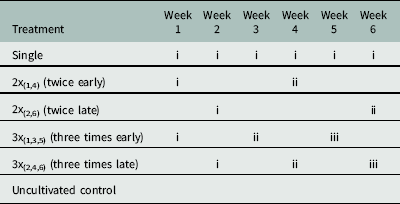
The experimental design was a randomized complete block with four replicates. Treatments examined interrow cultivation at six single cultivation timings, occurring weekly, in addition to multiple cultivation treatments occurring in different time periods: twice early, twice late, three times early, and three times late. An uncultivated control was included in the treatment list (Table 1). Weekly cultivation began at the aboveground 4-node stage for both field pea and lentil, as the beginning of the CPWC in lentil is at the 5-node stage (Fedoruk et al. Reference Fedoruk, Johnson and Shirtliffe2011). Harker et al. (Reference Harker, Blackshaw and Clayton2001) determined the CPWC of field pea to be 1 to 2 wk after crop emergence, so crop stage was assumed to be similar to lentil for this study.
Frequency and timing of cultivation treatments in field pea and lentil at all site-years in 2014 and 2015.Footnote a

a Abbreviations: i, denotes single cultivation treatment or first cultivation timing in the multiple cultivation treatments; ii, denotes second cultivation timing in multiple cultivation treatments; iii, denotes third cultivation timing in multiple cultivation treatments; x, denotes the frequency in which cultivation occurred over time.
Interrow cultivation was conducted using a hydraulically powered, steerable German Schmotzer interrow cultivator (Schmotzer Agrartechnic, Bad Windsheim, Germany). The hoe width on the cultivator was 12 cm, and the hoes were spaced 30-cm apart. Cultivation speed was approximately 5 km h−1, and hoes were set approximately 5-cm deep, adjusted for crop residue and soil type.
The field pea variety ‘CDC Dakota’ and lentil variety ‘CDC Impala’ were seeded into wheat stubble in May. Suggested plant populations for organic production of 240 plants m−2 for lentil (Baird et al. Reference Baird, Shirtliffe and Walley2009a) and 120 plants m−2 for field pea (Baird et al. Reference Baird, Walley and Shirtliffe2009b) were used to achieve plant populations representative of organic production. Seeding was conducted using a plot seeder in 2.2 by 6.0 m plots that had 6 rows with a 30.0-cm row spacing. In 2015, plots were lengthened to 8.0 m, and following the final cultivation timing, 1.0 m was mowed off both ends to a total length of 6.0 m. This avoided damage caused from entering and exiting plots with the interrow cultivator. Both field pea and lentil were seeded with EstablishTM (Loveland Products Canada, 789 Donnybrook Drive, Dorchester, ON N0L 1G5, Canada) granular rhizobial inoculant (Rhizobium leguminosarum) at 4.4 kg ha−1, and 11-52-0 was applied based on soil fertility recommendations from spring soil tests. Inoculant and fertilizer were placed with the seed. Weeds were controlled PRE and POST using imazamox+imazapethyr (Odyssey®, BASF Canada, 100 Milverton Drive, 5th Floor, Mississauga, ON L5R 4H1, Canada) at a rate of 30 g ai ha−1 and sethoxydim (Poast®, BASF Canada) at 211 g ai ha−1 to observe the crop injury from cultivation without confounding effects from weeds present. When herbicidal weed control was not adequate, hand weeding was performed to maintain weed-free plots. Fluxapyroxad+pyraclostrobin (Priaxor®, BASF Canada) was applied as a fungicide in 2015 at a rate of 222.5 g ai ha−1, because growing conditions were favorable for substantial disease pressure causing early senescence and crop failure.
Aboveground crop biomass was sampled from two 0.25-m2 quadrats. One sample was taken from the front and back of each plot after pod filling but before natural crop desiccation at approximately the 80 BBCH stage (Lancashire et al. Reference Lancashire, Bleiholder, Van Den Boom, Langeluddeke, Stauss, Weber and Witzenberger1991). Biomass samples were oven-dried at 70 C in paper bags for 48 h and then weighed. Dry biomass weights were used for analysis. At harvest, the four center rows of crop were harvested using a small-plot combine (harvested area of 7.2 m2). After removal of dockage, seeds were dried to uniform moisture and weighed, and yield was determined.
Statistical Analysis
A combined analysis of data from 4 site-years was performed, as there were no significant interactions between treatments and site (P>0.05). The MIXED procedure in SAS v. 9.4 (SAS Institute 2012) was used for ANOVA. Cultivation node stage for single treatments was treated as a continuous fixed effect, while multiple cultivation treatments were analyzed separately as a categorical fixed effect. Site-year, replicate, and node stage by site-year interaction were assigned as random effects, because there were too few treatment levels to analyze as a continuous effect. For single cultivation timings, a regression analysis was conducted to investigate the relationship between timing of cultivation and crop yield and crop biomass. The significance of regression was tested at P<0.05. Multiple cultivation treatment differences were analyzed by comparing differences of least-squares means (LSMEANS). Significance of treatment effect was set at P<0.05. Data were tested for homogeneity of variances before analysis. If variance was determined to not be homogeneous, log10 or square-root transformations were performed. Yield for single cultivation timings and multiple cultivation timings in field pea were log10 transformed. In lentil, only yield for single cultivation timings was log10 transformed. All data were back-transformed for presentation.
Results and Discussion
Lentil and Field Pea Biomass
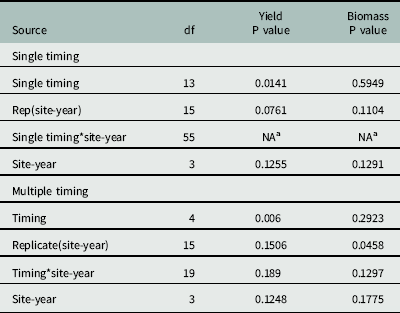
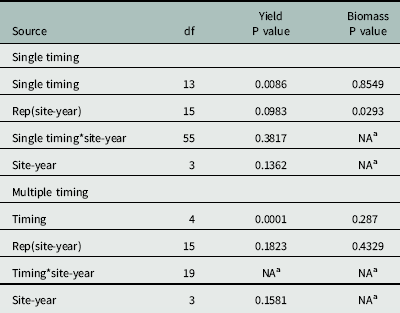
Lentil biomass did not significantly differ between treatments (P>0.05), regardless of cultivation frequency or timing (Table 2). Similar results were observed in field pea (Table 3). There was no significant effect of single or multiple cultivation timings on aboveground biomass (P>0.05). Previous studies have also observed minimal effects of interrow cultivation on crop biomass production (Johnson Reference Johnson2001; Šimon and Škrdleta Reference Šimon and Škrdleta1983), despite this being under weedy conditions.
ANOVA for lentil yield and crop biomass as affected by linear regression of single cultivation timings and multiple cultivation timings as assessed at KCRF and Vonda in 2014 and at KCRF and Osler in 2015.

a NA denotes no covariance associated with random effects found, not significant.
ANOVA for field pea yield and crop biomass as affected by linear regression of single cultivation timings and multiple cultivation timings as assessed at KCRF and Vonda in 2014 and at KCRF and Osler in 2015.

a NA denotes no covariance associated with random effects found, not significant.
Lentil and Field Pea Yield
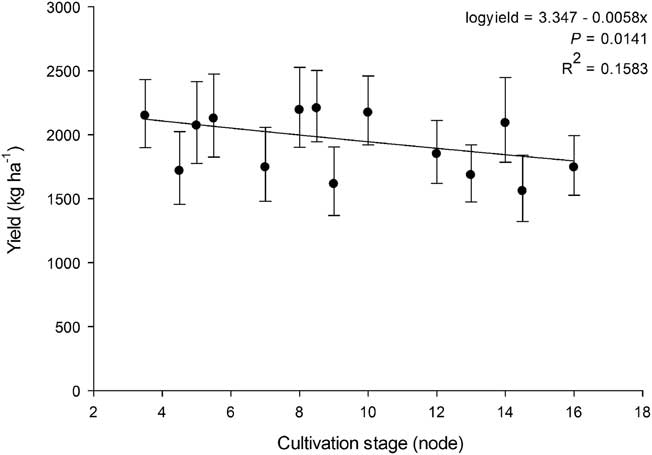
Lentil and field pea yield had a significant linear decline with delayed cultivation timing (Tables 2 and 3). Lentil yield declined by 15% from the earliest stage of cultivation at 3.5 nodes to the latest stage of cultivation at 16 nodes (P = 0.0141; Figure 1). The CPWC of lentil begins at approximately the 5-node stage, continuing to the 10-node stage (Fedoruk et al. Reference Fedoruk, Johnson and Shirtliffe2011). The 5- node to 10-node stages occurred earlier in cultivation treatments, and yield loss within this period was only 7% (Figure 1).
The relationship between the node stage at cultivation and lentil yield averaged over 4 site-years at the Kernen Crop Research Farm (KCRF) and Vonda in 2014 and at the KCRF and Osler in 2015, all located in Saskatchewan, Canada. Data were log10 transformed, and means were back-transformed for presentation. Error bars represent the standard errors of the least-squares mean.

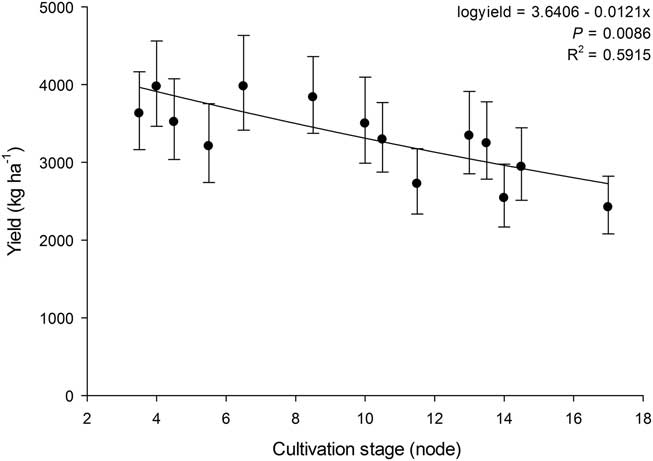
Similar trends were observed in field pea, although greater yield losses were observed when cultivation was delayed (Figure 2). A 31% reduction in field pea yield was observed when cultivation was delayed from 3.5 nodes to 17 nodes (P = 0.0086; Figure 2). The greater reduction in yield resulting from delayed cultivation could be attributed to the physiology of field pea, as its canopy closed earlier than that of lentil. It is important to quantify the mechanism of crop injury causing yield loss, because crop biomass did not decline as cultivation was delayed. Both field pea and lentil exhibited tolerance to early, single cultivation timing, but delayed cultivation significantly decreased crop yield.
The relationship between the node stage at cultivation and field pea yield averaged over 4 site-years at the Kernen Crop Research Farm (KCRF) and Vonda in 2014 and at the KCRF and Osler in 2015, all located in Saskatchewan, Canada. Data were log10 transformed, and means were back-transformed for presentation. Error bars represent the standard errors of the least-squares mean.

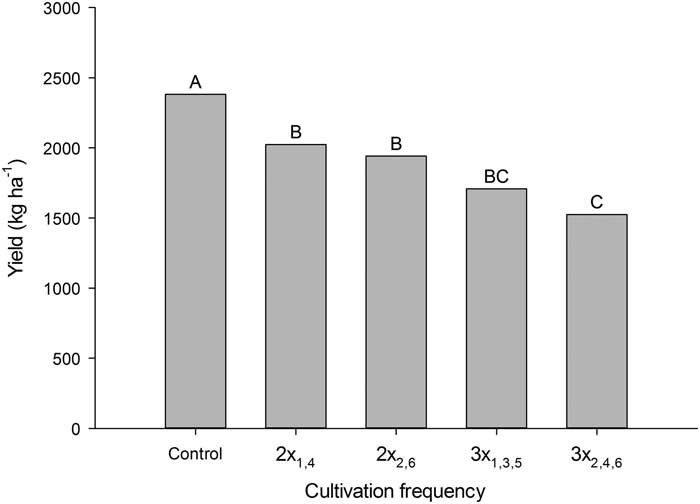
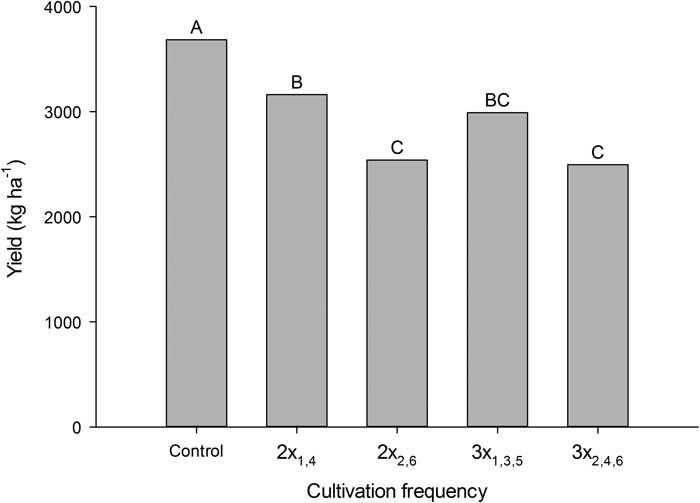
Yield loss as a result of multiple cultivation timings was observed in both field pea and lentil, although crop types varied in their tolerance to cultivation frequency. Lentil was more tolerant to being cultivated twice rather than three times during the growing season, regardless of timing (Figure 3). Yield declined approximately 15% with two cultivations, while yield reduction increased to 36% when cultivation occurred three times late in the growing season. Tolerance to multiple cultivation timings in field pea was less dependent on the number of passes and relied more on stage of cultivation. Cultivating twice early and three times early reduced yield by 14% and 19%, respectively, when compared with the uncultivated control (Figure 4). Late cultivation of two and three times increased yield losses to approximately 31% when compared with the uncultivated control. The greater losses observed in field pea when compared with lentil indicate that field pea may be more sensitive to delayed cultivation or to disturbance by wheel tracks of the tractor and cultivator. This was supported visually, as the crop canopy had more disturbance with multiple cultivation events in field pea compared with lentil. Multiple cultivation events may have resulted in ridging of soil beside the crop row, potentially resulting in yield losses at harvest due to the inaccessibility to seed below ridged areas. This ridging effect was also observed in previous studies examining interrow cultivation in field pea (Johnson Reference Johnson2001). Future studies should examine significance of potential crop yield loss due to soil ridging and methods to reduce this when using interrow cultivation.
The effect of cultivation frequency (represented by 2x and 3x) and timing (weeks indicated in subscripts) on lentil yield averaged over 4 site-years at the Kernen Crop Research Farm (KCRF) and Vonda in 2014 and at the KCRF and Osler in 2015, all located in Saskatchewan, Canada. Different letters represent a significant difference between treatment means at P<0.05.

The effect of cultivation frequency (represented by 2x and 3x) and timing (weeks indicated in subscripts) on field pea yield averaged over 4 site-years at the Kernen Crop Research Farm (KCRF) and Vonda in 2014 and at the KCRF and Osler in 2015, all located in Saskatchewan, Canada. Data were log10 transformed, and means were back-transformed for presentation. Different letters represent significant differences between treatment means at P<0.05.

The crop development stages in which substantial yield loss was observed are considerably later than the majority of stages studied in other POST mechanical weed control experiments. Tolerance of field pea and lentil to single cultivation timings of interrow cultivation may be greater than their tolerance to harrowing, but could be comparable to results seen with rotary hoeing. Harrowing in field pea past the 2-leaf stage has previously exhibited reductions in plant populations of up to 35% (Dastgheib Reference Dastgheib2004). It is important to note, however, that the study by Dastgheib (Reference Dastgheib2004) was not conducted under weed-free conditions, so the results may have been confounded by weed presence or weed removal. Under weed-free conditions, field pea has exhibited good tolerance to rotary hoeing up to the 9-node stage, as no yield losses were observed (Shirtliffe and Johnson Reference Shirtliffe and Johnson2012). Under single cultivation timings, interrow cultivation only resulted in substantial yield losses in field pea and lentil as cultivation was increasingly delayed. Alterations to the interrow cultivator may influence results observed. Sweep type, depth, and tractor speed may improve the selectivity of the interrow cultivator, allowing for later cultivation with reduced crop injury. These factors should be considered in future research.
Despite reductions in yield as single cultivation events were delayed, very little indication of crop damage was visually observed in the crop canopy at the end of the growing season. This observation and the data demonstrating no significant reduction in crop biomass may indicate yield loss from interrow cultivation is occurring through other means than crop death or removal. Interrow cultivation caused some disturbance on the soil surface, creating some challenges with harvest management. This may have resulted in yield losses at harvest time, which could have potentially been avoided through postcultivation rolling. Also, disturbance from tire tracks through plots may have caused additional plant stress, reducing yield. These factors should be investigated further through additional plant stand counts to determine whether reductions in yield are caused by these factors and can be minimized.
Field pea and lentil exhibited reduced yield losses to single cultivation timings at early stages of interrow cultivation and with fewer passes of the cultivator. Minimal yield losses were observed in field pea and lentil during the earlier stages of the CPWC, although yield did decline substantially as cultivation was delayed. These results supported our hypothesis that there would be no yield loss at early stages of cultivation, and yield loss would increase as cultivation was delayed or increased in frequency. No reduction of biomass was observed, which indicates the yield loss may be attributable to other disturbances, such as soil ridging impeding harvest or disturbance from wheel tracks. Future studies should conduct further sampling to confirm this. Minimal yield loss from interrow cultivation in narrow-row field pea and lentil demonstrates the potential for use of this approach in both organic and conventional production systems. Despite yield losses with delayed and multiple cultivation timings, current technological developments allowing for camera-guided steering may reduce crop damage through improved accuracy, further increasing the utility of the interrow cultivator in narrow-row field crops.
Acknowledgments
This research was funded in part through Agriculture and Agri-Food Canada’s Growing Forward 2 Policy Framework, which is a federal–provincial–territorial initiative, and the Saskatchewan Pulse Growers through Organic Science Cluster II. With thanks to Taryn Zdunich and Shaun Campbell for their technical assistance.