Introduction
The identification of discrete fish stocks for the development and appropriate management of commercial fisheries is vitally important (e.g. Waldman, Reference Waldman, Cadrin, Friedland and Waldman2005). The application of management measures that assume erroneous population boundaries can lead to depletion and extinction of local sub-stocks (Butterworth & Penney, Reference Butterworth, Penney, Payne, O'Brien and Rogers2004). The present investigation was part of the WESTHER project that had four major aims: (1) to identify discrete spawning populations; (2) to investigate the composition of non-spawning aggregations; (3) to link recruits on nursery grounds to spawning adult populations; and (4) to deliver advice on these findings to fisheries managers. The null hypotheses of these investigations were that herring to the west of the British Isles live as a single, well-mixed population which does not show significant regional variations in its parasitic faunal composition, prevalence and mean intensity; that herring from particular spawning grounds remain in discrete groups on their feeding grounds; and that parasites do not link juveniles on nursery grounds to spawning adult populations. Our investigations of the spatial and temporal variations in parasite prevalence and infracommunity of spawning herring Clupea harengus L. caught to the west of the British Isles and in the Baltic Sea are reported here.
Parasites are widely used as indicators of stock boundaries, recruitment, migration and mixing of commercially important species of marine, anadromous and freshwater fish. Since their first practical application (Herrington et al., Reference Herrington, Bearse and Firth1939), numerous reviews and guidelines for their use in this field have been published (see, for instance, MacKenzie, Reference MacKenzie2002) Although infection statistics of a single parasite species can be enough to determine the origin of fish and to identify stocks, to build up a more detailed picture of host population structure it is preferable to use either combined infection data from several parasite species (MacKenzie, Reference MacKenzie1985; MacKenzie & Longshaw, Reference MacKenzie and Longshaw1995; Larsen et al., Reference Larsen, Hemmingsen, MacKenzie and Lysne1997) or to analyse entire parasite assemblages (e.g. Lester et al., Reference Lester, Thompson, Moss and Barker2001; Moore et al., Reference Moore, Buckworth, Moss and Lester2003).
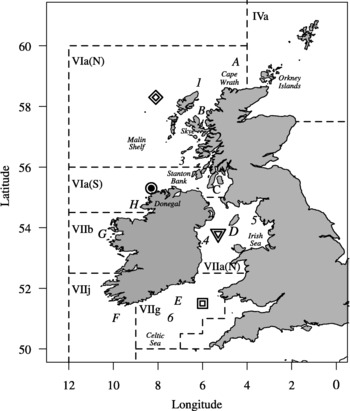
A considerable amount of research has been carried out on the complex of commercially important Atlantic herring Clupea harengus L. stocks to the west of Great Britain and around Ireland. Despite this intensive research, levels of mixing, recruitment patterns and genetic interactions within the complex are still poorly understood (Molloy, Reference Molloy2006). Parrish & Saville (Reference Parrish and Saville1965) considered the herring stocks to the west of the British Isles as consisting of two main components, the ‘oceanic’ and ‘shelf’ populations. Since then, two opposing theories of Atlantic herring population structure have been developed: the discrete population concept (Iles & Sinclair, Reference Iles and Sinclair1982) and the dynamic balance concept (Smith & Jamieson, Reference Smith and Jamieson1986). Current opinion is that neither of these concepts adequately explains herring population structure and dynamics, and that they are better described using the metapopulation concept (McQuinn, Reference McQuinn1997), where population structure in a given area can be considered as a complex of local subpopulations linked by variable degrees of gene flow. Herring to the west of the British Isles are currently managed on the basis of five different management areas; the west of Scotland [ICES Division VIa (North)]; the Firth of Clyde; the area to the north and west of Ireland [ICES Divisions VIa (South) and VIIb,c]; the Irish Sea to the north of 52°30’N [ICES Division VIIa (North)], and finally, the Celtic Sea and Division VIIj, to the south of Ireland (fig. 1).
Location of sampling sites. Spawning samples: A, Cape Wrath; B, Skye; C, Clyde; D, Irish Sea; E, Celtic Sea; F, Dingle; G, Rosamhil; H, Donegal. Juvenile samples: 1, Hebrides; 2, Scottish sea lochs; 3, Stanton Bank; 4, Western Irish Sea; 5, Eastern Irish Sea; 6, Celtic Sea. Mixed stock aggregations: diamonds, Management Unit VIa (North); circles, Management Unit VIa (South), VIIb,c; triangles, Irish Sea [Management Unit VIIa (North)]; squares, Celtic Sea and ICES subdivision VIIj.

Methods
To study the stock identity of herring, a sampling scheme appropriate to herring life-history needs to be devised. First, samples of herring at different life stages were collected: juveniles, spawning adults on their respective spawning grounds, and putative mixtures of non-spawning adults from known feeding grounds. In order to determine the scale of differences within and between the potential metapopulation being sampled, it was necessary to collect samples from populations that are known not to mix with populations to the west of the British Isles. Consequently, samples of spawning herring were collected in the Baltic Sea, near Rügen, and juveniles from the northern coast of Norway. To investigate possible mixing of recruits from the North Sea with west-coast spawners, juveniles were collected from the east and west coasts of the North Sea.
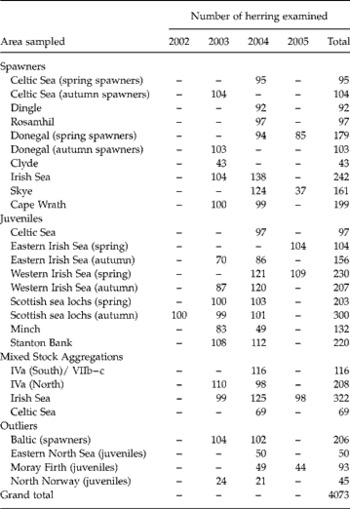
Samples were collected and processed at sea onboard research vessels, or were caught by commercial vessels and processed that day after the catch was landed. Approximately 100 spawning, juvenile and mixed stock aggregations of fish were subjected to parasitological examination. Samples were collected at a variety of times and locations, between late 2002 and early 2005, the details and realized sample sizes of which are presented in table 1.
Location of capture and sample size of spawning, non-spawning and juvenile herring samples examined.

The viscera were removed and preserved individually in vials of 80–96% ethanol for parasitological study. Due to the constraints of sample collection, ectoparasitic species were not recovered. Visceral examinations were carried out at Aberdeen and Liverpool universities, which helped increase the number of samples processed and standardize the methodology across institutes.
In the laboratory, the visceral organs of herring were removed from their vials and placed in tap water for several minutes to allow the tissue to soften, aiding examination. Viscera were then examined for helminth macroparasites under a dissecting microscope at magnifications of from × 60 to × 120. Numbers of pyloric caeca were counted and recorded, and smears of liver, spleen and gonad were examined for microparasites (myxozoans, protozoans, fungi) under a research microscope at × 300 to × 400. All parasites present were identified to species level, recorded, and all macroparasites counted. Samples of larval Anisakis sp. nematodes and renicolid metacercariae were preserved in 96% ethanol for development of molecular markers. Morphological identification of parasites was carried out by referring to the scientific literature, including descriptions of parasites previously reported from herring. Semi-permanent mounts of representative specimens of each helminth parasite species found, with the exception of Anisakis sp. nematode larvae, were stained with acetocarmine and mounted in DePeX. All specimens of Anisakis spp. larvae were preserved in ethanol and retained for investigation of molecular genetics, together with several hundred specimens of each species of renicolid metacercariae (see Cross et al., Reference Cross, Collins, Campbell, Watts, Chubb, Cunningham, Hatfield and MacKenzie2007). Prevalences were compared with chi-squared tests, parasite infracommunities were compared using Mann–Whitney U-tests.
Results
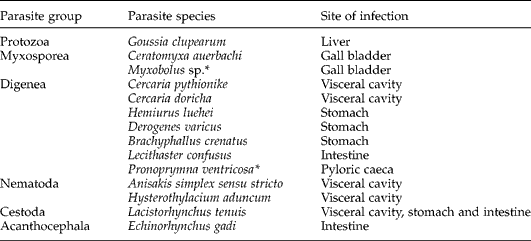
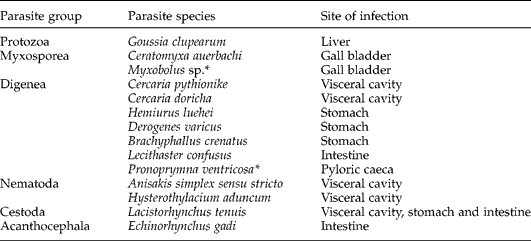
A total of 4073 herring viscera samples were examined for parasitic infections. This comprised 1649 juvenile herring, 1315 spawning herring, 715 mixed adults and 394 outliers (table 1). In total, 14 species of parasite were recorded in this study. Details of species and infection sites are presented in table 2.
Parasite species recorded from herring in this study. New host records are highlighted with an asterisk.
To confirm that renicolid infections remain constant for the life of the fish, abundances of Cercaria pythionike and C. doricha were log transformed, to normalize the data. Linear regression revealed no significant relationship between age and abundance of either C. pythionike (r 2 = 0.0021, P = 0.55) or C. doricha (r 2 = 0.016, P = 0.09). This indicates that further infection with these parasites does not occur in adult herring, that heavily infected individuals are not subject to increased mortality, and that infections are therefore strongly indicative of the nursery ground of origin.
Long-term temporal variation
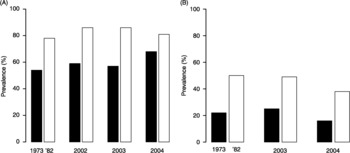
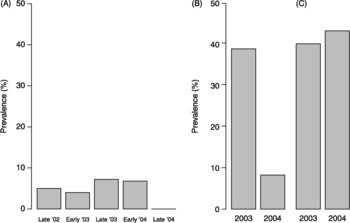
Two of the areas sampled in MacKenzie's (Reference MacKenzie1985) study, Stanton Bank, to the south of the Outer Hebrides, and a number of Scottish west coast sea-lochs, were sampled again during the present study, so it was possible to compare prevalences of infection of C. doricha and C. pythionike in samples taken from the same areas about 30 years apart (fig. 2). There were no significant differences between years in prevalence of either C. doricha (P = 0.059) or C. pythionike (P = 0.282) at Stanton Bank. There were significant differences between years in the Scottish sea lochs sampled (P = 0.002 for C. doricha, P = 0.039 for C. pythionike), but the prevalences were still remarkably similar (fig. 3).
Comparison of prevalences of Cercaria doricha (black) and Cercaria pythionike (white) between herring collected in Scottish sea lochs (A) and at Stanton Bank (B) between 1973 and 1982 (MacKenzie, Reference MacKenzie1985) and those collected in the present study.

Prevalences of Anisakis simplex in juvenile herring samples at different sites in ICES Division VIa (North): (A) Scottish sea lochs; (B) Hebrides; (C) Stanton Bank.

Short-term temporal variation
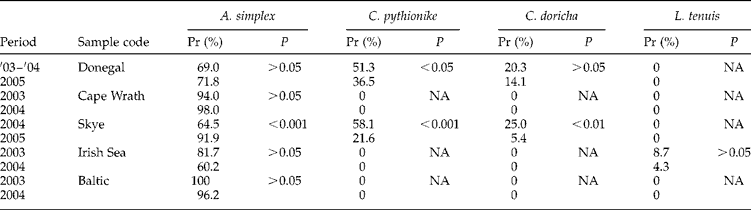
There were no significant differences in prevalence or abundance of any of the four tag species between autumn spawners collected off Donegal in October 2003, and spring spawners collected in the same area in February 2004, therefore we are confident that these samples were taken from a single population spawning in this area over an extended period and can be combined into a single sample. When combined with spring spawning herring collected in 2005 from a similar location, no significant differences were found between the mean intensities of any of the four species at any site across the two periods (table 3). The samples collected at Donegal showed very similar prevalences between years, only varying in the prevalence of C. pythionike.
Significance of temporal variability in prevalences (Pr) of selected tag parasites between spawning herring collected at the same site in multiple years.
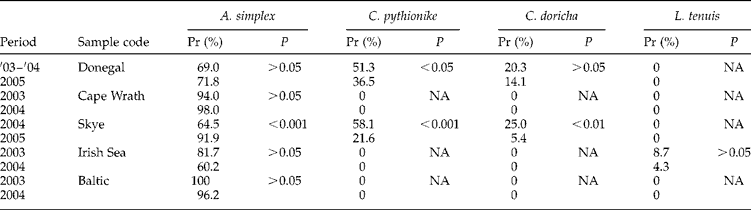
There were no significant differences in prevalence between samples collected in the two different sampling periods in the Irish Sea or at Cape Wrath, but there were significant differences in prevalence of the three tag species present in the samples collected off Skye (table 3). The similarity between the samples collected at Cape Wrath and those in the Baltic Sea is interesting, but without samples from intermediate locations, should not be seen to imply that these are samples taken from the same stock.
Spatial variability of infracommunities
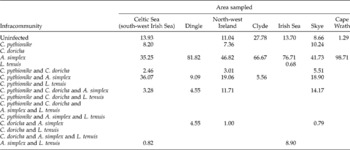
Spawning herring were pooled over different sampling periods and, where appropriate, all samples collected within an ICES management area were combined. A comparison of herring parasite infracommunities, grouped by management area, was performed (table 4). Visual inspection of the parasite community data highlights a number of obvious groupings. Herring from north-western Ireland [ICES Divisions VIa (South) and VIIb,c] and spring spawning fish from Skye [ICES Division VIa (North)] appear to have very similar parasite infracommunities. The two samples collected at different times of year in VIa (North), i.e. Skye, and Cape Wrath, have very different parasite infracommunities. Samples of Celtic Sea and Division VIIj herring are not self-consistent, suggesting this is home to some degree of stock mixing. While spawning herring from the north-west of Ireland [VIa (South) and VIIb,c] and Skye [VIa (North)] appear to be similar, with the other areas appearing to be more different from each other, Mann–Whitney U-test results between the different areas dilute these differences somewhat. The sample taken at Cape Wrath remained significantly different to all other samples. Other differences are less significant or produce confusing patterns, suggesting that the rather low number of species recorded may make this a rather blunt tool for identifying these populations.
Parasite infracommunity percentages observed in spawning samples.

Links between juveniles and adults
Anisakis simplex infections are not a useful tag species to link adults to juveniles on nursery grounds, due to the cumulative nature of their mode of infection. The prevalence of this species varied greatly between inshore and offshore samples collected to the west of Scotland, with prevalences of over 40% in juveniles collected from Stanton Bank and offshore of the Hebrides, but between 0% and 7% in Scottish sea loch juvenile samples (fig. 3). This illustrates the differences in parasite faunas between juveniles in adjacent nursery areas.
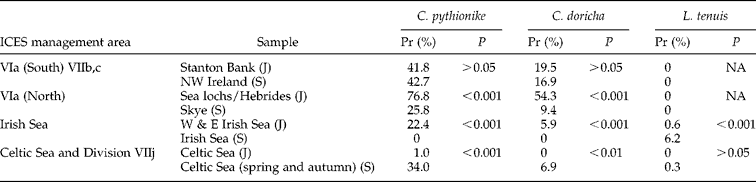
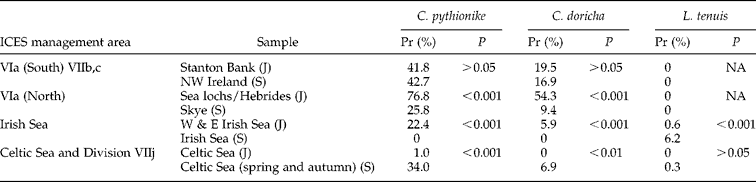
The prevalences of the three remaining tag species were not significantly different between spawning samples collected to the north-west of Ireland [ICES Divisions VIa (South) and VIIb,c] and juveniles collected at Stanton Bank (table 5). Samples collected in other management areas show significant differences in prevalence between juveniles and adults, although some of these are rather surprising.
Differences between prevalences (Pr) of tag parasites in spawning (S) and juvenile (J) samples from each ICES functional unit.
Links between spawning and non-spawning populations
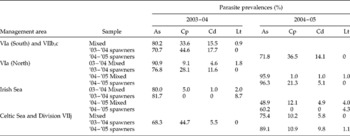
Comparisons were made between the prevalences of tag parasites in spawning samples and non-spawning mixed aggregations collected in the same management area in the same year (table 6). Interestingly, fish infected with C. doricha and C. pythionike were found in mixed stock aggregations in the Irish Sea, but were absent from the Irish Sea spawning population, showing that herring from different spawning populations do not remain in distinct groups on feeding grounds.
Comparison of prevalences of tag parasites (As, Anisakis simplex; Cp, Cercaria pythionike; Cs, C. doricha; Lt, Lacistorhynchus tenuis) from spawning and non-spawning samples collected in each functional unit.

Discussion
Pelagic marine fish species have been the subjects of many biological tag studies (Williams et al., Reference Williams, MacKenzie and McCarthy1992; MacKenzie, Reference MacKenzie2002), a number of which have focused on the clupeids – the Atlantic herring Clupea harengus, and the Pacific herring C. pallasi (see MacKenzie, Reference MacKenzie1985; Moser & Hsieh, Reference Moser and Hsieh1992). Anisakid nematode larvae have been used most frequently, but other tag groups include larval and adult digeneans, cestode plerocercoids, monogeneans and myxosporeans. MacKenzie (Reference MacKenzie1985) used two species of renicolid metacercariae, Cercaria doricha and C. pythionike, and a cestode plerocercoid, Lacistorhynchus tenuis, in his study of herring recruitment around the Scottish coasts. The value of the metacercariae as tags derived from three features of the host–parasite relationship: (1) herring were only susceptible to infection in their first year of life and no further infection occurs thereafter; (2) the parasites had life spans in herring extending to several years and possibly as long as that of the host itself; and (3) levels of infection varied significantly between different nursery areas. This meant that herring were effectively tagged for life as juveniles and these parasites could be used to trace samples of adult herring to their nursery grounds. The plerocercoid of Lacistorhynchus tenuis also infected herring as juveniles, but its value as a tag was constrained by the fact that further infection of herring as adults was possible. The study area of MacKenzie (Reference MacKenzie1985) overlapped that of the present study, and it was therefore anticipated that these three parasite species would prove to be useful tags once again.
Long-term stability of herring parasite fauna has not been observed previously (MacKenzie, Reference MacKenzie1985). Significant trends over time have, however, been reported. MacKenzie (Reference MacKenzie1987) recorded a decline in the prevalence of L. tenuis in herring from the North Sea. Between 1973 and 1978 prevalences remained at a stable level of around 10%, declining to a stable level of less than 1% in the years after 1978. MacKenzie (Reference MacKenzie1987) attributed this decline to the change in the distribution of an unknown copepod, required as an intermediate host (Mudry & Dailey, Reference Mudry and Dailey1971) associated with the end of the ‘great salinity anomaly’ (Dickson et al., Reference Dickson, Meincke, Malmberg and Lee1988). The prevalence of this parasite in this study remains at about the level that MacKenzie (Reference MacKenzie1987) reported from 1978 onwards; however, this could now be associated with the long-term decline in abundance of the spurdog (Squalus acanthias), the final host of this species (ICES, 2006).
The apparent stability of a parasite community over a period of about 30 years is an interesting feature that has not been reported previously for herring. Admittedly, there are no data from the intervening period, and it could be the case that large fluctuations have taken place in prevalence and community composition that have not been observed. However, the lack of short-term fluctuations observed in this study would suggest that this is not the case.
The finding of significant differences in the parasite fauna of herring sampled at different sites to the west of the British Isles allows us to reject the null hypothesis that herring in this area exist as a single, fully mixed population. We can also reject the null hypothesis that herring remain in discrete groups on their feeding grounds. This has implications for management, particularly in assigning catches of non-spawning fish to particular populations.
The analysis of parasite community composition shows a complex relationship between spawning herring populations to the west of the British Isles. Most apparent is the difference between the two spawning groups in area VIa (North). Autumn spawning herring taken from Cape Wrath have a very different parasite community to the spring spawning fish from Skye. The absence of either species of renicolid metacercariae in fish from Cape Wrath suggests that these fish have not recruited from the Scottish west coast, as these parasites are commonly found in west coast juveniles, and infection with these species is permanent. This pattern of infection was only observed in the juvenile herring collected in the eastern North Sea and from North Norwegian waters. While this might not be indicative of a recruitment of herring from the northern North Sea to the spawning population north of Scotland, we can say conclusively that the fish spawning at Cape Wrath have not been recruited from any of the nursery grounds to the west of the British Isles which have been sampled in this study. This is in agreement with the results of the Bløden herring tagging project (Anon., 1975), which showed conclusively that there was a migration of some adult herring from the North Sea to the west coast of Scotland. A number of studies have demonstrated a drift of herring larvae away from Cape Wrath, along the north coast of Scotland, around the Orkney Islands and into the North Sea (Heath & MacLachlan, Reference Heath and MacLachlan1987; Heath & Rankine, Reference Heath and Rankine1988). Heath et al. (Reference Heath, MacLachlan and Martin1987) reported that larvae of herring spawning to the west of the Hebrides are entrained into the Scottish coastal current and carried towards the North Sea, while those spawning in other areas are inshore of the main current flow, and the transport route of these larvae has not been identified convincingly. Our results support this pattern of larval drift and adult migration in the opposite direction.
The parasitological data allow us to make a number of inferences about stock identity of herring. The similarities in parasite prevalences in spawning fish collected to the north and west of Ireland, the mixed stock sample from management area VIa (South) and VIIb,c, and the juveniles collected at Stanton Bank and around the Hebrides suggest that these fish comprise a single stock.
There is a relationship between juveniles in the Irish Sea and those that spawn in the Celtic Sea, as evinced by the presence of C. doricha and C. pythionike in these samples. The absence of these parasites in fish that spawn in the Irish Sea suggests that not all juveniles in the Irish Sea go on to recruit to the Irish Sea spawning stock. The intermediate prevalence of C. doricha and C. pythionike in the Irish Sea mixed stock sample would suggest that this comprises a mixture of herring spawning both in the Irish Sea and Celtic Sea. The sample of Skye spawners taken in 2004 recruited mainly from Scottish coastal nurseries, whereas the one taken in 2005 included a component recruited from the eastern North Sea. The parasite fauna of the mixed stock sample taken from ICES Division VIa (North) was similar in its composition to that of the spawning fish taken at Cape Wrath. However, the finding of L. tenuis in these fish suggests the presence of some Irish Sea spawners, the only area where this species was recorded, and the finding of C. doricha and C. pythionike is indicative of the presence of some fish from the Skye spawning sample. There is, therefore, the potential for fish from three ICES management units to be present in the mixed aggregations found over the Malin Shelf, with significant implications for management in this area. Interestingly, it is apparent that C. doricha was never observed as a single infection but occurred only in the presence of other parasites.
The absence of L. tenuis in the mixed stock aggregation sample from the Celtic Sea indicates that no component of Irish Sea spawners could be detected in the Celtic Sea, suggesting that the fish spawning in the Irish Sea are more closely linked with populations on the Malin Shelf, rather than with those in the south-western approaches. There are obvious differences in parasite fauna between the fish spawning in the Irish Sea and the juveniles found on the nursery grounds there. Juveniles are infected with renicolid metacercariae, which are absent from the adults that spawn in the Irish Sea. The picture is reversed in fish from the Celtic Sea and Division VIIj management area, with juvenile fish having a significantly lower prevalence of C. doricha and C. pythionike than the spawning adults. The contiguity of these two management areas could mean that there is a drift of larvae from the Celtic Sea into the Irish Sea, which then migrate back as spawning adults. This would be supported by the finding of L. tenuis in a spawning sample to the south of Ireland – the only spawning fish infected with this parasite outside of the Irish Sea. There could also be recruitment of juveniles from the Celtic Sea, with their very low prevalences of C. pythionike and C. doricha, to the Irish Sea spawning population. However, it is clear that the southern Irish Sea is an area of stock mixing between populations with very different parasite prevalences.
Anisakis simplex is one of the most heavily studied of all fish parasites, and has been used as a tag species in herring a number of times (Grabda, Reference Grabda1974; Horbowy & Poldoska, Reference Horbowy and Poldoska2001). It reaches maturity in the intestines of cetaceans, uses a wide range of intermediate hosts and has a certain element of plasticity in its life cycle (Smith, Reference Smith1983; Klimpel et al., Reference Klimpel, Palm, Ruckert and Piatkowski2004). The anisakid nematodes found in this study were identified as Anisakis simplex sensu stricto using restriction fragment length polymorphism (RFLP) (M. Cross, unpublished data). This is in agreement with the findings of Mattiucci et al. (Reference Mattiucci, Farina, Campbell, Mackenzie, Ramos, Pinto, Abaunza and Nascetti2007), who found this species to be the dominant species infecting horse mackerel Trachurus trachurus in this region of the north-east Atlantic. Infection with anisakid nematodes has been shown to be cumulative with age (Gibson & Jones, Reference Gibson and Jones1993), which means that care must be taken when interpreting these data, particularly in relation to juvenile fishes, as differences in the mean age of otherwise similar samples of juvenile fishes could have a significant bearing on the levels of accumulated parasites observed.
The finding of a Myxobolus sp. free living in the gall bladder is uncommon. Over 450 species of Myxobolus have been described from fish hosts. Of these, most have been described from freshwater fishes (Landsberg & Lom, Reference Landsberg and Lom1991). This is the first record of a Myxobolus sp. infecting herring. The rarity and low intensity of this finding suggests that this was an accidental infection. This species does not provide any useful information on stock identity or distribution.
The finding of Pronoprymna ventricosa is a new host record for herring, having previously been reported from a range of small pelagic, mainly clupeid, fishes, and most frequently from shads (Alosa spp.). Bray & Gibson (Reference Bray and Gibson1980) reported and described specimens from Alosa alosa and A. fallax caught in the Celtic Sea and the River Severn. The other adult digeneans found in the digestive tract are generalist species that have previously been reported from a wide range of species.
In conclusion, the helminth fauna of the herring is a valuable tool for the identification of both discrete stocks and linkages between different life history stages in waters to the west of the British Isles. It is possible to build testable hypotheses from these results, which will hopefully lead to better understanding of stock dynamics and improved resource management in the future.
Acknowledgements
This project was funded by the EU Commission within the 5th framework program, Quality of Life and Management of Living Resources (Key Action 5: Sustainable agriculture, fisheries and forestry) Contract QLRT-2001-01 056. The authors are deeply grateful to all involved in the collection of herring samples, and to our partners in the WESTHER project for helpful comments and thoughtful discussion. The authors also wish to thank the anonymous reviewers for their comments on this work.