INTRODUCTION
Conversion of tropical forests to agriculture often leads to a decrease in bird species richness with only a subset of the forest species surviving in agricultural habitats (Dunn Reference DUNN2004a). Bird feeding guilds may vary in sensitivity to habitat alteration and the consequent negative responses of insectivorous guilds have often been emphasized (Canaday Reference CANADAY1996, Şekercioglu Reference ŞEKERCIOGLU2002a, Şekercioglu et al. Reference ŞEKERCIOḠLU, EHRLICH, DAILY, AYGEN, GOEHRING and SANDÍ2002, Stouffer & Bierregaard Reference STOUFFER and BIERREGAARD1995, Tscharntke et al. Reference TSCHARNTKE, SEKERCIOGLU, DIETSCH, SODHI, HOEHN and TYLIANAKIS2008). Agricultural landscapes may vary in their capacity to support forest birds indirectly through buffering edge effects, providing a permeable matrix or directly through provision of habitat.
Structurally complex agriculture is likely to support a broader range of bird species. For example, Clough et al. (Reference CLOUGH, DWI PUTRA, PITOPANG and TSCHARNTKE2009), found that the conversion to structurally complex shaded cocoa plantations did not disproportionately affect insectivorous birds, probably due to a high density of insect prey maintained by high tree densities. Agro-ecosystems of Africa, including those of Ethiopia, can often be complex with a diversity of indigenous and introduced crops and, in certain regions, a high density of scattered trees which may limit losses of sensitive guilds such as insectivores (Fischer et al. Reference FISCHER, STOTT and LAW2010, Gove et al. Reference GOVE, MAJER and RICO-GRAY2005, Manning et al. Reference MANNING, FISCHER and LINDENMAYER2006). At a broader landscape scale, a series of such farms may provide a broad range of habitats and therefore support a large number of bird species when compared with a homogeneous series of farms (Flather Reference FLATHER1996).
In Africa, bird species richness in forested regions (especially montane forests) is lower than other regions of the world, and lower than more open habitats such as savannas of Africa (Moreau Reference MOREAU1966). Therefore agricultural habitats of Ethiopia will possess more bird species if they are colonized by the relatively rich pool of species adapted to open habitats (Harrison & Cornell Reference HARRISON and CORNELL2008, Ricklefs Reference RICKLEFS1987). Connectivity to more open habitats such as savannas, wetlands or even agricultural areas with a longer history may also be an important variable in explaining the assemblage composition and guild structure in a newly disturbed region (Terborgh & Weske Reference TERBORGH and WESKE1969). Hence, farmlands that are both spatially connected to other open habitats and are structurally complex may sustain a guild structure not usually predicted for landscapes converted to agriculture (Harvey et al. Reference HARVEY, MEDINA, SÁNCHEZ, VÍLCHEZ, HERNÁNDEZ, SAENZ, MAES, CASANOVES and SINCLAIR2006).
In this paper we explore a landscape mosaic of agriculture and forest in south-west Ethiopia and determine whether particular Afromontane bird guilds are sensitive to conversion to agriculture and whether overall compositional changes reflect changes in feeding guild structure (Şekercioğlu et al. Reference ŞEKERCIOĞLU, DAILY and EHRLICH2004, Sodhi et al. Reference SODHI, LIOW and BAZZAZ2004). We hypothesize that the complex structure of the studied farms combined with a species pool of birds adapted to open habitats will lead to few losses of species diversity, even within particularly sensitive feeding guilds.
METHODS
Study region and sites
We conducted the study in a 40 × 35-km area surrounding the town of Bonga (36°14´E, 7°16´N), 450 km south-west of Addis Ababa, Ethiopia (Gove et al. Reference GOVE, HYLANDER, NEMOMISSA and SHIMELIS2008). The area's climate is warm tropical with the main rainy season occurring from March to October. Annual average rainfall is approximately 1700 mm y−1 and dominant vegetation is Afromontane rain forest (Friis et al. Reference FRIIS, RASMUSSEN and VOLLESEN1982) with species such as Sapium ellipticum (Hochst.) Pax (Euphorbiaceae), Schefflera abyssinica (A. Rich.) Harms (Araliaceae) and Millettia ferruginea (Hochst.) Baker (Fabaceae). We recorded 62 tree species in the study. The five most common farmland trees were: Albizia gummifera (J.F. Gmel.) C. A. Sm. (Fabaceae), Sapium ellipticum (Hochst.) Pax (Euphorbiaceae), Cordia africana Lam. (Boraginaceae), Ficus sur Forsskål (Moraceae) and Millettia ferruginea (Hochst.) Baker (Fabaceae), all of which are indigenous forest trees which have been promoted in agriculture. Only two species were introduced (Alangium chinense (Lour.) Harms (Alangiaceae) and Eucalyptus camaldulensis Dehnh. (Myrtaceae)). The landscape is a mosaic of forests and agricultural areas with both large (>100 ha) and small (<1 ha) patches of forest and agriculture. Approximately 40% of the landscape is currently covered with forest (Gove et al. Reference GOVE, HYLANDER, NEMOMISSA and SHIMELIS2008). During the last 50 y for which we have access to aerial photos and satellite imagery (LANDSAT) there has been a slow but steady land conversion to agriculture, with consequent reduction in the size of the forest fragments. Around 50% of our investigated agricultural areas are situated within areas that have been converted within this time frame. The history of the rest of the landscape is difficult to ascertain due to lack of older aerial photographs. However, even if there may have been fluctuations in forest cover during the last 150 y it is likely that annual crop agriculture is of much more recent origin here than in the central highlands (McCann Reference McCANN1995). We carried out all fieldwork during June–August 2007, during the bird breeding season, when identifying canopy birds from song was easiest.
Farms are made up of a variety of crops, and more than 60 food plants including corn and coffee are grown across these farms which often contain a variety of tree species.
We chose 19 farm sites and 19 forest sites, widely dispersed across the focal landscape, attempting to maximize the variation in coverage of agriculture and forest amongst sites. The sites were chosen from global Landsat images produced in 2000, with 15-m resolution. We separated our sites into farmland and forest as the landscape is clearly defined by these two habitat types, both superficially and by local communities responsible for their management. Sites were separated by at least 2 km within each habitat category. Altitude ranged from 1700 to 2350 m asl. We were led to each site using GPS and at each site we established a 100 × 200-m plot.
Bird surveys and vegetation
At each farm and forest site, we used 22 8-min point counts evenly distributed within the 100 × 200-m plot. Three rows of four points, alternating with two rows of five points with the outer points on the margin of the quadrat led to a survey area closer to 150 × 250 m. Given the small size and high heterogeneity of many farms and forest patches, we employed a relatively dense array of point counts. Each point was sampled once. This was necessary as we could only survey one site per day, due to the wide dispersal of sites and transport by foot, and our aim to samples as many sites as possible within a 3-mo field season. Increased, repeated sampling may have increased species richness estimates, but current sampling is sufficient for meaningful comparisons amongst habitat types. We recorded all bird species seen and heard within a 25-m radius. On several occasions we did not complete all 22 point counts (at least 18; usually due to rain). Each site survey was carried out in 1 d soon after sunrise and lasted approximately 3–4 h.
At each farm site, the 100 × 200-m plot was divided into fifty 20 × 20-m subplots in which we recorded density and diameter of all trees (dbh > 15 cm) and per cent cover of coffee and food plants. Where tree species could not be identified in the field, specimens were taken to the National Herbarium of Ethiopia (ETH) for identification and deposited there.
Data analysis
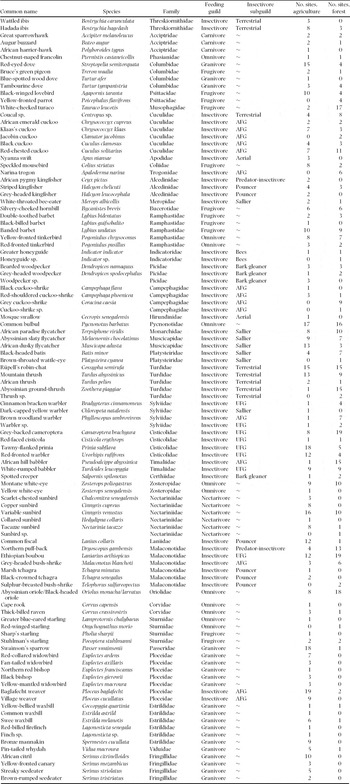
We classified bird feeding guilds based on Waltert et al. (Reference WALTERT, BOBO, SAINGE, FERMON and MÜHLENBERG2005). We further classified the insectivores into subguilds based on strata and feeding behaviour in a similar manner to Waltert et al. (Reference WALTERT, BOBO, SAINGE, FERMON and MÜHLENBERG2005) (Appendix 1). Species body weights were taken from Dunning (Reference DUNNING1992).
For each site we estimated species richness based on the Jackknife 2 estimator which accounts for variability in detection probability across species and habitats (Nichols et al. Reference NICHOLS, BOULINIER, HINES, POLLOCK and SAUER1998). Samples were considered to be the individual point counts, with species richness estimated for each site. Analysis was carried out using EstimateS 8 (http://viceroyeeb.uconn.edu/estimates). We used MANOVA to compare species richness across habitats (forest vs. agriculture), using Pilai's trace as our test criterion and after confirming assumptions of normality and sphericity. We performed one MANOVA for primary feeding guilds and another for the insectivorous subguilds.
For each species, we obtained an indicator value for each of the two habitats (agriculture and forest), using the technique of Dufrêne & Legendre (Reference DUFRÊNE and LEGENDRE1997) and including the frequency of occurrence of each species. The approach provides an indicator score for each species based on its fidelity to a single habitat type. We then calculated a preference index by subtracting the indicator value for agriculture from the value for forest. Therefore, species with a negative index suggested a preference for agriculture, while a positive index suggested a preference for forest (Dynesius et al. Reference DYNESIUS, HYLANDER and NILSSON2009). We used a general linear model with Gaussian error structure to test for a difference in response to agricultural clearing amongst guilds; the response variable was the indicator value of each species while guild and weight were treated as predictor variables. We used Anosim (Clarke Reference CLARKE1993) in a separate analysis for each guild to determine whether species composition of each guild differed between the forest and agriculture habitat. We used Sørensen's index as the measure of dissimilarity and randomized our data 999 times.
We tested for a multivariate correlation between bird species assemblage and tree species assemblage amongst farm sites using a Mantel test. Both bird and tree distance matrices were calculated using Bray–Curtis similarity. We performed tests for the bird assemblage as a whole, and for each bird feeding guild separately.
We used general linear models with Gaussian error structure to understand the variation in species richness of the guilds as it related to variation in measured environmental variables. The independent variables considered for model-inclusion were: tree density, tree species density (which was correlated with species density of forest tree species – a variable excluded from the model), and the proportion of fleshy-fruited trees (in terms of individuals and species). Final model diagnostics confirmed appropriate error structures. The most parsimonious models were selected using a best-subsets approach based on the Bayesian Information Criterion (Miller Reference MILLER2002).
In order to examine the level of species turnover in each of the guilds and habitats, species accumulation curves were created using EstimateS. Curves were created by randomization of observed data samples, with each site considered a sample. All other analyses were performed in R2.6.1 (http://www.R-project.org).
RESULTS
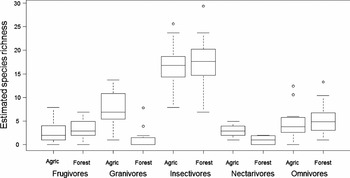
No guild declined in species richness with transition to farmland (Figure 1). However, nectarivore and granivore species richness were, respectively, three and seven times higher in farmlands (Figure 1; F1,36 = 34.6, P < 0.001, F1,36 = 38.3, P < 0.001 respectively). Amongst the insectivorous subguilds there were no significant changes in species richness between the two habitats (Pillai's trace = 0.240, F7,36 = 1.35, P = 0.262).
Ethopian tropical montane bird species richness in agricultural and forest habitats, with comparison among feeding guilds. Box plots represent the median value, with extent of box representing the 25th and 75th percentiles. Whiskers encompass observations within 1.5 times the extent of the box. Outliers are represented by individual points (Agric = Agricultural plots).

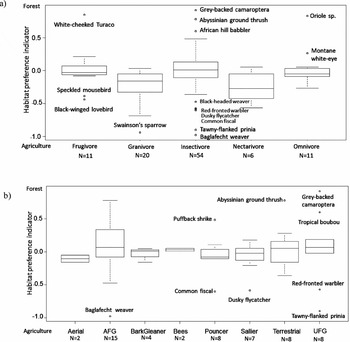
Based on indicator values, habitat preferences differed significantly amongst feeding guilds (Figure 2a; F4, 98 = 2.94, P = 0.024). Mean index of habitat preference differed from zero for both granivores (t19 = −4.23, P < 0.001) and nectarivores (t5 = −2.61, P = 0.047), suggesting significant preferences for the farmland habitat. However, within the insectivorous guild there are many species with strong preference for either agricultural or forest sites (Figure 2a), with the understorey foliage gleaners having the strongest set of preferences (Figure 2b). Body weight had no relationship with habitat preference based on indicator values (F1,96 = 0.041, P = 0.842), and had no significant interaction with feeding guild (F9,88 = 1.54, P = 0.146). All guilds differed in species composition between forest and agricultural habitat (ANOSIM statistic R = 0.057 – 0.664, P = 0.001–0.023).
Habitat preferences for bird species of tropical montane Ethiopia. Preferences of species are defined by their Indicator Value. Preference index is the indicator value for agriculture minus indicator value for forest. Positive values suggest a preference for forest, while negative numbers suggest a preference for agriculture. Habitat preference of species within each feeding guild (a). Habitat preference of species within each subguild of insectivores (b). (AFG = Arboreal foliage gleaner; UFG = Understorey foliage gleaner).

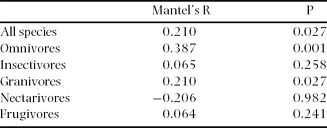
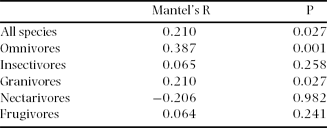
Farms had an average (± SD) of 4.3 ± 8.3 food plant species per 2-ha plot and a tree density of 4.9 ± 2.0 trees ha−1. Amongst the 19 farms, bird species assemblage was correlated with the tree species assemblage (Table 1). Within guilds, species composition of the omnivore and granivore assemblages was correlated with the tree species assemblages (Table 1).
Relationship between Ethiopian tropical montane bird assemblages and tree assemblages in agricultural plots. Multivariate correlations between the tree species composition of agriculture sites and the associated bird species composition (n = 19) were tested using Mantel tests. P is based on 1000 randomizations of the observed data.
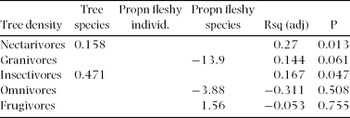
We were able to fit a significant environment-species richness model for two guilds within farmland (P < 0.05, Table 2). Nectarivore and insectivore species richness were both correlated with the species richness of trees. Frugivores and omnivores were not associated with any environmental variables including the proportion of fleshy-fruited trees, while granivores were negatively correlated with the proportion of fleshy-fruited tree species.
Ethiopian tropical montane bird assemblages in farmland: the response of bird feeding guilds to farm-level habitat variables tested across 19 farms. The response variable considered is the species richness within each feeding guild. Models were established using a minimum subset approach based on minimizing BIC. The table includes the model parameter estimates association with four predictor variables. Tree species is the number of species in each farm plot. ‘Propn fleshy individ’ is the proportion of individual trees with fleshy fruit, ‘Propn fleshy species’ is the proportion of tree species in each farm known to produce fleshy fruit.

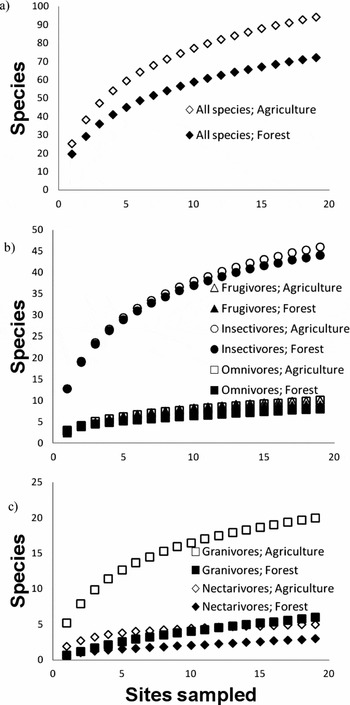
Granivores were the most species-rich guild and nectarivores the least rich. Overall, species accumulated at a faster rate in the agriculture plots than in the forest fragments and overall species richness was higher in agriculture (Figure 3a). Agricultural plots contained 22 more species than forest plots, 14 of which were granivorous species. Omnivores were the only group that was more species rich in the forest (10 versus 8 species). Within most guilds, species accumulation rates were similar in forest and agriculture (Figure 3b), with the strongest exception being the granivores which were almost four times richer in agriculture (Figure 3c). This was also true, but to a lesser extent for the nectarivores which were approximately twice as rich in agriculture.
Species accumulation curves for Ethiopian tropical montane bird assemblages in agriculture and forest. Accumulation curves are based on randomisation of samples, with comparisons amongst forest and agricultural plots. Each of the 38 sites was considered as the sample. Accumulation curves for all species combined (a) accumulation curves for frugivores, insectivores and omnivores considered separately (b) accumulation curves for granivores and nectarivores considered separately (c).

DISCUSSION
Here we demonstrate that avian feeding guilds are differentially affected by forest conversion in tropical montane Ethiopia. However effects were not those often emphasized in studies of tropical forest conversion, with instead the largest effects being the promotion of some guilds (nectarivores and granivores) rather than the decline in particular guilds. In terms of number of species, we observed no difference in insectivore occurrence between forests and farm sites and this lack of difference was maintained even when considering subguilds including understorey foragers. This is surprising given that understorey insectivores are considered one of the most sensitive bird guilds (Canaday Reference CANADAY1996, Şekercioglu Reference ŞEKERCIOGLU2002b, Şekercioglu et al. Reference ŞEKERCIOḠLU, EHRLICH, DAILY, AYGEN, GOEHRING and SANDÍ2002, Stouffer & Bierregaard Reference STOUFFER and BIERREGAARD1995, Tscharntke et al. Reference TSCHARNTKE, SEKERCIOGLU, DIETSCH, SODHI, HOEHN and TYLIANAKIS2008). However, when studying individual species it is evident that some insectivores have a strong association with forests, while others have a clear affiliation to the agricultural landscape (see also Martin et al. Reference MARTIN, VIANO, RATSIMISETRA, LALOË and CARRIÈRE2012). Thus the insectivore guild does respond to a conversion to agriculture, but that response does not lead to an overall decline in insectivore species richness.
While a high density of trees and a diversity of introduced and indigenous food plants can partially explain the species composition of the studied farmland (Gove et al. Reference GOVE, HYLANDER, NEMOMISSA and SHIMELIS2008, Hylander & Nemomissa Reference HYLANDER and NEMOMISSA2008, Martin et al. Reference MARTIN, VIANO, RATSIMISETRA, LALOË and CARRIÈRE2012), a complementary explanation is that there is connectivity both in time and space to other open areas – both savannas and areas cultivated for agriculture over long periods. There are thus many birds in the species pool that have evolved in more open areas (savannas in lowlands, alpine areas in the highlands, or wetlands) and/or have adapted to agricultural areas that could colonize forest areas which have been disturbed and converted (Moreau Reference MOREAU1966). A further explanation is that African bird species may not be as sensitive to forest conversion due to several thousand years of forest clearance and agrarian activity (Chapman & Chapman Reference CHAPMAN, CHAPMAN, McClanahan and Young1996, Darbyshire et al. Reference DARBYSHIRE, LAMB and UMER2003, Hamilton et al. Reference HAMILTON, TAYLOR and VOGEL1986) which may have selected African fauna to be more disturbance-tolerant than fauna of other regions (Karr Reference KARR1976). On the other hand, Danielson (Reference DANIELSEN1997) has suggested that based on stable ecoclimatic histories, African bird assemblages may be more susceptible to disturbances than other regions, but has been unable to support the suggestion.
The majority of studies documenting declines of insectivorous birds have been carried out in the Neotropics and Asia (Gray et al. Reference GRAY, BALDAUF, MAYHEW and HILL2007) and it is not well understood how broadly these generalizations can be applied. With African bird guilds a lack of response to disturbance or maintenance of species richness in disturbed areas for African insectivores does not appear universal. For instance, Şekercioğlu (Reference ŞEKERCIOGLU2002a), Waltert et al. (Reference WALTERT, BOBO, SAINGE, FERMON and MÜHLENBERG2005) and Mulwa et al. (Reference MULWA, BÖHNING-GAESE and SCHLEUNING2012) demonstrated negative responses of insectivore species richness or abundance. This suggests that African bird guilds are not necessarily more robust to disturbance than those of other regions and that effects may depend upon the structural diversity of disturbed habitats and their connectivity to bird species adapted to open habitats. It would be interesting to study a longer gradient in agricultural heterogeneity to identify thresholds in tree species density or tree species composition related to species persistence in the agricultural landscape. In Europe a large proportion of species are adapted to open habitats but are threatened by agricultural intensification (Donald et al. Reference DONALD, GREEN and HEATH2001). Ethiopia may also possess a bird fauna characteristic of structurally diverse small-scale-farming landscapes which are threatened by agricultural intensification and modernization. This is not unlikely given the high population density and high percentage of land used by people for subsistence agriculture. Another interpretation of the relatively high number of species in our agricultural sites is species-impoverished forest plots. However, we have previously demonstrated that the bird assemblages in the forest and agriculture sites are quite distinct (Gove et al. Reference GOVE, HYLANDER, NEMOMISSA and SHIMELIS2008), and here we describe many bird species that are indicative of forest habitats. With 40% of the forest still remaining in the landscape, we would expect that we have sampled a forest with some integrity and some level of forest fauna intact (Andrén Reference ANDRÉN1994), but as Moreau (Reference MOREAU1966) point out the Ethiopian montane forests have a rather depauperate bird fauna even compared with other African montane forest areas. Historical factors may therefore be an important explanation for the species pools (Ricklefs Reference RICKLEFS1987).
What are the consequences of such functional guild stability or change? While we do not demonstrate declines in species richness of any insectivorous guild, we do find changes in the insectivorous assemblage. It would thus be interesting to compare farm sites, which differ in similarity to forests, and ask, for example, whether pest control on insects are different in these sites (Greenberg et al. Reference GREENBERG, BICHIER, ANGON, MACVEAN, PEREZ and CANO2000). Lack of declines in nectarivore species richness and no habitat specialists suggest that bird-dependent pollination on farms is most likely intact. No forest-specialist granivores were identified, however intensive agriculture in other (temperate) parts of the world has led to declines in not only insectivorous and omnivorous species but also granivorous species (Siriwardena et al. Reference SIRIWARDENA, CRICK, BAILLIC and WILSON2000). A deeper understanding of how intensification in Ethiopia affects the bird communities and guild structures and ecological functions is important not only from a conservation perspective but also that of ecosystem service and disservices.
Frugivores were expected to have the clearest response to tree species composition through their association with fleshy-fruited trees (Da Silva et al. Reference DA SILVA, UHL and MURRAY1996, Daily et al. Reference DAILY, EHRLICH and SÁNCHEZ-AZOFEIFA2001, Luck & Daily Reference LUCK and DAILY2003). But in our study, frugivore assemblage composition was not correlated with tree composition and frugivores were not favoured by increased density or richness of fleshy-fruited trees. Season and the availability of fruit may have played some role in a lack of association between fleshy-fruited trees: We sampled in the wet season, when bird activity was expected to be highest; however most fruits are expected to be most abundant later in the season, which may explain the lack of correlation in our data. Although body size has been associated with extinction risk in birds (Gaston & Blackburn Reference GASTON and BLACKBURN1995) and has implications for ecosystem function (Fischer et al. Reference FISCHER, LINDENMAYER, BLOMBERG, MONTAGUE-DRAKE, FELTON and STEIN2007), we found no strong role of body size in species sensitivity to forest conversion. Body size played little role in the meta-analysis of Gray et al. (Reference GRAY, BALDAUF, MAYHEW and HILL2007) of guild responses and like our study, did not demonstrate a guild × body weight interaction in the response of bird species. We have no indication, for instance, that large frugivores are most likely to decline in agricultural landscapes, and therefore alter dispersal of large-fruited species. However, restriction of particular species to a given habitat may alter dispersal processes.
The heterogeneous structure of the studied farmlands may also explain why overall species richness was highest in agriculture. This is unusual, as homogeneity of agricultural habitats usually leads to a rapid flattening of the species accumulation curve (Sinclair et al. Reference SINCLAIR, MDUMA and ARCESE2002). A meta-analysis (Dunn Reference DUNN2004b) suggests that active tropical agriculture, on average, possesses around 50% fewer species than benchmark forests. It would appear that we still need to understand variation in the structure of agricultural systems, particularly amongst tropical, developing regions. Clearly, variation in structure of farms over a landscape can assist in maintaining more species within that landscape. Our results may also suggest that our forests were less species-rich than other forests, due to historical reasons such as bottlenecks in forest cover during climate change epochs or due to the disturbance at edges and not that our agricultural landscape was exceptionally rich (cf. Moreau Reference MOREAU1966). Due to the variety of methods used in both survey and analysis, it is difficult to make comprehensive comparisons across published studies, however total observed species in forests in our study is similar to that observed in Cameroon (Waltert et al. Reference WALTERT, BOBO, SAINGE, FERMON and MÜHLENBERG2005), Tanzania (Fjeldså Reference FJELDSÅ1999) and Uganda (Owiunji & Plumptre Reference OWIUNJI and PLUMPTRE1998). It would be interesting to test the hypothesis that the species richness in newly converted farm landscapes is higher if these landscapes are connected to other open landscapes (whether agricultural landscapes or naturally more open areas) than if the conversion is within the forest without such connectivity.
CONCLUSIONS
Here we have demonstrated that structurally and taxonomically diverse farmlands can have a similar or higher avian diversity compared with forests in all feeding guilds including ostensibly sensitive, bird feeding guilds such as understorey insectivores. The bird species that thrive in the agricultural landscape may be true forest birds that readily adapt to, and monopolize, a new environment or are birds of an evolutionary origin associated with open habitats readily able to colonize recently disturbed sites. The relative roles of local habitat variables and regional species pools remain a fruitful area of research.
ACKNOWLEDGEMENTS
We thank the many landowners and communities who allowed us access to their land and Teshome Takele for field assistance. The study was supported by a grant from Swedish International Development Cooperation Agency (SIDA) to K.H.
Species occurrences and feeding guild classifications. Nomenclature according to Redman et al. (Reference REDMAN, STEVENSON and FANSHAWE2009), family placement according to Ash & Atkins (Reference ASH and ATKINS2009). AFG = Arboreal foliage gleaner; UFG = Understorey foliage gleaner.