Surgical site infections (SSIs) are among the most common and most costly healthcare associated infection (HAIs) worldwide;Reference Lewis, Moehring, Chen, Sexton and Anderson 1 , Reference Zimlichman, Henderson and Tamir 2 they represent a major cause of increased length of hospital stay and HAI-related mortality.Reference Klevens, Edwards, Richards, Horan, Gaynes and Pollock 3 , Reference Mangram, Horan, Pearson, Silver and Jarvis 4
Although the CDC’s National Healthcare Safety Network (NHSN) promotes the use of standardized SSI definitions, 5 methods for identifying cases and data sources used for surveillance vary substantially among institutions. In addition, conventional SSI surveillance requires time-intensive medical record review by trained infection preventionists and is subject to interobserver variability.Reference Calderwood, Ma and Khan 6 , Reference Curtis, Graves and Birrell 7
Previous studies have analyzed automated surveillance algorithms that screen for diagnosis codes suggestive of infection alone or in combination with microbiology data to improve the sensitivity and objectivity of SSI detection after primary total hip arthroplasty (THA) and total knee arthroplasty (TKA) procedures.Reference Yokoe, Avery, Platt and Huang 8 – Reference Inacio, Paxton and Chen 10 The goal of this study was to evaluate the use of an automated surveillance methodology comprised of diagnosis codes for infection, inpatient antimicrobial exposure, and hospital readmissions following THA and TKA and to compare this methodology with routine surveillance.
METHODS
We conducted a retrospective cohort study at Hospital São Paulo, a large academic hospital with 750 beds in Sao Paulo, Brazil. We aimed to evaluate the use of (1) International Classification of Disease, Tenth Revision (ICD-10) diagnosis codes suggestive of infection, (2) quantitative antimicrobial exposure ≥7 days, and (3) hospital readmission to screen for SSI among patients who underwent primary THA or TKA. We compared this methodology with SSI routine surveillance.
For this study, we included all the patients aged ≥18 years who underwent primary TKA or THA between January 1, 2009, and February 28, 2012. Infection preventionists used NHSN surveillance definitions to perform routine prospective SSI surveillance after THA and TKA.
We performed a retrospective medical record review to assess SSI status (based on NHSN criteria) for all TKA and THA procedures and considered these results as the gold standard. Records were reviewed regarding the presence or absence of specific ICD-10 diagnosis codes indicative of postoperative infection logged from hospital electronic data: T81.3, T81.4, T84.5, T84.6, T84.7, T85.7, L08.9, and M86.9. Pharmacy data for intravenous or oral antimicrobial therapy administered postoperatively and during hospital readmissions were identified using hospital electronic data.
All statistical tests were 2-tailed; statistical significance was set at P<.05. Medcalc Software Program, version 11.4. (Mariakerke, Belgium) was utilized. The sensitivity, specificity, positive predictive value (PPV), and negative predictive value (NPV) of routine and automated surveillance were calculated.
RESULTS
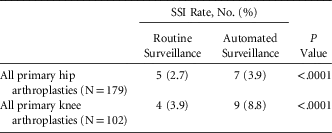
Among all records reviewed for the study period, 179 THA procedures and 102 TKA procedures were identified for inclusion in the analysis. Routine surveillance detected 5 THA SSIs (SSI rate, 2.7%) and 4 TKA SSIs (SSI rate, 3.9%). Retrospective medical record review for all patients who were not previously known to have SSIs identified 3 additional THA SSIs (SSI rate, 4.4%) and 5 additional TKA SSIs (SSI rate, 8.8%). Automated surveillance detected 2 additional THA SSIs (SSI rate, 3.9%) and 5 additional TKA SSIs (SSI rate, 8.8%) (Table 1).
Surgical Site Infection Rates Detected by Routine Surveillance and Automated Surveillance Based on Code Diagnosis Screening After Primary Knee and Hip Replacement

Among SSIs identified through automated surveillance, 1 THA SSI was classified as superficial incisional, 2 were classified as deep incisional, and 5 were classified as organ-space. In addition, 2 TKA SSIs were classified as superficial incisional, 3 were classified as deep incisional, and 4 were classified as organ-space. All organ-space infections were categorized as arthritis.
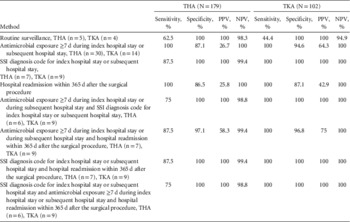
By screening for antimicrobial exposure ≥7 days during index hospital stay or subsequent hospital stays, we identified 30 THA patients (16.7%) and 14 TKA patients (13.7%). By screening medical records with at least 1 ICD-10 SSI diagnostic code, we identified 7 THA patients (3.9%) and 9 TKA patients (8.8%) whose record had at least 1 of the SSI diagnosis codes. Requiring the combination of both an SSI diagnosis code and antimicrobial exposure ≥7 days during index hospital stay or subsequent hospital stay and hospital readmission after the surgical procedure limited the identification to 6 THA patients (3.3%) and 9 TKA patients (8.8%).
The sensitivity of routine surveillance for detection of SSIs after THA was 62.5% (positive predictive value [PPV], 100%), and after TKA the sensitivity was 44.4% (PPV, 100%) (Table 2). SSI diagnosis code screening demonstrated a sensitivity of 87.5% after THA (PPV, 100%) and 100% after TKA (PPV, 100%). Both antimicrobial exposure ≥7 days and screening for hospital readmission after the surgical procedure demonstrated a sensitivity of 100% after THA (PPV, 26.7% and PPV, 25.8%, respectively) and 100% after TKA (PPV, 64.3% and PPV, 42.9%, respectively).
Sensitivity, Specificity, Positive Predictive Value (PPV) and Negative Predictive Value (NPV) of Routine Surveillance and Screening by Antimicrobial Exposure, Diagnosis Code, Readmission or Combination of Criteria for Identification of Surgical Site Infection (SSI) After Total Hip Arthroplasty (THA) and Total Knee Arthroplasty (TKA)

DISCUSSION
Many hospitals do not perform active SSI surveillance because it requires substantial resources. The identification of SSIs using coding or inpatient pharmacy information that is often available in electronic databases has several potential uses, including supplementing or aiding traditional surveillance and facilitating mandatory reporting.Reference Inacio, Paxton and Chen 10
When we compared the performance of routine surveillance with enhanced surveillance using SSI diagnosis codes and inpatient pharmacy data for SSI detection, we found a statistically significant difference in the sensitivity between the 2 methodologies for both THA and TKA.
Use of SSI diagnosis codes was substantially more sensitive than routine surveillance in our study. Both the addition of ≥7 days of antimicrobial exposure or hospital readmission after the surgical procedure improved the sensitivity after THA (62.5% vs 87.5%) and TKA (44.4% vs. 100%) compared with routine surveillance. These results are consistent with previous studies and suggest that screening for SSIs with diagnosis codes and quantitative measurement of antimicrobial exposure can be a useful SSI surveillance strategy after THA and TKA procedures.Reference Calderwood, Ma and Khan 6 , Reference Yokoe, Avery, Platt and Huang 8 – Reference Inacio, Paxton and Chen 10
Inacio et alReference Inacio, Paxton and Chen 10 reported an improvement in sensitivity and specificity of automated surveillance using ICD-9-CM compared with conventional surveillance. The authors evaluated 42,173 THA and TKA procedures and reported a sensitivity of 97.8% and specificity of 91.5%.Reference Inacio, Paxton and Chen 10 In contrast, Curtis et alReference Curtis, Graves and Birrell 7 demonstrated a reduction in sensitivity and specificity of the automated surveillance using ICD-10-AM (Australian Modification) codes to detect SSIs in patients undergoing THA or TKA compared with routine surveillance.
Our study had some limitations. First, we focused on inpatient SSI surveillance and did not include SSIs detected in ambulatory settings. Second, our SSI rates may have been underestimated because we did not identify patients with SSIs who were readmitted to hospitals. Third, THA procedures are often not elective but rather are precipitated by trauma, whereas TKA tend to be elective. This factor could potentially bias the results due to greater utilization of antimicrobial therapy in THA procedures contributing to less sensitivity of this parameter in assessing SSI determination. Fourth, ICD-10 coding is considered accurate, but inter-hospital variations in diagnosis and reporting can occur, causing coding inaccuracies. Fifth, the number of infections in both THA and TKA procedures was small, reducing the robustness of the study. Finally, this study was performed in a large academic hospital, and our results may not be generalizable to all hospitals.
The use of automated surveillance to identify patients who have developed SSIs after THA or TKA procedures showed high sensitivity and specificity in our study. This method was more sensitive than routine surveillance and might be useful to enhance SSI surveillance following arthroplasty procedures. Further studies are needed to assess this SSI surveillance model across hospitals and to evaluate the impact of this enhanced surveillance on improvement of perioperative processes.
ACKNOWLEDGMENTS
Financial support: No financial support was provided relevant to this article.
Potential conflicts of interest: All authors report no conflicts of interest relevant to this article.