INTRODUCTION
Members of the genus Neoclinus (Chaenopsidae) are typical blenniiform fishes, having a benthic habit and an elongate and relatively small body (to 200 mm in standard length (SL)). The genus is composed of 11 valid species: three from California, western coast of USA, and eight from Japan and Taiwan, western Pacific (Hubbs, Reference Hubbs1953; Fuako, Reference Fukao1980, Reference Fukao1987, Reference Fukao1990; Murase et al., Reference Murase, Aizawa and Sunobe2010; Aizawa & Doiuchi, Reference Aizawa, Doiuchi and Nakabo2013). The Japanese species are known as ‘hole-dwellers’, and their habit and small size, not exceeding 100 mm in total length (Fukao, Reference Fukao1980, Reference Fukao1987, Reference Fukao1990; Murase et al., Reference Murase, Aizawa and Sunobe2010; Murase & Sunobe, Reference Murase and Sunobe2011), makes them somewhat cryptic and difficult to identify underwater. Neoclinus is the only group in the family that is not endemic to the New World, and it has the most primitive phylogenetic position in the family (Hastings & Springer, Reference Hastings and Springer1994, Reference Hastings, Springer, Patzner, Gonçalves, Hastings and Kapoor2009; Hastings, Reference Hastings, Patzner, Gonçalves, Hastings and Kapoor2009). Recent analysis of molecular data (Lin & Hastings, Reference Lin and Hastings2013) indicate that the closest relative of Neoclinus is the monotypic Neotropical genus Mccoskerichthys. Although closely related to chaenopsids, these two genera may be outside this group. Together with the distributional pattern of the genus, these facts suggest an interesting evolutionary and biogeographical history; Hubbs (Reference Hubbs1953) stated the genus emigrated from the New World to Japan through the Aleutians during an interglacial period. Recently, some studies have revealed relationships between high diversity, including speciation, of coastal fish species and the Kuroshio Current in the coasts of southern Japan (Matsuura, Reference Matsuura2012). Therefore, the increased diversity of Neoclinus species in the north-western Pacific compared to the eastern Pacific suggests that speciation has occurred as a result of the complex currents surrounding the Japanese Archipelago.
Three Neoclinus species, Neoclinus bryope (Jordan & Snyder, 1902), Neoclinus chihiroe Fukao, Reference Fukao1987 and Neoclinus lacunicola Fukao, Reference Fukao1980, have been recorded from the Sea of Japan (Aizawa, Reference Aizawa, Okamura and Amaoka1997; Kawano et al., Reference Kawano, Doi and Hori2011, Reference Kawano, Miyake, Hoshino, Ito, Yamanaka, Komoto, Chubachi, Anzawa, Ikeda, Ookei, Kinoshita, Kodama, Tega, Yamasaki, Mori, Nagahama, Ootani, Yamada, Murayama, Ando, Kai, Doi, Sugiyama, Iida and Funaki2014; Aizawa & Doiuchi, Reference Aizawa, Doiuchi and Nakabo2013). During a survey of the marine fish fauna of Sadogashima Island, which is located in the Sea of Japan off the archipelago's central western coast, individuals identified as Neoclinus chihiroe and Neoclinus lacunicola were collected by the third author. Neoclinus chihiroe has been reported from Chiba to Wakayama Prefectures, Pacific coast of Japan, and in Toyama Bay, the Sea of Japan (Aizawa & Doiuchi, Reference Aizawa, Doiuchi and Nakabo2013). Neoclinus lacunicola has been reported from Chiba to Ehime Prefectures, Pacific coast of Japan, and Yamaguchi and Fukui Prefectures, the Sea of Japan (Kawano et al., Reference Kawano, Doi and Hori2011, Reference Kawano, Miyake, Hoshino, Ito, Yamanaka, Komoto, Chubachi, Anzawa, Ikeda, Ookei, Kinoshita, Kodama, Tega, Yamasaki, Mori, Nagahama, Ootani, Yamada, Murayama, Ando, Kai, Doi, Sugiyama, Iida and Funaki2014; Aizawa & Doiuchi, Reference Aizawa, Doiuchi and Nakabo2013). However, these records of the two species from the Sea of Japan are doubtful. The records of Neoclinus chihiroe from Toyama Bay reported by Aizawa (Reference Aizawa, Okamura and Amaoka1997) and Aizawa & Doiuchi (Reference Aizawa, Doiuchi and Nakabo2013) lacked voucher specimen information. Moreover, although Kawano et al. (Reference Kawano, Miyake, Hoshino, Ito, Yamanaka, Komoto, Chubachi, Anzawa, Ikeda, Ookei, Kinoshita, Kodama, Tega, Yamasaki, Mori, Nagahama, Ootani, Yamada, Murayama, Ando, Kai, Doi, Sugiyama, Iida and Funaki2014) reported Neoclinus lacunicola from both Yamaguchi and Fukui Prefectures, the record from the former prefecture was based on underwater photographs on a diving-shop website (http://www.sea-again.net/) and the record from the latter prefecture might be an error (M. Kawano, Yamaguchi Prefectural Fisheries Research Center, personal communication). In contrast, Kato (Reference Kato2014) showed an underwater photograph of Neoclinus lacunicola taken at Omijima Island, Yamaguchi Prefecture. Therefore, the presence of Neoclinus chihiroe and Neoclinus lacunicola in the Sea of Japan lacks any scientific evidence except for Kato (Reference Kato2014). In order to contribute additional biogeographic information on the genus, this present study documents the northernmost records of Neoclinus chihiroe and Neoclinus lacunicola and provides morphological information and colour photographs of voucher specimens from Sadogashima Island, the Sea of Japan. Furthermore, additional photographic materials of Neoclinus lacunicola, which extend the known distribution ~100 km north of Sadogashima Island, were found in the image database of the Kanagawa Prefectural Museum of Natural History.
MATERIALS AND METHODS
The specimens of Neoclinus chihiroe and Neoclinus lacunicola were collected by the third author using a hand net from various points of Sadogashima Island, the Sea of Japan (Figure 1), in June–August 2014 and April 2015 (detailed information as below). After being anesthetized with clove oil, the fishes were immediately killed in a box with a mixture of sea water and ice. Then, the fishes were fixed with 10% formalin, preserved in 70% ethanol and deposited in the fish collection of Kyoto University (FAKU: Maizuru Fisheries Research Station, Maizuru, Kyoto). The identification and scientific names of the species followed Fukao (Reference Fukao1980, Reference Fukao1987) and Aizawa & Doiuchi (Reference Aizawa, Doiuchi and Nakabo2013), but terminology, counts and measurements were based on Murase et al. (Reference Murase, Aizawa and Sunobe2010). Counts of the pectoral-fin rays were made on the left side and those of the vertebrae were taken from radiographs. Colour photographs of the specimens were taken when fresh but after thawing. Underwater photographs of the specimen were obtained just before capture.
Map showing the conventional distributional range (coastal lines and circle), new records from the Sea of Japan based on voucher specimens (stars) and photographs (triangle) of Neoclinus chihiroe (red line and red star) and Neoclinus lacunicola (yellow line and yellow symbols). The purple line indicates the distributional range of both species along the Pacific coast of central Japan. The yellow circle marks the photographic records of Neoclinus lacunicola from Yamaguchi Prefecture by Kato (Reference Kato2014).

Materials examined were as follows (with collection data in parentheses): Neoclinus chihiroe, five specimens, FAKU136057 (female, 45.8 mm SL, Mitate, north-east coast of Sadogashima Island, Niigata Prefecture, 38°17′20″N 138°30′56″E, a hole in a sunken ship, 20–25 m depth, 8 July 2014), FAKU136058 (male, 44.4 mm SL, same data as FAKU136057), FAKU136072 (male, 52.9 mm SL, same locality and habitat as FAKU136057, but 14 June 2014), FAKU136220 (female, 42.6 mm SL, Washizaki, north-east coast of Sadogashima Island, Niigata Prefecture, 38°20′20″N 138°29′19″E, a hole on rocky substrate, 5–15 m depth, 30 June 2014) and FAKU136221 (male, 45.4 mm SL, same locality as FAKU136057, but an empty shell of a barnacle, 24 m depth, 13 August 2014); Neoclinus lacunicola, four specimens, FAKU136059 (female, 38.9 mm SL, Kotoura, southern coast of Sadogashima Island, Niigata Prefecture, 37°48′08″N 138°14′52″E, a hole on rocky substrate, 10 m depth, 22 June 2014), FAKU136076 (male, 38.0 mm SL, same data as FAKU136059, accidentally damaged in head), FAKU137518 (female, 49.4 mm SL, Kotoura, southern coast of Sadogashima Island, Niigata Prefecture, a hole on rocky substrate, 3–5 m depth, 28 April 2015), FAKU137519 (male, 42.8 mm SL, same collection data as FAKU137518).
In addition to these collected specimens, FishPix (Senou & Matsuura, Reference Senou and Matsuura1998), the image data base of Kanagawa Prefectural Museum of Natural History (KPM-NR), was examined to revise the photographic records of the species in the Sea of Japan.
RESULTS
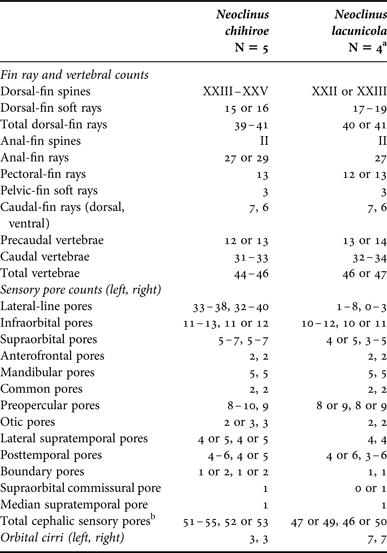
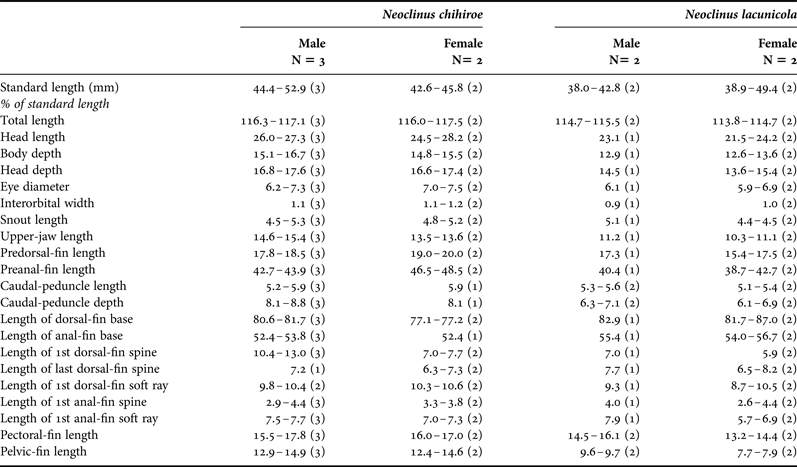
Information of the meristic characters and measurements for voucher specimens of two Neoclinus species collected from Sadogashima Island is shown in Tables 1 & 2, respectively.
Meristic data of two species of Neoclinus from Sadogashima Island, the Sea of Japan.
a Sensory pore counts of FAKU 136076 not included because of damage to head.
b Including single nasal pore in front of each nostril.
Measurements of two species of Neoclinus from Sadogashima Island, the Sea of Japan.
Sample size in parentheses.
Morphological characteristics of the five specimens of Neoclinus chihiroe from Sadogashima Island agreed well with the diagnosis of Neoclinus chihiroe of Fukao (Reference Fukao1987), having the following characters: not exceeding 70.0 mm in SL, no conspicuous sexual dimorphism in upper jaw, three multifid supraorbital cirri arranged in single row, no nuchal cirri, total vertebrae 44–46, total cephalic sensory pores 51–55 and pectoral-fin rays 13 (Table 1). Lateral-line canal runs from upper margin of opercle to a point below 8–10th dorsal-fin spine, having row of vertical paired pores and a single pore (rarely, paired pores) at the posteriormost part of the canal. Body squamation agrees well with the description of Fukao (Reference Fukao1987) and the diagrammatic illustration of Fukao (1980: Figure 14C), with scales distributed posteriorly from a line connecting the upper margin of pectoral fin and anal fin to the base of the caudal fin. A few scales are present in the upper region of the posterior lateral-line canal. Two colour morphs were detected among fresh specimens: whole body pinkish or reddish with 7–10 darker diamond-like bands from the trunk to the tail (FAKU136057, 136072 and 136221: Figure 2A, B); whole body dusky tan with 8–10 darker diamond-like bands from the trunk to the tail (FAKU136058 and 136220: Figure 2C, D). This colour variation was not related to the sex of the specimen. The red and tan colour-morphs were previously described by Fukao (Reference Fukao1987) and illustrated with colour photographs by Aizawa (Reference Aizawa, Okamura and Amaoka1997).
Colour photographs in fresh condition of Neoclinus chihiroe from Sadogashima Island, the Sea of Japan: reddish individuals, (A) FAKU136072, male, 52.9 mm SL, (B) FAKU136057, female, 45.8 mm SL; tannish individuals, (C) FAKU136058, male, 44.4 mm SL, (D) FAKU136220, female, 42.6 mm SL. Photographed by F. Tashiro.
The four specimens of Neoclinus lacunicola from Sadogashima Island agreed well with the key characters of Fukao (Reference Fukao1980), such as: nuchal cirri present, no ocellus on dorsal fin, supraorbital cirri 7 and arranged in two rows, dorsal-fin elements 40–41, anal-fin elements 29 and total vertebrae 46 or 47 (Table 1). Lateral-line canals are present only near the upper margin of the opercle (posterior ends present under the bases of 2nd–5th dorsal-fin spines) or completely lacking (right side of FAKU137518). Their pores, ranging in number from 0–8 (Table 1), positioned centrally, above or below the canal, sometimes forming 0–3 pairs of pores. Squamation is limited around the body axis from the area under the pectoral fin to the base of the caudal fin, corresponding to the description of Fukao (Reference Fukao1980). When fresh (Figure 3), head, supraorbital cirri, unpaired and pectoral-fin rays are reddish; body is barred with numerous wide black bands separated with narrow white areas, forming ‘m’ or ‘n’ shapes. This pattern somewhat corresponds to the reddish-phase specimens of Fukao (Reference Fukao1980). Male specimens have dusky brown pelvic fins while those of females are yellow or orange. The lateral-line canals of the specimens from Sadogashima Island tend to degenerate, which differs to the original description of Neoclinus lacunicola. Fukao (Reference Fukao1980) described the lateral-line canal with pores arranged in double-rows running from the upper margin of the opercle to a point below the 7th to 8th dorsal-fin spine.
Colour photographs in fresh condition of Neoclinus lacunicola from Sadogashima Island, the Sea of Japan: (A) FAKU137519, male, 42.8 mm SL, (B) FAKU136059, female, 38.9 mm SL. Photographed by F. Tashiro.
As the result of examination of the image data base of KPM-NR, individuals in two underwater photographs (KPM-NR70096, 70097) from Tobi-shima Island, Yamagata Prefecture, the Sea of Japan, 6 September 2009, were identified as Neoclinus lacunicola on the basis of the presence of nuchal cirri and two rows of long supraorbital cirri. These photographs extend the known distribution of the species ~100 km north-north-eastward from Sadogashima Island (Figure 1).
DISCUSSION
The specimens of Neoclinus chihiroe and Neoclinus lacunicola collected from Sadogashima Island extend the northernmost records of the species and represent the first records from the Sea of Japan based on the voucher specimens (Figure 1). Additionally, photographic materials of Neoclinus lacunicola extracted from the image data base of KPM-NR extended the range about 100 km northward from Sadogashima Island (Figure 1). The warm Tsushima Current runs along the coast in the Sea of Japan from the south (see Miyazaki et al., Reference Miyazaki, Ikeda and Senou2015 for the course of this current) and some tropical fish species are recorded from Aomori prefecture, which is located at one of the northernmost areas affected by the Tsushima Current (Shiogaki et al., Reference Shiogaki, Ishito, Nomura and Sugimoto2004). This fact and the distributional pattern of the two species of Neoclinus in the Sea of Japan suggest that the two species of Neoclinus are probably widely distributed along the coast in the Sea of Japan.
Although there has been no fresh colour photograph of Neoclinus chihiroe (but see Aizawa, Reference Aizawa, Okamura and Amaoka1997), the specimens obtained in this study provided information of both the fresh (Figure 2) and underwater coloration (Figure 4) of the species. The colour features appear useful in species identification within the genus Neoclinus, which are frequently photographed underwater with only the head visible. Each species of Neoclinus has multiple colour patterns (Uryu & Ohira, Reference Uryu and Ohira2004; Murase, unpublished data) and further coloration data are required, including geographic variations. Aizawa (Reference Aizawa, Okamura and Amaoka1997) reported the occurrence of Neoclinus bryope from Shakotan Peninusula, Hokkaido Prefecture, in the northern part of the Sea of Japan, based on an underwater photograph of the head, which is similar to the underwater condition of Neoclinus chihiroe taken in this study (Figure 4A). External distinctive characters among the three species of the Neoclinus bryope species complex (Neoclinus bryope, Neoclinus chihiroe and Neoclinus okazakii: Fukao, Reference Fukao1987) have not been studied in detail, but the three species can be distinguished with meristic characters such as vertebral and cephalic sensory pore counts (Fukao, Reference Fukao1987). Considering the present taxonomic status of the genus, an individual reported from Shakotan Peninsula, photographed by Aizawa (Reference Aizawa, Okamura and Amaoka1997), should be regarded as an unidentified species of Neoclinus.
Underwater photographs of two species of Neoclinus from Sadogashima Island, the Sea of Japan: (A) Neoclinus chihiroe, FAKU136221, male, 45.4 mm SL, 20–25 m depth, (B) Neoclinus lacunicola, FAKU136059, female, 38.9 mm SL, 10 m depth. Photographed by S. Awata.
Although the lateral-line canal of Neoclinus lacunicola collected from Sadogashima Island was reduced compared to that in the original description, the other morphological characters are consistent with the original description. Thus, this reduced form of the lateral line found in the population from Sadogashima Island can be considered a regional variation. Comparison with other local populations in the Sea of Japan is needed to determine whether or not this variation is restricted to Sadogashima Island specimens, or if it is more widely present in the Sea of Japan. In addition, further accumulation of distributional data, and the collection of specimens from various localities, are required to further clarify the biogeography of the genus with respect to the topographic features of the Japanese Archipelago and its surrounding currents.
ACKNOWLEDGEMENTS
We would like to express our sincere thanks to the following persons: Mitsuo Homma (Diving Service F. Wave) for helping with underwater fish collections; Hiromitsu Takashima (Ogi Diving Center), Tadashi Shoji (Diving Service S. World), Sadogashima SCUBA Diving Association and Kitakoura Recreational Fishing Cooperative for supporting field research; Yoshiaki Kai (FAKU) for his help with the loan of specimens; Hiroshi Senou (KPM) for permitting the use of photographic materials from the KPM-NR; Masahiro Aizawa (Imperial Palace) and Ryu Doiuchi (Tanabe City) for providing information on Neoclinus chihiroe in the Sea of Japan; Mitsuhisa Kawano (Yamaguchi Prefectural Fisheries Research Center) for providing distributional information on Neoclinus lacunicola in the Sea of Japan. We also thank Gordon Yearsley (Ellipsis Editing) for his revision of the manuscript in English and two anonymous reviewers for their valuable comments on the manuscript. This research was partly funded by the inventory survey of biodiversity of the Sadogashima City Government, Japan, to the third author.