Introduction
Gould–Trivelpiece (TG) waves are electrostatic waves which are significantly observed in the range of frequency between ion plasma frequency and electron cyclotron frequency. For many decades, the TG waves are being investigated theoretically and experimentally (Trivelpiece and Gould, Reference Trivelpiece and Gould1959; Malmberg and Wharton, Reference Malmberg and Wharton1966; Mannheimer, Reference Mannheimer1969; Lynov et al., Reference Lynov, Michelsen, Pecseli, Juul Rasmussen, Saeki and Turikov1979; Schamel, Reference Schamel1979) by the researchers due to their property of absorbing and heating the electrons effortlessly near the boundary of the plasma. In bounded plasmas, the TG wave appears as a short radial wavelength, whereas in unbounded plasmas, it is found to be accompanied with a short azimuthal wavelength (Stenzel and Urrutia, Reference Stenzel and Urrutia2016). Praburam and Sharma (Reference Praburam and Sharma1992) have studied the excitation of TG wave of higher frequency vibrations by electron beam of low-energy. Carmel et al. (Reference Carmel, Minami, Lou, Khes, Destler, Granatstein, Abe and Rodgers1990) have experimentally demonstrated the effect of high-power relativistic electron beam on a plasma column. They found that electrostatic TG modes propagate with the frequency below the plasma frequency, whereas electromagnetic waves propagate with the frequency above the plasma frequency. Zhai et al. (Reference Zhai, Garate, Prohaska, Benford and Fisher1993) observed TG mode in the experimental investigation of a plasma-filled backward wave oscillator. Haas and Pascoal (Reference Haas and Pascoal2017) have studied the electrostatic instabilities in magnetized plasma driven by neutrino. They found that the magnetic field significantly improves the linear instability growth rate for Supernova type II environments. High-frequency electromagnetic waves have been studied in unbounded as well as warm plasma by Assis and Sakanaka (Reference Assis and Sakanaka1990). Mouzouris and Scharer (Reference Mouzouris and Scharer1998) examined the helicon wave along with TG wave through wave propagation and absorption simulations. In their study, they developed a computer code in which they found that the power absorption is due to TG wave near the edge region, whereas transportation and deposition of energy in the core region of plasma is due to helicon wave.
Over the decades, there has been a great deal of interest shown by the researchers in the study of electrostatic and electromagnetic waves in dusty plasma environments. In laboratory, these waves have been investigated in non-magnetized dusty plasma (Pieper and Goree, Reference Pieper and Goree1996) and magnetized dusty plasma (Thompson et al., Reference Thompson, Barkan, D'angelo and Merlino1997). Theoretically, these waves have been studied for the effect of dust parameters on the dispersion and growth rate of these waves in various interactions (Prakash et al., Reference Prakash, Sharma, Vijayshri and Gupta2013a, Reference Prakash, Gupta, Sharma and Vijayshri2013b, Reference Prakash, Sharma, Vijayshri and Gupta2014; Sharma et al., Reference Sharma, Daljeet, Gahlot and Sharma2014; Gupta et al., Reference Gupta, Prakash, Sharma and Vijayshri2015). Recently, excitation of TG wave by relativistic electron beam in magnetized dusty plasma has been studied by Kaur et al. (Reference Kaur, Sharma and Pandey2018). In their study, they observed that the growth rate decreases with relativistic factor. Barkan et al. (Reference Barkan, D'angelo and Merlino1996) have studied ion-acoustic waves in magnetized dusty plasmas and found that the phase velocity of the ion acoustic waves (IAWs) lift up with the negatively charged dust grains. The drastic reduction in the strength of the Landau damping has also been reported in this case. Prakash et al. (Reference Prakash, Sharma, Vijayshri and Gupta2013a) have studied the excitation of surface plasma wave via Cerenkov and fast cyclotron interaction by a density-modulated electron beam in a magnetized dusty plasma cylinder and found that the dust significantly affects the dispersion and growth rate of waves. Excitation of lower hybrid wave by an ion beam has been investigated by Prakash et al. (Reference Prakash, Gupta, Sharma and Vijayshri2013b) and they found that the lower hybrid modes showed maximum growth when phase velocity of mode is comparable to the electron thermal velocity. Interaction of whistler waves with an electron beam in magnetoplasmas has been studied by Gupta et al. (Reference Gupta, Prakash, Sharma and Vijayshri2015) for parallel and oblique propagation of beam and whistlers. The effect of negatively charged dust grains on the excitation of dust-acoustic waves by an ion beam has been reported by Sharma et al. (Reference Sharma, Daljeet, Gahlot and Sharma2014).
In this paper, we have developed a model for the excitation of TG mode by streaming ions in magnetized dusty plasmas. Section “Instability analysis” contains the instability analysis. Using linear first-order perturbation theory, the response of TG waves due to streaming ions in dusty plasma is obtained. Section “Numerical results and discussion” gives the results and discussion of instability. The results of work are concluded in section “Conclusion”.
Instability analysis
Consider a plasma with equilibrium electron number density n e0, ion number density n i0, and dust grain number density n d0. The dusty plasma is under the influence of the static magnetic field B s in the z-direction. The electrons are defined by (−e, m e, T e), ions by (e, m i, T i) and dust particles by (−Q d0, m d, T d). Consider an electrostatic wave, say, TG mode, propagating almost perpendicular to the external magnetic field (propagation vector k) in the x-z plane. The streaming ions are considered to be magnetized and moving parallel to applied magnetic field with velocity v i, electrons are taken to be non-streaming and magnetized and dust grains are considered as negatively charged, non-streaming, and unmagnetized. Prior to the perturbation, plasma system is quasi-neutral such that − n e0 + n i0 − n d0 ≈ 0. This equilibrium is perturbed due to electrostatic TG mode and potential associated with it is given by
 $${\rm \phi} = {\rm \phi} _0\exp [-i({\rm \omega} t-k_xx-k_zz)]{\rm.} $$
The plasma species are taken as fluids and governed by the equation of motion [ $m(d\vec{v}/dt) = e\vec{E} + (e/c)\vec{v} \times \vec{B}_{\rm s}$] and equation of continuity [
 $(\partial n/\partial t) + \nabla. (n\vec{v}) = 0$]. On linearization, the equation of motion and the equation of continuity lead to the plasma electron, plasma ion, and dust grain density perturbations as:
 $$n_{1{\rm e}} = -\displaystyle{{n_{{\rm e}0}{\rm e}{\rm \phi}} \over {m_{\rm e}}}\left[ {\displaystyle{{k_x^2} \over {{\rm \omega}^2-{\rm \omega}_{{\rm ce}}^2}} + \displaystyle{{k_z^2} \over {{\rm \omega}^2}}} \right]{\rm,} $$
 $$n_{1{\rm i}} = \displaystyle{{n_{{\rm i}0}{\rm e}{\rm \phi}} \over {m_{\rm i}}}\left[ {\displaystyle{{k_x^2} \over {{({\rm \omega} -k_zv_{\rm i})}^2-{\rm \omega}_{{\rm ci}}^2}} + \displaystyle{{k_z^2} \over {{({\rm \omega} -k_zv_{\rm i})}^2}}} \right]{\rm,} $$
 $$n_{1{\rm d}} = -\displaystyle{{n_{{\rm d}0}Q_{{\rm d}0}k^2{\rm \phi}} \over {m_{\rm d}{\rm \omega} ^2}}{\rm,} $$
where ωce( = eB s/m ec) is the electron-cyclotron frequency and ωci( = eB s/m ic) is the ion-cyclotron frequency.
In this case, dust is taken as unmagnetized since ω ≫ ωcd with ωcd(=Q d0B s/m dc) (dust cyclotron frequency). Further applying the probe theory to a dust grain, Q d is said to be well-balanced with the plasma currents present on the grain surface (Whipple et al., Reference Whipple, Northdrop and Mendis1985; Jana et al., Reference Jana, Sen and Kaw1993) and the dust grain charge fluctuation as
 $$Q_{1{\rm d}} = \displaystyle{{ \vert I_{{\rm e}0} \vert} \over {i({\rm \omega} + i{\rm \eta} )}}\left( {\displaystyle{{n_{1{\rm i}}} \over {n_{{\rm i}0}}}-\displaystyle{{n_{1{\rm e}}} \over {n_{{\rm e}0}}}} \right).$$
Substituting the values of n 1e and n 1i from Eqs. (2) and (3) in Eq. (5), we obtain
 $$\eqalign{Q_{1{\rm d}} & = \displaystyle{{ \vert I_{{\rm e0}} \vert} \over {i{\rm} ({\rm \omega} + i{\rm \eta} )}} \bigg[ \displaystyle{{k_x^2 {\rm \phi}} \over {[{({\rm \omega} -k_zv_{\rm i})}^2-{\rm \omega}_{{\rm ci}}^2 ]m_{\rm i}}} \cr & \quad + \displaystyle{{k_z^2 {\rm \phi}} \over {{({\rm \omega} -k_zv_{\rm i})}^2m_{\rm i}{\rm \omega}^2}} + \displaystyle{{k_x^2 {\rm \phi}} \over {m_{\rm e}({\rm \omega}^2-{\rm \omega}_{{\rm ce}}^2 )}} + \displaystyle{{k_z^2 {\rm \phi}} \over {m_{\rm e}{\rm \omega}^2}} \bigg] {\rm.} } $$
Under the view of overall charge neutrality in equilibrium, we can write,
 $$-en_{{\rm i}0} + en_{{\rm e}0} + Q_{{\rm d}0}n_{{\rm d}0} = 0\quad {\rm or}\quad n_{{\rm d}0}/n_{{\rm e}0} = ({\rm \delta} -1)(e/Q_{{\rm d}0}),$$
where δ = n i0/n e0 is the relative density of negatively charged dust grains.
Using Poisson's equation
 $$\nabla ^2{\rm \phi} = 4{\rm \pi} n_{1{\rm e}}e-4{\rm \pi} n_{1{\rm i}}e + 4{\rm \pi} n_{{\rm d}0}Q_{1{\rm d}} + 4{\rm \pi} Q_{{\rm d}0}n_{1{\rm d}}$$
and substituting the values from Eqs. (2)–(4) and (6) in (7), and taking ω ≪ ωce for TG mode, we obtain
 $$\eqalign{1 + &\displaystyle{{{\rm \omega} _{{\rm pe}}^2 \,} \over {{\rm \omega} ^2\,K}}\displaystyle{{k_z^2} \over {k^2}} + \displaystyle{{i{\rm \beta}} \over {({\rm \omega} + i{\rm \eta} )K}}\displaystyle{{{\rm \omega} _{{\rm pe}}^2 \,} \over {{\rm \omega} _{{\rm ce}}^2 \,}}\displaystyle{{k_x^2} \over {k^2}}-\displaystyle{{i{\rm \beta}} \over {({\rm \omega} + i{\rm \eta} )K}}\displaystyle{{m_{\rm e}} \over {m_{\rm i}}}\displaystyle{{{\rm \omega} _{{\rm pe}}^2 \,} \over {{\rm \omega} ^2\,}}\displaystyle{{k_z^2} \over {k^2}} \cr & + \displaystyle{{{\rm \omega} _{{\rm pd}}^2} \over {{\rm \omega} ^2K}} = \displaystyle{{{\rm \omega} _{{\rm pi}}^2 \,} \over {{({\rm \omega} -k_zv_{\rm i})}^2\,K}}\displaystyle{{k_z^2} \over {k^2}} + \displaystyle{{{\rm \omega} _{{\rm pi}}^2 \,} \over {[{({\rm \omega} -k_zv_{\rm i})}^2-{\rm \omega} _{{\rm ci}}^2 ]\,K}}\displaystyle{{k_x^2} \over {k^2}} \cr & + \displaystyle{{i{\rm \beta}} \over {({\rm \omega} + i{\rm \eta} )K}}\displaystyle{{{\rm \omega} _{{\rm pe}}^2 \,} \over {[{({\rm \omega} -k_zv_{\rm i})}^2-{\rm \omega} _{{\rm ci}}^2 ]\,}}\displaystyle{{k_z^2} \over {k^2}},} $$
where
 $${\rm {\rm \omega}} _{{\rm pe}}^2 = \left( {\displaystyle{{4{\rm {\rm \pi}} n_{{\rm e}0}e^2} \over {m_{\rm e}}}} \right),\;{\rm {\rm \omega}} _{{\rm pi}}^2 = \left( {\displaystyle{{4{\rm {\rm \pi}} n_{{\rm i}0}e^2} \over {m_{\rm i}}}} \right)$$
and
 $${\rm {\rm \omega}} _{{\rm pd}}^2 = \left( {\displaystyle{{4{\rm {\rm \pi}} n_{{\rm d}0}e^2} \over {m_{\rm d}}}} \right).\;{\rm {\rm \beta}} = \left( {\displaystyle{{ \vert I_{{\rm e}0} \vert} \over e}\displaystyle{{n_{{\rm d0}}} \over {n_{{\rm e}0}}}} \right)$$
is the dust plasma coupling parameter given as
 $${\rm \beta} = 0.397(1-(1/{\rm \delta} ))\,(a/v_{{\rm te}})(m_{\rm i}/m_{\rm e}){\rm \omega} _{{\rm pi}}^2, {\rm and}$$
 $${\rm \eta} = 10^{-2}{\rm \omega} _{{\rm pe}}\left( {\displaystyle{a \over {{\rm \lambda}_{{\rm De}}}}} \right)\displaystyle{1 \over {\rm \delta}}. $$
where, η is the time scale of delay and  $v_{{\rm te}}( = \sqrt {2T_{\rm e}/m_{\rm e}} )$ is the thermal velocity of electrons (Prakash and Sharma, Reference Prakash and Sharma2009). For non-streaming ions v i = 0 and for a plasma without dust grains δ = 1. Using the conditions for the existence of TG wave, that is, ωpi ≪ ω ≪ ωce, we get ω = ωpe(k z/k) which is the standard dispersion relation of TG wave (Jain and Khristiansen, Reference Jain and Khristiansen1983; Jain and Khristiansen, Reference Jain and Khristiansen1984).
Equation (8) can be rewritten as
 $$\eqalign{&({\rm \omega} ^2-{\rm \alpha} ^2)({\rm \omega} + i{\rm \eta} + i({\rm \beta} _1 + {\rm \beta} _2)) \cr&\quad= \left[ {\displaystyle{{{\rm \omega}_{{\rm pi}}^2 \,{\rm \omega}^3} \over {[{({\rm \omega} -k_zv_{\rm i})}^2-{\rm \omega}_{{\rm ci}}^2 ]\,K}}\displaystyle{{k_x^2} \over {k^2}} + \displaystyle{{{\rm \omega}_{{\rm pi}}^2 \,{\rm \omega}^3} \over {{({\rm \omega} -k_zv_{\rm i})}^2}}\displaystyle{1 \over K}\displaystyle{{k_z^2} \over {k^2}}} \right] \cr &\quad + i\left[ \matrix{\displaystyle{{{\rm \omega}_{{\rm pi}}^2 \,{\rm \omega}^2} \over {[{({\rm \omega} -k_zv_{\rm i})}^2-{\rm \omega}_{{\rm ci}}^2 ]\,}}\displaystyle{1 \over K}\displaystyle{{k_x^2} \over {k^2}}({\rm \eta} + {\textstyle{{\rm \beta} \over {\rm \delta}}} ) + \,\displaystyle{{{\rm \omega}_{{\rm pi}}^2 \,{\rm \omega}^2{\rm \eta}} \over {{({\rm \omega} -k_zv_{\rm i})}^2\,}}\displaystyle{1 \over K}\displaystyle{{k_z^2} \over {k^2}} \hfill \cr -{\rm \alpha}^2({\rm \beta}_1 + {\rm \beta}_2) \hfill} \right],} $$
where
 $${\rm \alpha} ^2 = \displaystyle{1 \over K}\left( {{\rm \omega}_{{\rm pe}}^2 \displaystyle{{k_z^2} \over {k^2}}-{\rm \omega}_{{\rm pd}}^2} \right),$$
 $${\rm \beta} _1 = {\rm \beta} \displaystyle{1 \over K}\displaystyle{{{\rm \omega} _{{\rm pe}}^2} \over {{\rm \omega} _{{\rm ce}}^2}} \displaystyle{{k_x^2} \over {k^2}},$$
 $${\rm \beta} _2 = \left( {-{\rm \beta} \displaystyle{1 \over K}{\rm \omega}_{{\rm pe}}^2 \displaystyle{{k_z^2} \over {k^2}}\left( {1 + \displaystyle{{m_{\rm e}} \over {m_{\rm i}}}} \right)} \right)/{\rm \omega} ^2,$$
and
 $$K = 1 + \displaystyle{{{\rm \omega} _{{\rm pe}}^2} \over {{\rm \omega} _{{\rm ce}}^2}}. $$
Equation (11) gives dispersion relation for the TG wave. The first bracket on the left-hand side of Eq. (11) associates with TG modes in a dusty plasma with frequency given by Eq. (12). The second bracket of Eq. (11) gives the damping mode due to dust charge fluctuations. From Eq. (11), in the absence of streaming ions and putting δ( = n i0/n e0) = 1, that is, β → 0, we obtain
 $${\rm \omega} ^2 = {\rm \omega} _{{\rm tg}}^2 \left( {1 + \displaystyle{{m_{\rm i}} \over {m_{\rm e}}}\displaystyle{{k_z^2} \over {k^2}}} \right),$$
where
 $${\rm \omega} _{{\rm tg}}^2 = {\rm \omega} _{{\rm pi}}^2 /\left( {1 + \displaystyle{{{\rm \omega}_{{\rm pe}}^2} \over {{\rm \omega}_{{\rm ce}}^2}} \displaystyle{{k_x^2} \over {k^2}}} \right),$$
which are the standard expressions for TG mode in plasma.
Further, solving Eq. (11) under three limits:
Case I: For fast cyclotron interaction between TG wave and streaming plasma ions, that is, when ω − k zv i = +ωci, Eq. (11) can be rewritten as
 $$\Delta _1^2 = \left[ {\displaystyle{{{\rm \omega}_{{\rm pi}}^2} \over {4K{\rm \omega}_{{\rm ci}}}}\displaystyle{{k_x^2} \over {k^2}}{\rm \alpha}} \right] + i\left[ {\displaystyle{{{\rm \omega}_{{\rm pi}}^2} \over {4K{\rm \omega}_{{\rm ci}}}}\displaystyle{{k_x^2} \over {k^2}}\left( {{\rm \eta} + \displaystyle{{\rm \beta} \over {\rm \delta}}} \right)} \right],$$
where we have considered only the cyclotron interaction terms from RHS of Eq. (11). Δ1 is the small frequency discrepancy due to the finite value on RHS of Eq. (11). This gives the growth rate of TG mode as
 $${\rm \gamma} _1 = {\mathop{\rm Im}\nolimits} (\Delta _1) = \displaystyle{{Q_1} \over {2\sqrt {P_1}}}, $$
where
 $$P_1 = \displaystyle{{{\rm \omega} _{{\rm pi}}^2} \over {4K{\rm \omega} _{{\rm ci}}}}\displaystyle{{k_x^2} \over {k^2}}{\rm \alpha} $$
and
 $$Q_1 = \displaystyle{{{\rm \omega} _{{\rm pi}}^2} \over {4K{\rm \omega} _{{\rm ci}}}}\displaystyle{{k_x^2} \over {k^2}}\left( {{\rm \eta} + \displaystyle{{\rm \beta} \over {\rm \delta}}} \right).$$
Case II: For slow cyclotron interaction between TG wave and streaming plasma ions, that is, when ω − k zv i = −ωci, Eq. (11) can be rewritten as
 $$\Delta _2^2 = \left[ {\displaystyle{{{\rm \omega}_{{\rm pi}}^2} \over {4K(-{\rm \omega}_{{\rm ci}})}}\displaystyle{{k_x^2} \over {k^2}}{\rm \alpha}} \right] + i\left[ {\displaystyle{{{\rm \omega}_{{\rm pi}}^2} \over {4K(-{\rm \omega}_{{\rm ci}})}}\displaystyle{{k_x^2} \over {k^2}}\left( {{\rm \eta} + \displaystyle{{\rm \beta} \over {\rm \delta}}} \right)} \right],$$
where again we have considered only the cyclotron interaction terms from RHS of Eq. (11).
The growth rate of TG mode in this limit is obtained as
 $${\rm \gamma} _2 = {\mathop{\rm Im}\nolimits} (\Delta _2) = \displaystyle{{Q_2} \over {2\sqrt {P_2}}}, $$
where Δ2 is the small frequency discrepancy,
 $$P_2 = \displaystyle{{{\rm \omega} _{\,pi}^2} \over {4K(-{\rm \omega} _{ci})}}\displaystyle{{k_x^2} \over {k^2}}{\rm \alpha} $$
and
 $$Q_2 = \displaystyle{{{\rm \omega} _{{\rm pi}}^2} \over {4K(-{\rm \omega} _{{\rm ci}})}}\displaystyle{{k_x^2} \over {k^2}}\left( {{\rm \eta} + \displaystyle{{\rm \beta} \over {\rm \delta}}} \right).$$
Case III: For Cerenkov interaction when ω = k zv i then Eq. (11) can be written as
 $$\Delta _3^3 = \displaystyle{{{\rm \omega} _{{\rm pi}}^2} \over {2K}}\displaystyle{{k_z^2} \over {k^2}}({\rm \alpha} + i{\rm \eta} ),$$
where we have considered only the Cerenkov interaction terms from RHS of Eq. (11). Δ3 is the small frequency discrepancy.
Therefore, the growth rate of TG mode in this case is given by
 $${\rm \gamma} _3 = {\mathop{\rm Im}\nolimits} (\Delta _3) = \displaystyle{{\rm \eta} \over {3{\rm \alpha}}} \left[ {\displaystyle{{{\rm \omega}_{{\rm pi}}^2} \over {2K}}\displaystyle{{k_z^2} \over {k^2}}{\rm \alpha}} \right]^{1/3}.$$
Numerical results and discussion
For numerical calculations, the plasma parameters are taken as: number density of plasma ions n i0 = 109 cm−3, number density of plasma electrons n e0 = 0.2 × 10⁹ − 1 × 109 cm−3, temperatures of electrons and ions are taken as 0.2 eV, external magnetic field is 3kG, number density of dust grains density is 104 cm−3, and m i/m e = 7.16 × 10⁴ for potassium plasma and the average dust grain size a = 2 µm. Using Eq. (13), we have plotted the growth rate γ1(s−1) of TG mode during fast cyclotron interaction with plasma ions as a function of normalized parallel wave number k z/k for different values of δ = (n i0/n e0) (relative density of negatively charged dust grains) (c.f. Fig. 1). It is observed that the growth rate decreases as the parallel wave number increases. This shows that the growth rate of unstable mode decreases in the direction of the applied magnetic field or the direction of streaming ions. Therefore, we can say that the TG wave grows with an increase in perpendicular wave number or the unstable mode grows along its direction of propagation, if the magnetized plasma ions undergo a normal cyclotron resonance interaction with the TG waves. It can also be inferred from Eq. (13) that the growth rate of TG mode increases with an increase in the value of magnetic field, as observed by Haas and Pascoal, (Reference Haas and Pascoal2017). The growth of TG waves across the magnetic field may be attributed to the fact that these waves have a frequency between ion and electron gyrofrequencies. Due to which electrons are strongly magnetized but ions do not feel the presence of the magnetic field and can oscillate freely across the field lines. Therefore, the ions interact with waves having phase velocities perpendicular to the magnetic field. During normal resonance, the fast parallel component waves give energy to the streaming ions and their velocity increases. The high-velocity plasma ions interact with the perpendicular component of waves and the wave grows across the magnetic field.
Growth rate γ1(s−1) as a function of normalized parallel wave number k z/k during fast cyclotron interaction for δ = 1, 2, 3, 4, 5.

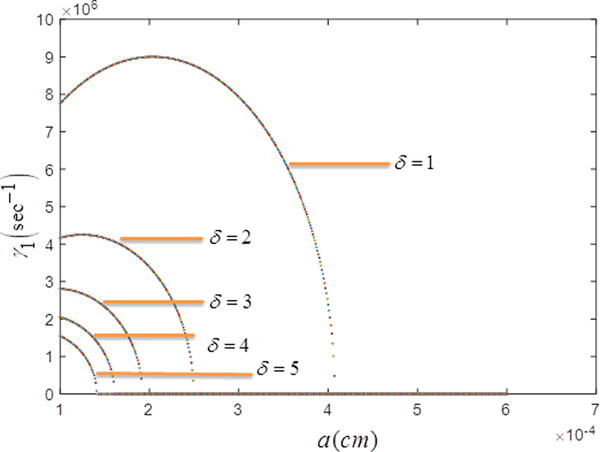
Figure 2 represents the growth rate γ1(s−1) as a function of dust grain size a (cm)for different values of δ keeping all the other parameters [c.f. Eq. (13)] same as used for plotting Figure 1. The growth rate of unstable mode first increases, reaches a maximum value, and then decreases to zero for δ = 1 and δ = 2. The reason for the above result is that as dust grains are added in the plasma, free electrons in the plasma approach it, increasing the surface potential of dust grains, further increasing the average dust grain charge Q d0. Hence the number density of free electrons in the plasma reduces with respect to number density of plasma ions. Thus the ions have an effective mass m ieff = (m i/n i0)n e0, which is less than m i and their greater mobility leads to wave generation along the magnetic field direction also. As the size of dust grain increases, more and more electrons approach it, and the growth rate of TG wave is enhanced. The growth rate shows a maxima and then decreases as observed in Figure 1 also. The parallel phase velocity of TG wave (ω/k z) is more than the streaming ions velocity during normal cyclotron resonance. The relative motion of the waves and ions across the magnetic field causes a Doppler shift of the wave frequency up to the ion cyclotron frequency and the waves are generated across the magnetic field. Thus the growth rate of TG mode decreases with parallel wave number as shown in Figure 2. It is also observed that the peak value of growth rate decreases as δ increases. The critical value of dust grain size to obtain a maximum growth for δ = 1 is 2.5 × 10⁻⁴ cm. Our trend of growth rate is similar to the results of Tribeche and Zerguini (Reference Tribeche and Zerguini2001) for a dusty plasma.
Growth rate γ1(s−1) as a function of size of dust grains a (cm) during fast cyclotron interaction, for δ = 1, 2, 3, 4, 5.

Again, using Eq. (13) we have plotted Figure 3 which shows the variation of growth rate γ1(s−1) as a function of δ = (n i0/n e0) for dust grain size a = 1.2 × 10⁻⁴ cm. The growth rate decreases with increase in the value of δ. As the value of δ increases, the relative density of electrons in dusty plasma decreases and the ambient plasma becomes deficient of electrons. Hence more and more energy will be supplied by the TG wave to the dusty plasma through dust grains, which decreases its growth.
Growth rate γ1(s−1) during fast cyclotron interaction as a function of δ for a = 1.2 × 10⁻⁴ cm .

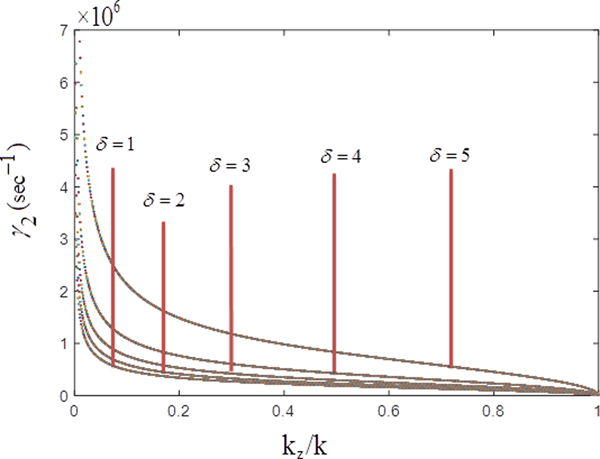
Using Eq. (14) we have plotted Figure 4 which shows the damping rate of TG mode in slow cyclotron interaction γ2(s−1) as a function of normalized parallel wave number k z/k. Figure 4 indicates that damping rate of TG wave reduces with an increase in parallel wave number. This indicates that the TG wave damps with an increase in the parallel wave number during anomalous cyclotron resonance interaction with the streaming ions. It can also be inferred that the wave damping reduces along the magnetic field direction or along the direction of streaming ions but enhances in a direction perpendicular to the magnetic field. During anomalous resonance, the positive ions overtake the waves (ω − k zv i = −ωci) as phase velocity of waves is less than the streaming ions velocity. The Doppler shift decreases the wave frequency to that of ion cyclotron frequency. The waves gain energy from the ions, and the damping of waves is reduced along the magnetic field lines.
Damping rate γ2(s−1) as a function of normalized parallel wave number k z/k during slow cyclotron interaction for δ = 1, 2, 3, 4, 5.

Further, when the phase velocity of TG mode is equal to the streaming ions velocity, that is, for Cerenkov interaction between plasma ions and TG mode, using Eq. (15) Figure 5 is plotted, which shows the growth rate γ3(s−1) of unstable mode as a function of normalized parallel wave number k z/k for different values of δ, keeping all other plasma parameters constant. It is observed that the growth rate of unstable mode increases with increase in parallel wave number for all the values of δ. In other words, the TG wave grows with an increase in parallel wave number during Cerenkov interaction with streaming ions. In this case, the phase velocity of TG wave is comparable to the streaming ions velocity, and therefore the wave grows due to inverse Landau damping. Due to cyclotron interactions, a situation is created, where in a given velocity interval around the phase velocity of the wave, there are more number of faster ions than of slower ions. Thus the waves grow by gaining energy from the ions, which corresponds to inverse Landau damping. The ions are thus decelerated and they lose their energy to the wave, synchronizing with the wave.
Growth rate γ3(s−1) as a function of normalized parallel wave number k z/k during Cerenkov interaction for δ = 1, 2, 3, 4, 5.

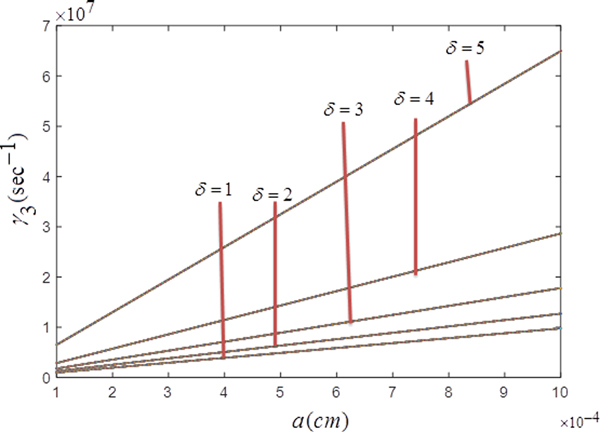
Figure 6 shows the variation of growth rate γ3(s−1) of unstable mode during Cerenkov interaction with respect to dust grain size a (cm) for different values of δ. It is found that growth rate of unstable TG mode increases (c.f. Eq. 15) with the increasing size of dust grains due to electron capturing ability. The dust grains capture electrons and wave will gain energy from these electrons through dust grains in the plasma which lead to the enhancement in the growth of TG wave, as obtained in the case of fast cyclotron interaction. In this case, a maxima in growth rate is not observed as the parallel phase velocity of wave is equal to the streaming ions velocity, due to which a strong interaction occurs between the two and the wave keeps growing along the ion streaming direction.
Growth rate γ3(s−1) as a function of size of dust grains a (cm) during Cerenkov interaction for δ = 1, 2, 3, 4, 5.

Figure 7 displays the growth rate γ3(s−1) of unstable mode during Cerenkov interaction as a function of δ. The growth rate of the unstable mode increases with increase in the value of δ, as observed in Figures 5 and 6 also. In this case, the growth rate increases as the number of dust grains are increased in the plasma, which is in contrary to the growth rate variation with δ in case of cyclotron interactions. This is because more number of dust grains shield more plasma electrons, increasing the mobility of plasma ions. An increase in the number of fast ions leads to energy transfer from ions to the waves by inverse Landau damping.
Growth rate γ3(s−1) during Cerenkov interaction as a function of δ for a = 1.2 × 10⁻⁴ cm.

Conclusion
The streaming ions in a dusty plasma are capable of generating TG waves, via Cerenkov and cyclotron interactions. In the case of fast cyclotron interaction or normal Doppler resonance (ω − k zv i = +ωci), it follows from Eq. (13) that growth rate is positive, the streaming ions are unstable, and the amplitude of the wave increases along its direction of propagation. Conversely, for the slow cyclotron interaction or anomalous Doppler resonance (ω − k zv i = −ωci), it follows from Eq. (14) that the growth rate is negative, that is, in this case the build-up is replaced by inverse Landau damping. The negatively charged dust grains decrease the growth rate during cyclotron interactions; however, the growth rate increases with the addition of dust grains in Cerenkov interaction. The process of dust charging encourages a highly damped wave of very small wavelength corresponding to the frequency ω = −(i[η + β1 + β2]/α) in the present model. Thus, the dust grains stabilize the TG mode in cyclotron interaction and excite the instability in Cerenkov interaction.